Proceedings of the 3rd Workshop on Computational Approaches to Subjectivity and Sentiment Analysis, pages 104–109,
Semantic frames as an anchor representation for sentiment analysis
Josef Ruppenhofer
Department of Information Science and Natural Language Processing University of Hildesheim, Germany [email protected]
Ines Rehbein
SFB 632: Information Structure German Department Potsdam University, Germany [email protected]
Abstract
Current work on sentiment analysis is char-acterized by approaches with a pragmatic fo-cus, which use shallow techniques in the inter-est of robustness but often rely on ad-hoc cre-ation of data sets and methods. We argue that progress towards deep analysis depends on a) enriching shallow representations with lin-guistically motivated, rich information, and b) focussing different branches of research and combining ressources to create synergies with related work in NLP. In the paper, we propose SentiFrameNet, an extension to FrameNet, as a novel representation for sentiment analysis that is tailored to these aims.
1 Introduction
Sentiment analysis has made a lot of progress on more coarse-grained analysis levels using shallow techniques. However, recent years have seen a trend towards more fine-grained and ambitious analyses requiring more linguistic knowledge and more com-plex statistical models. Recent work has tried to pro-duce relatively detailed summaries of opinions ex-pressed in news texts (Stoyanov and Cardie, 2011); to assess the impact of quotations from business leaders on stock prices (Drury et al., 2011); to detect implicit sentiment (Balahur et al., 2011); etc. Ac-cordingly, we can expect that greater demands will be made on the amount of linguistic knowledge, its representation, and the evaluation of systems.
Against this background, we argue that it is worthwhile to complement the existing shallow and pragmatic approaches with a deep, lexical-semantics based one in order to enable deeper analy-sis. We report on ongoing work in constructing
Sen-tiFrameNet, an extension of FrameNet (Baker et al., 1998) offering a novel representation for sentiment analysis based on frame semantics.
2 Shallow and pragmatic approaches
merely associated with statements of polar fact. Pragmatic considerations also lead to certain ex-pressions of sentiment or opinion being excluded from analysis. (Seki, 2007), for instance, annotated sentences as “not opinionated” if they contain indi-rect hearsay evidence or widely held opinions.
In the case of targets, the work by (Stoyanov and Cardie, 2008) exhibits a pragmatic focus as well. These authors distinguish between (a) thetopic of a fine-grained opinion, defined as the real-world ob-ject, event or abstract entity that is the subject of the opinion asintended by the opinion holder; (b) the
topic spanassociated with an opinion expression is the closest, minimal span of text that mentions the topic; and (c) the target span defined as the span of text that covers the syntactic surface form com-prising the contents of the opinion. As the defini-tions show, (Stoyanov and Cardie, 2008) focus on text-level, pragmatic relevance by paying attention to what the author intends, rather than concentrat-ing on the explicit syntactic dependent (their target span) as the topic. This pragmatic focus is also in evidence in (Wilson, 2008)’s work on contextual po-larity classification, which uses features in the clas-sification that are syntactically independent of the opinion expression such as the number of subjectiv-ity clues in adjoining sentences.
Among lexicon-driven approaches, we find that despite arguments that word sense distinctions are important to sentiment analysis (Wiebe and Mihal-cea, 2006), often-used resources do not take them into account and new resources are still being cre-ated which operate on the more shallow lemma-level (e.g. (Neviarouskaya et al., 2009)). Further, most lexical resources do not adequately represent cases where multiple opinions are tied to one expression and where presuppositions and temporal structure come into play. An example is the verb despoil: there is a positive opinion by the reporter about the despoiled entity in its former state, a negative opin-ion about its present state, and (inferrable) negative sentiment towards the despoiler. In most resources, the positive opinion will not be represented.
The most common approach to the task is an in-formation extraction-like pipeline. Expressions of opinion, sources and targets are often dealt with sep-arately, possibly using separate resources. Some work such as (Kim and Hovy, 2006) has explored
the connection to role labeling. One reason not to pursue this is that “in many practical situations, the annotation beyond opinion holder labeling is too ex-pensive” (Wiegand, 2010, p.121). (Shaikh et al., 2007) use semantic dependencies and composition rules for sentence-level sentiment scoring but do not deal with source and target extraction. The focus on robust partial solutions, however, prevents the cre-ation of an integrated high-quality resource.
3 The extended frame-semantic approach
We now sketch a view of sentiment analysis on the basis of an appropriately extended model of frame semantic representation.1
Link to semantic frames and roles Since the pos-sible sources and targets of opinion are usually iden-tical to a predicate’s semantic roles, we addopinion frames with slots for Source, Target, Polarity and Intensity to the FrameNet database. We map the Source and Target opinion roles to semantic roles as appropriate, which enables us to use semantic role labeling systems in the identification of opinion roles (Ruppenhofer et al., 2008).
In SentiFrameNet all lexical units (LUs) that are inherently evaluative are associated with opinion frames. The language of polar facts is not associ-ated with opinion frames. However, we show in the longer version of this paper (cf. footnote 1) how we support certain types of inferred sentiment. With re-gard to targets, our representation selects as targets of opinion the target spans of (Stoyanov and Cardie, 2008) rather than their opinion topics (see Section 2). For us, opinion topics that do not coincide with target spans are inferential opinion targets.
Formal diversity of opinion expressions For fine-grained sentiment-analysis, handling the full vari-ety of opinion expressions is indispensable. While adjectives in particular have often been found to be very useful cues for automatic sentiment anal-ysis (Wiebe, 2000; Benamara et al., 2007), eval-uative meaning pervades all major lexical classes. There are many subjective multi-words and idioms such as give away the store and evaluative mean-ing also attaches to grammatical constructions, even ones without obligatory lexical material. An
exam-1
ple is the construction exemplified byHim be a doc-tor? The so-called What, me worry?-construction (Fillmore, 1989) consists only of an NP and an in-finitive phrase. Its rhetorical effect is to express the speaker’s surprise or incredulity about the proposi-tion under consideraproposi-tion. The FrameNet database schema accommodates not only single and multi-words but also handles data for a constructicon (Fill-more et al., to appear) that pairs grammatical con-structions with meanings.
Multiple opinions We need to accommodate multi-ple opinions relating to the same predicate as in the case of despoil mentioned above. Predicates with multiple opinions are not uncommon: in a 100-item random sample taken from the Pittsburgh subjectiv-ity clues, 17 involved multiple opinions.
The use of opinion frames as described above en-ables us to readily represent multiple opinions. For instance, the verb brag in the modified Bragging
frame has two opinion frames. The first one has pos-itive polarity and represents the frame-internal point of view. The SPEAKERis the Source relative to the TOPICas the Target. The second opinion frame has negative polarity, representing the reporter’s point of view. The SPEAKERis the Target but the Source is unspecified, indicating that it needs to be resolved to an embedded source. For a similar representation of multiple opinions in a Dutch lexical resource, see (Maks and Vossen, 2011).
Event structure and presuppositions A complete representation of subjectivity needs to include event and presuppositional structure. This is necessary, for instance, for predicates likecome around (on)in (1), which involve changes of opinion relative to the
same target by thesame source. Without the pos-sibility of distinguishing between attitudes held at different times, the sentiment associated with these predicates cannot be modeled adequately.
(1) Newsom is still against extending weekday me-tering to evenings, but hasCOME AROUNDon Sunday enforcement.
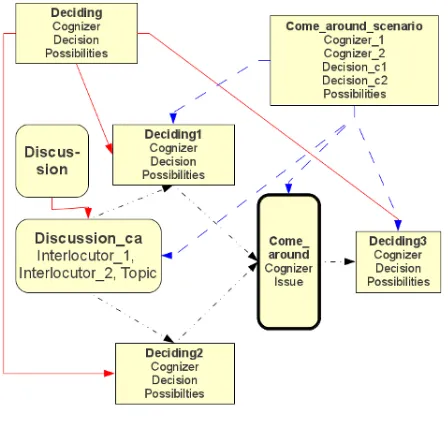
[image:3.612.320.544.78.291.2]For come around (on), we want to to distinguish its semantics from that of predicates such as ambiva-lentandconflicted, where a COGNIZER simultane-ouslyholds opposing valuations of (aspects of) a tar-get. Following FrameNet’s practice, we model pre-supposed knowledge explicitly in SentiFrameNet by
Figure 1: Frame analysis for "Come around"
using additional frames and frame relations. A par-tial analysis ofcome aroundis sketched in Figure 1.
We use the newly added Come around scenario
frame as a background frame that ties together all the information we have about instances of coming around. Indicated by the dashed lines are the SUB -FRAMES of the scenario. Among them are three instances of the Deciding frame (solid lines), all related temporally (dashed-dotted) and in terms of content to an ongoing Discussion. The initial dif-ference of opinion is encoded by the fact that
De-ciding1 and Deciding2 share the same POSSIBILI
-TIES but differ in the DECISION. The occurrence
ofCome_around leads toDeciding3, which has the
same COGNIZERasDeciding1 but its DECISIONis now identical to that inDeciding2, which has been unchanged. The sentiment information we need is encoded by simply stating that there is a sentiment of positive polarity of the COGNIZER (as source) towards the DECISION (as target) in the Deciding
as-sociated with sentiment information, which seems right given that it does not include a DECISIONas a frame element but only includes the ISSUE.
For a discussion of how SentiFrameNet captures factuality presuppositions by building on (Saurí, 2008)’s work on event factuality, we refer the inter-ested reader to the longer version of the paper.
Modulation, coercion and composition Speakers can shift the valence or polarity of sentiment-bearing expressions through some kind of negation operator, or intensify or attenuate the impact of an expression. Despite these interacting influences, it is desirable to have at least a partial ordering among predicates re-lated to the same semantic scale; we want to be able to find out from our resource thatgoodis less pos-itive thanexcellent, while there may be no ordering betweenterrificandexcellent. In SentiFrameNet, an ordering between the polarity strength values of dif-ferent lexical units is added on the level of frames.
The frame semantic approach also offers new per-spectives on sentiment composition. We can, for in-stance, recognize cases of presupposed sentiment, as in the case of the noun revenge, which are not amenable to shifting by negation: She did not take revengedoes not imply that there is no negative eval-uation of some injury inflicted by an offender.
Further, many cases of what has been called va-lence shifting for us are cases where the evaluation is wholly contained in a predicate.
(2) Just barelyAVOIDEDan accident today.
(3) I had served the bank for 22 years and had AVOIDED a promotion since I feared that I would be transferred out of Chennai city.
If we viewed avoid as a polarity shifter and fur-ther treated nouns like promotion and accident as sentiment-bearing (rather than treating them as de-noting events that affect somebody positively or neg-atively) we should expect that while (2) has positive sentiment, (3) has negative sentiment. But that is not so: accomplished intentional avoiding is always pos-itive for the avoider. Also, the reversal analysis for
avoidcannot deal with complements that have no in-herent polarity. It readily follows from the coercion analysis thatI avoid running into heris negative but that cannot be derived in e.g. (Moilanen and Pul-man, 2007)’s compositional model which takes into account inherent lexical polarity, which run (into)
lacks. The fact thatavoidimposes a negative evalu-ation by its subject on its object can easily be mod-eled using opinion frames.
4 Impact and Conclusions
Deep analysis Tying sentiment analysis to frame se-mantics enables immediate access to a deeper lexical semantics. Given particular application-interests, for instance, identifying statements of uncertainty, frames and lexical units relevant to the task can be pulled out easily from the general resource. A frame-based treatment also improves over resources such as SentiWordNet (Baccianella et al., 2008), which, while representing word meanings, lacks any representation of semantic roles.
Theoretical insights New research questions await, among them: whether predicates with multiple opin-ions can be distinguished automatically from ones with only one, and whether predicates carrying fac-tivity or other sentiment-related presuppositions can be discovered automatically. Further, our approach lets us ask how contextual sentiment is, and how much of the analysis of pragmatic annotations can be derived from lexical and syntactic knowledge.
Evaluation With a frame-based representation, the units of annotation are pre-defined by a gen-eral frame semantic inventory and systems can read-ily know what kind of units to target as potential opinion-bearing expressions. Once inherent seman-tics and pragmaseman-tics are distinguished, the correct-ness of inferred (pragmatic) targets and the polarity towards them can be weighted differently from that of immediate (semantic) targets and their polarity.
Synergy On our approach, lexically inherent sen-timent information need not be annotated, it can be imported automatically once the semantic frame’s roles are annotated. Only pragmatic information needs to be labeled manually. By expanding the FrameNet inventory and creating annotations, we improve a lexical resource and create role-semantic annotationsas well as doing sentiment analysis.
References
S. Baccianella, A. Esuli, and F. Sebastiani. 2008. SEN-TIWORDNET 3.0: An enhanced lexical resource for sentiment analysis and opinion mining. In Pro-ceedings of the Seventh conference on International Language Resources and Evaluation LREC10, pages 2200–2204. European Language Resources Associa-tion (ELRA).
Collin F. Baker, Charles J. Fillmore, and John B. Lowe. 1998. The Berkeley Framenet Project. In Proceed-ings of the 36th Annual Meeting of the Association for Computational Linguistics and 17th International Conference on Computational Linguistics-Volume 1, pages 86–90. Association for Computational Linguis-tics.
Alexandra Balahur, Jesús M. Hermida, and Andrés Mon-toyo. 2011. Detecting implicit expressions of senti-ment in text based on commonsense knowledge. In
Proceedings of the 2nd Workshop on Computational Approaches to Subjectivity and Sentiment Analysis (WASSA 2.011), pages 53–60, Portland, Oregon, June. Association for Computational Linguistics.
Farah Benamara, Sabatier Irit, Carmine Cesarano, Napoli Federico, and Diego Reforgiato. 2007. Sentiment analysis : Adjectives and adverbs are better than ad-jectives alone. In Proc of Int Conf on Weblogs and Social Media, pages 1–4.
Brett Drury, Gaël Dias, and Luís Torgo. 2011. A con-textual classification strategy for polarity analysis of direct quotations from financial news. InProceedings of the International Conference Recent Advances in Natural Language Processing 2011, pages 434–440, Hissar, Bulgaria, September. RANLP 2011 Organising Committee.
Charles J. Fillmore, Russell Lee-Goldman, and Russell Rhodes, to appear. Sign-based Construction Gram-mar, chapter The FrameNet Constructicon. CSLI, Stanford, CA.
Charles J. Fillmore. 1989. Grammatical construction theory and the familiar dichotomies. In R. Dietrich and C.F. Graumann, editors, Language processing in social context, pages 17–38. North-Holland/Elsevier, Amsterdam.
S.M. Kim and E. Hovy. 2006. Extracting opinions, opin-ion holders, and topics expressed in online news media text. InProceedings of the Workshop on Sentiment and Subjectivity in Text, pages 1–8. Association for Com-putational Linguistics.
Isa Maks and Piek Vossen. 2011. A verb lexicon model for deep sentiment analysis and opinion mining appli-cations. InProceedings of the 2nd Workshop on Com-putational Approaches to Subjectivity and Sentiment
Analysis (WASSA 2.011), pages 10–18, Portland, Ore-gon, June. Association for Computational Linguistics. Karo Moilanen and Stephen Pulman. 2007. Senti-ment composition. InProceedings of RANLP 2007, Borovets, Bulgaria.
A. Neviarouskaya, H. Prendinger, and M. Ishizuka. 2009. Sentiful: Generating a reliable lexicon for senti-ment analysis. InAffective Computing and Intelligent Interaction and Workshops, 2009. ACII 2009. 3rd In-ternational Conference on, pages 1–6. Ieee.
J. Ruppenhofer, S. Somasundaran, and J. Wiebe. 2008. Finding the sources and targets of subjective expres-sions. InLREC, Marrakech, Morocco.
Roser Saurí. 2008. A Factuality Profiler for Eventualities in Text. Ph.d., Brandeis University.
Yohei Seki. 2007. Crosslingual opinion extraction from author and authority viewpoints at ntcir-6. In Proceed-ings of NTCIR-6 Workshop Meeting, Tokyo, Japan. Mostafa Shaikh, Helmut Prendinger, and Ishizuka
Mit-suru. 2007. Assessing sentiment of text by semantic dependency and contextual valence analysis. Affec-tive Computing and Intelligent Interaction, pages 191– 202.
Veselin Stoyanov and Claire Cardie. 2008. Topic identification for fine-grained opinion analysis. In
Proceedings of the 22nd International Conference on Computational Linguistics - Volume 1, COLING ’08, pages 817–824, Stroudsburg, PA, USA. Association for Computational Linguistics.
Veselin Stoyanov and Claire Cardie. 2011. Auto-matically creating general-purpose opinion summaries from text. InProceedings of RANLP 2011, pages 202– 209, Hissar, Bulgaria, September.
Cigdem Toprak, Niklas Jakob, and Iryna Gurevych. 2010. Sentence and expression level annotation of opinions in user-generated discourse. InProceedings of ACL-10, the 48th Annual Meeting of the Association for Computational Linguistics, Portland. Association for Computational Linguistics.
Janyce Wiebe and Rada Mihalcea. 2006. Word sense and subjectivity. InProceedings of the 21st International Conference on Computational Linguistics and the 44th annual meeting of the Association for Computational Linguistics, ACL-44, pages 1065–1072, Stroudsburg, PA, USA. Association for Computational Linguistics. Janyce Wiebe, Theresa Wilson, and Claire Cardie. 2005.
Annotating expressions of opinions and emotions in language. Language Resources and Evaluation, 39(2/3):164–210.
Michael Wiegand. 2010. Hybrid approaches to senti-ment analysis. Ph.D. thesis, Saarland University, Saar-brücken.