Automatic Question Generation using Discourse Cues
Manish Agarwal∗, Rakshit Shah∗ and Prashanth Mannem Language Technologies Research Center
International Institute of Information Technology Hyderabad, AP, India - 500032
{manish.agarwal, rakshit.shah, prashanth}@research.iiit.ac.in
Abstract
In this paper, we present a system that au-tomatically generates questions from natural language text using discourse connectives. We explore the usefulness of the discourse con-nectives for Question Generation (QG) that looks at the problem beyond sentence level. Our work divides the QG task into content lection and question formation. Content se-lection consists of finding the relevant part in text to frame question from while question for-mation involves sense disambiguation of the discourse connectives, identification of ques-tion type and applying syntactic transforma-tions on the content. The system is evaluated manually for syntactic and semantic correct-ness.
1 Introduction
Automatic QG from sentences and paragraphs has caught the attention of the NLP community in the last few years through the question generation work-shops and the shared task in 2010 (QGSTEC, 2010). Previous work in this area has concentrated on gen-erating questions from individual sentences (Varga and Ha, 2010; Paland et al., 2010; Ali et al., 2010). Sneiders and E. (2002) used question templates and Heilman et al. (2009) used general-purpose rules to transform sentences into questions. A notable exception is Mannem et al. (2010) who generated questions of various scopes (general, medium and specific) ∗ 1 from paragraphs instead of individual
∗First two authors contributed equally to this work
1
General scope - entire or almost entire paragraph, Medium scope - multiple clauses or sentences, and Specific scope -
sen-sentences. They boil down the QG from paragraphs task into first identifying the sentences in the para-graph with general, medium and specific scopes and then generating the corresponding questions from these sentences using semantic roles of predicates.
Discourse connectives play a vital role in mak-ing the text coherent. They connect two clauses or sentences exhibiting discourse relations such as temporal,causal, elaboration,contrast,result, etc. Discourse relations have been shown to be use-ful to generate questions (Prasad and Joshi, 2008) but identifying these relations in the text is a difficult task (Pitler et al., 2009). So in this work, instead of identifying discourse relations and generating ques-tions using them, we explore the usefulness of dis-course connectives for QG. We do this by analyzing the senses of the connectives that help in QG and propose a system that makes use of this analysis to generate questions of the typewhy,when, give an example andyes/no.
The two main problems in QG are identifying the content to ask a question on and finding the corre-sponding question type for that content. We ana-lyze the connectives in terms of the content useful for question generation based on the senses they ex-hibit. We show that the senses of the connectives further help in choosing the relevant question type for the content.
In this paper, we present an end-to-end QG sys-tem that takes a document as input and outputs all the questions generated using the selected discourse connectives. The system has been evaluated man-ually by two evaluators for syntactic and semantic
tence or less
correctness of the generated questions. The over-all system has been rated 6.3 out of 8 for QGSTEC development dataset and 5.8 out of 8 for Wikipedia dataset.
2 Overview
Question Generation involves two tasks, content selection (the text selected for question generation) and question formation (transformations on the con-tent to get the question). Question formation further has the subtasks of (i) finding suitable question type (wh-word), (ii) auxiliary and main verb transforma-tions and (iii) rearranging the phrases to get the final question.
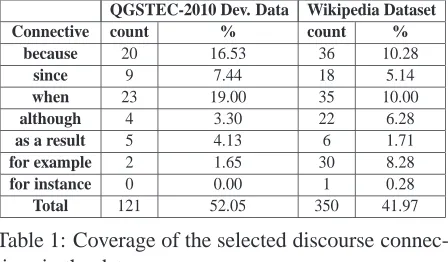
There are 100 distinct types of discourse connec-tives listed in PDTB manual (PDTB, 2007). The most frequent connectives in PDTB are and, or, but, when, because, since, also, although, f or example,however andas a result. In this paper, we provide analysis for four subordinating conjunc-tions, since, when, because and although, and three adverbials, for example, for instance and as a re-sult. Connectives such as and, or and also show-ing conjunction relation have not been found to be good candidates for generating wh-type ques-tions and hence have not been discussed in the pa-per. Leaving aside and, or and also, the selected connectives cover 52.05 per cent of the total number of the connectives in QGSTEC-20102 dataset and 41.97 per cent in Wikipedia articles. Connective-wise coverage in both the datasets is shown in Table 1. Though but and however denoting contrast re-lation occur frequently in the data, it has not been feasible to generate wh-questions using them.
QGSTEC-2010 Dev. Data Wikipedia Dataset
Connective count % count %
because 20 16.53 36 10.28
since 9 7.44 18 5.14
when 23 19.00 35 10.00
although 4 3.30 22 6.28
as a result 5 4.13 6 1.71
for example 2 1.65 30 8.28
for instance 0 0.00 1 0.28
[image:2.612.74.298.530.661.2]Total 121 52.05 350 41.97
Table 1: Coverage of the selected discourse connec-tives in the data
The system goes through the entire document and
2
QGSTEC 2010 data set involves Wikipedia, Yahoo An-swers and OpenLearn articles.
identifies the sentences containing at least one of the seven discourse connectives. In our approach, suit-able content for each discourse connective which is referred to as target argument is decided based on the properties of discourse connective. The system finds the question type on the basis of discourse re-lation shown by discourse connective.
3 Discourse connectives for QG
In this section, we provide an analysis of dis-course connectives with respect to their target argu-ments and the question types they take.
3.1 Question type identification
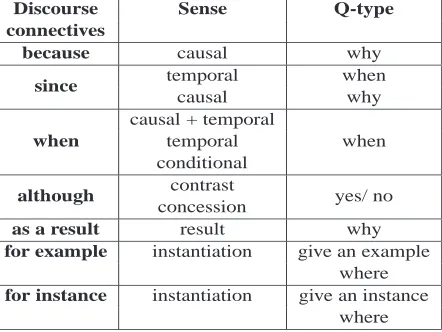
The sense of the discourse connective influences the question-type (Q-type). Since few discourse connectives such as when, since and although among the selected ones can show multiple senses, the task of sense disambiguation of the connectives is essential for finding the question type.
Since: The connective can show temporal, causal or temporal + causal relation in a sentence. Sen-tence exhibits temporal relation in presence of key-words like time(7 am), year (1989 or 1980s), start, begin, end, date(9/11), month (January) etc. If the relation is temporal then the question-type is when whereas in case of causal relation it would be why.
1. Single wicket has rarely been played since lim-ited overs cricket began.
Q-type: when
2. Half-court games require less cardiovascular stamina , since players need not run back and forth a full court.
Q-type: why
In examples 1 and 2, 1 is identified to show tem-poral relation because it has the keyword began whereas there is no keyword in the context of ex-ample 2 that gives the hint of temporal relation and so the relation here is identified as causal.
Sentence: The San−Francisco earthquake hit when resources in the field already were stetched. (Temporal)
Sentence: Venice’s long decline started in the 15th century, when it first made an unsuccessful attempt to hold Thessalonica
Sentence: Earthquake mainly occurs when the different blocks or plates that make up the Earth’s surface move relative to
Question: When do earthquake mainly occur ?
each other, causing distortion in the rock. ( Conditional ) Question: When did San−Francisco earthquake hit ?
against the Ottomans (1423−1430). ( Temporal + Causal )
Question: When did Venice’s long decline start in the 15th century ?
Figure 1: Questions for discourse connective when
Discourse Sense Q-type
connectives
because causal why
since temporal when
causal why
when
causal + temporal
when temporal
conditional
although contrast yes/ no
concession
as a result result why
for example instantiation give an example where
[image:3.612.78.299.203.369.2]for instance instantiation give an instance where
Table 2: Question type for discourse connectives
becomes unnecessary as a result of using discourse connectives.
Although: The connective can show concession or contrast discourse relations. It is difficult to frame a wh-question on contrast or concession relations. So, system generates a yes/no type question for al-though. Moreover, yes/no question-type adds to the variety of questions generated by the system.
3. Greek colonies were not politically controlled by their founding cities , although they often retained religious and commercial links with them .
Q-type: Yes/No
A yes/no question could have been asked for connectives but and however denoting a contrast re-lation but it was not done to preserve the question-type variety in the final output of the QG system. Y es/noquestions have been asked for occurrences of although since they occur less frequently than butandhowever.
Identifying the question types for other selected
discourse connectives is straight forward because they broadly show only one discourse relation (Pitler and Nenkova, 2009). Based on the relations exhibited by these connectives, Table 2 shows the question types for each discourse connective.
3.2 Target arguments for discourse connectives A discourse connective can realize its two argu-ments, Arg1 and Arg2, structurally and anaphori-cally. Arg2 is always realized structurally whereas Arg1 can be either structural or anaphoric (PDTB, 2007; Prasad et al., 2010).
4. [Arg1 Organisms inherit the characteristics of their parents] because [Arg2 the cells of the offspring contain copies of the genes in their parents’ cells.](Intra-sentential connective be-cause)
5. [Arg1 The scorers are directed by the hand sig-nals of an umpire.] For example, [Arg2 the umpire raises a forefinger to signal that the batsman is out (has been dismissed); he raises both arms above his head if the batsman has hit the ball for six runs.](Inter-sentential con-nective for example)
Consider examples 4 and 5. In 4, Arg1 and Arg2 are the structural arguments of the connective be-cause whereas in 5, Arg2 is the structural argument and Arg1 is realized anaphorically.
argu-Discourse connective Target argument
because Arg1
since Arg1
when Arg1
although Arg1
as a result Arg2
for example Arg1
[image:4.612.85.289.56.167.2]for instance Arg1
Table 3: Target argument for discourse connectives
ment i.e. either Arg1 or Arg2, which is used as con-tent for QG.
4 Target Argument Identification
Target argument for a discourse connective can be a clause(s) or a sentence(s). It could be one or more sentences in case of inter-sentential3discourse connectives, whereas one or more clauses in case of intra-sentential4connectives.
Discourse connectives for example and for in-stance can realize its Arg1 anywhere in the prior dis-course (Elwell and Baldridge, 2008). So the system considers only those sentences in which the connec-tives occur at the beginning of the sentence and the immediate previous sentence is assumed to be the Arg1 of the connective (which is the target argument for QG).
In case of intra-sentential connectives (because, since, although and when) and as a result (target ar-gument is Arg2 which would be a clause), identifi-cation of target argument is done in two steps. The system first locates the syntactic head or head verb of the target argument and then extracts it from the dependency tree of the sentence.
4.1 Locate syntactic head
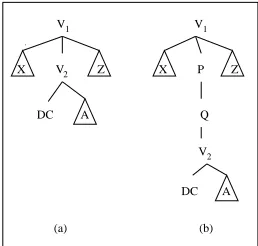
Approach for locating the syntactic head of tar-get argument is explained with the help of Figure 2 (generic dependency trees) and an example shown in Figure 3. Syntactic head of Arg2 is the first fi-nite verb while percolating up in the dependency tree starting from the discourse connective. In case of intra-sentential connectives where Arg1 is the target argument, the system percolates up until it gets the second finite verb which is assumed to be target head
3Connectives that realize its Arg1 anaphorically and Arg2
structurally
4Connectives that realize both of its arguments structurally
X P Z
DC A
(a) (b)
1 1
V V
2
X V Z
[image:4.612.352.481.58.181.2]V2 DC A Q
Figure 2: Head selection of the target argument for intra-sentential connectives (V1,V2: finite verbs;
X,Z: subtrees ofV1; A: subtree ofV2; P,Q:Not verbs; DC:discourse connective(child ofV2))
of Arg1. Number of percolations entirely depend on structure and complexity of the sentence. Figure 2 shows two dependency trees (a) and (b). Starting from the discourse connective DC and percolating up, the system identifies that the head of Arg2 isV2 and that of Arg1 isV1.
aux : "is"
played
competitive badminton
is indoors
by because flight is
wind shuttlecock
Why is competitive badminton played indoors ? affected Because
(From section 2.1) (From section 2.2)
qtype : "Why" Target Arg Head : "played"
(section 2.3) [Arg2 shuttlecock flight is affected by wind],
[image:4.612.313.517.380.517.2][Arg1 competitive badminton is played indoors].(content)
Figure 3: Question Generation process
Since the discourse connective in the example of Figure 3 is because, the target argument is Arg1 (from Table 2). By percolating up the tree starting from because, the head of Arg2 is affected and that of Arg1 is played. Once we locate the head of the target argument, we find the auxiliary as Mannem et al. (2010) does. For the example in Figure 3, the auxiliary for question generation is is.
4.2 Target Argument Extraction
Score Description Example
4 The question is grammatically correct and idiomatic/natural. In which type of animals are phagocytes highly developed?
3 The question is grammatically correct but does not read as In which type of animals are phagocytes, which are important fluently as we would like. throughout the animal kingdom, highly developed?
2 There are some grammatical errors in the question. In which type of animals is phagocytes, which are important throughout the animal kingdom, highly developed?
[image:5.612.81.533.56.167.2]1 The question is grammatically unacceptable. On which type of animals is phagocytes, which are important throughout the animal kingdom, developed?
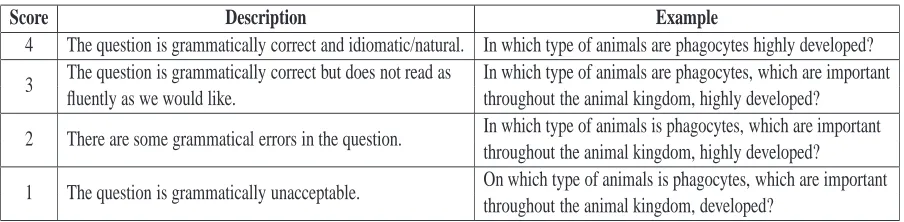
Table 4: Evaluation guidelines for syntactic correctness measure
as the head of the connective. For intra-sentential connectives, the target argument, Arg1, is the tree remaining after removing the subtree that contains Arg2.
In Figures 2 (a) and (b) both, a tree with head V1 and its children, X and Z, is left after removing Arg2 from dependency trees, which is the content required for generating the question. Note that in the tree of Figure 2(b), the child P of the head verbV1is removed with its entire subtree that contains Arg2. Thus, subtree with headV2is the unwanted part for the tree in Figure 2(a) whereas subtree with head P is the unwanted part for the tree in Figure 2(b) when the target argument is Arg1.
In Figure 3, after removing the unwanted argu-ment Arg2 (subtree with head affected), the system gets competitive badminton is played indoors which is the required clause (content) for question genera-tion. The next section describes how the content is transformed into a question.
5 Syntactic Transformations and Question Generation
The syntactic transformations used in this work are similar to those by Mannem et al. (2010). At this stage, the system has the question type, auxiliary and the content. The following set of transformations are applied on the content to get the final question. (1) If the auxiliary is present in the sentence itself then it is moved to the beginning of the sentence; otherwise auxiliary is added at the beginning of the sentence. (2) If a wh-question is to be formed, the question word is added just before the auxiliary. In case of Yes/No questions, the question starts with the auxiliary itself as no question word is needed. (3) A question-mark(?) is added at the end to complete the question.
Consider the example in Figure 3. Here the
con-tent is competitive badminton is played indoors. Applying the transformations, the auxiliary is first moved at the start of the sentence to get is compet-itive badminton played indoors. Then the question type Why is added just before the auxiliary is, and a question-mark is added at the end to get the final question, Why is competitive badminton played in-doors ?
Scope: In QGSTEC 2010 the question had to be assigned a scope, specific, medium or general. The scope is defined as: general - entire input paragraph, medium - one or more clauses or sentences and spe-cific - phrase or less. Questions generated using dis-course connectives are usually of the scope specific or medium. Mannem et al. (2010) assigned medium scope to the questions generated using the seman-tic roles such as ARGM-DIS (result), ARGM-CAU (causal) and ARGM-PNC (purpose) given by the SRL. However, most of the times, the scope of the answer to these questions is just a clause or a sen-tence and should have been assigned specific scope instead of medium.
6 Evaluation and Results
Automatic evaluation of any natural language generated text is difficult. So, our system is eval-uated manually. The evaluation was performed by two graduate students with good English profi-ciency. Evaluators were asked to rate the questions on the scale of 1 to 4 (4 being the best score) on syn-tactic and semantic correctness (Evalguide, 2010) of the question and an overall rating on the scale of 8 (4+4) is assigned to each question.
gram-Discourse
Example Connective
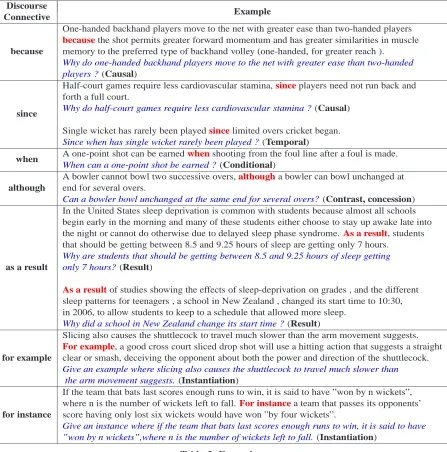
because
One-handed backhand players move to the net with greater ease than two-handed players
becausethe shot permits greater forward momentum and has greater similarities in muscle
memory to the preferred type of backhand volley (one-handed, for greater reach ).
Why do one-handed backhand players move to the net with greater ease than two-handed players ?(Causal)
since
Half-court games require less cardiovascular stamina,sinceplayers need not run back and forth a full court.
Why do half-court games require less cardiovascular stamina ?(Causal)
Single wicket has rarely been playedsincelimited overs cricket began.
Since when has single wicket rarely been played ?(Temporal)
when A one-point shot can be earnedwhenshooting from the foul line after a foul is made.
When can a one-point shot be earned ?(Conditional)
although
A bowler cannot bowl two successive overs,althougha bowler can bowl unchanged at end for several overs.
Can a bowler bowl unchanged at the same end for several overs?(Contrast, concession)
as a result
In the United States sleep deprivation is common with students because almost all schools begin early in the morning and many of these students either choose to stay up awake late into the night or cannot do otherwise due to delayed sleep phase syndrome.As a result, students that should be getting between 8.5 and 9.25 hours of sleep are getting only 7 hours.
Why are students that should be getting between 8.5 and 9.25 hours of sleep getting only 7 hours?(Result)
As a resultof studies showing the effects of sleep-deprivation on grades , and the different
sleep patterns for teenagers , a school in New Zealand , changed its start time to 10:30, in 2006, to allow students to keep to a schedule that allowed more sleep.
Why did a school in New Zealand change its start time ?(Result)
for example
Slicing also causes the shuttlecock to travel much slower than the arm movement suggests.
For example, a good cross court sliced drop shot will use a hitting action that suggests a straight
clear or smash, deceiving the opponent about both the power and direction of the shuttlecock.
Give an example where slicing also causes the shuttlecock to travel much slower than the arm movement suggests.(Instantiation)
for instance
If the team that bats last scores enough runs to win, it is said to have ”won by n wickets”, where n is the number of wickets left to fall.For instancea team that passes its opponents’ score having only lost six wickets would have won ”by four wickets”.
[image:6.612.85.532.58.510.2]Give an instance where if the team that bats last scores enough runs to win, it is said to have ”won by n wickets”,where n is the number of wickets left to fall.(Instantiation)
Table 5: Examples
matically correct and idiomatic/natural, 3 - grammatically correct, 2 some grammar problems, 1 -grammatically unacceptable. Table 4 shows syntac-tic correctness measure with examples.
The semantic correctness is evaluated using the following scores: 4 - semantically correct and id-iomatic/natural, 3 - semantically correct and close to the text or other questions, 2 - some semantic issues, 1 - semantically unacceptable.
Table 5 shows questions generated by the system for each connective. The results of our system on QGSTEC-2010 development dataset are shown in Table 6. The overall system is rated 6.3 out of 8 on
develop-ment dataset for syntactic correctness measure is 0.6 and is 0.5 for semantic correctness measure, and in case of Wikipedia articles the agreement is 0.7 and 0.6 for syntactic and semantic correctness measures respectively.
Discourse No. of Syntactic Semantic Overall connective questions Correctness(4) Correctness(4) Rating(8)
because 20 3.6 3.6 7.2
since 9 3.8 3.2 7
when 23 2.3 2.2 4.5
although 4 4 3.8 7.8
as a result 5 4 4 8
Overall 61 3.2 3.1 6.3
Table 6: Results on QGSTEC-2010 development dataset
Discourse No. of Syntactic Semantic Overall connective questions Correctness(4) Correctness(4) Rating(8)
because 36 3.3 3.2 6.5
since 18 3.1 3 6.1
when 35 2.4 2.0 4.4
although 22 3.1 2.8 5.9
as a result 6 3.6 3.2 6.8
for example 16 3.1 2.9 6.0
for instance 2 4 3 7
Overall 135 3.0 2.8 5.8
Table 7: Results on the Wikipedia data(cricket, foot-ball, basketfoot-ball, badminton, tennis)
On analyzing the data, we found that the Wikipedia articles have more complex sentences (with unusual structure as well as more number of clauses) than QGSTEC-2010 development dataset. As a result, the system’s performance consistently drops for all the connectives in case of Wikipedia dataset.
No comparable evaluation was done as none of the earlier works in QG exploited the discourse con-nectives in text to generate questions.
7 Error Analysis
An error analysis was carried out on the system’s output and the four most frequent types of errors are discussed in this section.
7.1 Coreference resolution
The system doesn’t handle coreference resolution and as a result of this, many questions have been rated low for semantic correctness by the evalua-tors. Greater the number of pronouns in the ques-tion, lesser is the semantic rating of the question.
6. They grow in height when they reach shallower
water, in a wave shoaling process. Question: When do they grow in height?
Although the above example 6 is syntactically correct, such questions are rated semantically low because the context is not sufficient to answer the question due to the pronouns in it. 13.54% of the generated questions on the Wikipedia dataset have pronouns without their antecedents, making the questions semantically insufficient.
7.2 Parsing Errors
Sometimes the parser fails to give a correct parse for the sentences with complex structure. In such cases, the system generates a question that is unac-ceptable. Consider the examples below.
7. In a family who know that both parents are car-riers of CF , either because they already have a CF child or as a result of carrier testing , PND allows the conversion of a probable risk of the disease affecting an unborn child to nearer a certainty that it will or will not be affected. Question: Why do in a family who know that both parents are carriers of CF , either or will not be affected ?
In example 7 above, the sentence has a com-plex structure containing paired connective, either-or, where the argument of either has because and that of or has as a result in it. Here the question is formed using because which is correct neither syn-tactically nor semantically due to the complex nature of the sentence. 9.38% sentences in the datasets are complex with either three or more discourse connec-tives.
7.3 Errors due to the inter-sentential connectives
For inter-sentential connectives, system considers only those sentences in which the connectives occur at the beginning of the sentence and the immediate previous sentence is assumed to be the Arg1 of the connective (which is the target argument for QG). But this assumption is not always true. Of the total number of instances of these connectives, 52.94% (for Wikipedia dataset) connectives occur at the ginning of the sentences. Consider the paragraph be-low.
player who is in the lead in the game needs only one more point to win the game. The termi-nology is extended to sets (set point), matches (match point), and even championships (cham-pionship point). For example, if the player who is serving has a score of 40-love, the player has a triple game point (triple set point, etc.) as the player has three consecutive chances to win the game.
Here in example 8, the third sentence in which the example is specified is related to the first sentence but not the immediately previous sentence. For these connectives, the assumption that immediate previ-ous sentence is Arg1 is false 14.29% of the times.
7.4 Fluency issues
The system does not handle the removal of pred-icative adjuncts. So the questions with optional phrases in it are rated low for syntactic correctness measure.
8 Conclusions and Future Work
Our QG system generates questions using dis-course connectives for different question types. In this work, we present an end-to-end system that takes a document as input and outputs all the ques-tions for selected discourse connectives. The system has been evaluated for syntactic and semantic sound-ness of the question by two evaluators. We have shown that some specific discourse relations are im-portant such ascausal, temporaland resultthan others from the QG point of view. This work also shows that discourse connectives are good enough for QG and that there is no need for full fledged dis-course parsing. In the near future, we plan to im-plement coreference resolution and sentences with more than two connectives. We aim to improve the system with respect to the sentence complexity and also incorporate other discourse connectives.
Acknowledgements
We would like to thank Suman Yelati and Sudheer Kolachina from LTRC, IIIT-Hyderabad for their helpful discussions and pointers during the course of this work. Thanks also to the anonymous reviewers for useful feedback.
References
2010 Question generation shared task and evaluation
challenge, http://questiongeneration.org/QG2010
Andrea Varga and Le An Ha 2010 WLV: A Question
Generation System for the QGSTEC 2010 Task B,
Proceedings of QG2010: The Third Workshop on Question Generation
Santanu Paland Tapabrata Mondal, Partha Pakray, Dipankar Das and Sivaji Bandyopadhyay 2010
QGSTEC System Description JUQGG: A Rule based approach , Proceedings of QG2010: The Third Workshop on Question Generation
Husam Ali, Yllias Chali, and Sadid A. Hasan 2010
Automation of Question Generation From Sentences,
Proceedings of QG2010: The Third Workshop on Question Generation
Eriks Sneiders 2002. Automated question answering
using question templates that cover the conceptual model of the database. In Proceedings of the 6th International Conference on Applications of Natural Language to Information Systems (pp. 235-239).
Michael Heilman, Noah A. Smith. 2009 Question
gener-ation via overgenerating transformgener-ations and ranking
Technical Report CMU-LTI-09-013, Carnegie Mellon University.
Prashanth Mannem, Rashmi Prasad and Aravind Joshi 2010 Question Generation from Paragraphs at UPenn: QGSTEC System Discription, Proceedings of
QG2010: The Third Workshop on Question Genera-tion
Rashmi Prasad and Aravind Joshi 2008 A
Discourse-based Approach to Generating why-Questions from text, Proceedings of the Workshop on the Question
Generation Shared Task and Evaluation Challenge Arlington, VA, September 2008
Emily Pitler, Annie Louis and Ani Nenkova 2009
Auto-matic sense prediction for implicit discourse relations in text , ACL ’09 Proceedings of the Joint Conference
of the 47th Annual Meeting of the ACL and the 4th International Joint Conference on Natural Lan-guage Processing of the AFNLP: Volume 2 - Volume 2
2007 PDTB 2.0 Annotation Manual,
Emily Pitler and Ani Nenkova 2009 Using syntax to
Disambiguate Explicit Discourse Connectives in Text,
ACLShort ’09 Proceedings of the ACL-IJCNLP 2009 Conference Short Papers
Rashmi Prasad and Aravind Joshi and Bonnie Webber 2010 Exploiting Scope for Shallow discourse Parsing, LREC2010
Robert Elwell and Jason Baldridge 2008 Discourse connective argument identification with connective specific rankers, In Proceedings of ICSC-2008
Evaluation guidelines 2010 In QGSTEC-2010 Task B