Extracting Parallel Phrases from Comparable Data
Sanjika Hewavitharana and Stephan Vogel Language Technologies Institute
Carnegie Mellon University Pittsburgh, PA 15213, USA
{sanjika,vogel+}@cs.cmu.edu
Abstract
Mining parallel data from comparable corpora is a promising approach for overcoming the data sparseness in statistical machine trans-lation and other NLP applications. Even if two comparable documents have few or no parallel sentence pairs, there is still poten-tial for parallelism in the sub-sentenpoten-tial level. The ability to detect these phrases creates a valuable resource, especially for low-resource languages. In this paper we explore three phrase alignment approaches to detect paral-lel phrase pairs embedded in comparable sen-tences: the standard phrase extraction algo-rithm, which relies on the Viterbi path; a phrase extraction approach that does not rely on the Viterbi path, but uses only lexical fea-tures; and a binary classifier that detects par-allel phrase pairs when presented with a large collection of phrase pair candidates. We eval-uate the effectiveness of these approaches in detecting alignments for phrase pairs that have a known alignment in comparable sentence pairs. The results show that the Non-Viterbi alignment approach outperforms the other two approaches on F1 measure.
1 Introduction
Statistical Machine Translation (SMT), like many natural language processing tasks, relies primarily on parallel corpora. The translation performance of SMT systems directly depends on the quantity and the quality of the available parallel data. However, such corpora are only available in large quantities for a handful of languages, including English, Ara-bic, Chinese and some European languages. Much
of this data is derived from parliamentary proceed-ings, though a limited amount of newswire text is also available. For most other languages, especially for less commonly used languages, parallel data is virtually non-existent.
Comparable corpora provide a possible solution to this data sparseness problem. Comparable doc-uments are not strictly parallel, but contain rough translations of each other, with overlapping infor-mation. A good example for comparable documents is the newswire text produced by multilingual news organizations such as AFP or Reuters. The de-gree of parallelism can vary greatly, ranging from noisy parallel documents that contain many paral-lel sentences, toquasi paralleldocuments that may cover different topics (Fung and Cheung, 2004). The Web is by far the largest source of compara-ble data. Resnik and Smith (2003) exploit the sim-ilarities in URL structure, document structure and other clues for mining the Web for parallel docu-ments. Wikipedia has become an attractive source of comparable documents in more recent work (Smith et al., 2010).
Comparable corpora may contain parallel data in different levels of granularity. This includes: par-allel documents, parpar-allel sentence pairs, or parpar-allel sub-sentential fragments. To simplify the process and reduce the computational overhead, the paral-lel sentence extraction is typically divided into two tasks. First, a document level alignment is iden-tified between comparable documents, and second, the parallel sentences are detected within the iden-tified document pairs. Cross-lingual information re-trieval methods (Munteanu and Marcu, 2005) and
61
Figure 1: Sample comparable sentences that contain parallel phrases
other similarity measures (Fung and Cheung, 2004) have been used for the document alignment task. Zhao and Vogel (2002) have extended parallel tence alignment algorithms to identify parallel sen-tence pairs within comparable news corpora. Till-mann and Xu (2009) introduced a system that per-forms both tasks in a single run without any doc-ument level pre-filtering. Such a system is useful when document level boundaries are not available in the comparable corpus.
Even if two comparable documents have few or no parallel sentence pairs, there could still be paral-lel sub-sentential fragments, including word transla-tion pairs, named entities, and long phrase pairs. The ability to identify these pairs would create a valu-able resource for SMT, especially for low-resource languages. The first attempt to detect sub-sentential fragments from comparable sentences is (Munteanu and Marcu, 2006). Quirk et al. (2007) later ex-tended this work by proposing two generative mod-els for comparable sentences and showed improve-ments when applied to cross-domain test data. In both these approaches the extracted fragment data was used as additional training data to train align-ment models. Kumano et al. (2007) have proposed a phrasal alignment approach for comparable corpora using the joint probability SMT model. While this approach is appealing for low-resource scenarios as it does not require any seed parallel corpus, the high computational cost is a deterrent in its applicability
to large corpora.
In this paper we explore several phrase alignment approaches to detect parallel phrase pairs embedded in comparable sentence pairs. We assume that com-parable sentence pairs have already been detected. Our intention is to use the extracted phrases directly in the translation process, along with other phrase pairs extracted from parallel corpora. In particular, we study three alignment approaches:
• the standard phrase extraction algorithm, which relies on the Viterbi path of the word alignment; • a phrase extraction approach that does not rely on the Viterbi path, but only uses lexical fea-tures;
• and a binary classifier to detect parallel phrase pairs when presented with a large collection of phrase pair candidates.
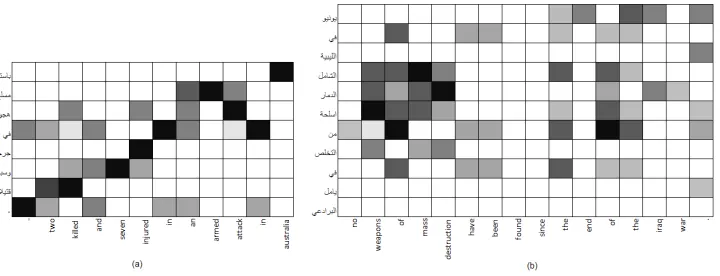
Figure 2: Word-to-word alignment pattern for (a) a parallel sentence pair (b) a non-parallel sentence pair
2 Parallel Phrase Extraction
Figure 1 shows three sample sentences that were ex-tracted from Gigaword Arabic and Gigaword En-glish collections. For each comparable sentence pair, the Arabic sentence is shown first, followed by its literal English translation (in Italics). The English sentence is shown next. The parallel sections in each sentence are marked in boldface. In the first two sen-tences pairs, the English sentence contains the full translation of the Arabic sentence, but there are addi-tional phrases on the English side that are not present on the Arabic sentence. These phrases appear at the beginning of sentence 1 and at the end of sentence 2. In sentence 3, there are parallel phrases as well as phrases that appear only on one side. The phrase “to Iraq” appears only on the Arabic sentence while the phrase “the former Egyptian foreign minister” appears only on the English side.
Standard word alignment and phrase alignment algorithms are formulated to work on parallel sen-tence pairs. Therefore, these standard algorithms are not well suited to operate on partially parallel sen-tence pairs. Presence of non-parallel phrases may result in undesirable alignments.
Figure 2 illustrates this phenomenon. It compares a typical word alignment pattern in a parallel sen-tence pair (a) to one in a non-parallel sensen-tence pair (b). The darkness of a square indicates the strength of the word alignment probability between the corre-sponding word pair. In 2(a), we observe high proba-bility word-to-word alignments (dark squares) over the entire length of the sentences. In 2(b), we see one dark area above “weapons of mass destruction”,
corresponding to the parallel phrase pair, and some scattered dark spots, where high frequency English words pair with high frequency Arabic words. This spurious alignments pose problems to the phrase alignment, and indicate that word alignment prob-abilities alone might not be sufficient.
Our aim is to identify such parallel phrase pairs from comparable sentence pairs. In the following subsections we briefly explain the different phrase alignment approaches we use.
2.1 Viterbi Alignment
Here we use the typical phrase extraction approach used by Statistical Machine Translation systems: obtain word alignment models for both directions (source to target and target to source), combine the Viterbi paths using one of many heuristics, and ex-tract phrase pairs from the combined alignment. We used Moses toolkit (Koehn et al., 2007) for this task. To obtain the word alignments for comparable sen-tence pairs, we performed a forced alignment using the trained models.
2.2 Binary Classifier
as:
p(c|S, T) = exp(
Pn
i=1λifi(c, S, T))
Z(S, T) , (1)
where S = sL1 is a source phrase of length L and T = tK1 is a target phrase of length K. c ∈ {0,1}
is a binary variable representing the two classes of phrases:parallelandnot parallel.p(c|S, T)∈[0,1]
is the probability where a valuep(c= 1|S, T)close
to 1.0 indicates thatSandT are translations of each
other. fi(c, S, T) are feature functions that are co-indexed with respect to the class variablec. The
pa-rametersλiare the weights for the feature functions obtained during training. Z(S, T) is the
normal-ization factor. In the feature vector for phrase pair
(S, T), each feature appears twice, once for each
classc∈ {0,1}.
The feature set we use is inspired by Munteanu and Marcu (2005) who define the features based on IBM Model-1 (Brown et al., 1993) alignments for source and target pairs. However, in our ex-periments, the features are computed primarily on IBM Model-1 probabilities (i.e. lexicon). We do not explicitly compute IBM Model-1 alignments. To compute coverage features, we identify alignment points for which IBM Model-1 probability is above a threshold. We produce two sets of features based on IBM Model-1 probabilities obtained by training in both directions. All the features have been nor-malized with respect to the source phrase lengthL
or the target phrase lengthK. We use the following
11 features:
1. Lexical probability (2): IBM Model-1 log probabilitiesp(S|T)andp(T|S)
2. Phrase length ratio (2): source length ratio
K/Land target length ratioL/K
3. Phrase length difference (1): source length mi-nus target length,L−K
4. Number of words covered (2): A source word
sis said to be covered if there is a target word t ∈ T such that p(s|t) > , where = 0.5. Target word coverage is defined accordingly. 5. Number of words not covered (2): This is
com-puted similarly to 4. above, but this time count-ing the number of positions that are not cov-ered.
6. Length of the longest covered sequence of words (2)
To train the classifier, we used parallel phrases pairs extracted from a manually word-aligned cor-pus. In selecting negative examples, we followed the same approach as in (Munteanu and Marcu, 2005): pairing all source phrases with all target phrases, but filter out the parallel pairs and those that have high length difference or a low lexical overlap, and then randomly select a subset of phrase pairs as the neg-ative training set. The model parameters are esti-mated using the GIS algorithm.
2.3 Non-Viterbi (PESA) Alignment
A phrase alignment algorithm called “PESA” that does not rely on the Viterbi path is described in (Vo-gel, 2005). PESA identifies the boundaries of the target phrase by aligning words inside the source phrase with words inside the target phrase, and sim-ilarly for the words outside the boundaries of the phrase pair. It does not attempt to generate phrase alignments for the full sentence. Rather, it identifies the best target phrase that matches a given source phrase. PESA requires a statistical word-to-word lexicon. A seed parallel corpus is required to au-tomatically build this lexicon.
This algorithm seems particularly well suited in extracting phrase pairs from comparable sentence pairs, as it is designed to not generate a complete word alignment for the entire sentences, but to find only the target side for a phrase embedded in the sentence. We briefly explain the PESA alignment approach below.
Instead of searching for all possible phrase align-ments in a parallel sentence pair, this approach finds the alignment for a single source phraseS = s1. . . sl. Assume that we have a parallel sentence pair(sJ
1, tI1)which contains the source phraseS in
the source sentence sJ1. Now we want to find the
target phraseT = t1. . . tk in the target sentencetI1
which is the translation of the source phrase. A constrained IBM Model-1 alignment is now ap-plied as follows:
phrase boundary are only aligned with target words outside the phrase boundary.
• Position alignment probability for the sentence, which is1/Iin IBM Model-1, is modified to be
1/kinside the source phrase and to1/(I −k)
[image:5.612.323.539.79.209.2]outside the phrase.
Figure 3 shows the different regions. Given the source sentence and the source phrase from position
j1toj2, we want to find the boundaries of the target
phrase,i1andi2. The dark area in the middle is the
[image:5.612.76.296.294.454.2]phrase we want to align. The size of the blobs in each box indicates the lexical strength of the word pair.
Figure 3: PESA Phrase alignment
The constrained alignment probability is calculated as follows:
p(s|t) =
jY1−1
j=1
X
i /∈(i1...i2) 1
I−kp(sj|ti)
×
j2
Y
j=j1
i2
X
i=i1 1
kp(sj|ti)
(2)
×
J Y
j=j2+1
X
i /∈(i1...i2) 1
I −kp(sj|ti)
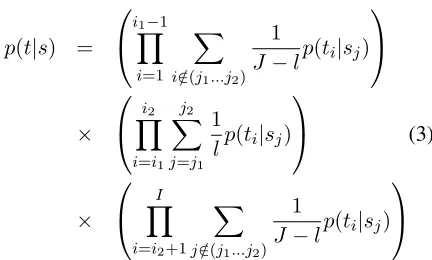
p(t|s) is similarly calculated by switching source and target sides in equation 2:
p(t|s) =
iY1−1
i=1
X
i /∈(j1...j2) 1
J−lp(ti|sj)
×
i2
Y
i=i1
j2
X
j=j1 1
lp(ti|sj)
(3)
×
I Y
i=i2+1
X
j /∈(j1...j2) 1
J −lp(ti|sj)
To find the optimal target phrase boundaries, we in-terpolate the two probabilities in equations 2 and 3 and select the boundary(i1, i2)that gives the highest
probability.
(i1, i2) = argmax
i1,i2
{(1−λ)log(p(s|t))
+λ log(p(t|s))} (4)
The value ofλis estimated using held-out data. PESA can be used to identify all possible phrase pairs in a given parallel sentence pair by iterating over every source phrase. An important difference is that each phrase is found independently of any other phrase pair, whereas in the standard phrase extrac-tion they are tied through the word alignment of the sentence pair.
There are several ways we can adapt the non-Viterbi phrase extraction to comparable sentence.
• Apply the same approach assuming the sen-tence pair as parallel. The inside of the source phrase is aligned to the inside of the target phrase, and the outside, which can be non-parallel, is aligned the same way.
• Disregard the words that are outside the phrase we are interested in. Find the best target phrase by aligning only the inside of the phrase. This will considerably speed-up the alignment pro-cess.
3 Experimental Results 3.1 Evaluation Setup
1 2 3 4 5 6 7 8 9 10 All test set 2,826 3,665 3,447 3,048 2,718 2,414 2,076 1,759 1,527 1,378 24,858 test set (found) 2,746 2,655 1,168 373 87 29 7 2 1 0 7,068
Table 1: N-gram type distribution of manually aligned phrases set
Using a manually aligned parallel corpus, and two monolingual corpora, we obtained a test corpus as follows: From the manually aligned corpus, we ob-tain parallel phrase pairs(S, T). Given a source lan-guage corpusS and a target language corpusT, for each parallel phrase pair(S, T)we select a sentence s from S which contains S and a target sentence
t from T which contains T. These sentence pairs
are then non-parallel, but contain parallel phrases, and for each sentence pair the correct phrase pair is known. This makes it easy to evaluate different phrase alignment algorithms.
Ideally, we would like to see the correct target phrase T extracted for a source phrase S.
How-ever, even if the boundaries of the target phrase do not match exactly, and only a partially correct trans-lation is generated, this could still be useful to im-prove translation quality. We therefore will evaluate the phrase pair extraction from non-parallel sentence pairs also in terms of partial matches.
To give credit to partial matches, we define pre-cision and recall as follows: Let W andG denote
the extracted target phrase and the correct reference phrase, respectively. LetM denote the tokens inW
that are also found in the referenceG. Then
P recision= |M|
|W|∗100 (5)
Recall= |M|
|G| ∗100 (6) These scores are computed for each extracted phrase pair, and are averaged to produce precision and re-call for the complete test set. Finally, precision and recall are combined to generated the F-1 score in the standard way:
F1 = 2·P recision·Recall
P recision+Recall (7)
3.2 Evaluation
We conducted our experiments on Arabic-English language pair. We obtained manual alignments for
663 Arabic-English sentence pairs. From this, we selected 300 sentences, and extracted phrase pairs up to 10 words long that are consistent with the un-derlying word alignment. From the resulting list of phrase pairs, we removed the 50 most frequently occurring pairs as well as those only consisting of punctuations. Almost all high frequency phrases are function words, which are typically covered by the translation lexicon. Line 1 in Table 1 gives the n-gram type distribution for the source phrases.
Using the phrase pairs extracted from the manu-ally aligned sentences, we constructed a comparable corpus as follows:
1. For each Arabic phrase, we search the Arabic Gigaword1 corpus for sentences that contain
the phrase and select up to 5 sentences. Sim-ilarly, for each corresponding English phrase we select up to 5 sentences from English Gi-gaword2.
2. For each phrase pair, we generate the Cartesian product of the sentences and produce a sen-tence pair collection. I.e. up to 25 comparable sentence pairs were constructed for each phrase pair.
3. We only select sentences up to 100 words long, resulting in a final comparable corpus consist-ing of 170K sentence pairs.
Line 2 in Table 1 gives the n-gram type distribu-tion for the phrase pairs for which we found both a source sentence and a target sentence in the mono-lingual corpora. As expected, the longer the phrases, the less likely it is to find them in even larger cor-pora.
We consider the resulting set as our comparable corpus which we will use to evaluate all alignment approaches. In most sentence pairs, except for the phrase pair that we are interested in, the rest of the sentence does not typically match the other side.
Lexicon Viterbi Classifier PESA
Exact P R F1 Exact P R F1 Exact P R F1
Lex-Full 43.56 65.71 57.99 61.61 54.46 81.79 85.29 85.29 67.94 93.34 86.80 90.22 Lex-1/3 42.95 65.68 56.69 60.85 53.57 81.32 88.34 84.69 67.28 93.23 86.17 89.56 Lex-1/9 41.10 63.60 51.15 56.70 52.38 80.30 86.64 83.35 65.81 91.95 84.73 88.19 Lex-1/27 41.02 62.10 49.38 55.01 52.51 80.51 83.84 82.14 63.23 89.41 82.06 85.57 Lex-BTEC 19.10 26.94 23.63 25.18 18.76 45.90 36.17 40.46 17.45 46.70 36.28 40.83
Table 2: Results for Alignment Evaluation of test phrases
We obtained the Viterbi alignment using stan-dard word alignment techniques: IBM4 word align-ment for both directions, Viterbi path combination using heuristics (‘grow-diag-final’) and phrase ex-traction from two-sided training, as implemented in the Moses package (Koehn et al., 2007). Because the non-parallel segments will lead the word align-ment astray, this may have a negative effect on the alignment in the parallel sections. Alignment mod-els trained on parallel data are used to generate the Viterbi alignment for the comparable sentences. We then extract the target phrases that are aligned to the embedded source phrases. A phrase pair is ex-tracted only when the alignment does not conflict with other word alignments in the sentence pair. The alignments are not constrained to produce contigu-ous phrases. We allow unaligned words to be present in the phrase pair. For each source phrase we se-lected the target phrase that has the least number of unaligned words.
The classifier is applied at the phrase level. We generate the phrase pair candidates as follows: For a given target sentence we generate all n-grams up to length 10. We pair each n-gram with the source phrase embedded in the corresponding source sen-tence to generate a phrase pair. From the 170 thou-sand sentence pairs, we obtained 15.6 million phrase pair candidates. The maximum entropy classifier is then applied to the phrase pairs. For each source phrase, we pick the target candidate for whichp(c=
1, S, T)has the highest value.
For the PESA alignment we used both inside and outside alignments, using only lexical probabilities. For each source phrase pair, we select the best scor-ing target phrase.
As our goal is to use these methods to extract parallel data for low resource situations, we tested
each method with several lexica, trained on differ-ent amounts of initial parallel data. Starting from the full corpus with 127 million English tokens, we gen-erated three additional parallel corpora with 1/3, 1/9 and 1/27 of the original size. The 1/9 and 1/27 cor-pora (with 13 million and 4 million English words) can be consideredmediumandsmallsized corpora, respectively. These two corpora are a better match to the resource levels for many languages. We also used data from the BTEC (Kikui et al., 2003) cor-pus. This corpus contains conversational data from the travel domain, which is from a different genre than the document collections. Compared to other corpora, it is much smaller (about 190 thousand En-glish tokens).
Table 2 gives the results for all three alignment ap-proaches. Results are presented as percentages of: exact matches found (Exact), precision (P), recall (R) and F1. The Viterbi alignment gives the lowest performance. This shows that the standard phrase extraction procedure, which works well for parallel sentence, is ill-suited for partially parallel sentences. Despite the fact that the classifier incorporates sev-eral features including the lexical features, the per-formance of the PESA alignment, which uses only the lexical features, has consistently higher precision and recall than the classifier. This demonstrates that computing both inside and outside probabilities for the sentence pair helps the phrase extraction. The classifier lacks this ability because the phrase pair is evaluated in isolation, without the context of the sentence.
Except for the BTEC corpus, the performance degradation is minimal as the lexicon size is re-duced. This shows that the approaches are robust for smaller parallel amounts of parallel data.
method of evaluating partial matches, is to give credit based on the length of the overlap between the extracted phrase and the reference. Precision and recall can then be defined based on the longest com-mon contiguous subsequence, similar to (Bourdail-let et al., 2010). Results obtained using this methods were similar to the results in Table 2.
4 Conclusion and Future Work
In this paper we explored several phrase alignment approaches for extracting phrase pairs that are em-bedded inside comparable sentence pairs. We used the standard Viterbi phrase alignment, a maximum entropy classifier that works on phrase pairs, and a non-Viterbi PESA alignment in the evaluation pro-cess. The results show that PESA outperforms both the Viterbi approach and the classifier, in both preci-sion and recall.
We plan to extend the PESA framework to use not only lexical features, but other features similar to the ones used in the classifier. We believe this will further improve the alignment accuracy.
While this paper focuses on comparisons of dif-ferent phrase alignment approaches in a realistic, yet controlled manner by selecting appropriate compa-rable sentence pairs for given phrase pairs, future experiments will focus on finding new phrase pairs from comparable corpora and evaluating the poten-tial utility of the extracted data in the context of an end-to-end machine translation system.
References
Julien Bourdaillet, St´ephane Huet, Philippe Langlais, and Guy Lapalme. 2010. TransSearch: from a bilingual concordancer to a translation finder. Machine Trans-lation, 24(3-4):241–271, dec.
Peter F. Brown, Stephen A. Della Pietra, Vincent J. Della Pietra, and Robert L. Mercer. 1993. The mathematics of statistical machine translation: Parameter estima-tion. Computational Linguistics, 19(2):263–311. Pascale Fung and Percy Cheung. 2004. Mining very
non-parallel corpora: Parallel sentence and lexicon ex-traction via bootstrapping and EM. InIn Proceedings of the Conference on Empirical Methods in Natural Language Processing, pages 57–63, Barcelona, Spain. Genichiro Kikui, Eiichiro Sumita, Toshiyuki Takezawa, and Seiichi Yamamoto. 2003. Creating corpora
for speech-to-speech translation. In In Proc. of EU-ROSPEECH 2003, pages 381–384, Geneva.
Philipp Koehn, Hieu Hoang, Alexandra Birch, Chris Callison-Burch, Marcello Federico, Nicola Bertoldi, Brooke Cowan, Wade Shen, Christine Moran, Richard Zens, Chris Dyer, Ondrej Bojar, Alexandra Con-stantin, and Evan Herbst. 2007. Moses: Open source toolkit for statistical machine translation. In Proceed-ings of the 45th Annual Meeting of the Association for Computational Linguistics, Prague, Czech Republic, June.
Tadashi Kumano, Hideki Tanaka, and Takenobu Toku-naga. 2007. Extracting phrasal alignments from com-parable corpora by using joint probability smt model. InIn Proceedings of the International Conference on Theoretical and Methodological Issues in Machine Translation, Skvde, Sweden, September.
Dragos Stefan Munteanu and Daniel Marcu. 2005. Im-proving machine translation performance by exploit-ing non-parallel corpora. Computational Linguistics, 31(4):477–504.
Dragos Stefan Munteanu and Daniel Marcu. 2006. Ex-tracting parallel sub-sentential fragments from non-parallel corpora. InProceedings of the 21st Interna-tional Conference on ComputaInterna-tional Linguistics and the 44th Annual Meeting of the Association for Com-putational Linguistics, pages 81–88, Sydney, Aus-tralia.
Chris Quirk, Raghavendra U. Udupa, and Arul Menezes. 2007. Generative models of noisy translations with applications to parallel fragment extraction. In Pro-ceedings of the Machine Translation Summit XI, pages 377–384, Copenhagen, Denmark.
Philip Resnik and Noah Smith. 2003. The web as a par-allel corpus. Computational Linguistics, 29(3):349– 380.
Jason R. Smith, Chris Quirk, and Kristina Toutanova. 2010. Extracting parallel sentences from compara-ble corpora using document level alignment. In Pro-ceedings of the Human Language Technologies/North American Association for Computational Linguistics, pages 403–411.
Christoph Tillmann and Jian-Ming Xu. 2009. A sim-ple sentence-level extraction algorithm for comparable data. InCompanion Vol. of NAACL HLT 09, Boulder, CA, June.
Stephan Vogel. 2005. PESA: Phrase pair extraction as sentence splitting. InProceedings of the Machine Translation Summit X, Phuket, Thailand, September. Bing Zhao and Stephan Vogel. 2002. Full-text story