Language use as a reflection of socialization in online communities
Dong Nguyen Carnegie Mellon University Language Technologies Institute
Pittsburgh, PA 15213 [email protected]
Carolyn P. Ros´e Carnegie Mellon University Language Technologies Institute
Pittsburgh, PA 15213 [email protected]
Abstract
In this paper we investigate the connection be-tween language and community membership of long time community participants through computational modeling techniques. We re-port on findings from an analysis of language usage within a popular online discussion fo-rum with participation of thousands of users spanning multiple years. We find community norms of long time participants that are char-acterized by forum specific jargon and a style that is highly informal and shows familiarity with specific other participants and high emo-tional involvement in the discussion. We also find quantitative evidence of persistent shifts in language usage towards these norms across users over the course of the first year of com-munity participation. Our observed patterns suggests language stabilization after 8 or 9 months of participation.
1 Introduction
In this paper we use text mining and machine learning methodologies as lenses through which to understand the connection between language use and community membership in online communi-ties. Specifically we examine an online medical sup-port community called breastcancer.org. We present analyses of data from an active online community with the goal of uncovering the connection between language and online community membership. In particular, we will look at language changes that oc-cur over time as people continue to participate in an online community. Consistent with the Communi-ties of Practice theory of participation within a
com-munity (Lave and Wenger, 1991), we find increas-ing conformity to community norms within the first year of participation that then stabilizes as partici-pants continue their involvement in the community.
Within the Communities of Practice view, social-ization into a community begins with peripheral par-ticipation, during which individuals have the op-portunity to observe community norms. Lave and Wenger’s theory has been applied to both online and face-to-face communities. In an online commu-nity, observing community norms begins with lurk-ing and readlurk-ing messages before an initial post. This is termed legitimate peripheral participation, and it is during this stage that potential new members ob-serve community norms in action. With an initial post, a user embarks upon the path of centripetal participation, as they are taking steps towards core participation.
Becoming a core member of a community means adopting community norms. Persistent language changes occur as an accumulation of local accom-modation effects (Labov, 2010a; Labov, 2010b). The extent of the adoption reflects the commitment to community membership. Thus, as an individual progressively moves from the periphery of a com-munity towards the core, their behavior will progres-sively grow towards conformity with these norms, although total conformity very rarely occurs. The quantitative analysis we present in the form of a regression model is consistent with this theoretical perspective and allows us to see what centripetal par-ticipation and core parpar-ticipation look like within the breastcancer.org community. We are able to test the robustness of these observations by using the extent
of conformity to community norms as a predictor of how long a member has been actively participat-ing in an online community. We will present results from this predictive analysis as part of the quantita-tive evidence we provide in support of this model of community participation.
Patterns of local accommodation and of long time language change within communities have been ex-tensively studied in the field of variationist sociolin-guistics. However, with respect to online commu-nities in particular, recent research has looked at accommodation (Danescu-Niculescu-Mizil et al., 2011; Nguyen et al., 2010) and some shorter term language changes (i.e., over a period of a few months). However, longitudinal analyses of lan-guage change spanning long time periods (i.e., more than a few months) in online communities as we present in this paper have been largely absent from the literature. Typically, long term language change in sociolinguistics requires reconstructing the past from the present using age grading techniques, since a comprehensive historical record is typically absent (Labov, 2010a; Labov, 2010b). Online communi-ties present a unique opportunity to study long term language change from a much more comprehensive historical record of a community’s development.
In the remainder of the paper, we first review prior work on computational models of accommodation and language change. We then present a qualitative view of communication within the breastcancer.org community. We then present two quantitative analy-ses, one that explores language change in the aggre-gate, and another that tests the robustness of findings from the first analysis with a regression model that allows us to predict how long a member has been active within the community. We conclude with dis-cussion and future work.
2 Related work
For decades, research under the heading of Social Accommodation Theory (Giles et al., 1973) has at-tempted to layer a social interpretation on patterns of linguistic variation. This extensive line of research has provided ample quantitative evidence that peo-ple adjust their language within interactions, some-times to build solidarity or liking, and other some-times to differentiate themselves from others (Eckert and
Rickford, 2001).
In this line of work, people have often looked at accommodation in small discussion groups and dyadic conversation pairs. For example, Gonza-les et al. (2010) analyzed style matching in small group discussions, and used it to predict cohesive-ness and task performance in the groups. Scis-sors et al. (2009) analyzed conversational pairs play-ing a social dilemma game and interactplay-ing through an instant messenger. They found that certain pat-terns of high linguistic similarity characterize high trusting pairs. Niederhoffer and Pennebaker (2002) found linguistic style matching both at the conver-sation level and locally at a turn-by-turn level in dyadic conversations. Paolillo (2001) looked at the connection between linguistic variation and strong and weak ties in an Internet Relay Chat channel. Nguyen et al. (2010) found accommodation effects in an online political forum that contains discus-sions between people with different political view-points. Recently, Danescu-Niculescu-Mizil et al. (2011) showed that accommodation was also present in Twitter conversations.
Table 1: Statistics dataset.
Posts 1,562,590
Threads 68,226
Users (at least one post) 31,307 Time-span Oct 2002 - Jan 2011
manual coding. Huffaker et al. (2006) examined a subset of the same data. When comparing consec-utive weeks over a 6 week time period, they found that the language diverged. They hypothesized that this was caused by external events leading to the in-troduction of new words.
Our research differs from the research by Cas-sell and Tversky (2005), Huffaker et al. (2006) and Postmes et al. (2000) in several respects. For ex-ample, in all of this work, participants joined the community simultaneously at the inception of the community. In contrast, our community of inquiry has evolved over time, with members joining inter-mittently throughout the history of the community. Additionally, our analysis spans much more time, specifically 2 years of data rather than 3 or 4 months. Thus, this research addresses a different question from the way community norms are first established at the inception of a community. In contrast, what we investigate is how new users are socialized into an existing community in which norms have already been established prior to their arrival.
We are not the first researchers to study our com-munity of inquiry (Jha and Elhadad, 2010). How-ever, prior work on data from this forum was focused on predicting the cancer stage of a patient rather than issues related to language change that we investi-gate.
3 Data description
We analyze one of the largest breast cancer forums on the web (http://community.breastcancer.org/). All posts and user profiles of the forum were crawled in January 2011.
The forum serves as a platform for many differ-ent kinds of interactions, and serving the needs of a variety of types of users. For example, a large pro-portion of users only join to ask some medical ques-tions, and therefore do not stay active long. In fact, we find that a lot of users (12,349) only post in the
first week after their registration. The distribution of number of weeks between a user’s last post and reg-istration date follows a power law. However, besides these short-term users, we also find a large number of users who appear to be looking for more social in-volvement and continue to participate for years, even after their disease is in remission.
This distinction in types of users is reflected in the forum structure. The forum is well organized, con-taining over 60 subforums targeting different topics. Besides specific subforums targeting medical topics (such as ‘Stage I and II Breast Cancer’ and ‘Radi-ation Therapy - Before, During and After’), there are subforums for certain population groups (such as ‘Canadian Breast Cancer Survivors’ and ‘Sin-gles with breast cancer’), for social purposes (such as ’Growing our Friendships After Treatment’, ‘Get Togethers’, and ‘CyberSisters Photo Album’) and non cancer related purposes (such as ‘Humor and Games’). In many of the subforums there are spe-cific threads that foster the formation of small sub communities, for example threads for people who started chemotherapy in a certain month.
In the data we find community norms of long time participants that are characterized by forum specific jargon and a style that is highly informal and shows familiarity with specific other participants and high emotional involvement in the discussion. We infer that the forum specific jargon is distinct from what we would find in those users outside of it, in that that there are places in the forum explaining commonly used abbreviations to new users. We also observe posts within threads where users ask about certain abbreviations used in previous posts. Some of these abbreviations are cancer related and also used in places other than the forum, such asdx(diagnosis), andrads(radiation, radiotherapy). Thus, they may be reflective of identification with a broader commu-nity of cancer patients who are internet users. Other often used abbreviations aredh(dear husband),dd
(dear daughter), etc. We also observed that users fre-quently refer to members of the community by name and even assister(s).
I am also new to the forum, but not new to bc, diagnosed last yr, [..] My follow-up with surgeon for reports is not until 8/9 over a week later. My husband too is so wonderful, only married a yr in May, 1 month before bc diagnosed, I could not get through this if it weren’t for him, never misses an appointment, [...] I wish every-one well. We will all survive.
The next two posts1 are from the same user, 2 to 4 years after her registration date. Both posts are di-rected to other forum members, very informal, and contain a lot of abbreviations (e.g. ‘DH’ (Dear Hus-band), ‘DD’ (Dear Daughter), ‘SIL’ (Son in Law)).
Gee Ann I think we may have shared the same ‘moment in time’ boy I am getting paid back big time for my fun in the sun. Well Rose enjoy your last day of freedom - LOL. Have lots of fun with DH ‘The Harley’. Ride long and hard ( either one you choose - OOPS ).
Oh Kim- sorry you have so much going on - and an idiot DH on top of it all. [..] Steph- vent away - that sucks - [..] XOXOXOXOXOXOXOX [..], quiet week-end kids went to DD’s & SIL on Fri-day evening, they take them to school [..], made an AM pop in as I am supposed to, SIL is an idiot but then you all know that.
This anecdotal evidence illustrates the linguistic shift we will now provide quantitative evidence for.
4 Patterns of language change
4.1 Approach
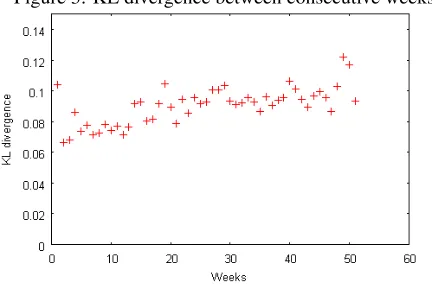
In this section we aggregate data across long time participants and look at global patterns of language change. Specifically, we will analyze patterns of change in the first year after registration of these members, and show how language patterns consis-tently become more different from the first week of participation and more similar to the stable pattern found within the second year of data. Furthermore, when comparing consecutive weeks we find that the
1Names are replaced in example
difference increases and then stabilizes by the end of the first year. The unit of analysis is one week of data. Because there are multiple ways to mea-sure the similarity or difference between two distri-butions, we explore the use of two different meth-ods. The first metric we use is the Kullback-Leibler (KL) divergence. Larger values indicate bigger dif-ferences in distribution. P represents the true distri-bution. Note that this metric is asymmetric.
KL(P, Q) =X i
P(i) logP(i)
Q(i)
We also explore using the Spearman’s Rank Corre-lation Coefficient (SRCC), which measures the sim-ilarity of two rankings:
SRCC= 1− 6
P id2i
n(n2−1)
Wherediis the difference between the ranks of word
iin the two rankings and n is the total number of words.
4.2 Sampling
In addition, we have limited our focus to the ini-tial two-year period of participation, because it is for this length of participation that we have enough users and enough posts to make a computational model feasible. We have also limited ourselves to examining high frequency words, because we have a large vocabulary but only a limited amount of data per week. Two weeks can look artificially similar if they both have a lot of non-occurring words. In summary, taking above considerations into account, we applied the following procedure:
• We only look at the first 2 years, for which we still have a large amount of data for every week.
• We only look at members who are long-term participants (2 years or longer), this leaves us with 3,012 users.
• For every week, we randomly sample an equal number of posts (i.e., 600 from each week). All posts are taken into account (i.e. both responses as well as thread openings).
• We only look at the distribution change of high frequency words (words occurring at least 1,000 times), this leaves us with 1,540 unique words. No stemming or stop word removal was done.
4.3 Comparison with early and late distributions
Using the dataset described in the previous section, we compare the language of each week during the first year after registration with language in the very first week and with language in the second year.
[image:5.612.313.530.86.239.2]First we analyze whether language in the first year becomes more similar to language used by members in their second year as time progresses. We there-fore compare the word distributions of the weeks of the first year with the overall word distribution of the second year. We apply KL divergence where we consider the distribution of the second year as the ‘true distribution’. The result is shown in Fig-ure 1. We see that the KL divergence decreases, which means that as time progresses, the word dis-tributions look more like the distribution of the sec-ond year. Fitting a Least Squares (LS) model, we get an intercept of 0.121033 and slope of -0.001080
Figure 1: KL divergence between weeks in first year and overall second year.
Figure 2: KL divergence between weeks in first year and first week.
(r2 = 0.5528). Using the Spearman Rank Correla-tion (SRCC) and fitting a LS model, we observe the same pattern (r2 = 0.6435).
Our second analysis involves comparing the dis-tributions of the first year (excluding the first week), with the distribution of the first week. The result is shown in Figure 2. We see that the KL divergence increases, meaning that as time progresses, the word distributions become less similar with the first week. (KL:r2= 0.6643, SRCC:r2 = 0.7962).
4.4 Comparing consecutive distributions
[image:5.612.314.531.249.426.2]Figure 3: KL divergence between consecutive weeks.
0.8178). The divergence pattern was also observed by Huffaker et al. (2006) (related, but not equiva-lent setting, as mentioned in the literature review). We hypothesize that the divergence occurs because users tend to talk about a progressively broader set of topics as they become more involved in the com-munity. To confirm this hypothesis, we compare the distributions of each week with the uniform distri-bution. We indeed find that as time progresses, the distributions for each week become more uniform. (KL:r2= 0.3283, SRCC:r2= 0.6435).
5 Predicting membership duration
In the previous section we found strong patterns of language change in our data. We are interested in the extent to which we can automatically predict how many weeksthe user has been a member, using only text or meta-features from that specific week. Iden-tifying which features predict how long a member has been active can give more detailed insight into the social language that characterizes the commu-nity. In addition, it tells us how prominent the pat-tern is among other sources of language variation.
5.1 Dataset
For this analysis, we set up the data slightly differ-ently. Now, rather than combine data across users, we keep the data from each user for each week sep-arate so we can make a sepsep-arate prediction for each user during each week of their participation. Thus, for each person, we aggregate all posts per week. We only consider weeks in the first two years after the registration in which there were at least 10 posts with at least 10 tokens from that user.
Table 2: Statistics dataset.
#Docs #Persons #Posts Training 13,273 1,591 380,143 Development 4,617 548 122,489 Test 4,571 548 134,141
5.2 Approach
Given an input vector x ∈ Rm containing the fea-tures, we aim to find a predictionyˆ∈Rfor the num-ber of weeks the person has been a memnum-ber of the communityy ∈ Rusing a linear regression model:
ˆ
y = β0 +x>β whereβ0 andβare the parameters to estimate. Usually, the parameters are learned by minimizing the sum of squared errors.
In order to strive for a model with high explana-tory value, we use Linear Regression, with L1 reg-ularization (Tibshirani, 1996). This minimizes the sum of squared errors, but in addition adds a penalty termλPmj=1|βj|, the sum of absolute values of the
coefficients. λ is a constant and can be found by optimizing over the development data. As a re-sult, this method delivers sparse models. We use Orthant-Wise Limited-memory Quasi-Newton Op-timizer (Andrew and Gao, 2007) as our optimiza-tion method. This method has proven to establish competitive performances with other optimization methods, while producing sparse models (Gao et al., 2007).
Because our observations suggest that language change decreases as members have been active longer, we also experimented with applying a log transformation on the number of weeks.
5.3 Features
For all features, we only use information that has been available for that particular week. We explore different types of features related to the qualitative differences in language we discussed in Section 3: textual, behavioral, subforum and meta-features.
5.3.1 Textual features
We explore the following textual features:
• Unigramsandbigrams.
[image:6.612.72.288.70.214.2]• LIWC(Pennebaker et al., 2001), a word count-ing program that captures word classes and stylistic features.
• Usernames. Because some of the usernames are common words, we only consider user-names of users active in the same thread.
• Proper names. We obtained a list containing common female names. We ranked them ac-cording to frequency in our dataset, and manu-ally deleted common words in our dataset, such ashappy, hope, tuesdayandmay, from our list.
• Slang words. We manually compile a list of common abbreviations and their whole words counterpart. We then count the number of ab-breviations and the number of whole words used in the post. The feature value then is(#abbrev−#wholewords)/#totalwords. Because in some contexts no abbreviations can be used, this feature takes into account if the user actually chose to use the abbrevia-tion/whole word, or if there was no need for it.
No stemming or stopword removal is used. Fre-quencies are normalized by length.
5.3.2 Behavioral features
We also explore additional features that indicate the behavior of the user:
• Ratio (posts starting threads) / (total number of posts).
• Number of posts.
5.3.3 Subforum features
[image:7.612.313.572.72.230.2]We include as features the distribution of subfo-rums the member has posted in. This captures two intuitions. First, it is an approximation of the current phase in the cancer process for that member. For ex-ample, we noticed that most of the new users have just been diagnosed, while long term users have al-ready finished treatment. Because the subforums are very specific (such as ‘Not Diagnosed with a Re-currence or Metastases but Concerned’), we expect these features to give a good approximation of the phase the user is currently in. In addition, these sub-forums also give an indication of the user’s interest.
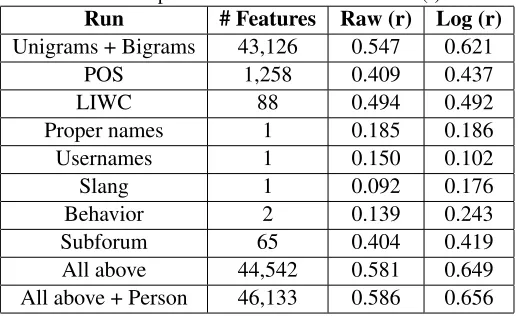
Table 3: Results reported with Pearsons correlation (r).
Run # Features Raw (r) Log (r) Unigrams + Bigrams 43,126 0.547 0.621
POS 1,258 0.409 0.437
LIWC 88 0.494 0.492
Proper names 1 0.185 0.186
Usernames 1 0.150 0.102
Slang 1 0.092 0.176
Behavior 2 0.139 0.243
Subforum 65 0.404 0.419
All above 44,542 0.581 0.649 All above + Person 46,133 0.586 0.656
For example, whether the user posts mostly in med-ical forums, or mostly in the social orientated subfo-rums.
5.3.4 Other features
Most of the persons appear multiple times in our dataset (e.g. multiple weeks). To help the model control for idiosyncratic features of individual users, we include for every person a dummy variable asso-ciated with that user’s unique identity. This helps the model at training time to separate variance in language usage across users from general effects re-lated to length of participation. Note that we do not use these features as test time.
5.4 Results
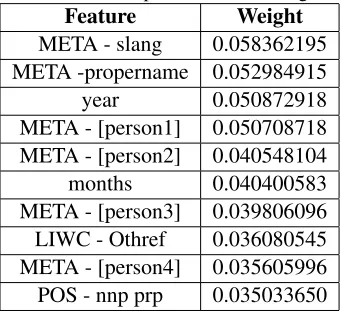
We experimented with individual types of features as well as all of them aggregated. The results (corre-lations) can be found in Table 3. The features having the most weight for long time participants in our best model (All incl. Person, Log) are presented in Table 4. We see that for most features the performance was higher when applying the log transformation. This was especially the case with the unigrams and bigrams features. For some features the difference was less, such as for proper names and the subforum features. This could indicate that these features have a more linear pattern as time progresses, while word patterns such as unigrams tend to stabilize earlier. We find that both stylistic patterns (such as POS) as well as patterns indicating conformity (social behav-ior, slang words) are individually already very pre-dictive.
Table 5: Qualitative grouping of textual features.
Type Short time members Long time members
Abbreviations Husband My DD (Dear Daughter), Your PS (Plastic Surgeon)
Social networks Facebook, fb
Greetings Hi all Hi girls, Hi gals
I versus other LIWC-I, My, Me LIWC-other, We, Sisters
Social support Hugs, Condolences, So sorry
Thanking Thanks, Thanx, Thx
Forum Bc org, On bco
Introducing Newbie, New here, Am new Asking information Info, LIWC-qmarks
Table 4: Top 10 features of long term users.
Feature Weight META - slang 0.058362195 META -propername 0.052984915 year 0.050872918 META - [person1] 0.050708718 META - [person2] 0.040548104 months 0.040400583 META - [person3] 0.039806096 LIWC - Othref 0.036080545 META - [person4] 0.035605996 POS - nnp prp 0.035033650
the slang and proper name features get a high weight for long time participants. Furthermore, we observe that a lot of the person meta features are included in the model when it is trained, although as men-tioned we do not use these features at testing time. The fact that the model assigns them weight indi-cates that idiosyncratic features of users explain a lot of variance in the data. Our best performing model has 3,518 non zero features. In Table 5 we qual-itatively grouped and contrasted features that were more associated with short-term or long-term mem-bers. We see that long-term members show much more social behavior and familiarity with each other. This is shown to references to each other, more so-cial support, references to soso-cial networks and ways of greeting. They furthermore talk about the forum itself more often by using the abbreviation ‘bco’. Short term members are characterized by words that are used when they introduce themselves to others.
Thus we find that long time participants are
char-acterized by informal language, containing many fo-rum specific jargon, as well as showing emotional involvement with other forum members. Our best run obtained a correlation ofr = 0.656, giving an
r2value of 0.430. This means that 0.43 of the vari-ation can be explained by our model. Since there are many other factors that influence the writing of users, it is understandable that our model does not explain all the variance.
6 Discussion
As discussed widely in previous literature, peo-ple become socialized into communities over time through their interactions with community mem-bers. The extent of conformity to group norms re-flects commitment to the group. Our first study showed evidence of increasing conformity to com-munity norms through changes in simple word dis-tributions. The second study then tested the robust-ness of these findings through a prediction task and extended the language features of the first study.
idea that rate of commitment making and conformity is person specific.
There are two limitations that need to be ad-dressed regarding the present studies. First, there are certain factors that influence the rate of adop-tion to the forum that we are not able to take into account. For example, some people might have al-ready been reading the forum for a while, before they actually decide to join the community. These people are already exposed to the community prac-tices, and therefore might already show more con-formity in the beginning than others.
Second, our experiments involved one online community targeting a very specific topic. Due to the nature of the topic, most of the active users come from a small subpopulation (mostly women between 40-60 years). Therefore, it is a question how well these results can be applied to other online commu-nities.
As a future application, a model that can capture these changes could be used in research related to commitment in online communities.
7 Conclusion
It is widely accepted that persistent language change in individuals occurs over time as a result of the accumulation of local processes of accommodation. Although previous research has looked at accommo-dation within short periods of time, including recent research on social media data, persistent language change as a result of longer term involvement in an online community is still an understudied area.
In this paper we have presented research aiming to close this gap. We have analyzed data from a large online breast cancer forum. Analyzing data of long time members, we found strong patterns indicating language changes as these members participated in the community, especially over the course of their first year of participation.
We then presented a regression approach to pre-dict how long a person has been a member of the community. Long time participants were character-ized by showing more social behavior. Furthermore, they used more forum specific language, such as cer-tain abbreviations and ways of greeting. Due to the nature of our dataset, language was also influenced by external factors such as changes in the cancer
pro-cess of individuals.
Although our observations are intuitive and agree with observations in previous, related literature re-garding socialization in communities, it is still a question whether our observations generalize to other online communities.
In our current work we have looked at changes across users and across contexts. However, it is well known that individuals adapt their language depend-ing on local interactions. Thus, a next step would be to model the process by which local accommoda-tion accumulates and results in long term language change.
Acknowledgments
The authors would like to thank Michael Heilman for the regression code and Noah Smith for ideas for the regression experiments. This work was funded by NSF grant IIS-0968485.
References
Galen Andrew and Jianfeng Gao. 2007. Scalable train-ing of l1-regularized log-linear models. In Proceed-ings of the 24th international conference on Machine learning, ICML ’07, pages 33–40, New York, NY, USA. ACM.
Justine Cassell and Dona Tversky. 2005. The language of online intercultural community formation. Journal of Computer-Mediated Communication, 10:16–33. Cristian Danescu-Niculescu-Mizil, Michael Gamon, and
Susan Dumais. 2011. Mark my words! linguistic style accommodation in social media. InProceedings of WWW.
Penelope Eckert and John R. Rickford. 2001. Style and Sociolinguistic Variation. Cambridge: University of Cambridge Press.
Jianfeng Gao, Galen Andrew, Mark Johnson, and Kristina Toutanova. 2007. A comparative study of pa-rameter estimation methods for statistical natural lan-guage processing. InProceedings of the 45th Annual Meeting of the Association of Computational Linguis-tics, pages 824–831, Prague, Czech Republic, June. Association for Computational Linguistics.
Howard Giles, Donald M. Taylor, and Richard Bourhis. 1973. Towards a theory of interpersonal accommoda-tion through language: some canadian data. Language in Society, 2(02):177–192.
David Huffaker, Joseph Jorgensen, Francisco Iacobelli, Paul Tepper, and Justine Cassell. 2006. Computa-tional measures for language similarity across time in online communities. In Proceedings of the HLT-NAACL 2006 Workshop on Analyzing Conversations in Text and Speech, ACTS, pages 15–22, Stroudsburg, PA, USA. Association for Computational Linguistics. Mukund Jha and No´emie Elhadad. 2010. Cancer stage
prediction based on patient online discourse. In Pro-ceedings of the 2010 Workshop on Biomedical Natu-ral Language Processing, BioNLP ’10, pages 64–71, Stroudsburg, PA, USA. Association for Computational Linguistics.
William Labov. 2010a. Principles of Linguistic Change, Volume I, Internal Factors. Wiley-Blackwell.
William Labov. 2010b. Principles of Linguistic Change, Volume I, Social Factors. Wiley-Blackwell.
Wan S. E. Lam. 2008. Language socialization in on-line communities. In Nancy H. Hornberger, editor, En-cyclopedia of Language and Education, pages 2859– 2869. Springer US.
Jean Lave and Etienne Wenger. 1991. Situated Learn-ing. Legitimate peripheral participation. Cambridge: University of Cambridge Press.
Dong Nguyen, Elijah Mayfield, and Carolyn P. Rose. 2010. An analysis of perspectives in interactive set-tings. InProceedings of the 2010 KDD Workshop on Social Media Analytics.
Kate G. Niederhoffer and James W. Pennebaker. 2002. Linguistic style matching in social interaction. John C. Paolillo. 2001. Language variation on internet
relay chat: A social network approach. Journal of So-ciolinguistics, 5:180–213.
James W. Pennebaker, Roger J. Booth, and Martha E. Francis, 2001. Linguistic Inquiry and Word Count (LIWC): A Computerized Text Analysis Program. Tom Postmes, Russell Spears, and Martin Lea. 2000.
The formation of group norms in computer-mediated communication. Human Communication Research, 26(3):341–371.
Lauren E. Scissors, Alastair J. Gill, Kathleen Geraghty, and Darren Gergle. 2009. In cmc we trust: the role of similarity. InProceedings of the 27th international conference on Human factors in computing systems, CHI ’09, pages 527–536, New York, NY, USA. ACM. Robert Tibshirani. 1996. Regression shrinkage and se-lection via the lasso. Journal of the Royal Statistical Society. Series B (Methodological), 58(1):267–288. Kristina Toutanova, Dan Klein, Christopher D. Manning,
and Yoram Singer. 2003. Feature-rich part-of-speech tagging with a cyclic dependency network. In Pro-ceedings of the 2003 Conference of the North Ameri-can Chapter of the Association for Computational Lin-guistics on Human Language Technology - Volume 1,