D-Confidence: an active learning strategy which efficiently identifies small
classes
Nuno Escudeiro
Instituto Superior de Engenharia do Porto Rua Dr Ant´onio Bernardino de Almeida, 431
Porto, P-4200-072 PORTO, Portugal LIAAD-INESC PORTO L.A.
Rua de Ceuta, 118 - 6
Porto, P-4050-190 PORTO, Portugal
Al´ıpio Jorge
LIAAD-INESC PORTO L.A. Rua de Ceuta, 118 - 6
Porto, P-4050-190 PORTO, Portugal
Abstract
In some classification tasks, such as those re-lated to the automatic building and mainte-nance of text corpora, it is expensive to ob-tain labeled examples to train a classifier. In such circumstances it is common to have mas-sive corpora where a few examples are la-beled (typically a minority) while others are not. Semi-supervised learning techniques try to leverage the intrinsic information in unla-beled examples to improve classification mod-els. However, these techniques assume that the labeled examples cover all the classes to learn which might not stand. In the pres-ence of an imbalanced class distribution get-ting labeled examples from minority classes might be very costly if queries are randomly selected. Active learning allows asking an or-acle to label new examples, that are criteri-ously selected, and does not assume a previ-ous knowledge of all classes. D-Confidence is an active learning approach that is effective when in presence of imbalanced training sets. In this paper we discuss the performance of d-Confidence over text corpora. We show empir-ically that d-Confidence reduces the number of queries required to identify examples from all classes to learn when compared to confi-dence, a common active learning criterion.
1 Introduction
Classification tasks require a number of previously labeled cases. A major bottleneck is that case label-ing is a laborious task requirlabel-ing significant human effort. This effort is particularly high in the case of
text documents, web pages and other unstructured objects.
The effort required to retrieve representative la-beled examples to learn a classification model is not only related to the number of distinct classes (Adami et al., 2005); it is also related to class distribution in the available pool of examples. On a highly imbal-anced class distribution, it is particularly demanding to identify examples from minority classes. These, however, may be important in terms of represen-tativeness. Failing to identify cases from under-represented classes may have costs. Minority classes may correspond to specific information needs which are relevant for specific subgroups of users. In many situations, such as fraud detection, clinical diagno-sis, news (Ribeiro and Escudeiro, 2008) and Web resources (Escudeiro and Jorge, 2006), we face the problem of imbalanced class distributions.
The aim of our current work is to get a classifica-tion model that is able to fully recognize the target concept, including all the classes to learn no mater how frequent or rare they are.
requiring extensive labeling (Chapelle et al, 2006) but still requires that labeled examples fully cover the target concept. Unsupervised learning does not require any labeling but users have no chance to tai-lor clusters to their specific needs and there is no guarantee that the induced clusters are aligned with the classes to learn. In active learning, that seems more adequate to our goals, the learner is allowed to ask an oracle (typically a human) to label examples – these requests are calledqueries. The most infor-mative queries are selected by the learning algorithm instead of being randomly selected as is the case in supervised learning.
In this paper we evaluate the performance of d-Confidence(Escudeiro and Jorge, 2009) on text cor-pora. D-Confidence is an active learning approach that tends to explore unseen regions in case space, thus selecting cases from unseen classes faster – with fewer queries – than traditional active learn-ing approaches. D-Confidence selects queries based on a criterion that aggregates the posterior classifier confidence – a traditional active learning criterion – and the distance between queries and known classes. This criterion is biased towards cases that do not be-long to known classes (low confidence) and that are located in unseen areas in case space (high distance to known classes). D-confidence is more effective than confidence alone in achieving an homogeneous coverage of target classes.
In the rest of this paper we start by reviewing ac-tive learning, in section 2. Section 3 describes d-Confidence. The evaluation process is presented in section 4 and we state our conclusions and expecta-tions for future work in section 5.
2 Active Learning
Active learning approaches (Angluin, 1988; Cohn et al., 1994; Muslea et al., 2006) reduce label com-plexity – the number of queries that are necessary and sufficient to learn a concept – by analyzing un-labeled cases and selecting the most useful ones once labeled. Queries may be artificially generated (Baum, 1991) – the query construction paradigm – or selected from a pool (Cohn et al., 1990) or a stream of data – thequery filteringparadigm. Our current work is developed under the query filtering approach.
The general idea in active learning is to estimate the value of labeling one unlabeled case. Query-By-Committee (Seung et al., 1992), for example, uses a set of classifiers – the committee – to identify the case with the highest disagreement. Schohn et al. (2000) worked on active learning for Support Vec-tor Machines (SVM) selecting queries – cases to be labeled – by their proximity to the dividing hyper-plane. Their results are, in some cases, better than if all available data is used to train. Cohn et al. (1996) describe an optimal solution for pool-based active learning that selects the case that, once labeled and added to the training set, produces the minimum ex-pected error. This approach, however, requires high computational effort. Previous active learning ap-proaches (providing non-optimal solutions) aim at reducing uncertainty by selecting the next query as the unlabeled example on which the classifier is less confident.
Batch mode active learning – selecting a batch of queries instead of a single one before retraining – is useful when computational time for training is crit-ical. Brinker (2003) proposes a selection strategy, tailored for SVM, that combines closeness to the di-viding hyperplane – assuring a reduction in the ver-sion space close to one half – with diversity among selected cases – assuring that newly added examples provide additional reduction of version space. Hoi et al. (2006) suggest a new batch mode active learning relying on the Fisher information matrix to ensure small redundancy among selected cases. Li et al. (2006) compute diversity within selected cases from their conditional error.
Dasgupta (2005) defines theoretical bounds show-ing that active learnshow-ing has exponentially smaller la-bel complexity than supervised learning under some particular and restrictive constraints. This work is extended in Kaariainen (2006) by relaxing some of these constraints. An important conclusion of this work is that the gains of active learning are much more evident in the initial phase of the learning process, after which these gains degrade and the speed of learning drops to that of passive learn-ing. Agnostic Active learning (Balcan et al., 2006),
on label complexity.
All these approaches assume that we have an ini-tial labeled set covering all the classes of interest.
Clustering has also been explored to provide an initial structure to data or to suggest valuable queries. Adami et al. (2005) merge clustering and oracle labeling to bootstrap a predefined hierarchy of classes. Although the original clusters provide some structure to the input, this approach still de-mands for a high validation effort, especially when these clusters are not aligned with class labels. Das-gupta et al. (2008) propose a cluster-based method that consistently improves label complexity over su-pervised learning. Their method detects and exploits clusters that are loosely aligned with class labels.
Among other paradigms, it is common that active learning methods select the queries which are clos-est to the decision boundary of the current classi-fier. These methods focus on improving the decision functions for the classes that are already known, i.e., those having labeled cases present in the training set. The work presented in this paper diverges classifier attention to other regions increasing the chances of finding new labels.
3 D-Confidence Active Learning
Given a target concept with an arbitrary number of classes together with a sample of unlabeled exam-ples from the target space (the working set), our purpose is to identify representative cases covering all classes while posing as few queries as possible, where a query consists of requesting a label to a spe-cific case. The working set is assumed to be repre-sentative of the class space – the reprerepre-sentativeness assumption (Liu and Motoda, 2001).
Active learners commonly search for queries in the neighborhood of the decision boundary, where class uncertainty is higher. Limiting case selec-tion to the uncertainty region seems adequate when we have at least one labeled case from each class. This class representativeness is assumed by all ac-tive learning methods. In such a scenario, selecting queries from the uncertainty region is very effective in reducing version space.
Nevertheless, our focus is on text corpora where only few labeled examples exist and when we are still looking for exemplary cases to qualify the
con-cept to learn. Under these circumstances – while we do not have labeled cases covering all classes – the uncertainty region, as perceived by the active learner, is just a subset of the real uncertainty region. Being limited to this partial view of the concept, the learner is more likely to waste queries. The amount of the uncertainty region that the learner misses is re-lated to the number of classes to learn that have not yet been identified as well as to the class distribution in the training set.
The intuition behinf d-Confidence is that query selection should be based not only on classifier con-fidence but also on distance to previously labeled cases. In the presence of two cases with equally low confidence d-Confidence selects the one that is far-ther apart from what is already know, i.e., from pre-viously labeled cases.
3.1 D-Confidence
Common active learning approaches rely on classi-fier confidence to select queries (Angluin, 1988) and assume that the pre-labeled set covers all the labels to learn – this assumption does not hold in our sce-nario. These approaches use the current classifica-tion model at each iteraclassifica-tion to compute the posterior confidence on each known class for each unlabeled case. Then, they select, as the next query, the unla-beled case with the lowest confidence.
D-Confidence, weighs the confidence of the clas-sifier with the inverse of the distance between the case at hand and previously known classes.
Table 1: d-Confidence algorithm.
(1) givenW;L1andK
(2) compute distance among cases inW
(3) i= 1
(4) while (not stopping criteria){
(5) Ui =W −Li
(6) learnhifromLi
(7) applyhitoU igeneratingconfi(uj, ck)
(8) for(ujinUi){
(9) disti(uj, ck) =aggrIndivDistk(ui, ck)
(10) dconfi(uj, ck) =
confi(uj,ck)
disti(uj,ck)
(11) dCi(uj) =agConfk(dconfi(uj, ck))
(12) }
(13) qi=uj :dCi(uj) =minu(dCi(u))
(14) Li+1=Li∪< qi, label(qi)>
(15) i+ +
(16) }
on this region, while we are still looking for exem-plary cases on some labels that are not yet known, is not effective. Unknown classes hardly come by un-less they are represented in the current uncertainty region.
In Table 1 we present the d-Confidence algorithm – an active learning proposal specially tailored to achieve a class representative coverage fast.
W is the working set, a representative sample of cases from the problem space. Li is a subset ofW.
Members ofLi are the cases inW whose labels are
known at iteration i. U, a subset of W, is the set of unlabeled examples. At iterationi,Uiis the (set)
difference betweenW andLi; K is the number of
target concept classes,ck;hirepresents the classifier
learned at iterationi; qi is the query at iteration i;
Ci is the set of classes known at iteration i– that
is the set of distinct classes from all Li elements;
confi(uj, ck)is the posterior confidence on classck
given caseuj, at iterationi.
D-Confidence for unlabeled cases is computed at steps (8) to (12) in Table 1 as explained below. In (13) the case with the minimum d-Confidence is se-lected as the next query. This query is added to the labeled set (14), and removed from the unlabeled pool, and the whole process iterates.
Computing d-Confidence d-Confidence is ob-tained as the ratio between confidence and distance
among cases and known classes (Equation 1).
arg max
k
conf(ck|u)
medianj(dist(u, Xlabj,k))
!
(1)
For a given unlabeled case,u, the classifier gen-erates the posterior confidence w.r.t. known classes (7). Confidence is then divided by an indicator of the distance, dist(), between unlabeled caseu and all labeled cases belonging to classck,Xlabj,k(9).
This distance indicator is the median of the dis-tances between caseuand all cases inXlabj,k. The
median is expected to soften the effect of outliers. At step (10) we compute dconfi(u, ck) – the
d-Confidence for each known class,ck, given the case
u– by dividing class confidence for a given case by aggregated distance to that class.
Finally, d-Confidence of the case is computed,
dCi(u), as the maximum d-Confidence on
individ-ual classes,agConfk(confi(u, ck)), at step (11).
4 Evaluation
D-Confidence was evaluated on two text corpora. We have selected a stratified sample from the 20 Newsgroups (NG) – with 500 documents – and an-other one from the R52 set of the Reuters-21578 collection (R52) – with 1000 documents. The NG dataset has documents from 20 distinct classes while the R52 dataset has documents from 52 distinct classes. These samples have been selected because they have distinct class distributions.
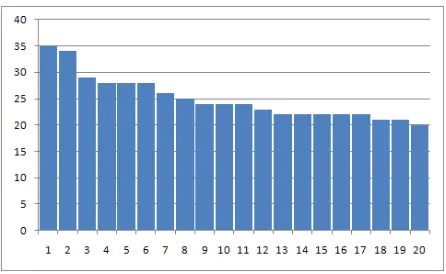
[image:4.612.313.536.538.675.2]The class distribution of NG is fairly balanced (Figure 1) with a maximum frequency of 35 and a minimum frequency of 20.
On the other hand, the R52 dataset presents an highly imbalanced class distribution (Figure 2).
Figure 2: Class distribution in R52 dataset
The most frequent class in R52 has a frequency of 435 while the least frequent has only 2 examples in the dataset. This dataset has 42 classes, out of 52, with a fequency below 10.
4.1 Experimental Setting
We have used Support Vector Machine classifiers (SVM) with linear kernels in all experiments.
In all the experiments we have compared the per-formance of d-Confidence against confidence – a common active learning setting where query selec-tion is based on low posterior confidence of the cur-rent classifier. This comparison is important to eval-uate our proposal since d-Confidence is derived from confidence by means of an aggregation with distance in case space. Comparing both these criteria, one against the other, will provide evidence on the per-formance gains, or losses, of d-Confidence on text when compared to confidence, its baseline.
We have performed 10-fold cross validation on all datasets for standard confidence and d-Confidence active learning. The labels in the training set are hid-den from the classifier. In each iteration, the active learning algorithm asks for the label of a single case. For the initial iteration in each fold we give two la-beled cases – from two distinct classes – to the clas-sifier. The two initial classes are chosen for each fold, so that different class combinations occur in different folds. Given an initial class to be present in
L1, the specific cases to include inL1are randomly sampled from the set of cases on that class. Given the fold, the sameL1is used for all experiments.
4.2 Results
Our experiments assess the ability of d-Confidence to reduce the labeling effort when compared to con-fidence.
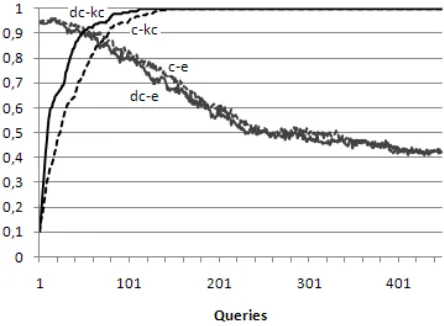
We have recorded, for each dataset, the number of distinct labels already identified and the progress of the error on the test set for each iteration (gen-eralization error). From these, we have computed, for each dataset, the mean number of known classes and mean generalization error in each iteration over all the cross validation folds (Figures 3 and 4).
The chart legends usecfor confidence,dcfor d-Confidence,efor generalization error andkcfor the number of known classes. For convenience of rep-resentation the number of classes that are known at each iteration has been normalized to the total num-ber of classes in the dataset thus being transformed into the percentage of known classes instead of the absolute number of known classes. This way the number of known classes and generalization error are both bounded in the same range (between 0 and 1) and we can conveniently represented them in the same chart.
Figure 3: Known classes and error in NG dataset
[image:5.612.313.535.382.545.2]Figure 4: Known classes and error in R52 dataset
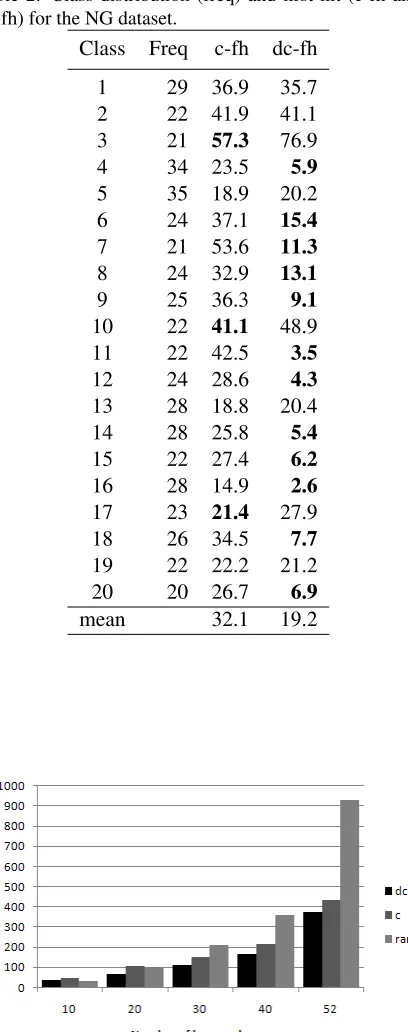
We have performed significance tests, t-tests, for the differences of the means observed when using confidence and d-Confidence. Statistically different means, at a significance level of 5%, are bold faced.
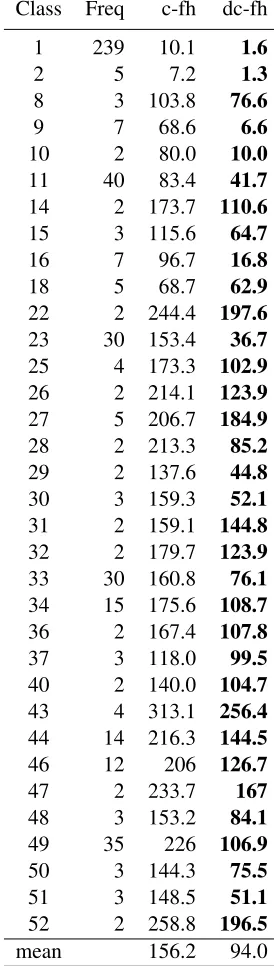
[image:6.612.78.298.62.227.2]When computing first hit for a given class we have omitted the experiments where the labeled set for the first iteration contains cases from that class. Figures 5 and 6 give an overview of the number of queries that are required in each setting to first hit a given number of distinct classes.
Figure 5: Queries required to identify bunches of distinct classes in NG dataset
[image:6.612.325.529.113.629.2]A benchmark based on random selection is also provided – averaged over 10 random samples. We have recorded the number of queries required to identify bunches of distinct classes in multiples of 10 for R52 and multiples of 4 in NG.
Table 2: Class distribution (freq) and first hit (c-fh and dc-fh) for the NG dataset.
Class Freq c-fh dc-fh
1 29 36.9 35.7 2 22 41.9 41.1 3 21 57.3 76.9 4 34 23.5 5.9
5 35 18.9 20.2 6 24 37.1 15.4
7 21 53.6 11.3
8 24 32.9 13.1
9 25 36.3 9.1
10 22 41.1 48.9 11 22 42.5 3.5
12 24 28.6 4.3
13 28 18.8 20.4 14 28 25.8 5.4
15 22 27.4 6.2
16 28 14.9 2.6
17 23 21.4 27.9 18 26 34.5 7.7
19 22 22.2 21.2 20 20 26.7 6.9
mean 32.1 19.2
[image:6.612.355.488.128.426.2]Table 3: Class distribution (Freq) and first hit (c-fh and dc-fh) for the R52 dataset. Only for those classes where d-Confidence outperforms confidence with statistical sig-nificance at 5% sigsig-nificance level.
Class Freq c-fh dc-fh
1 239 10.1 1.6
2 5 7.2 1.3
8 3 103.8 76.6
9 7 68.6 6.6
10 2 80.0 10.0
11 40 83.4 41.7
14 2 173.7 110.6
15 3 115.6 64.7
16 7 96.7 16.8
18 5 68.7 62.9
22 2 244.4 197.6
23 30 153.4 36.7
25 4 173.3 102.9
26 2 214.1 123.9
27 5 206.7 184.9
28 2 213.3 85.2
29 2 137.6 44.8
30 3 159.3 52.1
31 2 159.1 144.8
32 2 179.7 123.9
33 30 160.8 76.1
34 15 175.6 108.7
36 2 167.4 107.8
37 3 118.0 99.5
40 2 140.0 104.7
43 4 313.1 256.4
44 14 216.3 144.5
46 12 206 126.7
47 2 233.7 167
48 3 153.2 84.1
49 35 226 106.9
50 3 144.3 75.5
51 3 148.5 51.1
52 2 258.8 196.5
[image:7.612.356.492.269.546.2]mean 156.2 94.0
Table 4: Class distribution (Freq) and first hit (c-fh and dc-fh) for the R52 dataset. Only for those classes where d-Confidence does not outperforms confidence.
Class Freq c-fh dc-fh
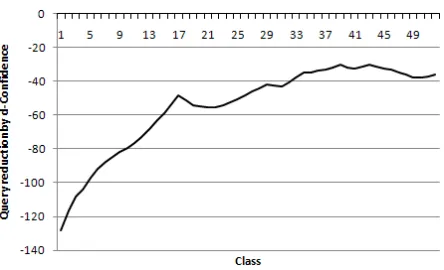
Figure 7: Average gain of d-Confidence to confidence. Classes are sorted by increasing order of their frequency.
4.3 Discussion
The charts in Figures 3 and 4 confirm the results that have been previously reported for standard non-textual datasets (Escudeiro and Jorge, 2009), w.r.t. identification of cases from unknown classes, i.e., d-Confidence reduces the labeling effort that is re-quired to identify examples from all classes. How-ever, the error rate gets worse in the R52 dataset. D-Confidence gets to know more classes from the target concept earlier although less sharply. In the R52 dataset we are exchanging accuracy by repre-sentativeness. This might be desirable or not, de-pending on the specifc task we are dealing with. If we are trying to learn a target concept but we do not know examples from all the classes to learn – for in-stance if we are in the early stage of a classification problem – this effect might be desirable so we can get a full specification of the target concept with a reduced labeling effort.
It is interesting to notice that d-Confidence out-performs confidence to a greater extent on minority classes. This is obvious in R52 if we compute the cumulative average of the gain in labeling effort that is provided by d-Confidence when compared to con-fidence (Figure 7).
The gain for each class is defined as the number of queries required by d-Confidence to first hit the class minus the ones that are required by confidence. To compute the moving average, these gains are sorted in increasing order of the class frequency. The aver-age gain starts at -128, for a class with frequency 2, and decreases to the overall average of -36 as class frequency increases up to 435. The bigger gains are
observed in the minority classes. Although not as obvious as in R52 this same behaviour is also ob-served in the NG dataset.
Figures 5 and 6, as well as Tables 2 to 4, show that d-Confidence reduces the labeling effort required to identify unknown classes when compared to confi-dence. When selecting cases to label randomly, the first bunch of 10 distinct classes is found as fast as with d-Confidence but, from there on, when rare classes come by, d-Confidence takes the lead. The outcome is quite different in the NG dataset. In this dataset d-Confidence still outperforms confidence but it is beaten by random selection of cases after identifying 13.3 classes on average (after 22 queries on average). This observation led us to suspect that when in presence of balanced datasets, d-Confidence identifies new classes faster than random selection in the initial phase of the learning process but selecting cases by chance is better to identify cases in the lat-est stage of collecting exemplary cases, when few classes remain undetected.
5 Conclusions and Future Work
The evaluation procedure that we have performed provided statistical evidence on the performance of d-Confidence over text corpora when compared to confidence. Although the evaluation has been per-formed only on two datasets, the conclusions we have reached point out some interesting results.
D-Confidence reduces the labeling effort and identifies exemplary cases for all classes faster that confidence. This gain is bigger for minority classes, which are the ones where the benefits are more rele-vant.
D-Confidence performs better in imbalanced datasets where it provides significant gains that greatly reduce the labeling effort. For balanced datasets, d-Confidence seems to be valuable in the early stage of the classification task, when few classes are known. In the later stages, random se-lection of cases seems faster in identifying the few missing classes. However, d-Confidence consis-tently outperforms confidence.
increasing error. This increase in error is probably due to the fact that we are diverting the classifier from focusing on the decision function of the major-ity classes to focus on finding new, minormajor-ity, classes. As a consequence the classification model gener-ated by d-Confidence is able of identifying more dis-tinct classes faster but gets less sharp in each one of them. This is particularly harmful for accuracy since a more fuzzy decision boundary for majority classes might cause many erroneous guesses with a negative impact on error.
We are now exploring semi-supervised learning to leverage the intrinsic value of unlabeled cases so we can benefit from the reduction in labeling effort provided by d-Confidence without increasing error.
6 References
G. Adami, P. Avesani, and D. Sona. Clustering doc-uments into a web directory for bootstrapping a su-pervised classification. Data and Knowledge Engi-neering, 54:301325, 2005.
D. Angluin. Queries and concept learning. Ma-chine Learning, 2:319342, 1988.
M.-F. Balcan, A. Beygelzimer, and J. Langford. Agnostic active learning. In In ICML, pages 6572. ICML, 2006.
E. Baum. Neural net algorithms that learn in polynomial time from examples and queries. IEEE Transactions in Neural Networks, 2:519, 1991.
K. Brinker. Incorporating diversity in active learning with support vector machines. In Proceed-ings of the Twentieth International Conference on Machine Learning, 2003.
O. Chapelle, B. Schoelkopf and A. Zien (Eds). Semi-supervised Learning. MIT Press, Cambridge, MA, 2006.
D. Cohn, L. Atlas, and R. Ladner. Training con-nectionist networks with queries and selective sam-pling. In Advances in Neural Information Process-ing Systems, 1990.
D. Cohn, L. Atlas, and R. Ladner. Improving gen-eralization with active learning. Machine Learning, (15):201221, 1994.
D. Cohn, Z. Ghahramani, and M. Jordan. Active learning with statistical models. Journal of Artificial Intelligence Research, 4:129145, 1996.
S. Dasgupta. Coarse sample complexity bonds for
active learning. In Advances in Neural Information Processing Systems 18. 2005.
S. Dasgupta and D. Hsu. Hierarchical sampling for active learning. In Proceedings of the 25th Inter-national Conference on Machine Learning, 2008.
N. Escudeiro and A.M. Jorge. Efficient coverage of case space with active learning. In P. M. L. M. R. Lus Seabra Lopes, Nuno Lau, editor, Progress in Artificial Intelligence, Proceedings of the 14th Por-tuguese Conference on Artificial Intelligence (EPIA 2009), volume 5816, pages 411422. Springer, 2009. S. Hanneke. A bound on the label complexity of agnostic active learning. In Proceedings of the 24th International Conference on Machine Learn-ing, 2007.
S. Hoi, R. Jin, and M. Lyu. Large-scale text cat-egorization by batch mode active learning. In Pro-ceedings of the World Wide Web Conference, 2006. M. Kaariainen. Algorithmic Learning Theory, chapter Active learning in the non-realizable case, pages 63 77. Springer Berlin / Heidelberg, 2006.
M. Li and I. Sethi. Confidence-based active learn-ing. IEEE Transactions on Pattern Analysis and Ma-chine Intelligence, 28:12511261, 2006.
H. Liu and H. Motoda. Instance Selection and Construction for Data Mining. Kluver Academic Publishers, 2001.
I. Muslea, S. Minton, and C. A. Knoblock. Active learning with multiple views. Journal of Artificial Intelligence Research, 27:203233, 2006.
P. Ribeiro and N. Escudeiro. On-line news ‘a la carte. In Proceedings of the European Conference on the Use of Modern Information and Communication Technologies, 2008.
N. Roy and A. McCallum. Toward optimal active learning through sampling estimation of error reduc-tion. In Proceedings of the International Conference on Machine Learning, 2001.
G. Schohn and D. Cohn. Less is more: Active learning with support vector machines. In Proceed-ings of the International Conference on Machine Learning, 2000.