Is sentence compression an NLG task?
Erwin Marsi, Emiel Krahmer Tilburg University Tilburg, The Netherlands [email protected]
Iris Hendrickx, Walter Daelemans Antwerp University
Antwerpen, Belgium [email protected] [email protected]
Abstract
Data-driven approaches to sentence com-pression define the task as dropping any subset of words from the input sentence while retaining important information and grammaticality. We show that only 16%
of the observed compressed sentences in the domain of subtitling can be accounted for in this way. We argue that part of this is due to evaluation issues and estimate that a deletion model is in fact compat-ible with approximately 55% of the ob-served data. We analyse the remaining problems and conclude that in those cases word order changes and paraphrasing are crucial, and argue for more elaborate sen-tence compression models which build on NLG work.
1 Introduction
The task ofsentence compression(orsentence re-duction) can be defined as summarizing a single sentence by removing information from it (Jing and McKeown, 2000). The compressed sentence should retain the most important information and remain grammatical. One of the applications is in automatic summarization in order to com-press sentences extracted for the summary (Lin, 2003; Jing and McKeown, 2000). Other appli-cations include automatic subtitling (Vandeghin-ste and Tsjong Kim Sang, 2004; Vandeghin(Vandeghin-ste and Pan, 2004; Daelemans et al., 2004) and displaying text on devices with very small screens (Corston-Oliver, 2001).
A more restricted version defines sentence compression as dropping any subset of words from the input sentence while retaining impor-tant information and grammaticality (Knight and
Marcu, 2002). This formulation of the task pro-vided the basis for the noisy-channel en decision-tree based algorithms presented in (Knight and Marcu, 2002), and for virtually all follow-up work on data-driven sentence compression (Le and Horiguchi, 2003; Vandeghinste and Pan, 2004; Turner and Charniak, 2005; Clarke and Lapata, 2006; Zajic et al., 2007; Clarke and Lapata, 2008) It makes two important assumptions: (1) only word deletions are allowed – no substitutions or insertions – and therefore no paraphrases; (2) the word order is fixed. In other words, the com-pressed sentence must be a subsequence of the source sentence. We will call thisthe subsequence constraint, and refer to the corresponding com-pression models asword deletion models. Another implicit assumption in most work is that the scope of sentence compression is limited to isolated sen-tences and that the textual context is irrelevant.
Under this definition, sentence compression is reduced to a word deletion task. Although one may argue that even this counts as a form of text-to-text generation, and consequently an NLG task, the generation component is virtually non-existent. One can thus seriously doubt whether it really is an NLG task.
thor-oughly reshaped. In support of this claim we pro-vide epro-vidence that the coverage of deletion models is in fact rather limited and that word reordering and paraphrasing play an important role.
The remainder of this paper is structured as fol-lows. In Section 2, we introduce our text material which comes from the domain of subtitling. We explain why not all material is equally well suited for studying sentence compression and motivate why we disregard certain parts of the data. We also describe the manual alignment procedure and the derivation of edit operations from it. In Sec-tion 3, an analysis of the number of deleSec-tions, in-sertions, substitutions, and reorderings in our data is presented. We determine how many of the com-pressed sentences actually satisfy the subsequence constraint, and how many of them could in prin-ciple be accounted for. That is, we consider al-ternatives with the same compression ratio which do not violate the subsequence constraint. Next is an analysis of the remaining problematic cases in which violation of the subsequence constraint is crucial to accomplish the observed compression ratio. We single out (1) reordering after deletion and (2) paraphrasing as important factors. Given the importance of paraphrases, Section 3.4 dis-cusses the perspectives for automatic extraction of paraphrase pairs from large text corpora, and tries to estimate how much text is required to obtain a reasonable coverage. We finish with a summary and discussion in Section 4.
2 Material
We study sentence compression in the context of subtitling. The basic problem of subtitling is that on average reading takes more time than listen-ing, so subtitles can not be a verbatim transcrip-tion of the speech without increasingly lagging be-hind. Subtitles can be presented at a rate of 690 to 780 characters per minute, while the average speech rate is considerably higher (Vandeghinste and Tsjong Kim Sang, 2004). Subtitles are there-fore often a compressed representation of the orig-inal spoken text.
Our text material stems from theNOS Journaal, the daily news broadcast of the Dutch public tele-vision. It is parallel text with on one side the au-tocuesentences (aut), i.e. the text the news reader is reading, and on the other side the corresponding
subtitlesentences (sub). It was originally collected and processed in two earlier research projects –
Atranos and Musa – on automatic subtitling (Van-deghinste and Tsjong Kim Sang, 2004; Vandegh-inste and Pan, 2004; Daelemans et al., 2004). All text was automatically tokenized and aligned at the sentence level, after which alignments were manually checked.
The same material was further annotated in an ongoing project called DAESO1, in which the gen-eral goal is automatic detection of semantic over-lap. All aligned sentences were first syntactically parsed after which their parse trees were manually aligned in more detail. Pairs of similar syntactic nodes – either words or phrases – were aligned and labeled according to a set of five semantic similar-ity relations (Marsi and Krahmer, 2007). For cur-rent purposes, only the alignment at the word level is used, ignoring phrasal alignments and relation labels.
Not all material in this corpus is equally well suited for studying sentence compression as de-fined in the introduction. As we will discuss in more detail below, this prompted us to disregard certain parts of the data.
Sentence deletion, splitting and merging For a start, autocue and subtitle sentences are often not in a one-to-one alignment relation. Table 1 speci-fies the alignment degree (i.e. the number of other sentences that a sentence is aligned to) for autocue and subtitle sentences. The first thing to notice is that there is a large number of unaligned sub-titles. These correspond to non-anchor text from, e.g., interviews or reporters abroad. More inter-esting is that about one in five autocue sentences is completely dropped. A small number of about 4 to 8 percent of the sentence pairs are not one-to-one aligned. A long autocue sentence may be split into several simpler subtitle sentences, each containing only a part of the semantic content of the autocue sentence. Conversely, one or more -usually short - autocue sentences may be merged into a single subtitle sentence.
These decisions of sentence deletion, splitting and merging are worthy research topics in the con-text of automatic subtitling, but they should not be confused with sentence compression, the scope of which is by definition limited to single sen-tence. Accordingly we disregarded all sentence pairs where autocue and subtitle are not in a one-to-one relation with each other. This reduced the data set from 15289 to 11034 sentence pairs.
Degree: Autocue: (%) Subtitle: (%) 0 3607 (20.74) 12542 (46.75) 1 12382 (71.19) 13340 (49.72)
2 1313 (7.55) 901 (3.36)
3 83 (0.48) 41 (0.15)
[image:3.595.79.282.62.134.2]4 8 (0.05) 6 (0.02)
Table 1: Degree of sentence alignment
Word compression A significant part of the re-duction in subtitle characters is actually not ob-tained by deleting words but by lexical substitution of a shorter token. Examples of this include sub-stitution by digits (“7” for “seven”), abbreviations or acronyms (“US” for “United States”), symbols (euro symbol for “Euro”), or reductions of com-pound words (“elections” for “state-elections”). We will call thisword compression. Although an important part of subtitling, we prefer to abstract from word compression and focus here on sen-tence compression proper. Removing all sensen-tence pairs containing a word compression has the dis-advantage of further reducing the data set. Instead we choose to measure compression ratio(CR) in terms of tokens2rather than characters.
CR= #toksub
#tokaut
(1)
This means that the majority of the word com-pressions do not affect the sentence CR.
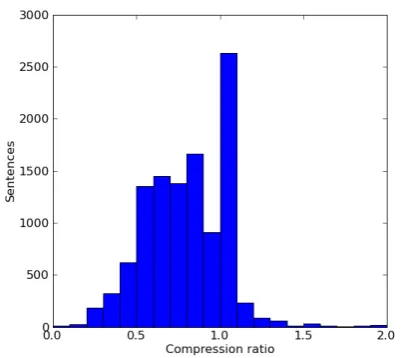
Variability in compression ratio The CR of subtitles is not constant, but varies depending (mainly) on the amount of provided autocue ma-terial in a given time frame. The histogram in Figure 1 shows the distribution of the CR (mea-sured in words) for one-to-one aligned sentences. In fact, autocue sentences are most likely not to be compressed at all (thus belonging to the largest bin, from1.00to1.09in the histogram).3 In order to obtain a proper set of compression examples, we retained only those sentence pairs where the compression ratio is less than one.
Parsing failures As mentioned earlier detailed alignment of autocue and subtitle sentences was carried out on their syntactic trees. However, for various reasons a small number of sentences (0.2%) failed to pass the parser and received no parse tree. As a consequence, their trees could not
2Throughout this study we ignore punctuation and letter case.
[image:3.595.308.509.75.254.2]3Some instances even show a CR larger than one, because occasionally there is sufficient time/space to provide a clari-fication, disambiguation, update, or stylistic enhancement.
Figure 1: Histogram of compression ratio
Min: Max: Sum: Mean: SD:
aut-tokens 2 43 80651 15.41 5.48
sub-tokens 1 29 53691 10.26 3.72
[image:3.595.313.521.273.325.2]CR 0.07 0.96 nan 0.69 0.17
Table 2: Properties of the final data set of 5233 pairs of autocue-subtitle sentences: mini-mum value, maximal value, total sum, mean and standard deviation for number of tokens per au-tocue/subtitle sentence and Compression Ratio
be aligned and there is no alignment at the word level available either. Variability in CR and pars-ing failures are together responsible for a further reduction down to 5233 sentence pairs, the final size of our data set, with an overall CR of 0.69. Other properties of this data set are summarized in Table 2.4
Word deletions, insertions and substitutions
Having a manual alignment of similar words in both sentences allows us to simply deduce word deletions, substitutions and insertions, as well as word order changes, in the following way:
• if an autocue word is not aligned to a subtitle word, then it is was deleted
• if a subtitle word is not aligned to an autocue word, then it was inserted
• if different autocue and subtitle words are aligned, then the former was substituted by the latter
• if alignments cross each other, then the word order was changed
The remaining option is where the aligned words are identical (ignoring differences in case).
4We use the acronym
Without the word alignment, we would have to resort to automatically calculating the edit dis-tance, i.e. the sum of the minimal number of insertions, deletions and substitutions required to transform one sentence in to the other. However, this would result in different and often counter-intuitive sequences of edit operations. Our ap-proach clearly distinguishes word order changes from the edit operations; the conventional edit dis-tance, by contrast, can only account for changes in word order by sequences of the edit operations. Another difference is that substitution can also be accomplished as deletion followed by insertion, which means edit operations need to have an as-sociated weight. Global tuning of these weights turns out to be hard.
3 Analysis
3.1 Edit operations
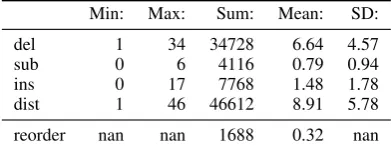
The observed deletions, insertions, substitutions, edit distances, and word order changes are shown in Table 3. As expected, deletion is the most fre-quent operation, with on average seven deletions per sentence. Insertion and substitutions are far less frequent. Note also that – even though the task is compression – insertions are somewhat more frequent than substitutions. Word order changes occur in 1688 cases (32.26%). Here, reordering is a binary variable – i.e. the word order is changed or not – hence Min, Max and SD are undefined.
Another point of view is to look at the number of sentence pairs containing a certain edit oper-ation. Here we find 5233 pairs (100.00%) with deletion, 2738 (52.32%) with substitution, 3263 (62.35%) with insertion, and 1688 (32.26%) with reordering.
The average CR for subsequences is 0.68
(SD = 0.20) versus 0.69 (SD = 0.17) for non-subsequences. A detailed inspection of the relation between the subsequence/non −
subsequenceratio and CR revealed no clear
cor-relation, so we did not find indications that non-subsequences occur more frequently at higher compression ratios.
3.2 Percentage of subsequences
The subtitle is a subsequence of the autocue if there are no insertions, no substitutions, and no word order changes. In contrast, if any of these do occur, the subtitle is not a subsequence. It turns
Min: Max: Sum: Mean: SD:
del 1 34 34728 6.64 4.57
sub 0 6 4116 0.79 0.94
ins 0 17 7768 1.48 1.78
dist 1 46 46612 8.91 5.78
[image:4.595.318.514.63.138.2]reorder nan nan 1688 0.32 nan
Table 3: Observed word deletions, insertions, sub-stitutions, and edit distances
out that only 843 (16.11%) subtitles are a subse-quence, which is rather low.
At first sight, this appears to be bad news for any deletion model, as it seems to imply that the model cannot account for close to 84% the ob-served data. However, the important thing to keep in mind is that compression of a given sentence is a problem for which there are usually multiple solutions (Belz and Reiter, 2006). This is exactly what makes it so hard to perform automatic evalu-ation of NLG systems. There may very well exist semantically equivalent alternatives with the same CR which do satisfy the subsequence constraint. For this reason, a substantial part of the observed non-subsequences may have subsequence counter-parts which can be accounted for by a deletion model. The question is: how many?
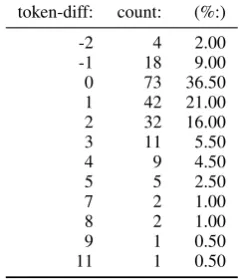
In order to address this question, we took a random sample of 200 non-subsequence sentence pairs. In each case we tried to come up with an alternative subsequence subtitle with the same meaning and the same CR (or when opportune, even a lower CR). Table 4 shows the distribu-tion of the difference in tokens between the orig-inal non-subsequence subtitle and the manually-constructed equivalent subsequence subtitle. Ap-parently 95 out of 200 (47%) subsequence sub-titles have the same (or even fewer) tokens, and thus the same (or an even lower) compression ra-tio. This suggests that the subsequence constraint is not as problematic as it seemed and that the cov-erage of a deletion model is in fact far better than it appeared to be. Recall that16%of the original subtitles were already subsequences, so our anal-ysis suggests that a deletion model is compatible with55%(16%plus47%of84%).
3.3 Problematic non-subsequences
(1)Aut de the bron source was was een a geriatrische geriatric patient patient die who zonder without het it zelf self te to merken notice uitzonderlijk exceptionally veel many larven larvae bij with zich him bleek appeared te to dragen carry en and een a grote large verspreiding spreading veroorzaakte caused
“the source was a geriatric patient who unknowingly carried exceptionally many larvae and caused a wide spreading” Sub een a geriatrische geriatric patient patient met with larven larvae heeft has de the verspreiding spreading veroorzaakt caused
Seq de bron was een geriatrische patient die veel larven bij zich bleek te dragen en een verspreiding veroorzaakte
(2)Aut in in verband relation met to de the lawineramp avalanche-disaster in in gal¨ur Galt¨ur hebben have de the politieke political partijen parties in in tirol Tirol gezamenlijk together besloten decided de the verkiezingscampagne election-campaign voor for het the regionale regional parlement parliament op up te to schorten postpone Sub de the politieke political partijen parties in in tirol Tirol hebben have besloten decided de the verkiezingen elections op up te to schorten postpone “Political parties in Tirol have decided to postpone the elections”
(3)Aut velen many van of hen them worden are door by de the servi¨ers Serbs in in volgeladen crammed treinen trains gedeporteerd deported Sub vluchtelingen refugees worden are per by trein train gedeporteerd deported
token-diff: count: (%:)
-2 4 2.00
-1 18 9.00
0 73 36.50
1 42 21.00
2 32 16.00
3 11 5.50
4 9 4.50
5 5 2.50
7 2 1.00
8 2 1.00
9 1 0.50
[image:5.595.120.240.310.450.2]11 1 0.50
Table 4: Distribution of difference in tokens between original non-subsequence subtitle and equivalent subsequence subtitle
the best equivalent subsequence we could ob-tain still has nine more tokens than the origi-nal non-subsequence. These problematic non-subsequences reveal where insertion, substitution and/or word reordering are essential to obtain a subtitle with a sufficient CR (i.e. the CR observed in the real subtitles). At least three different types of phenomena were observed.
Word order In some cases deletion of a con-stituent necessitates a change in word order to ob-tain a grammatical sentence. In example (2), the autocue sentence has the PP modifier in verband met de lawineramp in gal¨ur in its topic position (first sentence position). Deleting this modifier, as is done in the subtitle, results in a sentence that starts with the verbhebben, which is interpreted as a yes-no question. For a declarative interpretation, we have to move the subjectde politieke partijen
to the first position, as in the subtitle. Incidentally, this indicates that it is instructive to apply sentence compression models to multiple languages, as a word order problem like this never arises in En-glish.
Similar problems arise whenever an embedded clause is promoted to a main clause, which re-quires a change in the position of the finite verb in Dutch. In total, a word order problem occurred in 24 out 200 sentences.
Referring expressions Referring expressions are on many occasions replaced by a shorter one – usually a little less precise. For example, de belgische overheid ‘the Belgian authorities’ is replaced by belgie ‘Belgium’. Extreme cases of this occur where a long NP like deze tweede impeachment-procedure in de amerikaanse geschiedenis ‘this second impeachment-procedure in the American history’ is replaced by an anaphor likehet‘it’.
Paraphrasing Apart from the reduced referring expressions, there are nominal paraphrases reduc-ing a noun phrases likemedewerkers van banken
‘employees of banks’ to a compound word like
bankmedewerkers ‘bank-employees’. Likewise, there are adverbial paraphrases such assinds een paar jaar ‘since a few years’ to tegenwoordig
‘nowadays’, andvan de afgelopen tijd‘of the past time’ torecent‘recent’. However, the majority of the paraphrasing concerns verbs as in the two ex-amples below.
(4)Aut X X
neemt takes
het the
initiatief initiative
tot to
oprichting raising
van of
Y Y Sub X
X zet sets
Y Y
op up (5)Aut X
X om for
zijn his
uitlevering extradition
vroeg asked
maar but
Y Y
die that
weigerde refused Sub Y
Y hem him
niet not
wilde wanted
uitleveren extradite
aan to
X Y “Y refused to extradite him to Y”
Even though not all paraphrases are actually shorter, it seems that at least some of them boost compression beyond what can be accomplished with only word deletion. In the next Section, we look at the possibilities of automatic extraction of such paraphrases.
3.4 Perspectives for automatic paraphrase extraction
There is a growing amount of work on automatic extraction of paraphrases from text corpora (Lin and Pantel, 2001; Barzilay and Lee, 2003; Ibrahim et al., 2003; Dolan et al., 2004). One general pre-requisite for learning a particular paraphrase pat-tern is that it must occur in the text corpus with a sufficiently high frequency, otherwise the chances of learning the pattern are proportionally small. In this section, we investigate to what extent the para-phrases encountered in our random sample of 200 pairs can be retrieved from a reasonably large text corpus.
In a first step, we manually extracted 106 paraphrase patterns. We filtered these pat-terns and excluded anaphoric expressions, general verb alternation patterns like active/passive and continuous/non-continuous, as well as verbal pat-terns involving more than two slots. After this fil-tering step, 59 pairs of paraphrases remained, in-cluding the examples shown in the preceding Sec-tion.
The aim was to estimate how big our corpus has to be to cover the majority of these
para-phrase pairs. We started with counting for each of the paraphrase pairs in our sample how often they occur in a corpus of Dutch news texts, the Twente News Corpus5, which contains approxi-mately 325M tokens and 20M sentences. We em-ployed regular expressions to count the number of paraphrase pattern matches. The corpus turned out to contain70%percent of all paraphrase pairs (i.e. both patterns in the pair occur at least once). We also counted how many pairs have a frequencies of at least 10 and 100. To study the effect of corpus size on the percentage of covered paraphrases, we performed these counts on 1, 2, 5, 10, 25, 50 and
100%of the corpus. Figure 2 shows the percent-age of covered paraphrases dependent on the cor-pus size. The most strict threshold that only counts pairs that occur at least 100 times in our corpus, does not retrieve any counts on1%of the corpus (3M words). At 10%of the corpus size only4%
of the paraphases is found, and on the full data set
25%of the pairs is found.
For 51% percent of the patterns (with a fre-quency of at least 10) we find substantial evidence in our corpus of 325M tokens. We fitted a curve through our data points, and found a logarithmic line fit with adjustedR2 value of .943. This sug-gests that in order to get75%of the patterns, we would need a corpus that is 18 times bigger than our current one, which amounts to roughly 6 bil-lion words. Although this seems like a lot of text, using the WWW as our corpus would easily give us these numbers. Today’s estimate of the Index Dutch World Wide Web is 688 million pages6. If we assume that each page contains at least 100 to-kens on average, this implies a corpus size of 68 billion tokens.
The patterns used here are word-based and in many cases they express a particular verb tense or verb form (e.g. 3rd person singular), and word order. This implies that our estimations are the minimum number of matches one can find. For more abstract matching, we would need syntacti-cally parsed data (Lin and Pantel, 2001). We ex-pect that this would also positively affect the cov-erage.
5
http://www.vf.utwente.nl/˜druid/TwNC/ TwNC-main.html
6http://www.worldwidewebsize.com/
Figure 2: Percentage of covered paraphrases as a function of the corpus size
4 Discussion
We found that only16.11%of 5233 subtitle sen-tences were proper subsequences of the corre-sponding autocue sentence, and therefore84%can not be accounted for by a deletion model. One consequence appears to be that the subsequence constraint greatly reduces the amount of avail-able training material for any word deletion model. However, an attempt to rewrite non-subsequences to semantically equivalent sequences with the same CR suggests that a deletion model could in principle be adequate for55%of the data. More-over, in those cases where an application can toler-ate a little slack in the CR, a deletion model might be sufficient. For instance, if we are willing to tol-erate up to two more tokens, we can account for as much as 169 (84%) of the 200 non-subsequences in our sample, which amounts to87% (16%plus
84%of84%) of the total data.
It should be noted that we have been very strict regarding what counts as a semantically equiva-lent subtitle: every piece of information occurring in the non-subsequence subtitle must reoccur in the sequence subtitle. However, looking at our original data, it is clear that considerable liberty is taken as far as conserving semantic content is concerned: subtitles often drop substantial pieces of information. If we relax the notion of seman-tic equivalence a little, an even larger part of the non-subsequences can be rewritten as proper se-quences.
The remaining problematic non-subsequences are those where insertion, substitution and/or word reordering are essential to obtain a sufficient CR. One of the issues we identified is that deletion
of certain constituents must be accompanied by a change in word order to prevent an ungrammati-cal sentence. Since changes in word order appear to require grammatical modeling or knowledge, this brings sentence compression closer to being an NLG task.
Nguyen and Horiguchi (2003) describe an ex-tension of the decision tree-based compression model (Knight and Marcu, 2002) which allows for word order changes. The key to their approach is that dropped constituents are temporarily stored on adeletion stack, from which they can later be re-inserted in the tree where required. Although this provides an unlimited freedom for rearranging constituents, it also complicates the task of learn-ing the parslearn-ing steps, which might explain why their evaluation results show marginal improve-ments at best.
In our data, most of the word order changes ap-pear to be minor though, often only moving the verb to second position after deleting a constituent in the topic position. We believe that unrestricted word order changes are perhaps not necessary and that the vast majority of the word order problems can be solved by a fairly restricted way of reorder-ing. In particular, we plan to implement a parser-based model with an additional swap operation that swaps the two topmost items on the stack. We expect that this is more feasible as a learning task than a model with a deletion stack.
Apart from reordering, other problems for word deletion models are the insertions and substitu-tions as a result of paraphrasing. Within a deci-sion tree-based model, paraphrasing of words or continuous phrases may be modeled by a combi-nation of a paraphrase lexicon and an extra opera-tion which replaces thentopmost elements on the stack by the corresponding paraphrase. However, paraphrases involving variable arguments, as typ-ical for verbal paraphrases, cannot be accounted for in this way. More powerful compression mod-els may draw on existing NLG methods for text revision (Inui et al., 1992) to accommodate full paraphrasing.
quarters of the paraphrases.
Incidentally, we identified two other tasks in automatic subtitling which are closely related to NLG. First, splitting and merging of sentences (Jing and McKeown, 2000), which seems related to content planning and aggregation. Second, gen-eration of a shorter referring expression or an anaphoric expression, which is currently one of the main themes in data-driven NLG.
In conclusion, we have presented evidence that deletion models for sentence compression are not sufficient, and that more elaborate models in-volving reordering and paraphrasing are required, which puts sentence compression in the field of NLG.
Acknowledgments
We would like to thank Nienke Eckhardt, Paul van Pelt, Han-neke Schoormans and Jurry de Vos for the corpus annota-tion work, and Erik Tsjong Kim Sang and colleagues for the autocue-subtitle material from the ATRANOS project, and Martijn Goudbeek for help with curve fitting. This work was conducted within the DAESO project funded by the Stevin program (De Nederlandse Taalunie).
References
Regina Barzilay and Lillian Lee. 2003. Learning to paraphrase: an unsupervised approach using multiple-sequence alignment. InProceedings of the 2003 Confer-ence of the North American Chapter of the Association for Computational Linguistics on Human Language Technol-ogy, pages 16–23, Morristown, NJ, USA.
Anja Belz and Ehud Reiter. 2006. Comparing automatic and human evaluation of NLG systems. InProceedings of the 11th Conference of the European Chapter of the Associa-tion for ComputaAssocia-tional Linguistics, pages 313–320. James Clarke and Mirella Lapata. 2006. Models for sentence
compression: a comparison across domains, training re-quirements and evaluation measures. InProceedings of the 21st International Conference on Computational Lin-guistics and the 44th annual meeting of the Association for Computational Linguistics, pages 377–384, Morristown, NJ, USA.
James Clarke and Mirella Lapata. 2008. Global inference for sentence compression an integer linear programming approach. Journal of Artificial Intelligence Research, 31:399–429.
Simon Corston-Oliver. 2001. Text compaction for display on very small screens. InProceedings of the Workshop on Automatic Summarization (WAS 2001), pages 89–98, Pittsburgh, PA, USA.
Walter Daelemans, Anita H¨othker, and Erik Tjong Kim Sang. 2004. Automatic sentence simplification for subtitling in Dutch and English. InProceedings of the 4th Interna-tional Conference on Language Resources and Evalua-tion, pages 1045–1048.
Bill Dolan, Chris Quirk, and Chris Brockett. 2004. Unsuper-vised construction of large paraphrase corpora: Exploiting massively parallel news sources. InProceedings of the 20th International Conference on Computational Linguis-tics, pages 350–356, Morristown, NJ, USA.
Ali Ibrahim, Boris Katz, and Jimmy Lin. 2003. Extract-ing structural paraphrases from aligned monolExtract-ingual cor-pora. In Proceedings of the 2nd International Work-shop on Paraphrasing, volume 16, pages 57–64, Sapporo, Japan.
Kentaro Inui, Takenobu Tokunaga, and Hozumi Tanaka. 1992. Text Revision: A Model and Its Implementation. InProceedings of the 6th International Workshop on Nat-ural Language Generation: Aspects of Automated NatNat-ural Language Generation, pages 215–230. Springer-Verlag London, UK.
Hongyan Jing and Kathleen McKeown. 2000. Cut and paste based text summarization. InProceedings of the 1st Con-ference of the North American Chapter of the Association for Computational Linguistics, pages 178–185, San Fran-cisco, CA, USA.
Kevin Knight and Daniel Marcu. 2002. Summarization be-yond sentence extraction: A probabilistic approach to sen-tence compression.Artificial Intelligence, 139(1):91–107. Nguyen Minh Le and Susumu Horiguchi. 2003. A New Sen-tence Reduction based on Decision Tree Model. In Pro-ceedings of the 17th Pacific Asia Conference on Language, Information and Computation, pages 290–297.
Dekang Lin and Patrick Pantel. 2001. Discovery of infer-ence rules for question answering. Natural Language En-gineering, 7(4):343–360.
Chin-Yew Lin. 2003. Improving summarization perfor-mance by sentence compression - A pilot study. In Pro-ceedings of the Sixth International Workshop on Informa-tion Retrieval with Asian Languages, volume 2003, pages 1–9.
Erwin Marsi and Emiel Krahmer. 2007. Annotating a par-allel monolingual treebank with semantic similarity re-lations. In Proceedings of the 6th International Work-shop on Treebanks and Linguistic Theories, pages 85–96, Bergen, Norway.
Jenine Turner and Eugene Charniak. 2005. Supervised and unsupervised learning for sentence compression. In Pro-ceedings of the 43rd Annual Meeting of the Association for Computational Linguistics, pages 290–297, Ann Ar-bor, Michigan, June.
Vincent Vandeghinste and Yi Pan. 2004. Sentence com-pression for automated subtitling: A hybrid approach. In
Proceedings of the ACL Workshop on Text Summarization, pages 89–95.
Vincent Vandeghinste and Erik Tsjong Kim Sang. 2004. Using a Parallel Transcript/Subtitle Corpus for Sentence Compression. InProceedings of LREC 2004.
David Zajic, Bonnie J. Dorr, Jimmy Lin, and Richard Schwartz. 2007. Multi-candidate reduction: Sentence compression as a tool for document summarization tasks.