ISSN Online: 2152-7393 ISSN Print: 2152-7385
DOI: 10.4236/am.2019.104018 Apr. 29, 2019 234 Applied Mathematics
A Modern Method for Constructing the S-Box of
Advanced Encryption Standard
W. Eltayeb Ahmed
1,21Mathematics and Statistics Department, Faculty of Science, Imam Mohammad Ibn Saud Islamic University, Riyadh, KSA 2Department of Basics and Engineering Sciences, Faculty of Engineering, University of Khartoum, Khartoum, Sudan
Abstract
The substitution table (S-Box) of Advanced Encryption Standard (AES) and its properties are key elements in cryptanalysis ciphering. We aim here to propose a straightforward method for the non-linear transformation of AES S-Box construction. The method reduces the steps needed to compute the multiplicative inverse, and computes the matrices multiplication used in this transformation, without a need to use the characteristic matrix, and the result is a modern method constructing the S-Box.
Keywords
Advanced Encryption Standard, S-Box, Extended Euclidean Algorithm, Greatest Common Divisor, XOR Operation
1. Introduction
The S-Box table of AES is taken as a lookup table to substitute an input byte by another, this table is constructed using a non-linear transformation depends on the usual method taking more calculation steps to give the corresponding byte.
The S-Box plays a fundamental role in encryption and decryption processes, as byte substitution appears in many steps. At the first round of the encryption process, we add the plaintext matrix to the key matrix, then we substitute each byte by another byte according to S-Box, for example, to substitute the byte
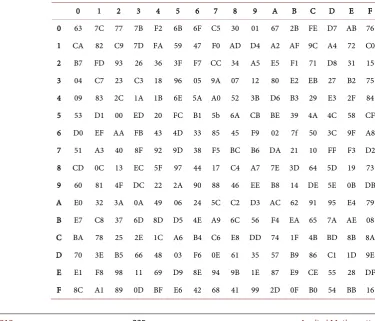
xy(say), we take the byte in the cell that has x as the column index and y as the row index, we do this substitute byte step in all rounds of the encryption process, and in all round of the decryption process, we do the inverse substitute byte step, to substitute the byte xy(say), we take the index of the column, and the index of the row of the cell that contains xy, as the left and the right character of the re-sult byte, respectively. The S-Box (Table 1), involves substitution bytes for all
How to cite this paper: Ahmed, W.E. (2019) A Modern Method for Constructing the S-Box of Advanced Encryption Stan-dard. Applied Mathematics, 10, 234-244. https://doi.org/10.4236/am.2019.104018
Received: March 22, 2019 Accepted: April 26, 2019 Published: April 29, 2019
Copyright © 2019 by author(s) and Scientific Research Publishing Inc. This work is licensed under the Creative Commons Attribution International License (CC BY 4.0).
http://creativecommons.org/licenses/by/4.0/
DOI: 10.4236/am.2019.104018 235 Applied Mathematics
bytes from {00} to {FF} in hexdecimal presentation.
The S-Box is constructed using the following operations [1]:
1) Finding the multiplicative inverse of an input byte in the finite field GF
( )
28based on the irreducible polynomial P x
( )
=x8+x4+x3+ +x 1.2) Multiplying this multiplicative inverse by a specific matrix (matrix M). 3) Adding the multiplication result to a specific vector
(
{ }
63 =01100011)
.We convert the hexadecimal presentation of the input byte into binary pres-entation as
(
a a a a a a a a7 6 5 4 3 2 1 0)
and write it as a polynomial( )
7 6 5 4 3 27 6 5 4 3 2 1 0
A x =a x a x a x a x a x a x a x a+ + + + + + + , let its multiplicative
in-verse be
( )
7 6 5 4 3 27 6 5 4 3 2 1 0
T x =t x t x t x t x t x t x t x t+ + + + + + + , we multiply T x
( )
by the following characteristic matrix:
1 0 0 0 1 1 1 1 1 1 0 0 0 1 1 1 1 1 1 0 0 0 1 1 1 1 1 1 0 0 0 1 1 1 1 1 1 0 0 0 0 1 1 1 1 1 0 0 0 0 1 1 1 1 1 0 0 0 0 1 1 1 1 1 M
=
(1)
Then, we add the result to (01100011).
[image:2.595.158.534.424.745.2]We note that, for the input {00} the output is {63}.
Table 1. The AES S-Box.
DOI: 10.4236/am.2019.104018 236 Applied Mathematics
1.1. Problem Statement
We search for an easier and straightforward method for constructing the AES S-Box.
1.2. Proposed Solution
The multiplicative inverse of an input byte can be computed in clear steps using an iterated formula.
Multiplying the multiplicative inverse matrix by the characteristic matrix can be determined directly from this multiplicative inverse using simple XOR opera-tions, without a need to use the characteristic matrix.
2. Traditional Way
In cryptography, the extended Euclidean algorithm has wide uses especially for finding a multiplicative inverse (modular inverse).
Euclidean algorithm is used to find the greatest common divisor of two integ-ers a and b, (denoted by gcd ,
( )
a b ).When b a> , and
b r aq− = (2) for some integers r and q, we say
(
mod)
r b= a (3)
and if b
(
moda)
=0 then( )
gcd ,a b =a (4) With the polynomials A x
( )
and P x( )
, we write gcd(
A x P x( ) ( )
,)
[2]. The algorithm below gives gcd(
A x P x( ) ( )
,)
, where A x( )
<P x( )
Algorithm (1): Euclidean algorithm [3]
Input: Polynomials A x P x( ) ( ), . Output: gcd
(
A x P x( ) ( ),)
. 1) While A x( )≠0 doa) r x( )=P x( )modA x( ), P x( )=A x( ), A x( ) ( )=r x . 2) Return P x( ).
The step (1.(a)) of the algorithm (1) involves the division algorithm:
( )
( ) ( ) ( )
P x =A x q x r x+ (5)
where 0≤r x
( )
=P x( )
modA x( )
<A x( )
. It implies that [4]( ) ( )
(
)
(
( ) ( )
)
gcd A x P x, =gcd A x r x, (6)
If r x
( )
≠0, the step will be repeated, let us write the repeated application of the division algorithm as:( )
1( ) ( )
1( )
DOI: 10.4236/am.2019.104018 237 Applied Mathematics
( )
2( ) ( )
1 2( )
A x =q x r x r x+ , 0≤r x2
( )
<r x1( )
( )
( ) ( )
( )
1 3 2 3
r x =q x r x r x+ , 0≤r x3
( )
<r x2( )
( )
( ) ( )
( )
3 1 2 1
i i i i
r− x =q− x r− x r+ − x , 0≤ri−1
( )
x <ri−2( )
x( )
( ) ( ) ( )
2 1
i i i i
r− x =q x r x r x− + , 0≤r xi
( )
<ri−1( )
x (7)When r xi
( )
=0, and since( ) ( )
(
)
(
1( ) ( )
)
gcd A x P x, =gcd ri− x r x,i (8) weget
( ) ( )
(
)
1( )
gcd A x P x, =ri− x (9)
The extended form of the Euclidean algorithm is called Extended Euclidean algorithm, it gives (besides gcd
(
A x P x( ) ( )
,)
, X x( )
and Y x( )
such that( ) ( )
(
)
( ) ( )
( ) ( )
gcd A x P x, =A x X x +P x Y x (10) Rewrite the equations of the system (7) as:
( )
( )
( ) ( )
1 1
r x =P x q x A x−
( )
( )
( ) ( )
2 2 1
r x = A x q x r x−
( )
( )
( ) ( )
3 1 3 2
r x =r x q x r x−
( )
( )
( ) ( )
2 4 2 3
i i i i
r− x =r− x q− − x r− x
( )
( )
( ) ( )
1 3 1 2
i i i i
r− x =r− x q− − x r− x (11)
Then, in the last equation of system (11), ri−1
( )
x =ri−3( )
x q− i−1( ) ( )
x ri−2 x ,replace ri−2
( )
x with its value from the above equation (it involves ri−3( )
x ),then replace ri−3
( )
x with its value from the above equation, continue doingthis replacement, we obtain
( )
( )
(
( )
)
(
( )
(
( )
)
(
( )
(
( )
)
( )
(
( )
)
(
( ) ( )
(
( ) ( )
)
)
(
)
)
)
1 3 1 4 2 5 3
6 4 1
i i i i i i i
i i
r x r x q x r x q x r x q x
r x q x P x q x A x
− − − − − − −
− −
= − − −
× − − (12)
Equation (12) takes the form
( )
( ) ( )
( ) ( )
1
i
r x− =A x X x +P x Y x (13)
In our problem 1≤ <i 8, and since the multiplicative inverse only exists when
the gcd is 1 [5].
( )
1 1
i
r x− = (14)
The multiplicative inverse [2] of A x
( )
modulo P x( )
is A x−1( )
such that( ) ( )
1 1 mod(
( )
)
A x A x− = P x (15)
When gcd
(
A x P x( ) ( )
,)
=1,( ) ( )
( ) ( )
DOI: 10.4236/am.2019.104018 238 Applied Mathematics
( )
(
)
(
( ) ( )
( ) ( )
)
(
( )
)
1 modP x = A x X x +P x Y x modP x (17)
and since
( ) ( )
0 mod(
( )
)
P x Y x = P x (18)
we get
( )
1( )
X x =A x− (19)
So, the procedure of the extended Euclidean algorithm finds the greatest common divisor, also it finds the multiplicative inverse.
Below an algorithm to find A x−1
( )
, we will denote A x−1( )
by T x( )
.Algorithm (2): Extended Euclidean algorithm [3]
Input: Polynomials A x P x( ) ( ), .
Output: The multiplicative inverse of A x( ). 1)Set y x2( )=0, y x1( )=1.
2) While A x( )≠1 do
a) q x( )=P x divA x( ) ( ), r x( )=P x( ) ( ) ( )+q x A x . b) y x( )=y x2( )+y x q x1( ) ( )
c) y x2( )=y x1( ), y x1( )=y x( ). d) P x( )=A x( ), A x( ) ( )=r x . 3) Return y x1( ).
Now, we have T x
( ) (
= t t t t t t t t7 6 5 4 3 2 1 0)
, we multiply it (from the left) by matrix M( )
(
)
0 0 4 5 6 7
1 0 1 5 6 7
2 0 1 2 6 7
3 0 1 2 3 7
4 0 1
5 6 7
1 0 0 0 1 1 1 1 1 1 0 0 0 1 1 1 1 1 1 0 0 0 1 1 1 1 1 1 0 0 0 1 1 1 1 1 1 0 0 0 0 1 1 1 1 1 0 0 0 0 1 1 1 1 1 0 0 0 0 1 1 1 1 1
t t t t t t
t t t t t t
t t t t t t
t t t t t t
M T x
t t t
t t t + + + + + + + + + + + + + + + + = = +
2 3 4
1 2 3 4 5
2 3 4 5 6
3 4 5 6 7
t t t t t t t t t t t t t t t t t t
+ + + + + + + + + + + + + + + (20)
Then, we add the result to
(
{ }
63 =01100011)
to obtain the output of thein-put A x
( ) (
= a a a a a a a a7 6 5 4 3 2 1 0)
0 4 5 6 7 0 4 5 6 7
0 1 5 6 7 0 1 5
0 1 2 6 7
0 1 2 3 7
0 1 2 3 4
1 2 3 4 5
2 3 4 5 6
3 4 5 6 7
1 1 1 0 0 0 1 1 0
t t t t t t t t t t
t t t t t t t t
t t t t t t t t t t t t t t t t t t t t t t t t t t t t t t
+ + + + + + + + + + + + + + + + + + + + + + + + + = + + + + + + + + + + + + + + + + 6 7
0 1 2 6 7
0 1 2 3 7
0 1 2 3 4
1 2 3 4 5
2 3 4 5 6
3 4 5 6 7
1
1 1 t t t t t t t t t t t t t t t t t t t t t t t t t t t t t t t t
DOI: 10.4236/am.2019.104018 239 Applied Mathematics
Example
Using the traditional way, we want to find the output byte that corresponding to the input byte {53} (Table 2).
{ }
53 01010011= , A x( )
=x6+x4+ +x 1, P x( )
=x8+x4+x3+ +x 1.Iteration 1
( )
2 0
y x = , y x1
( )
=1,( )
2 1q x =x + , r x
( )
=x2,( )
2 1y x =x + , y x2
( )
=1,( )
21 1
y x =x + ,
( )
6 4 1P x =x +x + +x , A x
( )
=x2.Iteration 2
( )
4 2q x =x +x , r x
( )
= +x 1,( )
6 2 1y x =x +x + ,
( )
22 1
y x =x + ,
( )
6 21 1
y x =x +x + ,
( )
2P x =x , A x
( )
= +x 1.Iteration 3
( )
1q x = +x , r x
( )
=1,( )
7 6 3y x =x +x +x +x,
( )
6 22 1
y x =x +x + ,
( )
7 6 31
y x =x +x +x +x,
( )
1P x = +x , A x
( )
=1.( )
( )
7 6 31 11001010
T x =y x =x +x +x x+ = .
1 0 0 0 1 1 1 1 0 0
1 1 0 0 0 1 1 1 1 1
1 1 1 0 0 0 1 1 0 1
1 1 1 1 0 0 0 1 1 1
1 1 1 1 1 0 0 0 0 0
0 1 1 1 1 1 0 0 0 0
0 0 1 1 1 1 1 0 1 0
0 0 0 1 1 1 1 1 1 1
=
(22)
0 1 1
1 1 0
1 0 1
1 0 1
0 0 0
0 1 1
0 1 1
1 0 1
+ =
(23)
DOI: 10.4236/am.2019.104018 240 Applied Mathematics Table 2. To find the output of {53}.
… 3 …
⋮ … … …
5 … ?? …
⋮ … … …
3. Modern Way
We use the formula [6] below to find the multiplicative inverse.
3.1. The Iterated Formula
The iterated formula( )
(
( )
)
(
1( )
)
( )
i i i i
T x = q x T− x +T x , 2≤ <i 8 (24)
where T x0
( )
=1,T x1( )
=q x1( )
, gives the multiplicative inverse T T= i when1
i
r = .
To show that, we use the system (11). When i=1, r x1
( )
=1,( )
( )
(
( )
)
(
( )
)
1 1
r x =P x − q x A x (25)
( )
(
1( )
)
(
( )
)
1=P x − q x A x (26)
We obtain T x
( )
=q x1( )
=T x1( )
. (Equation (24), takes this as given).When i=2, r x2
( )
=1, r x1( )
≠0,( )
( )
(
( )
)
(
( )
)
2 2 1
r x =A x − q x r x (27)
( )
(
( )
)
(
( )
(
( )
)
(
( )
)
)
( )
(
)
(
( )
)
(
)
(
( )
)
(
( )
)
(
( )
)
( )
(
)
(
( )
)
(
)
(
( )
)
(
( )
)
(
( )
)
2 1
2 1 2
2 1 2
1 1 1
A x q x P x q x A x
q x q x A x q x P x
q x q x A x q x P x
= − −
= − −
= − −
(28)
We obtain T x
( )
=(
q x q x2( )
)
(
1( )
)
+1. From Equation (24)( )
2( )
2( ) ( )
1 0( )
(
2( )
)
(
1( )
)
1T x =T x =q x T x +T x = q x q x + (29)
When i=3, r x3
( )
=1, r x1( )
≠0, r x2( )
≠0,( )
( )
( ) ( )
3 1 3 2
r x =r x −q x r x (30)
( )
( ) ( )
( )
(
(
( ) ( )
)
( )
( ) ( )
)
( )
(
)
(
( ) ( )
)
( )
(
)
( )
( ) ( )
1 3 2 1 2
3 2 1 1
1 1
1
P x q x A x q x q x q x A x q x P x
q x q x q x q x A x K x P x
= − − − −
= − − + (31)
We obtain
( )
(
3( )
)
(
1(
2( )
)
(
1( )
)
)
1( )
3( ) ( )
2 1( )
T x = q x − q x q x −q x =q x T x +T x (32)
and from Equation (24)
( )
3( )
3( ) ( )
2 1( )
T x =T x =q x T x T x+ (33)
By this way, we can show that Equation (24) gives T x
( )
for 2≤ <i 8, when1
i
DOI: 10.4236/am.2019.104018 241 Applied Mathematics
Below an algorithm to find T x
( )
using the modern way.Algorithm (3): Modern way to find a multiplicative inverse Input: Polynomials A x P x( ) ( ), .
Output: T x( ), the multiplicative inverse of A x( ). 1) Set T x0( )=0, T x1( )=1.
2) q x( )=P x divA x( ) ( ), r x( )=P x( ) ( ) ( )+q x A x . 3) T x( )=q x T x T x( ) ( )1 + 0( )
4) If r xi( )=1 then return T x( ), stop.
5) Else P x( )=A x( ), A x( ) ( )=r x .
( ) ( )
0 1
T x =T x , T x1( )=T x( ). 6) Go to 2
Now, we want to multiply T x
( )
by the matrix M. First, write M as [7]1 0 0 0 1 1 1 1
1 1 0 0 0 1 1 1
1 1 1 0 0 0 1 1
1 1 1 1 0 0 0 1
1 1 1 1 1 0 0 0
0 1 1 1 1 1 0 0
0 0 1 1 1 1 1 0
0 0 0 1 1 1 1 1
M = (34) Let 1
1 0 0 0 1 1 0 0 1 1 1 0 1 1 1 1 M =
, 2
1 1 1 1 0 1 1 1 0 0 1 1 0 0 0 1 M = (35)
And write T x
( )
asDOI: 10.4236/am.2019.104018 242 Applied Mathematics
Then
0
0 1
1 1
0 1 2
0 1 2 3
t t t M T
t t t
t t t t
+
=
+ +
+ + +
(38)
4
4 5
1 2
4 5 6
4 5 6 7
t t t M T
t t t t t t t
+
=
+ +
+ + +
(39)
3 2 1 0
3 2 1
2 1
3 2
3
t t t t t t t M T
t t t
+ + +
+ +
=
+
(40)
7 6 5 4
7 6 5
2 2
7 6
7
t t t t t t t M T
t t t
+ + +
+ +
=
+
(41)
So, the multiplication of M and T x
( )
gives1 1 2 2
2 1 1 2
M T M T M T M T
+
+
From Equation (38) and Equation (39), we note that the results of these mul-tiplications give the form
first element first second first second third first second third fourth
+
+ +
+ + +
of the second matrix, and similarly, Equation (40) and Equation (41), show that the results give the form
fourth third second first fourth third second
fourth third fourth
+ + +
+ +
+
of the second matrix, so we don’t need to use matrix M, as the traditional me-thod.
In the last step, we add M T x
(
( )
)
to(
{ }
63 =01100011)
.3.2. Example
Using the modern way, we want to find the output of {53}
{ }
53 01010011= , A x( )
=x6+x4+ +x 1, P x( )
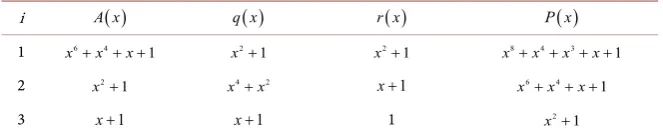
=x8+x4+x3+ +x 1.DOI: 10.4236/am.2019.104018 243 Applied Mathematics Table 3. Finding multiplicative inverse of {53}.
i A x( ) q x( ) r x( ) P x( )
1 x6+x4+ +x 1 x2+1 x2+1 x8+x4+x3+ +x 1 2 x2+1 x4+x2 x+1 x6+x4+ +x 1
3 x+1 x+1 1 x2+1
Since r x3
( )
=1,( )
( )
(
( )
)
( )
( )
( )
(
)
(
(
( )
)
(
( )
)
)
( )
(
)
(
)(
)
3 3 2 1
3 2 1 1
4 2 2 2
7 6 3
1
1 1 1 1
11001010
T x T x q x T x T x
q x q x q x q x
x x x x x
x x x x
= = +
= + +
= + + + + + +
= + + +
=
Then, computing the matrices multiplication:
0 0
0 0
1 0
1 1
1 0
0 1
0 1
1 1
0 0 0 0
0 0 0 0
1 1 1 0
1 1 0 1
→ =
(42)
Last, adding (01100011)
0 1 1
1 1 0
1 0 1
1 0 1
0 0 0
0 1 1
0 1 1
1 0 1
+ =
(43)
So, the output is 11101101=ED.
4. Conclusions
In this paper, a straightforward method for obtaining the Advanced Encryption Standard S-Box look-up table without the traditional use of the characteristic Matrix M is proposed. We have demonstrated that the two methods are equiva-lent. In addition, the multiplicative inverse of A x
( )
has been found more ele-gantly.DOI: 10.4236/am.2019.104018 244 Applied Mathematics
Conflicts of Interest
The author declares no conflicts of interest regarding the publication of this pa-per.
References
[1] National Institute of Standards and Technology (NIST) (2001) Advanced Encryp-tion Standard (AES). FIPS PublicaEncryp-tion 197.
[2] Burton, D.M. (2007) Elementary Number Theory. 6th Edition, McGraw-Hill, New York.
[3] Menezes, A., van Oorschot, P. and Vanstone, S. (1997) Handbook of Applied Cryp-tography. CRC Press, New York.https://doi.org/10.1201/9781439821916
[4] Cormen, T.H., Leiserson, C.E., Rivest, R.L. and Stein, C. (2009) Introduction to Al-gorithms. 3rd Edition, The MIT Press, Cambridge, London.
[5] Ahmed, W.E. (2019) A Way to Compute a Greatest Common Divisor in the Galois Field (GF (2^n)). Journal of Advances in Mathematics, 16, 8317-8321.
https://doi.org/10.24297/jam.v16i0.8167
[6] Ahmed, W.E. (2019) Some Techniques to Compute Multiplicative Inverses for Ad-vanced Encryption Standard. Journal of Advances in Mathematics, 16, 8208-8212.
https://doi.org/10.24297/jam.v16i0.8016