1
[Accepted author manuscript]
Missing in action? The role of the knowledge mobilisation
literature in developing knowledge mobilisation practices
Alison E Powell, Huw T O Davies, Sandra M Nutley, School of Management, University of St Andrews
Despite a burgeoning literature and the development of new theories about knowledge mobilisation in the past fifteen years, findings from this online survey in 2014 of over 100 research agencies (n=106; response rate 57%) show the challenges of making effective use of formal and informal learning. Many agencies rely on traditional knowledge ‘push’ activities; formal use of theoretical models and frameworks is patchy; and knowledge-sharing between agencies and the comprehensive evaluation of knowledge mobilisation programmes are limited. Closer links between research agencies, and between these and knowledge
mobilisation researchers, could enhance future knowledge mobilisation practice and theory.
Keywords: knowledge mobilisation; evidence-based policy; evidence-based practice; research intermediation
Introduction
The gulf between the emergence of research evidence and its use in policy and practice has long been recognised (Estabrooks et al, 2008); the implications in terms of waste, duplication, avoidable harm and ineffective policies and services are well documented (Barnes et al, 2015; Harvey, 2013). In response, the last two decades have seen the development of a deeper understanding of the nature of knowledge use in complex organisations and an increasing focus by researchers and others on the issue of how research use can best be encouraged in these settings. A range of terms have emerged in the course of this work, including
knowledge exchange, knowledge translation, knowledge transfer, knowledge mobilisation and evidence-based policy and practice (Best and Holmes, 2010; Graham et al, 2006).
2
dissemination and use are unlikely to be adequate in these complex and challenging contexts (Contandriopoulos et al, 2010; Ferlie et al, 2012; Marshall et al, 2014). To increase the likelihood that research-based evidence informs policy and practice, active ‘knowledge mobilisation’1 strategies are therefore needed that take account of competing definitions of knowledge, the internal and external contexts, the parties involved, the organisational factors and the political dynamics (Brown, 2012; Contandriopoulos et al, 2010; Moat et al, 2013; Pitchforth et al, 2013).
Drawing on diverse disciplinary fields, a range of models, theories and frameworks has been developed that aim to provide insight into these processes (Field et al, 2014; Nilsen, 2015). Their proliferation has attracted criticisms that there are now too many models, theories and frameworks, and too little guidance on how to select the most appropriate one (Nilsen, 2015). Moreover, many of the models and frameworks lack both empirical testing and detail on practical strategies for their application (Pentland et al, 2011; Redman et al, 2015; Ward et al, 2009). Nevertheless, there is growing support for relationship models (which emphasise engagement between researchers and potential research users) over more linear ‘push’ or ‘pull’ approaches (Tetroe et al, 2008). There is also growing support for the principle of a ‘knowledge to action’ cycle (Baumbusch et al, 2008; Graham et al, 2006). Key principles of this cycle include the idea that knowledge mobilisation interventions should: be attentive to context and the needs of research users; draw on a range of types of knowledge; and be tested and evaluated in practice, with that learning feeding back into and informing future practice.
Alongside these more theoretical developments in the field, there is also a growing body of less formal discussion and debate in the literature. Observations are emerging from
experience in the field that point to the potential to enhance knowledge mobilisation, and a range of issues has been explored including how the knowledge mobilisation field sits with other developments (e.g. the growth of implementation science) and whether greater standardisation of terminology is required. This part of the literature provides emerging propositions that might inform future research and practice in knowledge mobilisation and might suggest policy or infrastructure changes required (see later for a full listing of these).
Among the key players in the knowledge mobilisation field for whom these debates and new understandings about research uptake and use are relevant are research agencies of various kinds: agencies that fund or produce research and agencies that seek to act as intermediaries between research and policy and practice. In response to the changes in thinking about how to encourage research use, many new arrangements have emerged as existing research agencies have been considering the need to change their own approaches and adopt more active strategies for sharing research knowledge and encouraging its use. Sometimes these refined arrangements have substantive form with identifiable organisation boundaries, such as new university research groupings, think tanks or support agencies; others are more virtual, such as knowledge networks, collaborations or consortia that run across traditional organisation boundaries.
3
al, 2013), the development of the Researcher-in-Residence model (Marshall et al, 2014), and projects such as ‘Research Learning Communities’ and ‘Research Champions’ developed by the Education Endowment Foundation. Outside the UK, the European Commission has recently established several initiatives to increase the use of evidence in policy-making in children’s services (Kilburn and Frearson, 2013), while in health care, agencies like the Sax Institute and the National Health and Medical Research Council in Australia (NHMRC), and the Institute for Healthcare Improvement (IHI) and the Agency for Healthcare Research and Quality (AHRQ) in the US, have all instituted new initiatives and fresh investment aimed at increasing the influence of research on policy-making and practice.
Although there has been considerable activity by these agencies in the knowledge
mobilisation field over the past decade, there has so far been little empirical work to map the relationship between the new ways of thinking about knowledge mobilisation and the
approaches that these research agencies are actually using in practice. This is a rapidly developing field however and detailed empirical work on specific agencies and initiatives is emerging. To note just two examples, there are the National Institute for Health Research (NIHR) funded external evaluations of the CLAHRC programme, 2 which complement the internal evaluations carried out by the CLAHRCs, and there are the evaluations of the US Department of Veterans Affairs Quality Enhancement Research Initiative (Stetler et al, 2008). Less empirical attention has been paid however to mapping the field as a whole. For example, as far as we are aware, the major international study of 33 research funding agencies in health care conducted in 2003-4 (Tetroe et al, 2008) has not been replicated. A later study of 13 health research funding agencies from six countries (Smits and Denis, 2014) looked at the websites of these agencies in the period 2005-2011 but this study was limited to 13 agencies and did not include agencies that produce research or those that act as
intermediaries, for example, by brokering connections between research and policy and practice. Similarly, recent mapping work in the education sector in Canada (Cooper, 2014) focused on only one type of agency (research brokering organisations).
We therefore set out to address this gap by mapping the knowledge mobilisation activities that research agencies were carrying out (up to 2014), the terminology they were using, whether they were drawing on models, theories and frameworks from the literature, and the extent to which they were evaluating their knowledge mobilisation activities. We also sought the views of those working in these agencies on the factors that needed to be considered in developing innovative knowledge mobilisation approaches. A further objective was to explore the extent to which those working in knowledge mobilisation roles agreed with some of the key propositions emerging in the knowledge mobilisation literature.
Our specific research questions then were:
What terminology are research agencies using around knowledge mobilisation?
What models and frameworks are research agencies using in the development of their knowledge mobilisation approaches?
4
What practical knowledge mobilisation activities are research agencies carrying out?
What factors do research agencies think should be considered in developing such knowledge mobilisation approaches?
What degree of agreement exists around key propositions from the literature about effective knowledge mobilisation and the development of the knowledge mobilisation field?
And finally,
To what extent are research agencies evaluating their knowledge mobilisation activities?
Methods
Our focus in the study was on key research funders, major research producers and key research intermediaries (e.g. research collation agencies, think tanks, charities etc.) rather than on the policy or practice settings where research might be applied. We used the term ‘research agencies’ to refer to a variety of organisations at this ‘macro’ level. We chose to study the knowledge mobilisation approaches of agencies at this level because of their importance in the knowledge mobilisation field and the relative lack of attention they have received in recent empirical work. We focused on health care in the UK and in the main English-speaking countries/regions known to be active in knowledge mobilisation (Canada, the United States, Australia, New Zealand, Norway and the Netherlands) because this is a sector which has seen a lot of interest in knowledge mobilisation in the past two decades. To enhance the data we also studied agencies in social care and education in the UK as these are two major public sector areas that share similar contextual challenges to health care.
We first compiled from our own previous work and from key reviews a list of the key research funders, major research producers and key research intermediaries in these sectors and circulated the draft list to key contacts in each sector so that they could confirm and expand the list. In order to seek wider confirmation that the updated list included the main relevant agencies we also used email discussion lists to solicit details of further relevant agencies. At each stage we sought in particular to include agencies that had a reputation for creativity and innovation in knowledge mobilisation or that were carrying out knowledge mobilisation programmes at scale: the aim was not to compile an inventory of all of the agencies carrying out knowledge mobilisation in their respective sectors but simply to ensure that we had captured the main strategies, approaches and innovations in use. The final list (available from the authors on request) consisted of 186 agencies. We chose to survey the agencies as this made it possible to obtain a breadth of data across a large number of agencies in a range of countries and in more than one sector.
Survey development
5
mobilisation activities; (iii) the knowledge mobilisation activities themselves; (iv) the factors that might be considered in developing knowledge mobilisation activities; (v) agreement on the ideas underpinning knowledge mobilisation; and (vi) the ongoing evaluation of
knowledge mobilisation activities. The content of questions drew on 71 key reviews of knowledge mobilisation published in the period 2000-2013, data from reviewing the websites of the agencies in the study and data from semi-structured interviews conducted in another phase of the study (Davies et al, 2015; Davies et al, 2016).
Two main types of question were included: questions where respondents were asked to select from a pre-set list (e.g. has your organisation drawn on any of the following
models/frameworks in developing knowledge mobilisation activities?) and questions with Likert-type scales where respondents were invited to indicate agreement on a five point scale (strongly agree; agree; neither agree nor disagree; disagree; strongly disagree) or to indicate the degree of importance (e.g. often/sometimes/never or very important/fairly important/not that important). Free text boxes were provided at appropriate places in the survey. The draft survey was reviewed by the study’s International Advisory Board members (n=8) and the final version was piloted with colleagues for comprehension and ease of use. The final version of the survey can be seen at
http://www.st-andrews.ac.uk/business/km-study/documents/kmstudy-text-of-web-survey.pdf. Data collection
The survey was sent out by email to a named recipient in each of the 186 agencies; a link was provided within the email for the respondent to access the survey at Survey Monkey.3
Recipients were identified from the agencies’ websites and from our own networks as those with a key role in relation to knowledge mobilisation; recipients were asked to nominate an alternative contact in that agency if more appropriate. Survey responses were anonymous. The two follow up emails were therefore sent to all of the original recipients as it was not possible to exclude those who had already responded.
Analysis
Data analysis involved compiling descriptive statistics (e.g. percentages of respondents using a particular framework from the literature). In analysing the section on agreement with key propositions we collapsed the Likert scale by combining ‘strongly agree’ and ‘agree’ and ‘strongly disagree’ and ‘disagree’. Since the survey was descriptive with no prior hypotheses, formal statistical testing has not been applied. However, we note that on sample sizes of around 100 (as here) the point estimates of percentages lie in a 95% Confidence Interval of between ±6 and ±10% (Zar, 1984). Free text comments were analysed by thematic content.
Ethics
The study was approved by the University Teaching and Research Ethics Committee at the University of St Andrews. The standard principles of informed consent, voluntary
6
Results
Response rate
The survey was sent to 186 agencies. After two follow-up emails, we received 106 responses, a response rate of 57%. Only 69% of respondents answered the survey question about models and frameworks but for all other questions the percentage completing the question was much higher, ranging from 85% to 93% of respondents. Data in tables are arranged so that the rows nearer the top reflect the higher frequency with which those items were selected. The
percentages reported do not always sum to 100 because of rounding.
Types of agencies
Around two thirds of the respondents were based in the UK (69%); the next largest groups came from Canada (11%) and the US (10%). Just over half of the agencies were in health care (55%) with 5% from social care and 18% from education; 15% described themselves as cross-sector agencies. Respondents were asked to choose the term (research producer, research funder, research intermediary) that most closely fitted their agency. We recognise that many agencies fall into more than one category. Around two-fifths of respondents (42%) identified their agency primarily as a research producer while 39% identified themselves as a research intermediary; 19% of respondents came from agencies that predominantly saw themselves as research funders.
Terminology around knowledge mobilisation
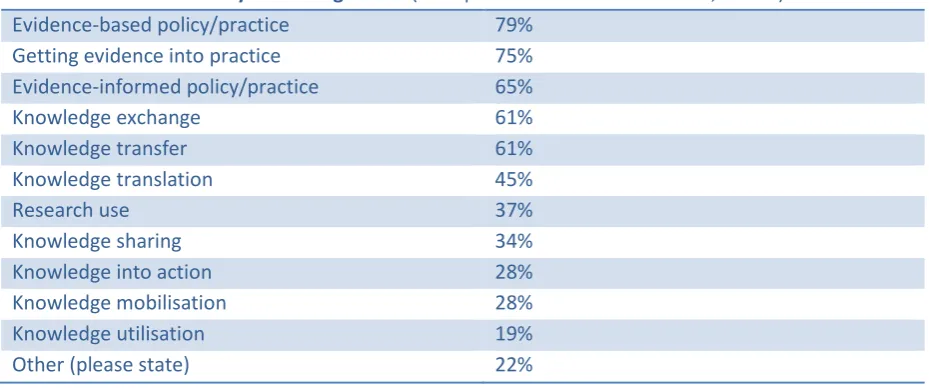
We provided respondents with a list of terms drawn from the key reviews and asked them to indicate which were commonly used in their agency. The majority listed were selected by at least a third of respondents (Table 1). The most commonly used terms were ‘evidence-based policy/practice’ (79% of respondents), ‘getting evidence into practice’ (75%), ‘evidence-informed policy/practice (65%), ‘knowledge exchange’ (61%) and ‘knowledge transfer’ (61%). Knowledge mobilisation, the embracing term that we were using for the study, was only in common use in just over a quarter of respondent agencies (28%). Respondents suggested a range of other terms, including some using the word ‘research’ (e.g. research translation, research into practice, research implementation, research utilisation, research uptake) or the word ‘knowledge’ (e.g. knowledge management, knowledge integration, knowledge interaction).
[Table 1 here]
Models and frameworks used by research agencies
We provided respondents with a list of around 25 of the most prominent models and
frameworks in the literature (Table 2) and asked them which of these their agency had drawn on in developing knowledge mobilisation activities. Around a third of respondents (31%) skipped this question. Although all but three of the 25 models and frameworks listed were identified as being used by at least 5% of respondents, only four of the models and
7
respondents (23%) also indicated that their agency used other models and frameworks that were not on the list.
[Table 2 here]
Several respondents suggested that their agencies were taking a flexible and eclectic approach to drawing on models and frameworks from the literature, one commenting that they used “a
bit of everything... but we do not formally attribute much” (research intermediary, cross-sector, UK).
Knowledge mobilisation activities
A major section of the survey (spread over three questions to improve visual presentation on screen and to reduce respondent fatigue) gave a list compiled from the literature and from interviews (Davies et al, 2015) of 37 types of knowledge mobilisation activities and asked respondents to indicate with what frequency each activity was carried out by their agency. In summarising the results here, we group the 37 activities into six broad categories based on the long-standing ‘push, pull, linkage and exchange’ framework (Lavis et al, 2006; Lomas, 2000):
Push activities: creating and disseminating research products (9 items).
Pull activities: encouraging local demand for research evidence; building local capacity for research use; facilitating local research implementation (7 items).
Linkage and exchange activities: knowledge brokerage; linking across different environments (8 items).
Other activities involving practitioners or policy makers (4 items).
Activities involving patients, service users or members of the public (5 items).
Advocatingand advancing knowledge mobilisation (4 items).
Push activities
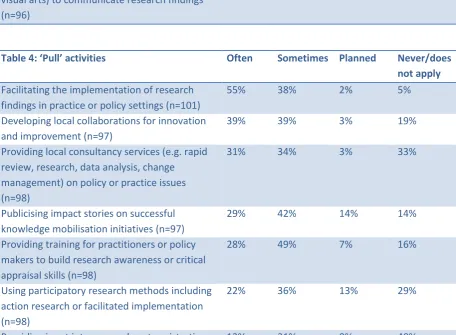
Producing publications, other written materials or tools for practitioners or policy makers was the most common ‘push’ activity for the agencies in our survey (Table 3): 78% did this often. Other activities that were done often were creating digested research summaries or guidelines (59%) or providing ‘rapid response’ research synthesis services (38%). Using social media to create debate around research was much less common: less than a third of agencies often did this. Similarly, few agencies regularly used social marketing approaches (25%) or the arts (5%) to communicate research findings.
[Table 3 here]
Pull activities
8
innovation and improvement was also common (39%). However, less than a quarter of agencies (22%) often used participatory research methods (e.g. action research). Over a quarter of agencies provided training for practitioners or policy makers in research awareness or critical appraisal skills but it was rarer to provide input into pre- or post-registration
training.
[Table 4 here]
‘Linkage and exchange’ activities
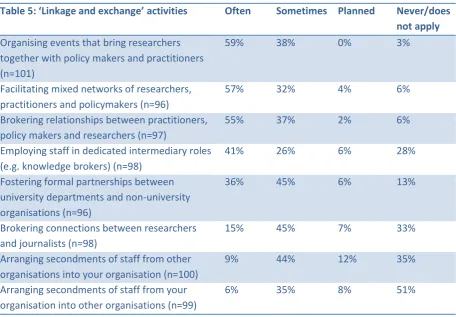
The activities that we characterised as ‘linkage and exchange’ included a range of ways to bring researchers, practitioners and policy makers together (Table 5). Organising events (59%), facilitating networks (57%) and brokering relationships (55%) between these groups were all common, but brokering connections with journalists was much rarer (only 15% reported that this often happened). Employing staff in dedicated intermediary roles like knowledge broker was common for less than half of the agencies (41%) while only about a third of agencies (36%) often fostered formal partnerships between university departments and non-university organisations. It was relatively uncommon to arrange secondments from or into the agency: less than ten per cent of agencies in the study often did this.
[Table 5 here]
Other activities involving practitioners or policy makers
It was most common for agencies to involve practitioners and policy makers in interpreting or communicating research findings, in problem definition and prioritising research and in collaborative research or co-production: around half of the agencies in the survey often did so (Table 6). Facilitating or funding peer networks or communities of practice among
practitioners and policy makers themselves was less common: only a quarter of agencies did so regularly.
[Table 6 here]
Activities involving patients, service users or members of the public
Agencies in our study tended to focus their knowledge mobilisation activities on practitioners or policy makers: knowledge mobilisation activities involving patients, service users or members of the public were much less common (Table 7). The only one of the five types of activities in this latter category that was done often by more than a third of respondents was producing publications, other written materials or tools aimed at lay audiences. Only a handful of agencies regularly organised public debates and two thirds of agencies never did.
[Table 7 here]
Advocating and advancing knowledge mobilisation
9
funded or conducted projects to advance the science of the knowledge mobilisation field. Only around one in nine agencies (11%) often provided post-project funding for knowledge mobilisation activities, although around a third (30%) sometimes did.
[Table 8 here]
Factors influencing the development of knowledge mobilisation approaches
We sought respondents’ views on those factors that were most important for agencies to consider when developing their knowledge mobilisation activities. Respondents were given a list of 13 factors (drawn from the literature) that agencies might want to consider in
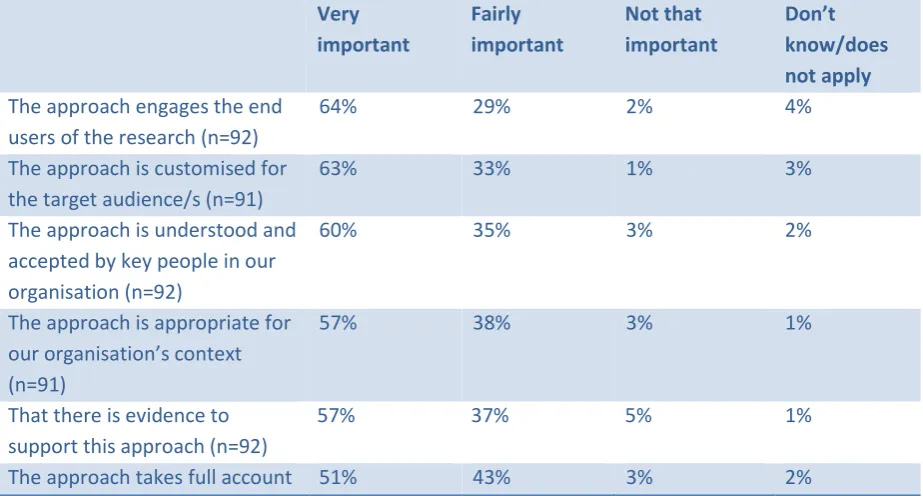
developing knowledge mobilisation approaches and were asked to indicate how important each factor was (Table 9). A large majority thought that it was very important to have evidence supporting the chosen knowledge mobilisation approach (57%), that the approach should be customised for the target audience (63%), that it should engage the end users of the research (64%), that it should be appropriate for the agency’s context (57%) and the users’ context (51%) and that it should be understood and accepted by key people in the research agency (60%). There was less interest in whether the approach made effective use of communication technologies (36%) or existing formal and informal networks (42%), in the feasibility of evaluating the approach in use (38%) and in whether the agency had used the approach previously with good results (30%). Only a handful of respondents (11%) rated as very important that similar agencies were using that approach.
[Table 9 here]
Several respondents added comments that suggested that they believed that agencies need a strongly pragmatic approach to knowledge mobilisation rather than waiting for the ‘ideal’ approach that met a range of criteria, for example: “I worry that by waiting to see if other organisations are also doing the work....or that everything is tailored and well accepted... it will be too late! Facilities should start looking for key signals that are appropriate for them so they move more quickly. Part of our problem with adoption of best practices is everyone waiting around for double-blind studies to support every component - we have to move faster”. (Research funder, producer and intermediary, health, US).
Key propositions about effective knowledge mobilisation
From the burgeoning literature on knowledge mobilisation we crafted a number of
propositions about effective practices and presented these for agreement or otherwise. Table 10 shows these propositions grouped into four pragmatic categories based on their underlying themes:
Activities andfocus for effective knowledge mobilisation (5 items);
Terminology in use (4 items);
Models and frameworks and their utility (3 items); and
The relationship between literature and practice in knowledge mobilisation (3 items).
10
users/patients is currently under-developed (87%); that knowledge mobilisation would be enhanced by a stronger focus on more supportive organisational environments (85%) and that a stronger emphasis is needed on the active promotion of knowledge products rather than on their production alone (85%). Respondents were also aligned in agreeing that organisations need to use a range of knowledge mobilisation models and frameworks rather than just one (82%) and that securing broad agreement on key terms is an important starting point in knowledge mobilisation activities (70%). None of the propositions elicited widespread disagreement: the highest levels of disagreement shown were from around a quarter of respondents in relation to the propositions about whether knowledge mobilisation and its activities are distinct from quality improvement and from improvement science, and in relation to the proposition that ‘the lack of commonly accepted knowledge mobilisation frameworks hinders the development of knowledge mobilisation strategies’.
[Table 10 here]
Evaluation by agencies of their knowledge mobilisation activities
One of the key principles of knowledge mobilisation as set out in the literature is the importance of evaluating the use of interventions in practice and feeding that learning back into the evidence base and into future practice. It follows that agencies may decide to evaluate their own knowledge mobilisation approaches.
We asked respondents to select one of three options that best described the agency’s current approach to evaluating their knowledge mobilisation activities. Although over half of respondents (61%) stated that ‘There is some evaluation of the organisation’s knowledge mobilisation activities’, around a quarter (24%) stated that ‘There is currently little or no formal evaluation of the organisation’s knowledge mobilisation activities’. Only 14% stated ‘We have a comprehensive approach to evaluating our knowledge mobilisation activities’.
Discussion
This research aimed to explore the relationship between contemporary ways of thinking about knowledge mobilisation, as set out in the literature, and the approaches being used by major research funders, producers and intermediaries with a reputation for creativity and innovation in knowledge mobilisation or for carrying out knowledge mobilisation at scale.
The survey builds on the earlier empirical work on the knowledge mobilisation activities of health research funding agencies in a range of countries (Smits and Denis, 2014; Tetroe et al, 2008). That earlier work showed marked variations between agencies, limited use of
11
surveyed and by including in our mapping three types of agencies (research funders, research producers and research intermediaries) and the fields of health care, social care and education in the UK and health care outside the UK. The survey was sent to 186 research agencies which had been purposively selected to include those responsible for innovative and large-scale knowledge mobilisation activities. The response rate of 57% (106/186) is higher than for many online surveys in health care and social care, and there was a good completion rate from those who embarked on the survey: all but one of the survey questions were completed by at least 85% of the 106 respondents. A degree of non-response bias cannot be ruled out, but our expectation would be that those with the most experience and the most interest in the topic would be more likely to reply.Key tenets of the new ways of thinking about knowledge mobilisation, as encapsulated in variants of the knowledge-to-action cycle, include an
emphasis on: using relational approaches that bring researchers and research users together, rather than relying on ‘push’ and ‘pull’ approaches alone; acknowledging the importance of context; being aware of the needs of research users; drawing on a range of types of
knowledge, not just research-based knowledge; and testing and evaluating interventions and feeding that knowledge back into future practice. From the survey data, relatively few research agencies are yet fully embodying these insights in their own approaches to
knowledge mobilisation. Major research funders, producers and intermediaries are carrying out a range of knowledge mobilisation activities but with a marked focus on producing knowledge products and on traditional ways of engaging policy-makers and practitioners. Despite the strong emphasis in the literature on ‘linkage and exchange’ approaches which are more relational and which seek to bring researchers and potential research users together (e.g. in networks or at events), such activities are a regular feature of knowledge mobilisation programmes for only around half of the agencies in the study. We found too that despite the growing emphasis in the literature on knowledge broker and other intermediary roles and the call from some authors (e.g. Long et al, 2013; Meagher and Lyall, 2013) for more empirical work on such roles, only 41% of agencies often employed them. More innovative approaches like using the arts or social media were even less common. Knowledge mobilisation activities with service users or patients were relatively rare.
The use of models and frameworks from the knowledge mobilisation literature in planning knowledge mobilisation approaches was patchy. The question asking respondents to indicate which of the models and frameworks they used attracted the largest non-response of all of the survey questions (31%), which may suggest that this issue was not seen as relevant or
interesting. Indeed several respondents to the survey commented in strong terms about their sense of the lack of connection between the academic literature on knowledge mobilisation, with its complex concepts and growing jargon, and the more pragmatic world of promoting research use in policy and practice. It is well documented (e.g. Redman et al, 2015) that the existing frameworks are often hard to use in practice. The apparent low levels of use of specific models and frameworks do not of course mean that agencies were not drawing on the theoretical literature in more diffuse ways: free text comments in the survey and the
interviews in another part of the study (Davies et al, 2015) suggest that at least some agencies drew on multiple frameworks, adapted existing frameworks or based their approaches
12
If many of those participating in the survey had relatively low expectations about what help the theoretical literature could provide to inform their knowledge mobilisation approaches, were they looking instead to empirical evidence in the literature, to their own experience, or to that of other agencies? The survey would suggest that the majority of agencies were not. A majority of respondents thought that the availability of evidence to support the choice of particular knowledge mobilisation activities was a very important factor in developing knowledge mobilisation activities; a majority also agreed that the lack of evidence in relation to many activities was hindering development, although almost a third did not feel strongly about this. However, prior use of an approach by that agency or by similar agencies were not highly rated by respondents as factors to weigh in developing knowledge mobilisation
activities and few research agencies were able to conduct robust evaluations of their own knowledge mobilisation activities. Thus there is the ironic situation that the field of
knowledge mobilisation practice seems somewhat detached from its own knowledge base, with knowledge mobilisation activities often being developed and carried out without reference to the existing theory or to practical experience and without the robust evaluations that could contribute to the knowledge base for the future.
The survey findings are concerning both in relation to the need for research to have an impact on health, social care and education and in terms of the potential for future development of the knowledge mobilisation field. Low levels of use of more long-term or interactive approaches that appear on the basis of current evidence to be more effective in encouraging research use (like ‘linkage and exchange’ or knowledge brokerage approaches) and the reliance on traditional research products and dissemination by many agencies suggest that some current knowledge mobilisation efforts may be less effective in improving services than they might be.
Compounding the challenges, the low levels of formal and informal evaluation by research agencies perpetuate the vicious circle of a limited evidence base on which agencies can draw. An earlier survey of 265 directors of applied health or economic/social research organisations in Canada conducted in 2001 (Lavis et al, 2003) found that only around a tenth of the
organisations did any kind of evaluation of their knowledge mobilisation work. Some thirteen years later our study across a range of English-speaking countries suggests a more optimistic picture in that 61% of respondents said that some form of evaluation was carried out, but with only 14% of respondent agencies having a comprehensive programme of evaluation and around a quarter of agencies with little or no evaluation. It is clear that substantial challenges remain.
Although a pragmatic approach to KM practices may be appropriate at this stage of
13
Less formally, the current lack of opportunities to learn from and share learning with other agencies risks duplication and ‘reinvention of the wheel’ in knowledge mobilisation. For example, the lower priority given by respondents to making effective use of communication technologies and of networks may be indicative of a perceived lack of skills and experience in these areas. Given that some agencies in the field have considerably more experience of knowledge mobilisation than others, support and mechanisms to enable agencies to share their learning and examples of innovative practice more widely with other agencies would be fruitful.
In making these comments we do not intend to underplay the impact on what agencies were able to do of a range of factors that add to the challenges of carrying out knowledge
mobilisation activities in the contemporary context. The survey suggests that many agencies were struggling to create a supportive environment for knowledge mobilisation: funding or conducting projects to advance the science of knowledge mobilisation and providing post-project funding for knowledge mobilisation activities were relatively rare. We are aware that agencies operate under a variety of, often competing, organisational objectives and remits and are subject to the requirements of a range of stakeholders (Cooper, 2014; Davies et al, 2015; Tetroe et al, 2008). Earlier research has also emphasised the impact of capacity issues: organisational and individual incentives and adequate resources are needed for knowledge mobilisation. Although our survey did not ask specifically about resources allocated to knowledge mobilisation work, we know from the free text comments, from our own work (Davies et al, 2015) and from the work of others (e.g. Cooper, 2014) that those working in knowledge mobilisation roles in agencies often struggle to secure resources or due
recognition for these activities and that they often find themselves doing this work ‘off the side of the desk’. Similarly, lack of capacity in potential research user organisations (e.g. government departments, schools and hospitals) can hinder the development of ongoing relationships, jeopardise the implementation of projects around research use or stifle
innovation (see for example Davies et al, 2015 or Scarborough et al, 2014). Other aspects of the organisational environment can also serve to act as disincentives to more innovative approaches around research use and impact. The problem for UK academic researchers in some disciplines that there are few incentives to work alongside practitioners or to publish in practitioner journals is well recognised (e.g. Marshall, 2014; Orr and Bennett, 2012).
Although there is increasing emphasis on impact in the Research Excellence Framework this may not in practice do much to alter incentives for engagement if the main emphasis is on more direct, linear and traceable impacts (Greenhalgh and Fahy, 2015).
Against this background it is possible that many of the survey responses reflect a strongly pragmatic or even resigned approach on the part of agencies, so that, for example, it was not a lack of interest in learning from that agency’s knowledge mobilisation activities or in
14
Implications for researchers in the field of knowledge mobilisation A key message from this survey for researchers who research the field of knowledge mobilisation is that many of those working in knowledge mobilisation practice perceive the theoretical literature as distant from practice and too concerned with issues of terminology and theory. Although some knowledge mobilisation researchers are already actively engaging with research funding agencies and research intermediary agencies, fostering better
connections and more co-production between all knowledge mobilisation researchers and the research organisations that are the potential users of their research may help to reduce this perceived gulf and to ensure that knowledge mobilisation theory and practice are both informed by and inform each other.
Implications for research funders and research commissioners In funding and commissioning research, funders and commissioners need not only to
encourage and provide resources for knowledge mobilisation activities alongside the research projects they fund and commission but also to promote and fund robust evaluations of those knowledge mobilisation activities. Research funders and research commissioners could also contribute resources to develop mechanisms to encourage sharing and learning among
agencies. In this way those agencies that have developed innovative approaches to knowledge mobilisation or developed and successfully applied evaluation frameworks to their
knowledge mobilisation activities could share that learning with other agencies.
Implications for research agencies
Those working in knowledge mobilisation roles in research agencies could reflect on the challenge of ‘practising what we preach’ and the risk of defaulting back to reliance on research products and take steps through advocacy, collaboration with other research
agencies facing similar challenges and seeking appropriate resources to address current gaps as highlighted by this survey. Stronger cross-agency fora could enable learning from those agencies that are already promoting their products more effectively, embracing more innovative approaches, communication technologies and networks and evaluating their knowledge mobilisation activities and could help to address variations in skills and experience in these areas.
15 Disclaimer
This project was funded by the National Institute for Health Research Health Services and Delivery Research programme (project number 11/2004/10). The views and opinions expressed therein are those of the authors and do not necessarily reflect those of the Health Services and Delivery Research programme, NIHR, NHS or the Department of Health.
Notes
1. We use the term ‘knowledge mobilisation’ as a short-hand for the range of active approaches used to encourage the creation, sharing and use of research-informed knowledge.
2. CLAHRC evaluations funded by the NIHR Health Services and Delivery Research programme:
http://www.nets.nihr.ac.uk/projects/browse/?collection=netscc&browsetype=hs_dr_them e&browse_view=CLAHRCs
3. https://www.surveymonkey.com/
References
Barnes, R O, Holmes, B J, Lindstrom, R, Trytten, C, Wale, M C J, 2015, Evidence-informed healthcare through integration of health research, Healthcare Management Forum, 28, 75-78
Baumbusch, J, Reimer Kirkham, S, Basu Khan, K, McDonald, H, Semeniuk, P, Tan, E, Anderson, J M, 2008, Pursuing common agendas: a collaborative model for knowledge translation between research and practice in clinical settings, Research in Nursing & Health, 31, 131-140
Best, A, Hiatt, R A, Norman, C D, 2008, Knowledge integration: conceptualizing
communications in cancer control systems, Patient Education and Counseling, 71, 319-327
Best, A, Holmes, B, 2010, Systems thinking, knowledge and action: towards better models and methods, Evidence & Policy, 6, 145-159
Brown, C, 2012, The 'policy preferences model': a new perspective on how researchers can facilitate the take-up of evidence by educational policy makers, Evidence & Policy, 8, 455-472
Chew, S, Armstrong, N, Martin, G, 2013, Institutionalising knowledge brokering as a sustainable knowledge translation solution in healthcare: how can it work in practice? Evidence & Policy, 9, 335-351
16
Cooper, A, 2014, Knowledge mobilisation in education across Canada: A cross case analysis of 44 research brokering organisations, Evidence & Policy, 10, 29-59.Crilly, T, Jashapara, A, Ferlie, E, 2010, Research Utilisation and Knowledge Mobilisation: A Scoping Review of the Literature: Report for the National Institute for Health Research Service Delivery and
Organisation Programme, HMSO: London
Damschroder, L J, Aron, D C, Keith, R E, Kirsh, S R, Alexander, J A, Lowery, J C, 2009, Fostering implementation of health services research findings into practice: a consolidated framework for advancing implementation science, Implementation Science, 4: 50
Davies, H T O, Nutley, S, Walter, I, 2008, Why 'knowledge transfer' is misconceived for applied social research, Journal of Health Services Research and Policy, 13, 188-190
Davies, H T O, Powell, A E, Nutley, S M, 2015, Mobilising knowledge to improve UK health care: learning from other countries and other sectors - a multimethod mapping study, Health Services and Delivery Research, 3
Davies, H, Powell, A, Nutley, S, 2016, Mobilizing knowledge in health care, in E.Ferlie, K.Montgomery and A. Reff Pedersen (eds), Oxford Handbook of Health Care Management, Oxford: Oxford University Press (in press)
Estabrooks, C A, Derksen, L, Winther, C, Lavis, J N, Scott, S D, Wallin, L,
Profetto-McGrath, J, 2008, The intellectual structure and substance of the knowledge utilization field: A longitudinal author co-citation analysis, 1945 to 2004, Implementation Science, 3
Estabrooks, C A, Thompson, D S, Lovely, J E, Hofmeyer, A, 2006, A guide to knowledge translation theory, The Journal of Continuing Education in the Health Professions, 26, 25-36
Ferlie, E, Crilly, T, Jashapara, A, Peckham, A, 2012, Knowledge mobilisation in healthcare: A critical review of health sector and generic management literature, Social Science & Medicine, 74, 1297-1304
Ferlie, E, Fitzgerald, L, Wood, M, Hawkins, C, 2005, The nonspread of innovations: the mediating role of professionals, Academy of Management Journal, 48, 117-134
Field, B, Booth, A, Ilott, I, Gerrish, K, 2014, Using the Knowledge to Action Framework in practice: a citation analysis and systematic review, Implementation Science, 9
Gabbay, J, le May, A, 2004, Evidence-based guidelines or collectively constructed
"mindlines"? Ethnographic study of knowledge management in primary care, British Medical Journal, 329, 1013-1017
17
Greenhalgh, T, Robert, G, Macfarlane, F, Bate, P, Kyriakidou, O, 2004, Diffusion of
innovations in service organizations: systematic review and recommendations, The Milbank Quarterly, 82, 581-629
Greenhalgh, T, Wieringa, S, 2011, Is it time to drop the 'knowledge translation' metaphor? A critical literature review, Journal of the Royal Society of Medicine, 104, 501-509
Harvey, G, 2013, The many meanings of evidence: implications for the translational agenda in healthcare, International Journal of Health Policy and Management, 1, 187-188
Hunter, D J, 2015, Role of politics in understanding complex, messy health systems: an essay by David J Hunter, British Medical Journal, 350
Kilburn, R, Frearson, M (2013) The time is ripe for evidence (blog), http://www.alliance4usefulevidence.org/the-time-is-ripe-for-evidence/
Kitson, A, Harvey, G, McCormack, B, 1998, Enabling the implementation of evidence based practice:a conceptual framework, Quality in Health Care, 7, 149-158
Langley, G J, Nolan, K M, Nolan, T W, Norman, C L, Provost, L P, 1996, The Improvement Guide, San Francisco: Jossey-Bass
Lavis, J N, Lomas, J, Hamid, M, Sewankambo, N K, 2006, Assessing country-level efforts to link research to action, Bulletin of the World Health Organization, 84, 620-628
Lavis, J N, Robertson, D, Woodside, J M, McLeod, C B, Abelson, J, The Knowledge Transfer Study Group, 2003, How can research organizations more effectively transfer research knowledge to decision makers? The Milbank Quarterly, 81, 221-248
Levin, B, 2004, Making research matter more, Education Policy Analysis Archives, 12
Logan, J, Graham, I D, 1998, Towards a comprehensive model of health care research use, Science Communication, 20, 227-246
Lomas, J, 2000, Using linkage and exchange to move research into policy at a Canadian foundation, Health Affairs, 19, 236-240
Long, J C, Cunningham, F C, Braithwaite, J, 2013, Bridges, brokers and boundary spanners in collaborative networks: a systematic review, BMC Health Services Research, 13, 158
Marshall, M, 2014, Bridging the ivory towers and the swampy lowlands; increasing the impact of health services research on quality improvement, International Journal for Quality in Health Care, 26, 1-5
18
May, C, Finch, T, 2009, Implementing, embedding and integrating practices: an outline of normalization process theory, Sociology, 43, 535-554
Meagher, L, Lyall, C, 2013, The invisible made visible: using impact evaluations to
illuminate and inform the role of knowledge intermediaries, Evidence & Policy, 9, 409-418
Moat, K A, Lavis, J N, Abelson, J, 2013, How contexts and issues influence the use of policy-relevant research syntheses: A critical interpretive synthesis, Milbank Quarterly, 91, 604-648
Nicolini, D, Powell, J, Conville, P, Martinez-Solano, L, 2008, Managing knowledge in the healthcare sector: a review, International Journal of Management Reviews, 10, 245-263
Nilsen, P, 2015, Making sense of implementation theories, models and frameworks, Implementation Science, 10, 53
Nutley, S M, Walter, I, Davies, H T O, 2007, Using evidence: how research can inform public services, Bristol: Policy Press
Orr, K, Bennett, M, 2012, Public administration scholarship and the politics of co-producing academic-practitioner research, Public Administration Review, 72, 487-496
Pentland, D, Forsyth, K, Maciver, D, Walsh, M, Murray, R, Irvine, L, Sikora, S, 2011, Key characteristics of knowledge transfer and exchange in healthcare: integrative literature review, Journal of Advanced Nursing, 67, 1408-1425
Pitchforth, E, Nolte, E, Miani, C, Winpenny, E, 2013, Options for effective mechanisms to support evidence-informed policymaking in RMNCH in Asia and the Pacific, Cambridge: RAND Europe
Redman, S, Turner, T, Davies, H, Williamson, A, Haynes, A, Brennan, S, Milat, A, O'Connor, D, Blyth, F, Jorm, L, Green, S, 2015, The SPIRIT Action Framework: A structured approach to selecting and testing strategies to increase the use of research in policy, Social Science & Medicine, 136-137, 147-155
Smits, P, Denis, J-L, 2014, How research funding agencies support science integration into policy and practice: An international overview, Implementation Science, 9
Stetler, C B, Mittman, B S, Francis, J, 2008, Overview of the VA Quality Enhancement Research Initiative (QUERI) and QUERI theme articles: QUERI series, Implementation Science, 3,8
19
Walter, I, Nutley, S M, Percy-Smith, J, McNeish, D, Frost, S (2004) Improving the use of research in social care. Knowledge Review 7, London: Social Care Institute for Excellence
Ward, V, House, A, Hamer, S, 2009, Developing a framework for transferring knowledge into action: a thematic analysis of the literature, Journal of Health Services Research and Policy, 14, 156-164
20
Table 1: Terms commonly used in agencies (multiple selections were allowed; n=103)
Evidence-based policy/practice 79%
Getting evidence into practice 75%
Evidence-informed policy/practice 65%
Knowledge exchange 61%
Knowledge transfer 61%
Knowledge translation 45%
Research use 37%
Knowledge sharing 34%
Knowledge into action 28%
Knowledge mobilisation 28%
Knowledge utilisation 19%
Other (please state) 22%
Table 2: Models and frameworks identified as being used in agencies in developing their knowledge mobilisation approaches (multiple selections were allowed; n=73)
Plan-Do-Study-Act (PDSA) cycles 44%
The Knowledge to Action (KTA) Cycle (Graham et al, 2006) 38%
The Greenhalgh model for considering the diffusion of innovations in health service organisations (Greenhalgh et al, 2004)
36%
Push, pull, linkage and exchange (Lavis et al, 2006; Lomas, 2000) 33%
The IHI Model for Improvement (Langley et al, 1996) 32%
Lavis et al’s framework for knowledge transfer (five questions about the research, four potential audiences) (Lavis et al, 2003)
27%
The PARIHS Framework (Promoting Action on Research Implementation in Health Services) (Kitson et al, 1998)
25%
The Levin model of research knowledge mobilisation (Levin, 2004) 19%
Normalization Process Theory (May and Finch, 2009) 18%
Mindlines (Gabbay and le May, 2004) 16%
School Improvement Model (Education Endowment Foundation) 14%
The Knowledge Integration model (Best et al, 2008) 12%
Ottawa Model of Research Use (OMRU) (Logan and Graham, 1998) 12%
The Knowledge Exchange Framework (Contandriopoulos et al, 2010) 11%
The Consolidated Framework for Implementation Research (CFIR) (Damschroder et al, 2009)
10%
The three generations framework (Best et al, 2008) 10%
Walter et al’s three models of research use (Walter et al, 2004) 10%
Ward et al’s conceptual framework of the knowledge transfer process (Ward et al, 2009)
10%
[image:20.595.65.532.334.724.2]21
Table 3: ‘Push’ activities Often Sometimes Planned Never/does
not apply Producing publications, other written materials
or tools aimed at practitioners or policy makers (n= 99)
78% 19% 1% 2%
Creating digested research summaries and/or guidelines (e.g. mythbusters, fact sheets) (n=99)
59% 28% 4% 9%
Providing ‘rapid response’ research synthesis services to policy makers or practitioners (n=98)
38% 42% 9% 11%
Creating debate using social media (n=100) 29% 38% 15% 18%
Using social marketing approaches to
communicate research findings, change ideas or promote evidence-based change (n=95)
25% 35% 11% 29%
Providing live and archived webinars for practitioners and policy makers (n=97)
20% 26% 23% 32%
Providing research-based commentary on issues in the news (n=97)
12% 42% 12% 33%
Producing videos or animations to communicate research findings (n=97)
15% 36% 22% 27%
Using the arts (e.g. drama, music, narrative, visual arts) to communicate research findings (n=96)
[image:21.595.71.528.421.756.2]5% 24% 7% 64%
Table 4: ‘Pull’ activities Often Sometimes Planned Never/does
not apply Facilitating the implementation of research
findings in practice or policy settings (n=101)
55% 38% 2% 5%
Developing local collaborations for innovation and improvement (n=97)
39% 39% 3% 19%
Providing local consultancy services (e.g. rapid review, research, data analysis, change management) on policy or practice issues (n=98)
31% 34% 3% 33%
Publicising impact stories on successful knowledge mobilisation initiatives (n=97)
29% 42% 14% 14%
Providing training for practitioners or policy makers to build research awareness or critical appraisal skills (n=98)
28% 49% 7% 16%
Using participatory research methods including action research or facilitated implementation (n=98)
22% 36% 13% 29%
22 training for practitioners (n=96)
Table 5: ‘Linkage and exchange’ activities Often Sometimes Planned Never/does
not apply Organising events that bring researchers
together with policy makers and practitioners (n=101)
59% 38% 0% 3%
Facilitating mixed networks of researchers, practitioners and policymakers (n=96)
57% 32% 4% 6%
Brokering relationships between practitioners, policy makers and researchers (n=97)
55% 37% 2% 6%
Employing staff in dedicated intermediary roles (e.g. knowledge brokers) (n=98)
41% 26% 6% 28%
Fostering formal partnerships between university departments and non-university organisations (n=96)
36% 45% 6% 13%
Brokering connections between researchers and journalists (n=98)
15% 45% 7% 33%
Arranging secondments of staff from other organisations into your organisation (n=100)
9% 44% 12% 35%
Arranging secondments of staff from your organisation into other organisations (n=99)
[image:22.595.69.531.452.766.2]6% 35% 8% 51%
Table 6: Other activities involving practitioners or policy makers
Often Sometimes Planned Never/does
not apply Involving practitioners or policy makers in
interpreting and communicating research findings (n=99)
52% 39% 5% 4%
Involving practitioners or policy makers in problem-definition and in prioritising research areas (n=99)
49% 46% 1% 3%
Involving practitioners or policy makers in collaborative research or co-production (n=99)
45% 39% 5% 10%
Facilitating or funding peer networks or communities of practice among practitioners and policy makers (n=96)
27% 41% 8% 24%
Table 7: Activities involving patients, service users or members of the public
Often Sometimes Planned Never/does
not apply Producing publications, other written materials
or tools aimed at lay audiences (e.g. online resources, articles in consumer magazines or
23 newspapers etc) (n=100)
Involving patients or service users in problem-definition and in prioritising research areas (n=98)
24% 55% 4% 16%
Involving patients or service users in interpreting and communicating research findings (n=98)
22% 43% 7% 28%
Involving patients or service users in
collaborative research or co-production (n=96)
20% 45% 8% 27%
Hosting Cafe Scientifique or similar public debates (n=97)
[image:23.595.65.535.95.455.2]9% 20% 7% 64%
Table 8: Advocating and advancing knowledge mobilisation
Often Sometimes Planned Never/does
not apply Advocating for knowledge mobilisation by
actively making the case for the value of research-based knowledge in policy and practice (n=95)
52% 42% 2% 4%
Including non-academic members on research project advisory boards. (n=96)
44% 33% 3% 20%
Funding or conducting projects to advance the science of knowledge mobilisation. (n=96)
25% 39% 9% 27%
Providing post-project funding for knowledge mobilisation activities (n=97)
11% 30% 3% 56%
Table 9: Factors that agencies might want to consider in developing knowledge mobilisation approaches Very important Fairly important Not that important Don’t know/does not apply The approach engages the end
users of the research (n=92)
64% 29% 2% 4%
The approach is customised for the target audience/s (n=91)
63% 33% 1% 3%
The approach is understood and accepted by key people in our organisation (n=92)
60% 35% 3% 2%
The approach is appropriate for our organisation’s context (n=91)
57% 38% 3% 1%
That there is evidence to support this approach (n=92)
57% 37% 5% 1%
[image:23.595.68.530.516.764.2]24 of the users’ organisational
context/s (n=92)
The approach is tailored to the type of knowledge to be mobilised (n=92)
47% 48% 2% 3%
The approach makes good use of the perspectives of
patients/service users (n=92)
45% 46% 5% 4%
The approach taps into existing formal and informal networks (n=92)
42% 42% 11% 4%
It is feasible to evaluate the approach in use (n=92)
38% 55% 5% 1%
The approach makes effective use of communication
technologies (n=92)
36% 53% 5% 5%
We have used this approach previously with good results (n=92)
30% 44% 22% 4%
Similar organisations are using this approach (n=92)
[image:24.595.65.539.498.762.2]11% 50% 37% 2%
Table 10: Propositions about effective knowledge mobilisation
Activities and focus for effective knowledge mobilisation
Strongly agree/agree
Neither agree nor disagree
Strongly
disagree/disagree
The role of service
users/patients in knowledge mobilisation is currently under-developed (n=92)
87% 9% 4%
For effective and sustainable knowledge mobilisation we need to focus more on creating supportive organisational environments (n= 91)
85% 12% 3%
Effective knowledge mobilisation needs a stronger emphasis on the active promotion of
25 knowledge products rather
than on their production alone (n=90)
Knowledge mobilisation activities need to be carefully targeted at particular bodies of knowledge (n=91)
59% 32% 9%
There is currently too much emphasis on knowledge mobilisation at the practitioner level and not enough at the organisation or multi-organisation level (n=92)
50% 36% 14%
Terminology in use
Strongly agree/agree
Neither agree nor disagree
Strongly
disagree/disagree
Securing broad agreement on key terms is an important starting point in knowledge mobilisation activities (n=92)
70% 21% 9%
A plethora of terms around knowledge mobilisation is unavoidable (n=92)
59% 26% 15%
Knowledge mobilisation activities are distinct from quality improvement work (n=90)
53% 20% 27%
Knowledge mobilisation is distinct from
implementation science (n=92)
51% 25% 24%
Models and frameworks and their utility
Strongly agree/agree
Neither agree nor disagree
Strongly
disagree/disagree
Organisations need to use a range of knowledge
26 mobilisation models and
frameworks rather than just one (n=91)
Many of the existing knowledge mobilisation frameworks are hard to operationalise (n=89)
47% 48% 4%
The lack of commonly accepted knowledge mobilisation frameworks hinders the development of knowledge mobilisation strategies (n=90)
37% 37% 27%
The relationship between literature and practice in knowledge mobilisation
Strongly agree/agree
Neither agree nor disagree
Strongly
disagree/disagree
The theory on knowledge mobilisation as set out in the literature is more advanced than the practice in organisations (n=91)
69% 21% 10%
The lack of evidence on the impact of knowledge mobilisation approaches is hindering development (n=90)
59% 31% 10%
Organisations are still trying to make ‘linkage and exchange’ work but the literature has moved on to newer approaches (n=90)