Phosphorescent cationic iridium(
III
) complexes
dynamically bound to cyclodextrin vesicles:
applications in live cell imaging
†
Frauke Schibilla,aAnna Holthenrich,bBoyi Song,cAnna L´ıvia Linard Matos,b David Grill,bDiego Rota Martir,cVolker Gerke,bEli Zysman-Colman *c
and Bart Jan Ravoo *a
We report cationic Ir(III) complexes functionalized with adamantyl groups designed to bind to b
-cyclodextrin vesicles (CDV) with high affinity (Ka¼1106M1). The emission of the complexes is tuned by changing the nature of the cyclometalating ligands. The host–guest adduct of CDV and Ir(III)
complexes shows increased and significantly blue-shifted emission due to the lower mobility of the Ir(III
)-complexes residing in the less polar environment of the vesicle surface. Ir(III)-decorated CDV are
efficiently taken up by cells and can be used in live cell imaging. The CDV act as carriers to transport the phosphorescent complexes into cells where they selectively stain mitochondria.
Introduction
Cationic Ir(III) complexes containing two bidentate
cyclo-metalating ligands (C^N,e.g., 2-phenylpyridinato, ppy) and one bidentate diimine ligand (N^N, e.g., 2-20-bipyridine, bpy) are a family of phosphorescent materials featuring microsecond emission lifetimes (sPL), high photoluminescence quantum yields (FPL), wide color tunability as a function of ligand design, and high photo- and chemostability.1,2Cationic Ir(III) complexes
are widely used in organic light-emitting diodes (OLEDs),3–5
chemosensing systems6–8 and bioimaging.9–11 Bioimaging, in
particular the visualization of specic processes and structures in live biological specimens such as cells, has greatly benetted from the introduction ofuorescence-based imaging methods together with tools to deliver such uorescence probes into cells. Luminophores used in live cell imaging should exhibit high chemoselectively, biocompatibility and optical bright-ness.12 Cationic Ir(III)-complexes are attractive candidates for
bioimaging, showing several advantages over organic uo-rophores, due to their outstanding photophysical properties, including highFPL, photobleaching resistance due to both the long sPL and large Stokes shis.13–16 Ir(III)-alkyne probes, for example, were utilized for real-time imaging of dynamic processes in live cells by photoluminescence lifetime imaging.17
The cytotoxicity and solubility of probes are two major concerns for biological applications. One strategy to enhance the potential of cyclometalated Ir(III) complexes as imaging (re)agents and
cellular probes is to couple a poly(ethylene glycol) (PEG) chain resulting in good solubility and low cytotoxicity.18–20 For the
purpose of photodynamic therapy a high cytotoxic activity can be useful, but for cellular probes minimal cytotoxicity is desired.21
Cyclodextrins (CD) are well known to form host–guest inclusion complexes with hydrophobic guest molecules,22–24
which are for example used for cell surface functionalisation25
or as nanocarriers.26Amphiphilic CD derivatives self-assemble
in aqueous solution to form CD vesicles (CDV).27 CDV are
biocompatible and have, for example, been used as a model for biological cell membranes.28The cavity of the CD in the CDV
remains available for host–guest interactions. Thus, the surface of the CDV can be decorated by various functionalities via
molecular anchors such as adamantane. These interactions have been exploited towards a“self-assembled glycocalyx”29,30by
decorating CDV with carbohydrates. Moreover, decoration of CDV with stimulus-responsive polymer shells resulted in nanocontainers that could be applied for triggered payload delivery into cells.31However, CDV without polymer shells have
never been used to deliver compounds into cells and CDV have never been functionalized with Ir(III) complexes.
There are but a small number of studies that combine phosphorescent complexes with CDs.32Yamet al.immobilized
aOrganic Chemistry Institute and Center for So Nanoscience, Westf¨alische Wilhelms-Universit¨at M¨unster, Correnstrasse 40, 48149 M¨unster, Germany. E-mail: [email protected]
bInstitute of Medical Biochemistry, Center for Molecular Biology of Inammation, Cells-in-Motion Cluster of Excellence (EXC1003-CiM), Westf¨alische Wilhelms-Universit¨at M¨unster, Von-Esmarch-Strasse 56, 48149 M¨unster, Germany
cOrganic Semiconductor Centre, EaStCHEM School of Chemistry, University of St Andrews, St. Andrews, Fife KY16 9ST, UK. E-mail: eli.zysman-colman@st-andrews. ac.uk
†Electronic supplementary information (ESI) available: Experimental procedures, absorption and emission spectra, isothermal titration calorimetry, cell culture experiments and synthesis. See DOI: 10.1039/c8sc02875c. The research data supporting this publication can be accessed at https://doi.org/10.17630/1254db92-71d2-45a6-ac87-247894110d66.
Cite this:DOI: 10.1039/c8sc02875c
All publication charges for this article have been paid for by the Royal Society of Chemistry
Received 29th June 2018 Accepted 6th August 2018
DOI: 10.1039/c8sc02875c
rsc.li/chemical-science
Science
EDGE ARTICLE
Open Access Article. Published on 09 August 2018. Downloaded on 8/31/2018 4:45:53 PM.
This article is licensed under a
Creative Commons Attribution 3.0 Unported Licence.
View Article Online
adamantane-functionalized Ru(II) and Re(I) complexes onb-CD
capped gold nanoparticles for the detection of biomolecules.33
Furthermore, a three component system consisting of a CD substituted Ir-complex as the photosensitizer, a viologen-based electron relay and CD-modied platinum nanoparticles as the catalyst was developed for the generation of hydrogen.34,35
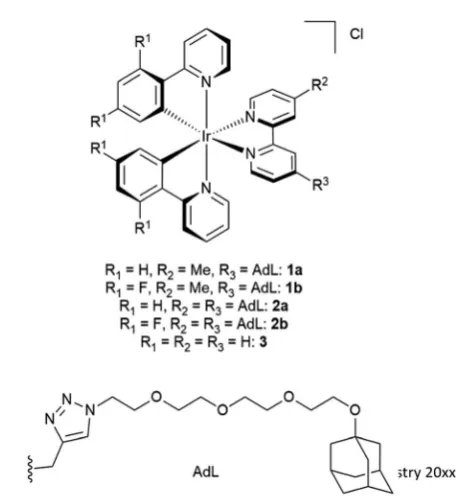
In this study,ve water-soluble cationic Ir-complexes, four of which are functionalized with adamantyl units that can form host–guest assemblies with CDV, were generated and analyzed. The emission properties of the Ir-luminophores were tuned by using either 2-phenylpyridine (ppyH) or 2-(2,4-diuorophenyl) pyridine (dFppyH) as the cyclometalating ligands. The ancillary ligand constituted of a 2,20-bipyridine (bpy) functionalized with either one or two tetraethylene glycol chains bearing a terminal adamantyl group (Fig. 1). The tetraethylene glycol linker was used to improve the water solubility, with the added benet of lowering cytotoxicity. The Ir-decorated CDV were applied as luminescent probes in live cell imaging experiments allowing the visualization of intracellular compartments.
Results and discussion
The investigated adamantane-functionalized Ir(III)-complexes
1a, 1b (one adamantane substituent), 2a and 2b (two ada-mantane substituents) and reference compound [Ir(ppy)2(bpy)] Cl,3, are shown in Fig. 2. The synthesis is described in the ESI.†
Photophysical characterization
The photophysical properties of the complexes were investi-gated by steady-state and time-resolved emission spectroscopy in both acetonitrile (MeCN) and phosphate buffer solutions,
(PB; pH¼7.4). The photophysical properties of1aand1bare summarized in Table 1. All complexes mainly absorb in the UV region up toca.480 nm in both MeCN and PB, with the uo-rinated complexes (1band2b) showing a signicant shoulder at around 300 nm (ESI, Fig. S1†). The high energy absorption bands above 300 nm can be assigned to spin-allowed p–p* (ligand-centered, LC) transitions while bands between 300 nm and 425 nm are associated with mixed of spin-allowed metal-to-ligand charge-transfer (1MLCT) and ligand-to-ligand
charge-Fig. 1 Schematic representation of the formation of luminescent vesicles by host–guest interaction of CDV and Ir(III) complexes. The green and
blue color represent the blue shift of the emission upon the immobilization of the Ir(III) complexes on the CDV.
Fig. 2 Molecular structure of Ir(III) complexes1a,1b,2a,2band3.
Open Access Article. Published on 09 August 2018. Downloaded on 8/31/2018 4:45:53 PM.
This article is licensed under a
[image:2.595.53.548.54.291.2] [image:2.595.307.545.462.712.2]transfer (1LLCT) transitions.36 Complexes 1a, 2a, and 3 each
show broad and unstructured orange emission in PB with an emission maximum at 565 nm. The presence of the triazole-tetraethylene glycol chains on the ancillary ligand has little effect on the optoelectronics of the complex. Complexes1band 2b show signicantly more intense, broad and unstructured green emission at 525 nm in PB (ESI, Fig. S1†), which is the result of the inclusion of the electron-withdrawing uorine atoms on the cyclometalating ligands.37
Photoluminescence lifetimes, sPL, and photoluminescence quantum yields,FPL, of1aand1bwere measured in degassed MeCN, degassed PB, and PB in air. In MeCN,1aexhibited asPL of 475 ns with aFPL of 35%. For 1bthe sPL is considerable longer at 1310 ns, along with a correspondingly higherFPLof 63%. In general, both Ir-complexes 1a and 1b show a blue-shied emission and a higher FPL compared to literature complexes [Ir(ppy)(bpy)]PF6 (ref. 40) or [Ir(dFppy)(bpy)]PF6,41 respectively. The emission was signicantly quenched in aqueous solution, which was previously observed for other Ir-complexes.42–44In PB the photophysical properties of1adid not
show any sensitivity to O2(73 ns, 4%, with and without air). On the other hand, 1b did show oxygen sensitivity, with considerable quenching of both thesPLand theFPLcompared to degassed conditions (791 ns, 34% to 459 ns, 15%).
Interaction with cyclodextrin vesicles
The interaction of1a and 1b with b-CD was investigated by isothermal titration calorimetry (ITC). Both show a 1 : 1 stoi-chiometry and association constants of around 104M1, which are comparable to those reported for similar adamantane/b-CD interactions.45 The association constant of the uorinated
complex1b(Ka¼5.8103M1) is a little lower compared to the non-uorinated analog1a(Ka¼1.9104M1, ESI, Fig. S7†). The addition of unmodiedb-CD to1aor1bdoes not inuence either the absorption or luminescence proles of the Ir-complex (ESI, Fig. S2†).
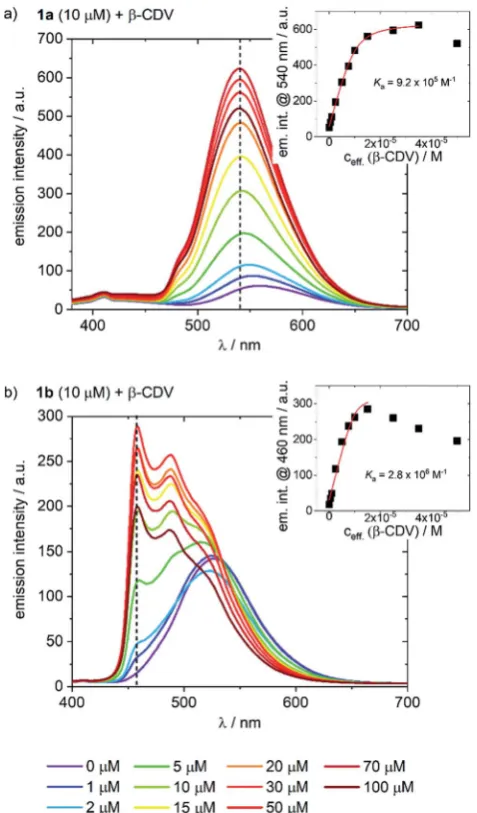
The behavior of the Ir-complexes with CDV was subsequently investigated. The preparation of the CDV is described in the ESI.†Titration of non-emissive CDV (1–100mM) into a constant concentration of Ir-complex (10mM) resulted in changes in both the emission intensity and prole (Fig. 3). Zeta-potential
measurements of the vesicles conrmed the expected host– guest interaction. Initially, CDV showed a slightly negative zeta-potential ofca.6.5 mV, which became positive (up to 11 mV) upon association with the Ir-complexes (ESI, Table S1†). With high CDV to Ir-complex ratios (5 : 1), the potential is expect-edly lower, due to lower coverage of the vesicles by the Ir-complex. This positive surface potential conrms an adhesion of the Ir-complexes to the surface of the vesicles.
[image:3.595.309.548.48.455.2]The addition of CDV to a PB solution of1aled to an increase in the emission intensity concomitant with a hypsochromic shiand a small shoulder appearing at 480 nm (Fig. 3a). At high CDV concentrations (>70mM) the emission intensity decreased. This is likely the result of aggregation-induced quenching, which was conrmed by DLS measurements and by scattering
Table 1 Photophysical data of1aand1bin degassed (deg.) MeCN, deg. PB and PB (air)
Entry lPLa[nm] FPL[%] sPLd[ns]
1a, deg. MeCN 557 34.6b 475
1a, deg. PB 565 3.8b 74
1a, PB (air) 565 3.5b 73
1b, deg. MeCN 520 62.8c 1310
1b, deg. PB 525 34.2c 791
1b, PB (air) 525 14.8c 459
al
exc¼360 nm.blexc¼420 nm, using [Ru(bpy)3]Cl2as the standard
(FPL¼4% in aerated H2O at 298 K).38clexc¼360 nm, using quinine
sulfate as the standard (FPL¼54.6% in 0.5 M H2SO4at 298 K).39dlexc
¼378 nm.
Fig. 3 Emission spectra of (a)1aand (b)1b(10mM) with increasing concentration of CDV (0–100mM) in PB;lexc¼360 nm. The insets indicate the changes in emission intensity at (a) 540 nm and (b) 460 nm as a function of CDV concentration. Association constants (Ka) were calculated using a Langmuir regression. The effective concentration of CDV (ceff) is used because it is assumed that only CDs on the outer surface of the CDV are available for host–guest interaction.
Open Access Article. Published on 09 August 2018. Downloaded on 8/31/2018 4:45:53 PM.
This article is licensed under a
[image:3.595.42.292.73.159.2]observed in the UV/vis spectra (ESI, Fig. S3/S8†). CDV were likewise added to1b(Fig. 3b), resulting in a shiof the emis-sion to higher energy. However, two sharp, non-shiing bands at 485 and 460 nm with increasing intensity were observed, which are the result of a change in the nature of the emission from3CT to 3LC. Association constants of 1aand1bto CDV were calculated using a Langmuir regression of theuorescence titrations (1a@CDV:Ka¼9.2105M1;1b@b-CDV:Ka¼2.8 106M1; Fig. 3, inset). The binding constants are around two orders of magnitude higher than for pureb-CD indicating high affinity binding to the CDV. We attribute the high binding constants to electrostatic interaction of the cationic Ir(III
)-complexes with the negatively charged surface of the CDV. Most likely, the change in the nature of the emission, along with the blue shi, is a result of the less polar environment around the Ir-complexes when they are bound to the surface of the vesicles. Similar to1a, at high CDV concentrations (>30mM) the emission intensity of 1b decreased, likely due to aggregation-induced quenching. The behavior of the complexes in the presence of CDV was investigated further. In PB, both1a and1bemitviaa mixed CT state that was assigned based on a positive solvatochromic behavior (ESI, Fig. S4†); in apolar PhMe, the emission becomes structured and more ligand-centered, with maxima that align to those observed during the addition of CDV to the complexes.
To assess the contribution of the host–guest inclusion complexation of CDV and1aor1bto the observed changes in the emission spectra, we studied the addition ofb-CDV to3, which acts as a negative control. A small increase in intensity and a blue-shiwas observed, but these effects were negligible compared to those observed using1a(ESI, Fig. S5†). Thus, the change in the emission properties observed for1aand1bcan condently be attributed to the host–guest interactions of the Ir-complexes with the CDV.
The emission lifetimes of the Ir-complexes were measured in the presence of CDV. In all cases thesPLbehavior was found to be bi-exponential, with a rst component of a magnitude reminiscent of the Ir-complex without CDV (1a: 73 ns/1b: 459 ns), and a second, longer component of around 530 ns for1a and 1100 ns for1b, attributed to1aand1bbound to the CDV. This behavior may be explained by the dynamic nature of the host–guest system in which the Ir-complexes exist both as bound adducts and freely dissociated in solution. Aer degassing, the second lifetime component of1aincreased to around 630 ns while the rst component stayed almost unchanged. In the case of 1b, both lifetime components increased to around 500 ns and 1600 ns, respectively.
The addition of a second adamantane unit onto the ancillary ligand in2aand2bwas expected to increase the association constant of the 2a/2b-CDV adduct through multivalency and thus increase the stability of the luminescent CDV while decreasing the amount of unbound Ir-complex in solution. To this end, the emission behavior of2a and2b with CDV was investigated. Both complexes demonstrated a behavior similar to1aor1b, respectively, but aggregated at lower CDV concen-trations (ESI, Fig. S6†), which can be explained by the undesired cross-linking of CDV through the Ir-complex.
Cell experiments
Ir-decorated CDV were applied as phosphorescent probes for live cell imaging, with the aim to develop a robust delivery system for imaging of intracellular compartments and traf-cking. We selected complex1bfor cell experiments, because this complex showed a higher emission intensity compared to 1a in thein vitro studies. Human umbilical vein endothelial cells (HUVECs) were chosen as a model because they represent primary human cells. Toxicity and lytic activity of the Ir-complexes were analyzed by a cytotoxicity assay employing the compounds 1b,1b in 1% DMSO,1b@CDV and only CDV at concentrations ranging from 0 to 100mM on HUVECs. Release of lactate dehydrogenase as an indicator of cell lysis was only observed at concentrations exceeding 80mM for CDV alone or 1balone. Likewise,1b@CDV showed relatively low cytotoxicity with signicant cell lysing only observed at concentration above 15mM. In contrast,1bdissolved in 1% DMSO was highly toxic inducing efficient cell lysis already at a concentration below 0.1 mM (ESI, Fig. S10†). Next, HUVECs were incubated with 1b@CDV or 3 and CDV and subjected to live cell imaging (Fig. 4). Efficient cellular uptake of the Ir-complex was depen-dent on the presence of the adamantane unit, since3and CDV showed very little intracellular luminescence signal (ESI, Fig. S11†). Although both 1b alone as well as 1b@CDV were taken up and detected as elongated structures in the cell (ESI, Fig. S12†), 1b@CDV showed signicantly higher intracellular uorescence signals (Fig. 5). To gain insight about the fate of the CDV aer internalization, we tried to visualize the CDV uptake by labeling the CDV with rhodamine. Aer addition of 1b@CDV-rhodamine to HUVECs, we were able to show the uptake of1bbut we failed to detect any rhodamine signal (ESI, Fig. S13†). Thus,1bseems to disassociate from the CDV upon entering the cells. The CDV might fuse with the plasma membrane and laterally diffuse within the membrane, thus diluting the signal below the detection limit. The CDV might also act as a carrier, enhancing the solubility of 1b in the aqueous medium. To further assess this, we tried to enhance uptake of1bby increasing its solubility through the addition of 1% DMSO. Uptake efficiency of1bin 1% DMSO was, however, low and comparable to the uptake of1balone (Fig. 5).
To analyze the localization of the 1b@CDV within cells, HUVECs were incubated with preformed1b@CDV (1.25mM1b complex and 3.75mM CDV) diluted in medium and imaged aer 5, 10, 20, 30 and 60 min (ESI, Fig. S14/15/16†). Initial experi-ments indicated an uptake of the complexviasmall vesicles and a subsequent localization to structures possessing a morphology reminiscent of mitochondria. To verify this localization and to identify the cellular compartments accessed by 1b, HUVECs were either transfected with a construct encoding the Mitochondrial Targeting Signal conjugated to mRFP (hereto referred as Mito-RFP) or the late endosomal marker Rab7-RFP. To label early endosomes, untransfected cells were incubated with 50mg mL1Transferrin-TexasRed for 5 min before starting the uptake of the complex. A partial co-localization with transferrin can be observed 5 min past addi-tion of 1b@CDV (Fig. 4, ESI, Fig. S16†). Aer 10 min the
Ir-Open Access Article. Published on 09 August 2018. Downloaded on 8/31/2018 4:45:53 PM.
This article is licensed under a
complex starts to partially co-localize with Rab7 (ESI, Fig. S15†). This strongly indicates that1b@CDV is taken upviaan endo-cytic pathway, where it remains during endosomal maturation to late endosomes. At around 30 min, co-localization between the Ir-complex and Rab7 is the strongest (Fig. 4). Aer 30 min, the Ir-complex also starts to co-localize with mitochondria, indicative of a transfer from late endosomes to the mitochon-dria (Fig. 4, ESI, Fig. S14†).
The specic association of1bwith mitochondria that is even more evident at longer incubation times most likely is a conse-quence of both the high cationic charge and the lipophilicity of the Ir-complex, resulting in a preferred interaction with the mitochondria-specic lipid cardiolipin. The mitochondrial
signal of1bincreases over the observed time period of 90 min and remains for at least 24 h. It should be noted that Ir(III)
complexes were already used to stain mitochondria in live cell imaging and it was shown that Ir-complexes possess several advantages to conventional Mitotracker reagents:46–50 due to
their photostability, Ir-complexes can be used in long time imaging of cells and as opposed to Mitotracker, their localiza-tion to mitochondria is not dependent upon the mitochondrial membrane potential. MTT assays conducted in HeLa cells showed that the used complexes possess little cytotoxicity. In our work, more sensitive primary cells (HUVECs) were used and, importantly, no cytotoxic effects were observed. Thus, the immobilization of Ir-complexes on CDV result in a highly soluble and less toxic imaging agent that demonstrates improved uptake into cells. Due to their versatile intrinsic properties, the easy chemical modication and modular construction, CDV represent a diverse class of delivery systems in cellular approaches.
Conclusions
In summary, we have shown that two cationic Ir-complexes bearing adamantane anchoring units bind strongly to CDV giving rise to enhanced emissions that are shied to higher energies compared to measurements in aqueous solution. This observation is attributed to a less polar and more viscous local environment near the CDV surface. Importantly, Ir-complexes immobilized on CDV can be readily internalized by cells where they eventually localize to mitochondria following transportation through the endocytic pathway. Ir-complexes
Fig. 4 Live cell confocal microscopy images of HUVEC after incu-bation with1b-decorated CDV diluted in medium for 5 min, 30 min or 60 min. The complex is shown in blue. Cells were either transfected with Rab7-RFP (middle panel) Mito-RFP (lower panel) or pre-treated with transferrin-TexasRed (upper panel) for 5 min to label early endosomes. Scale bar 20mm.
Fig. 5 Analysis of cell uptake of1bafter 45 min of incubation with either 1.25mM1b, 1.25mM1band 1% DMSO or 1.25mM1band 3.75mM CDV. HUVECs were imaged (lexc¼405 nm,lem¼410–556 nm) and analyzed by thresholding thefluorescence signal and calculating the integrated signal density (meanfluorescence valuearea). n¼10 cells. ns¼non statistically significant,***¼statistical significance,o¼ outlier data point.1b/1b+DMSO:p¼0.089;1b/1b@CDV:p¼0.0002;
1b+ DMSO/1b@CDV:p< 0.0001.
Open Access Article. Published on 09 August 2018. Downloaded on 8/31/2018 4:45:53 PM.
This article is licensed under a
[image:5.595.309.548.47.253.2] [image:5.595.50.286.49.479.2]without CDV were taken up with very little efficiency, demon-strating the capability of these vesicles as delivery vehicles. CDV decorated with luminescent Ir-complexes are therefore prom-ising agents for bioimaging. We envisage that due to the modular self-assembly strategy, CDV can be developed into versatile platforms for theranostic applications.
Con
fl
icts of interest
There are no conicts to declare.
Acknowledgements
We are grateful for nancial support by the Deutsche For-schungsgemeinscha(DFG Ra 1732/7, SFB 858 and Ge 514/6) and Deutscher Akademischer Austauschdienst (DAAD). E. Z.-C. acknowledges the University of St. Andrews and EPSRC (EP/ M02105X/1) fornancial support.
References
1 Z. Liu, Z. Bian and C. Huang, inMolecular Organometallic Materials for Optics, ed. H. Bozec and V. Guerchais, Springer-Verlag, Berlin, Heidelberg, 2010, vol. 28, pp. 113– 142.
2 A. F. Henwood and E. Zysman-Colman, Chem. Commun., 2017,53, 807.
3 E. Longhi and L. De Cola, inIridium(III) in Optoelectronic and Photonics Applications, ed. E. Zysman-Colman, John Wiley & Sons, Ltd, Chichester, UK, 2017, pp. 205–274.
4 Z.-G. Wu, Y.-M. Jing, G.-Z. Lu, J. Zhou, Y.-X. Zheng, L. Zhou, Y. Wang and Y. Pan,Sci. Rep., 2016,6, 38478.
5 S. Kappaun, C. Slugovc and E. J. W. List,Int. J. Mol. Sci., 2008, 9, 1527.
6 D.-L. Ma, S. Lin, W. Wang, C. Yang and C.-H. Leung,Chem. Sci., 2017,8, 878.
7 V. Guerchais and J.-L. Fillaut,Coord. Chem. Rev., 2011,255, 2448.
8 K. K.-W. Lo, M.-W. Louie and K. Y. Zhang,Coord. Chem. Rev., 2010,254, 2603.
9 K. K.-W. Lo,Acc. Chem. Res., 2015,48, 2985.
10 Y. You and W. Nam,Chem. Soc. Rev., 2012,41, 7061. 11 K. K.-W. Lo, K. H.-K. Tsang, K.-S. Sze, C.-K. Chung,
T. K.-M. Lee, K. Y. Uhang, W.-K. Hui, C.-K. Li, J. S.-Y. Lau, D. C.-M. Ng and N. Zhu,Coord. Chem. Rev., 2007,251, 2292. 12 J. Chan, S. C. Dodani and C. J. Chang,Nat. Chem., 2012,4,
973.
13 Q. Zhao, M. Yu, L. Shi, S. Liu, C. Li, M. Shi, Z. Zhou, C. Huang and F. Li,Organometallics, 2010,29, 1085.
14 K. K.-S. Tso and K. K.-W. Lo, inIridium(III) in Optoelectronic and Photonics Applications, ed. E. Zysman-Colman, John Wiley & Sons, Ltd, Chichester, UK, 2017, vol. 1, pp. 415–477. 15 L. C. C. Lee, J. C. W. Lau, H. W. Liu and K. K. W. Lo,Angew.
Chem., Int. Ed., 2016,55, 1046.
16 C. Li, M. Yu, Y. Sun, Y. Wu, C. Huang and F. Li,J. Am. Chem. Soc., 2011,133, 11231.
17 J. Wang, J. Xue, Z. Yan, S. Zhang, J. Qiao and X. Zhang,
Angew. Chem., Int. Ed., 2017,56, 14928.
18 S. P.-Y. Li, H.-W. Liu, K. Y. Zhang and K. K.-W. Lo,Chem.–
Eur. J., 2010,16, 8329.
19 H. Yang, L. Li, L. Wan, Z. Zhou and S. Yang,Inorg. Chem. Commun., 2010,13, 1387.
20 S. P. Li, C. T. Lau, M. Louie, Y. Lam, S. H. Cheng and K. K. Lo,
Biomaterials, 2013,34, 7519.
21 Y. Li, C. Tan, W. Zhang, L. He, L. Ji and Z. Mao,Biomaterials, 2015,39, 95.
22 E. M. M. Del Valle,Process Biochem., 2004,39, 1033–1046. 23 G. Crini,Chem. Rev., 2014,114, 10940.
24 M. V. Rekharsky and Y. Inoue,Chem. Rev., 1998,98, 1875. 25 M. T. M. Rood, S. J. Spa, M. M. Welling, J. B. ten Hove,
D. M. van Willigen, T. Buckle, A. H. Velders and F. W. B. van Leeuwen,Sci. Rep., 2017,7, 39908.
26 S. M. N. Sim˜oes, A. Rey-Rico, A. Concheiro and C. Alvarez-Lorenzo,Chem. Commun., 2015,51, 6275.
27 P. Falvey, C. W. Lim, R. Darcy, T. Revermann, U. Karst, M. Giesbers, A. T. M. Marcelis, A. Lazar, A. W. Coleman, D. N. Reinhoudt and B. J. Ravoo,Chem.–Eur. J., 2005,11, 1171.
28 J. Voskuhl and B. J. Ravoo,Chem. Soc. Rev., 2009,38, 495. 29 J. Voskuhl, M. C. A. Stuart and B. J. Ravoo,Chem.–Eur. J.,
2010,16, 2790.
30 F. Schibilla, J. Voskuhl, N. A. Fokina, J. E. P. Dahl, P. R. Schreiner and B. J. Ravoo, Chem.–Eur. J., 2017, 23, 16059.
31 W. C. De Vries, D. Grill, M. Tesch, A. Ricker, N. Harald, J. Klingauf, A. Studer, V. Gerke and B. J. Ravoo, Angew. Chem., Int. Ed., 2017,56, 9603.
32 J. M. Haider, R. M. Williams, L. De Cola and Z. Pikramenou,
Angew. Chem., Int. Ed., 2003,42, 1830.
33 F. C. M. Leung, V. K. M. Au, H. O. Song and V. W. W. Yam,
Chem.–Eur. J., 2015,21, 16448.
34 N. Mourtzis, P. C. Carballada, M. Felici, R. J. M. Nolte, R. M. Williams, L. de Cola and M. C. Feiters,Phys. Chem. Chem. Phys., 2011,13, 7903.
35 P. Contreras Carballada, N. Mourtzis, M. Felici, S. Bonnet, R. J. M. Nolte, R. M. Williams, L. De Cola and M. C. Feiters,Eur. J. Org. Chem., 2012, 6729.
36 S. Ladouceur and E. Zysman-Colman,Eur. J. Inorg. Chem., 2013, 2985.
37 A. Singh, K. Teegardin, M. Kelly, K. S. Prasad, S. Krishnan and J. D. Weaver,J. Organomet. Chem., 2015,776, 51–59. 38 K. Suzuki, A. Kobayashi, S. Kaneko, K. Takehira,
T. Yoshihara, H. Ishida, Y. Shiina, S. Oishi and S. Tobita,
Phys. Chem. Chem. Phys., 2009,11, 9850.
39 W. H. Melhuish,J. Phys. Chem., 1961,65, 229–235.
40 S. Ladouceur, D. Fortin and E. Zysman-Colman, Inorg. Chem., 2011,50, 11514.
41 F. Lafolet, S. Welter, Z. Popovi´c and L. De Cola, J. Mater. Chem., 2005,15, 2820.
42 L. R. Alrawashdeh, M. P. Cronin, C. E. Woodward, A. I. Day, L. Wallace, E. Woodward, A. I. Day and L. Wallace, Inorg. Chem., 2016,55, 6759.
Open Access Article. Published on 09 August 2018. Downloaded on 8/31/2018 4:45:53 PM.
This article is licensed under a
43 F. Scarpelli, A. Ionescu, L. Ricciardi, P. Plastina, I. Aiello, M. La Deda, A. Crispini, M. Ghedini and N. Godbert,
Dalton Trans., 2016,45, 17264.
44 T. S.-M. Tang, K.-K. Leung, M.-W. Louie, H.-W. Liu, S. H. Cheng and K. K.-W. Lo,Dalton Trans., 2015,44, 4945. 45 W. C. Cromwell, K. Bystr¨om and M. R. Eink,J. Phys. Chem.,
1985,89, 326.
46 Q. Zhang, R. Cao, H. Fei and M. Zhou,Dalton Trans., 2014, 43, 16872.
47 K. Qiu, H. Huang, B. Liu, Y. Liu, P. Zhang, Y. Chen, L. Ji and H. Chao,J. Mater. Chem. B, 2015,3, 6690.
48 Y. Chen, L. Qiao, B. Yu, G. Li, C. Liu, L. Ji and H. Chao,Chem. Commun., 2013,49, 11095.
49 L. K. McKenzie, I. V. Sazanovich, E. Baggaley, M. Bonneau, V. Guerchais, J. A. G. Williams, J. A. Weinstein and H. E. Bryant,Chem.–Eur. J., 2017,23, 234.
50 C. Jin, J. Liu, Y. Chen, L. Zeng, R. Guan, C. Ouyang, L. Ji and H. Chao,Chem.–Eur. J., 2015,21, 12000.
Open Access Article. Published on 09 August 2018. Downloaded on 8/31/2018 4:45:53 PM.
This article is licensed under a