ISSN Print: 2162-2078
DOI: 10.4236/tel.2019.94062 Apr. 22, 2019 959 Theoretical Economics Letters
Exploration of Entrepreneurial Intentions of
Management Students Using Shapero’s Model
Vivek Ranga
1, Shweta Jain
2, P. Venkateswarlu
31ICFAI Business School (IBS), Ahmedabad, India 2ICFAI University Jaipur, Jaipur, India
3ICFAI Business School (IBS), Hyderabad, India
Abstract
This study was conceived as an attempt to explore the entrepreneurial inten-tions of management scholars with the objective to ascertain the contribution of selected variables in shaping and defining the entrepreneurial intentions of these students. For the same reason, Shapero’s model for explaining the en-trepreneurial intentions was applied on the students studying the manage-ment program in a business school at Ahmedabad. The model was based on three fundamental variables as perceived feasibility, perceived desirability and propensity to act. Data collection was made through a questionnaire and analyzed for descriptive statistics and partial least squares regression analysis using SPSS. As the study was primarily directed towards the students pur-suing management program, important conclusions pertaining to the entre-preneurial intentions of these students were drawn using Shapero’s model as the key premise. Among the three independent variables, perceived desirabil-ity was identified to have significant contribution to the entrepreneurial in-tentions followed by perceived feasibility. The study indicated that students were enthusiastic about becoming entrepreneurs and believed that being en-trepreneurs positively brings in a larger sense of gratification. A course on entrepreneurship with specialized modules if introduced, is expected to create interest and develop their attitude towards business. These modules would also enhance the entrepreneurial skills of the students.
Keywords
Shapero & Sokol Model of Entrepreneurial Event, Perceived Feasibility, Perceived Desirability, Propensity to Act, Partial Least Squares (SEM) Regression
1. Introduction
Entrepreneurship, as the term is generally understood, is venturing into a busi-How to cite this paper: Ranga, V., Jain, S.
and Venkateswarlu, P. (2019) Exploration of Entrepreneurial Intentions of Manage-ment Students Using Shapero’s Model. Theoretical Economics Letters, 9, 959-972. https://doi.org/10.4236/tel.2019.94062
Received: February 10, 2019 Accepted: April 19, 2019 Published: April 22, 2019
Copyright © 2019 by author(s) and Scientific Research Publishing Inc. This work is licensed under the Creative Commons Attribution International License (CC BY 4.0).
http://creativecommons.org/licenses/by/4.0/
DOI: 10.4236/tel.2019.94062 960 Theoretical Economics Letters ness activity driven by the ambition and acumen to translate one’s idea into a commercial set-up. Defining the same from an economist’s perspective, entre-preneurs are better understood as individuals who mobilize various resources, tangible as well as intangible, to establish and operate potential profitable ven-tures, actuated by their business acumen and risk taking propensity. Entrepre-neurship in essence, is capitalizing upon an innovation and accordingly deploy-ing essential resources to undertake a business endeavor, assumdeploy-ing the allied risks and rewards. Entrepreneurship is characterized by the astute and readiness to anticipate and address the risks that accompany these opportunities.
The challenges in terms of market uncertainties, regulatory obligations and financing quandaries serve as major bottlenecks. Steering through the tests and trials of the market, addressing the bureaucratic glitches and responding to the unrestrained dynamics of global business environments, demands high level of endurance and risk taking ability.
Ambition, enterprise and providence drive individuals to embark upon entre-preneurial initiatives, as the prospects for drawing one’s identity as an achiever, being one’s own boss and above all, making wealth, serve as catalysts to the en-trepreneurial intents. At the same time, the potential downside of losing on mul-tiple fronts compounds the vulnerability, as not all entrepreneurial ventures are destined to become success stories.
Despite all risks and liabilities, Entrepreneurship is vital to the socio-economic health of any country. Entrepreneurs serve as the drivers for a prospering economy, and the contribution is manifold. Entrepreneurial activities stimulate socio-economic development through multiple channels, be it in terms of inno-vation that leads to enhancing the quality of life for larger public by means of superior products and services, creating job opportunities at various levels and above all contributing through wealth generation. Entrepreneurial initiatives in-vite public investment and in turn maximize the wealth for larger set of inves-tors. With the establishment of these businesses and industries, particularly in semi urban and rural areas, the fundamental infrastructure and public services witness enhancement, leading to inclusive growth and improved standard of living.
DOI: 10.4236/tel.2019.94062 961 Theoretical Economics Letters the young populace is tremendous.
In view of the growing emphasis to develop an inclusive and sustainable eco-nomic framework, the need to promote entrepreneurs and entrepreneurship is imperative. The overall macro environment essentially needs to be conducive and growth-oriented to leverage upon the available talent, innovation and cut-ting edge technology. In the same context, attempts to analyze and ascertain the relevant factors that stimulate and shore up the entrepreneurial intentions amongst the young populace can be considered valid and pertinent. This study was conceived with the same intent, and for that reason, Shapero’s model for ex-plaining the entrepreneurial intentions has been selected as the core premise.
With the key objective to identify the entrepreneurial intentions of the stu-dents in line with the Shapero & Sokol model of Entrepreneurial Intentions, a set of students pursuing management program at one of the prominent institutes in Ahmedabad was selected for this study. The students at this institute included the ones in the 2nd year of their management education, notably at the critical juncture of decision making as to whether take up entrepreneurship as career or opt for placement with any company. This has helped to ensure whether they possess en-trepreneurial intentions or lack of any such intentions was expressed genuinely.
2. Review of Literature
A number of researchers and academicians have made attempts to identify a model that best describes and fits to explain the relationship of personal charac-ters of individuals and their entrepreneurial intentions. Significant models were developed by [1] [2] [3] [4] [5]. Amongst the prominent ones, the three models that have been widely accepted and applied are, Ajzen, Shapero & Sokol and Krueger models [6].
The Entrepreneurial Intentions have been studied to a large extent by two models namely Ajzen’s Theory of Planned Behaviour (TPB) and Shapero and Sokol’s model of Entrepreneurial Event (SEE). Behaviour was described as the function of three independent variables that are associated with the behavioural intentions by Azjen’s Theory of Planned Behaviour. Ajzen identified the first independent variable, Personal Attitude as the influencing factor which he de-fined as the evaluation of the consequences of the behaviour, whether it is posi-tive or negaposi-tive. The second independent factor, the subjecposi-tive norm describes the social and cultural pressure from families and relatives, if the individual will be able to perform the behaviour. The third independent variable influencing the intentions is the Perceived Behaviour Control, which represents the individual’s capacity to perform the behaviour.
be-DOI: 10.4236/tel.2019.94062 962 Theoretical Economics Letters haviour, it is very important to have the knowledge of their intention to carry out a specific behaviour.
Research has been conducted to identify what motivates individuals to do business. Starting a new business is not accidental or spontaneous; these actions for entrepreneurship are intentional. It is a purposive and intentional career choice [7] [8]. Krueger et al., added that it is very important for researchers or theoreticians to explain or develop models to identify the purpose or the reasons as to why large number of people make a decision to start their own business.
Ajzen conceptualized a model and explained the role and importance of the individuals’ intentions in assessing the entrepreneurial intentions. He has pro-posed the model during the time when a lot of research was done using various models for determining the factors impacting the entrepreneurial intentions [9]. Two models viz. Ajzen’s model of Theory of Planned Behaviour and Shapero & Sokol model have subsequently become very popular [8]. Ajzen opined that attributes viz., attitude, subjective norm and perceived behaviour control have great influence on the individual’s entrepreneurial intentions [6] [10] [11].
The Shapero’s Model
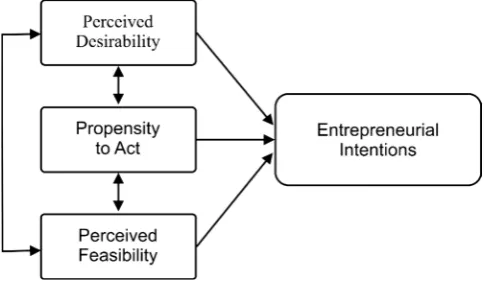
Shapero’s SEE model assumes that to start any new business or new venture, two components are very important, first the person proposing to do the business should have entrepreneurial intentions, termed as “credibility” and second that a new business or new venture requires some “event”. It requires some extent of feasibility, desirability and propensity to act on the business opportunity [12].
[image:4.595.252.498.564.705.2]As depicted in Figure 1, Shapero and Sokol Model of SEE is built on various aspects of cognitive behaviour framework. The major factors influencing an in-dividual’s intention to start a business are desirability, feasibility and propensity to act. He recognized that the changeable factors in this relationship are (i) En-trepreneurial Intentions as dependent variable which in this study pertains to the entrepreneurial behaviour of the management students at Ahmedabad; (ii) Per-ceived Desirability, Feasibility and Propensity to Act as independent variables. (1) Perceived feasibility is the extent of attraction people perceive, towards a spe-cific; (2) Perceived Desirability is the positive or negative attitude and the
DOI: 10.4236/tel.2019.94062 963 Theoretical Economics Letters perception of individuals capacity to perform a specific behaviour and (3) Pro-pensity to Act is personal disposition to act on individuals’ decisions that reflects willingness and intentions.
Shapero’s model assumes that the entrepreneurial intentions require the po-tential for a specific activity to exist before its displacement, either positive or negative and inclination to act after the displacement [13].
Any entrepreneurial event is a combination of credibility, perceived feasibility, perceived desirability and perceived propensity to act. Shapero revealed that the behavioural intention formation is highly dependent on the perception of indi-viduals towards entrepreneurship, actual business venture, and deliberate choice of a business option.
Entrepreneurial Venture Credibility: Shapero’s model deals with the impor-tance of persons’ overall assessment pertaining to the credibility and propensity to perform a specific behaviour. As mentioned earlier, the person’s intentions are mainly dependent on two factors credibility and propensity to act. The ante-cedents of credibility and propensity to act affect the behaviours towards entre-preneurial intentions or the actions of creating a business venture. The Shapero model accepts the case where an individual perceives creating a new venture as feasible and desirable and thus credible and such perceptions are likely to create intention to do business or start new business venture [14].
Perceived Desirability: In the context of Entrepreneurship, Perceived Desira-bility is the extent to which individuals find doing business is an attractive choice and is depicted by their desire to perform that behaviour in order to achieve the goal [2] [5]. It acts as a motivational factor that transforms attitude into entrepreneurial intentions [15]. Favourable attitude justifies favourable perceptions towards the specific behaviour of becoming an entrepreneur and the perceived desirability is related to Ajzen’s attitude and subjective norm variables. In this case, social background, cultural and traditional influences, family, rela-tives and friends can influence the perceived desirability for entrepreneurship.
Perceived Feasibility: In the entrepreneurship context, Perceived Feasibility refers to the attitude of the individuals towards the feasibility of the specific be-haviour required to become an entrepreneur. It also reflects the attitude regard-ing the persons’ potential to do business in the form of competence [5] which is in line with Azjen’s theory.
Propensity to Act: It is the personal disposition to act on individual’s decisions that reflects willingness and intentions. Propensity to act is from the significant efforts of individuals and their desire and willingness to perform a specific beha-viour that is starting a business venture [2] [5].
DOI: 10.4236/tel.2019.94062 964 Theoretical Economics Letters Shapero and Sokol, Bird, Krueger and Kolvereid [17] have recognized the key role that entrepreneurial intent plays. Researchers suggested that for the entre-preneurial process, some of the pre-requisite steps that are especially important include the existence of business opportunity, identification of the opportunity by the entrepreneur, and most importantly the conscious decision to exploit the opportunity. Contrary to this, Krueger [8] argued that it is the individual inten-tion to identify or lay hands on the opportunity, but the entrepreneurial process tends to be an individual’s idea or plan.
Based on the cited literature and subsequent interpretations, this study was conducted to analyze the entrepreneurial intentions of the students studying management program with respect to the components of the Shapero’s model of Entrepreneurial Intentions. The following set of hypothesis was developed to test based on the literature and the conclusions drawn from the model:
Hypothesis 1: Positive impact of perceived desirability on the management student’s entrepreneurial intentions.
Hypothesis 2: Positive impact of perceived feasibility on the management student’s entrepreneurial intentions.
Hypothesis 3: Positive impact of Propensity to Act on the management stu-dent’s entrepreneurial intentions.
3. Methodology
Taking the scholars of post graduate program at one of the management insti-tutes at Ahmedabad as the base population, this study aims to analytically ex-plain the Entrepreneurial Intentions of these students. In this context, the En-trepreneurial Intentions of the management students represent the dependent variable while the other three components of Shapero’s model such as Perceived Desirability, Perceived Feasibility and Propensity to Act serve as the indepen-dent variables. Indepenindepen-dent variables have been tested to assess their influence on the entrepreneurial intentions.
3.1. Data Collection
DOI: 10.4236/tel.2019.94062 965 Theoretical Economics Letters Descriptive Survey design was used to collect the data. The target population for the study comprises of the students pursuing management education, both senior and junior batch students, thus the sample accounts to 125 students. The demographic characteristics of the population are given in Table 1.
3.1.1. Demographic Analysis of the Sample Population
The population consisted of 66% boys and 34% girls with 25% in the age of 20 - 21 and 54% in the age of 22 - 23 and others above 24 years of age. Out of these, 78% of the students have come from commerce background and 16% were en-gineering graduates. In all, 46% of the students have selected Marketing as their specialization in the program and 43% opted for Finance specialization and others were from HR and Operations specializations. It was identified that 80% of the stu-dents did not have experience and 57% stustu-dents have come from business families.
4. Results & Discussion
The data was analyzed using SPSS package and the results are discussed in the following headings:
4.1. Descriptive Analysis of Independent Variables
[image:7.595.203.539.396.732.2]The study was to investigate the level of agreement of the students for the statements
Table 1. Demographic profile of respondents.
Variable Dimension Frequency Percentage
Gender Boys 83 66.4
Girls 42 33.6
Age
20 - 21 31 24.8
22 - 23 67 53.6
24 - 25 22 17.6
26 & above 5 0.04
Degree
Arts 5 4.0
Commerce 97 77.6
Engineering 20 16.0
Medical 3 2.4
Specialization in MBA
Marketing 57 45.6
Finance 54 43.2
Operations 2 1.6
HR 12 9.6
Experience Yes 25 20.0
No 100 80.0
Business Family Yes 71 56.8
DOI: 10.4236/tel.2019.94062 966 Theoretical Economics Letters pertaining to the perceived desirability. The results in Table 2 indicated that the respondents have shown interest that if opportunity and resources are available, they would like to be entrepreneurs (X= 3.82). They also strongly felt that being an entrepreneur gives them great satisfaction as indicated by the mean of 3.71. They are excited to become the entrepreneurs (X = 3.54) and consider that being an entrepreneur, they have several advantages (X = 3.30).
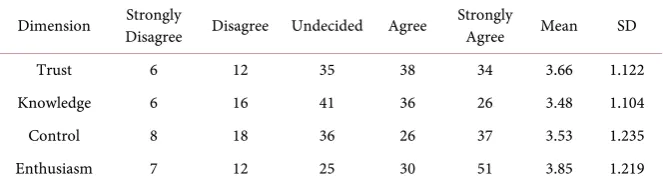
The results in Table 3 indicated the extent of agreement of the respondents to the statements pertaining to the Perceived Feasibility of being entrepreneurs. It indicated that students have strongly agreed that it is enthusiastic to take up en-trepreneurship as their career (X = 3.85) and they also felt and agreed that trust of their family or friends in their ability, whether they can be successful as an entrepreneur is important (X = 3.66). They have also expressed that they would like to have complete control over the situation once they start their own business venture (X = 3.53). It was also found to be in agreement to a signifi-cant extent that they had the knowledge and complete practical details as to how to start their own business (X = 3.48).
[image:8.595.207.541.478.573.2]The study was conducted to find out as to what extent the students would carry out the behaviours to start their own business ventures (Table 4). Majority of the students were in agreement only to a moderate extent for the operations, expansion, research and innovation. However, it was felt by few students that introducing products regularly for customers will develop their business to a great extent (X = 3.18). It was shown that bringing in the latest processes and systems into production will enhance their business to a great extent (X = 2.78). Research and development has been found to be important to a great ex-tent to develop new products and services, and in turn to grow the business (X
Table 2. Perceived desirability of entrepreneurship.
Dimension Disagree Disagree Undecided Strongly Agree Strongly Agree Mean SD
Satisfaction 4 14 28 47 32 3.71 1.069
Advantages 8 22 39 36 20 3.30 1.130
Opportunity 8 11 24 35 47 3.82 1.214
Excitement 10 18 31 25 41 3.54 1.317
Source: Primary Data collected by the Authors.
Table 3. Perceived feasibility of entrepreneurship.
Dimension Disagree Strongly Disagree Undecided Agree Strongly Agree Mean SD
Trust 6 12 35 38 34 3.66 1.122
Knowledge 6 16 41 36 26 3.48 1.104
Control 8 18 36 26 37 3.53 1.235
Enthusiasm 7 12 25 30 51 3.85 1.219
[image:8.595.207.539.618.710.2]DOI: 10.4236/tel.2019.94062 967 Theoretical Economics Letters = 2.57). They also indicated that expanding the business can have fast track de-velopment in their business as depicted with a mean of 2.14.
These results are in alignment with the studies conducted by [16]. It estab-lished the fact that with the lower extent of predisposition to act, the neurial intentions were not likely to develop and the sole predictor of entrepre-neurial intentions will be perceived desirability.
4.2. Descriptive Analysis of Dependent Variable
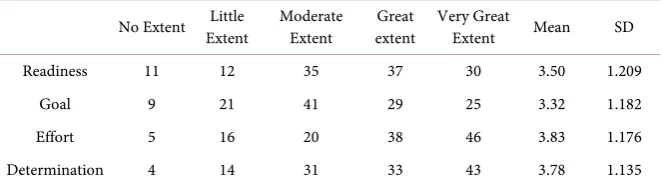
The dependent variable, Entrepreneurial Intention was measured with four items. The results from Table 5 indicated that majority of the students were willing to make their efforts to the maximum extent to be successful entrepre-neurs (X = 3.83) and all of them had shown determination to the highest de-gree (X = 3.78). They were all willing to take up entrepreneurship as their ca-reer with a mean of 3.50 and eventually achieve their goal.
4.3. Scale Validity and Reliability Analysis
Reliability and Consistency test using Cronbach Alpha was subjected to analysis before examining the relationships between the Shapero’s model and the entre-preneurial intentions. The Cronbach alpha coefficient for the complete set was 0.835 and for independent variables, it ranged from 0.874 to 0.917 of the ques-tionnaire, which indicates high internal consistency and alpha was above 0.7 as recommended by [18].
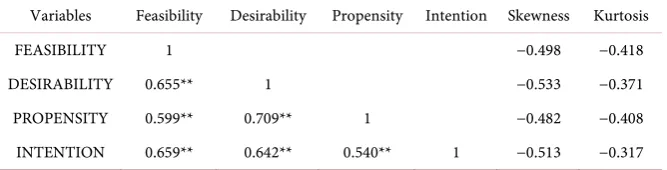
[image:9.595.207.540.479.570.2]The Skewness and Kurtosis (Table 6) was measured for both dependent and independent variables and were found within the normal range [19]. Significantly high positive correlation was found between the dependent and independent
Table 4. Propensity to Act and the behaviours to develop business.
No Extent Little Extent Moderate Extent extent Great Very Great Extent Mean SD
Operations 34 47 37 6 1 2.14 0.904
Expansion 6 41 57 16 5 2.78 0.876
Research 19 34 55 16 1 2.57 0.928
Innovation 9 17 56 29 14 3.18 1.040
Source: Primary Data collected by the Authors.
Table 5. Descriptive analysis of entrepreneurial intentions.
No Extent Little Extent Moderate Extent extent Great Very Great Extent Mean SD
Readiness 11 12 35 37 30 3.50 1.209
Goal 9 21 41 29 25 3.32 1.182
Effort 5 16 20 38 46 3.83 1.176
Determination 4 14 31 33 43 3.78 1.135
[image:9.595.208.540.616.708.2]DOI: 10.4236/tel.2019.94062 968 Theoretical Economics Letters variables with strongest relationship between desirability and the entrepreneurial intentions (r = 0.709). Significantly strong association between all the variables illustrates that all the variables are integrated and associated in influencing the entrepreneurial intentions.
4.4. PLS (SEM) Regression Analysis
Data was analyzed for Partial Linear Squares Regression Analysis to find out the relationship between the independent variables Perceived Desirability, Perceived Feasibility and Propensity to Act against Entrepreneurial Intentions among the students pursuing management program.
[image:10.595.207.541.388.473.2]Results from Table 7, latent factors explain the percentage of variance ac-counted for by the independent variables. For latent factor 1, 85.5% variance is explained by Perceived Desirability (first independent variable) and 86.6% by the entrepreneurial intentions (dependent variable). In the second and third factors, the variance explained by X and Y are lesser. Hence the first model of factor 1 explaining X and Y relationship, which has higher variance explained, can be considered.
Table 8 depicts the estimated regression coefficient of each independent vari-able for predicting entrepreneurial intentions. The results indicate that Perceived
Table 6. Pearson correlation coefficient.
Variables Feasibility Desirability Propensity Intention Skewness Kurtosis
FEASIBILITY 1 −0.498 −0.418
DESIRABILITY 0.655** 1 −0.533 −0.371
PROPENSITY 0.599** 0.709** 1 −0.482 −0.408
INTENTION 0.659** 0.642** 0.540** 1 −0.513 −0.317
[image:10.595.208.539.518.611.2]**. Correlation is significant at the 0.01 level.
Table 7. Proportion of variance explained by TPB constructs.
Latent Factors
Statistics X Variance
Explained Cum. X Variance Explained Y Variance explained Cum. Y Var (R Square) Adjusted R Square
1 0.855 0.855 0.866 0.866 0.847
2 0.081 0.936 0.021 0.887 0.852
[image:10.595.206.540.643.728.2]3 0.064 1.000 0.103 0.99 0.849
Table 8. Regression coefficients.
TPB Constructs Regression Coefficient t-value Sig.
Constant 0.714
Perceived Feasibility 0.334 5.42 0.000
Propensity to Act 0.210 5.91 0.000
DOI: 10.4236/tel.2019.94062 969 Theoretical Economics Letters Desirability has the highest regression coefficient (0.612) which has impact on the entrepreneurial intentions followed by Perceived Feasibility and Propensity to Act. The Propensity to Act does not have much impact on the entrepreneurial intentions.
[image:11.595.207.539.509.590.2]Taking all the factors into account and constant at zero, the entrepreneurial intention is 0.714. With all the independent variables at zero, a unit increase in Perceived Desirability will lead to 0.334 increase in the entrepreneurial inten-tions; a unit increase in Propensity to Act will lead to 0.21 and a unit increase in Perceived Desirability will lead to 0.612 increase in entrepreneurial intentions respectively, which is an indication that Perceived Desirability and Perceived Feasibility have greater influence on the intentions of the students. Propensity to Act does not have much influence on the entrepreneurial intentions which is in agreement with the study conducted by Krueger.
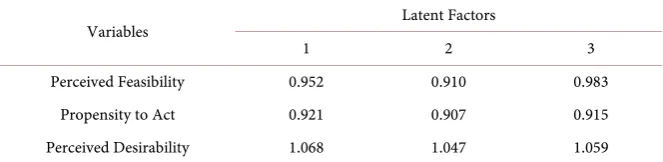
Table 9 shows the importance of TPB constructs in a given factor. In all the latent factors, Perceived Desirability has the highest value (1.068) followed by Perceived Feasibility and Propensity to Act.
The relationship between variables and factors is given in Table 10. Results infer that perceived desirability, perceived feasibility and propensity to act and entrepreneurial intentions have positive relationship with factor 1 and similarly with factor 2 and 3 respectively, whereas the propensity to act has a negative re-lationship with factor 2 and 3.
5. Conclusions
The study was set out to analyze the entrepreneurial intentions of the students pursuing management program at a business school in Ahmedabad with the ap-plication of the Shapero’s Model of Entrepreneurial Intentions as the basis. The in-dependent variables viz., perceived desirability, perceived feasibility and propensity
Table 9. Variable importance in the projection.
Variables Latent Factors
1 2 3
Perceived Feasibility 0.952 0.910 0.983
Propensity to Act 0.921 0.907 0.915
Perceived Desirability 1.068 1.047 1.059
Table 10. Weights.
Variables Latent Factors
1 2 3
Perceived Feasibility 0.612 0.378 0.653
Propensity to Act 0.598 −0.452 −0.692
Perceived Desirability 0.699 0.901 0.144
DOI: 10.4236/tel.2019.94062 970 Theoretical Economics Letters to act were expected to influence the students.
The descriptive analysis of data indicated that the students had shown greater interest in becoming entrepreneurs and the career of entrepreneurship was per-ceived more attractive by them, by virtue of the potential advantages to them. The idea of being an entrepreneur gives them lot of satisfaction as they believe they can provide employment to others and also contribute to the growth of the nation. They had significant enthusiasm towards entrepreneurship coupled with the confidence that innovating and introducing new products for customers, in-troducing new systems and process and expanding the firm etc. will have bear-ing on the development of their business. The study also has revealed that eco-nomic opportunity to start their own business is very important for them. Au-thority and autonomy plays a very significant role in their decision making.
The correlation analysis indicated a strong positive relationship between all dependent and independent variables. However perceived desirability had the strongest relationship with entrepreneurial intentions indicating that the wil-lingness or desire to take up entrepreneurship was the key determinant in the process of making the decision to be an entrepreneur. This was further investi-gated with the application of partial least squares regression analysis.
The results from the partial least squares (SEM) regression analysis indicated that the entrepreneurial intentions of the students were predicted significantly by the independent variables of the model. However, Perceived Desirability has the overriding impact on the entrepreneurial intentions (having a high regres-sion coefficient) followed by Perceived Feasibility. It can be concluded that stu-dents possess attitude and dispositions towards becoming entrepreneurs which affect their intention positively. All of the three hypotheses are supported by the results. However, results have shown that the lesser the predisposition to act, lesser is the probability that entrepreneurial intentions will not develop and the sole predictor has been the perceived desirability as supported by study con-ducted by [16].
It is recommended that the business school where the students are pursuing their management program should emphasize more on entrepreneurship related courses and introduce specialized modules to impart essential skills and know-ledge. This would enable the students to develop interest and acquire the rele-vant skills and competencies essential for an entrepreneur who in turn would contribute in strengthening the socio-economic firmament of the nation.
The sample size was small and the data was collected from a particular institu-tion to draw inferences to understand the entrepreneurial inteninstitu-tions of the stu-dents. This served as a limitation, albeit the study can be further extended to more number of institutions, taking a larger sample into consideration. Accor-dingly, the inferences could be substantiated further.
Conflicts of Interest
DOI: 10.4236/tel.2019.94062 971 Theoretical Economics Letters
References
[1] Ajzen, I. (1987) Attitudes, Traits and Actions: Dispositional Prediction of Behavior in Social Psychology. Advances in Experimental Social Psychology, 20, 1-63.
https://doi.org/10.1016/S0065-2601(08)60411-6
[2] Shapero, A. and Sokol, L. (1982) The Social Dimensions of Entrepreneurship. In: Shapero, A., Ed., The Encyclopedia of Entrepreneurship, Prentice Hall, Englewood Cliffs, 72-90.
[3] Bird, B. (1988) Implementing Entrepreneurial Ideas: The Case for Intentions. Acade-my of Management Review, 13, 442-454.https://doi.org/10.5465/amr.1988.4306970
[4] Boyd, N.G. and Vozikis, G.S. (1994) The Influence of Self-Efficacy on the Develop-ment of Entrepreneurial Intentions and Actions. Entrepreneurship Theory and Practice, 18, 63.https://doi.org/10.1177/104225879401800404
[5] Krueger, N.F. and Brazeal, D.V. (1994) Entrepreneurial Potential and Potential En-trepreneurs. Entrepreneurship Theory and Practice, 18, 91.
https://doi.org/10.1177/104225879401800307
[6] Ajzen, I. (1991) The Theory of Planned Behavior. Organizational Behavior and Hu-man Decision Processes, 50, 179-211.
https://doi.org/10.1016/0749-5978(91)90020-T
[7] Urban, B. (2010) A Gender Perspective on Career Preferences and Entrepreneurial Self-Efficacy. SA Journal of Human Resource Management, 8, 1-8.
https://doi.org/10.4102/sajhrm.v8i1.293
[8] Krueger, N.F.J., Reillly, M.D. and Carsrud, A.L. (2000) Competing Models of En-trepreneurial Intentions. Journal of Business Venturing, 15, 411-432.
https://doi.org/10.1016/S0883-9026(98)00033-0
[9] Peng, Z., Lu, G. and Kang, H. (2012) Entrepreneurial Intentions and Its Influencing Factors: A Survey of the University Students in Xi’an China. Creative Education, 3, 95-100.https://doi.org/10.4236/ce.2012.38B021
[10] Liñán, F. (2008) Skill and Value Perceptions: How Do They Affect Entrepreneurial Intentions? International Entrepreneurship and Management Journal, 4, 257-272.
https://doi.org/10.1007/s11365-008-0093-0
[11] Ahmad, S.Z., Jabeen, F. and Khan, M. (2014) Entrepreneurs Choice in Business Venture: Motivations for Choosing Home-Stay Accommodation Businesses in Pe-ninsular Malaysia. International Journal of Hospitality Management, 36, 31-40.
https://doi.org/10.1016/j.ijhm.2013.08.006
[12] Kim, J. (2017) Building a Dynamic Model of Entrepreneurial Intention Formation in Sharing Economy Platform: The Resource-Based Theory Approach. Graduate Theses and Dissertations, Iowa State University.
[13] Krueger, N.F., Relly, M.D. and Carsrud, A.L. (2000) Competing Models of Entre-preneurial Intentions. Journal of Business Venturing, 15, 411-432.
[14] Veciana, J.M., Aponte, M. and Urbano, D. (2005) University Students’ Attitudes towards Entrepreneurship: A Two Countries Comparison. The International En-trepreneurship and Management Journal, 1, 165-182.
https://doi.org/10.1007/s11365-005-1127-5
[15] Peterman, N.E. and Kennedy, J. (2003) Enterprise Education: Influencing Students’ Perceptions of Entrepreneurship. Entrepreneurship Theory and Practice, 28, 129-144.
https://doi.org/10.1046/j.1540-6520.2003.00035.x
DOI: 10.4236/tel.2019.94062 972 Theoretical Economics Letters
5.https://doi.org/10.1177/104225879301800101
[17] Kolvereid, L. (1996) Prediction of Employment Status Choice Intentions. Entrepre-neurship Theory and Practice, 21, 47-57.
https://doi.org/10.1177/104225879602100104
[18] Nunnally, J. (1978) Psychometric Methods.