https://www.scirp.org/journal/ce ISSN Online: 2151-4771
ISSN Print: 2151-4755
DOI: 10.4236/ce.2019.1012247 Nov. 30 2019 3235 Creative Education
Framework Development of
Serious Game-Based Instrument
for Malay Language Early
Literacy Assessment
Rohani Aziz1,2, Helmi Norman1,3*, Norazah Nordin1, Fatin Nabilah Wahid1, Ruslina Ibrahim1
1Faculty of Education, Universiti Kebangsaan Malaysia (UKM), Bangi, Selangor, Malaysia 2Examination Syndicates, Ministry of Education, Kuala Lumpur, Malaysia
3Center for Teaching and Learning Technologies, UKM, Bangi, Selangor, Malaysia
Abstract
Literacy achievement is important because it is the underpinning skills that sustain an individual’s competencies in early education. However, most of assessment instrument nowadays are in the form of traditional summative assessment. The emerging assessment instrument in recent evolution of technology allows teachers, educators and assessment workers to seek for better approaches in evaluating and assessing students’ achievement. While the traditional assessment methods are gradually being transformed into in-formal and formative assessment methods, an establishment of an alternative assessment framework is needed to accommodate the transformation. There-fore, the aim of this study is to establish the framework development of a Se-rious Game-Based Instrument for early literacy student assessment. The study used the Focus Group Discussion (FGD) approach to determine the appropriate gamification features of Serious Games and develop the serious game-based assessment framework. For that purposed, 17 experts from dif-ferent fields of studies were involved in the FGD session. The findings were analyzed using descriptive analysis. This study concludes by highlighting the proposed framework of the Serious Game-Based Literacy Assessment by ve-rifying gamification features and literacy constructs needed for the develop-ment of Serious Games of Early Literacy Student Assessdevelop-ment.
Keywords
Serious Games, Assessment Framework, Early Literacy, Literacy Assessment, Serious Game-Based Instrument Framework
How to cite this paper: Aziz, R., Norman, H., Nordin, N., Wahid, F. N., & Ibrahim, R. (2019). Framework Development of Serious Game-Based Instrument for Malay Lan-guage Early Literacy Assessment. Creative Education, 10, 3235-3242.
https://doi.org/10.4236/ce.2019.1012247
Received: October 21, 2019 Accepted: November 27, 2019 Published: November 30, 2019
Copyright © 2019 by author(s) and Scientific Research Publishing Inc. This work is licensed under the Creative Commons Attribution International License (CC BY 4.0).
http://creativecommons.org/licenses/by/4.0/
DOI: 10.4236/ce.2019.1012247 3236 Creative Education
1. Introduction
Emerging technologies can be integrated to support student needs in alternative assessment. As mentioned by (Prensky, 2001) nowadays, student generation of digital natives that have spent their entire lives with gadgets and technological tool, computers, video games, cell phones, video cams and all sort of technolo-gical need an up-to-date approach to challenge their concentration and enhance their ability in learning. The Ministry of Education Malaysia has initiated three major strategies for ICT implementation in education (Ministry of Finance Ma-laysia, 2001). The first strategy is to emphasize and enable ICT utilized for all students to decrease the existing digital gap between schools. The second strate-gy refers to the function of ICT as an effective teaching and learning tool. Paral-lel to these notions, Ministry of Education Malaysia has again come up with the new rules to overcome the issue of summative types of assessment for early pri-mary students aged 7 to 9 as well as to enforce the effective implementation of formative assessment in school.
2. Overview
2.1. The Concept of Serious Games
Serious games are designed to have an impact on the target audience (Bellotti, Kapralos, Lee, Moreno-Ger, & Berta, 2013) which is beyond the pure entertain-ment aspect (Bellotti, Kapralos, Lee, Moreno-Ger, & Berta, 2013; Coovert,
Win-ner, Bennett, & Howard, 2017); to make formal education more exciting and
engaging via enhancement of pedagogical and assessment approaches in tech-nological innovation (Arnab et al., 2012) and an attractive tool for education and training (Coovert, Winner, Bennett, & Howard, 2017). Therefore, Serious Games is one of the alternative platforms to perform formative and real time assessment for student. The concept of Serious Games first raised from the con-cept of making a game as mixed reality or media to conveys objective meaning throughout the process (Hashim, Rafiq, & Md Yunus, 2019; Marsh, 2011).
2.2. The Concept of Alternative Assessment
Gard-DOI: 10.4236/ce.2019.1012247 3237 Creative Education ner, Cartledge, Ramnath, & Council, 2017); The first generation uses designs based on paper-pencil assessments; The next generation is the generation that will be using new formats including multimedia based responses, automated item builds and scoring automatically; while the next generation is a generation that implements complex simulations and smart tutoring applications and artifi-cial intelligence.
2.3. The Underpinning Issues of Literacy Assessment
According to the United Nations Children’ s Fund (2012), while more and more children are attending school worldwide, many of them drop out or fail to meet minimum standards of learning. In addition, statistics showed that of the world’s 650 million children of primary school age, 120 million do not reach Grade 4; another 130 million reach Grade 4 but fail to achieve a minimum level of learn-ing. Meanwhile, the UNESCO Institute for Statistics (UIS) 2016 data on literacy have shown that although literacy has been high on the development agenda over the past decades, yet 750 million adults which two-thirds of whom are women are still lack basic reading and writing skills. Similarly, literacy perfor-mance of primary students in Malaysia has shown the huge disparity of the re-sults for K7-K9 student’s screening test on language literacy compared to K12 student’s achievement test.
3. Method
The study was conducted in Focus Group Discussion (FGD) technique. 17 ex-perts from various fields of study were involved in the FGD session. The proce-dure begins by gathering empirical studies related to gamification features and literacy assessment framework from academic literature repositories. The ele-ments and constructs gathered, later were discussed and classified into several section and subsection respectively. Experts then determined the suitable and appropriate game elements or features as well as literacy constructs to be imple-mented in the development of Serious Games for Malay Language Literacy As-sessment. The findings of the discussion were analyzed using descriptive and thematic analysis (Figure 1).
4. Results
4.1. Assessment Element’s Framework
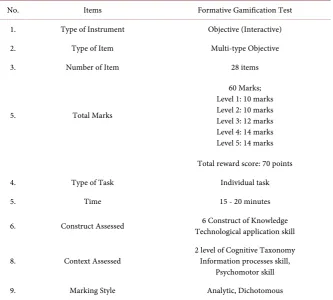
Results indicate various construct proposed based on literature reviewed (Table 1).
4.2. Gamification and Multimedia Element’s Framework
DOI: 10.4236/ce.2019.1012247 3238 Creative Education Figure 1. Focus group discussion (FGD) procedure.
Table 1. Assessment framework element by expert’s consensus.
No. Items Formative Gamification Test
1. Type of Instrument Objective (Interactive)
2. Type of Item Multi-type Objective
3. Number of Item 28 items
5. Total Marks
60 Marks; Level 1: 10 marks Level 2: 10 marks Level 3: 12 marks Level 4: 14 marks Level 5: 14 marks
Total reward score: 70 points
4. Type of Task Individual task
5. Time 15 - 20 minutes
6. Construct Assessed Technological application skill 6 Construct of Knowledge
8. Context Assessed 2 level of Cognitive Taxonomy Information processes skill, Psychomotor skill
9. Marking Style Analytic, Dichotomous
construct of knowledge in assessment framework element proposed, then estab-lish a serious games application, and finally efficiently save and maintain stu-dent’s achievement by designing and implementing Serious Games-based As-sessment for literacy asAs-sessment.
Therefore, there are five elements of multimedia and gamification was dis-cussed and finalized to get the expert consensus in establishing the foundation of Serious Games-based Assessment proposed for early literacy assessment frame-work. The five elements are as follows;
• Multimedia elements • Game elements • Genre
• Reward element • Platform option
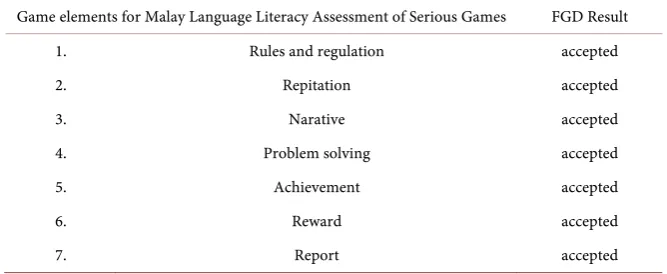
Table 2 showed gamification elements accepted by the experts to be embedded
in the development of Serious Games Malay Language Literacy Assessment. These seven gamification elements were accepted in consideration of the complexity of
elements and
DOI: 10.4236/ce.2019.1012247 3239 Creative Education Table 2. Game elements/features.
Game elements for Malay Language Literacy Assessment of Serious Games FGD Result
1. Rules and regulation accepted
2. Repitation accepted
3. Narative accepted
4. Problem solving accepted
5. Achievement accepted
6. Reward accepted
7. Report accepted
the literacy instrument develops. Therefore, experts agreed that these gamifica-tion elements may be discarded during the development process based on the instrumentation develop by the content experts of Malay Language Literacy.
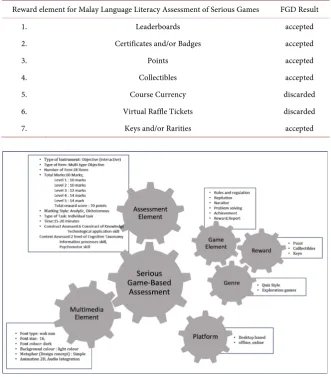
Table 3 showed the reward elements agreed by the experts. Seven reward
ele-ments proposed and discussed among experts; Leaderboards, Certificates and/or Badges, Points, Collectibles, Course Currency, Virtual Raffle Tickets, Keys and/or Rarities. Five were accepted by the panel of experts while another two; Course Currency and Virtual Raffle Tickets were discarded as they were less suitable for target games user.
5. Discussion
The emerging categories of game features may represent various game-based learning framework and varied ways of combining assessment elements with game elements (Azman & Farhana Dollsaid, 2018). The study attempted to pro-vide serious game assessment features and taxonomy derived from a compre-hensive analysis of both assessment and game elements. Game, multimedia and assessment elements were grouped to categories, encompassing a collection of assessments, game and multimedia elements to be used in designing a game for early literacy assessment purposes. It is perceived that the elements will help in-structional designers and game developers to better discern types of assessment element with game and multimedia elements. Therefore, based on expert con-sensus, the serious game-based assessment framework was outlined as follows (Figure 2).
DOI: 10.4236/ce.2019.1012247 3240 Creative Education Table 3. Gamification elements (reward).
Reward element for Malay Language Literacy Assessment of Serious Games FGD Result
1. Leaderboards accepted
2. Certificates and/or Badges accepted
3. Points accepted
4. Collectibles accepted
5. Course Currency discarded
6. Virtual Raffle Tickets discarded
7. Keys and/or Rarities accepted
Figure 2. Serious game-based assessment framework for early literacy assessment.
To summarize, the framework proposed helps the serious game designers and serious game developers be deliberate and intentional about the design choices they make. The framework is aimed for thinking about additions or modifica-tions to the game’s elements that are intended to make serious games achieve the assessments’ objectives in informal context; or at least to spot situations where design decisions may need to be traded off with assessment objectives and se-rious game objectives accordingly, which sometimes is a reasonable thing to do to meet the serious game-based assessment goals.
The framework developed through the FGD research technique is imple-mented in the development of serious game-based assessment proposed. For the implementation, the initial prototyping is done using GDevelop gaming soft-ware, in which assessment element and game element were blended accordingly.
6. Conclusion
DOI: 10.4236/ce.2019.1012247 3241 Creative Education and how Serious Games can be integrated as an alternative assessment form to bring out the assessment objective in such informal context. In carrying out real time assessment, it is recommended that the instrument be designed and devel-oped with appropriate game elements. As the proposed framework was done, several suggestions are recommended for future research. Objectively, serious game-based assessment in early literacy should focus on three key elements of serious game design: 1) the use of various storylines and assessments element to enhance user engagement, 2) increased use of game elements that facilitate the transfer of knowledge and skills in real-time contexts, 3) the use of different platform options inmaximizing the user accessibility, and 4) the use of learning analytics or network diagrams (e.g. social network analysis) for learning assess-ment. Finally, several key areas of design considerations should be considered by researchers when they design serious games for certain target groups proposed to provide a valuable supplementary tool for an alternative assessment. In sum, it is hoped that this study could assist future educators and researchers interest-ed on investigations of serious games as an alternative format of assessments to suit the needs of fourth Industrial Revolution in educational settings (Nordin, Norman, & Hamdan, 2018; Adnan & Ritzhaupt, 2018; Dogan, Norman, Alrobai, Jiang, Nordin, & Adnan, 2019; Andersen, Na-songkhla, Hasse, Nordin, & Nor-man, 2018).
Acknowledgements
This research is funded by the Translational MRUN Rakan-RU Program Grant (Grant No. MRUN-RAKAN RU-2019-003/2) and Dana Pecutan Penerbitan FPend (Grant No. PP-FPEND-2019).
Conflicts of Interest
The authors declare no conflicts of interest regarding the publication of this paper.
References
Adnan, N. F., & Ritzhaupt, A. D. (2018). Software Engineering Design Principles Applied to Instructional Design: What Can We Learn From Our Sister Discipline? TechTrends, 62, 77-94. https://doi.org/10.1007/s11528-017-0238-5
Andersen, B. L., Na-songkhla, J., Hasse, C., Nordin, N., & Norman, H. (2018). Percep-tions of Authority in a Massive Open Online Course: An Intercultural Study.
Interna-tional Review of Education, 64, 221-239. https://doi.org/10.1007/s11159-018-9708-z
Arnab, S. et al. (2012). Framing the Adoption of Serious Games in Formal Education.
Electronic Journal of e-Learning, 10, 159-171.
Azman, H., & Farhana Dollsaid, N. (2018). Applying Massively Multiplayer Online Games (MMOGs) in EFL Teaching. Arab World English Journal, 9, 3-18.
https://doi.org/10.24093/awej/vol9no4.1
Ar-DOI: 10.4236/ce.2019.1012247 3242 Creative Education
ticle ID: 136864. https://doi.org/10.1155/2013/136864
Bennett, J. G., Gardner, R., Cartledge, G., Ramnath, R., & Council, M. R. (2017). Second Grade Urban Learners: Preliminary Findings for a Computer-Assisted, Culturally Re-levant, Repeated Reading Intervention. Education and Treatment of Children, 40,
145-185. https://doi.org/10.1353/etc.2017.0008
Bennett, S., Dawson, P., Bearman, M., Molloy, E., & Boud, D. (2017). How Technology Shapes Assessment Design: Findings from a Study of University Teachers. British
Journal of Educational Technology, 48, 672-682. https://doi.org/10.1111/bjet.12439
Coovert, M. D., Winner, J., Bennett, W., & Howard, D. J. (2017). Serious Games Are a Se-rious Tool for Team Research. International Journal of Serious Games, 4, 41-55
https://doi.org/10.17083/ijsg.v4i1.141
Dogan, H., Norman, H., Alrobai, A., Jiang, N., Nordin, N., & Adnan, A. (2019). A Web-Based Intervention for Social Media Addiction Disorder Management in Higher Education: Quantitative Survey Study. Journal of Medical Internet Research, 21,
e14834. https://doi.org/10.2196/14834
Hashim, H., Rafiq, R. M., & Md Yunus, M. (2019). Improving ESL Learners’ Grammar with Gamified-Learning. Arab World English Journal, No. 5, 41-50.
https://doi.org/10.24093/awej/call5.4
Khan, A. B. M. A., Aziz, M. S. A., & Stapa, S. H. (2019). Examining the Factors Mediating the Intended Washback of the English Language School-Based Assessment: Pre-Service ESL Teachers’ Accounts. Pertanika Journal of Social Sciences & Humanities, 27, 51-68. Luckin, R., Clark, W., Avramides, K., Hunter, J., & Oliver, M. (2017). Using Teacher In-quiry to Support Technology-Enhanced Formative Assessment: A Review of the Lite-rature to Inform a New Method. Interactive Learning Environments, 25, 85-97.
https://doi.org/10.1080/10494820.2015.1121152
Marsh, T. (2011). Serious Games Continuum: Between Games for Purpose and Experien-tial Environments for Purpose. Entertainment Computing, 2, 61-68.
https://doi.org/10.1016/j.entcom.2010.12.004
Ministry of Finance Malaysia (2001). Economic Report 2001/2002: 63-77.
Nordin, N., Norman, H., & Hamdan, F. (2018). Quality Education with Instructional De-sign via Massive Open Online Courses. Advanced Science Letters, 24, 2541-2545.
https://doi.org/10.1166/asl.2018.11000
Prensky, M. (2001). On the Horizon. Horiz. Libr. Hi Tech News, 9, 12-13.
Tapp, D., & Martin, L. (2014). We Do Not Like Old Fashioned Exams: The Innovative Use of Alternative Assessments on a Law Degree with a Foundation Year.Innovative