A cilia-inspired closed-loop sensor-actuator array
James G.H. Whiting, Richard Mayne, Chris Melhuish, Andrew Adamatzky
Unconventional Computing Centre and Bristol Robotics Laboratory, University of the West of England, Bristol, UK
Abstract
Cilia are finger-like cell-surface organelles that are used by certain varieties of aquatic unicellular organisms for motility, sensing and object manipula-tion. Initiated by internal generators and external mechanical and chemical stimuli, coordinated undulations of cilia lead to the motion of a fluid sur-rounding the organism. This motion transports micro-particles towards an oral cavity and provides motile force. Inspired by the emergent properties of cilia possessed by the pond organismP. caudatum, we propose a novel smart surface with closed-loop control using sensor-actuators pairings that can ma-nipulate objects. Each vibrating motor actuator is controlled by a localised microcontroller which utilises proximity sensor information to initiate actu-ation. The circuit boards are designed to be plug-and-play and are infinitely up-scalable and reconfigurable. The smart surface is capable of moving ob-jects at a speed of 7.2 millimetres per second in forward or reverse direction. Further development of this platform will include more anatomically similar biomimetic cilia and control.
Keywords:
Bioinspiration; Artificial Cilia; Object Manipulation; sorting platforms.
1. Introduction
Cilia are finger-like cellular projections possessed by a wide variety of eu-karyotic cell types; there is a high degree of ciliary homology between different species[1]. In multi-ciliated cells, these organelles possess the ability to beat
with a whip-like motion[2]: this primarily serves to provide motile force in unicellular organisms (ciliated protozoa and algae)[3]or otherwise drives fluid
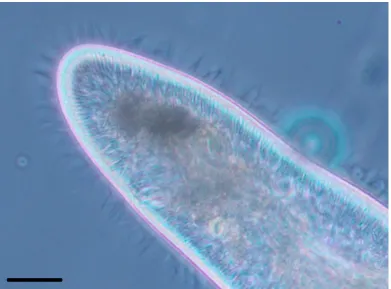
Figure 1: Phase contrast micrograph of P. caudatum’s anterior apex. Cilia may be ob-served coating the organism. Scale bar 25 µm.
human bronchial epithelial tissues [[4]]. Secondary roles include manipulation
of proximate particulate matter, sensing and substance absorption[5;3;4].
As each cilium is a discrete sensing element and actuator in its own right; a ciliated cell may be viewed as a parallel actuator array with decentralised control. Crucially, the ability of ciliated cells for spontaneously generating metachronal waves, sequential travelling wave patterns of ciliary beating, demonstrates the capacity these systems possess for facilitating emergent behaviour in the absence of a centralised control system. Hence, cilia arrays are a prime target for the fabrication of bio-inspired sensorial-actuation sys-tems; the investigation detailed here is presented in context with our aims to develop a smart actuation surface inspired by the cilia possessed by the protozoan P. caudatum.
direction of the belt; this arrangement has been used for hundreds of years[6;7].
Modern conveyor belt systems are more complex than their predecessors by having camera sensing and sorting actuators however still have the basic motorised belt for manipulation; a shortfall of having belt fed conveyors is the lack of adaptability to new sorting or manipulation tasks, with the system requiring redesign to change the manipulation direction and protocol. Belt fed conveyors are also unable to manipulate multiple objects in different directions simultaneously and are often without sensor feedback.
In devices with open-loop control, the actuation is sensor-less and with-out feedback. In object manipulation applications, the processor does not receive any explicit information about the object’s geometry, and actuation is based solely on interaction of the geometry of the resulting force field and the geometry of the transported object[8;9]. Open-loop control utilises a
method-ology of pre-programmed manipulation, which are calculated by a computer and generated on a surface of the manipulator; open-loop systems are often used for transport rather than specific manipulation tasks such as sorting. Closed-loop control is sensory, with feedback of an important parameter for error-resistance and improved accuracy. In systems of this type, sensors in-form the central processor about the manipulated object at each moment of time. The processor changes patterns of actions depending upon the partic-ulars of the object motion. The information about the manipulated object could be provided either by an external sensor, such as a vision system, or by a distributed sensing (optical or tactile) system, i.e., when every actuator of the array has its own sensor.
Alternatives to conveyor belt systems are present in industry, such as vibratory bowl feeders or sensor-less mechanical systems[10;11]. Mechanical
design coupled with a directional motile force, from either vibration or con-veyor systems, manipulates objects in an open loop system; the design of these systems is very part specific, with each part often requiring their own system to orientate an object. It is the aim of this project to create a platform which is not object specific and can be adaptable.
Most of the work on sensor based parallel manipulator devices has em-ployed centralised control and has been implemented at the micro-scale such as micro-electro-mechanical systems (MEMS) and at the macro-scale with vi-brating plates [9]. These MEMS or vibrating plates move objects by creating
manipulation with programmed force vectors is a hard computational task. The problem becomes even more resource-demanding when manipulating multiple objects. Furthermore, programmed fields, in their ‘pure’ form, offer a narrow space for manoeuvre as they have a limited number of combina-tions of ’typical’ fields that successfully process an object[12;13]. Centralised
control, applied to parallel manipulating systems is also a drawback from the points of view of system scaling, maintenance, reliability and compact-ness. In view of the discrete nature of the manipulator and disadvantages of centralised control, the idea of decentralised control, with use of non linear media is promising.
With a little increase of communication complexity we can couple actuat-ing units with their own unique sensors and with their nearest neighbours and thus not simply transfer information between units but collectively produce a co-ordinated action using local information. In this way local sensing and actuation contributes to a global emergent outcome, even in the absence of a centralised controller. Such an approach is complementary to the structure and function of cilia.
Alternative manipulation surfaces have been proposed which document the development of smart surfaces; micro-actuator arrays and micro-electrical-mechanical systems (MEMS) based systems have been proposed[14]; dealing
with small scale object manipulation, however many are based on single control with optical feedback using camera-computer systems[15;16;17] rather
than distributed control, or even open loop control without sensors[18;19].
These closed loop systems offer a greater degree of accuracy than traditional conveyor belt systems but lack distributed autonomy and to some degree scalability.
This paper investigates the feasibility of an entirely up-scalable, plug-and-play, sensor-actuator system with localised autonomy using vibrating motors for object manipulation. Investigating a bio-inspired control mechanism, we test the level of object manipulation of a closed loop protocol similar to that of the P. caudatum organism.
2. Methods
2.1. Hardware
ultrabright LEDs using pulse-width-modulation (Octolively Kit1). These
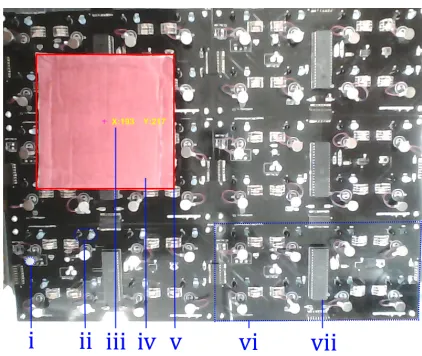
boards have been adapted to control low power vibrating motors with custom software. Each board is controlled by an ATmega164P microcontroller, there are 8 proximity sensors and 8 vibration actuators per board (each uniquely paired); proximity sensors are 940 nm infra-red phototransistors, which have programmable sensitivity. The IR phototransistors detect the presence of an object above them by surface reflection from corresponding IR LEDs and the actuator is activated accordingly by way of increased RPM. It is possible to re-programme this control system to perform different tasks when ob-jects are detected, or indeed replace the IR sensors with something different which could be task dependent. Reversing of direction in this application was changed in the software however it is entirely possible that direction reversal could be triggered by another parameter; different sized or shaped objects could be manipulated differently in order for them to be sorted into different categories. The actuators are Precision Microdrives 310 10mm diameter vi-brating DC motors2. A total of 6 boards are tiled to produce a 6×8 matrix
of actuators. The motors are mounted on the PCB using medium density PVC foam 5mm square and 9.6mm high pads (RS Components, UK) to allow adequate spacing above the other components while maintaining a degree of flexibility for vibration. The motors are capable of rotating at 12200 RPM, the equivalent of approximately 203 Hz. The motors create vibration by ro-tating an offset mass around the shaft; the typical vibration amplitude is 1.3 G. This rotating is similar to cilia in P. caudatum in that the cilia rotate at an offset angle, creating a directional force in the surrounding fluid; the similarity of the reversible rotation and trajectory of the distal tip of the cilia is also notable.
2.2. Software
In vivo, Paramecia’s cilia beat constantly; changes in beating frequency are caused by external stimuli that precipitate calcium ion influx/efflux via membrane hyper-polarisation (which causes an increase in frequency) or de-polarisation (decrease)[20]. An example of such an external stimulus is the de-tection of food; a favourable chemo-attractant gradient detected in the local environment results in changes in beating frequency, however the direction of
1 http://wiki.evilmadscientist.com/Octolively
ciliary beat appears independent however beating direction may reverse when an unfavourable stimulus depolarises the ciliary membrane to the degree that calcium-permeable voltage-gated ion channels open. Therefore it can be as-sumed that beating frequency modulation is instrumental in facilitating both the positive and negative taxes with favourable and unfavourable conditions, respectively. Our material approximation of this system is to have the cilia moving slowly until the surface is stimulated. When stimulation occurs, the organism increases beating frequency thus moves faster or manipulates an object with more speed. To mimic this control mechanism with the vibrat-ing motors, each motor is programmed to rotate slowly, until such point that the local sensor detects an object above the actuating motor, in a closed loop system; the fast beating speed is the full RPM of the motor. No neighbour communication between cilia is currently required at this stage however local communication is being investigated, as the platform allows for neighbour data-links.
2.3. Experimental set up
Figure 2: An example image from the overhead camera and Matlab software with the tiled PCBs in the field of view, together with the tracking details overlaid on the object where i) is a vibrating motor, ii) a pair of IR LEDs and IR phototransistors, iii) centre mass of the red object with appropriate coordinates, iv) the red card object being manipulated, v) the outline of the red object, vi) one plug-and-play board, vii) an ATmega164P microprocessor
the object was placed at random on the sensor-actuator surface and the smart surface manipulated the object with the closed-loop autonomous algorithm described in section 2.2; 12 repeats were performed and the movement of the object was tracked via the webcam and the location per frame was recorded.
3. Results
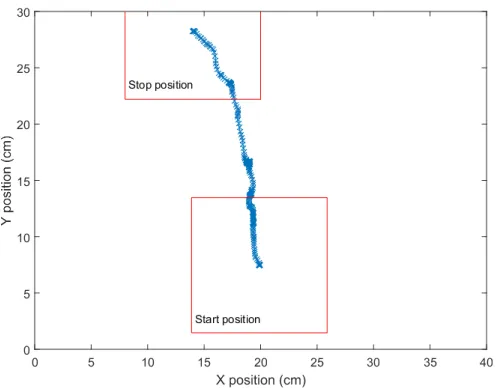
Figure 3 shows an example of the movement an object over a period of approximately 25 seconds; the image shows the start and stop positions and the blue cross shows the centre of mass of the object in each frame. The objects were often rotated by the motors in addition to moving over the surface; the centre of mass was used to track the object as this was a better method of position detection and rotation of the object is not relevant for object locomotion and sorting. The object appears to move outside the platform on the example which is elevated above the table so not to interfere with an object moving near the edge of the platform; if the object fell from the edge of the platform then tracking ceased. Starting positions were spread out in order to evaluate the whole surface’s manipulation ability.
Figure 3: An example of the movement from the start to stop position tracking of the object. The object’s centre-mass is represented by the blue crosses (one per frame) and the red squares represent the start and stop positions
repeats; the object occasionally slowed or moved back and forth throughout tracking, which after a period of a few seconds returned to original direction and speed. As is demonstrated in figure 3, the object did not always travel in a linear fashion due to the constant shift in relative actuator-object po-sitioning; to facilitate comparison between repeats, the speed vectors were calculated.
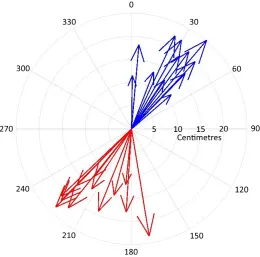
a significant difference between direction in which the object moved using a two tailed t-test (p<0.01).
4. Discussion
The results demonstrate that the smart surface is capable of sensing and moving an object placed on the cilia bio-inspired surface by IR light reflection from the object and resultant local vibratory motor force. The objects are transported across the surface in a North to North-Easterly direction with normal motor polarity and South-South-East to South-West with reversed motor polarity. This demonstrates that we have 2 directional transportation using this system, the manipulation equivalent of reversing the direction of the conveyor belt; since each vibrating motor can be controlled individually, local areas of reversed direction can be created, meaning unlike conveyor belts, objects on the same surface can travel in opposite directions. In addi-tion to being transported, objects were rotated as well as transversely moved across the surface, this was the result of the motor rotation; the necessity or importance of object orientation is application dependent. Some applica-tions such as object sorting do not require orientation manipulation, however the feasibility of controlled rotation is the subject of future work using this system now that a re-programmable sensor-actuator platform has been de-veloped. While the same square object was used in a testing environment, the authors also tested other shaped objects with no apparent difference in object manipulation; so long as an object is large enough to sit atop at least 3 motors at all times, it will be manipulated in the same direction although it may face more or less rotation while it is being moved.
This mode of bidirectional eccentric motor actuation is phenomenologi-cally similar to the beating of P. caudatum cilia, as all object manipulation is unidirectional (anterior to posterior, with a constant counter-clockwise rotation) as the organism swims forwards (and vice versa when the organ-ism reverses its direction of ciliary beating). The biological purpose of this mechanism is, as aforementioned, to facilitate grazing and drive net anterior or posterior migration, as these movements create fluid vortexes about the organism.
a computer and camera[15;16;17], where the computer interprets the object’s
position on the surface using the camera as a single sensing agent and manip-ulates the actuators with closed-loop control. Computer-camera closed-loop systems offer an improvement over open-loop systems however the subject of scalability becomes issue; the camera’s view needs to be modified for ev-ery change in smart surface layout, potentially with the need for calibration, while the computer’s control of an increasing number of sensors becomes ever more demanding. In this experiment the camera is used purely for data cap-ture and analysis, it offers no feedback to the system. The system presented here offers only local sensor-actuator control, which is a significant improve-ment for scalability and reconfiguration, as the boards can be arranged in any shape, without the need to modify the feedback or control mechanism. The board layout also supports local communication between boards and sensor-actuator units so different algorithms can be implemented with neighbour communication should this be required. This integration of a sensing loop into the platform represents the key novelty of our approach which, crucially, is designed to mimic the properties of biological cilia. While it would be possibly to shrink the boards down for scaling down the boards, there is sig-nificant advantage of the up-scalability of plug and play boards; the lack of centralised control means that absolutely no software reconfiguration needs to occur to increase the number of boards (and thus size of the platform) or change the overall shape of the platform.
Closed loop systems allow for more predictive manipulation. Governed by certain mapping rules, the closed loop system can fulfil the function of a simple conveyor, where the direction of motion and the final destination of the moved object depend on its initial displacement and orientation on the grid. The closed loop manipulators are sensitive to an objects shape. The manipulators are re-programmable, decentralised geometrical filters or sort-ing machines. Studies of parallel manipulators revealed beneficial properties and a high potential for distributed and decentralised object processing at micro and macro scales.
waves, which is presumably a route towards more efficient transport. As the mechanisms underlying the generation of metachronal rhythms in vivo are still only partially understood, their replication in silico may also enhance our understanding of this phenomenon. This topic of vibrating motor manip-ulation has been implemented in open loop systems[19]and will be the subject
of future work with this closed-loop platform. Local communication can be employed in future systems to organise a multitude of sorting algorithms, both bio-inspired or artificial.
A limitation of the board layout is the 15mm distance between sensor and actuator, meaning that there may be an object on the actuator, it is not sensed unless it is above the sensor; this may account for the somewhat unsteady movement of the object. Currently the vibrating motor actuator only rotates in a single direction, leading to directional limitations, however improvements to the actuator will improve the level and direction of ma-nipulation. The density of sensors and actuators is such that the object’s diameter must be greater than 8cm so that it is supported by at least 3 ac-tuators; a smaller object and it may fall in between the actuators. MEMS based smart surfaces[21] can manipulate much smaller and lighter objects (thin glass cover slips of a few mm in size in this example) but would ulti-mately fail to manipulate larger and heavier objects due to the lower force generated by the actuators; the density of sensor-actuator units may be im-proved in future generations. Zhou et al.[14] noted that MEMS cilia are
markedly different from their biological counterpart, and vibrating motor ac-tuators are no different; P. caudatum ciliary beat frequency is between 15 and 45 Hz[22], compared to the vibrating motors’ 205 Hz. Future generations
of MEMS or bespoke actuators may bridge the gap between bio-inspiration and become significantly more bio-mimetic.
5. Conclusion
the current system which we hope to address with ongoing research but this platform offers proof-of-concept for a scalable smart actuating surface with emergent properties.
We combined unconventional computing, bio-inspired engineering in a prototype of a parallel closed-loop actuators. In future developments, the actuators will be able to autonomously decide the particulars of orientation and transportation by itself without using any centralised facilities. The actuator array will intelligently recognise the object and will adapt to various shapes of manipulated objects; all using bio-inspired algorithms for localised neighbour communication. The manipulator surface will also process several objects at a time independently.
Declaration of Interest
The authors declare no conflict of interest and acknowledge the support of the Leverhulme Trust research project “ArtificialP. caudatum: intelligent distributed sensing and manipulation by ciliates” (Number RPG-2013-345).
6. References
[1] D Mitchell. The evolution of eukaryotic cilia and flagella as motile and sensory organelles. Advances in experimental medicine and biol-ogy, 607:130–140, 2007.
[2] Sidney L. Tamm. Ciliary motion in Paramecium A Scanning Electron Microscope Study. The Journal of Cell Biology, 55(1):250–255, 1972.
[3] In´es Ibanez-Tallon, Nathaniel Heintz, and Heymut Omran. To beat or not to beat: roles of cilia in development and disease. Human Molecular Genetics, 12(suppl 1):R27–R35, 2003.
[4] P Satir and S Christensen. Structure and function of mammalian cilia.
Histochemistry and Cell Biology, 129(6):687–693, 2008.
[6] Michael A Peshkin and Arthur C Sanderson. Planning robotic manip-ulation strategies for workpieces that slide. IEEE Journal on Robotics and Automation, 4(5):524–531, 1988.
[7] Patrick M McGuire. Conveyors: application, selection, and integration. CRC Press, 2009.
[8] B Borovic, AQ Liu, D Popa, H Cai, and FL Lewis. Open-loop versus closed-loop control of mems devices: choices and issues. Journal of Micromechanics and Microengineering, 15(10):1917, 2005.
[9] K.-F. B¨ohringer and Howie Choset. Distributed manipulation. Springer Science & Business Media, 2012.
[10] Mikell P Groover. Automation, Production Systems, and Computer-Integrated Manufacturing. Pearson Education Limited, third edition, 2014.
[11] K.Y. Goldberg. Orientating polygonal parts without sensors. Algorith-mica, 10(2):201–225, 1993.
[12] Lydia E Kavraki. Part orientation with programmable vector fields: Two stable equilibria for most parts. InRobotics and Automation, 1997. Proceedings., 1997 IEEE International Conference on, volume 3, pages 2446–2451. IEEE, 1997.
[13] K.-F. Bohringer, Bruce Randall Donald, and Noel C MacDonald. Pro-grammable force fields for distributed manipulation, with applications to mems actuator arrays and vibratory parts feeders. The International Journal of Robotics Research, 18(2):168–200, 1999.
[14] Zhi guo Zhou and Zhi wen Liu. Biomimetic Cilia Based on MEMS Technology. Journal of Bionic Engineering, 5(4):358–365, 2008.
[15] Manabu Ataka, Bernard Legrand, Lionel Buchaillot, Dominique Col-lard, and Hiroyuki Fujita. Design, fabrication, and operation of two-dimensional conveyance system with ciliary actuator arrays.
[16] K. Boutoustous, G. J. Laurent, E. Dedu, L. Matignon, J. Bourgeois, and N. Le Fort-Piat. Distributed control architecture for smart sur-faces. IEEE/RSJ 2010 International Conference on Intelligent Robots and Systems, IROS 2010 - Conference Proceedings, pages 2018–2024, 2010.
[17] John W. Suh, R. Bruce Darling, Karl F. Bohringer, Bruce R. Donald, Henry Baltes, and Gregory T A Kovacs. CMOS integrated ciliary actua-tor array as a general-purpose micromanipulation tool for small objects.
Journal of Microelectromechanical Systems, 8(4):483–496, 1999.
[18] K.-F. Bohringer, B.R. Donald, R. Mihailovich, and N.C. MacDonald. Sensorless manipulation using massively parallel microfabricated actu-ator arrays. Proceedings of the 1994 IEEE International Conference on Robotics and Automation, pages 826 – 833, 1994.
[19] Ioannis Georgilas, Andrew Adamatzky, David Barr, Piotr Dudek, and Chris Melhuish. Metachronal waves in cellular automata: Cilia-like ma-nipulation in actuator arrays. Studies in Computational Intelligence, 512:261–271, 2014.
[20] P Brehm and R Eckert. An electrophysiological study of the regula-tion of ciliary beating frequency in paramecium. Journal of Physiology, 283:557–568, 1978.
[21] K. F. Bohringer, B. R. Donald, and N. C. MacDonald. Single-crystal silicon actuator arrays for micro manipulation tasks. Micro Electro Me-chanical Systems, 1996, MEMS ’96, Proceedings. An Investigation of Micro Structures, Sensors, Actuators, Machines and Systems. IEEE, The Ninth Annual International Workshop on, pages 7–12, Feb 1996.