Contents lists available atScienceDirect
Behavioural Processes
journal homepage:www.elsevier.com/locate/behavproc
Complementary landmarks facilitate ant navigation
Edmund R. Hunt
a,⁎, Christopher Kendall
a,1, Emma Stanbury
a,1, Ana B. Sendova-Franks
b,
Nigel R. Franks
aaSchool of Biological Sciences, University of Bristol, BS8 1TQ, UK
bDepartment of Engineering Design and Mathematics, University of the West of England, BS16 1QY, UK
A R T I C L E I N F O
Keywords:
Navigation Vision Ants
Route landmarks Localisation
Temnothorax albipennis
A B S T R A C T
Visual landmarks are important navigational aids to many animals, and when more than one is available their juxtaposition can convey valuable new information to a navigator about progress toward a goal, depending on the landmarks’ comparative distinctiveness. We investigated the effect of presenting rock ant colonies (Temnothorax albipennis) with identical horizontal landmarks either side of their route, versus one horizontal landmark paired with a sloping landmark, as they navigated to a new nest site. Ourfindings suggest that ants can obtain more navigational information from a combination of dissimilar landmarks: the average tortuosity of the route taken between old and new nests was significantly lower when a horizontal landmark was paired with a monotonically downward sloping landmark (the paths were more direct). The impact on available navigational information from the similarity or dissimilarity of nearby landmarks is likely made through more distinctive visual panoramas, and could be an influential factor in individual and collective animal decision-making about which routes are followed. Furthermore, the effect of landmark complementarity may be relevant to a wide range of species, including other insects or birds, and highlights the possibility that there is an intrinsic dif-ference in the informational content of natural vs. artificial environments.
Significance Statement
To navigate between two points animals often make use of mem-orised route landmarks to follow a direct path toward the goal. When two landmarks are available nearby, one might presume that the route is even easier to follow: but the shape of the landmarks in relation to each other could influence their overall usefulness. We investigated whether colonies ofTemnothorax albipennisrock ants navigated to new nest sites with straighter paths when presented with a pair of identical horizontal landmarks, or a horizontal landmark and a landmark that sloped downward toward the new nest. The ants followed straighter paths when the landmarks were dissimilar, suggesting that this com-bination makes available more useful navigation information. Such an effect could have widespread relevance to animals’decision-making about which route to follow, given alternative paths to a destination with differently shaped landmarks.
1. Introduction
If external landmarks are available during navigation to a goal this can greatly reduce uncertainty in a navigator’s position, because
although position can be estimated through path integration, errors tend to accumulate over time (Cheung et al., 2007). Memorised land-marks are of major importance for the navigation of many ant species, either en route (Collett et al., 2001; Collett, 2010; Wystrach et al., 2011b) or as a beacon to be aimed for at the goal (Graham et al., 2003); and trail pheromones are often laid as a complementary source of na-vigational information (Czaczkes et al., 2015). The impact of differently shaped, sized and positioned landmarks has been extensively in-vestigated in ant and bee navigation studies (Collett et al., 1997;Collett and Kelber, 1988; Narendra and Ramirez-Esquivel, 2017; Woodgate et al., 2016), and yet the interplay between multiple landmarks, in relation to the emergence of new navigation information when the landmarks are differently-shaped, appears to have received relatively little consideration (for example, (Wystrach et al., 2011b) examines transposition or displacement of landmarks, rather than alteration of their relative appearances). Indeed, if two landmarks are identically shaped, this may be less useful to a navigator than if they have dis-tinctive, complementary characteristics. In natural environments such combinations, for example from rocky terrain and lines of trees, are likely to be typical, compared to the symmetrical landmark geometry often found in controlled experiments such as squares (Cartwright and
https://doi.org/10.1016/j.beproc.2018.03.004
Received 9 January 2018; Received in revised form 28 February 2018; Accepted 5 March 2018
⁎Corresponding author at: Department of Engineering Mathematics, University of Bristol, Merchant Venturers Building Office 2.51, Bristol BS8 1UB, UK.
1These authors contributed equally.
E-mail address:[email protected](E.R. Hunt).
Available online 06 March 2018
0376-6357/ © 2018 The Authors. Published by Elsevier B.V. This is an open access article under the CC BY license (http://creativecommons.org/licenses/BY/4.0/).
Collett, 1983) and cylinders (Durier et al., 2003). Here, we investigate whetherTemnothorax albipennisant colonies navigate more effectively to a new nest site when an extended horizontal landmark is placed alongside their route, opposite a landmark that slopes downward to-ward their goal, compared to a pairing with another identical hor-izontal landmark.
Our study species, the house-hunting rock ant Temnothorax albi-pennis, has been shown to use both the edge of a wall and discrete visual landmarks for navigation during an emigration to a new nest site (Pratt et al., 2001;McLeman et al., 2002). For comparison, the use of a wall for route landmark navigation has also been shown in wood ants (Formica rufa) (Graham and Collett, 2002). Another study ofT.
albi-pennis variously blocked the vision of follower and leader ants in a
tandem run and found that tandem runs without any impaired vision were actually the slowest, suggesting that this is because the ants are normally taking the opportunity to learn visual landmarks as they travel along (Franklin et al., 2011). Further research confirmed that follower ants learn landmarks during tandem running (Basari et al., 2013). Visually navigating ants can also memorise the appearance of landmarks for places (the nest and foraging locations) and along the route between them, route landmarks being associated with a particular direction of movement (Cruse and Wehner, 2011). Sequential landmark memory retrieval may be important in both ants and bees (Collett et al., 2006), and this route-following mechanism can be surprisingly robust (Collett et al., 2007). Wood ants (Formica rufa), when far from a goal, use landmarks like beacons, or divert around them, or use them to in-form directional choices (Graham et al., 2003). They typically follow a sequence of visual landmark memories tofind their way between the nest and a foraging area according to their feeding state (fed or unfed) (Harris et al., 2005). Previous studies have examined the impact of removing certain landmarks, with for example the removal of trees affecting the natural visual environment (Narendra and Ramirez-Esquivel, 2017). Sequential landmark retrieval can be understood as operating within a mechanism of panoramic image matching, whereby ants move tofit a memorised 2D image of the goal’s surroundings to their current view (Lent et al., 2010;Woodgate et al., 2016). This image matching process can be understood as operating like a terrestrial visual compass (Graham et al., 2010;Zeil, 2012). The navigation literature has tended to discuss edge following, proximal landmarks, visual bea-cons, and distant panorama as distinct sources of navigational in-formation and hence navigational strategies. However, recognition of the panoramic surround can be understood as a navigation strategy which aggregates all of these informational sources both near and far. Indeed, evidence suggests that for insects with relatively poor visual resolution, like the Temnothoraxants studied here (Ramirez-Esquivel et al., 2017), the ability to isolate landmarks from the rest of the scene may be both lacking and functionally unnecessary (see for example studies of the Australian desert antMelophorus bagoti, (Wystrach et al., 2011b;Schultheiss et al., 2016)). Therefore, the influence of similar or dissimilar landmarks is perhaps most likely to be through its impact on a navigating ant’s perception of the panoramic surround.
One scenario where visual navigation can be of critical importance for animals is in the emigration to a new nest site. In the case of T.
albipennisants emigrating to a new nest, the goal orientation of the ants
is clear: toward the new nest and away from the old one. Therefore, as in the studies of Pratt et al and McLeman et al (Pratt et al., 2001; McLeman et al., 2002) the emigration procedure of the ants is an ex-cellent opportunity to observe how the ants make use of multiple visual landmarks in their visual panoramas. WhenT. albipennishas learnt a route toward a new nest using a horizontal landmark to guide its way toward the goal, it stays a constant distance from the wall as it walks along by maintaining it at a persistent retinal position. This has been demonstrated by raising the wall, inducing the ants to shift away from it (because it appears bigger, or closer) and lowering the wall, inducing a shift toward it (because it appears smaller, or further away) (Pratt et al., 2001). This effect was also found in desert ants, both Cataglyphis
(Heusser and Wehner, 2002) andMelophorus, where research on visual panoramas found the ants moved toward a lowered wall, while still using the overall panorama for determining direction of travel ( Julle-Daniere et al., 2014). While a horizontal landmark can be used by
Temnothorax ants to estimate their location perpendicular to it, the
retinal image it creates is constant from the beginning of a journey to its end, and thus does not convey any information itself as to the journey’s longitudinal progress parallel to the wall. However, if a sloping land-mark (monotonically increasing or decreasing in height) was available opposite an existing horizontal landmark, there should also be in-formation available in relation to longitudinal distance. This is because the height of the sloping landmark may be used to indicate the progress toward the goal of an ant navigating parallel to the wall, with reference to afixed perceived height of the horizontal landmark. Opticflow is used by honeybees to measure the distance to a food source (Esch and Burns, 1995), and a sloping landmark could add to the opticflow and thus aid navigation; however, optic flow was not found to influence distance estimation inCataglyphis(Ronacher et al., 2000) and is per-haps even less relevant to slowly movingTemnothoraxants. A sloping landmark edge being used for navigation, without a second landmark reference to estimate lateral position, might be expected to yield an oblique path, as considered in Pratt et al (Pratt et al., 2001). For comparison, work on desert ants, Cataglyphis fortis, found a visual centring behaviour whereby ants walk along the midlines of alleys formed by adjacent low shrubs (Heusser and Wehner, 2002). The ants try to balance the vertical angle subtended by the landmarks on either side, and so if the height of one side is raised, they tend to move their path closer to the lower side (Heusser and Wehner, 2002); somewhat similarfindings are identified inMelophorus bagoti(Julle-Daniere et al., 2014). Considering horizontal or sloping landmarks in terms of their influence over the‘skyline’panorama (Julle-Daniere et al., 2014), with two horizontal landmarks either side of the route the panorama gives no directionality toward the goal. When a sloping landmark is present, the ants’ ‘skyline’becomes distinct and one part of it points toward the goal, and thus navigability is improved, which should be evident in straighter paths. In sum, while 30 years of social insect research has accumulated important insights into the mechanisms of route landmark memorisation and retinal image matching in natural (Zeil, 2012) and laboratory environments (Stürzl et al., 2008), the specific interplay of landmark shapes (similar or dissimilar) in determining the navigability of paths has received relatively little attention. Yet, differences between alternative paths in how easy they are to navigate are likely to be highly influential in individual and collective decision-making about which route to take.
It has been suggested previously that T. albipennis may exhibit sensory lateralization during navigation, responding more strongly to landmarks in their right-hand visualfield (Basari et al., 2013). Later-alization of brain and behaviour is increasingly recognised as common among insects (Frasnelli et al., 2012;Frasnelli, 2017;Hunt et al., 2014), with for instance honeybees (Apis millifera) showing lateralization in their visual system to learn a colour stimulus better with their right eye (Letzkus et al., 2008). Therefore, we also sought to investigate whether there is a difference between the ants’response to landmarks on the left and right side of their visualfield.
2. Materials and methods
2.1. Experimental colonies
Five queenrightT. albipenniscolonies were collected in Dorset, U.K., in September 2014. All the colonies had a similar number of workers, and consisted of workers, brood items, and a single queen. The colonies were emigrated into artificial nests made from two 75 × 50 × 1 mm glass microscope slides with a 2 mm thick layer of cardboard sand-wiched in between. The nests were 4 mm tall. The cardboard had a central 65 × 40 mm cavity, area 2600 mm2and an entrance 5 mm wide and 5 mm long. The front edges of the cardboard perimeter were cut so they could be carefully removed with forceps, which helped to induce a non-emergency emigration because the ants prefer narrow, defensible nest entrances (Franks et al., 2003). A cardboard layer on top kept the nests dark, which could also be removed to further reduce the quality of the original nest. The nests were kept in 100 × 100 × 17 mm petri dishes with Fluon applied to the walls to prevent the ants from es-caping. The ants were fed once a week on honey solution and dead
Drosophilaflies and fresh water were availablead libitum.
2.2. Experimental treatments
Three different experimental treatments were carried out in a 700 × 210 × 105 mm arena made of white card for the walls and a large pane of glass for the base (Fig. 1A). Tape 10 mm wide was applied to the base of each wall and Fluon applied to prevent the ants from escaping. An A4 (297 × 210 mm) sheet of clear acetate was placed in the centre of the arena, which could be replaced with a clean one before recording each ant’s navigation across it, to prevent the use of pher-omone trails or other cues assisting navigation (Basari et al., 2014;
Bowens et al., 2013;Pratt et al., 2001).
A permanent 700 × 45 mm rectangular landmark made of black card was affixed to each of the two longer walls (Fig. 1A). For a small ant of 2–3 mm in length, the 297 mm long acetate sheet is around 100 body lengths, a considerable distance to navigate successfully. This distance also makes it reasonable to assume that the ants cannot see the goal (the new nest) from the beginning of their journey given their angle of acuity (see later).
The three experimental treatments were applied using three dif-ferent configurations of black card landmarks. These were as follows: two (permanently placed) horizontal rectangles; a triangular sloping shape added to the right side (as facing the new nest); or a triangle added to the left side (Fig. 1B). The right-angled triangle had sides of 700 × 50 mm, subtending an angle of 4.09 degrees (Fig. 1C).
The landmarks were large enough to make sure that if the ant was at the opposite side of the arena (210 mm away), they would still be re-solvable with a conservatively assumed 7° angle of acuity, a value used in a previous study (Pratt et al., 2001). A recent study ofTemnothorax
rugatulusreports an average inter-ommatidial angle of 16.8° in workers,
suggesting considerably poorer spatial resolution than this assumption (Ramirez-Esquivel et al., 2017). Using this angle, simple trigonometry indicated that each landmark must be larger than 25.8 mm in height if they are to be discernible at either side of the 210 mm sheet. By maintaining a constant height of the horizontal landmark in theirfield of view, the ants should be able to maintain a constant position in the 210 mm between the arena sides (Pratt et al., 2001); while the height of the sloping landmark (paired with a given horizontal landmark height on the opposite side) could indicate progress along the route toward the new nest site.
2.3. Experimental set-up and protocol
At the beginning of an experimental trial a colony was placed in the arena and the front walls and cardboard cover of the nest removed (while keeping the top glass slide intact) to lower its quality, stimu-lating ant scouts to leave the nest in search of an alternative (Franks et al., 2003;Dornhaus et al., 2004). A higher-quality nest was placed at the opposite end of the arena, with identical dimensions as the starting nest but with intact front walls and a layer of red acetate on the top, so that the nest would be rendered dark (and hence more attractive to scouting ants) but with the ants remaining observable. After scouting ants had discovered the higher quality alternative nest, and recruited other ants to inspect the site, a quorum would be reached after a period of time and an emigration would begin. The nests were situated 50 mm from the edge of the acetate sheet so that the ants would be unlikely, given their angle of acuity (see earlier), to observe the 4 mm tall nests (old and new) using sight until they had walked all or most of the way across the sheet.Temnothoraxants can mark the area inside nests using pheromones as familiar (Franks et al., 2007) or undesirable (Sasaki et al., 2014); whileLasius nigerants mark the area around their nest entrance using colony-specific, cuticular hydrocarbon footprints, albeit at a low level (Lenoir et al., 2009). Because the nests were 50 mm from the marking free-area (post sheet removal) it is therefore unlikely that the navigating ants could detect their goal through chemical informa-tion.
After placing the starting nest (containing the colony) and the empty new nest in the arena, recording began of the emigration process across the acetate sheet. After the new nest site had been discovered and a collective decision to migrate there had been taken by the colony (Pratt et al., 2002), individual ants carrying a brood item were selected for tracking (see followingData Collectionsubsection) by pointing to them with a paintbrush and noting the time. By selecting only brood-carrying ants for tracking it was certain that only ants attempting to navigate to the new nest would be sampled.
[image:3.595.42.283.394.631.2]Brood transporters were selected randomly, such that the tracks recorded are likely to be representative of all the colony tracks, in Fig. 1.(A) The experimental arena showing the new nest (left) and the old nest
(right). An A4-sized (210 × 297 mm) acetate sheet is placed in the centre. The horizontal landmark treatment is shown, with one side not visible.
(B) The three landmark configurations used in the experiment, as seen from above: a) horizontal; b) sloping landmark on the right; c) sloping landmark on the left. The old nest is located at the bottom, the new nest at the top, and the A4 acetate sheet is the rectangle in the middle.
proportion to the frequency of individual transporters. As such, fre-quent transporters are more likely to be represented than one-off transporters. Before a selected ant stepped onto the acetate sheet, the sheet was removed and replaced with a clean one without any pher-omone deposits. This ensured that the navigating ant would not be relying on any pheromone markers to guide it to its destination, which would otherwise confound the effect of changing the available visual landmarks. For example,T. albipennisworkers have been shown to lay pheromone trails during their tandem running process (Basari et al., 2014). If there were any ants on the sheet when it needed to be re-moved they were brushed off back to behind the starting nest. Re-moving ants after they had deposited their carried brood item would have been too disruptive to the emigration process, and ants were not marked individually, so a single ant may have contributed more than one recorded trajectory. Therefore, our sampling unit is ant colony trajectory not the trajectories of individual ants and hence our results represent the typical trajectories at the colony level (some ants are more active brood transporters than others), rather than the diversity of the trajectories of individuals (that is, including the trajectories of in-frequent or one-offbrood transporters). Statistics are thus undertaken at the level of the colony relocation behavioural process.
There was a target to record 15 ant trajectories per day of experi-menting, but also a time limit of 4 h for the emigration. In several trials, either owing to slow emigrations, or because ants reversed their path and returned back to the nest (outside the video camera’sfield of view) and could no longer be identified, this target could not always be reached (Table 1). Nevertheless, the average number of trajectories recorded per day was 12.2, with a minimum of 7.
After the emigration process was completed, with all the brood items and the queen moved into the new nest, the starting nest was rebuilt (the front walls returned to their original place), and it was put back into the colony’s petri dish. The colony’s new nest was placed back into the dish on top of the old nest, and its roof was removed to make
the ants to move back into their original nest. Treatments were rotated according to date (Table 1): each colony had at least eight days between experimental trials so they would forget the landmarks and not improve their migration speed. Previous research found that after a period of six days or more,T. albipennisants that have moved nest do not show any improvement in emigration speed (Langridge et al., 2004), indicating that trial experience has been forgotten or diminished in influence. Thus, the minimum eight-day gap between trials controlled for any effect of individual experience. All the experimental trials were carried out at the same time of day under constant artificial lighting conditions. After a day’s experimenting was completed, the glass arenafloor, the new nest’s component parts (microscope slides and red acetate cover) and the acetate sheets used for each track were cleaned. A four-step cleaning process was employed to remove any pheromones left by the ants:first, a weak solution of detergent and water; second, a rinse of water; third, a wipe of ethanol solution (70% ethanol, 30% water); fourth, another rinse of water.
2.4. Data collection
It was not possible to record data blind because the treatments were visually distinctive (different landmarks). FiveT. albipennis colonies were each tested with each of the three landmark treatments, for N = 15 trial days. The unit of measurement was each colony’s trajec-tories rather than the individual ant.
A video camera (Panasonic HC-X900M) was mounted on a copy stand outside of the arena to record the ants’movements. The paths of ants were traced out manually from the recorded videos by following a navigating ant with the computer mouse cursor in Presentation Assistant v2.9.1, free software that can be used to draw on the screen in the Microsoft Windows operating system. The trajectories were traced from one side of the acetate sheet to the other as a green line, with the sides of the sheet also being recorded as reference dimensions as a red line. The trajectories were then converted into coordinates using MATLAB R2014a, using a simple script that loaded the JPEG images into an RGB matrix, discarded the red and blue channels, and then picked out the centroid coordinates of the traced green lines in the direction of travel. The time spent by each ant on the acetate sheet was also recorded from the videos.
The tortuosityτof the paths was calculated asτ= −1 D L/ , whereD
is the straight-line distance between the points where the ant stepped onto and offthe sheet, andLis the length of the path followed. This measure of tortuosity ranges between 0 (D=L, a straight line, not at all tortuous) and 1 (L> >D, not at all like a straight line, very tortuous), and is a reliable measure of the efficiency of an oriented path (Benhamou, 2004).
2.5. Statistical analysis
The tortuosity and speed values werefirst calculated in MATLAB 2015b, and then IBM SPSS Statistics 23 was used to perform in-vestigations into the shape of distributions, Shapiro-Wilk’s test of nor-mality, and linear mixed model (LMM) analysis of the speed and tor-tuosity data.
[image:4.595.51.275.459.747.2]The tortuosity data (the dependent variable in the LMM) were not normally distributed, so they were given a log10transformation to make them more compatible with a normal distribution (Shapiro-Wilk test statistic = 0.975, df = 183, p = 0.002, Fig. S1). A LMM with normal error distribution and an identity link was specified with log10 tortu-osity as the response, treatment as afixed factor predictor, speed as a covariate, the interaction between treatment and speed and colony as a random factor predictor (including intercept estimation). This LMM had approximately normal Pearson residuals, indicating reasonable model fit at large N = 183 (Shapiro-Wilk test statistic = 0.978, df = 183, p = 0.005, Fig. S2). A sequentialŠidák correction was made for repeated comparisons between the different treatment effects. Table 1
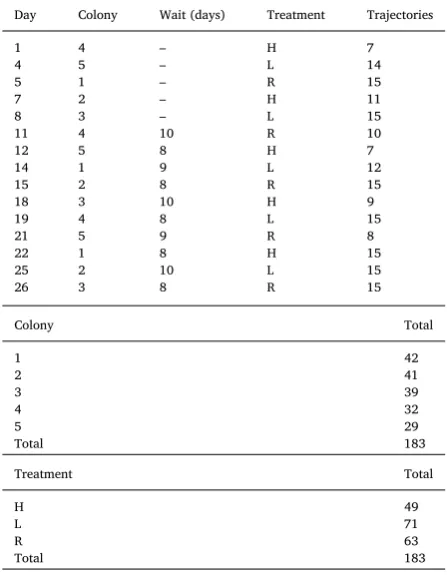
The order of treatments undergone by each colony, and number of trajectories recorded. H = Horizontal landmarks only, L = sloping landmark present on left, R = present on right.
Day Colony Wait (days) Treatment Trajectories
1 4 – H 7
4 5 – L 14
5 1 – R 15
7 2 – H 11
8 3 – L 15
11 4 10 R 10
12 5 8 H 7
14 1 9 L 12
15 2 8 R 15
18 3 10 H 9
19 4 8 L 15
21 5 9 R 8
22 1 8 H 15
25 2 10 L 15
26 3 8 R 15
Colony Total
1 42
2 41
3 39
4 32
5 29
Total 183
Treatment Total
H 49
L 71
R 63
3. Results
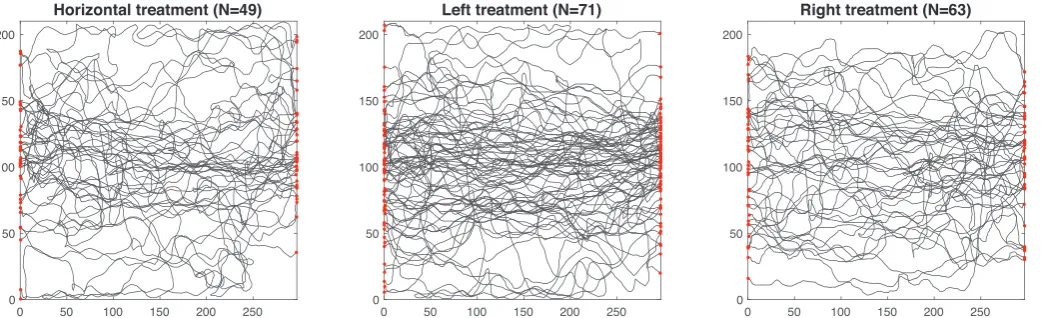
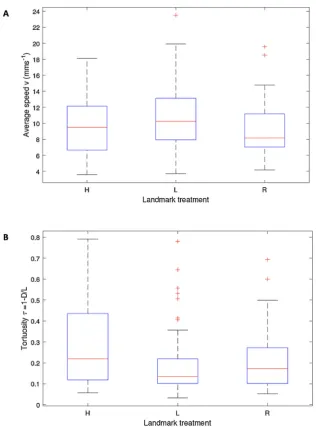
We found that ant colonies follow less tortuous routes to a new nest site when a sloping landmark was present, and we also found a sig-nificant interaction between movement speed and landmark treatment. The number of trajectories recorded from each colony-treatment pairing is shown inTable 1. In total, 183 trajectories were recorded. Two example trajectories from the same treatment and colony (hor-izontal landmarks, colony 1) are shown inFig. 2, while all trajectories are shown inFig. 3. The average (mean) speeds in mms−1for each treatment were as follows: horizontal landmarks, vH=9.51±0.50; sloping landmark on the left,vL=10.48±0.46; sloping landmark on the right,vR=9.10±0.39(mean ± standard error). The back-transformed mean tortuosities, after a log10 transformation to account for rightward skew, were: τH=0.225±0.047, τL=0.152±0.034, τR=0.173±0.035. Boxplots of the speed and tortuosity data are shown inFig. 4.
Linear mixed model analysis showed that, as might be expected, speed was negatively related to tortuosity (F1,177= 27.218, p< 0.001), i.e. journeys undertaken at a higher average movement speed were also less tortuous, perhaps indicating the effect of greater confidence in the path being taken. Even when this relationship was taken into account, by including speed into the model, the experimental treatments had a significant effect on tortuosity (F2,177= 6.175, p= 0.003). The tortuosity was significantly higher in the horizontal landmarks treatment compared to the left sloping landmark treatment
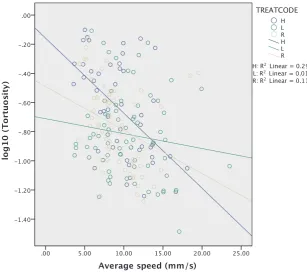
[image:5.595.145.456.52.198.2](mean difference = 0.066, t = 2.948, df = 177,p= 0.011) and right sloping landmark treatment (mean difference = 0.053, t = 2.262, df = 177,p= 0.049) but the left and right treatments were not sig-nificantly different (mean difference = 0.012, t = 0.676, df = 177, p= 0.500). However, the interaction between treatment and speed was also significant (F2,177= 3.837,p= 0.023) indicating that the experi-mental treatments did not simply affect tortuosity but the gradient of the relationship between tortuosity and speed (Fig. 5). More specifi -cally, this relationship was statistically significant for the H and R treatments, though not for the L treatment, where the gradient was not different to zero (H: t =−4.438, p< 0.001; R: t =−2.732, p= 0.007; L: t =−1.318,p= 0.189). This may be explained by re-ference toFig. 3 and Fig. 4B which indicate that the majority of tra-jectories in the L treatment are direct. The gradient for the treatment with the sloping landmark on the left was significantly smaller in comparison to the horizontal treatment (t =−2.742,p= 0.007) but there was no significant difference between left and right sloping landmark treatments (t = 1.330,p= 0.185), nor between horizontal and right (t = 1.290,p= 0.199,Fig. 5). This together with the asso-ciation between smaller gradients and smaller intercepts in the re-lationship between speed and log-transformed tortuosity is evidence that the pairing of a horizontal and a sloping landmark affects ant movement behaviour. The random factor colony was not significant (z = 0.726,p= 0.468).
Fig. 2.Examples of trajectories (from colony 1 and the horizontal landmarks treatment): a relatively low tortuosity trajectory (top path in blue,τ=0.116) and a higher tortuosity trajectory (bottom path in red,τ=0.463). The loop in the red path may indicate a visual reorientation. The direction of tracking is marked, from the old nest to the new nest. (For interpretation of the references to colour in thisfigure legend, the reader is referred to the web version of this article).
[image:5.595.42.563.526.685.2]4. Discussion
The results presented here show that ant colonies navigating to a new nest site while carrying brood items follow a less tortuous path when two landmarks, running parallel to the ants’paths on either side, are dissimilar (horizontal and sloping) compared to when they are si-milar (matching horizontal). We hypothesise that this is because the dissimilar landmark combination offers enhanced navigational in-formation: and landmark information can be used to reduce path errors (Cheung et al., 2007). We consider below how this navigational in-formation may be perceived.
A significant interaction between treatment and speed was also found and is further evidence that landmark pairings affect movement behaviour. Speed and tortuosity were negatively associated in the colony-level statistics, afinding which may relate to greater confidence in the route being followed by ants that have already carried at least one brood item. Such an association between higher speeds and straighter paths has been found before in humans (Mittelstaedt and Mittelstaedt, 2001). On the other hand, apart from uncertainty, a ne-gative tortuosity-speed relationship may reflect simply physical or
mechanical limitations of higher movement speed when paths have more turns. Interestingly, the sloping landmark on the right treatment had the lowest mean speed of the treatments (Fig. 4A), notwithstanding its lower average tortuosity than the horizontal treatment, which may suggest that multiple alternative factors are at work: speeds could be lower because of higher tortuosity, or because when better landmark information is available, ants may slow down to follow it. We did not find statistical evidence for our hypothesis that the ants would navigate most effectively (with the least tortuous path) in the treatment with the sloping landmark on the right (there was no significant difference be-tween left and right). However, although the metrics of tortuosity and average speed do not detect a difference,Fig. 3gives qualitative in-dication that the trajectories between old and new nest are more cen-trally located when the sloping landmark is on the right side.
[image:6.595.139.456.50.478.2]How might the experimental scenarios examined here relate to real situations encountered by ants and other animals? While symmetrical landmarks are perhaps unlikely to be found in many natural environ-ments, some situations such as walking along the bottom of a trench (e.g. a crack in dry earth, a split log, or a dry rivulet) may mimic this kind of setup in our study, especially if viewed through a low-resolution Fig. 4.Boxplots showing the median and quartiles, whiskers indicate the most extreme points that are not outliers, and outliers are plotted individually (defined as more than 1.5 times the interquartile range away from the top or bottom of the box). N = 49, 61, 73 for H, L, R.
visual system. Many artificial environments such as urban landscapes might also be rich in symmetrical visual cues. This suggests the possi-bility that there is an intrinsic difference in the informational content of natural vs. artificial environments, a point which is worthy of con-sideration in the interpretation of any study of animal navigation.
Ourfindings suggest that certain configurations of environmental objects make more effective navigation possible, depending on the geometric characteristics of the objects as perceived from a navigator’s perspective. While previous research on navigating T. albipennis sug-gested that jagged rock edges may result in more sinuous paths than horizontal edges (Pratt et al., 2001), the opposite may be true in certain contexts. This is because the combination of a horizontal landmark, paired with a monotonically sloping landmark, may make available more navigational information than two matched horizontal land-marks. This could result from multiple plausible mechanisms, but we suggest that the creation and perception of more distinctive visual pa-noramas is the most likely mechanism. First we consider the possibility that, if an ant can perceive that the height of a downward sloping landmark, for example, is lowest at its goal it could track toward the lower end of the slope using it like a beacon (like the landmark objects in McLeman et al., (McLeman et al., 2002)). However, this may be somewhat unlikely, because even with a generously assumed spatial resolution of 7° the ant would be unable to see the end of the slope from the beginning of its journey at the edge of the acetate sheet (T. rugatulus workers have an average inter-ommatidial angle of 16.8° ( Ramirez-Esquivel et al., 2017)). The second explanation we consider is that ants can observe a changing height in the sloping landmark as they move parallel to it and, after associating the location of the new nest with a particular pair of heights on the sloping landmark and the horizontal landmark opposite it, better track their progress between the old and new nests during navigation. Alternatively, if the height of a landmark could be simultaneously perceived at points across its whole length it is possible that a single sloping edge could be used for both lateral and longitudinal positioning. This may be possible with a small landmark and hence relatively short journeys, though in such circumstances al-ternative navigation techniques such as path integration may be suffi -cient alone. Either way, ants are unlikely to make such geometrical ‘calculations’: not only may they lack the ability to parse the world into
particular landmarks of interest, this might not be necessary to gain navigational information from the presence of landmarks in theirfield of view. Therefore, the third explanation we consider is that the overall scene produced by two dissimilar landmarks may be more distinctive in aggregate along the route, and thus facilitate orientation, than when two landmarks are identical. This is likely to be perceived as a change in the ant’s visual panorama (Julle-Daniere et al., 2014;Wystrach et al., 2011a,b), which comprises features otherwise regarded as distinct by a human observer (prominent edges, both proximal and distant land-marks, and visual beacons), without processing a functional segregation (Wystrach and Graham, 2012;Baddeley et al., 2012). In the experiment considered here, ants of the same genus,Temnothorax rugatulus, have only 45–76 ommatidia per compound eye (Ramirez-Esquivel et al., 2017) compared to 420–590 in M. bagoti (Schwarz et al., 2011). Moreover, T. rugatulus eyes are severely under-focussed ( Ramirez-Esquivel et al., 2017), which could suggest far-sightedness (i.e. that distant objects are perceived more clearly than close ones). Both of these characteristics suggest that dissimilar landmarks are likely to be perceived in a changing visual panorama. The distinguishability of potential routes, as formed by dissimilar landmarks within the visual panorama, may be an important, understudied factor in individual and collective decision-making about where to form a path to a resource, for example, with a route featuring more distinctive landmark objects being preferred, all else being equal.
[image:7.595.36.344.54.326.2]Our results may be relevant to other animals that rely on route landmarks for navigation. For instance, honey bees memorise the sun’s course with respect to local landmarks, such as lines of trees, for when it is not available (von Frisch, 1967;Dyer and Gould, 1981). Honeybee foragers use deformations in the landscape horizon as cues for distance navigation when available: in the absence of such physiographic fea-tures they engage in a searching flight pattern (Southwick and Buchmann, 1995). For aflying insect using a slope to navigate, if it does not maintain its altitude, it could appear as if the animal was gaining height, and so in such a case separate mechanisms to maintain altitude may be necessary. The usefulness of a sloping landmark to enhance navigational accuracy, beyond that possible withflat environmental features (with or without a horizontal edge for reference), may be found in future in vertebrates, such as migratory birds or mammals. Pigeons Fig. 5.The interaction between speed (mms−1) and treat-ment, in relation to tortuosity. Thefitted gradient for the left sloping landmark treatment is significantly lower than for the horizontal treatment (t =−2.742, p = 0.007). Lines of best
fit for H: y = -0.144-0.053x, R: -0.474-0.031x, L: y = -0.695-0.012x. (For interpretation of the references to colour in this
have been shown to use slopes to encode a goal location (Nardi and Bingman, 2009a,b;Nardi et al., 2010;Nardi et al., 2012), while golden hamsters (Mesocricetus auratus) have been shown to use visual land-marks to reset their path integrator, preventing the accumulation of errors (Etienne et al. 2004). There has also been research on humans using slopes in the terrain for reorientation (Nardi et al., 2009;Nardi et al., 2013;Restat et al., 2004).
Thefindings presented here could also be relevant to efforts to de-velop more effectively navigating autonomous robots, in as much as they emphasise the change in information available to a navigator with even slightly different environmental object configurations. Ants’ ap-parent reliance on a sequence of memorised images tofind their way toward a goal (Wehner and Räber, 1979) has already inspired various biomimetic navigation methods. For example, panoramic images have been used for navigation in aflying robot, taking advantage of the re-tinotopic matching technique’s relatively low computational and hence energy demands (Philippides et al., 2016). An even more parsimonious method performed sky segmentation using ultraviolet light to obtain binarised (sky and non-sky) images for use in a visual compass (Stone et al., 2014); this was inspired by the behaviour ofM. bagotidesert ants (Graham and Cheng, 2009). Localisation was also found to be possible using UV-segmented images (Stone et al., 2014); mobile robots typi-cally implement some type of simultaneous localisation and mapping (SLAM) algorithm, whereby an unknown environment is mapped and the robot’s position within that map is estimated at the same time (Thrun and Leonard, 2008). Roboticists face the same challenge as the ants of extracting relevant informational cues from the environment and integrating them into movement decisions. A renewed focus on the positional information made available by the juxtaposition of dissimilar landmarks, such as a pair of horizontal and monotonically sloping landmarks (or similar) could reveal previously untapped potential for the enhancement of localisation accuracy.
5. Conclusion
We studied the effect of presenting similar or dissimilar landmarks
toTemnothoraxworker ants carrying their brood to a new nest site. The
ants navigated more directly (with a lower tortuosity) when a hor-izontal landmark on one side of their route was paired with a down-wards sloping landmark on the other side, rather than paired with another horizontal landmark. We suggest that this is because the dis-similarity conveys more navigational information, by creating more distinctive visual panoramas for the ants to perceive with their low-resolution optical system. Our experimental setup could be relevant to various real-life scenarios, such as walking along the bottom of a trench (e.g. a crack in dry earth, a split log, or a dry rivulet), while artificial environments such as urban landscapes might also be rich in symme-trical visual cues. Ourfindings highlight the possibility that there is an intrinsic difference in the informational content of natural vs. artificial environments, and may be relevant to a wide variety of animals that use landmarks for navigation, including other insects or birds.
Funding
E.R.H. acknowledges funding from the UK Engineering and Physical Sciences Research Council (grant no. EP/I013717/1 to the Bristol Centre for Complexity Sciences).
Author contributions
E.R.H. drafted the manuscript, helped to plan the experiment and assisted with data acquisition; C.K. and E.S. performed the experiments and acquired the path trajectories; A.B.S.-F. carried out the statistical analysis; N.R.F. conceived the study; all authors contributed to thefinal manuscript and gavefinal approval for publication.
Appendix A. Supplementary data
Supplementary data (trajectory lengths and durations) are available on Mendeley Data at DOI:10.17632/7nz8n394bn.1.
References
Baddeley, B., Graham, P., Husbands, P., Philippides, A., 2012. A model of ant route na-vigation driven by scene familiarity. PLoS Comput. Biol. 8, e1002336.http://dx.doi. org/10.1371/journal.pcbi.
Basari, N., Bruendl, A.C., Hemingway, C.E., Roberts, N.W., Sendova-Franks, A.B., Franks, N.R., 2013. Landmarks and ant search strategies after interrupted tandem runs. J. Exp. Biol. 217, 944–954.http://dx.doi.org/10.1242/jeb.087296.
Basari, N., Laird-Hopkins, B.C., Sendova-Franks, A.B., Franks, N.R., 2014. Trail laying during tandem-running recruitment in the antTemnothorax albipennis.
Naturwissenschaften 101, 549–556.http://dx.doi.org/10.1007/s00114-014-1191-1. Benhamou, S., 2004. How to reliably estimate the tortuosity of an animal’s path:
straightness, sinuosity, or fractal dimension? J. Theor. Biol. 229, 209–220.http://dx. doi.org/10.1016/j.jtbi.2004.03.016.
Bowens, S.R., Glatt, D.P., Pratt, S.C., 2013. Visual navigation during colony emigration by the antTemnothorax curvispinosus. PLoS One 8.http://dx.doi.org/10.1371/journal. pone.0064367.
Cartwright, B.A., Collett, T.S., 1983. Landmark learning in bees. J. Comp. Physiol. 151, 521–543.http://dx.doi.org/10.1007/bf00605469.
Cheung, A., Zhang, S., Stricker, C., Srinivasan, M.V., 2007. Animal navigation: the
dif-ficulty of moving in a straight line. Biol. Cybern. 97, 47–61.http://dx.doi.org/10. 1007/s00422-007-0158-0.
Collett, M., 2010. How desert ants use a visual landmark for guidance along a habitual route. Proc. Natl. Acad. Sci. 107, 11638–11643.
Collett, T.S., Collett, M., Wehner, R., 2001. The guidance of desert ants by extended landmarks. J. Exp. Biol. 204, 1635–1639.
Collett, T.S., Fauria, K., Dale, K., Baron, J., 1997. Places and patterns—a study of context learning in honeybees. J. Comp. Physiol. A 181, 343–353.http://dx.doi.org/10. 1007/s003590050120.
Collett, T.S., Graham, P., Harris, R.A., 2007. Novel landmark-guided routes in ants. J. Exp. Biol. 210, 2025–2032.http://dx.doi.org/10.1242/jeb.000315.
Collett, T.S., Graham, P., Harris, R.A., Hempel-de-Ibarra, N., 2006. Navigational mem-ories in ants and bees: memory retrieval when selecting and following routes. Advances in the Study of Behavior. Academic Press.
Collett, T.S., Kelber, A., 1988. The retrieval of visuo-spatial memories by honeybees. J. Comp. Physiol. A 163, 145–150.http://dx.doi.org/10.1007/bf00612004. Cruse, H., Wehner, R., 2011. No need for a cognitive map: decentralized memory for
insect navigation. PLoS Comput. Biol. 7, e1002009.http://dx.doi.org/10.1371/ journal.pcbi.1002009.
Czaczkes, T.J., Gruter, C., Ratnieks, F.L.W., 2015. Trail pheromones: an integrative view of their role in social insect colony organization. Annu. Rev. Entomol. 60 (60), 581–599.http://dx.doi.org/10.1146/annurev-ento-010814-020627.
Dornhaus, A., Franks, N.R., Hawkins, R.M., Shere, H.N.S., 2004. Ants move to improve: colonies ofLeptothorax albipennisemigrate whenever theyfind a superior nest site. Anim. Behav. 67, 959–963.http://dx.doi.org/10.1016/j.anbehav.2003.09.004. Durier, V., Graham, P., Collett, T.S., 2003. Snapshot memories and landmark guidance in
wood ants. Curr. Biol. 13, 1614–1618.http://dx.doi.org/10.1016/j.cub.2003.08.024. Dyer, F.C., Gould, J.L., 1981. Honey bee orientation: a backup system for cloudy days.
Science 214, 1041–1042.http://dx.doi.org/10.1126/science.214.4524.1041.
Esch, H., Burns, J., 1995. Honeybees use opticflow to measure the distance of a food source. Naturwissenschaften 82, 38–40.
Etienne, A.S., Maurer, R., Boulens, V., Levy, A., Rowe, T., 2004. Resetting the path in-tegrator: a basic condition for route-based navigation. J. Exp. Biol. 207, 1491–1508.
http://dx.doi.org/10.1242/jeb.00906.
Franklin, E.L., Richardson, T.O., Sendova-Franks, A.B., Robinson, E.J.H., Franks, N.R., 2011. Blinkered teaching: tandem running by visually impaired ants. Behav. Ecol. Sociobiol. 65, 569–579.http://dx.doi.org/10.1007/s00265-010-1057-2. Franks, N.R., Hooper, J.W., Dornhaus, A., Aukett, P.J., Hayward, A.L., Berghoff, S.M.,
2007. Reconnaissance and latent learning in ants. Proc. R. Soc. London B: Biol. Sci. 274, 1505–1509.http://dx.doi.org/10.1098/rspb.2007.0138.
Franks, N.R., Mallon, E.B., Bray, H.E., Hamilton, M.J., Mischler, T.C., 2003. Strategies for choosing between alternatives with different attributes: exemplified by house-hunting ants. Anim. Behav. 65, 215–223.http://dx.doi.org/10.1006/anbe.2002. 2032.
Frasnelli, E., 2017. Lateralization in invertebrates. Lateralized Brain Functions. Springer. Frasnelli, E., Vallortigara, G., Rogers, L.J., 2012. Left-right asymmetries of behaviour and nervous system in invertebrates. Neurosci. Biobehav. Rev. 36, 1273–1291.http://dx. doi.org/10.1016/j.neubiorev.2012.02.006.
Graham, P., Cheng, K., 2009. Ants use the panoramic skyline as a visual cue during na-vigation. Curr. Biol. 19, R935–R937.http://dx.doi.org/10.1016/j.cub.2009.08.015.
Graham, P., Collett, T.S., 2002. View-based navigation in insects: how wood ants (Formica rufaL.) look at and are guided by extended landmarks. J. Exp. Biol. 205, 2499–2509. Graham, P., Fauria, K., Collett, T.S., 2003. The influence of beacon-aiming on the routes
of wood ants. J. Exp. Biol. 206, 535–541.http://dx.doi.org/10.1242/jeb.00115. Graham, P., Philippides, A., Baddeley, B., 2010. Animal cognition: multi-modal
interac-tions in ant learning. Curr. Biol. 20, R639–R640.http://dx.doi.org/10.1016/j.cub. 2010.06.018.
Heusser, D., Wehner, R., 2002. The visual centring response in desert ants,Cataglyphis fortis. J. Exp. Biol. 205, 585–590.
Hunt, E.R., O’Shea-Wheller, T., Albery, G.F., Bridger, T.H., Gumn, M., Franks, N.R., 2014. Ants show a leftward turning bias when exploring unknown nest sites. Biol. Lett. 10, 20140945.http://dx.doi.org/10.1098/rsbl.2014.0945.
Julle-Daniere, E., Schultheiss, P., Wystrach, A., Schwarz, S., Nooten, S.S., Bibost, A.-L., Cheng, K., 2014. Visual matching in the orientation of desert ants (Melophorus bagoti): the effect of changing skyline height. Ethology 120, 783–792.http://dx.doi.org/10. 1111/eth.12247.
Langridge, E.A., Franks, N.R., Sendova-Franks, A.B., 2004. Improvement in collective performance with experience in ants. Behav. Ecol. Sociobiol. 56, 523–529.http://dx. doi.org/10.1007/s00265-004-0824-3.
Lenoir, A., Depickère, S., Devers, S., Christidès, J.-P., Detrain, C., 2009. Hydrocarbons in the antLasius niger: from the cuticle to the nest and home range marking. J. Chem. Ecol. 35, 913–921.http://dx.doi.org/10.1007/s10886-009-9669-6.
Lent, D.D., Graham, P., Collett, T.S., 2010. Image-matching during ant navigation occurs through saccade-like body turns controlled by learned visual features. Proc. Natl. Acad. Sci. 107, 16348–16353.http://dx.doi.org/10.1073/pnas.1006021107. Letzkus, P., Boeddeker, N., Wood, J.T., Zhang, S.W., Srinivasan, M.V., 2008.
Lateralization of visual learning in the honeybee. Biol. Lett. 4, 16–19.http://dx.doi. org/10.1098/rsbl.2007.0466.
McLeman, M.A., Pratt, S.C., Franks, N.R., 2002. Navigation using visual landmarks by the antLeptothorax albipennis. Insectes Soc. 49, 203–208.http://dx.doi.org/10.1007/ s00040-002-8302-2.
Mittelstaedt, M.-L., Mittelstaedt, H., 2001. Idiothetic navigation in humans: estimation of path length. Exp. Brain. Res. 139, 318–332.http://dx.doi.org/10.1007/
s002210100735.
Nardi, D., Bingman, V.P., 2009a. Pigeon (Columba livia) encoding of a goal location: the relative importance of shape geometry and slope information. J. Comp. Psychol. 123, 204.
Nardi, D., Bingman, V.P., 2009b. Slope-based encoding of a goal location is unaffected by hippocampal lesions in homing pigeons (Columba livia). Behav. Brain Res. 205, 322–326.http://dx.doi.org/10.1016/j.bbr.2009.08.018.
Nardi, D., Funk, A.Y., Newcombe, N.S., Shipley, T.F., 2009. Reorientation by slope cues in humans. Cogn. Process. 10, 260–262. http://dx.doi.org/10.1007/s10339-009-0279-6.
Nardi, D., Mauch, R.J., Klimas, D.B., Bingman, V.P., 2012. Use of slope and feature cues in pigeon (Columba livia) goal-searching behavior. J. Comp. Psychol. 126, 288. Nardi, D., Newcombe, N.S., Shipley, T.F., 2013. Reorienting with terrain slope and
landmarks. Mem. Cognition 41, 214–228. http://dx.doi.org/10.3758/s13421-012-0254-9.
Nardi, D., Nitsch, K.P., Bingman, V.P., 2010. Slope-driven goal location behavior in pi-geons. J. Exp. Psychol. Anim. Behav. Process. 36, 430.
Narendra, A., Ramirez-Esquivel, F., 2017. Subtle changes in the landmark panorama disrupt visual navigation in a nocturnal bull ant. Phil. Trans. R. Soc. B Biol. Sci. 372.
http://dx.doi.org/10.1098/rstb.2016.0068.
Philippides, A., Steadman, N., Dewar, A., Walker, C. and Graham, P. 2016. Insect-Inspired Visual Navigation for Flying Robots. In: F.N. Lepora, A. Mura, M. Mangan, F.M.J.P. Verschure, M. Desmulliez and J.T. Prescott, Biomimetic and Biohybrid Systems: 5th International Conference, Living Machines 2016, Edinburgh, UK, July 19-22, 2016. Proceedings, Springer International Publishing, Cham.
Pratt, S.C., Brooks, S.E., Franks, N.R., 2001. The use of edges in visual navigation by the antLeptothorax albipennis. Ethology 107, 1125–1136.http://dx.doi.org/10.1046/j. 1439-0310.2001.00749.x.
Pratt, S.C., Mallon, E.B., Sumpter, D.J.T., Franks, N.R., 2002. Quorum sensing, recruit-ment, and collective decision-making during colony emigration by the ant
Leptothorax albipennis. Behav. Ecol. Sociobiol. 52, 117–127.http://dx.doi.org/10. 1007/s00265-002-0487-x.
Ramirez-Esquivel, F., Leitner, N.E., Zeil, J., Narendra, A., 2017. The sensory arrays of the ant,Temnothorax rugatulus. Arthropod Struct. Dev. 46, 552–563.http://dx.doi.org/ 10.1016/j.asd.2017.03.005.
Restat, J.D., Steck, S.D., Mochnatzki, H.F., Mallot, H.A., 2004. Geographical slant facil-itates navigation and orientation in virtual environments. Perception 33, 667–687.
http://dx.doi.org/10.1068/p5030.
Ronacher, B., Gallizzi, K., Wohlgemuth, S., Wehner, R., 2000. Lateral opticflow does not influence distance estimation in the desert antCataglyphis fortis. J. Exp. Biol. 203, 1113–1121.
Sasaki, T., Hölldobler, B., Millar, J.G., Pratt, S.C., 2014. A context-dependent alarm signal in the antTemnothorax rugatulus. J. Exp. Biol. 217, 3229–3236.http://dx.doi.org/10. 1242/jeb.106849.
Schultheiss, P., Wystrach, A., Schwarz, S., Tack, A., Delor, J., Nooten, S.S., Bibost, A.-L., Freas, C.A., Cheng, K., 2016. Crucial role of ultraviolet light for desert ants in de-termining direction from the terrestrial panorama. Anim. Behav. 115, 19–28.http:// dx.doi.org/10.1016/j.anbehav.2016.02.027.
Schwarz, S., Narendra, A., Zeil, J., 2011. The properties of the visual system in the Australian desert antMelophorus bagoti. Arthropod Struct. Dev. 40, 128–134.http:// dx.doi.org/10.1016/j.asd.2010.10.003.
Southwick, E.E., Buchmann, S.L., 1995. Effects of horizon landmarks on homing success in honey bees. Am. Nat. 146, 748–764.http://dx.doi.org/10.1086/285823.
Stone, T., Mangan, M., Ardin, P., Webb, B., 2014. Sky segmentation with ultraviolet images can be used for navigation. Robotics: Science and Systems, Robotics: Science and Systems.
Stürzl, W., Cheung, A., Cheng, K., Zeil, J., 2008. The information content of panoramic images I: the rotational errors and the similarity of views in rectangular experimental arenas. J. Exp. Psychol. Anim. Behav. Process. 34, 1–14.http://dx.doi.org/10.1037/ 0097-7403.34.1.1.
Thrun, S., Leonard, J.J., 2008. Simultaneous localization and mapping. In: Siciliano, B., Khatib, O. (Eds.), Springer Handbook of Robotics. Springer Berlin Heidelberg, Berlin, Heidelberg.
von Frisch, K., 1967. The Dance Language and Orientation of Bees. Harvard University Press, Cambridge, MA.
Wehner, R., Räber, F., 1979. Visual spatial memory in desert ants,Cataglyphis bicolor
(Hymenoptera: Formicidae). Experientia 35, 1569–1571.http://dx.doi.org/10.1007/ bf01953197.
Woodgate, J.L., Buehlmann, C., Collett, T.S., 2016. When navigating wood ants use the centre of mass of a shape to extract directional information from a panoramic skyline. J. Exp. Biol. 219, 1689–1696.http://dx.doi.org/10.1242/jeb.136697.
Wystrach, A., Beugnon, G., Cheng, K., 2011a. Landmarks or panoramas: what do navi-gating ants attend to for guidance? Front. Zool. 8, 1.http://dx.doi.org/10.1186/ 1742-9994-8-21.
Wystrach, A., Graham, P., 2012. What can we learn from studies of insect navigation? Anim. Behav. 84, 13–20.http://dx.doi.org/10.1016/j.anbehav.2012.04.017. Wystrach, A., Schwarz, S., Schultheiss, P., Beugnon, G., Cheng, K., 2011b. Views,
land-marks, and routes: how do desert ants negotiate an obstacle course? J. Comp. Physiol. A 197, 167–179.http://dx.doi.org/10.1007/s00359-010-0597-2.
Zeil, J., 2012. Visual homing: an insect perspective. Curr. Opin. Neurobiol. 22, 285–293.