2-Bromo-1-(4-methoxyphenyl)ethanone
Jian Zhang, Ling-hua Zhuang and Guo-wei Wang*
Department of Light Chemical Engineering, College of Food Science and Light Engineering, Nanjing University of Technology, Nanjing 210009, People’s Republic of China
Correspondence e-mail: [email protected]
Received 13 August 2009; accepted 21 August 2009
Key indicators: single-crystal X-ray study;T= 305 K; mean(C–C) = 0.009 A˚; Rfactor = 0.054;wRfactor = 0.116; data-to-parameter ratio = 15.0.
The title compound, C9H9BrO2, prepared by the reaction of 4-methoxyacetophenone and cupric bromide, , is approximately planar (r.m.s. deviation 0.0008 A˚ ). In the crystal, weak intermolecular aromatic C—H Ocarbonyl hydrogen-bonding interactions result in a one-dimensional chain structure.
Related literature
For background to hydrazone compounds, see: Domianoet al. (1984); Liet al.(1988); Sadiket al.(2004). For background to thiazole compounds, see: Shinagawaet al.(1997); Shivaramaet al.(2003); Dinc¸eret al.(2005); Zhanget al.(2009). For bond-length data, see: Allenet al.(1987).
Experimental
Crystal data
C9H9BrO2
Mr= 229.06 Monoclinic,P21=c a= 7.7360 (15) A˚
b= 12.441 (3) A˚
c= 10.048 (2) A˚ = 111.42 (3)
V= 900.3 (4) A˚3
Z= 4
MoKradiation = 4.52 mm1
T= 305 K
0.200.100.10 mm
Data collection
Enraf–Nonius CAD-4 diffractometer
Absorption correction: scan (Northet al., 1968)
Tmin= 0.465,Tmax= 0.661
1634 measured reflections
1634 independent reflections 924 reflections withI> 2(I) 3 standard reflections
every 200 reflections intensity decay: 9%
Refinement
R[F2> 2(F2)] = 0.054
wR(F2) = 0.116
S= 1.01 1634 reflections
109 parameters
H-atom parameters constrained
max= 0.35 e A˚ 3 min=0.53 e A˚ 3
Table 1
Hydrogen-bond geometry (A˚ ,).
D—H A D—H H A D A D—H A
C7—H7A O1i
0.93 2.58 3.505 (7) 171
Symmetry code: (i)xþ1;yþ1 2;zþ
1 2.
Data collection: CAD-4 Software (Enraf–Nonius, 1989); cell refinement: CAD-4 Software; data reduction: XCAD4 (Harms & Wocadlo, 1995); program(s) used to solve structure: SHELXS97 (Sheldrick, 2008); program(s) used to refine structure:SHELXL97 (Sheldrick, 2008); molecular graphics:SHELXTL(Sheldrick, 2008); software used to prepare material for publication:SHELXTL.
The authors thank the Center of Testing and Analysis, Nanjing University, for support.
Supplementary data and figures for this paper are available from the IUCr electronic archives (Reference: ZS2006).
References
Allen, F. H., Kennard, O., Watson, D. G., Brammer, L., Orpen, A. G. & Taylor, R. (1987).J. Chem. Soc. Perkin Trans. 2, pp. S1–19.
Dinc¸er, M., O¨ zdemir, N., C¸ukurovalı, A. & Yılmaz, I˙. (2005).Acta Cryst.E61, o1712-o1714.
Domiano, P., Pelizzi, C. & Predieri, G. (1984).Polyhedron,3, 281–286. Enraf–Nonius (1989).CAD-4 Software. Enraf–Nonius, Delft, The
Nether-lands.
Harms, K. & Wocadlo, S. (1995).XCAD4. University of Marburg, Germany. Li, X. R., Sun, Z. M. & Chang, J. C. (1988).Synth. React. Inorg. Met. Org.
Chem.18, 657–665.
North, A. C. T., Phillips, D. C. & Mathews, F. S. (1968).Acta Cryst.A24, 351– 359.
Sadık, G., Necmi, D., Ibrahim, Y., Alaaddin, C¸ . & Dinc¸er, M. (2004).Acta Cryst.E60, o889-o891.
Sheldrick, G. M. (2008).Acta Cryst.A64, 112–122.
Shinagawa, H., Yamaga, H., Houchigai, H., Sumita, Y. & Sunagawa, M. (1997).
Bioorg. Med. Chem.5, 601–621.
Shivarama, H. B., Malini, K. V., Sooryanarayana, R. B., Sarojini, B. K. & Suchetha, K. N. (2003).Eur. J. Med. Chem.38, 313–318.
Zhang, J., Wu, L., Zhuang, L. & Wang, G. (2009).Acta Cryst.E65, o884. Acta Crystallographica Section E
Structure Reports Online
supporting information
Acta Cryst. (2009). E65, o2245 [doi:10.1107/S1600536809033303]
2-Bromo-1-(4-methoxyphenyl)ethanone
Jian Zhang, Ling-hua Zhuang and Guo-wei Wang
S1. Comment
The chemistry of hydrazones, owing to their coordinating capability, pharmacological activity, antibacterial and
antifungal properties, and their use in analytical chemistry as highly selective extractants, has been intensively
investigated (Domiano et al., 1984; Li et al., 1988; Sadık et al., 2004). In addition, many thiazole compounds are of
considerable importance because of their antibacterial and anti-inflammatory activity (Shinagawa et al., 1997; Shivarama
et al., 2003; Dinçer et al., 2005). We have focused our synthetic and structural studies on new derivatives of
thiazole-substituted hydrazones (Zhang et al., 2009). We report here the crystal structure of a bromo-thiazole-substituted
methoxyaceto-phenone, the title compound C9H9BrO2 (I), which is a very important intermediate for the synthesis of thiazole-substituted
hydrazones.
In (I), all bond lengths are within normal ranges (Allen et al., 1987). The presence of a strong intramolecular aromatic
C8–H···O1carbonyl hydrogen bond (Table 1) forms a pseudo five-membered ring [O1/C2/C3/C8/H8A with an r.m.s.
deviation 0.0069 Å], maintaining essential coplanarity of the ketone side chain with the benzene ring (Fig. 1) [torsion
angle: C1–C2–C3–C8, -178.0 (5)°]. The methoxy group is similarly essentially coplanar [torsion angle: C5–C6–O2–C9,
172.0 (6)°].
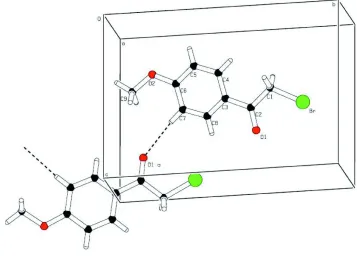
The molecules of (I) associate through weak intermolecular aromatic C—H···Ocarbonyl hydrogen bonds forming
one-dimensional chains which extend along the b axial direction in the unit cell (Fig.2).
S2. Experimental
4-Methoxyacetophenone (1.50 g, 0.01 mol) was dissolved in 50 ml ethyl acetate, cupric bromide (3.36 g, 0.015 mol) was
added and the mixture was refluxed for ca. 3 h. On cooling, the solid which separated was filtered and recrystallized from
ethyl acetate. Crystals of (I) suitable for X-ray diffraction were obtained by slow evaporation of ethyl acetate. 1H NMR
(CDCl3, δ, p.p.m.) 8.17 (d, 2 H), 7.49 (d, 2 H), 4.5 (s, 2 H), 3.81 (s,3 H).
S3. Refinement
All H atoms were positioned geometrically, with C—H = 0.93 Å, and constrained to ride on their parent atoms, with
Figure 1
A view of the molecular structure of (I) showing the atom-numbering scheme with non-H atoms drawn as 30%
displacement ellipsoids. The intramolecular hydrogen bond is shown as a dashed line.
Figure 2
The crystal packing of (I) showing hydrogen bonds as dashed lines.
2-Bromo-1-(4-methoxyphenyl)ethanone
Crystal data
C9H9BrO2
Mr = 229.06
Monoclinic, P21/c
Hall symbol: -P 2ybc a = 7.7360 (15) Å b = 12.441 (3) Å c = 10.048 (2) Å
V = 900.3 (4) Å3
Z = 4 F(000) = 456 Dx = 1.690 Mg m−3
[image:3.610.124.481.292.548.2]T = 305 K Block, colorless
0.20 × 0.10 × 0.10 mm
Data collection
Enraf–Nonius CAD-4 diffractometer
Radiation source: fine-focus sealed tube Graphite monochromator
ω/2θ scans
Absorption correction: ψ scan (North et al., 1968)
Tmin = 0.465, Tmax = 0.661
1634 measured reflections
1634 independent reflections 924 reflections with I > 2σ(I) Rint = 0.000
θmax = 25.3°, θmin = 2.7°
h = −9→8 k = 0→14 l = 0→12
3 standard reflections every 200 reflections intensity decay: 9%
Refinement
Refinement on F2
Least-squares matrix: full R[F2 > 2σ(F2)] = 0.054
wR(F2) = 0.116
S = 1.01 1634 reflections 109 parameters 0 restraints
Primary atom site location: structure-invariant direct methods
Secondary atom site location: difference Fourier map
Hydrogen site location: inferred from neighbouring sites
H-atom parameters constrained w = 1/[σ2(F
o2) + (0.048P)2]
where P = (Fo2 + 2Fc2)/3
(Δ/σ)max = 0.001
Δρmax = 0.35 e Å−3
Δρmin = −0.53 e Å−3
Special details
Geometry. All e.s.d.'s (except the e.s.d. in the dihedral angle between two l.s. planes) are estimated using the full covariance matrix. The cell e.s.d.'s are taken into account individually in the estimation of e.s.d.'s in distances, angles and torsion angles; correlations between e.s.d.'s in cell parameters are only used when they are defined by crystal symmetry. An approximate (isotropic) treatment of cell e.s.d.'s is used for estimating e.s.d.'s involving l.s. planes.
Refinement. Refinement of F2 against ALL reflections. The weighted R-factor wR and goodness of fit S are based on F2,
conventional R-factors R are based on F, with F set to zero for negative F2. The threshold expression of F2 > σ(F2) is used
only for calculating R-factors(gt) etc. and is not relevant to the choice of reflections for refinement. R-factors based on F2
are statistically about twice as large as those based on F, and R- factors based on ALL data will be even larger.
Fractional atomic coordinates and isotropic or equivalent isotropic displacement parameters (Å2)
x y z Uiso*/Ueq
Br 0.20597 (10) 0.66539 (6) 0.07859 (7) 0.0717 (3)
O1 0.3621 (7) 0.8754 (4) 0.2083 (5) 0.0848 (15)
C1 0.1809 (8) 0.8016 (5) −0.0164 (6) 0.0576 (17)
H1A 0.2308 0.7957 −0.0918 0.069*
H1B 0.0500 0.8190 −0.0608 0.069*
O2 0.2187 (6) 1.3075 (4) −0.1487 (5) 0.0689 (13)
C2 0.2781 (8) 0.8917 (5) 0.0820 (6) 0.0534 (16)
C3 0.2657 (7) 0.9994 (5) 0.0181 (6) 0.0478 (14)
C4 0.1597 (8) 1.0221 (5) −0.1242 (6) 0.0593 (17)
H4A 0.0957 0.9671 −0.1849 0.071*
C5 0.1493 (9) 1.1250 (5) −0.1751 (7) 0.0633 (18)
H5A 0.0780 1.1390 −0.2703 0.076*
C7 0.3497 (8) 1.1859 (5) 0.0560 (7) 0.0600 (17)
H7A 0.4138 1.2406 0.1172 0.072*
C8 0.3586 (8) 1.0831 (5) 0.1051 (6) 0.0564 (16)
H8A 0.4297 1.0688 0.2003 0.068*
C9 0.2906 (10) 1.3980 (6) −0.0610 (8) 0.083 (2)
H9A 0.2625 1.4618 −0.1186 0.124*
H9B 0.4227 1.3908 −0.0151 0.124*
H9C 0.2353 1.4028 0.0102 0.124*
Atomic displacement parameters (Å2)
U11 U22 U33 U12 U13 U23
Br 0.0721 (5) 0.0588 (5) 0.0722 (5) 0.0064 (4) 0.0121 (3) 0.0076 (4)
O1 0.104 (4) 0.067 (3) 0.050 (3) 0.002 (3) −0.011 (3) 0.003 (2)
C1 0.054 (4) 0.060 (4) 0.050 (3) 0.002 (3) 0.008 (3) −0.003 (3)
O2 0.079 (3) 0.054 (3) 0.070 (3) −0.007 (2) 0.021 (2) −0.002 (2)
C2 0.042 (3) 0.060 (4) 0.049 (4) 0.007 (3) 0.006 (3) −0.005 (3)
C3 0.036 (3) 0.050 (4) 0.053 (4) −0.001 (3) 0.011 (3) −0.003 (3)
C4 0.060 (4) 0.056 (4) 0.049 (3) −0.002 (3) 0.005 (3) −0.012 (3)
C5 0.067 (4) 0.059 (4) 0.052 (4) 0.005 (4) 0.007 (3) 0.000 (3)
C6 0.047 (4) 0.056 (4) 0.058 (4) −0.004 (3) 0.018 (3) −0.007 (3)
C7 0.054 (4) 0.062 (5) 0.058 (4) −0.011 (3) 0.013 (3) −0.010 (3)
C8 0.044 (4) 0.064 (4) 0.049 (3) −0.004 (3) 0.001 (3) −0.005 (3)
C9 0.087 (5) 0.063 (5) 0.096 (5) −0.012 (4) 0.031 (4) −0.004 (4)
Geometric parameters (Å, º)
Br—C1 1.920 (6) C4—H4A 0.9300
O1—C2 1.213 (6) C5—C6 1.387 (8)
C1—C2 1.502 (8) C5—H5A 0.9300
C1—H1A 0.9700 C6—C7 1.400 (8)
C1—H1B 0.9700 C7—C8 1.363 (8)
O2—C6 1.359 (7) C7—H7A 0.9300
O2—C9 1.412 (8) C8—H8A 0.9300
C2—C3 1.474 (8) C9—H9A 0.9600
C3—C8 1.380 (7) C9—H9B 0.9600
C3—C4 1.393 (8) C9—H9C 0.9600
C4—C5 1.370 (8)
C2—C1—Br 113.3 (4) C4—C5—H5A 119.4
C2—C1—H1A 108.9 C6—C5—H5A 119.4
Br—C1—H1A 108.9 O2—C6—C5 115.8 (5)
C2—C1—H1B 108.9 O2—C6—C7 125.6 (6)
Br—C1—H1B 108.9 C5—C6—C7 118.6 (6)
H1A—C1—H1B 107.7 C8—C7—C6 119.6 (6)
C6—O2—C9 118.7 (5) C8—C7—H7A 120.2
O1—C2—C3 122.1 (6) C6—C7—H7A 120.2
C3—C2—C1 117.0 (5) C7—C8—H8A 118.9
C8—C3—C4 118.2 (6) C3—C8—H8A 118.9
C8—C3—C2 118.3 (5) O2—C9—H9A 109.5
C4—C3—C2 123.4 (6) O2—C9—H9B 109.5
C5—C4—C3 120.3 (6) H9A—C9—H9B 109.5
C5—C4—H4A 119.9 O2—C9—H9C 109.5
C3—C4—H4A 119.9 H9A—C9—H9C 109.5
C4—C5—C6 121.2 (6) H9B—C9—H9C 109.5
Br—C1—C2—O1 0.0 (8) C9—O2—C6—C5 172.0 (6)
Br—C1—C2—C3 −179.8 (4) C9—O2—C6—C7 −6.3 (9)
O1—C2—C3—C8 2.2 (9) C4—C5—C6—O2 −178.5 (6)
C1—C2—C3—C8 −178.0 (5) C4—C5—C6—C7 0.0 (9)
O1—C2—C3—C4 −175.3 (6) O2—C6—C7—C8 178.3 (6)
C1—C2—C3—C4 4.5 (9) C5—C6—C7—C8 0.0 (9)
C8—C3—C4—C5 0.1 (9) C6—C7—C8—C3 0.0 (9)
C2—C3—C4—C5 177.6 (6) C4—C3—C8—C7 −0.1 (9)
C3—C4—C5—C6 0.0 (10) C2—C3—C8—C7 −177.8 (6)
Hydrogen-bond geometry (Å, º)
D—H···A D—H H···A D···A D—H···A
C8—H8A···O1 0.93 2.47 2.780 (8) 100
C7—H7A···O1i 0.93 2.58 3.505 (7) 171