3
Heather JONES (corresponding author) 4
Centre for Transport and Society 5
University of the West of England 6
Frenchay Campus, Coldharbour Lane 7
Bristol, BS16 1QY 8
United Kingdom 9
Phone: +44 117 3283799 10
Fax: +44 (0)117 32 83899 11
Email: [email protected]
12 13
Dr Kiron CHATTERJEE 14
Centre for Transport and Society 15
University of the West of England 16
Frenchay Campus, Coldharbour Lane 17
Bristol, BS16 1QY 18
United Kingdom 19
Phone: +44 (0)117 32 82032 20
Fax: +44 (0)117 32 83899 21
22 23
Prof. Selena GRAY 24
Faculty of Health and Life Sciences 25
Glenside Campus, Blackberry Hill 26
Bristol, BS16 1DD 27
United Kingdom 28
29 30
Number of words: 7,715 31
Number of tables: 0 32
Number of figures: 1 33
Total:7,965
TRB Annual Meeting 2011
ABSTRACT
1
UK transport statistics suggest there was a marked decline in levels of walking and cycling in the 2
second half of the twentieth century, yet what this looks like in the life course patterns of walking and 3
cycling of individuals and cohorts alive at this time is unclear and unknowable from present sources. 4
This paper introduces research in progress that applies a life course perspective with a life history 5
methodology to understand life course patterns of walking and cycling of individuals. Trajectories of 6
walking and cycling are reconstructed with older and younger cohorts through life history interviews. 7
These cohorts are drawn from the same families to construct Parent and Child dyads. Walking and 8
cycling trajectories are depicted through biographical accounts, summary descriptive texts and visual 9
depictions. Emergent findings are that wider social changes are apparent in inter-cohort variation in 10
life course structure and timing and that this is producing inter-cohort variation in walking and cycling 11
trajectories. There are also indications of intergenerational influence on walking and cycling 12
trajectories within families much of which is mediated through caring roles. 13
This approach has the potential to deliver a more sophisticated understanding of the processes of 14
change in travel behaviour in individual lives, their relation to events and transitions in multiple life 15
course trajectories, and the interdependency of life courses. Looking ahead potential policy 16
implications could include the need for a policy approach that recognises that population cohorts’ 17
walking and cycling trajectories are distinguished by the social and historical backdrop. 18
TRB Annual Meeting 2011
6.
INTRODUCTION
1
This paper introduces research in progress that applies a life course perspective with a life history 2
methodology to understand life course patterns of walking and cycling. The primary objectives of this 3
research are to enhance understanding of change and continuity in walking and cycling behaviour 4
over the life course and to trial the application of the life course perspective in the study of travel 5
behaviour. 6
Referring to the UK road traffic counts Chatterjee and Dudley suggested that the distance 7
cycled on UK roads collapsed in the two and half decades following the Second World War before 8
entering four decades of relative stability [1]. The total distance cycled on UK roads decreased from 9
an estimated 23.6 billion kilometres in 1949 to 4.6 billion kilometres in 1969. Between 1969 and 2006 10
this figure fluctuated about this level reaching a high of 6.4 in 1984 and a low of 3.8 in 1973 [2]. 11
The National Travel Survey offers a shorter and more recent temporal window to look at the 12
trends in walking and cycling with a time series of comparable data from 1975 forwards. Total 13
average distance walked per person per year dropped from 410 km in 1975/6 to 309km in 2001 and 14
was most recently at 310km in 2008 [2]. The proportion of all trips that were made on foot fell from 15
34.8% in 1975/6 to by 23% in 2009. The total average distance cycled per person per year declined 16
from 69km in 1995/96 to 58km in 2005 before rising to 74 km in 2009 [3]. These changes in walking 17
and cycling happened in the context of steadily rising car ownership, road network expansion and 18
significant increase in distance travelled by cars on UK roads [1]. 19
Evidence that population health was being adversely affected by declining physical activity 20
did not begin to emerge until the 1980s in the UK [4], when it is likely that a decline in active 21
transport and wider social changes that were removing physical activity from daily lives had been in 22
effect for many decades. Further, researchers and practitioners in public health were slow to discern 23
the significance of the decline in active travel for the observed decrease in daily energy expenditure 24
with emphasis falling instead on leisure physical activity and exercise. In the last decade UK 25
Government health policy has recognised the potential contribution of active travel in raising levels of 26
daily energy expenditure and supported measures to promote walking and cycling to improve public 27
health. For example the Department of Health has supported expansion of the child cycle training 28
programme ‘Bikeability’ and the Walking into Health programme [5]. Over a similar time frame, 29
transport policy has adopted objectives for increasing walking and cycling both to reduce congestion 30
and emissions and support health objectives [6]. 31
An important contribution to knowledge which could inform efforts to ‘recover’ levels of 32
walking and cycling is to understand the change and continuity of walking and cycling in the life 33
course of individuals. 34
The impact of social changes on the life course of individuals cannot be inferred from 35
aggregate level data. This is to fall foul of the ecological fallacy. An illustration of this flawed logic 36
was highlighted in research that looked at the impact of structural changes in the economy on the 37
employment trajectories of individuals [7, 8]. While aggregate data pointed to a deindustrialisation 38
from a manufacturing to a service-based economy, this shift was not reflected in individual level data 39
by a wide scale shift of individuals moving from manufacturing to service sector jobs. Disaggregate 40
longitudinal data indicated this change was largely brought about by the workforce exit of people in 41
manufacturing jobs and the next generation of workers starting work in the service sector, hence de-42
industrialisation was not a common feature of the employment trajectories of individuals. 43
Applying this insight to walking and cycling, the replacement of older cohorts who had high 44
levels of walking and cycling with younger cohorts who engage in less walking and cycling could be 45
an explanation of the aggregate change. Seeking to test this hypothesis is one reason for taking a 46
longitudinal approach to studying walking and cycling. It is similarly unfounded to deduce the natural 47
TRB Annual Meeting 2011
this splices together the experience of different cohorts who have encountered different contexts for 1
walking and cycling over the course of their lives. 2
Health research in to food choice and participation in physical exercise has applied a life 3
course perspective [9,10]. An underlying premise for such work is that an individual arrives at their 4
current status regarding food choice or exercise within trajectories that are developed over the course 5
of their lives and that are shaped by the contexts they have encountered and the past transitions they 6
have made. This accords with the principle of travel behaviour dynamics that travel behaviour is a 7
process that evolves over time rather than a permanent state of being. Studies of physical activity [11] 8
and travel behaviour [12, 13] that have identified life events as a prompt for behaviour change 9
indicate that an analytical framework that attends to personal biography and the changing social 10
contexts of the life course may yield fuller explanations of walking and cycling behaviour. The life 11
course pattern of walking and cycling will therefore be conceived as life course trajectories unfolding 12
within a changing social and historical context, subject to macro and micro level influences. A more 13
detailed introduction to the life course perspective follows. 14
The Life Course Perspective
15The life course perspective is a theoretical orientation that provides a broad framework for descriptive 16
and explanatory research on human development and aging within a constantly changing society [14]i. 17
Whilst frequently engaged in other areas of social science, it has received limited employment in the 18
field of travel behaviour. Life course research views the experiences of a person’s life as a set of 19
interwoven age-graded trajectories pertaining to different realms of behaviour or experience, e.g. 20
education, employment and health. Trajectories are long term patterns of stability and change which 21
can involve multiple transitions. Five paradigmatic principles constitute the primary analytic and 22
conceptual themes of life course studies and connect life course studies to a wider body of cross-23
disciplinary scholarship that emphasizes the role of time, context and process [14]. These are outlined 24
here: 25
Human Agency 26
People construct their life course through the choices and actions taken within the constraints of their 27
situation. As such they are causal agents in their own life course. 28
Development as a life-long process 29
Human development and aging are life-long processes. Developmentally meaningful changes occur in 30
life stages beyond childhood and adolescence. Research that examines short, detached segments of the 31
life course precludes understanding the influence of formative experiences in early stages of life on 32
later outcomes. 33
Linked lives 34
Lives are socially embedded which means that often a life event in one life course will have resonance 35
in the life course of another individual. Such linkages are not confined to households. For instance, 36
when a woman enters motherhood her mother simultaneously enters grandmother-hood. 37
Historical time and place 38
The life course of individuals is embedded and shaped by the historical times and places they 39
experience over their lifetime [14]. Membership of a specific birth cohort denotes a particular 40
historical experience. Individuals alive at the same time will encounter the same historical events and 41
conditions; however birth cohorts are united by an experience of those events at the same age. 42
Timing 43
The developmental antecedents and consequences of life transitions, events, and behaviour patterns 44
TRB Annual Meeting 2011
Travel Behaviour Studies
1Most travel behaviour studies seek to explain travel behaviour by explaining differences in behaviour 2
among a population observed at a particular point in time (using cross-sectional data). A particular 3
concern with cross-sectional studies is attribution of behaviour to current circumstances when it may 4
have been influenced by past experiences and events and these have not been observed or given 5
consideration. There has been a small but growing body of research in travel behaviour which has 6
given explicit attention to the dynamics of travel behaviour. For example, Chatterjee [15] reviews 7
studies that have used panel data to study travel behaviour and presents an analysis of the travel 8
choices of residents before and after the introduction of a new bus rapid transit service. 9
Other recent research in travel behaviour has emphasised the role of life events in behavioural 10
change. A small body of work has taken the biographical course of travel demand as the unit of 11
analysis [16]. The term mobility biography has been adopted to denote a person’s mobility experience 12
in its entirety. The correlation between biographical processes and changes in spatial mobility was 13
detected first in studies of migration, prior to the establishment of individual travel behaviour as a 14
research interest [16]. 15
The sparse collection of longitudinal data on travel behaviour has hindered the exploration of 16
the effect of life events on travel behaviour. Without reference to the life course perspective, Scheiner 17
calls for longitudinal inquiry, endorsing panel surveys and retrospective surveys to serve a 18
biographical perspective on long term dynamics of travel behaviour [16]. In practice the handful of 19
studies that operationalise the mobility biography have examined aspects of mobility pertaining to car 20
use. 21
In their introduction of the mobility biography as a theoretical framework for study of travel 22
behaviour, Lanzendorf et al. are explicit about the import of the conceptual tools from the life course 23
perspective as a means to organise the continuity and change in mobility behaviour in the context of 24
life events and role transitions [17]. However the useful explanation of these salient concepts does not 25
extend to the consideration of the five principles of the life course framework. In one study the 26
mobility biography was used to look at car ownership changes with a five year segment of a panel 27
survey [18]. To restate Scheiner, achieving a whole life view from panel studies is unrealistic given 28
that panels accrue in real time [16]. Their utility is therefore confined to exploring the impact of life 29
course events on travel behaviour within segments of the life course but not to look at travel 30
behaviour over the life span in its entirety. A whole life view is more readily accessible with 31
retrospective data collection although the reliability and validity of recalled data on past travel 32
behaviour has to be considered. Verhoeven et al. (2008) found with an Internet-based retrospective 33
survey that respondents’ ability to recall seven major life-change events and attributes of the events 34
was satisfactory [19]. 35
The life course perspective has been advocated as part of a proposed new theoretical 36
landscape for the generation of travel behaviour theory. Through the presentation of a hypothetical 37
mobility biography Goulias demonstrates how the life course framework, together with 38
Bronfenbrenner’s bioecological model of behavioural influences and Bourdieu’s concept of habitus 39
might provide a theoretical framework for the investigation of long-term dynamics of travel behaviour 40
[20]. For Goulias, the life course perspective is a necessary development to orientate research towards 41
explanations of travel behaviour that considers the role of past experiences in present travel behaviour 42
rather than solely presenting it as a product of current circumstances. 43
Mobility biographies have been applied in studies away from the mainstream of travel 44
behaviour research. In research in tourism and mobility, Frandberg applied the mobility biography to 45
study the institutionalisation of international travel [21]. Data collection combined a questionnaire 46
designed to capture the extent of young people’s international mobility and follow-up interviews 47
which explored meanings attributed to international mobility. 48
Pooley et al., as social historians looking at changes in everyday mobility over the 20th 49
century adopted an oral history approach to reconstruct the mobility histories of people in four age 50
groups whose life courses spanned the century [22]. This combined retrospective quantitative data 51
collected via a structured questionnaire on mobility at four life stages and a semi-structured interview 52
TRB Annual Meeting 2011
Life History methodology
1Application of the life course framework has mainly occurred within the quantitative tradition of 2
social sciences. It received momentum from the wealth of longitudinal and cohort studies and 3
techniques for analysing longitudinal data that emerged in the 1960s. Although quantitative logic 4
permeates the majority of life course research, the life course framework is indebted to sociological 5
inquiry that took place within the interpretative tradition decades earlier. Biographical research began 6
with a study of the lives of Polish immigrants in the United States first published in the 1920s [23]. 7
This original study established the course and substance of lives as a subject for sociological inquiry 8
and life history methods as a means of study. 9
However the progress of biographical research faltered two decades after publication of The 10
Polish Peasant when social science was struggling to counter criticisms of subjective interpretation. 11
From this point biographical research and life history methods all but disappeared within the 12
prevailing positivist climate of social science that favoured variable-centred research, employing 13
emergent survey and statistical techniques. 14
Life history methods had a renaissance in the 1970s in midst of a more general revival of 15
qualitative approaches. Qualitative research continues to pose ontological and epistemological 16
questions. Nevertheless the potential for complementary qualitative inquiry, powered by 17
contextualised data and naturalistic methods, to enhance explanations of social phenomena sustains 18
efforts to pursue methodological pluralism. 19
For clarity it is important to characterise the distinction between the biographical perspective 20
emerging in travel behaviour research and the biographical research across social sciences. Although 21
both are concerned with life course, biographical researchers work with a range of mostly qualitative 22
data to understand and interpret the human experience and produce knowledge about human lives. 23
Although researchers in travel behaviour sometimes have used qualitative interviews to construct 24
mobility biographies [24], the research strategy that is generally employed is to determine the 25
relationship between certain life events and mobility behaviours in quantitative terms, (for example 26
Zwerts, Janssens and Wets 2007) [25]. 27
In summary, the biographical course of travel behaviour is an emerging theme in travel 28
behaviour research. While some authors make reference to the life course framework as the source for 29
the conceptual tool of trajectories and for the definition of terms such as life event, transition, etc., it is 30
established there is no existing travel behaviour research in which the full set of principles of the life 31
course perspective are applied as the theoretical foundation. The contribution of this study is 32
therefore to apply the life course perspective to the study of travel behaviour and simultaneously to 33
develop knowledge on the dynamics of walking and cycling travel behaviour in relation to life events 34
and wider social change. In order to gain a whole life view walking and cycling trajectories will be 35
constructed retrospectively using a life history methodology. 36
7.
METHOD
37
A walking or cycling trajectory depicts the long term pattern of stability and change in walking or 38
cycling. It includes turning points in walking or cycling that may be associated with a life event. 39
These trajectories are elicited from retrospective accounts and are represented in visual and textual 40
form. The construction of the trajectories takes place over the course of the data collection and 41
analysis process and involves the researcher’s interpretation of information reported by research 42
participants. 43
Data collection consists of a two-stage life history interview. The first is structured around the 44
completion of a life history calendar recording life events, walking and cycling behaviour and 45
participation in non-work interests. At the end of the first interview, with the calendar complete, the 46
participant is asked to give an overview of the changes and continuity of walking and cycling in their 47
life course. In between the first and second interviews, working from the interview recording and the 48
TRB Annual Meeting 2011
and transport walking and cycling and interests involving physical activity. This timeline represents a 1
tidier version of the original calendar, supplemented with information from the interview. The 2
participant is given the opportunity to view and amend the time line at the start of the second 3
interview. One of the common methodological challenges to qualitative research is on the validity and 4
reliability of the data. In this study questions of validity and reliability relate to whether the 5
reconstructed walking and cycling trajectories truthfully and reliably portray the participant’s 6
retrospective view of their walking and cycling history. Having the participants review the time lines 7
at this stage is a means to converge the researcher’s interpretation of the first interview with the 8
participants reconstruction. The second interview then proceeds with the interviewer asking questions 9
about the participant’s turning points in walking and cycling. 10
Research participants in this study belong to either the leading edge of the demographic bulge 11
known as the baby boomers (born between 1946-1951) or a second younger and more dispersed age 12
group that are the children of the baby boomer participants (born between 1976-1991). These two 13
participant groups are referred to as Baby Boomers/Parents and Children. A confusion of terminology 14
is often created by the imprecise description of the baby boomers as a generation. They are more 15
accurately identified as a cohort, leaving the term generation to denote structural kinship relations. 16
This research will observe this distinction and refer to the Parents and Child generations and the older 17
baby boomer cohort and the younger cohort. Restricting the older cohort to the first five years of the 18
baby boomer cohort gives the index group a narrow historical location which in practice means the 19
age at which they lived through historical events and social change falls within five years. The 20
participant group has been designed to permit inter-generational comparison of life course trajectories 21
of walking and cycling between parent and child dyads as well as a comparison between an older and 22
younger cohort. This orientates the study to give more explicit consideration to two of the life course 23
principles: linked lives and historical time. 24
As well as their own trajectories the parents are asked to give an overview of both their 25
parents’ and their childrens’ walking and cycling trajectories during the first interview. Children are 26
asked to give an overview of their parents’ walking and cycling trajectory. 27
8.
ANALYSIS
28
Data analysis is a process of distillation in which the interview outputs, recordings and 29
calendar/timeline are used to identify the long term patterns and turning points of walking and cycling 30
across the life course. The outputs take the form of visual depictions and textual descriptions of 31
trajectories and supporting biographical accounts that report the complexities of the individual life 32
course. The participant’s response to being asked to give an overview of their walking and cycling in 33
their life course is transcribed. These representations of the case is then the basis for the inter-34
generational comparison with a family member. 35
The biographical account is produced through a process of repeated listening to the interview 36
recordings and reference to the biographical information from the calendar and time line. The 37
purpose of this is to transfer all biographical information and reports of walking and cycling 38
experience into a textual account. From this summary biography two more concise accounts are 39
produced that detail periods of stable walking and cycling and the circumstances associated with 40
turning points in behaviour. Finally the life events, role transitions or other explanations for change 41
are listed with a clarification of the direction of change, i.e. positive or negative. 42
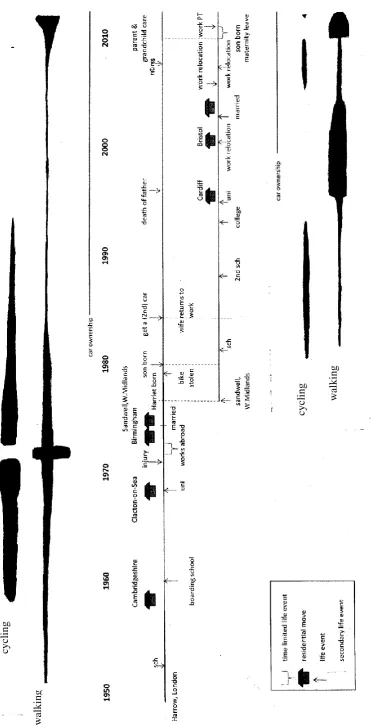
To facilitate inter-generational comparison the parent and child timelines are presented 43
alongside each other with ‘shared’ life events being indicated by a vertical line intersecting both time 44
lines. Visual depictions of the trajectories are depicted separately for walking and cycling, above and 45
below the time lines of each family member. The visual depiction is a line of varying thickness which 46
denotes amount of walking or cycling activity. However it is not possible to infer the absolute amount 47
TRB Annual Meeting 2011
participant’s recall of their past walking or cycling behaviour. What the visual representation is 1
intended to indicate is changes in the level of walking or cycling and periods when walking or cycling 2
was absent and periods when walking or cycling featured more strongly. 3
An intergenerational comparison of walking and cycling trajectories is made based on this 4
intergenerational timeline, the textual trajectories and the biographical accounts. The trajectory of 5
parents is compared only with their children up until the age of their children. For instance, if the 6
child is 35 the comparison will only be made over the first 35 years of the parent’s life. 7
To illustrate the method and analysis the following section presents a series of outputs from 8
the interview and early analysis of the trajectories of a father and daughter dyad, Julian and Harriet. 9
Presented first are Julian and Harriet’s biographical accounts followed by a description of the walking 10
and cycling trajectories in text form. This is followed by a visual depicting an intergenerational time 11
line and visual interpretations of their trajectories. This section concludes with a brief description of 12
the intergenerational differences in their trajectories. 13
TRB Annual Meeting 2011
Julian and Harriet
1Julian Yates is a retired school teacher who lives in Sandwell, West Midlands with his wife Gwen, 2
also a retired teacher. He has a grown up daughter Harriet who lives in Bristol with her one year old 3
son Billy and her husband Jack. Harriet’s younger brother Chris lives in Cardiff with his partner. 4
Julian was born in north London in 1949, the only child of a bank clerk and housewife. 5
Julian’s parents did not own a car until after he had left home. He walked half an hour to his primary 6
school. When he was 10 the family moved to a village outside of Cambridge. During this time he 7
cycled two miles to school and spent a lot of his free time exploring the countryside on his bike. He 8
went to boarding school at 11 which involved a 20 minute walk from his boarding house into school 9
each day. He sometimes used a bike at school and continued to cycle a lot in the holidays from home. 10
At 16 his family moved into Cambridge and cycling continued to be his main mode of 11
transport. At 18 he went to teacher training college where he continued to cycle to get about, apart 12
from travelling to teaching practice when transport was provided. In his final year Julian was 13
involved in a car accident and injured his knee. This restricted him from hill walking and could be 14
aggravated when he played sport. He nevertheless continued to play some racquet sports. After 15
gaining his teaching qualification he spent a year teaching in Papua New Guinea for a year when he 16
didn’t do any cycling but did a considerable amount of walking. 17
On his return he moved to Birmingham where he rented a flat with other teachers. He met 18
Gwen in 1972 and they got married in 1973 and moved to Sandwell, an urban area north of 19
Birmingham. Shortly before their wedding, Julian’s mother died. Gwen already owned a car which 20
they shared for the first 10 years of their marriage. During this period Julian would either walk, cycle, 21
get a lift from Gwen or drive himself and latterly use a motorcycle to get to work. Gwen gave up work 22
for seven years when their first child was born and went back to work part time when their youngest 23
child started school. The family got a second car when Gwen returned to work. From then on Julian 24
drove to work every day. Most of the family’s travel was accomplished by car; this included the 25
school run and most other children’s activities, the shops and visiting friends. 26
In the course of job changes to progress his career, the distance to work became too great to 27
cycle or walk. Cycling to work was ruled out permanently when his bike was stolen from school and 28
never replaced. However cycling remained a regular feature on holidays when they visited his father 29
in Cambridgeshire. Julian’s father’s health declined in the mid 1990s and Julian would make more 30
frequent trips to Cambridge to support him, sometimes travelling there and back after work. Julian 31
worked fulltime until 2006 and then went part time before retiring fully in 2009. In 2008 on holiday in 32
Singapore Gwen and Julian had a day’s cycling on hired bikes. He became a grandfather in 2009 33
when Harriet had Billy. Over the last few years Julian and Gwen have been providing care for her 34
parents who 10 minutes away by car. They currently visit at least every other day. Sometimes they 35
walk as a way to use the trip to get exercise. They also travel to Bristol once a week to look after Billy 36
when Harriet is at work. This involves one hour and a half’s walk for Julian with Billy in the push 37
chair. 38
Harriet is now a 35 year old mother and part time accountant. She works two and a half days 39
a week since returning to work after her son was born. Harriet’s mother was at home until Harriet was 40
8 years old. Harriet recalled that she sometimes walked to school at first and was sometimes driven. 41
After her mother returned to work part time Harriet and her brother were dropped at school on her 42
way to work. Harriet recalled a lot of outdoor play both in their garden and cycling around their cul-43
de-sac and further afield as they got older. Music, swimming and tennis became a more significant 44
feature as she got older with these journeys all made by car. When she changed schools at 11 Harriet 45
had to travel further and would get a lift or get the bus. Harriet’s cycling declined in her teenage years 46
and had finished by 16. Harriet had to take a bus and then a train to get to Sixth Form College. She 47
gained her driver’s licence when she was 18. 48
Harriet left home to go to university in Cardiff where she ‘walked everywhere’. At university 49
Harriet continued her music and met her future husband, Jack. Following university Harriet and Jack 50
stayed on in Cardiff where she completed 3 years of accountancy training. Harriet got her first car to 51
travel to clients however she continued to walk into the office. After qualifying, Harriet and Jack 52
TRB Annual Meeting 2011
they got married. From their city centre location Harriet continued walking to the office and using the 1
car for work travel. When they moved to the suburbs Harriet used the bus for a while but found it 2
preferable to drive part of the way and then walk. 3
Harriet started to use the car every day when she changed jobs to work in the outskirts of 4
Bristol. At this time Harriet and Jack bought bikes for recreational cycling at weekends and also did 5
some hiking. This recreational cycling ended when Harriet became pregnant. Harriet had almost a 6
year off when Billy was born in 2009. Becoming a mother has meant ‘loads of pounding the 7
pavements with a push chair’ as this was the only way to get Billy to sleep during the day. Harriet and 8
Jack have talked about cycling with Billy now he is old enough to sit in a child’s bike seat. 9
10
Julian’s walking trajectory
11Julian walked significantly in childhood, teenager, and student and for the year spent in Papua 12
New Guinea. 13
He walked to work for a time in his early career but then this declined as job changes and the 14
work load of career progression made walking impractical and eventually he got a car. 15
Family life and their residential location restricted utilitarian walking. Julian’s walking was 16
restricted to walking with his family on holiday. 17
Walking has increased since his retirement in association with caring from his grandchild and 18
parents in law. Gwen and Julian drive to places in the country nearby to walk along the 19
canals. 20
Harriet’s walking trajectory
21Harriet did not do a significant amount of walking in childhood or adolescence. The 22
combination of where things where located and both parents working meant that she was 23
driven for nearly all trips. 24
Harriet utilitarian walking increased significantly when she went to university in Cardiff. 25
Harriet walked to work in the early years of her career, after she had got her car. 26
Walking to work ended following a move into the suburbs and relocation of work. 27
Harriet’s walking increased significantly when she became a mother for the duration of her 28
maternity leave. 29
This has declined since she has returned to work part time but still features on the days she is 30
at home. 31
The recreational walking Harriet and Jack did in the early years of their relationship also 32
declined with the arrival of Billy. 33
Julian’s cycling trajectory
34Julian’s cycling began when his family moved to Cambridgeshire. It was his primary means 35
TRB Annual Meeting 2011
He cycled a bit in the early years of teaching to get to work. 1
Cycling began to decline as the journey became less feasible and then stopped altogether as a 2
means of transport when his bike was stolen. 3
Recreational cycling continued with his family when visiting his father in Cambridge. This 4
declined as the children got older and then finished when his father died. 5
Gwen and Julian cycled on a recent trip to Singapore. 6
Harriet’s cycling trajectory
7Harriet and her brother cycled on the streets around their home and on holiday in 8
Cambridgeshire. Cycling was always recreational and never for the purposes of travel. 9
Cycling declined in her adolescence and had stopped by the time Harriet went to sixth form. 10
Harriet and Jack bought bikes which they used for recreational rides before they started their 11
family. They plan to use them again with their son soon. 12
TRB Annual Meeting 2011
1
cyc
li
ng
cyc
li
ng
w
al
ki
n
g
w
al
ki
n
[image:12.595.75.448.55.781.2]g
TRB Annual Meeting 2011
Walking
1
Julian grew up in a non-car owning household. Harriet grew up in a household that went from one car 2
to two cars when she was about 6. Julian did significant walking in his childhood and adolescence for 3
transport and recreation.Harriet did very little walking for transport when she was growing up. 4
Walking to school stopped when her mother returned to work. From then on she was driven to school 5
and later got the bus. Nearly all of her after school activities involved car journeys. 6
Harriet and her father’s transitions into employment were similar. They both did A levels and a 7
degree. Harriet then had three year’s professional training. Both started their careers in their early 8
twenties. 9
For Julian, university meant a continuation of fairly significant amounts of walking both for 10
transport and recreation. He had a year of significant levels of walking in Papua New Guinea. Julian 11
initially walked to work then variously used a bike, motor bike and shared a car as work relocation 12
and career progression gradually made active travel options less feasible. Julian recalled that the 13
amount of things he had to carry to and from work increased as his career progressed. 14
Walking became Harriet’s primary means of transport for the first time at university and this 15
meant a significant increase in her walking. A lower level of walking for transport persisted in her 16
early career but she then ceased for travel to work following a residential and job relocation. 17
Julian and Harriet’s walking trajectory were affected differently by parenthood. These effects 18
are differentiated by their roles as primary or secondary care giver and in practice, gender. Julian did 19
not recall any changes in walking at the time of his transition into parenthood. Harriet had almost a 20
year’s maternity leave and recalled a significant increase in walking in this time. This declined on her 21
return to part time employment but remains higher than when she had worked previously fulltime. 22
Cycling
23Julian’s cycling started later than Harriet’s at the age of 10 and combined recreation with a means of 24
getting about. For Harriet cycling was solely recreational and spatially restricted (by her parents). 25
Harriet cycled from age 4 until she was a teenager. Harriet had lost interest in cycling by the time she 26
was 16. 27
Both Harriet and her father contrasted Julian’s childhood home in Cambridgeshire which was 28
considered favourable for cycling with the location in the West Midlands where Harriet grew up 29
which was a place where cycling was difficult and unpleasant. 30
For Julian cycling continued past 16 as a mode of transport. He cycled at university and in his 31
early career. He cycled less with career progression. Cycling for transport finished when his bike was 32
stolen. He continued to use his father’s bike on family holidays. 33
Harriet returned to recreational cycling in her late twenties with her partner. This stopped 34
when she was pregnant but now Billy is two they are considering cycling again with him. 35
9.
DISCUSSION OF EMERGENT FINDINGS
36
At this early stage of the analysis emerging findings are discussed. Interviews have been completed 37
with 16 individuals from 6 families. In some families more than one parent or child was interviewed. 38
The participant group comprises 9 Parents and 7 Children. 39
The life history methodology has been deliberately selected and crafted for this research to fill 40
a knowledge gap on patterns of walking and cycling across the life course at the individual level. A 41
challenge for the analysis is how to preserve the complexity of these individual life courses and 42
walking and cycling trajectories in the course of intra-familial, within cohort and inter cohort 43
comparisons. The following are nascent findings based on the individual trajectories of Julian, Harriet 44
and our other participants and based on analysis of inter-generational influence on trajectories within 45
families and inter-cohort differences. 46
Cycling trajectories can be broadly characterised as suspended or reoccurring. There were no 47
trajectories that indicated continuous cycling. So far all participants have reported some childhood 48
TRB Annual Meeting 2011
beyond childhood. These trajectories are classified as suspended. Others reconstructed trajectories 1
show that cycling featured periodically in adulthood. 2
Walking trajectories are different in nature to cycling trajectories due to the essential and 3
incidental nature of walking, for most people. This makes it more difficult for participants to recall 4
past changes in overall levels of walking. In the case of walking the reconstructed trajectories are 5
likely to be more indicative of changes in routine walking as opposed to overall levels of walking. 6
The visual trajectories ebb and flow. 7
There is an apparent effect of gender on the walking and cycling trajectories in the Parents 8
generation. In all but one of the families the woman began a significant career break when the first 9
child was born. These women all took part-time employment when their youngest child started school 10
and most eventually returned full-time. While they were at home with their children their daily 11
activities were conducted more locally and included more walking. When their children were at 12
school, these women combined the school run with part time employment. For the most part these 13
more complex travel needs were met by the car. The absence of this family career break in our male 14
baby boomers and the tendency for responsibility for care of children outside of school to fall on their 15
female partners, has translated in to more stable travel behaviour for male baby boomers. 16
In one family, where both partners were interviewed the husband’s pattern of driving to work 17
will have proceeded uninterrupted from the age of 23 until his pending retirement. Car use has also 18
heavily dominated his travel beyond getting to work with walking featuring only slightly and cycling 19
not at all. His wife had a seven year career break followed by part time employment before eventually 20
returning fulltime. This was reflected in her walking and cycling trajectory where walking increased 21
during her career break, then when her children were at primary school there was little walking, no 22
cycling and high car use, and as her children got older her walking increased and she returned to 23
cycling. 24
Due to a current gender imbalance in the Childrens generation we are unable to speculate as 25
to whether these gender effects are present in the younger cohort. If the wider social trends towards 26
greater gender equality have translated into more equal distribution of childcare then it may be found 27
that the trajectories of younger men are more affected by parenthood than their fathers were and 28
younger women less so. 29
A common characteristic of the cycling trajectories of the parents is a transition from 30
recreational and transport cycling in youth to predominantly recreational cycling for those who had a 31
cycling experience as an adult. Their children in contrast experienced mostly recreational cycling as 32
children, although they tended to have a bike earlier and longer in childhood. What cycling 33
experiences they have had as adults has again been predominantly recreational. 34
Three of the Children recalled how walking to school had ceased and they had been driven to 35
school after their mothers returned to employment. This is an example of how the walking trajectories 36
of children can be influenced by events in their parents’ life course. 37
Some of the Parents generations reported caring responsibilities for their grandchildren and 38
their parents or parents in laws (Grandparent generation) both currently and earlier in their life course. 39
The impact of caring responsibilities on walking behaviour has been varied. In the one case of 40
grandchild care this had caused them to do more walking. In the case of elder care both positive and 41
negative effects were found on walking. In a number of cases Grandparents had at some stage moved 42
close to their offspring and so this meant the Parents and Children were making more walking trips to 43
visit the Grandparents. In other cases where the Grandparents were further away looking after them 44
made the Parents more time pressured and restricted their walking. 45
10.
SUMMARY
46
The aim for this paper was to detail and illustrate the approach, methods, analysis and a selection of 47
nascent findings of this research. Application of life history methodology within the life course 48
framework brings potential to deliver a more sophisticated understanding of the processes of change 49
in travel behaviour in individual lives, their relation to events and transitions in multiple life course 50
TRB Annual Meeting 2011
The inclusion of an older and younger cohort in the study has highlighted that wider social 1
trends are manifest in changes in the normative life course. This has been apparent in the transition 2
into adulthood where the younger cohort are, broadly speaking, spending longer in education or 3
training, starting careers later, leaving their parents home later, spending longer living as an 4
independent adult and becoming parents later. Their Parents therefore appear to enter periods of 5
relative stability and also interdependency earlier than their Children. One avenue to be pursued in 6
analysis will be to understand the implication of these structural changes in the life course for walking 7
and cycling trajectories. 8
The next steps for this study are to proceed simultaneously with advancing the analysis whilst 9
bringing to a close the data collection phase. The ongoing priority for recruitment is to establish a 10
participant group with a varied life experience. In practice this means ensuring the group is gender-11
balanced and encompasses heterogeneity in levels of education and occupation and current and 12
childhood residential location. 13
The projected outcomes of this study are an understanding of recalled change and continuities 14
in walking and cycling and anticipation of future behaviour from adults living through their seventh 15
decades and adults ranging between their second and fourth decades. There will also be insights into 16
the intergenerational influence of walking and cycling. 17
With life-long walking and cycling a public health and transport policy objective (in the UK) it is 18
anticipated that the implications from this research will be a policy approach that recognises that 19
population cohorts’ walking and cycling trajectories are distinguished by the social and historical 20
backdrop. This can mean quite different contexts for walking and cycling in childhood and adulthood. 21
It is also expected that the study will produce a better understanding of the influence of roles within 22
families on walking and cycling experiences at different stages of the life course. 23
6.
REFERENCES
[1]
Chatterjee, K. and G. Dudley, (2008) Time series information and pivotal events. In: D. Tarrant and A.Lovell, eds. Conference for the Institution of Highways and Transportation: With the Advantage of Hindsight, Portsmouth 26 August 2008. Institute of Highways and Transportation, pp5-89[2] Department for Transport (2007) Transport Statistics Great Britain 2007 33rd edition. London HMSO
[3] Department for Transport (2009) Transport Trends 2009 edition. London HMSO
[4] Fox, K.R. and M. Hillsdon, (2007) Physical activity and obesity. Obesity reviews [online] 8 (Suppl 1) pp. 115-121 [Accessed 20 July 2011]
[5] Department of Health and Department for Children, Schools and Families (2008) Healthy Weight, Healthy Lives. A Cross-Government Strategy for England. London HMSO
[6] Department for Transport (2011) Creating Growth, Cutting Carbon Making Sustainable Local Transport Happen. London HMSO
[7] Walby, S. (1991) Labour markets and industrial structures in women’s working lives. In S.Dex (ed). Life and Work History Analyses London: Routledge. pp. 167-86.
[8] Elliot, J., Narrative and identity: constructions of the subject in qualitative and quantitative research. In Using Narrative in Social Research London Sage pp. 119
[9] Sobal, J., CA, Bisogni, CM. Devine, M. Jastran,. A Conceptual Model of the Food Choice Process over the Life Course. In R. Shepherd and M. Raats. The Psychology of Food Choice Oxfordshire, UK, CABI 2006
[10] Scanlon-Mogel, J.M. and K.A. Roberto. (2004) Older adults’ beliefs about physical activity and exercise: Life course influences and transitions. Quality in Ageing- Policy, practice and research 5 (3)
TRB Annual Meeting 2011
[12] Stanbridge, K., G. Lyons, and S. Farthing. Travel Behaviour Change and Residential
Relocation. Paper presented at the 3rd International Conference of Traffic and Transport Psychology, Nottingham, 2004.
[13] van der Waerden, P., H. Timmermans and A Borgers. The influence of key events and critical incidents on transport mode choice switching behaviour: a descriptive analysis. Presented at 10th International Conference on Travel Behaviour Research. Lucerne 2003.
[14] Elder, G.H. ,M Kirkpatrick Johnson, and R Crosnoe, The emergence and development of life course theory. In Mortimer, J.T. and Shanahan, M.J. (2004) Handbook of the Life Course. Springer pp. 3-19
[15] Chatterjee, K. (2011). Modelling the dynamics of bus use in a changing travel environment using panel data. Transportation, 38(3), 487-509.
[16] Scheiner, J. (2007). Mobility biographies: Elements of a biographical theory of travel demand. Erdkunde 61(1), 161-173.
[17] Lanzendorf, M. Mobility biographies. A new perspective for understanding travel behaviour. Presented at 10th International Conference on Travel Behaviour Research. Lucerne 2003 [18] Prillwitz, J., S. Harms, and M. Lanzendorf, (2006) Impact of Life-Course Events on Car Ownership. In Transportation Research Record Journal of the Transportation Research Board. No 1985Transportation Research Board of the National Academies, Washington D.C. 2006, pp.71-77.
[19] Verhoeven, M., T Arentze, H., Timmermans and P., van der Waerden Retrospective Surveys: Some Experience in the Context of Measuring Lifecycle Events. Presented at 87th Annual Meeting of the Transportation Research Board, Washington D.C. 2008.
[20] Goulias, K., Travel behaviour dynamics from a lifespan development perspective. Presented at 12th International Conference on Travel Behaviour Research, Jaipur, India 2009
[21] Frändberg, L. (2006) International Mobility Biographies: A Means to Capture the
Institutionalisation of Long-distance Travel? Current Issues in Tourism 9 (4&5) [Accessed 03 March 2011]
[22] Pooley, CG., J. Turnball, M. Adams A Mobile Century? Changes in Everyday Mobility in Britain in the Twentieth Century Aldershot UK Ashgate 2005.
[23] Thomas, WI., and Znaniecki, F. (1958) The Polish Peasant in Europe and America. Vol 1-2 New York: Dover (Originally published in 1918-20)
[24] Lanzendorf, M. (2010). Key events and their effect on mobility biographies: The case of childbirth. International Journal of Sustainable Transportation 4(5), 272-292.