Providing Traceability for Neuroimaging Analyses
R. McClatchey, A. Branson, A. Anjum, P. Bloodsworth, I. Habib, K. Munir, J.
Shamdasani, K. Soomro and S.Green
Centre for Complex Cooperative Systems, CEMS Faculty, Univ. of the West of England, Coldharbour Lane, Frenchay, Bristol BS16 1QY, United Kingdom
Telephone: +44 117 328 3761, FAX: +44 117 344 3155
Emails: {Richard.McClatchey, Andrew.Branson, Ashiq.Anjum, Kamran.Munir, Jetendr.Shamdasani, Kamran.Soomro}@cern.ch; [email protected]; Peter.
[email protected]; [email protected]
Correspondence to:
Professor Richard McClatchey
Centre for Complex Cooperative Systems
University of the West of England,
Frenchay, Bristol BS16 1QY, UK
Abstract: With the increasingly digital nature of biomedical data and as the complexity of
analyses in medical research increases, the need for accurate information capture, traceability
and accessibility has become crucial to medical researchers in the pursuance of their research
goals. Grid- or Cloud-based technologies, often based on so-called Service Oriented
Architectures (SOA), are emerging as potential solutions for managing and collaborating
distributed resources in the medical domain. Few examples exist, however, of successful
implementations of Grid-enabled medical systems that provide the traceability or provenance of
research data needed to facilitate complex analyses and even fewer, if any, have been deployed
for evaluation in practice. Over the past decade, we have been working with mammographers,
paediatricians and neuroscientists in three generations of projects to provide the data
management and provenance services now required for 21st century medical research. This
paper proposes a software solution that provides the foundation for such support. It introduces
the use of the CRISTAL software to provide provenance management as one of a number of
services delivered on a SOA, deployed to manage neuroimaging projects that have been
studying biomarkers in the identification of the onset of Alzheimer’s disease. In the neuGRID
project a provenance service has been designed and implemented that is intended to capture,
store, retrieve and reconstruct the workflow information needed to facilitate users in conducting
neuroimaging analyses. The software enables neuroscientists to track the evolution of
workflows (or pipelines) and datasets. It tracks the outcomes of various analyses and provides
provenance traceability throughout the lifecycle of their studies. The paper also comments on
the suitability of such an ‘analysis service’ in the wider context of medical research and reflects
1. Introduction and Background
The past decade has witnessed orders of magnitude increases in computing power and data
storage capacity, giving birth to new applications that can handle increasingly complex data in
large volumes. Similar increases in network speed and availability pave the way for applications
distributed over the web, carrying the potential for better resource utilisation and on-demand
resource sharing for bringing meaningful insights from the volumes of data. Medical
informatics is one of the areas in which these technological advances could bring significant
benefit both for scientists’ research study and clinicians’ everyday work. With the arrival of the
deluge of data and information that has resulted from the advances in the medical domain,
medical research is faced with increasing problems of data analysis and particularly of data
traceability or provenance in the analysis of those data.
Over the past two decades, Grid Computing has emerged as a powerful computing paradigm to
support large-scale experiments in medical and other scientific domains. It is defined as the
"flexible, secure, coordinated resource sharing among dynamic collections of individuals,
institutions and resources" [1]. The Grid and latterly the Cloud [2] have provided the
infrastructures and platforms to address the research challenges in medical research (as
examples see [3], [4], and [5]). Emphasis has now shifted from the development of such
infrastructures, to the provision of services through which medical researchers can access data
and algorithms to facilitate their programmes of research. For example, consider computational
neuroimaging tools which require huge computing resources and the increasing availability of
large image datasets will further enhance this need. Many efforts have been directed at creating
brain image repositories including the recent US Alzheimer Disease Neuroimaging Initiative
(ADNI) [6]. Geographically distributed computing infrastructures have been launched with the
goal of fostering shared resources and intensive data analysis to advance knowledge of
been undertaken to focus on providing Grid infrastructures that support neuroimaging
applications.
The study of Alzheimer’s disease was chosen as the motivational application domain for our
work because it was an early adopter of imaging-based research techniques. The search for
imaging biomarkers is a complex task and has led to the use of resource intensive image
processing algorithms which measure physical brain features, such as the thickness of the cortex
region. Until recently such analyses could be carried out locally on a reasonably high
specification desktop or a local cluster. The growth in both the number of images becoming
available via international studies such ADNI and the increasing resolution of scans will make
this local approach unsustainable in the near future. Many research groups cannot create
large-scale computing infrastructures locally because of the cost, space and maintenance issues that
are associated with such facilities. neuGRID [9] was an effort which targeted these limitations
and sought to improve on existing fledgling neuroimaging based Grid infrastructures.
The neuGRID project was undertaken to provide a European infrastructure and a set of platform
services that were designed to support and enhance research, necessary for the analysis of
neuro-degenerative diseases. neuGRID was an EC-funded scheme, arising from the needs of the
Alzheimer’s disease imaging community, which allowed the collection and archiving of large
amounts of imaging data paired with services, Grid-based algorithms and sufficiently powered
computational resources. It is being followed up by the N4U (neuGRID for You [10]) project
which will provide user-facing services, including provenance and querying services, to enable
neuroimaging analyses to be performed using the data stored in the neuGRID infrastructure.
The intended benefit of these projects is to enable, ultimately, the faster discovery of new
disease markers that will be valuable for earlier diagnosis and development of innovative drugs.
The traceability (or provenance) of data is essential in carrying out meaningful analyses of large
scale neuroimaging datasets. Provenance typically means the history, ownership and usage of
data in some domain of interest. In both the neuGRID and N4U projects the vital need for data
through the provision of a Provenance Service whose description is the main contribution of this
article.
In this paper we firstly outline the infrastructures that support service-based neuroimaging
analysis. Suitable architectures for supporting neuroscience analysis are considered and the
infrastructure adopted in the neuGRID and N4U projects is described. We then investigate the
needs for data traceability that emerges in the specification and execution of (stages in)
neuroimaging analysis pipelines and in the definition and refinement of data samples used in
studies of Alzheimer’s disease; this section also introduces the neuGRID/N4U Provenance
Service. The next section describes the use of a system called CRISTAL, as the basis of the
provenance service. The use of CRISTAL is evaluated as a practical use case in the penultimate
section of the paper and we draw lessons on its use. The paper concludes with discussion of
future research including how a provenance repository could act as a knowledge resource for
providing guided assistance to clinical researchers in biomedical analyses.
2. Infrastructure and Architecture for Neuroscience Analyses
The design philosophy that underpins both neuGRID and N4U is one that embodies the
principles of reuse, flexibility and expandability. A layered and service-oriented approach has
been followed in order to deliver against this philosophy. This approach enables a separation of
concerns between the details of the application services (brain imaging) and the Grid
deployment infrastructure. Different services have been delivered to satisfy the specific
requirements of neuroscientists but have been designed and implemented to be flexible in nature
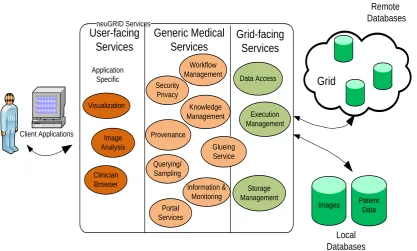
and reusable in application. As shown in Figure 1, a set of generic services ‘glues’ a wide range
of user applications to available Grid platforms, resulting in a system that addresses specific
applications but retains a large degree of underlying generality, thus being able to cope with the
still rapidly changing Grid environment.
There is general consensus that Service Oriented Architectures [11] provide a suitable basis for
computing, a service-oriented architecture (SOA) represents a method in which a loose coupling
of functions between operating systems, programming languages and applications can be
achieved; a SOA separates functions into distinct services [12]. The MammoGrid project
proposed perhaps the first healthcare example of a Grid-based service-oriented architecture [13].
Its philosophy was to provide a set of generic services that were independent both of the
front-end clinician-facing software and of the back-front-end Grid-facing software. A three-layer service
architecture was proposed and implemented where the clinician was isolated from the Grid.
The aim of the neuGRID project was to provide a user-friendly platform and a set of generalised
services to enable the European neuroscience community in carrying out research that is
necessary for the study of degenerative brain diseases. neuGRID is an example of an
infrastructure designed to provide researchers with a shared set of facilities through which they
can carry out their research. At the heart of the platform is a distributed computation
environment that is designed to efficiently handle the running of complex image processing
pipelines (or workflows) such as the CIVET algorithm [14], which enables longitudinal
measurement of the thinning of the brain cortex. It is not enough on its own however, to provide
support for neuroimaging analysis, since users require more than simple processing power.
They need to be able to access a large distributed library of data and to search for a group of
images with which they will work. A significant proportion of clinical research involves the
development of new workflows and image analysis techniques. The ability to edit existing, and
to construct new workflows using established tools is therefore crucial. Researchers need to be
able to examine each stage in the processing of an analysis workflow in order to confirm that it
is accurate. neuGRID has followed the MammoGrid philosophy in developing a platform based
on a SOA [15] in order to enhance its flexibility and interoperability and to promote
re-usability, potentially across other medical applications. This architecture (as shown in Figure 1)
allows neuGRID, and now N4U, to be implemented in such a way that its users do not require
often find it difficult to cope with the inherent complexities of Grid infrastructures, including
setting, configuring and maintaining the infrastructure. Performing these tasks requires in-depth
technical know-how that most neuroscientists usually do not possess.
[image:7.595.94.512.177.428.2]neuGRID Services Provenance Security Privacy Workflow Management Data Access Storage Management Execution Management Visualization Querying/ Sampling Clinician Browser Portal Services Knowledge Management Image Analysis Glueing Service Information & Monitoring Client Applications Grid User-facing Services Grid-facing Services Application Specific Generic Medical Services Images Patient Data Local Databases Remote Databases
Figure 1: Layered Services Architecture in neuGRID
By abstracting Grid middleware specific considerations and customisations from clinical
research applications, the neuGRID generic services provide functionality aimed at medical
applications. Lower-level services hide the peculiarities of any specific Grid technology from
the upper service layers thereby providing application independence and enabling the selection
of ‘fit-for-purpose’ infrastructures. The generic services glue a wide-range of user applications
to the available Grid platforms creating a foundation of cross-community and cross-platform
services. The generic medical services are not tied to a particular application or Grid
middleware; they could be used in any application domain and can be deployed potentially on
any Grid infrastructure. These services are designed in such a way that a variety of applications
3. Data Traceability and the neuGRID Provenance Service
In clinical research environments analyses or tasks can be expressed in the form of workflows
(elsewhere called pipelines). A scientific workflow is a step-wise formal specification of a
scientific process; an example of a workflow is one which represents, streamlines, and
automates the steps from dataset selection and integration, computation and analysis, to final
data product presentation and visualization. A workflow management system supports the
specification, execution, re-run, and monitoring of scientific processes. As a consequence of the
complexity of scientific (or biomedical) workflows, researchers require a means of tracking the
execution of specified workflows to ensure that important analyses are accurately (and
reproducibly) followed. Currently this is carried out manually and can often be error-prone.
Errors may include, amongst others, incorrect workflow specifications, inappropriate links
between pipeline components or execution failures because of the dynamic nature of the
resources. A real challenge in this scenario is tracking the faults as and when they occur, due to
the absence of a data and information tracking mechanism during the workflow specification,
distribution and execution. This may in turn lead to a loss of user control or repetition of errors
during subsequent analyses. Users may be prevented from being able to:
i. Reconstruct a past workflow or parts of it to view the errors at the time of specification.
ii. Validate a workflow specification against a reference specification.
iii. View the intermediary results produced in the execution of a workflow to determine
that those results are valid.
iv. Validate overall workflow execution results against a reference dataset.
v. Query information of interest from past analyses.
vi. Compare different analyses.
vii. Search annotations associated with a pipeline or its components for future reference.
The benefit of managing specified workflows over time is that they can be refined and evolved
so-called ‘gold standard’). Users need to collect information about (versions of) workflow
specifications that may have been gathered from multiple users together with whatever results
or outcomes were generated and then to use this so-called 'provenance data' as the drivers for
improved decision making. This provenance data may, thereby over time, become a valued
source of acquired knowledge as the nature of the analyses evolve; the provenance data store
will essentially become a knowledge base for researchers. In future users must be able to invoke
services to automatically monitor and analyse provenance databases to return statistical results
that match some criteria as set by the end user. This should provide efficient and dependable
problem solving functionality and decision support system for the researchers.
In neuGRID a Provenance Service has been designed and implemented that is primarily
intended to capture the information needed to populate a project-wide provenance database. As
described below the service will support and enable the refinement of the workflows in the
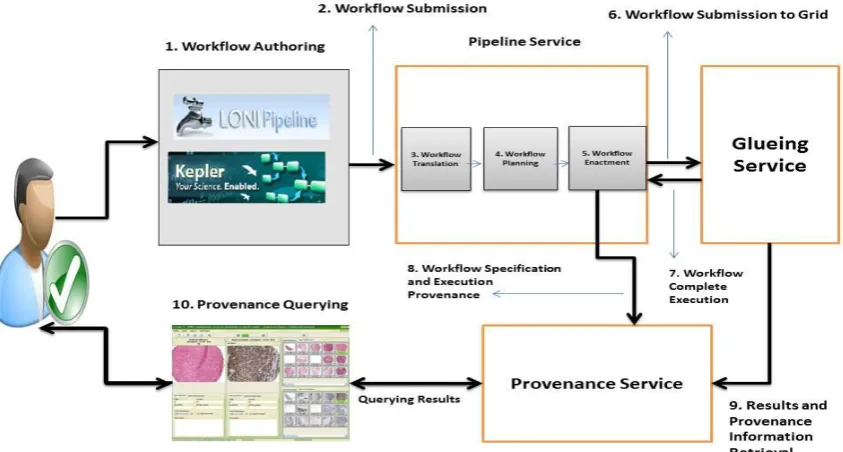
neuGRID project by capturing (as shown in Figure 2):
a. Workflow specifications.
b. Data or inputs supplied to each workflow task.
c. Annotations added to the workflow and individual workflow task.
d. Links and dependencies between workflow tasks.
e. Execution errors generated during analysis.
f. Output produced by the workflow and each workflow task.
As shown in Figure 2, the provenance capture process starts from the Pipeline authoring step.
Users can write their workflows and analyses in a number of authoring conventions. A Pipeline
Service enables clients to perform various functions such as the submission of workflows,
tracking progress and functions to monitor workflows. The user-facing component of the
Pipeline Service supports numerous workflow-authoring environments, such as the LONI
Pipeline and Kepler. These workflows are translated by the Pipeline Service translation
and eventually submit it to the neuGRID infrastructure for execution. The Pipeline Service
supports multiple workflow specification formats; therefore unified format is required for
processing workflows that have been authored in different environments. For this purpose an
object-oriented workflow API has been built. The translation component implements an API
[image:10.595.90.512.223.449.2]which allows the translation of various workflow specification formats to a common format.
Figure 2: Provenance Service and Neuroimaging Analysis
When a workflow is submitted to the Pipeline Service, at first an appropriate translator for the
format is instantiated dynamically. The format specific translator translates the workflow into a
common object-oriented workflow model. This model is then forwarded to the Pipeline Service
planner for workflow optimisation to enable efficient enactment (step 5 in Figure 2). The
provenance service captures the workflow specification as well as execution provenance as
shown in steps 7 and 8 in Figure 2. The executed workflows report the status update to the
workflow enactment engine (step 7 in Figure 2) which is then passed on to the provenance
service. The final results and execution traces retrieved from the Grid (step 9) are also stored in
the provenance service to have a consolidated view of the specification, execution, monitoring
service to browse the provenance information and may even use this information for workflow
validation to find if the results are accurate or not.
The neuGRID infrastructure supports interoperable, reusable, extensible and scalable services.
The Provenance Service is one such service that traces, stores and provides access to analysis
data for improved decision making. It is primarily intended to capture workflow specifications,
final and intermediate datasets and meta-data produced during an analysis and information
pertaining to the environment where the data was produced (compute node, architecture, etc.)
The neuGRID Provenance Service allows users to query analysis information, to regenerate
analysis workflows, to detect errors and unusual behaviour in past analyses and to validate
analyses. It assists users by providing them with access to past executions or histories of their
analyses. It also provides users with a means of capturing and maintaining workflow
specifications and execution information in its provenance database. After the execution of a
workflow all the information that was initially provided and that which was generated during an
analysis is stored in the provenance database. The service thereby supports the continuous
fine-tuning and refinement of pipelines in the neuGRID project. The provenance database can be
queried by the user to verify results or improve and fine-tune pipelines and acts as a rich
knowledge base of accumulated analysis steps and outcomes for users to consult.
The neuGRID Provenance Service has adapted a system called CRISTAL [16] that has been
developed by the authors to manage the construction of large-scale High-Energy Physics (HEP)
detectors for the Large Hadron Collider (LHC) at CERN, Geneva, for the purposes of tracking
neurological analyses of Alzheimer’s disease. The next section outlines how CRISTAL has
been adapted to provide provenance tracking functionality for medical analysis.
4. CRISTAL as the Basis of a Provenance Service in neuGRID and N4U
CRISTAL is a distributed data and workflow management system which uses a generic and
dynamic object modelling for the design of its objects and components. These techniques are
critical in handling the complexity of data and workflow traceability in distributed systems and
to provide the flexibility to adapt to the changing analysis scenarios typical of any research
production system. CRISTAL has been based on a so-called description-driven approach in
which all logic and data structures are ‘described’ by meta-data, which can be modified and
versioned online as the description of the object, component, item or an application changes. A
Description-Driven System (DDS) architecture, as advocated previously in [17] is an example
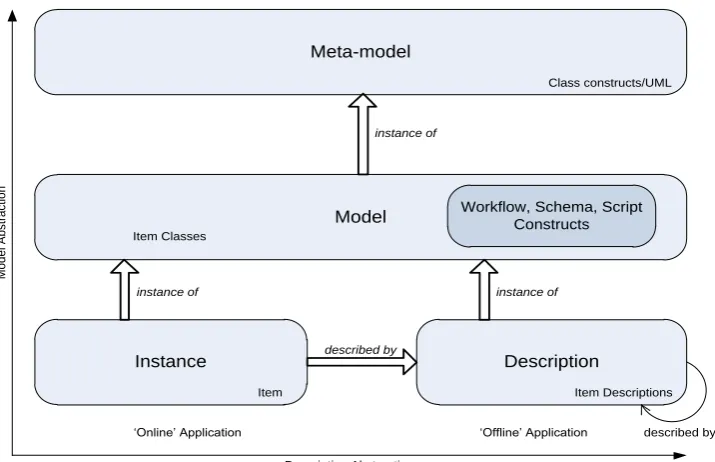
of a reflective meta-layer architecture (as shown in Figure 3).
DDSs make use of meta-objects to store diverse domain-specific system descriptions (such as
items, processes, lifecycles, goals, agents and outcomes), which control and manage the
lifecycles of instances or domain objects i.e. the essential objects of a particular domain. In
neuroimaging these objects might be, for example, raw image datasets, pipelines, derived
datasets or analysis outcomes etc. As objects, reified system descriptions of DDSs can be
organised into libraries conforming with frameworks for modelling of languages in general, and
to their adaptation for specific domains.
Instance Model Meta-model instance of Description instance of instance of M o d e l A b st ra ct io n Descriptive Abstraction Item Descriptions Item Class constructs/UML
‘Online’ Application ‘Offline’ Application
described by
Workflow, Schema, Script Constructs
Item Classes
described by
[image:12.595.114.472.483.714.2]
The meta-data along with the instantiated elements of data are stored in the database and the
evolution of the design is tracked by versioning the changes in the meta-data over time. Thus
DDSs make use of meta-objects to store domain-specific system descriptions that control and
manage the lifecycles of domain objects. The separation of descriptions from their instances
allows specification and management to evolve independently and asynchronously. This
separation is essential in handling the complexity issues facing many web-based computing
applications and facilitates interoperability, reusability and system evolution. Separating
descriptions from their instantiation allows new versions of defined objects (and in turn their
descriptions) to coexist with older versions. Neuroimaging is constantly developing new
algorithms and workflows which may require variations to the provenance data that is collected.
At the same time provenance data to be useful needs to remain consistent over time, to be
traceable, queryable and easily accessible and scientists’ analyses need to be conducted on those
data. CRISTAL handles all of this.
The reader is directed to previous publications on DDS (i.e.
[17] and [18]) for further background. CRISTAL [19] is essentially a provenance tracking
system which has previously been used to track the construction of large-scale experiments e.g.
the CMS project [20] at CERN. It is both a process modelling and provenance capture tool,
which addresses the harmonisation of processes so that multiple potentially heterogeneous
processes can be integrated and have their workflows tracked in the CRISTAL database.
Using its facilities for description and dynamic modification in a generic and reusable manner,
CRISTAL is able to support modifiable and reconfigurable workflows. It uses the
description-driven nature of the CRISTAL models [17] to act dynamically on process instances already
running and can thus intervene in the actual process instances during execution. Figure 4 shows
how the CRISTAL system captures and tracks workflow provenance. User interaction starts
with the authoring of a pipeline, which the user wants to execute on datasets held on the Grid.
The workflow specification is enriched by including provenance actors for provenance
collection. In neuGRID the so-called Pipeline Service translates the workflow specification into
facilitates the linking (and importantly the isolation) of services such as the Pipeline Service and
Provenance Service to/from the underlying enabling (Grid) infrastructure. The reader should
[image:14.595.83.513.173.435.2]consult [21] for more information on these services.
Figure 4: The Provenance Service in neuGRID
The planned workflow, as depicted in Figure 4, is forwarded to the CRISTAL enabled
provenance service which then creates an internal representation of this workflow and stores the
workflow specification into its schema. This schema has sufficient information to track the
workflow during subsequent phases of the workflow execution. The workflow activity is
represented as a directed acyclic graph; all associated dependencies, parameters, and
environment details are represented in this graph. The schema also provides support to track the
workflow evolution and the descriptions of derived workflows and its constituent parts are
related to the original workflow activity.
Once a workflow has been enacted in the Grid, the Provenance Service coordinates the retrieval
of all final data outcomes as well as intermediate data that was produced during the lifetime of
the CRISTAL model, a workflow consists of a number of activities, these activities being
associated to multiple events and each event is associated with an outcome. An activity event
may denote that the activity has failed and its outcome may include associated error logs, while
the outcome of a successful activity may be the data produced during the runtime of the job. The
adopted model enables the pervasive tracking of the entire life-cycle of a neuroimaging
workflow, from the pre-planned workflow to the final data outcomes.
5. The neuGRID Provenance Service in Practice
A prototype Provenance Service was deployed during the final stages of neuGRID and
evaluated against the requirements from users. In order to thoroughly evaluate it a two pronged
strategy was pursued. This involved functional testing via large-scale data challenges and a
more user focused testing scheme which was based on a clinical researcher defined case study.
The results of such evaluations are considered in detail in the next sections and conclusions are
drawn regarding lessons learned and future directions for further work in this area.
Since the completion of neuGRID the Provenance Service has been further refined in the N4U
project to ensure that it satisfies the tracking as detailed in the neuroscience research
community’s requirements [22]. It satisfied the need for independent analysis traceability via
CRISTAL. This provided the ability for users to define, run and share the output of user
analysis between neuroimaging researchers for the first time. The Provenance Service consisted
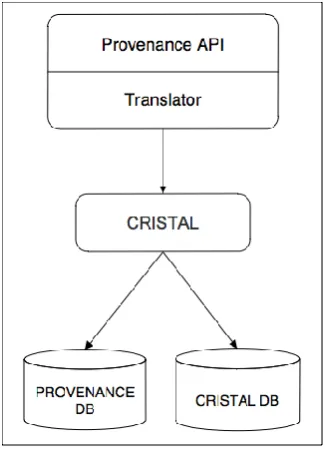
of two layers; an API layer and the CRISTAL layer, as shown in Figure 5. The CRISTAL API
layer implements the Web Service API that serves as entry point into the Provenance Service. It
was implemented using Apache Axis 1.4 (http://ws.apache.org/axis/) and Tomcat 6.2.20
(http://tomcat.apache.org/). This layer also consists of a so-called Translator component. The
API allows clients to store workflow templates, create workflow instances and update workflow
instance status. The Translator component is responsible for converting the workflow passed to
two-pass translation mechanism. In the first two-pass, the workflow is mined for information about each
activity such as TaskName, Executable, Priority etc. In the second pass, the CRISTAL
[image:16.595.216.379.166.392.2]workflow is constructed using information mined during the first pass.
Figure 5: Provenance Service Architecture
The CRISTAL layer is the tracking element in the Provenance Service. Once a workflow
execution starts in the neuGRID infrastructure, a parallel workflow simulation is created within
CRISTAL. This allows clients (typically the Pipeline Service) to send incremental updates to
the Provenance Service. The virtual workflow within CRISTAL simulates the actual execution
of the workflow on the grid infrastructure. Adapting CRISTAL for the Provenance Service
involved creating the appropriate item descriptions and factories within CRISTAL. As shown in
Figure 5, CRISTAL uses two databases; the ‘CRISTAL DB’ stores only the CRISTAL internal
model and the ‘Provenance DB’ stores workflows’ provenance. Other neuGRID services (e.g.
Querying Service) directly interact with the Provenance DB for the execution of users’ queries.
6. Evaluation of the neuGRID Platform through International Data Challenges
In order to test the functionality of neuGRID infrastructure thoroughly and to demonstrate the
data challenges to be conducted across international boundaries were devised. These challenges
were designed to test each deployed service individually and to evaluate the neuGRID
infrastructure as a whole. They were selected to test the major aspects of the platform including:
a. Performance: that the infrastructure performs efficiently and as expected.
b. Scalability: that the infrastructure scales up appropriately in relation to the size of the
jobs submitted to it.
c. Fault tolerance: that the infrastructure should be able to detect, report and recover from
any errors that occur.
d. Functionality: that the required functionality in order to successfully carry out and
trace the Neuroimaging Analysis is available.
In order to carry out the evaluation in a structured way, a group of three progressively more
intensive data challenges were developed. The first challenge was designed to test the
functionality of the underlying grid infrastructure. In this test, each of the individual services
provided by gLite, the middleware used in neuGRID, were tested. This involved setting up a set
of automated scripts that ran some standard tests of the services and reported any problems. The
test validated the system functionality in that all the services were reported to work according to
their specifications.
Experiment duration on the Grid < 2 weeks
Analysed data Patients 715
MRI Scans 6,235
Number of parallel cores 184
[image:17.595.75.509.535.611.2]Output data produced 1 TB
Table 1: Second Data Challenge Statistics
The second data challenge involved a real world analysis which was performed on the
US-ADNI dataset [6]. This challenge was designed to test the infrastructure as a whole via a
medium-scale test. Table 1 shows some details about the configuration and results. The dataset
to 20 MB data file in MINC format. The entire dataset represented about 108 GB of data. The
analysis consisted of running the CIVET pipeline [14] on the dataset and retrieving the results.
The CIVET pipeline was converted into an automated workflow using the neuGRID Pipeline
Service and then enacted on the underlying gLite infrastructure using the neuGRID Glueing
Service (figure 2). The analysis steps were tracked, modelled and archived using the neuGRID
Provenance Service. To run the test, two out of three sites (Fatebenefratelli (FBF) in Italy and
Karolinska Institute (KI) in Sweden) of the neuGRID infrastructure were commissioned. They
were set up with 64-bit worker nodes and 64-bit gridified versions of the CIVET pipeline.
Between them, the two sites provided 184 processing cores and 5.3 TB of storage capacity. The
sites were connected via the GEANT2 network, thus guaranteeing good network connectivity.
Initial tests had shown that CIVET takes about seven hours to process a single scan and as
output generates in volume about ten times the input data. Therefore, it was estimated that the
test would take two weeks to run and produce an output of approximately 1 TB. During the first
15 minutes, a service at the FBF site was identified which was misreporting because of an
inherent bug in the version deployed. This service was successfully updated with the data
challenge still running. Subsequently, after the test had been running for about 12 hours the FBF
site disappeared from the grid due to a power failure. The Workload Management Service
(WMS) that is responsible for managing the workload across the different sites detected this
failure and rescheduled all the jobs from FBF to KI, causing the job queue at the KI site to
overload. This was resolved by limiting the size of the job queue to 3000 jobs. After this the
remainder of the test ran smoothly and all the jobs were completed successfully. The entire test
took less than two weeks to complete, as was originally estimated.
Experiment duration on the Grid ~3 weeks
Analysed data Patients 800
MRI Scans ~7,500
Number of parallel cores ~1000
[image:18.595.78.504.647.726.2]Output data produced 2.2 TB
The third data challenge was similar to the second; however, it was more compute and
data-intensive. The purpose was to test the infrastructure under extreme conditions and to confirm its
scalability. Table 2 shows the statistics for the third data challenge. As with the previous one,
the US-ADNI dataset was chosen. However, as opposed to 6,235 scans in the second challenge,
the third challenge involved analysing approximately 7,500 scans in DICOM format. The scans
represented approximately 112 GB of data, with each scan being 10 to 20 MB in size. The
challenge consisted of analysing these images using three popular pipelines used by
neuroscientists i.e. CIVET [14], FREESURFER [23] and BRAINVISA [24]. Therefore, a total
of 22,500 jobs were to be executed on the infrastructure. This was beyond the capacity of the
three neuGRID sites to handle. Therefore, additional sites were added to the Grid for this
challenge, made available by the European Grid Infrastructure (EGI). After the neuGRID
infrastructure was reconfigured to include these sites, a total of approximately 1000 processing
cores became available for this challenge. This reduced the estimated time of completion of the
jobs to approximately three months.
A significant feature of this challenge was that CIVET and BRAINVISA both require input data
in the MINC format. However, as noted above, the data available for this challenge was in
DICOM format. Therefore, it needed to be pre-processed in order to convert it to MINC format
for use with CIVET and BRAINVISA The data challenge finished execution in approximately
three months and produced a total of 2.2 TB of data. The successful completion of this
large-scale evaluation confirmed that the infrastructure and integrated services were functioning
correctly as was anticipated.
7. Evaluation of the neuGRID Provenance Service with End Users
In order to evaluate the neuGRID Provenance Service practically with researchers, an
end-to-end use case scenario was developed in collaboration with end-to-end users. The community of end-to-end
users included medically trained clinical researchers, statisticians, PhD students and imaging
which spans a complete analysis cycle in neuGRID from initial data collection, through analysis
workflow execution to collaborative data analysis. This use case has been previously introduced
briefly in [22] but is expanded here in order to illustrate the process of evaluation of the
Provenance Service. By carrying out test cases which were based on this use case, the neuGRID
platform has been thoroughly tested and evaluated by end users. The early stages of the use
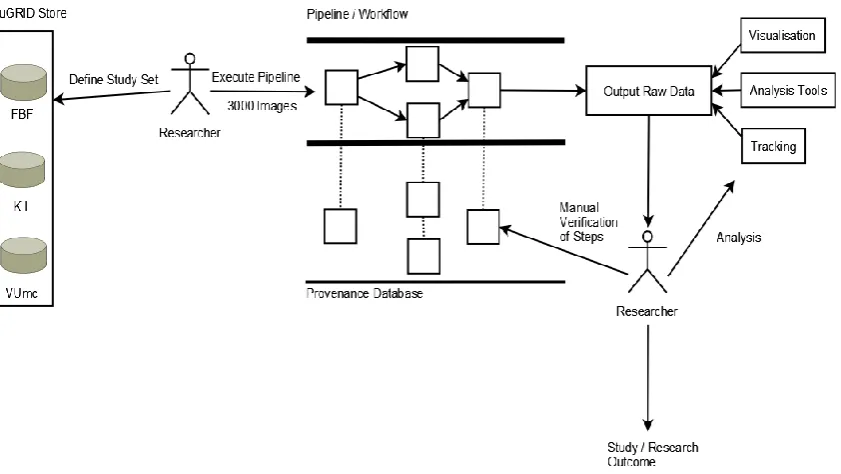
case initialise the platform prior to an analysis being carried out. The first action in the use case,
shown on the left in Figure 6 (the progression in time is from left to right), was to register
images in the neuGRID store that have been collected from the hospital data acquisition systems
[image:20.595.92.513.316.553.2]or have been imported from other research projects.
Figure 6: An end-to-end example of the neuGRID Analysis Environment
Existing data was put through a process that enforces quality control, formatting and ethical
compliance (plus anonymisation when required). The data was then integrated with the
neuGRID data model, which enabled other researchers to access it and carry out their research.
As new data sets were acquired they were put through a local quality control step before passing
through the system-wide quality control, formatting, ethical compliance and data model
recorded its creation and stored the definitions of the datasets for subsequent tracking of their
usage in analyses.
When the data had been registered, the next step in the analysis process was to make the data
browsable through automated querying tools. The user interacts with the system using the
neuGRID data store, to search for and to identify an appropriately large set of images from a
group of hospitals that match the required criteria. Once the data has been imported into the
neuGRID system and users are able to access and query these data, they can carry out studies
with their corresponding data analyses (as shown in Figure 6). The Provenance Service is made
aware of the creation of analysis workflows so that their subsequent usage may be tracked. For
example, a researcher may wish to run a comparative analysis using a study set of MRI scans
stored in geographically distributed medical centres. The user would typically interact with the
system to choose a study set of perhaps 3000 images (again this study is recorded in the
provenance database), may select the CIVET [14] pipeline through which the analysis will take
place and would start the analytical process. Users are not limited to using previously specified
workflows and study samples; they can also construct new workflows. These workflows are
also captured in the provenance database for later execution and monitoring on the Grid.
It is important that results should be reproduced and reconstructed using their full set of
Provenance information. It may also be necessary to validate and to view the original workflow
that has been used to obtain the results. For example, a user may create a new workflow and run
it on a test data set. At each stage in the execution of the workflow, the intermediary images or
data would be stored by the Provenance Service and a full audit trail of the data will be kept.
After results have been produced, the user can examine the provenance database to check that
each stage of the analysis has been completed correctly. The raw results can then be exported
into the user’s preferred analysis tool such as SPSS [25] and the whole process can be added to
workflows, it would be difficult, to correct the process and generate accurate results. Once a
workflow has been developed and verified, a user is able to share it with other researchers.
Reflecting on the reasoning behind why certain user requirements were captured and described
in the previous use case, can guide us in further evaluating the completed neuGRID
infrastructure and help us to assess the degree to which CRISTAL addressed the needs of
researchers in terms of traceability. Clinical researchers develop research hypotheses which are
then evaluated by teams of statisticians, computer scientists and associated experts. The
collective effort that is necessary makes traceability a key feature of the research process. There
is always a fear that a small error or even misunderstanding in one part of a highly complex
analysis can render the final results useless, thereby wasting a large amount of time, money and
potentially embarrassing the research team if they need to retract published work. In order to
avoid such problems researchers need to follow established methodologies.
The standard scientific method requires that research results should be repeatable. This means
that an independent team should be able to take an experiment that has been carried out
elsewhere and repeat it in order to verify the results that were originally produced. In many
scientific disciplines this is a relatively simple task, provided that methods are described with an
appropriate level of detail. In the medical imaging domain however repeating experiments
becomes much more complicated. Researchers would need to know details such as which
images were used, their source, which pipelines were applied, which algorithms, algorithm
versions, settings that were given and much more in order to be able to reproduce the analysis.
The level of the traceability that the underlying CRISTAL provenance system provides in
neuGRID can therefore be determined by comparing such requirements against what is actually
captured by CRISTAL in terms of provenance data.
While designing the integration of CRISTAL as the basis of the neuGRID Provenance Service
with the Pipeline and Glueing Services, it was decided that CRISTAL would not be used to
orchestrate every step in the execution of each workflow. This was because it was believed that
Pipeline Service, to extract the next step from the stored workflow specification and to delegate
it to the Pipeline Service would increase the already high workflow execution times. In addition
the gLite V2.1 framework [26] used to provide the Grid platform already supported DAG
(Directed Acyclic Graph) based jobs that facilitated workflow execution on the Grid computing
element itself. Furthermore it was believed that this will reduce the dependency of the low level
services (such as workflow execution) on CRISTAL, allowing those services to run workflows
without the Provenance Service if a particular deployment did not require it. In this instance
CRISTAL simply tracked the workflow, replicating its state when it received notifications from
the Pipeline Service about remote workflow events.
During the experimentation and evaluation of neuGRID, it became clear that CRISTAL should
in fact be used as the orchestrator for each and every workflow step. CRISTAL could then
control the execution of the workflow by acting on any changes in state during the execution as
notified by the Pipeline Service and could instruct it as to the next workflow step. In the absence
of such adequate pushing of workflow state changes to the Pipeline Service, events could be
missed and provenance lost. In practice, without such controlled orchestration, it proved
impossible to replay the correct state changes on the CRISTAL workflow to keep it in-line with
the workflow execution on the Grid. Moreover when the support for DAG jobs was removed
from gLite (in its upgrade from V2.1 to V2.2) the ability of the Pipeline Service to run
independent workflows on the Grid became unsupported. It would have required a major rewrite
of the Pipeline Service itself in order to replace the functionality that was removed. If control of
workflow orchestration had resided within CRISTAL, manifested through the Pipeline and
Provenance services, then neither of these flaws would have made any difference to their
operation.
The resulting lesson learned from neuGRID was that provenance and execution control need to
be tightly coupled to avoid any problems of infrastructure evolution later in the project lifecycle.
required to enable researchers to have full analysis tracking, the system must have all elements
of analysis provenance data pushed to it. In other words the provenance system must be
informed of all information generated through the execution of the analysis workflows. If
fragments of the workflow need to be farmed out remotely for execution, then a robust
mechanism of delivering the execution progress must be in place to make sure that the relevant
provenance data is returned.
The neuGRID project concentrated on the management, orchestration and infrastructure aspects
of provenance tracking rather on the user-facing services to facilitate usability. Consequently
users found the interface to the Provenance Service non-intuitive and with only infrequent
access, difficult to use. In the N4U project we are addressing this by the provision of a so-called
Analysis Service in which users can define their personalised analyses visualised through a
Virtual Laboratory (VL) interface. In the context of provenance data management, the
CRISTAL data model is currently being adapted for compliance with the emerging standard
Open Provenance Model [27] in the Virtual Laboratory environment of N4U. In the near future
the Analysis Service will develop and transform neuGRID into a VL in N4U, capable of
meeting the requirements of the vast majority of scientists working in the field of imaging of
neurodegenerative diseases, white matter diseases, and psychiatric diseases. The VL offers
scientists access to a wide range of datasets, algorithm applications, access to computational
resources, services, and provenance support (see [10]).
CRISTAL has been adapted in the Provenance Service to track the provenance of neuroimaging
analysis in neuGRID. The important question that immediately comes to mind is how well the
CRISTAL model can cope with tracking detailed provenance in the medical domain in general.
In the neuGRID context, pipelines (workflows) provide a means of capturing processes and
their associated metadata, which is a relatively common format to specify and build analyses in
almost all types of medical applications. The underlying CRISTAL structure is flexible, this
flexibility allows CRISTAL to store all of the information that users require in terms of
requested by users during the requirements analysis. This was validated through the feedback of
users during infrastructure testing where the provenance capture mechanism was demonstrated
to them. All of the processes outlined in the neuroimaging example from neuGRID and N4U are
common across the domain of (bio) medical research. The need to capture analysis
specifications, both in terms of the data (e.g. images) and the workflows (or pipelines) to be run
on those data are not specific to neuroimaging. Furthermore the requirement to collect
provenance data as workflows are executed and to compile a history or audit of the analysis
processes is also common practice especially with the need for repeatability and independent
verification. Having worked with mammographers and paediatricians in the research domain it
is clear that a general purpose Provenance Service, potentially delivered using CRISTAL,
would be widely applicable and desirable to the community of (bio) medical researchers. This
hypothesis will be tested in future applications of the neuGRID/N4U Provenance Service.
8. Conclusions and Future Directions
In this paper we have outlined the approach to provenance management that is being developed
in the neuGRID and N4U projects. neuGRID has built the foundations for exploitation of Grids
in the neuroscience domain through the construction of an adaptable and extensible platform
providing customisable, generalised services. N4U is being executed to build the environment
in which end-users can access that platform and services and, in particular, to take advantage of
the Provenance service. The major benefit in neuroimaging for Alzheimer’s studies should
ultimately be earlier diagnosis and faster development of new drugs, which will improve the
quality of life of elderly people. The set of services has been designed and developed using the
service oriented architecture paradigm. These services can be reusable both across Grid-based
neurological data and later for wider application in medical analyses.
We have shown that the neuGRID Provenance Service captures the workflow information
needed to populate a project-wide provenance database. It tracks the origins of the data and their
information, to regenerate analysis workflows, to detect errors and unusual behaviour in past
analyses and, finally, to validate analyses. The use of CRISTAL as the Provenance Service
database for neuGRID has enabled neuroscientists to support their complex image analyses over
time and to collaborate together in teams with fully versioned workflows and datasets.
Ultimately one important N4U deliverable will be the Virtual Laboratory which will provide the
environment for users to conduct their analyses on sets of images and associated clinical data
derived from a collection of project-specific data. This will provide facilities for users to interact
with the underlying set of N4U services. The VL will comprise a ‘Dashboard’ to present the
underlying system, a set of integrated data resources, a set of services enabling access to the
neuGRID infrastructure, and a user analysis workbench to define/configure pipelines and
inspect analysis output. As the Dashboard is the first point of entry for the user to the underlying
N4U services, the work area is the first point of experimentation that empowers the user to use
the N4U services in an infrastructure. This Dashboard service presents the underlying system
with a standard user-defined look and feel and which can handle role-specific (novice, regular,
advanced user) access to the services. This will enable users to prototype their analyses by
refining data selections and pipelines, by trying out simple tests and ultimately larger
experiments and to visualize the results of those test and experiments. In this way we believe
that CRISTAL could become an essential building block for future projects requiring data and
analysis tracking with provenance management both in execution and design.
Acknowledgements
The authors wish to thank their institutes and the European Commission for their support and to
acknowledge the contribution of the following neuGRID and N4U project members: Dr
Giovanni Frisoni and Alberto Redolfi (Fatebenefratelli, Brescia), David Manset and Jerome
Revillard (Maat GKnowledge, France), Professor Frederik Barkof and his team at VU Medical
Eva Orndahl (Karolinska Institute, Stockholm) and Alex Zijdenbos of Prodema Medical
(Braunshofen, Switzerland).
References
1. Foster I, Kesselman C & Tuecke S, The Anatomy of the Grid: Enabling Scalable Virtual Organizations. Int J Supercomput Appl. 2001;15(3):200-222
2. Foster I et al., Cloud Computing and Grid Computing 360-Degree Compared.Grid Computing Environments WorkshopGCE '08, pp. 1-10 2008.
3. Ellisman M et al., BIRN: Biomedical Informatics Research Network. Stud Health Technol Inform. 2005;112:100-109
4. CBRAIN Project, http://cbrain.mcgill.ca/. Last accessed 27th May 2012.
5. Benkner S et al., GEMSS – Grid Infrastructure for Medical Service Provision. Methods Inf Med. 2008;44(2):177-181.
6. Mueller SG et al., Ways toward an early diagnosis in Alzheimer’s disease: the Alzheimer’s Disease Neuroimaging Initiative (ADNI). Alzheimers Dement. 2005;1(1) :55–66.
7. Montagnat J et al., NeuroLOG: a community-driven middleware design. Stud Health Technol Inform. 2008;138:49-58.
8. Joseph S, NeuroGrid: Semantically Routing Queries in Peer-to-Peer Networks. Proc of the Int. Workshop on Peer-to-Peer Computing Pisa, Italy 2003;95:194-199
9. Redolfi A et al., Grid infrastructures for computational neuroscience: the neuGRID example. Future Neurol 2009;4:703-722(20).
10. neuGRID for You (N4U). See: neugrid4you.eu. Last accessed 27th May 2012.
11. Erl T, Service-oriented Architecture: Concepts, Technology, and Design. Prentice Hall PTR 2005.
12. Newcomer E & Lomow G, Understanding SOA with Web Services. Addison-Wesley Professional 2005.
13. Amendolia SR et al., MammoGrid: A Service Oriented Architecture based Medical Grid Application. Grid and Cooperative Computing 3251, 939-942 2004.
14. Zijdenbos AP, Forghani R & Evans AC, Automatic ‘pipeline’ analysis of 3D MRI data for clinical trials: Application to multiple sclerosis, IEEE Trans Med Imag. 2002;21(10):1280–1291
15. Hauer T et al., Experiences of engineering Grid-based medical software. Int J Med Inform. 2007;76(8):621-632.
16. McClatchey R et al., A Distributed Workflow & Product Data Management Application for the Construction of Large Scale Scientific Apparatus. NATO ASI Series F:Computer & Systems Sciences Vol 164 pp 18-34. Springer Verlag 1998.
17. Estrella F et al., Pattern Reification as the Basis for Description-Driven Systems. J Software & System Modelling Vol 2 No 2, pp 108-119 2003.
18. Estrella F et al., Meta-Data Objects as the Basis for System Evolution. Lecture Notes Computer Science (LNCS) Vol 2118, pp 390-399 2001.
19. Branson A et al., Evolving Requirements: Model-Driven Design for Change. Under final review at Information Systems, Elsevier publishers 2012.
21. Anjum A et al., Reusable Services from the neuGRID Project for Grid-Based Health Applications. Stud Health Technol Inform. 2009;147:283-288
22. Anjum A et al., Research Traceability using Provenance Services for Biomedical Analysis. Stud Health Technol Inform 2010;159:88-99
23. Sanchez-Benavides G et al., Manual validation of FreeSurfer's automated hippocampal segmentation in normal aging, mild cognitive impairment, and Alzheimer Disease subjects, Psychiatry Res, 2010, 181(3): 219-225.
24. Rivière D et al., A Structural Browser of Brain Anatomy, NeuroImage, 11(5), HBM, San Antonio, 2000.
25. SPSS software. See: http://www-01.ibm.com/software/uk/analytics/spss/products/statistics/ Last accessed 27th May 2012.
26. Kretsis A et al., Developing Scheduling Policies in gLite Middleware. Proc of the 9th IEEE/ACM International Symposium on Cluster Computing and the Grid, pp. 20-27 2009