Coercive vs legitimate power: A paradox for
consumer protection
Author:
Adam C Poole MSc
PhD Student
Cardiff Business School, Cardiff University, Aberconway Building, Colum Drive,
Cardiff CF10 3EU United Kingdom
This developmental paper identifies a potential paradox in consumer protection regulation based upon the employment by a regulator of ‘coercive power’ upon those that transgress consumer protection regulation.
Whilst consumers have been shown to draw considerable reassurance from the employment of such power through the imposition of fines and other punishments, research in the field of tax compliance suggests that this is counter-productive and reduces rather than increases compliance with rules and regulations.
This paper proposes to examine the regulation of the UK financial advice industry where coercive power is regularly used by the regulator to determine if this paradox exists, and also to determine if an alternative approach based upon the employment of ‘legitimate power’ would be more effective.
Coercive versus legitimate power: A paradox for consumer protection
1
Introduction
Consumers have been shown to draw considerable reassurance from rules and regulations designed to protect them and also the ability of regulators to penalise those that transgress such rules by means of the imposition of fines and other sanctions (Gefen et al. 2003). The practice of doing so has been described as an antecedent or component of ‘system’ or ‘environmental’ trust by authors such as McKnight and Chervany (2001). It is argued that such system-based or environmental trust helps build consumer confidence in a particular marketplace thereby increasing the willingness of consumers to transact (McKnight and Chervany 2001).
A regulatory approach that relies upon the threat of punishment, such as the imposition of fines or other sanctions to ensure compliance with rules and regulations, uses ‘coercive power’ as defined by French and Raven (1959) and is often characterised by conflict, the enforcement of rules and regulations against the will of those being regulated, and a low trust environment between the regulator and the regulated. An alternative approach relies upon a regulator operating in a fair, open and transparent manner with the aim of becoming an ‘accepted’ authority, and is often characterised by voluntary deference and compliance with rules and regulations and high levels of cooperation and trust between the regulator and the regulated. It is argued by authors such as Tyler (20006) that this latter approach, which relies upon the use of ‘legitimate power’ as defined by French and Raven (1959), is more effective and leads to higher levels of compliance with rules and regulations whilst the former
approach, reliant upon ‘coercive power’, is counterproductive and reduces compliance. Studies in the context of individual (rather than corporate) compliance with tax authorities by authors including Muehlbacher et al., (2011) and Kogler et al. (2013) have examined this particular issue using the ‘Slippery Slope’ model developed by Kirchler et al., (2008) and found the employment of legitimate power to be more effective than the employment of coercive power in that particular context. Furthermore Kastlunger et al., (2013) found that the use of co-receive power reduced compliance with the tax authorities and increased attempts at tax evasion.
These findings, together with the arguments of other authors such as Turner (2005) who notes that the use of coercive power can require the expenditure of significant resources in order to achieve limited returns, suggest a potential paradox for consumer protection authorities. An approach using coercive power that relies upon the imposition of fines and other punishments upon those that transgress rules designed to protect consumers, which as noted earlier,
consumers draw considerable reassurance from, may not only be less effective at ensuring compliance with those rules and regulations than an approach based upon ‘legitimate power’, but may actually also be counter-productive, in that the use of coercive power by a regulator may actually reduce compliance with rules and regulations designed to protect consumers.
2
whether an approach employing coercive power or legitimate power is more effective in gaining adherence to consumer protection rules and regulations, and by establishing if the identified paradox is occurring or otherwise. A further contribution of this study will also be to text the validity of the theoretical framework and ‘Slippery Slope’ model in a context other than the one for which it was designed, thereby broadening the application of the model.
Literature Review
Whilst there is no formal theory or definition of power, many authors including Festinger (1950), French and Raven (1959) and Keltner et al., (2003) have been researching the subject for many decades. Despite this lack of a formal theory or definition of power, a set of general assumptions has become widely shared that sees power as the capacity to influence others by means of controlling resources that can lead to positive or negative outcomes including rewards (positive or negative), costs and information which are either desired, valued or needed by others in order to satisfy their needs or attain their goals (Turner 2005). French and Raven (1959) noted five bases or foundations of power:
1. Reward power whereby an influencing agent rewards compliance. 2. Coercive power whereby an influencing agent punishes non-compliance.
3. Legitimate power whereby an influencing agent becomes accepted as a legitimate authority leading to a social obligation to comply.
4. Referent power whereby an individual wishes to identify with the influencing agent and therefore complies with the requests of the influencing agent.
5. Expert power whereby the influencing agent is judged to be an expert within a certain area such as law and whose wishes are therefore adhered to.
As noted in the introduction, this paper is concerned with the use of coercive and legitimate power. As coercive power is exercised by punishing non-compliance with rules and
regulations the use of coercive power can be perceived as an attempt by an authority to enforce a certain behaviour amongst those being regulated against their volition (Kirchler et al., 2008). Essentially compliance with rules and regulations is not voluntary, which can lead to an antagonistic environment between the authority and those being regulated. Such an environment is often characterised by little respect being shown for the other by either party and a lack of trust (Muehlbacher et al., 2013) leading authors such as Tyler (2006) to
conclude that it is difficult for authorities to impose influence on others based upon the possession and use of coercive power only and that the adoption of such an approach leads to low or modest levels of influence often gained at a high material cost. Keltner et al., (2003) develop the argument that that that the use of coercive power can be counterproductive further with their assertion that the use of punishment by an authority can in fact reduce the overall level of power held by that authority.
In contrast, legitimate power is exercised by an authority that is generally accepted by those being regulated with voluntary deference often being paid to the regulator (Kirchler et al., 2008). Essentially compliance with rules and regulations is a social norm, voluntary and perceived as being right and proper. This can lead to a synergistic climate characterised by high levels of co-operation and trust between authorities and those being regulated
Coercive versus legitimate power: A paradox for consumer protection
3
authority is gained by the adoption of procedures and processes that are perceived and experienced as being fair (Tyler 2001) and can be encouraged by a variety of means such as authorities offering support and assistance in meeting regulatory obligations (Kirchler et al., 2008).
The ‘Slippery Slope’ model
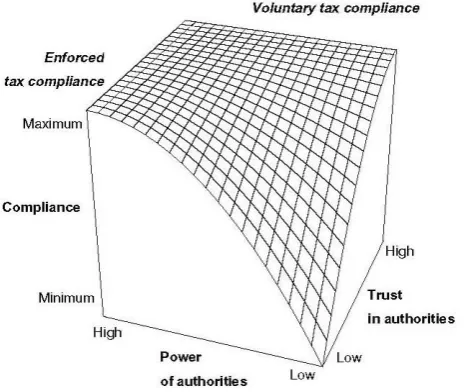
In order to empirically test these arguments in the context of tax compliance by individual tax payers, Kirchler et al., (2008) developed the ‘Slippery Slope’ model shown in figure one below. The model is designed to examine the interaction between the employment of coercive and legitimate power, the effect of the employment of both upon compliance with tax rules and regulations, and also the effect of the employment of both upon the levels of trust between the tax authorities and individual tax payers.
[image:5.595.177.410.287.483.2]
Figure one. The Slippery Slope model
The model theorizes that whilst the level of tax compliance increases as the level of power possessed by tax authorities increases, that the type of power employed by the tax authorities leads to differing outcomes; Where legitimate power is employed, levels of trust will increase leading to voluntary tax compliance. Where coercive power is employed, levels of trust will decrease leading to enforced tax compliance. Kirchler et al., (2008) propose that where trust is high citizens would support the tax authorities thereby easing their work by, for example, cooperating and potentially whistleblowing, leading to higher levels of compliance and higher revenues. Conversely they propose that as coercive power decreases trust, the more that authorities exercise this power by, for example, imposing audits and other sanctions deemed as unfair, the less likely citizens are to co-operate with the authorities leading to a need to exercise even more coercive power to ensure compliance. In such as scenario a potential downward spiral could easily develop as each subsequent action by the tax
4
This model has been employed and tested in a variety of studies related to tax collection in several different countries and across several different cultures including the examination of the moderating effects of age and education. The studies validated the model and found that where an approach utilising coercive power was adopted by tax authorities levels of trust were low leading to the development of a ‘cops and robbers’ mentality between tax
authorities and tax payers. As a result tax payers felt persecuted and less inclined to comply and voluntarily pay taxes, and levels of tax evasion increased. Alternatively, where an approach utilising legitimate power was adopted by tax authorities, these studies found that there were higher levels of trust and increased levels of voluntary compliance with the tax authorities which could result in increased tax revenue (Kirchler et al. 2008; Wahl et al. (2010); Muehlbacher et al., 2011; Kastlunger et al. 2013; Kogler et al., 2013). Better educated and younger taxpayers where less intimidated by the use of coercive power and therefore more likely to engage in tax evasion when coercive power was employed whereas better educated individuals of all ages responded positively to the employment of legitimate power and were more likely to voluntarily comply as a result (Muehlbacher et al. 2011).
Fundamentally, these studies show that the employment of legitimate power increased levels of trust and voluntary compliance with the authorities whilst that the employment of coercive power was counter-productive and decreased levels of trust and co-operation with the
authorities. Furthermore, as the studies found increased levels of tax evasion where coercive power was employed, they also demonstrate that the consumer protection paradox outlined earlier could easily occur where coerceive power is used i.e. the imposition fines and other punishments by a regulator upon those that transgress rules designed to protect consumers may result in the opposite of the desired effect by decreasing rather than increasing the level of compliance with those rules and regulations.
To achieve the aims of this study, the theoretical framework offered by the ‘Slippery Slope’ model will therefore be utilised to examine the interaction between the employment of both coercive and legitimate power in the context of the regulation of the UK financial advice industry, including the interaction between both types of power and levels of trust in the regulator, in order to establish which approach is more effective and also if this consumer protection paradox outlined above is occurring.
Methodology
Coercive versus legitimate power: A paradox for consumer protection
5
appropriate sample of financial advisers. The sample to be used could be obtained from a variety of sources such as the main regulator, the Financial Conduct Authority, a professional association such as the Institute of Financial Planning, or from a commercial source. The collected data will then be analysed using structural equation modelling in order to achieve the aims of this study and demonstrate the validity and applicability of the model in the context of the enforcement of consumer protection regulation.
Further development
Further development of the literature review needs to be carried out in order to anchor the contribution this paper will make within the literature relating to the relationship between corporate governance and the alternatives that exist in that field.
References
Festinger, L. 1950. Informal social communication. Psychological Review. 57(5), pp. 271-282.
French, J., and Raven, B. 1959. The bases of social power. In D. Cartwright (Ed.), Studies in Social Power. pp. 150-167. Ann Arbour, MI: Institute of Social Research.
Gefen, D., Karahanna, E. and Straub, D. 2003. Trust and TAM in online shopping: An integrated model. MIS Quarterly. 27(1), pp. 51-90.
Kastlunger, B., Lozza, E., Kirchler, E. and Schabmann, A. 2013. Powerful authorities and trusting citizens: The slippery slope framework and tax compliance in Italy. Journal of Economic Psychology. 34(1), pp. 36-45
Keltner, D., Gruenfeld, D., and Anderson, C. 2003. Power, approach and inhibition. Psychological Review. 110(), pp. 265-284.
Kirchler, E., Hoelzl, E. and Wahl, I. 2008. Enforced versus voluntary tax compliance: The “slippery slope” framework. Journal of Economic Psychology. 29(2), pp. 210-225.
Kogler, C., Batrancea, L., Nichita, A., Pantya, J., Belianin, A. and Kirchler, K. 2013. Trust and power as determinants of tax compliance: Testing the assumptions of the slippery slope framework in Austria, Hungary, Romania and Russia. Journal of Economic Psychology. 34, pp. 169.180.
McKnight, D. and Chervany, N. 2001. Trust and distrust definitions: One bite at a time. In: Falcone, R., Singh, M. and Tan, Y. eds. Trust in cyber-societies. Berlin: Springer, pp. 27-54.
Muehlbacher, S., Kirchler, E. and Schwarzenberger, H. 2011. Voluntary versus enforced tax compliance: Empirical evidence for the “slippery slope” framework. European Journal of Law and Economics. 32(1), pp.89-97.
Turner, J. 2005. Explaining the nature of power: A three-process theory. European Journal of Social Psychology. 35(1), pp. 1-22.
6
Tyler, T. 2006. Psychological perspectives on legitimacy and legitimation. Annual Review of Psychology. 57, pp. 375-400.