Supported by the Internal Grant Agency FA MENDELU, Brno, Czech Republic (Project IGA TP 5/2014).
Apparent ileal amino acids digestibility of diets
with graded levels of corn DDGS and determination
of DDGS amino acids digestibility by difference
and regression methods in broilers
M. Foltyn, M. Lichovníková, V. Rada, A. Musilová
Department of Animal Breeding, Faculty of Agronomy, Mendel University in Brno, Brno, Czech Republic
AbStrAct:This study was conducted to determine apparent ileal amino acids digestibility (AIAAD) of diets with different levels of corn distiller’s dried grains with solubles (DDGS) and to determine AIAAD of corn DDGS by difference and regression methods in broiler chickens. One hundred and fifty 30-day-old male broiler chickens were used in the experiment. The corn DDGS were incorporated into basal diets at graded levels (0, 4, 8, 12, and 16%). All birds were killed at the age of 35 days and the contents of the lower half of the ileum were collected. AIAAD was calculated using chromic oxide as the indigestible marker. For AIAAD of DDGS determination, difference and regression methods were used. AIAAD of Lys (78.6%) and Met (91.3%) were the significantly highest in the diet without DDGS in comparison with other diets (P < 0.01). AIAAD of the rest of essential and nonessential amino acids were the lowest in the diet with 8% of DDGS in comparison with the diets with 0 or 16% of DDGS (P < 0.01). The apparent ileal crude protein digestibility was also the lowest in the diet with 8% (61.8%) of DDGS (P < 0.01). The highest differences in AIAAD of DDGS determined by the difference method and in the diet without DDGS (basal diet) determined by the regression methods were found in Lys and Met. There were very low differences between DDGS and basal diet in AIAAD of nonessential amino acids, except Ala and Asp. These results show that higher levels of DDGS decrease AIAAD.
Keywords:chickens; digesta; crude protein; lysine; methionine
Abbreviations: Arg = Arginine, His = Histidine, Ile = Isoleucine, Leu = Leucine, Lys = Lysine, Met = Methio-nine, Phe = PhenylalaMethio-nine, Thr = ThreoMethio-nine, Val = Valine, Ala = AlaMethio-nine, Asp = Aspartate, Glu = Glutamate, Gly = Glycine, Pro = Proline, Ser = Serine, Tyr = Tyrosine
Corn distiller’s dried grains with solubles (DDGS) is a by-product of the fuel ethanol industry. During the production of alcohol, starch is removed from the grain and converted into alcohol and carbon dioxide. As a result of starch fermentation, the concentration of the remaining nutrients in the grain increases approximately threefold (Spiehs et al., 2002). Increased emphasis on ethanol produc-tion in global scale leads to significant increases in the production of DDGS. From 1 kg of corn grains, almost 0.32 kg of ethanol and 0.33 kg of
the DDGS samples. In general, DDGS samples that were more yellow and lighter in colour had higher total and digestible AA levels (Batal and Dale, 2006; Fastinger et al., 2006). Lys content and digestibility seemed to be reduced to a greater extent in the darker coloured DDGS than the other essential AA, suggesting that the Maillard reaction reduced total Lys content and lowered its digestibility. Fastinger and Mahan (2006) also stated that darker coloured DDGS sources may have lower analyzed Lys contents, as well as lower Lys and essential AA digestibility than lighter coloured DDGS sources.
A lot of studies were conducted to determine amino acids digestibility using different methods; precision-fed cecectomized rooster assay was used by Batal and Dale (2006), Fastinger et al. (2006), Adedokun et al. (2009), and Pahm et al. (2009). Batal and Dale (2006) also used conventional pre-cision-fed rooster assay. Adedokun et al. (2009) applied the direct method in 3-week-old broilers and in 37-week-old laying hens. One year earlier the team of Adedokun et al. (2008) used the direct method in 5-day-old and 3-week-old broilers and turkey poults. In 2012 Kozlowski et al. (2012) used direct method in male growing turkeys, too. Ileal digestibility of feed with different level of DDGS in 6-week-old broilers was tested by Liu et al. (2011). But application of the difference method in calculation of ileal digestibility of DDGS is not common with only few studies dealing with it (Oryschak et al., 2010 – in 4-week-old broiler).
The objective of this study was to evaluate the AIAAD of diets with graded level of DDGS and to determine amino acids digestibility of a DDGS sample by the difference method and the regression method.
MAteriAl AnD MetHoDS
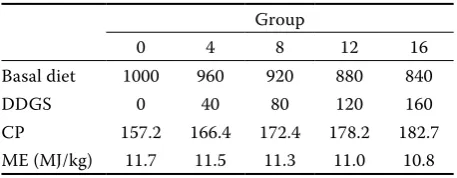
The experiment was conducted on 150 male broil-ers obtained from conventional farm at 25 days of age and housed in the test cages batteries at Mendel University in Brno. The birds were distributed among 15 cages in two batteries (10 chicks per cage). First five days after transfer to cage technology, during acclimatization period, all chickens were fed the same basal diet (Table 1). The basal diet provided 157.2 g/kg crude protein and 11.7 MJ/kg metaboliz-able energy. On day 30 the cages were divided into 5 treatments (each treatment in 3 cages). Test period lasted for five days (from day 30 to day 35 of broil-ers’ age) and the birds were fed experimental diets
(Table 2). Broilers in the first group were fed only the basal diet, broilers in the next four groups were fed test diets where the basal diet was replaced by DDGS at the levels of 4, 8, 12, and 16%. DDGS used in the study had light yellow colour with the follow-ing parameters: lightness (L*) 70.4, redness (a*) 9.3, and yellowness (b*) 41.0. Access to drinking water and feed was provided ad libitum. The last day of the experiment birds were fasted for 12 h and then they were allowed to consume the diets ad libitum again for 4 h. Then the birds were killed by cervical dislocation. Abdominal cavity was opened imme-diately and gut content from the lower half of the ileum to 3 cm proximal to the ileocecal junction was gently pushed by fingers to Petri dishes and frozen for next processing. Digesta of the first five randomly chosen broilers from one cage was collected to one Petri dish and digesta of the second five broilers was collected to another one. Finally six replicates of digesta were collected per one treatment. Before the analysis, the digesta samples were freeze-dried and finely ground.
The samples of the diets and ileal digesta were treated by oxidative acid hydrolysis of HCl (c = 6 mol/l). The hydrolysate samples were chromato-Table 1. Composition of the basal diet(g/kg)
Wheat 577
Corn 170
SBM 150
Soybean oil 17
DDGS 10
MCP 10
Limestone 10
Salt 3
Cr2O3 3
Complex of minerals and vitamins 50
[image:2.595.306.532.99.238.2]DDGS = distiller’s dried grains with solubles, SBM = soybean meal, MCP = monocalcium phosphate
Table 2. Composition of the experimental diets (g/kg)
Group
0 4 8 12 16
Basal diet 1000 960 920 880 840
DDGS 0 40 80 120 160
CP 157.2 166.4 172.4 178.2 182.7 ME (MJ/kg) 11.7 11.5 11.3 11.0 10.8
[image:2.595.304.533.636.725.2]graphically analyzed (AAA 400 analyser; INGOS, s.r.o., Prague, Czech Republic) using Na-citrate buffers and ninhydrin to detect the amounts of particular amino acids.
Apparent ileal amino acids digestibility (AIAAD) of feed was calculated with the following formula: AIAAD = 100 – (100 × Id × AAdc/Idc × AAd) (%) where:
Id = content of indicator in the dry matter of the diet AAdc = content of amino acid in the dry matter of
digesta
Idc = content of indicator in the dry matter of digesta AAd = content of amino acid in the dry matter of the
diet
Apparent ileal digestibility values of amino acids in DDGS (DDDGS) calculated by difference method were determined as follows (Fan and Sauer, 1995): DDDGS = (DD –DB × SB)/SA;SB = 1 – SA
where:
DD = apparent ileal amino acids digestibility in the test diet (%)
DB = apparent ileal amino acids digestibility in the basal diet (%)
SB = contribution level of amino acid from the basal feedstuf to the tested diet (decimal %)
SA = contribution level of amino acid from the tested feedstuff to the tested diet (decimal %)
For the determination of digestibility coefficients of amino acids in DDGS by the difference method the coefficients of AIAAD of diets with 0 g/kg DDGS (basal diet; DB) and diets with 160 g/kg DDGS (tested diet; DA) were used.
For determination of AIAAD coefficients of di-ets with a different level of DDGS a simple linear regression was used (Fan and Sauer, 1995): DDi = A + B × SBi
where: DD
i = apparent ileal digestibility of an amino acid in the ith tested diet (%)
A = DA B = DB – DA
DB, DA = apparent ileal digestibility values of amino acids to be determined for the basal and the tested feedstuffs
SB
i =contribution level of amino acid from the basal feedstuff to the ith tested diet (decimal %) Kruskal-Wallis analysis followed by LSD test was used for statistical evaluation using software package Unistat (Version 5.1, 2002).
reSultS AnD DiScuSSion
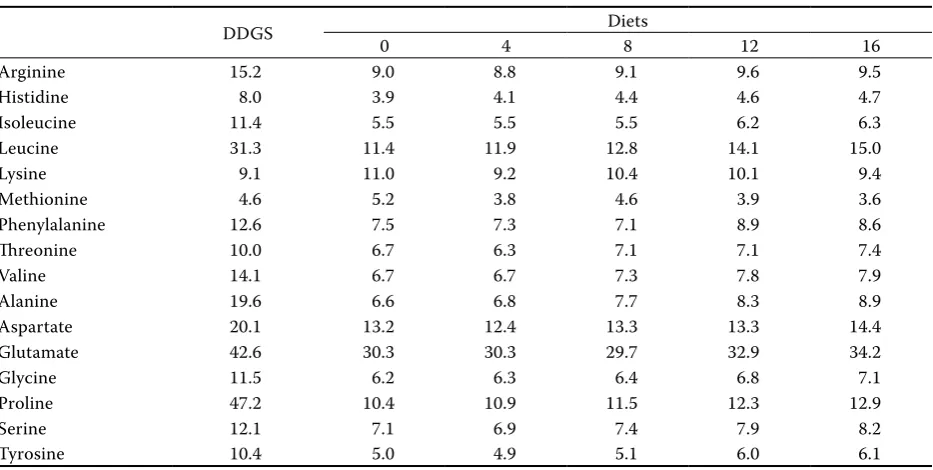
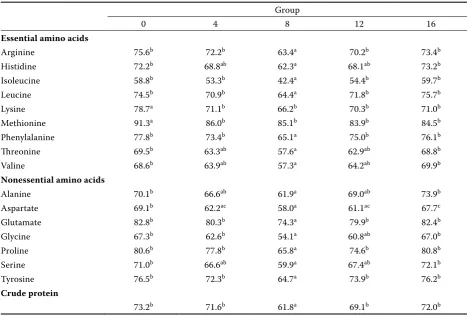
[image:3.595.65.532.503.738.2]The amino acids composition of DDGS and the diets is presented in Table 3. The apparent ileal digestibility values of amino acids and crude protein of diets with different levels of DDGS are presented Table 3. Amino acids composition of DDGS and the diets (g/kg)
DDGS 0 4 Diets8 12 16
Arginine 15.2 9.0 8.8 9.1 9.6 9.5
Histidine 8.0 3.9 4.1 4.4 4.6 4.7
Isoleucine 11.4 5.5 5.5 5.5 6.2 6.3
Leucine 31.3 11.4 11.9 12.8 14.1 15.0
Lysine 9.1 11.0 9.2 10.4 10.1 9.4
Methionine 4.6 5.2 3.8 4.6 3.9 3.6
Phenylalanine 12.6 7.5 7.3 7.1 8.9 8.6
Threonine 10.0 6.7 6.3 7.1 7.1 7.4
Valine 14.1 6.7 6.7 7.3 7.8 7.9
Alanine 19.6 6.6 6.8 7.7 8.3 8.9
Aspartate 20.1 13.2 12.4 13.3 13.3 14.4
Glutamate 42.6 30.3 30.3 29.7 32.9 34.2
Glycine 11.5 6.2 6.3 6.4 6.8 7.1
Proline 47.2 10.4 10.9 11.5 12.3 12.9
Serine 12.1 7.1 6.9 7.4 7.9 8.2
Tyrosine 10.4 5.0 4.9 5.1 6.0 6.1
in Table 4. AIAAD of Lys and Met were significantly the highest in the diet without DDGS in comparison with other diets (P < 0.01). Coefficients of AIAAD of His and Thr were significantly lower in the diet with 8% of DDGS than in the diets with 0 and 16% of DDGS (P < 0.01). In the rest of essential amino acids (Arg, Ile, Leu, Phe, Val) the AIAAD were the lowest in the diet with 8% of DDGS in comparison with all other diets (P < 0.01). AIAAD of nonessential amino acids were also the lowest in the diet with 8% of DDGS (P < 0.01). The apparent ileal crude protein digestibility was the lowest in the diet with 8% (61.8%) of DDGS (P < 0.01), too. Ile was poorly digested in all groups and its digestibility ranged 42.4–59.7%. The highest digestibility was found in Met ranging 83.9–91.3%.
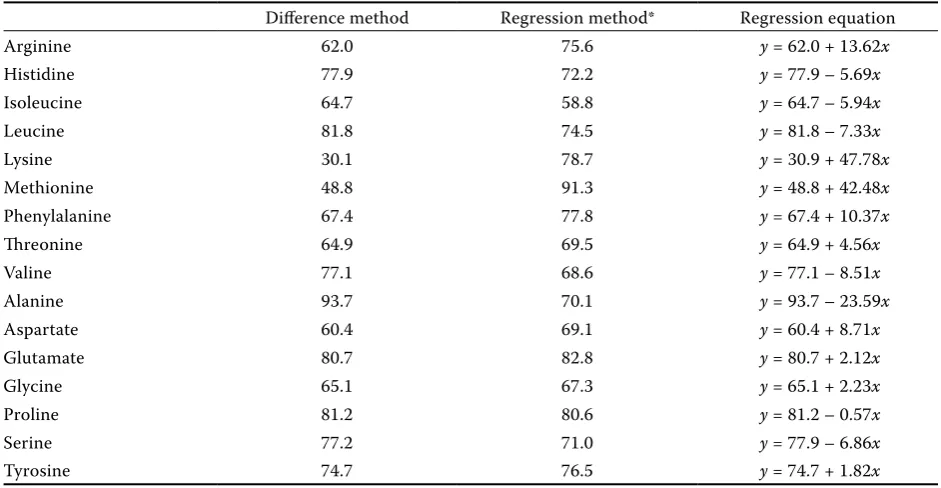
Ileal amino acids digestibility of DDGS was calcu-lated by the difference method and the regression method according to Fan and Sauer (1995). Regression equations for calculation of AIAAD of each amino acid in the diets with different levels of DDGS were determined according to Fan and Sauer (1995), too. Results of the methods are shown in Table 5.
The highest differences between AIAAD of DDGS determined by the difference method and the basal diet without DDGS were found in Lys and Met. According to the difference method the AIAAD was relatively low (Met 48.8%, Lys 30.1%). This reflects the fact that apparent ileal digestibilities of Lys and Met were the highest in the diet with 0% of DDGS. The differences in AIAAD between DDGS and the basal diet higher than 10 percent points were observed in Arg (13.6%) and Phe (10.4%). In the rest of essential amino acids the differences between the methods were lesser than 10 percent points. The lowest difference between the DDGS and the basal diet was determined in Thr (4.6%). In nonessential amino acids the highest difference between the DDGS and the basal diet in AIAAD was for Ala. In Glu, Gly, Pro, and Tyr the differ-ences were lower than 2.5%.
These results show that at the higher level of inclusion, the digestibility values in DDGS reduce the AIAAD of the diets. The reduction is higher for amino acids that are present in lower amounts in DDGS (Lys, Met). As Fan and Sauer (1995) con-Table 4. Values of apparent ileal amino acid digestibility in the diets with different levels of DDGS (%)
Group
0 4 8 12 16
essential amino acids
Arginine 75.6b 72.2b 63.4a 70.2b 73.4b
Histidine 72.2b 68.8ab 62.3a 68.1ab 73.2b
Isoleucine 58.8b 53.3b 42.4a 54.4b 59.7b
Leucine 74.5b 70.9b 64.4a 71.8b 75.7b
Lysine 78.7a 71.1b 66.2b 70.3b 71.0b
Methionine 91.3a 86.0b 85.1b 83.9b 84.5b
Phenylalanine 77.8b 73.4b 65.1a 75.0b 76.1b
Threonine 69.5b 63.3ab 57.6a 62.9ab 68.8b
Valine 68.6b 63.9ab 57.3a 64.2ab 69.9b nonessential amino acids
Alanine 70.1b 66.6ab 61.9a 69.0ab 73.9b
Aspartate 69.1b 62.2ac 58.0a 61.1ac 67.7c
Glutamate 82.8b 80.3b 74.3a 79.9b 82.4b
Glycine 67.3b 62.6b 54.1a 60.8ab 67.0b
Proline 80.6b 77.8b 65.8a 74.6b 80.8b
Serine 71.0b 66.6ab 59.9a 67.4ab 72.1b
Tyrosine 76.5b 72.3b 64.7a 73.9b 76.2b crude protein
73.2b 71.6b 61.8a 69.1b 72.0b
DDGS = distiller’s dried grains with solubles
[image:4.595.63.533.100.416.2]cluded, the reliability of the determination of the apparent ileal digestibility values of amino acids with the difference method is dependent on the contributions of amino acids in the assay feedstuff to their total dietary contents. Therefore for the determination of DDGS AIAAD the results of AIAAD of the diet with the highest level of DDGS (16%) were used in this study.
Concerning the essential amino acids, the values of AIAAD determined by the difference method were lower in this study than reported by Oryschak et al. (2010), except His and Thr. In comparison with the present study, Kozlowski et al. (2012) published higher standardized AIAAD of wheat DDGS in growing turkeys except Leu, Val, Ala, and Pro. The values of AIAAD can be influenced by the content of amino acids in the feedstuff, which was also found by Fan et al. (1994).
The AIAAD is affected also by the colour of the DDGS. Batal and Dale (2006) found correla-tions (P < 0.01) between AIAAD and L* values (r = 0.87) and b* values (r = 0.96) but not with a* values. More lightness (L* = 60.3) and more yel-lowness (b* = 25.9) were associated with a 76.8% Lys digestibility, whereas darker (L* = 50.4) and less yellow (b* = 7.41) samples were associated with 45.8% Lys digestibility. In this study, also a high AIAAD of Lys was determined by the
regres-sion method (78.7%) and L* and b* values were also higher (70.4 and 41.0), which confirms the conclusion of the mentioned authors. Correlation between colour and AIAAD was also found by Fastinger et al. (2006).
AIAAD is affected by individual feed ingredi-ents and type of bird (meat vs. egg) or methods by which they are determined (Adedokun et al., 2009) and digestibility measurements may be in-fluenced by a number of factors such as rate of passage, physiological status as related to growth or maintenance, feed consumption, and nutritional adequacy of test diets (Huang et al., 2007).
Based on the results of the present study it can be concluded that higher levels of DDGS decreased AIAAD of the diets, but if included up to 16%, DDGS did not negatively affect AIAAD except Lys and Met.
reFerenceS
Adedokun S.A., Adeola O., Parsons C.M., Lilburn M.S., Applegate T.J. (2008): Standardized ileal amino acid di-gestibility of plant feedstuffs in broiler chickens and turkey poults using a nitrogen-free or casein diet. Poultry Science, 87, 2535–2548.
[image:5.595.62.533.101.345.2]Adedokun S.A., Utterback P., Parson C.M., Adeola O., Lil-burn M.S., Applegate T.J. (2009): Comparison of amino
Table 5. Apparent ileal amino acid digestibility values of DDGS determined by difference and regression methods (%)
Difference method Regression method* Regression equation
Arginine 62.0 75.6 y = 62.0 + 13.62x
Histidine 77.9 72.2 y = 77.9 – 5.69x
Isoleucine 64.7 58.8 y = 64.7 – 5.94x
Leucine 81.8 74.5 y = 81.8 – 7.33x
Lysine 30.1 78.7 y = 30.9 + 47.78x
Methionine 48.8 91.3 y = 48.8 + 42.48x
Phenylalanine 67.4 77.8 y = 67.4 + 10.37x
Threonine 64.9 69.5 y = 64.9 + 4.56x
Valine 77.1 68.6 y = 77.1 – 8.51x
Alanine 93.7 70.1 y = 93.7 – 23.59x
Aspartate 60.4 69.1 y = 60.4 + 8.71x
Glutamate 80.7 82.8 y = 80.7 + 2.12x
Glycine 65.1 67.3 y = 65.1 + 2.23x
Proline 81.2 80.6 y = 81.2 – 0.57x
Serine 77.2 71.0 y = 77.9 – 6.86x
Tyrosine 74.7 76.5 y = 74.7 + 1.82x
DDGS = distiller’s dried grains with solubles *SB
i (contribution level of amino acid from the basal feedstuff to the i
acid digestibility of feed ingredients in broilers, laying hens and caecectomised roosters. British Poultry Sci-ence, 50, 350–358.
Batal A.B., Dale N.M. (2006): True metabolizable energy and amino acid digestibility of distillers dried grains with solubles. Journal of Applied Poultry Research, 15, 89–93. Fan M.Z., Sauer W.C., Hardin R.T., Lien K.A. (1994): De-termination of apparent ileal amino acid digestibility in pigs: effect of dietary amino acid level. Journal of Animal Science, 72, 2851–2859.
Fan M.Z., Sauer W.C. (1995): Determination of apparent ileal amino acid digestibility in barley and canola meal for pigs with the direct, difference, and regression methods. Journal of Animal Science, 73, 2364–2374.
Fastinger N.D., Mahan D.C. (2006): Determination of the ileal amino acid and energy digestibilities of corn distil- lers dried grains with solubles using grower-finisher pigs. Journal of Animal Science, 84, 1722–1728.
Fastinger N.D., Latshaw J.D., Mahan D.C. (2006): Amino acid availability and true metabolizable energy content of corn distillers dried grains with solubles in adult ce-cectomized roosters. Poultry Science, 85, 1212–1216. Huang K.H., Ravindran V., Li X., Ravindran G., Bryden W.L.
(2007): Apparent ileal digestibility of amino acids in feed ingredients determined with broilers and layers. Journal of the Science of Food and Agriculture, 87, 47–53. Kozłowski K., Helmbrecht A., Jankowski J., Lemme A.,
Kluge H., Jeroch H. (2012): Standardized ileal amino acid
digestibility (SIAAD) of wheat DDGS in male growing turkeys. Archiv fur Geflugelkunde, 76, 136–139. Liu N., Ru Y.J., Tang D.F., Xu T.S., Partridge G.G. (2011):
Effects of corn distillers dried grains with solubles and xylanase on growth performance and digestibility of diet components in broilers. Animal Feed Science and Technology, 163, 260–266.
McAloon A., Taylor F., Yee W., Ibsen K., Wooley R. (2000): Determining the Cost of Producing Ethanol from Corn Starch and Lignocellulosic Feedstocks. National Renew-able Energy Laboratory, Technical Report NREL/TP-580-28893, Golden, USA.
Oryschak M., Korver D., Zuidhof M., Meng X., Beltranena E. (2010): Comparative feeding value of extruded and nonextruded wheat and corn distillers dried grains with solubles for broilers. Poultry Science, 89, 2183–2196. Pahm A.A., Scherer C.S., Pettigrew J.E., Baker D.H., Parsons
C.M., Stein H.H. (2009): Standardized amino acid digest-ibility in cecectomized roosters and lysine bioavailability in chicks fed distillers dried grains with solubles. Poultry Science, 88, 571–578.
Spiehs M.J., Whitney M.H, Shurson G.C. (2002): Nutrient database for distiller’s dried grains with solubles produced from new ethanol plants in Minnesota and South Dakota. Journal of Animal Science, 80, 2639–2645.
Received: 2013–08–02 Accepted after corrections: 2013–12–28
Corresponding Author
Doc. Ing. Martina Lichovníková, Ph.D., Mendel University in Brno, Faculty of Agronomy, Department of Animal Breeding, Zemědělská 1, 613 00 Brno, Czech Republic