RURAL AREA AND AGRICULTURE
The total area of the Czech Republic is 78 867 km2. According to the Czech Office for Survaying, Mapping and Cadastre (COSMC), the share of agricultural land is 54% and the share of non-agricultural land is 45.87%, out of which 33.63% is forestland. In the course of years, the share of individual cultures on the overall area of the country is changing. The long-term trend is diminishing of agricultural land that is being gradually replaced by non-agricultural land.
During 1934–2003, the area of agricultural land shrunk by 723 000 ha and arable land diminished even more – 773 000 ha. The downward trend of both
cul-tures was sustained throughout the whole time period. On the other hand, the area of permanent grasslands (PGL) diminished during that time by 91 000 ha. This process can be divided into two different periods. Until 1949, the area of PGL was slightly rising. Then there was gradual but ever growing decline all the way to 1990, when the trend changed direction and started to grow again. Between 1934–1990 there was a deficit of 228 000 ha, and period 1990–2003 recorded rise by 137 000 ha. During the entire monitored period, the area of forestland rose by 291 000 ha. According to the data of the COSMC for 2004, the total area of the territory requiring permanent care of agricul-tural, forest and fisheries caretaker was 7 073 000 ha,
The problems of maintenance of the countryside
in the Czech Republic
Problematika údržby venkovské krajiny v České republice
Z. TRÁVNÍČEK
Research Institute of the Agricultural Economics, Prague, Czech Republic
Abstract: The rural areas are regions with very low residential density. They cover more than 90% of the European Union territory with almost half of its population. The countryside in the Czech Republic represents 58 183 square kilometres, i.e. 73% of the Czech territory, which includes 5 629 municipalities with 25.6% of inhabitants. Among the problems of sustai-ned development of the rural areas and maintenance of the countryside, there belong the low residential density, unfavou-rable age structure, unsatisfactory civil facilities, and infrastructure. These are the reasons of gradual population outflow from such regions. At the meetings in Lisbon, Göteborg and Salzburg, the European Union declared three main objectives for rural and agriculture development in the period of 2007–2013. The intention is not only the orientation at economic re-structuring, but also a focus on the total economic diversification that should help mainly to rural areas.
Key words: rural area, region, ruralist, regional development, subsidies
Abstrakt: Venkovské oblasti jsou oblasti s velmi nízkou hustotou obyvatelstva. V Evropské unii zaujímají více než 90 % rozlohy, na které žije téměř polovina jejího obyvatelstva. Venkov v České republice představuje území o rozloze 58 183 km2,
tj. 73 % z celkové rozlohy ČR, na kterém se nachází 5 629 obcí, ve kterých žije 25,6 % populace republiky. Mezi problémy trvale udržitelného rozvoje venkova a údržby jeho krajiny patří nízká hustota osídlení, nedobrá věková struktura, v prů-měru špatná občanská vybavenost a infrastruktura. To jsou jedny z příčin postupného odlivu obyvatelstva z těchto území. Evropská unie v novém plánovacím období 2007–2013 formulovala na jednáních v Lisabonu, Göteborgu a Salzburgu tři hlavní cíle rozvoje venkova a zemědělství. Záměrem je nejen orientace na hospodářskou restrukturalizaci, nýbrž i pozornost na celkovou hospodářskou diversifikaci, které by měly pomoci především venkovským oblastem.
Klíčová slova: venkovské oblasti, venkov, venkovský rozvoj, dotace a podpory, trvale udržitelný rozvoj venkova
which is 89.92% of the entire area of the country. The share of agricultural land is 4 269 000 ha, arable land 3 062 000 ha, PGL 970 000 ha, and forest land 2 644 000 ha (Figure 1).
According to the published results of the census of people, houses and flats from 2000, the total of 230 409 citizens of the republic indicated “active farmer”, and “forestry and fishery employee” as their profes-sion. It means that for every 100 ha of agricultural
land, forestland and ponds, there are 3.26 workers. Unfortunately, there is little mutual linkage of these professions, so it is hard to take advantage of free seasonal capacities.
[image:2.595.72.470.78.284.2]We must focus much bigger efforts on the use of agricultural land and the maintenance and protection of the countryside. The best way to take care of this land is its regular use by farmers. As opposite to the period before 1990, our joining of Europe and new Figure 1. Development of land use in 1934–2003
Source: Statistical yearbook of the Czech Statistical Office
0 1,000 2,000 3,000 4,000 5,000 6,000 7,000 8,000 9,000
19
34
a
ž
193
8
194
9
195
5
196
0
196
5
197
0
197
5
198
0
198
5
199
0
199
5
200
0
200
3
tis
. h
a
Orná p�da
ttp
Zem�d�lská p�da
Lesní pozemky
Celková vým�ra
arable land
permanent grassland
agricultural land
forest land
total area
19
34
–
1
00
0
ha
Figure 2. Regression between density of the cattle and the degree of arability (agricultural land)
Source: Agrocensus 2000 and author´s own computations y = –0.0097x2 + 1.462x+ 31.505
R2 = 0.9643
y = 0.0014x2 – 0.1122x + 6.3049 R2 = 0.0265
0.0 10.0 20.0 30.0 40.0 50.0 60.0 70.0 80.0 90.0 100.0
0 10 20 30 40 50 60 70 80 90
0.00 5.00 10.00 15.00 20.00 25.00 30.00 35.00
%zorn�ní zp/dj kvadratická fce kvadratická fce
District in increasing order, by % arable land
% of arable land agricultural land/LU quadratic function quadratic function
%
a
rg
ri
cu
ltu
ra
l l
an
[image:2.595.80.508.490.719.2]requirements of the Common Agricultural Policy of the European Union are setting different parameters for agricultural production and activities then are those our agriculture is mostly oriented at.
The lasting problems are the high share of arable land (nearly 72%), the obsolete distribution of agricul-tural production on the territory of the state and the inadequate production conditions and final economic parameters that is detrimental to competitiveness.
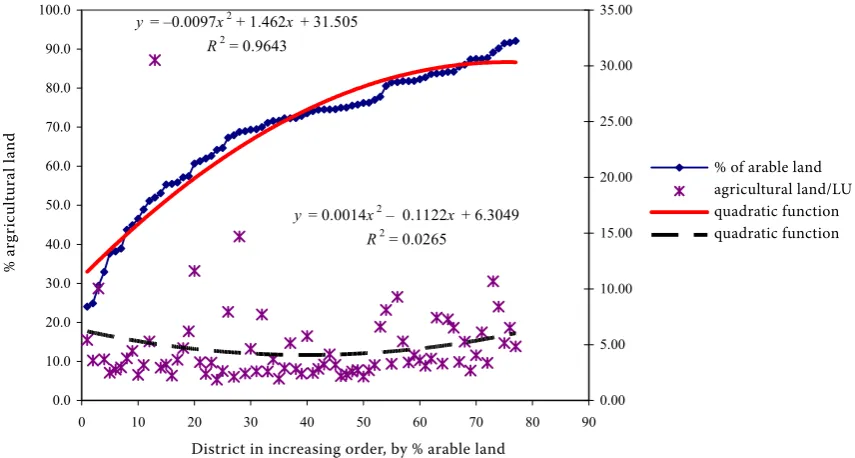
The contemporary trends in agricultural production points to direction of strengthening non-food use of the production and rising of share of permanent grasslands, especially in the less favourable areas. The natural users of green mass of meadows and pastures are herbivorous animals, especially cattle. After 1990, the number of cattle started to go sharply down all the way to one half of the pre-1990 state. According to the Agrocensus 2000, the cattle numbers 1 565 418 heads, which is 1 273 568 Livestock Unit (LU). It is 97.3% of the number of statistically monitored productive live-stock using green mass as their fodder. In comparison with the neighbouring countries, there is a very low density of cattle in our country – just 29 LU/100 ha of agricultural land. There is very low headcount of cattle in the areas with high share of permanent grasslands. It concerns the border districts of northern Bohemia, especially Teplice, Most, Chomutov, Sokolov, Louny, Česká Lípa and others.
The computation of the relation between degree of arability and the density of LU of cattle did not prove any statistically significant correlation. It means that the relation between cattle and permanent grasslands is not decisive any more and that intensive cattle rising take place in rather more favourable production condi-tions. It also means that intensive animal husbandry is significantly lowering the possibility of livestock grazing the countryside and does not contribute to its maintenance. This reality is markedly highlighted by high degree of stabling, which works against its dispersion throughout countryside (Figure 2).
COUNTRYSIDE AND RURAL POPULATION
There have been many attempts to delimitate coun-tryside. Each author was highlighting different criteria according to its goal.
From this point of view, the simple but apt meth-odology of the OECD and the Eurostat distinguishes 3 types of regions in the dimension NUTS III: 1. Predominantly rural regions. More then 50% of
residents of the region live in rural settlements 2. Significantly rural regions. 15–50% of the residents
live in rural settlements
3. Predominantly urban regions. In these regions, there are less than 15% of rural residents
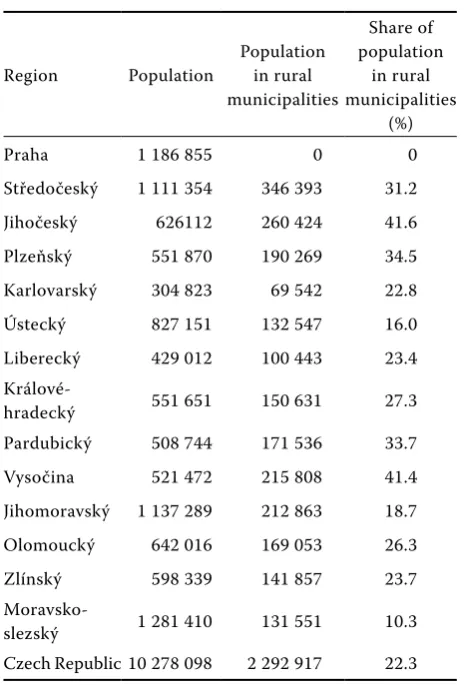
According to Perlín (2003), no region in the Czech Republic can be evaluated as a predominantly rural re-gion and all rere-gions with exception of Moravskoslezský (and Prague) belongs to significantly rural regions category.
According to the OECD methodology, only Morav-skoslezský region can be considered predominantly urban region (Table 1).
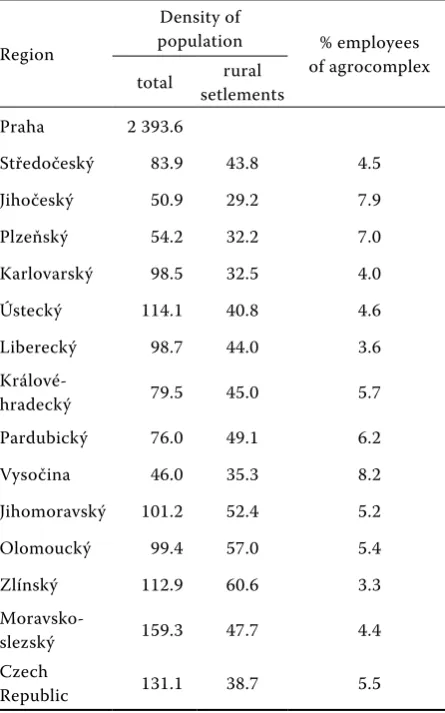
[image:3.595.303.536.404.747.2]When using density of the population per km2 as an indicator, its value according to Perlín (2003) for the Czech Republic is 131.1 person/km2. In comparison, the density of population living in rural municipalities (defined by the MMR as settlements with more then 2 000 people) is according to data from the same source 38.7 persons/km2. In comparative analysis Perlín (2003) proves that on the basis of effectuated analyses it can be recommended to evaluate rural space of the CR on the basis of the indicator of number of residents in municipalities and consider rural communities as those with less then 2 000 residents. Rural area is then the
Table 1 Categorisation of Czech regions by the type of rural area
Region Population Population in rural municipalities
Share of population
in rural municipalities
(%)
Praha 1 186 855 0 0
Středočeský 1 111 354 346 393 31.2
Jihočeský 626112 260 424 41.6
Plzeňský 551 870 190 269 34.5
Karlovarský 304 823 69 542 22.8
Ústecký 827 151 132 547 16.0
Liberecký 429 012 100 443 23.4
Králové-
hradecký 551 651 150 631 27.3
Pardubický 508 744 171 536 33.7
Vysočina 521 472 215 808 41.4
Jihomoravský 1 137 289 212 863 18.7
Olomoucký 642 016 169 053 26.3
Zlínský 598 339 141 857 23.7
Moravsko-
slezský 1 281 410 131 551 10.3
The more then ¼ population of the Czech Republic lives in rural areas (if we consider the criterion of com-munities with less then 2,000 people). It comprises nearly ¾ of the state territory.
[image:4.595.64.290.146.268.2]Total nine out of 10 communities and more then 75% of seats into rural area defined by this criterion (Table 2).
Table 3 gives data on density of population by re-gions.
Maintenance of the countryside depends on the density of the population, which provides workforce for this area. This workforce requires specific qualifi-cation, which in this case is the relationship to nature and countryside.
Long-term trends point to the direction of gradual emptying (depopulation) of the rural areas and over-all worsening of age index (age index = people ≥ 64 years*)/(people ≤ 14 years). According to statistics, it
Table 3. Density of population
Region
Density of
population % employees of agrocomplex total setlementsrural
Praha 2 393.6
Středočeský 83.9 43.8 4.5
Jihočeský 50.9 29.2 7.9
Plzeňský 54.2 32.2 7.0
Karlovarský 98.5 32.5 4.0
Ústecký 114.1 40.8 4.6
Liberecký 98.7 44.0 3.6
Králové-
hradecký 79.5 45.0 5.7
Pardubický 76.0 49.1 6.2
Vysočina 46.0 35.3 8.2
Jihomoravský 101.2 52.4 5.2
Olomoucký 99.4 57.0 5.4
Zlínský 112.9 60.6 3.3
Moravsko-
slezský 159.3 47.7 4.4
Czech
Republic 131.1 38.7 5.5
Source: Perlín (2003), author´s computation
[image:4.595.308.532.289.780.2]Note: The number of workers of agro-complex comes from census of people, buildings and apartments (SLDB ČSÚ, 2000) and includes workers in agriculture, forestry and fisheries
Figure 3. Age index in % by size groups of towns
Source: Výsledky sčítání... 2000, authors own computa-tion
Figure 4. Age index by the size of the towns
0.00 20.00 40.00 60.00 80.00 100.00
<=100 > 100
%
< 100 100 - 500 500 - 1000 1000 - 2000 > = 2000
<1
00
1
00
–5
00
50
0–
10
00
10
00
–2
00
0
≥2
00
0
<1
00
1
00
–5
00
50
0–
10
00
10
00
–2
00
0
≥2
00
0
age index (≥ 64 year/≤ 14 year)
≤ 100 > 100
%
<100 100–500 500–1000 1000–2000 ≥2000
size of groups of towns 0
20 40 60 80 100 120 140 160
<100 100-500 500-1000 1000-2000 >=2000
<100 100-500 500-1000 1000-2000 >=2000 %
Table 2. The characteristics of rural areas of the CR
Indicators CR
Rural areas (to 2000 people)
number number %
Population 10 278 098 2 632 064 25.6
Area 78 863.9 58182.79 73.8
Number of
communities 6 251 5 629 90.0
Number of seats 15 003 11 383 75.9 Source: Perlín (2003)
[image:4.595.64.287.334.691.2] [image:4.595.305.534.518.734.2]is a phenomenon influencing the whole country. From the point of view of countryside and its maintenance, this situation is very complex (Figure 3 and 4).
CONCLUSION
Maintenance of the countryside cannot be secured without the quality workforce and this are hard to keep in place without quality living conditions (housing, general living standard). The creation of the conditions for stabilisation of the rural area population as the source of labour for the maintenance of countryside is a task for local government, regional authorities and relevant ministries. Without functional infra-structure and creation of job, it will be hard to keep such people in place.
For the preservation of cultural landscape for the future generation and its use as a source of work, the maintenance of countryside is narrowed only to the agro-complex workforce. It is necessary to create systematically conditions for keeping people in the rural areas and for their sustainable development.
The basic requirements for sustainable develop-ment of rural areas:
– Stronger identity of rural areas
– Development of local partnership and cooperation so typical for the village life in the past
– Renaissance of the pride of rural cultural heritage, ethnographic peculiarities and traditions, putting new life into group activities
– Securing basic civic facilities and accessible services for rural settlements, such as schools, healthcare, social services, cultural and civic activities etc.
– Increasing competitiveness and stability of the rural areas, agriculture, and small and middle-size businesses. Renewal of local and traditional crafts and artisan production
– Systematic care of countryside, environment and biodiversity
– Complex land consolidation including ecological and water protective measures.
Systemic attitude towards rural problems will lead to strengthening of the local identity and economi-cal social and cultural development. Synergy of all components of rural life will positively influence the dynamism of entrepreneurial activities. It will also lead to diversification of activities and create more jobs for rural population that will in turn lead to overall stabilisation of village life.
REFERENCES
Perlín R. (2003): Předpoklady rozvoje českého ven-kova. Přírodovědecká fakulta UK, Praha.
Vávra V. et al. (2003): Funkce politiky v agrárním sektoru a rozvoji venkova v nejdůležitějších typech regionů v období před a po vstupu do EU. Výroční zpráva NAZV QF 3001, VÚZE Praha.
Horizontální plán rozvoje venkova ČR pro období 2004–2006 (2004). MZe, Praha.
Operační program Rozvoj lidských zdrojů (2003). MPSV, Praha.
Společný regionální operační program České repub-liky na léta 2004–2006 (2004). MMR, Praha. Výsledky Sčítání lidu, domů a bytů 2000 (2002). ČSÚ,
Praha.
Arrived on 18th April 2005
Contact address:
Ing. Zdeněk Trávníček, CSc., Výzkumný ústav zemědělské ekonomiky Praha (VÚZE), Mánesova 75, 120 58 Praha 2, Česká republika