consumer behaviour research enables better un-derstanding and forecasting not only of the subject of purchases but also of purchasing motives and purchas-ing frequency (Schiffman, Kanuk 2004). one of the present fundamental presumptions for the consumer behaviour research is the fact, that people often buy products not because of their main function but for their subjectively perceived value. it does not mean
that products’ basic function is not important, but that the today’s role of product exceeds its service limits (Salomon 2004). Even more often consumers do not rate products according to their cores (it means the main the main utility provided) but above all accord-ing to so-called real product (it means the particular products’ qualities) and the extended product, which represents the set of intangible factors bringing the
Factors influencing consumer behaviour
Faktory ovlivňující chování spotřebitele
J. Stávková, L. Stejskal, Z. Toufarová
Faculty of Business and Economics, Mendel University of Agriculture
and Forestry, Brno, Czech Republic
Abstract: The main aim of the article is to understand the influence of factors biasing purchase decisions connected with measurement of consumers’ involvement. consumption expenditures are purposefully subdivided according to the classifi-cation made by the Statistical office of the European communities. The performed survey showed that the most important factors biasing purchases of all commodity groups are products’ characteristics and the perceived quality. Together with these goes the factor price, nevertheless for example for the commodity group health price did not appear in the scale of the perceived importance at all. Factor necessity of need proved to be significant for decision making about the purchase of all commodities with the exception of alcoholic drinks and tobacco and recreation. Former experience compared to that is not crucial for clothing and footwear and housing equipment and contents. For alcoholic drinks and tobacco, there has notably approved also the factor brand. These analyses enable disclosure of rules of consumer decision making and thereby definition which factors for individual commodities should be targeted by the help of the marketing doyens or where the gradual changes should be achieved.
Key words: consumer behaviour, purchase decision making, commodity groups, interference factors
Abstrakt: Článek se zabývá spotřebitelským chováním z pohledu subjektu provádějícího jednotlivá nákupní rozhodnutí, tedy spotřebitele, případně jeho domácnosti. Spotřební výdaje jsou účelově členěny podle klasifikace vytvořené statistickým úřadem Evropské unie pro zajištění transparentnosti mezinárodních srovnání. navazuje vymezení faktorů ovlivňujících spotřebitelská nákupní rozhodnutí u jednotlivých komoditních skupin. hlavním cílem příspěvku je sledování vlivu těchto faktorů podle míry angažovanosti spotřebitele. z šetření vyplynulo, že nejdůležitějšími faktory pro všechny skupiny komo-dit jsou vlastnosti a kvalita produktu. Společně s tím je významným faktorem cena, ale například pro skupinu komokomo-dit zdraví, léky a vitaminy se cena ve stupnici vnímané důležitosti vůbec neobjevila. Faktor nezbytnosti potřeby se projevil jako relevantní pro rozhodování u všech komodit s výjimkou alkoholických nápojů a tabáku, rekreace a kultury. Dřívější zkušenost oproti tomu není rozhodující u odívání, obuvi i bytového vybavení a zařízení. U jedné komodity – alkoholické nápoje a tabák – se jako významná projevila i značka. Analýza umožnila odhalit pravidla rozhodování a tím definovat, které faktory pro jednotlivé komodity pomocí marketingových manažerů posilovat nebo jak postupným působením dosáhnout změny.
Klíčová slova: spotřební chování, nákupní rozhodnutí, skupiny komodit, ovlivňující faktory
Agric. Econ. – czEch, 54, 2008 (6): 276–284 277 demanded perceived advantage to consumer –
im-age, consultancy, after-sale service and other (Foret, Procházka 2007).
Trommsdorff (2002) however warns of that there are no activities more important for the consumer behaviour research, connected with consumption, than the personal characteristics. According to him the term “consumer” (Konsument) is being used instead of a more accurate one “target customer”, and also the term “consumer behaviour” (Konsumentenverhalten). This conception causes problems afterwards because it must comprehend more personal roles – decision maker, buyer and consumer.
Except the conventional conception of consump-tion being the only instrument of the basic needs’ satisfaction, Solomon (2004) identifies another four different types of consumers’ activities:
– consumption as an experience (emotive or aesthetic reaction to product consumption),
– consumption as an instrument of integration (us-age and consumption of the product integrates us somehow to the society),
– consumption as a classification scale (choice of products influences the way how we are perceived by our environment and how we are ranged in the society),
– consumption as a game.
There are a lot of factors influencing consumer by decision-making process. The literature classifies and structures these factors in various ways. For exam-ple division into inner and outer factors (Koudelka 1997), distinguishing three basic categories: personal, psychological and social factors (Brown 2006), to which Kotler (2001) adds the cultural factors as the independent category. The next group of factors can be labelled as situational factors, it means factors forming the environment of the concrete decision-making situation. Because the subject of the analysed inquiry are factors belonging to groups of personal, psychological and situation factors, in the hereafter text the attention is devoted only to them.
As a personal factors, there are referred the ones unique for each consumer. Above all data like age, sex, place of domicile, occupational and economic conditions, personality and self – consciousness can be found here (horská, Sparke 2007)
Psychological factors include motivation, percep-tion, skills and knowledge, positions, personality, style of life (Brown 2006).
Perception means the adaption of reality. The process of selection, processing and interpretation of input data from the environment to make them purposeful (Brown 2006).
Personality is created by inner characteristics and by behaviour. This makes a person unique. Personal characteristics influence the way how people behave. it is, however, difficult to find a reliable connection between the individual personality and the behav-iour type.
consumers’ skills and knowledge are connected to learning and predestinate changes of behaviour. Therefore to cause changes of consumer behaviour concerning the concrete product, it is necessary to give the adequate information. Learning process can come through a simple association between the impulse and the reaction to it, or through the com-plicated set of rational activities.
Motive means the inner driving force that orients human/consumers’ activities towards meeting the needs or achievement of the definite aim. in every decision-making process several motives plays role, not only one. in case of need of measuring or analyz-ing, there is one questionable thing that motives often work only on the subconscious level (Brown 2006).
Knowledge and positive or negative feelings influ-ence humans’ perception and consequently decision making and behaviour. People learn their bearings through experience and interaction with other people. The eventual changes of positions are conditioned by consumers’ personality and his style of life. consumer generally refuses information that is in conflict with his positions, eventually he modifies them to reach correspondence.
Situational factors can notably influence purchase decision. Social environment, physical environment of the purchase place, time influences and the previ-ous states fall into this group. (Berkowitz et al. 1992; Vysekalová 2004; nagyová 2001a).
Consumers’ decision includes the product (brand) selection from the set of possibilities.
Understanding consumers’ decision making includes clarifying answers to these questions:
Which products (brands) are considered at the se-lection?
What information is being used to compare the prod-ucts (brands) with one another?
how are these information used?
Selection based on stimulation means selection whereat we can directly compare products, because they are being kept at one’s disposal. Selection based on memory means selection whereat we do not have the possibility to directly compare products.
out from the presumption that a higher price means also higher quality).
There is quite a number of other heuristics, ex-cept the above mentioned relation price – quality. Strategies based on positions are called the compen-satory strategies, which means that good attributes may compensate worse ones. They suppose that the product/brand associated with mostly favourable positions will be chosen. The application of heuristics based on positions requires a fractional effort.
if consumers have not created an attitude towards certain products or brands and are not motivated or able to create their positions, they derive ben-efits from the decision-making strategy based on the attributes of products or brands. These heuristic strategies are not compensatory because a high score of one attribute cannot compensate a low score on other characteristics. it means that every attribute is compared separately and compromises among the single attributes stay out in consideration.
Lexicography heuristics includes the selection of the best brand/product on the basis of its most im-portant attribute.
Lexicography multilevel heuristics issues from a similar principle but at the juxtaposition, however, it is taking score in the definite dull interval as a draw and survey on other characteristics.
connecting heuristics includes setting of the mini-mal acceptable level for each attribute and the choice of first option that meets these minimal levels in all characteristics. other options then already are not considered.
The influence over the approach to solving of the given situation and purchase decisions is excerted also by the variables like involvement and responsibility. involvement depends on personal significance or the importance given to the decision, the responsibility reflects need to explain or vindicate our decisions before other people. Both these variables escalate motivation to make a good decision, even if it re-quested bigger effort and more time. Therefore at the low level of involvement we use rather the easier selection heuristics.
The content of this paper is in understanding of the influence of the surveyed factors coming out of measurement of consumers’ involvement (purchase behaviour types: routine or habit based, limited, extensive or impulsive), for individual kinds of com-modities. This will contribute to a better knowledge of consumer behaviour and the elaboration of dif-ferentiated marketing strategies.
The results published in the paper are part of re-search objective, id. code: 62156 48904 “The czech republic in the process of integration and globalization
and the evolution of agrarian and service sectors in the new conditions of the European integrated market”, thematic area 03 “The evolution of trade relation-ships regarding changes in a life style and purchasing behaviour and changes of business environment in the process of integration and globalization” that is conducted with a financial support of the Ministry of Education, Youth and Sports.
MAteriAl And MethodS
Sources for the analysis of factors biasing the con-sumer at purchase decision-making process were gained through a marketing survey. The instrument used to collect the primary data was the electronic questioning system rELA (Souček, Pavlíček 2005). This system proved itself to be very efficient espe-cially on the ground that the data were immediately available after the end of survey. This means that no additional data processing or conversions were necessary.
When constructing the questionnaire, all inten-tions of marketing research were considered. The crucial part of the questionnaires’ preparations was the pre-research that acknowledged the correctness of construction and intelligibility for a broad spectrum of informants. The questionnaire survey proceeded, on December 2007 in various areas of czech republic, when there were gathered 731 survey results. however, after removing of the invalid data there remained 609 correctly completed questionnaires acceptable to use for analyses. For selection of informants there were not used any restrictive criteria that could concentrate focus only on certain segment.
The aim of survey was to obtain information about the influence by the above mentioned factors at the purchase decision making on consumers concerning various commodity groups. The surveyed factors were: habit and tradition, necessity of need, former experience, recommendation of relatives and friends, recommendation of specialists, product characteristics and parameters, quality, brand, price, discount action, inspiration by an advertisement, endeavour to try out novelties, fashion trend and design of products. Measurement of the interference by mentioned fac-tors at purchase decision making was recorded on 10 point scale where 1 meant no interference and 10 maximum interference. Measure of influence by the mentioned factors encompassed these commodity groups:
Agric. Econ. – czEch, 54, 2008 (6): 276–284 279 – health, pharmaceuticals and vitamins
– transport
– post services and telecommunications – recreation and culture
– education
– boarding and accommodation – other goods and services
The commodity group “food and non-alcoholic drinks” was analysed from the point of view of the interference by the surveyed factors also in the pre-ceding years 2006 and 2005. This enabled the authors to find out whether the influence by factors changes in time. The survey in year 2005 covered 1074 in-formants and in 2006 there were 726 inin-formants (Stávková et al. 2007.)
Data evaluation was made by the help of the sta-tistical software STATiSTicA cz 8. The used tech-nique was data classification by the interference measurement.
reSUltS And diScUSSion
The surveyed set of 609 informants consisted of 362 men and 247 women. The prevailing age cat-egory was 40–49 years (45%) and 50–59 years (32%). Prevailing social group were employees (60%), then self-employers (25%) and pensioners (10.5%). other social groups were insignificant. The education level of informants is especially secondary, i.e. apprentice training centres, secondary schools and grammar school (55%) followed by universities (40%).
Food and non-alcoholic drinks
[image:4.595.308.528.337.473.2]commodity that the fills basic needs to survive represents important expenditure item in households’ budget. it represents 13.1% of average expenditures averaged on one households’ member (Eurostat 2005).
Figure 2. comparison of interference by single factors at purchasing food and non-alcoholic drinks in years 2005, 2006 and 2007
0 0.51 1.52 2.53 3.54 4.55
2005 2006 2007
1 2 3 4 5 6 7 8 9 10 11 12 3 14 Factors 10
9 8 7 6 5 4 3 2 1
in
flu
en
ce
m
ea
su
[image:4.595.63.286.362.477.2]re
Figure 1. Measure of interference by factors at purchasing food and non-alcoholic drinks
1
2 3 4 5 6 7 8 9 10
1 2 3 4 5 6 7 8 9 10 11 12 13 14 10
9 8 7 6 5 4 3 2 1
Factors
in
flu
en
ce
m
ea
su
re
1 2 3 4 5 6 7 8 9 10
1 2 3 4 5 6 7 8 9 10 11 12 13 14 Factors 10
9 8 7 6 5 4 3 2 1
in
flu
en
ce
m
ea
su
re
Figure 3. Measure of interference by factors at purchasing alcoholic drinks and tobacco
Figure 4. Measure of interference by factors at purchasing dress and footwear
1 2 3 4 5 6 7 8 9 10
1 2 3 4 5 6 7 8 9 10 11 12 13 14 10
9 8 7 6 5 4 3 2 1
Factors
in
flu
en
ce
m
ea
su
re
explanation for Figures 1–12
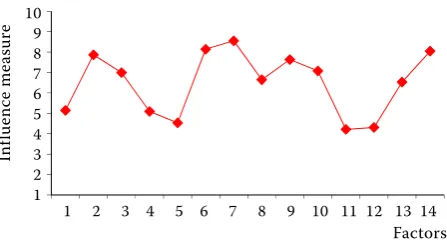
[image:4.595.306.530.544.664.2] [image:4.595.64.285.547.664.2]The most important factors at purchase decision mak-ing have been identified the necessity of need (9.02), quality (8.06), former experience (7.57), price (7.32) and products’ characteristics and parameters (7.07). Decision making then proceeds in accordance with model of routine – habit purchase, whereat change of a decision can be caused above all by change of char-acteristics and change of products’ quality (nagyová 2001b). Price influences customers’ decision making as fourth in order of importance (Figure 1).
Figure 2 shows the records of surveys in years 2005, 2006 and 2007. it is evident that the consumers’ views and factors determining their purchases of food and non-alcoholic drinks do not change during the last years.
Decision making at food purchase acknowledges the complexity of factors determining the purchase: consumers’ characteristics and external products’ characteristics. After the usage of product (typical for food), also the internal characteristics and quality of the product play role.
Alcoholic drinks and tobacco
Alcoholic drinks and tobacco are lined rather to the non-essential goods. They are not among the significant expenditure entries and represents only 3.8% of expenses per one households’ member (Eurostat 2005). The most significant factors at deci-sion making about purchase of these commodities are quality (7.28), price (6.65), brand (6.55), former experience (6.48) and products’ characteristics and parameters. The special attention has to be paid to the group of informants addicted to these products (Figure 3).
clothing and footwear
[image:5.595.310.530.354.493.2]clothing and footwear are counted to normal goods, they constitute 6.1% of the expenses per one house-holds’ member (Eurostat 2005). Purchase decision making is mostly influenced by quality of product
Figure 7. Measure of interference by factors at decision making about expenditures on transport
For explanation see page 279
1 2 3 4 5 6 7 8 9 10
1 2 3 4 5 6 7 8 9 10 11 12 13 14 10
9 8 7 6 5 4 3 2 1
Factors
in
flu
en
ce
m
ea
su
[image:5.595.65.287.373.492.2]re
Figure 6. Measure of interference by factors at decision making about health, medicines and vitamines
For explanation see page 279
1 2 3 4 5 6 7 8 9 10
1 2 3 4 5 6 7 8 9 10 11 12 13 14 10
9 8 7 6 5 4 3 2 1
Factors
in
flu
en
ce
m
ea
su
[image:5.595.308.528.566.705.2]re
Figure 5. Measure of interference by factors at purchase of housing equipment and contents
For explanation see page 279
1 2 3 4 5 6 7 8 9 10
1 2 3 4 5 6 7 8 9 10 11 12 13 14 10
9 8 7 6 5 4 3 2 1
Factors
in
flu
en
ce
m
ea
su
re
Figure 8. Measure of interference by factors at decision making about expenditures on postage and telecommu-nication services
For explanation see page 279
1 2 3 4 5 6 7 8 9 10
1 2 3 4 5 6 7 8 9 10 11 12 13 14 10
9 8 7 6 5 4 3 2 1
Factors
in
flu
en
ce
m
ea
su
[image:5.595.64.288.569.721.2]Agric. Econ. – czEch, 54, 2008 (6): 276–284 281 (8.55), products’ characteristics and parameters (8.14),
design of product (8.05), necessity of need (7.87) and price (7.63) (Figure 4).
For this commodity group, there are typical so-called limited purchases which are characteristic by the fact, that the consumer does not know the purchased product, but issues only from a common experience. At the purchase there is supposed a higher level of consumers’ involvement and a high measure of inter-ference (by quality, characteristics, design, or price). chance for the incidence of situation factors.
housing equipment, contents
housing equipment and contents represent 6.6% of the expenses per one households member (Eurostat 2005). At the purchase decision-making, the consumer is mostly influenced by quality (8.28) and products’ characteristics or parameters (8.23), then price (7.80), design of product (7.78) and necessity of need (7.30).
it is a commodity with prevailing extensive purchase behaviour with a high involvement of buyers and a high level of the need of information about a product (Figure 5).
health, pharmaceuticals, vitamins
health, pharmaceuticals and vitamins constitute 3.5% of the expenses per one households member (Eurostat 2005). This expenditure item, however, gains on importance. Expenses grow on a yearly base, which is proved by the records of the czech Statistical office (ČSÚ 2008). The consumer is at decision making about this commodity group mostly influenced by the necessity of the need, i.e. health reasons (8.39), quality of products (8.30), prod-ucts’ characteristics and parameters (7.87), former experience (7.68) and recommendation of special-ists- doctors (7.33). The purchase is not limited by price (Figure 6).
1 2 3 4 5 6 7 8 9 10
1 2 3 4 5 6 7 8 9 10 11 12 13 14 10
9 8 7 6 5 4 3 2 1
factors
in
flu
en
ce
m
ea
su
[image:6.595.63.284.360.501.2]re
Figure 10. Measure of interference by factors at decision -making about expenditures on education
For explanation see page 279
1 2 3 4 5 6 7 8 9 10
1 2 3 4 5 6 7 8 9 10 11 12 13 14 10
9 8 7 6 5 4 3 2 1
factors
in
flu
en
ce
m
ea
su
[image:6.595.307.531.360.502.2]re
Figure 9. Measure of interference by factors at decision making about expenditures on recreation and culture For explanation see page 279
Figure 11. Measure of interference by factors at decision making about expenditures on boarding and accommoda-tion
For explanation see page 279
1 2 3 4 5 6 7 8 9 10
1 2 3 4 5 6 7 8 9 10 11 12 13 14 10
9 8 7 6 5 4 3 2 1
factors
in
flu
en
ce
m
ea
su
re
0 1 2 3 4 5 6 7 8 9 10
1 2 3 4 5 6 7 8 9 10 11 12 13 14 10
9 8 7 6 5 4 3 2 1
factors
in
flu
en
ce
m
ea
su
re
[image:6.595.64.288.584.709.2] [image:6.595.306.531.587.719.2]transport
Transport constitutes the second most considerable households’ expenditure item, it forms 13.5% of the households’ expenses. This commodity is ranked among rather necessary goods. respondents mainly stated that they are influenced by the necessity of theirs need (8.08), price of transport (7.58) and it is quality (7.33), further also products’ characteristics and parameters (7.19) and former experience (7.04) (Figure 7).
The most considerable expenditure items are hous-ing, water, energy and fuelling expenditures. This expenditure item was not the subject of investiga-tion and that is why it is not part of the commodities expenditure analyses.
Postage and telecommunication
nowadays communication services gain on impor-tance. households’ expenditures on this commodity grow. it constitutes 2.8% of the expenses calculated per one household (Eurostat 2005), in the czech republic it was even 4.8% in 2006 (ČSÚ 2008). Purchase deci-sion making of informants is mostly formed by the necessity of need (7.29), price (6.96), quality (6.76), former experience (6.59) and products’ characteristics and parameters (6.38) (Figure 8).
recreation and culture
recreation and culture expenditures constitute 9.4% of the general expenses per one household member. it is necessary to say that this number did not no-tably change over the last years. it means that the economic development in the czech republic did not affect the expenditures on the commodity rec-reation and culture.
At purchase decision-making, informants were mostly influenced by decision making quality of prod-ucts (7.92), price (7.70), former experience (7.39), products’ characteristics and parameters (7.37) and recommendation of relatives and friends (7.05). Quality and price are decisive with the high measure of consumers’ involvement (Figure 9).
education
[image:7.595.63.540.455.747.2]Education presents only 1% from the general house-holds’ expenses. consumers are mostly influenced by the quality of education (8.19), realize it is a ne-cessity (7.31), characteristics and parameters (7.27), former experience (6.58) and price of education (6.48). Decision making proceeds according to the extramural purchase model with a high personal involvement (Figure 10).
Table 1. Factors influencing purchase of particular commodities
Commodity/factor
N
ec
es
si
ty
of
n
ee
d
Fo
rm
er
ex
pe
ri
en
ce
R
ec
om
m
en
da
tio
n
of
fr
ie
nd
s
an
d
re
la
tiv
es
R
ec
om
m
en
da
tio
n
of
s
pe
ci
al
is
ts
Pr
od
uc
ts
‘
ch
ar
ac
te
ri
st
ic
s
an
d
pa
ra
m
et
er
s
Q
ua
lit
y
B
ra
nd
Pr
ic
e
D
is
co
un
t
ac
tio
n
D
es
ig
n
Food, non-alcoholicdrinks 9.02 7.57 6.33 5.25 7.07 8.06 5.60 7.32 6.75 4.78
Alcoholic drinks, tobacco 4.40 6.48 5.43 4.10 6.13 7.28 6.55 6.65 6.11 3.83
Clothing and footwear 7.87 7.00 5.09 4.53 8.14 8.55 6.65 7.63 7.07 8.05
Health, pharmaceuticals,
vitamins 8.39 7.68 6.49 7.33 7.87 8.30 5.42 5.80 5.03 3.09
Transport 8.08 7.04 5.26 5.04 7.19 7.33 5.69 7.58 5.87 5.38
Post, telecomunications 7.29 6.59 5.21 4.66 6.38 6.76 4.91 6.96 5.54 4.14
Recreation, culture 5.48 7.39 7.05 5.19 7.37 7.92 5.18 7.70 6.74 4.74
Education 7.31 6.58 6.45 6.11 7.27 8.19 5.50 6.48 5.25 3.76
Boarding, accommodation 7.71 7.65 6.67 5.02 7.49 8.02 5.27 7.29 5.94 4.99
Other goods and services 6.66 6.72 6.14 5.31 7.01 7.50 5.44 7.27 6.41 5.70
Housing equipment,
contents 7.30 6.67 5.66 5.36 8.23 8.28 6.02 7.80 6.80 7.78
Agric. Econ. – czEch, 54, 2008 (6): 276–284 283 Boarding and accommodation
This commodity constitutes 9.0% of the consum-ers’ expenses. At the purchase decision making, he is mostly influenced by the quality of these services (8.02), necessity of need (7.71), former experience (7.65), products’ characteristics and parameters (7.49) and by price (7.29).
consumer involvement is ranked among the im-pulsive or habit-based types of purchase and it is necessary to adapt the used marketing tools to this (Figure 11).
other goods and services
Purchase expenditures on these commodities con-stitute 9.9% of all consumers’ expenses. Decision mak-ing is mostly influenced by the quality of goods and services (7.50), price (7.27), products’ characteristics and parameters (7.01), former experience (6.72) and the necessity of need (6.66) (Figure 12).
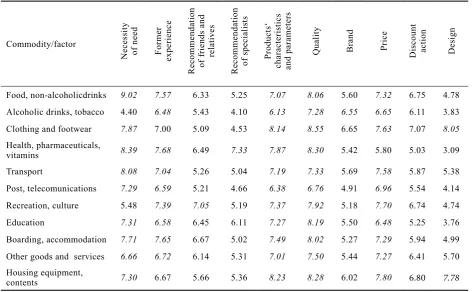
Factors influencing purchase of particular com-modities are shown in the Table 1.
conclUSion
The Table 1 mentioned above was constructed for all commodities and all factors placed on 1st to 5th place
concerning their perceived importance to purchase decision. The results of the survey and following data processing showed that the most important factors for all commodities are products’ characteristics and the quality of product. Along with those factors, there goes the importance of price, although it never appeared on 1st place of importance and for health the price was not among 5 most considerable factors at all.
necessity of need showed itself like a significant factor to purchase decision making nearly for all commodities with the exception of alcoholic drinks and tobacco and recreation and culture. Former experience is decisive for most commodities with the exception of clothing and footwear and housing equipment and contents.
As to the others factors, there proved itself as sig-nificant the design for commodities clothing and footwear and furnishings and household equipment and factor recommendation of relatives and friends for recreation and culture and factor recommenda-tion of specialists for health, medicines and vitamins. For purchasing alcoholic drinks and tobacco, there is notable also the products’ brand.
The effected analysis enabled defining of rules for decision making and thereby possibility to define
what factors should be targeted by the help of the marketing doyens.
reFerenceS
Berkowitz E.n., Kerin r.A., hartley S.W., rudelius W. (1992): Marketing. 3th edition, irwin, Boston;
iSBn 0-256-09182-X.
Foret M., Procházka P. (2007): Buying behaviour of households in the czech republic. Agricultural Economics – czech, 53 (7): 318–324.
horská E., Sparke K. (2007): Marketing attitudes towards the functional food and implications for market segmentation. Agricultural Economics – czech, 53 (7): 349–353.
Kotler P. (2001): Marketing management. grada, Praha, 10thedition; iSBn 80-247-0016-6.
Koudelka J. (1997): Spotřební chování a market-ing (consumer behaviour and marketmarket-ing). grada, Praha; iSBn 80-7169-372-3.
nagyová L. (2001a): Faktory ovplivňujíce proces rozhodovania zákazníka pri kúpe cestovín (Factor influencing the customer decision process when purchasing pasta). in.: zborník s vedeckej konfe-rencii Výživa a potraviny pre tretie tisícročie. SPU, nitra, pp. 242–245; iSBn 80-7137-847X.
nagyová L. (2001b): Súčasná situácia na trhu potravín a jej dopad na účastníkov marketingové vertikály. in: zborník vedeckých prac K aktuálnym otázkam v PPok pri vstupe do tretieho tisícročia. SPU, nitra, pp. 102–106; iSBn 80-7137-878-X.
Schiffman L.g., Kanuk L. (2004): nákupní chování (Purchasing behaviour). computer Press, Brno; iSBn 80-251-0094-4.
Solomon M.r. (2004): consumer Behavior. Buying, having, and Being. Pearson Prenctice hall. Saddle river; iSBn: 0-13-123011-5.
Souček M., Pavlíček M. (2005): Aplikace dotazníkové-ho systému (Questionnaire system application). in: zborník vedeckých prác z medzinárodne vedecké konferencie mladých vedeckých pracovníkov a do-ktorandov Mladá veda 2005: Budúcnosť Európy je v rukách mladých. SPU, nitra, pp. 1–8; iSBn 80-8069-673-X.
Stávková J., Prudilová h., Toufarová z., nagyová L. (2007): Factors influencing the consumer behav-iour when buying food. Agricultural Economics – czech, 53 (7): 276–284.
Trommsdorff V. (2002): Konsumentenverhalten. Kohlhammer, Stuttgart, 4th edition; iSBn
3-17-017004-X.
do the customers shop?). grADA Publishing, Praha, 1st edition; iSBn 80-247-0393-9.
Electronic resources
Brown A.: chapter 6 class notes. Available at http:// www.udel.edu/alex/chapt6.html [quoted 2006-07-05].
Vydání a spotřeba domácností zpravodajského soubo-ru v časové řadě (Expenditures and consumption of households of the controled sample in time series data). Available at http://www.czso.cz/csu/
Contact address:
Jana Stávková, Ladislav Stejskal, zuzana Toufarová, Mendel University of Agriculture and Forestry in Brno, zemědělská 1, 613 00 Brno, czech republic
e-mail: [email protected], [email protected], [email protected]
2007edicniplan.nsf/kapitola/10n1-07-2007-0900 [quoted 2008-04-24].
Europe in figures – Eurostat Yearbook 2004 (2005). office for official Publications of European com-munities, Luxembourg, 1nd vyd.; iSBn
92-894-9122-1. Available at http://epp.eurostat.ec.europa. eu/portal/page?_pageid=1334,49092079,1334_ 49092702&_dad=portal&_schema=PorTAL [quoted 2006-10-10].