Agricultural businesses across the Czech Republic tend to be similar to each other. The similarity re-sults from the history of the forcible collectivization of agriculture in the 1950s. The current businesses are the successors of the vanished communist as-sociations from the previous political regime. The necessity to deal with the ownership rights of the individual citizens who had been forced to become part of the associations during the communist regime is a shared trait among all agricultural businesses. Another typical characteristic is the fact that most businesses do not own the land they work on, there-fore, they have to rent it. All the businesses usually specialize in producing the same products (the only exceptions are plants requiring specific climate condi-tions and particular land types so only the businesses with suitable environment can produce them) as the customers do not care who the producer is as long as their quality demands are met. That is why it is very difficult to establish any profitable differentiation from the competitors. The agricultural production
is also very specific when it comes to financing. A large number of these businesses would not be able to survive in their current state without subsidies. If the European funds ceased to provide for the Czech Republic (while still supporting the other neighbour states), it would probably lead to the devastation of the already weakened Czech animal farming, given there would be no intervention from the Czech gov-ernment. The profitability of the Czech arable farm-ing if the system of subsidies ceased to exist would depend on the price development in the commodity market. Currently, the consumers’ purchase price is below the price at the commodity market. Despite the infamous “heritage” of the previous communist regime (intensive agriculture focusing on large areas, anonymity of the land ownership, focus on maximal production without regard for the environment, etc.), the Czech agriculture has been improving since 1989. One of the important milestones in the Czech agriculture development was caused by the Czech Republic entering the European Union in 2004 as
Strategy for SMEs in the area of primary agricultural
production
Helena CHLADKOVA, Sylvie FORMANKOVA
Department of Management, Faculty of Business and Economics, Mendel University in Brno, Czech Republic
Abstract: Th e goal of the paper was to defi ne recommendations of a suitable business strategy for SMEs in the area of primary agricultural production. First, the external environment was analysed to defi ne suitable recommendations for the industry, and also to discover opportunities and threats through fi tting strategic analyses, that aff ect the aforementioned businesses. Secondly, it was necessary to get familiar with the internal environment and functioning of specifi c businesses in the industry (namely those that operate in the Western region of Prostějov at the foot of the Drahanska Highlands) and to evaluate their effi ciency to defi ne their strengths and weaknesses. Th e paper demonstrates that there is a wide range of means that can be taken advantage of when defi ning fi tting strategies for agricultural businesses, e.g. the Porter’s Five Forces Model, the IFE and the IE Matrix, the SWOT Matrix as well as the general strategies by Ansoff . Among the most important recommendations for increasing the competitiveness of SMEs in the agricultural industry, there belong: taking advantage of all the suitable agricultural subsidies, taking advantage of accredited agricultural advisors, making sure that the legal requirements of governmental bodies are met, increasing revenues for arable farming (through a good quality seed stock, chemicals and fertilizers, the foundation of suitable storage facilities in order to postpone the sales of the grain after the harvest season), creating sales cooperatives/associations to balance the competing force of buyers, rejuvenating the workforce, solidifying the ownership structure in the businesses, entrepreneurial diversifi cation (electrical energy produc-tion), increasing quality in animal farming.
the Czechs became a part of the shared agricultural policies, tools and goals. Typically for this period, there is an increased demand for greater environment protection including welfare of the farmed animals (that are also part of various European subsidies).
The current Czech agriculture is not focused solely on the quantity of the produced goods but mainly on their quality, harmlessness and the environment protection/sustainability.
Agriculture is a very specific field as it depends on land and is heavily influenced by the environmental conditions. Land is the most significant, basic and irreplaceable production factor (IAEI 2013). Various climatic and land conditions in the Czech Republic led to establishing 5 main production areas that differ by e.g. the average year temperature, the type of land, the slope of terrain, and the natural predisposition for growing the particular crops. The areas are knows as the maze area (1%), sugar beet area (24%), grain area (40%), potato area (19%) and fodder plants area (16%) (Němec 2001).
There is about 3.5 million hectares of agricultural land (out of which 2.5 million hectares is the arable land) in the Czech Republic. There was about 22 900 agricultural businesses putting this land to work in 2010 (their number rose to 26 200 in 2013). Important entrepreneur entities are the business companies (about 3000) that work with 2.47 million hectares of land (CSO 2015).
As there is a great number of businesses in the agricultural field, it is impossible for one of them (or for a smaller number of them) to have any say in the purchase price of the commodities. The biggest player in the industry is, however, the Agrofert Holding, a.s., which controls agricultural businesses that work on 100 000 hectares of land (which is about 2.8% from the total Czech agricultural land). According to the Czech Statistical Office, most corporate bod-ies doing business in agriculture rent the land they work on. From the overall 2.47 million hectares of land, 2.15 million hectares are rented from the land owners (data from 2010). The current profit earned by these businesses is mostly used to stabilize their own business. The current threats and also oppor-tunities are as follows: cooperative shares, business shares in the limited liability companies, shares in joint-stock companies that buy those companies in the industry that are strong and stable, this way a company can also earn its say in a competitor’s company. The safest way to increase one’s market share is to buy another company in the industry or to
conduct an acquisition with either strange or partly owned company.
There are significant obstacles and barriers to enter the industry, mainly because it is necessary to own or rent land (high capital investment). The threats for the current businesses in the industry are young agricultural entrepreneurs and new ranches focus-ing on tourism (as they are subsidized by the EU to purchase land, to do investments into the arable and animal farming, as well as into agricultural machin-ery). The new and young agricultural businessmen are supported within the program “Young Agrarians” where they can reach subsidies up to EUR 40 000.
The purchasing power of the buyers is very signifi-cant in the industry, e.g. they condition the future purchase of goods by dictating the kind of grain and quality they require.
Some questions of the selected agricultural sec-tions were investigated by Czech authors e.g. Duda and Tlačbabová (2012), their paper describes pro-duction barriers for organic milk. Kučerová (2005) analyses the development of the basic characteristics of the dairy industry in the Czech Republic. Prokeš and Tomšík (2012) in their paper describe the main reasons for the formation of new regional winery association based on different wine origins within the wine region of Moravia (in the Southeast part of the Czech Republic). This research aim is to examine whether the development of more strategic alliances is possible (and beneficial) when taking into account the location factor. Gurská’s paper (2011) focuses on the organization Czech Wine Growers Association and defines the strengths, weaknesses, opportunities and threats from its environment. A set of recom-mendations has been identified, including publishing a magazine for the general public, advisory services, changing the organizational structure and division of the Union on sub- alliances for each wine region. Syrovatkova et al. (2015) in their research results show a high theoretical potential of the Czech agricultural sector to supply farmers’ markets because there are relatively many small farmers producing products sellable on farmers’ markets. In the Czech context, where the tradition of running independent businesses was interrupted by the country’s communist past, the lack of experience with private entrepreneurship and marketing among farmers seems to be the main obstacle to a broader involvement of farmers in the farmers’ markets.
in-tensively studied by Bagchi-Sen and Scully (2007). Their paper examines the characteristics of small and medium-sized enterprises (SMEs) involved in the agricultural biotechnology (agro-bio) sector. Its specific objectives are as follows: to understand the firm-specific strategies aiming at staying com-petitive in an uncertain business environment, and to examine the impact of government policies and farmers on the strategies. Crescimanno et al. (2013) deal with the strategy for small fruits production companies in Sicily. The need of new management strategies to guide the future development of animal husbandry was looked into by Chong et al. (2015). Suitable strategies for the sector of viticulture and enology were engaged by Baldari et al. (2013). Kim et al. (2013) said in their article that the larger the scale of agricultural companies was, the more important were the innovation capability and the economy of scale. In the case of small scale companies, the capability for small quantity batch production was important. Thus, agricultural companies need to differentiate the management strategy by scale, and to develop the management capability according to such company strategy. Strategies suitable for farms were also dealt with by Campos-Climent et al. (2012). The theme of their article was about agricultural cooperatives having been able to become a strong and consolidated organizational form despite the new challenges of globalization and trade liberali-zation requiring changes in the strategic approach. The performed Delphi analysis revealed that the Mediterranean agriculture suffers from a severe crisis for which the solutions are hard to find, although the existence of the agricultural cooperatives and certain specific forms of performance and financing can partly improve the described situation. The authors also used the SWOT analysis. Arcas et al. (2011) studied interesting challenges the agricultural companies face and tried to empirically verify the relationship between the size of the agricultural cooperatives and their performance. The paper of Ungureanu (2011) deals with one of the most important challenges of Romanian agriculture. His study is absolutely vital for comprehending the individual performance of differ-ent types of companies, namely its risk assessmdiffer-ent is greatly contributory. As agricultural companies encounter a number of risks in their business, it is very important to control the risks for their stable management. So Kim (2011) examined the agricultural business risks and proposed the risk management strategies for the agricultural companies.
The goal of this paper was to set recommendations for SMEs operating in the area of primary production that would help to define a fitting business strategy. First, it was necessary to analyse the external envi-ronment and (through suitable strategic analyses) to reveal opportunities and threats that influence busi-ness in the industry. In order to disclose strengths and weaknesses, a set of agricultural businesses from the area of Prostějov (at the foot of the Drahanska Highlands) was examined and their production ef-ficiency evaluated. The analysed businesses partly belonged to the area of “grain land” (that is suitable for growing: grains, non-food industrial crops, rape plant and potatoes) and partly to the area of “potato land” (that is suitable for growing: crop plants, potatoes for starch production, potatoes for food purposes, rape plant, flax plant, feeding grains).
Creating business strategy can be viewed as one of the most significant processes in the business management irrespective of the company size and focus of business. The goal of a good strategy and its implementation is to make sure the company in question prospers and thrives in the ever demand-ing competitive environment while allocatdemand-ing its resources effectively. A good and well-applied strategy demonstrates itself by the company reaching profit (short-term) and increasing its value (long-term). If there is no clearly defined business strategy, the company behaves intuitively and tends to react to the upcoming changes inconsistently and with a delay. That has a negative impact on the company perfor-mance and can even lead to the company downfall.
MATERIAL AND METHODS
speaks of so-called “Core competences” – being able to exploit business opportunities and also to create the added value for customers that is hard to imitate by the competition (Hammel and Prahaland 1990).
To create strategic alternatives is quite a demanding process which starts by analysing the environment but mainly relies on intuitive predictions of the future developments. There is a wide range of tools in order to facilitate this process. They help to recommend a certain type of general strategies that are necessary to be worked out into a specific plan suitable for the given situation. The tools used in this paper were as follows: SWOT analysis, EFE and IFE matrix, IE matrix and competitive analysis.
The SWOT analysis is a universal analytical tech-nique focusing on the evaluation of internal and external factors affecting the success of a given or-ganization or any other evaluated system. Most often, the SWOT analysis is used in the strategic manage-ment of an organization in the evaluation of a stra-tegic intention. The author of the SWOT analysis is Humphrey who designed it in the sixties of the 20th century. The internal and external factors within the SWOT analysis are evaluated. The internal factors include strengths and weaknesses of the organization/ system. The external factors include opportunities and threats which are related to the surroundings of the organization/system. The SWOT is an acronym formed by the first letters of the individual factors (Koontz and Weihrich 1993).
The EFE Matrix is an analytical technique related to the SWOT analysis. The EFE is an acronym of the External Factor Evaluation. The EFE Matrix evalu-ates the external position of the organization or its strategic intent.
The evaluation process: The first is to process the table of external factors (such as key 5O and 5T of the SWOT).
Weight is assigned to each factor in the range from 0.00 to 1.00 according to the importance of the strengths or weaknesses. The sum of weights must be equal to 1.00.
Then, rate factors as follows: 4 points – major O, 3 points – minor O, 2 points – minor T, 1 point – major T.
Multiply the weight and rating for each factor. The result is a weighted ratio. The sum of the weighted ratios of the individual factors results in the overall weighted ratio.
Overall evaluation – the resulting weighted ratio evaluates the internal position of the organization
or strategic intent. The best possible score is 4, the worst is 1. The average values are around 2.5.
The strategy of the organization or mutual evalua-tion and comparison of different strategic intenevalua-tions can be evaluated by the EFE Matrix. The intention with the best result of the overall weighted average should be chosen. The EFE Matrix results should be combined with the results of the IFE matrix.
The IFE Matrix is an analytical technique related to the SWOT analysis. The IFE is an acronym of the Internal Factor Evaluation. The IFE Matrix evalu-ates the internal position of the organization or its strategic intent.
The evaluation process is as follows: The first step is to process the table of internal factors (such as key 5S and 5W of SWOT)
Then, assign to each factor a weight in the range from 0.00 to 1.00 according to the importance of the strengths or weaknesses – the sum of weights must be equal to 1.00
Rate the factors as follows: 4 points – major S, 3 points – minor S, 2 points – minor W, 1 point – major W.
Multiply the weight and rating for each factor – the result is a weighted ratio. The sum of the weighted ratios of individual factors is the overall weighted ratio. The overall evaluation – the resulting weighted ratio evaluates the internal position of the organiza-tion or strategic intent. The best possible score is 4, the worst is 1. The average values are around 2.5.
The matrix can be divided into three main areas: A. Growth and Development (I, II, IV field) –
inten-sive and integration strategy
B. Maintaining and Strengthening (III, V, VII field) – market penetration and new products development C. Harvest or Sale (VI, VIII, IX field) (David 1991).
The competitive analysis is taken advantage of when evaluating the position of a company with regard to its competitors. The key factors are used as the evaluation criteria.
In accordance with the concept of the CSF, it is fully sufficient to identify and select only those phe-nomena (factors) that are essential to the success of the organization or a particular project or plan. That way, the amount of the observed phenomena can be reduced to the order of the unit, instead of watching tens, hundreds or thousands of phenomena. An analy-sis of the critical success factors is used in situations where it is necessary to identify the key factors that may indicate failure, or vice versa. As the individual factors are not of the same importance in many cases, an importance score is given to each factor. The total of the importance scores should add up to 1. The factors are marked on the scale from 1 to 5 and the weighted evaluation is set as the multiple of scores and their importance. The total of the importance evaluations for a particular company functions as an indicator of the overall competitiveness. Comparing the weighted scores for the individual companies shows the competitive position of each company and their rivals (Tichá and Hron 2013).
This paper works with the terms micro, small and medium-sized enterprise as specified in the Article 1, Commission Regulation (EC) No 800/2008. The defi-nition of SME is vital for establishing equal condi-tions for all entrepreneurial subjects and enabling statistical comparisons within the EU (European Commission 2012).
Article 1 – Micro, Small and Medium-Sized Enter-prise Micro, Small and Medium-Sized Enterprise (SME) is a businessman or businesswoman who employs less than 250 employees and his or her assets do not exceed 43 mil. EUR (in CZK equivalent) or his or her turnover/revenues do not exceed 50 mil. EUR (in CZK equivalent).
Small-Sized Enterprise is a businessman or busi-nesswoman who employs less than 50 employees and his or her assets or his or her turnover/revenues do not exceed 10 mil. EUR (in CZK equivalent).
Micro-Sized Enterprise is a businessman or busi-nesswoman who employs less than 10 employees and his or her assets or his or her turnover/revenues do not exceed 2 mil. EUR (in CZK equivalent).
The internal environment was evaluated with the use of the internal documents of ZS Bohuslavice, a.s., agricultural company TERRIS Budětsko, a.s. and agricultural business cooperative Ludmírov.
The afore mentioned businesses were analysed in the period of 2007–2011, therefore their economic results were influenced by the 2008 economic crisis. Nonetheless, the same methodical approach and tools can be applied in the years to come as well.
RESULTS
This paper analysed 3 businesses from the Drahanska Highlands in the vicinity of Konice, the Olomouc region: ZS Bohuslavice, a.s. (a joint-stock company), agricultural company TERRIS Budětsko, a.s. (a joint-stock company) and agricultural business cooperative Ludmírov (business cooperative).
– ZS Bohuslavice, joint-stock company
Number of employees: 50–99, Revenues: 50 000– 100 000 CZK
Products:
– Animal farming – beef cattle, goat and pigs, do-mestic fowls, farmed animals’ welfare, farming & bio-farming,
– Arable farming –wheat, malting barley, rye, oat, maze and 1-year fodder plants
The company manages the land area of 1600 hec-tares. Most of the land is leased. There is winter rape, malting barley, wheat, food and feed crops harvested green produced by the company. The company is located in an area with less favourable conditions and therefore receiving the LFA payments (NHP provided in the mountain areas and payments in other disadvantaged areas) on permanent grassland.
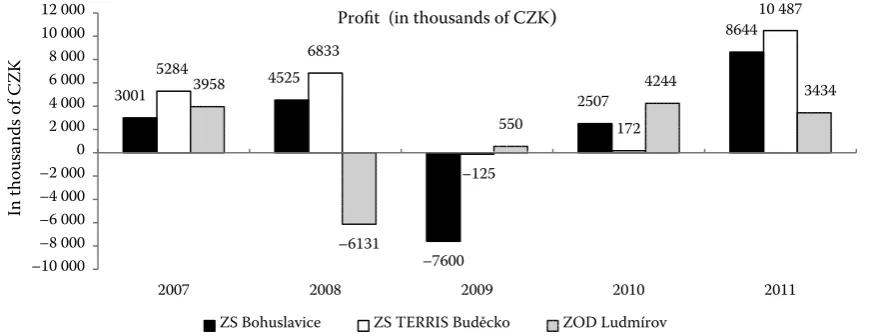
The animal production part of the company mostly focuses on producing milk for the market. Previously, the company raised pigs but stopped breeding them in 2010. ZS Bohuslavice reached profit in all of the years 2007–2011 except for 2009, when the com-pany posted a loss of 7.6 million CZK. The comcom-pany achieved its highest profit in 2011 (8 644 000 CZK). – Agricultural company Terris Budětsko, joint-stock
company
The company manages about 1400 hectares of agricultural land. Most of the land is leased on a long-term. The company operates in the traditional agricultural production, including breeding pigs, raising cattle and milk production. There is the pro-duction of bread wheat, malting barley, rape plant, poppy seed and fodder crops for their own use. The company achieved the highest profit (10.5 million CZK) in 2011. The company was in loss in 2009 alone (125 thousand CZK)
– Agricultural business cooperative Ludmírov. Number of employees: 50–99 employees, Revenues: 50 000–100 00 CZK
The cooperative engages in the economic activity on some 1600 hectares of agricultural land. The company is located in an area with less favourable conditions and therefore is receiving the LFA payments on per-manent grassland. There is the production of food wheat, malting barley, winter rape, winter rye and feed crops harvested green. The animal part of produc-tion mainly focuses on milk producproduc-tion. Previously, the company focused on raising pigs, but stopped breeding them in 2010 just like ZS Bohuslavice. The year 2008 was marked by the loss of 6.1 million CZK. The company’s highest profit was achieved in 2009 (4.2 million CZK).
When comparing all these 3 companies togeth-er, it can be stated that the best economic results were achieved by the agricultural company TERRIS Budětsko, a.s. (within the period 2007–2011). The only unprofitable year for this company was the year 2009 with the loss of 125 000 CZK. The best year for the company was the year 2011 when the profit of almost 10.5 million CZK was achieved (Figure 1).
Its loss of 125 000 was also the lowest from the 3 competing companies.
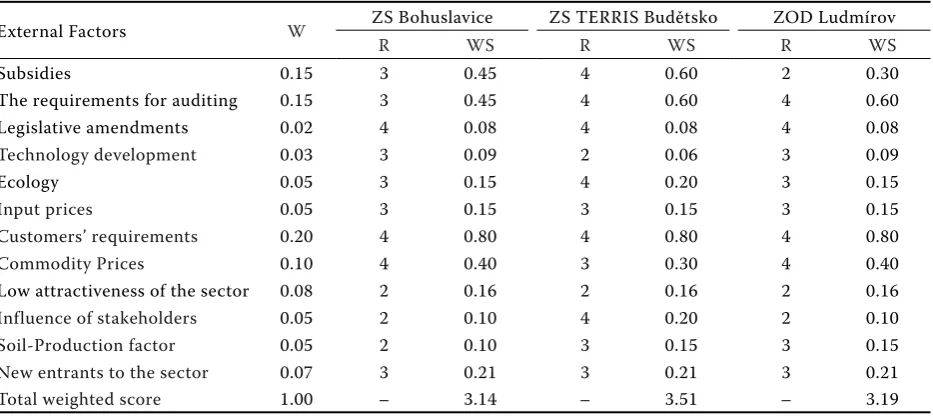
Table 1 demonstrates the most important factors of the external environment that influence the agricul-tural businesses in the Czech Republic. The signifi-cance of the factors is expressed by the importance score – weight – that was set based upon consultations with managers from the three aforementioned agri-cultural businesses as well as the point score – rating – that reflects how the particular company reacts to each factor. The highest weight was attributed to the factor “Customers Requirements” (weight 0.20). As the table demonstrates, all 3 businesses react very well to this factor with their current strategy (point score – rating 4).
The results of all the followed businesses are higher than 2.5 when it comes to their total weighted score. That means that the companies react very well to the factors coming from the external environment. The best reaction to the chosen factors from the external environment were shown by the agricultural company TERRIS Budětsko, a. s., and then by agricultural busi-ness cooperative Ludmírov, with the ZS Bohuslavice not far behind.
E.g. the TERRIS Budětsko should pay more attention to the technology development (use more modern technologies and replace the out-dated ones). The Ludmírov should focus more on taking advantage of the EU subsidies. All the agricultural businesses should try their best to attract young people as their potential employees.
Having completed the analyses of the micro- and macro-environment of the followed agricultural busi-nesses, the most significant opportunities and threats
3001
4525
–7600
2507
8644
5284
6833
–125
172
10 487
3958
–6131
550
4244 3434
–10 000 –8 000 –6 000 –4 000 –2 000 0 2 000 4 000 6 000 8 000 10 000 12 000
2007 2008 2009 2010 2011
ZS Bohuslavice ZS TERRIS Buděcko ZOD Ludmírov
Profit (in thousands of CZK)
[image:6.595.81.523.552.720.2]In thousands of CZK
Figure 1. Economic results throughout the years 2007–2011
were identified. Also, the responsive reaction to these factors through the companies’ strategies was set. All the followed businesses reached the overall weighted score exceeding the average value. Among the most significant opportunities, there belonged:
– putting the fodder plants (grown for the purposes of the biogas stations) into the “greening arrangement plan” (Greening consists of three basic parts: plant diversification, keeping the acreage of grassland and areas that fall into the ecological focus of the EFA) – increasing the purchase price of the arable
farm-ing products,
– increasing the food consumption, – new technology development,
– subsidies for the modernization and business di-versification,
– subsidies for the renewable sources of energy.
Among the most significant threats belonged: – “ceiling” to direct payments from the EU, – “greening arrangement plan”,
– low purchase price of milk, – purchasing power of buyers,
– conditions for the arable and animal farming be-coming increasingly strict,
– soil erosion and climatic changes and influence.
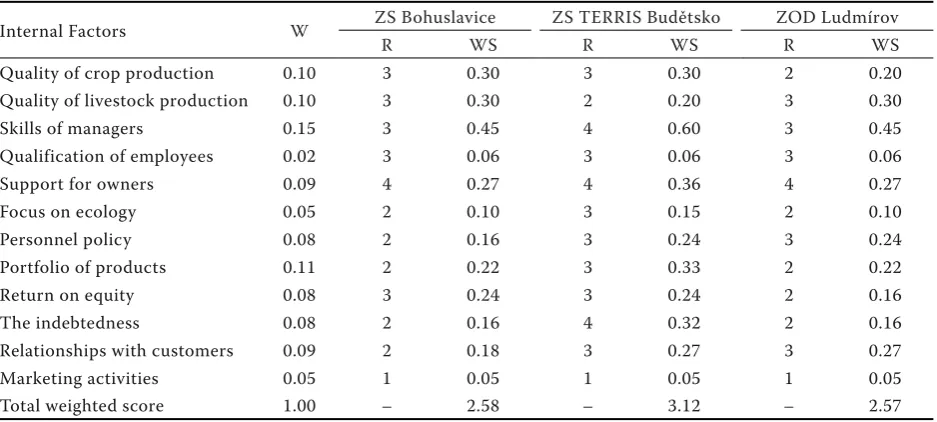
Table 2 shows the factors from the IFE matrix. The responsive reaction (through a particular business strategy) to the factors from the internal
environ-ment of the aforeenviron-mentioned businesses is evaluated. A capable management and a product portfolio can be considered as the most significant ones (their total weighted score was the highest).
All three agricultural businesses exceeded the value of 2.5 (the overall weighted average score) in their total weighted score. The best result was achieved by the TERRIS Budětsko. For all the three businesses, there was a poor result recorded for the marketing activities area.
[image:7.595.65.532.113.321.2]While analysing the internal environment, the vi-sions and vocation of the three agricultural companies have been identified. Those are in line with the main production of the companies. Also, the success fac-tors were determined as well as the most successful products within the companies’ product portfolios. Success factors of these companies are as follows: a big enough land acreage, the quality of arable and animal farming products, increasing percentage of land the companies own (and not lease) and good relations in the producer-buyer chain. The most successful agricultural products are the following agricultural commodities (mainly from the area of arable farm-ing): rape plant, wheat for human consumption, rye, barley and poppy seed (included in the production again after several years). There are also important products from the area of animal farming produc-tion. However, these are the products that play an important role in the companies’ revenues but not so much in their profit. The followed agricultural
Table 1. EFE Matrix
External Factors W ZS Bohuslavice ZS TERRIS Budětsko ZOD Ludmírov
R WS R WS R WS
Subsidies 0.15 3 0.45 4 0.60 2 0.30
The requirements for auditing 0.15 3 0.45 4 0.60 4 0.60
Legislative amendments 0.02 4 0.08 4 0.08 4 0.08
Technology development 0.03 3 0.09 2 0.06 3 0.09
Ecology 0.05 3 0.15 4 0.20 3 0.15
Input prices 0.05 3 0.15 3 0.15 3 0.15
Customers’ requirements 0.20 4 0.80 4 0.80 4 0.80
Commodity Prices 0.10 4 0.40 3 0.30 4 0.40
Low attractiveness of the sector 0.08 2 0.16 2 0.16 2 0.16
Influence of stakeholders 0.05 2 0.10 4 0.20 2 0.10
Soil-Production factor 0.05 2 0.10 3 0.15 3 0.15
New entrants to the sector 0.07 3 0.21 3 0.21 3 0.21
Total weighted score 1.00 – 3.14 – 3.51 – 3.19
W=Weight, R= Rating, WS= Weighted Score
businesses achieved better than average scores when it came to their reaction to the internal environment factors. Among the identified companies’ strengths, there belonged:
– the ability to take advantage of the available sub-sidies,
– management,
– product quality in the area of arable farming, – yield in the area of animal farming,
– new technology implementation,
– good purchase-buyer relations and reputation, – profitability of the companies over the past few years.
The following factors were identified as the weak-nesses from the internal environment of the com-panies:
– delegation and active involvement of employees, – not taking advantage of the trade department, – low storage capacity in the area of arable farming, – land with high degrees of slopping,
– low profitability in the area of animal farming, – dependence on buyers.
In order to define the success factors, a comparison among the three followed agricultural businesses was made. The specifics of the primary agriculture production were taken into account. All the necessary data for the success factors comparison were taken from the internal documents of the companies and consultations with the companies’ management. The
position of each company was evaluated in relation to its main competitors through the competitive analysis. The key factors of success were used as the evaluating areas (Tichá and Hron 2013).
The identified success factors were used in the competitive analysis. As their significance differed, a weighted score was associated with each one of them. Each factor was awarded a score from 1 to 5 where 5 meant the best possible evaluation.
The TERRIS Budětsko achieved the best weight-ed score within the set key success factors when evaluated through the competitive analysis. The Ludmírov scored as second, tightly followed by the ZS Bohuslavice.
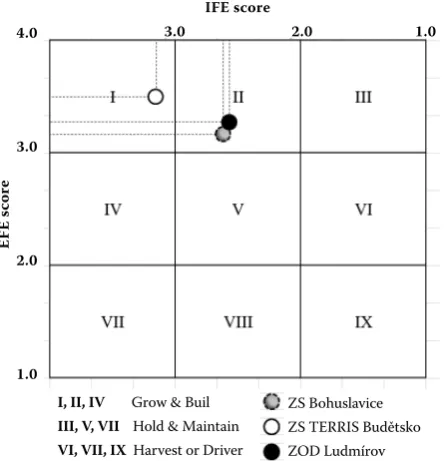
The internal-external matrix (IE Matrix) was used for the summary of the internal and external envi-ronment. The IE Matrix sums up the results of the factors evaluation – the external factors evaluation (EFE matrix) and the internal factors evaluation (IFE matrix). The intersection point of the two overall weighted scores for the examined agricultural busi-nesses suggests which strategy area should be taken advantage of by each company. The TERRIS Budětsko falls into the sector I, while the ZS Bohuslavice and Ludmírov fall into the sector II, as their achieved worse results in the IFE matrix. However, all three companies should focus on the strategy area: Growth and Development as shown on Figure 2.
[image:8.595.64.533.113.324.2]The three agricultural businesses should, therefore, try their best to increase their market share, to develop
Table 2. IFE matrix
Internal Factors W ZS Bohuslavice ZS TERRIS Budětsko ZOD Ludmírov
R WS R WS R WS
Quality of crop production 0.10 3 0.30 3 0.30 2 0.20
Quality of livestock production 0.10 3 0.30 2 0.20 3 0.30
Skills of managers 0.15 3 0.45 4 0.60 3 0.45
Qualification of employees 0.02 3 0.06 3 0.06 3 0.06
Support for owners 0.09 4 0.27 4 0.36 4 0.27
Focus on ecology 0.05 2 0.10 3 0.15 2 0.10
Personnel policy 0.08 2 0.16 3 0.24 3 0.24
Portfolio of products 0.11 2 0.22 3 0.33 2 0.22
Return on equity 0.08 3 0.24 3 0.24 2 0.16
The indebtedness 0.08 2 0.16 4 0.32 2 0.16
Relationships with customers 0.09 2 0.18 3 0.27 3 0.27
Marketing activities 0.05 1 0.05 1 0.05 1 0.05
Total weighted score 1.00 – 2.58 – 3.12 – 2.57
W=Weight, R= Rating, WS= Weighted Score
new products for the current and future markets, to increase the quality of the current products and to seek new markets for them. Another option is to fo-cus on the integration with another business subject. The possibilities are as follows: backward integration, forward and horizontal integration. Having taken into account the business conditions of the three followed
agricultural companies, the forward and horizontal integration is recommended to be implemented.
Also, based on the conducted analyses and the identification of opportunities, threats, weaknesses and strengths, the SWOT matrix can be taken advan-tage of, too, when defining a suitable list of strategies for the SMEs in the industry. A specific example can be a suggestion to establish a small-sized dairy (ST strategy).
The threat of the low purchase price of milk can be dealt with by advancing in the distribution channel. Specifically, the low indebtedness of the company can be exploited in terms of getting a loan from a bank to have a small-sized dairy built. The dairy should focus on the local area and take advantage of a good company name and reputation in the area. It is pos-sible to co-finance the project with the help of the Rural Development Program 2014–2020. The RDP focuses on the development and restructuring of the physical capital, the support for innovation and, specifically, adding value to agricultural and food products. The same RDP program can be exploited to expand and start cheese production, too.
[image:9.595.64.532.112.352.2]When recommending general strategies to the followed businesses, Ansoff and his strategies can be suggested to be taken advantage of as well, e.g. the product development strategy. New products for the current market could be as follows: agricultural commodities from organic farming. The agricultural
Table 3. The competitive analysis
Critical Success Factors Weight ZS Bohuslavice ZS TERRIS Budětsko ZOD Ludmírov
Long business history in the market 0.02 4 4 5
Reputation of the company 0.05 3 5 4
Ownership structure 0.10 4 5 2
Qualityof land 0.05 5 4 5
Relationships with businesspartners 0.02 3 5 4
Ownership of land 0.10 2 5 5
Direct payments to the area 0.10 5 4 5
Successin the operational programs 0.08 3 5 3
Crop production 0.10 4 5 3
Quality of crop production 0.05 5 5 4
Livestock production 0.08 5 3 5
Landfor livestock 0.05 4 3 5
The efficiencyof livestock production 0.05 3 5 4
Possibility of credit financing 0.10 3 5 3
Profitability of capital 0.05 4 5 3
Weighted score competitive forces 1.00 3.78 4.57 3.87
Source: Calculations of authors based on Bílý (2013)
E
FE s
core
IFE score
3.0 2.0 1.0 4.0
3.0
2.0
1.0
I, II, IV Grow & Buil III, V, VII Hold & Maintain VI, VII, IX Harvest or Driver
ZS Bohuslavice ZS TERRIS Budětsko ZOD Ludmírov
Figure 2. Internal-External Matrix (IE Matrix)
[image:9.595.65.288.487.718.2]company would devote a portion of its land for organi-cally grown crops where the land would be fertilized by manure only without adding any chemicals or artificial fertilizers. It would be advisable to place this portion of business into the already protected zones for drinking and surface water, where there is a ban to use certain chemicals. These that can be used are purchased at a high price. Before devoting any portion of the land to the organic farming project, however, the business partners should be inquired to determine whether there would be any demand for such products and if so, what quantity? It is also advisable to replace the plant cultivars with less suit-able parameters with newer ones that can increase the yield and have better results in various parameters that are valued at the purchase. Therefore, it is rec-ommended not to be afraid of change, to go forward with innovations and not to rely on the verified but out-dated cultivars only. Also, the companies should not focus solely on one particular cultivar for each commodity. Even if it shows the best results in one season, it may not achieve the same results in another year (due to different weather conditions).
Companies in the agricultural industry may put to use a business diversification strategy while taking advantage of the European Funds resources provided through the State Agricultural Intervention Fund in the Czech Republic. Another potential area for diversification is the support for the renewable re-sources of energy. The greatest advantage of this sort of diversification is the fact that a significant portion of production input can be produced by the company itself within its own production process. There is an ongoing trend in the Czech Republic to have a biogas station as a source of renewable energy. Currently, there is still room for more biogas stations to be built as the capacity for the 2020 plan has not been reached yet (energy production in biogas stations and their share as a source in the renewable energy total). The three followed companies do not own a biogas station as it would be difficult for them to grow enough corn/ maze crops to keep the station running. The reason behind this is a high level of slopping of a big portion of their land which prevents them from growing crops requiring wide row widths, namely corn. Also, these companies refuse to use all their manure as an input for the biogas station as they prefer to use it as an important organic fertilizer instead. Therefore, the companies should consider a shared ownership and operation of the BPS through a joint venture with the same shares and rights for each company. The
companies could also start paying attention to the fast growing woody plants for the biomass, as this biomass is already used in the thermal power stations and the ecological boiler houses.
The State Agricultural Intervention Fund and its programs to support rural development should be taken advantage of to co-finance the foundation of a dairy (possibly extending the production by adding cheese products, too). Taking this step would mean getting closer to the company’s customers. As the dairy would be only a small-sized one, the products would sell in the local market only and its buyers would know exactly where their milk comes from. Local groceries and mobile grocery stores owned by the company could sell the dairy products to start with.
CONCLUSIONS
The paper demonstrates that in order to identify suitable strategies and conduct the needed analyses, a wide range of approaches can be exploited for the SMEs doing business in the agricultural industry. The Porter’s Five Force Model serves well and it is fully applicable in the agricultural sector. One of the most significant forces in the agricultural business is the purchasing power of buyers as the agricultural companies have no other option than to accept the buyer’s conditions of purchase during the harvest season (unless they dispose of a sufficient storage capacity that enables the companies to sell their commodities at a more propitious time). The companies’ share in the Czech market is usually too small to be able to negotiate the conditions of the purchase contract. However, there is an opportunity to establish agricultural sales cooperatives and to negotiate better contract conditions thanks to the increased market share in the local market. Another important force in the agricultural business is the purchasing power of suppliers. Many buyers strictly focus on specific plant cultivars they buy, and often they also sell them – they become suppliers of the particular seed stocks only.
Among the main recommendations in the area of strategy identification for SMEs operating in the agricultural industry, there belong:
– taking advantage of all available and suitable sub-sidies supporting the agricultural business – using the accredited agricultural advisors
– increasing revenues of the arable farming through: – taking advantage of the available good quality
seed stocks, chemicals and fertilizers
– building extra storage facilities to be able to conduct the commodity sales after the harvest season
– establishing agricultural sales cooperatives to limit the purchasing power of buyers
– including younger workforce in the business – strengthening the ownership structure in the
com-panies
– business diversification through the electrical en-ergy production
– increasing quality of the animal farming products.
REFERENCES
Annual reports of the ZS Bohuslavice, a.s., Zemědělská společnost TERRIS Budětsko, a.s. and Zemědělské ob-chodní družstvo Ludmírov (2008–2012).
Arcas N., Garcia D., Guzman I. (2011): Effect of size on performance of Spanish agricultural cooperatives. Ca-hiers Agricultures, 20: 382–386.
Bagchi-Sen S., Scully J. (2007): Strategies and external relationships of small and medium-sized enterprises in the US agricultural biotechnology sector. Environment and Planning C: Government and Policy, 25: 844–860. Baldari M., Di Gregorio D., Sara M. (2013): The economic evaluation of investments in vineyards at high plant den-sity: analysis of a case study in a DOC area of Calabria Region. Evoluzione dei valori fondiari e politiche agri-cole: 27–37.
Bílý V. (2013): Návrh strategie pro malé a střední podniky
v odvětví zemědělství. (Strategy for small and
medium-sized enterprises in the agriculture sector). [Diploma thesis.] PEF Mendelu, Brno.
Campos-Climent V., Apetrei A., Chaves-Avila R. (2012): Delphi method applied to horticultural cooperatives.
Management Decision, 50: 1266–1284.
Chong Lei M., Jing Z. (2015): Identifying management strategies to improve sustainability and household in-come for herders on the desert steppe in Inner Mongolia, China. Agricultural Systems, 132: 62–72.
Crescimanno M., Farruggia D., Galati A., Schimmenti, E.,
Siggia, D. (2013): Can Coopetition be a winning strategy for for small fruits companies in Sicily? In: 6th Annual EuroMed Conference of the
EuroMed-Academy-of-Business. Cascais, Sept. 23–24: 674–685.
CSO (2015). Czech Statistics Office, Praha. Available at:
http://www.czso.cz (accessed July 2015).
David F.R. (1991): Strategic Management. Macmillan Pub-lishing company, New York.
Drucker P.F. (2009): Drucker na každý den 366 zamyšlení a podnětů, jak dělat správně věci. (The Daily Drucker: 366 Days of Insight and Motivation for Getting the Right Things Done.) Management Press, Praha.
Duda J., Tlačbabová M. (2012): Barriers to organic milk production. Acta Universitatis Agriculturae et Silvicul-turae Mendelianae Brunensis, 60: 55–60.
European Commission (2012): Small and medium-sized en-terprises (SMEs) [online]. Available at http://ec.europa. eu/enterprise/policies/sme/facts-figures-analysis/sme-definition (accessed March 2015).
Gurská S. (2011): Strategy Proposal for the Wine-growers Association of Czech Republic. [CD-ROM]. In: Firma a konkurenční prostředí 2011: 260–270.
Hammel G., Prahalad C.K. (1990): The Core Competence of the Corporation. Harvard Business Review. Available at https://hbr.org/1990/05/the-core-competence-of-the-corporation (accessed February 2015).
Institute of Agricultural Economics and Information (IAEI) (2013): Jak začít podnikat v zemědělství (How to start a business in agriculture.) Available at http://eagri.cz/ public/web/file/261965/Jak_zacit_podnikat_v_zeme-delstvi.pdf (accessed February 2015).
Kim Ch. (2011): Strategies for Risk Management of Agri-cultural Business in AgriAgri-cultural Companies. Journal of Agricultural Extension & Community Development, 18: 633–666.
Kim J.Y., Choe Y. (2013): The Strategic Implication from Analysis on Agricultural Companies within the Frame-work of Resource-Based View. Korean Journal of Food Marketing Economics, 30: 1–27.
Kim W.CH., Mauborgne R. (2009): Strategie modrého oce-ánu. (Blue Ocean Strategy.) Management Press, Praha. Koontz H., Weihrich H. (1993): Management. Victoria
Publishing, Praha.
Kučerová R. (2005): Analýza vývoje základních charakter-istik odvětví mlékárenského průmyslu v ČR. (Analysis of the development of the basic characteristics of the sector of the dairy industry in the Czech Republic.) Acta Universitatis Agriculturae et Silviculturae Mendelianae Brunensis, 53: 93–100.
Němec J. (2001): Bonitace a oceňování zemědělské půdy České republiky. (Valuation and pricing of agricultural
land Czech Republic.) VÚZE, Praha.
Porter M.E. (1998): Competitive strategy: techniques for analyzing industries and competitors. 1st ed. Free Press, New York.
Prokeš M., Tomšík P. (2012): Increasing competitiveness of wine producers in strategic alliances VOC. Acta Universitatis Agriculturae et Silviculturae Mendelianae Brunensis. 60: 293–298.
Syrovatkova M., Hrabak J., Spilkova J. (2015): Farmers’ markets’ locavore challenge: The potential of local foodproduction for newly emerged farmers’ markets in Czechia. Renewable Agriculture and Food Systems, 30: 305–317.
Tichá I., Hron J. (2013): Strategické řízení. (Strategic Management.) Česká zemědělská univerzita v Praze, Provozně ekonomická fakulta, Praha.
Ungureanu G., Brezuleanu S., Brezuleanu O. (2011): Study of risks strategy in agricultural companies (Case study: SC “KOSAROM” SA PASCANI). In: Management of technological Changes, Book 2: 761–764.
Received: 8th September 2015 Accepted: 29th November 2015
Contact Address: