A Feasible SIMS Study for Characterizing Ferric Oxyhydroxides Formed
on the Iron Surface Using Deuterium
Shigeru Suzuki
*, Yohei Takahashi and Yoshio Waseda
Institute of Multidisciplinary Research for Advanced Materials, Tohoku University, Sendai 980-8577, Japan
Secondary ion mass spectrometry (SIMS) has been applied to hydrogen and deuterium analysis for ferric oxyhydroxides, which is formed by reaction of an iron substrate with water; either H2O or D2O containing a small amount of sodium chloride. Mass spectra of positive and negative ions obtained by SIMS showed that deuterium in ferric oxyhydroxides can be differentiated from hydrogen, although many species of secondary ion peaks are detected. Mass spectra from an iron sample, which firstly reacted with H2O, subsequently dried and finally reacted with D2O, indicated that D2O reaches a reaction front of the iron substrate through ferric oxyhydroxides formed by reaction with H2O. This implies that the ferric oxyhydroxides formed by reaction with H2O are, more or less, porous and thus water penetrates into ferric oxyhydroxides to the substrate. These results also suggest that SIMS analysis using isotopes enable us to characterize a formation process of ferric oxyhydroxides and permeability of foreign ions in the ferric oxyhydroxides.
(Received February 25, 2003; Accepted May 21, 2003)
Keywords: surface analysis, secondary ion mass spectrometry, x-ray photoelectron spectroscopy, surface reaction, ferric oxyhydroxides
1. Introduction
An oxide layer consisting of iron and oxygen is easily formed on the surface of iron and steel, when these metals are
heated in air.1) Secondary ion mass spectrometry (SIMS)
spectra show many ion species emitted from the iron oxides,
which are not only ions of single atoms but also cluster ions.2)
On the other hand, ferric oxyhydroxides, which are typical corrosion products of iron and steel, are also known to be formed on the iron surface, when it is exposed to humid air at about room temperature. The structure of ferric
oxyhydr-oxides is described by a network structure of FeO6octahedral
units containing hydrogen.3)As related to the structure, the
elemental analysis is also required for obtaining information on a formation process of the ferric oxyhydroxides. For instance, ferric oxyhydroxides consists of not only iron and oxygen but also hydrogen, and hydrogen is considered to play an important role in their formation. Therefore, it is of great interest to analyze fragment ions consisting of iron, oxygen and hydrogen, because mass spectra of secondary ions from such ferric oxyhydroxides may include information on their composition and structure. This kind study has been carried
out in structural characterization of polymers.4)Furthermore,
by replacing hydrogen with deuterium, that is an isotope of hydrogen, some additional information of ferric oxyhydr-oxides, a formation process of the ferric oxyhydroxides may be obtained.
Thus, the objective of this work is to obtain characteristic SIMS mass spectra from the iron surface, which reacts with
water, that is H2O or D2O, containing a small amount of salt.
A feasible study was also carried out for obtaining funda-mental information of a corrosion process by replacing hydrogen with deuterium in the reaction.
2. Experimental
2.1 Sample preparation
An ingot of pure iron was made by vacuum melting, and it was rolled to 0.5 mm in thickness. The contents of main impurities in the ingot were 0.0007 mass% C, 0.005 mass%
Si,<0:0001mass% Mn, 0.0006 mass% P and 0.0003 mass%
S. They were mechanically polished for analyzing a flat surface using SIMS. The sample prepared is referred to as Sample F hereafter.
A drip of H2O or D2O solution containing 2 mass% sodium
chloride was dropped on the sample surface. Corrosion products of about fifty micrometers in thickness were formed on the sample surface at room temperature for about
8:6104s. Since the corrosion products, which are mostly
ferric oxyhydroxides,3) are non-conductive, most of the
corrosion products were mechanically removed close to the reaction front of the iron substrate by a pair of tweezers for
SIMS measurements. The samples reacted with H2O and
D2O are referred to as Sample H and Sample D, respectively.
In order to study a cyclic corrosion process of iron, the
sample surface firstly reacted with H2O containing sodium
chloride at room temperature for 8:6104s, subsequently
dried in air for1:7105s, and finally reacted with of H
2O
for 8:6104s. SIMS measurements were performed in the
sample surface, on which ferric oxyhydroxides were removed close to the reaction front. This sample is referred to as Sample HD.
2.2 Measurements
SIMS was used for analyzing ion species from ferric oxyhydroxides, which remain close to the reaction front of the iron substrate. SIMS measurements were carried out using PHI-6600 with quadrupole-type mass analyzer. The mass resolution of quadrupole-type analyzer is relatively low compared to the other type of analyzer, but it is enough to obtain information on a number of ion species in a wide mass
range. An incident beam of 5.0 keV Csþions was irradiated
to the sample surface, and positive and negative secondary
*Corresponding author: Email: [email protected]
ions were detected from the surface. Narrow mass spectra in low mass ranges were also studied, in order to find hydrogen and deuterium relevant ion species. Sputter depth profiling in SIMS is often useful for characterizing a layered structure of a flat surface. However, sputter depth profiles of ferric oxyhydroxides are not shown in this work, since they do not provide clear information. This is because a thick layer of ferric oxyhydroxides is non-conductive and heterogeneous, and the sample surface is not flat.
3. Results and Discussion
3.1 Wide mass spectra by SIMS
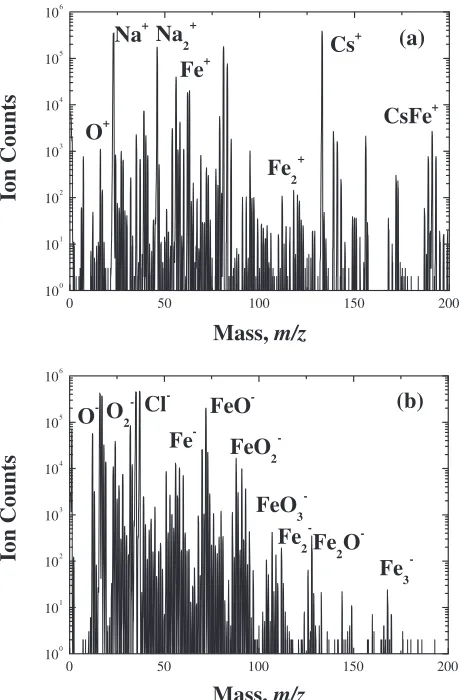
Figures 1(a) and (b) show wide mass spectra of positive ions and negative ions emitted from Sample F (pure iron), respectively. The mass spectra were measured after the sample was sputtered by about five micrometers in-depth, in order to remove contaminated and oxidized surface layer. However, the influence of oxygen and carbon on these mass spectra is detected, especially in the mass spectra of negative ions. Carbon relevant ions are likely to originate from carbon in the sample matrix, while oxygen relevant ions may be attributed to native oxides formed on the sample surface.
Native oxides are produced by exposure to air.5) Iron ions
(54Fe,56Fe and57Fe) and iron cluster ions (112Feþ
2,189CsFeþ)
are dominant in the mass spectra of positive ions, whereas
oxygen and carbon relevant ions are sensitive in the mass spectra of negative ions.
Figures 2(a) and (b) provide wide mass spectra of positive ions and negative ions from Sample H, which is mainly ferric
oxyhydroxides formed by reaction with H2O. It is noted that
counts of positive and negative ions from Sample H are much larger than those of Sample F, although measuring conditions in SIMS are almost constant. This phenomenon is attributed to the matrix effect, by which the production of secondary ions is varied, as observed in enhancement of secondary ions
from oxides.6) A large number of sodium ions are also
detected in these spectra, in addition to iron relevant ions observed in Sample F. The sodium ions originate from sodium chlorides in aqueous solution, which still remain on the sample surface after drying the sample. The large count of sodium ions means that the sensitivity of sodium is very high, since sodium is easily ionized. Large counts of sodium
cluster ions are also observed in 46Naþ, 81(Na
2Cl)þ and 82(Na
2Cl)þ in mass spectra of positive ions. On the other
hand, many iron relevant ions are detected in the mass spectra of negative ions. These ions are likely to be fragment ions from ferric oxyhydroxides, of which the structure is
composed of FeO6 octahedral units containing hydrogen.3)
Chlorine ions are also observed in the mass spectra of negative ions, since the electron affinity of chlorine ions is very large.
0 50 100 150 200
100 101
102
103
104 105 106
(a)
CsFe
+Cs
+Fe
2+
Fe
+Ion Counts
Mass,
m/z
0 50 100 150 200
100 101
102
103 104 105 106
(b)
Fe
3
-Fe
2
-FeO
2
-FeO
-Fe
-O
2
-C
2
-O
-C
-Ion Counts
Mass,
m/z
Fig. 1 Wide mass spectra of (a) positive ions and (b) negative ions from Sample F.
0 50 100 150 200
100 101 102 103
104
105
106
(a)
O
+Na
+Na
2 +
Fe
+Fe
2+
CsFe
+Cs
+Ion Counts
Mass,
m/z
0 50 100 150 200
100 101
102 103 104
105
106
(b)
Fe
3
-Fe
2
O
-Fe
2
-FeO
3
-FeO
2
-FeO
-Fe
-Cl
-O
2
-O
-Ion Counts
Mass,
m/z
[image:2.595.313.543.404.754.2] [image:2.595.52.293.404.757.2]Wide mass spectra of positive ions and negative ions from Sample D, consisting mainly of ferric oxyhydroxides formed
by reaction with D2O, are shown in Figs. 3(a) and (b),
respectively. Fundamental features of these mass spectra are similar to those for Sample H. Some differences are observed in counts of sodium and chlorine relevant ions between these two samples, but it may be attributed to differences of the amount of sodium chlorides and ferric oxyhydroxides on the sample surface. Significant difference between Sample H and Sample D is hardly observed in wide mass spectra, although different features will be found in a low mass range, as shown below.
3.2 Narrow mass spectra by SIMS
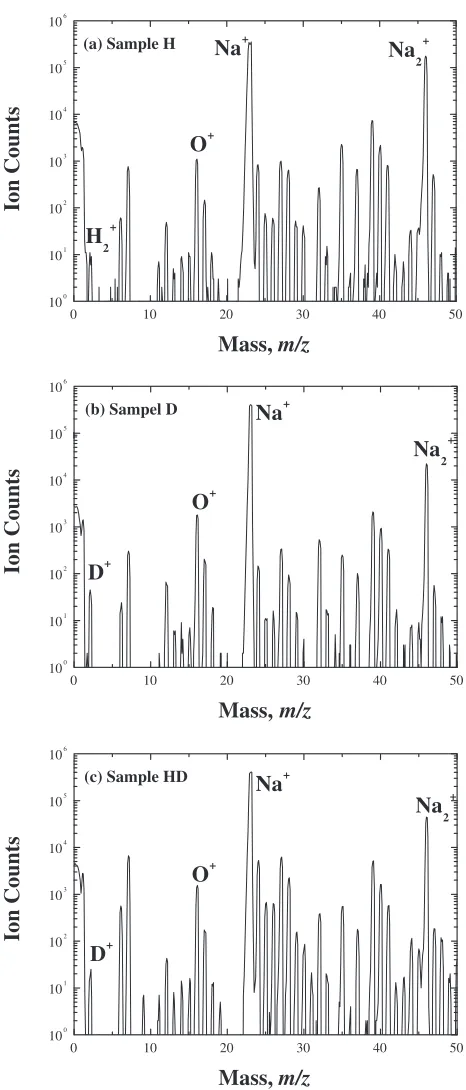
Figures 4(a), (b) and (c) show narrow mass spectra of positive ions form Sample H, Sample D and Sample HD, respectively. Absolute values of secondary ion counts are not likely to be compared among these data, since the amounts of ferric oxyhydroxides and sodium chlorides remaining on the sample surface are not constant in these samples. Therefore, the relative ion counts should be focused on finding a difference between mass spectra associated with hydrogen and deuterium. Ions of one in mass number may be attributed to residual hydrogen in the ultra-high vacuum analyzer and
adsorbed hydrocarbon5) as well as hydrogen in ferric
oxyhydroxides, and ions of two in mass number are
considered to include molecule ions of hydrogen and single ions of deuterium. The relative count of ions of two in mass number to those of one in mass number in Sample D is found to be higher than the in Sample H case. This suggests that hydrogen and deuterium are present in ferric oxyhydroxides formed on these sample surfaces. It is also interesting to note that the relative count of the ions in Sample HD corresponds just between Sample H and Sample HD, as shown in Fig. 4(c).
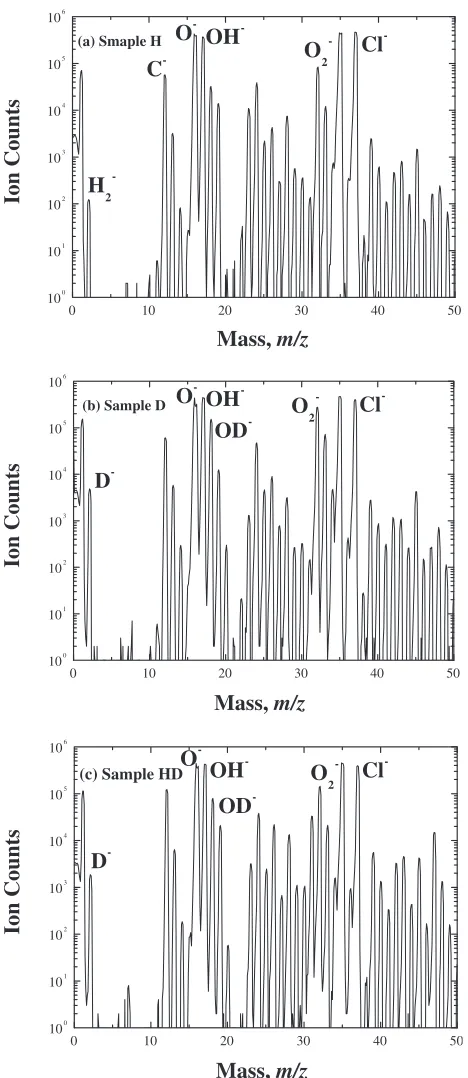
Similar differences are found in mass spectra of negative ions from Sample H, Sample D and Sample HD, as shown in
0 50 100 150 200
100 101 102 103
104
105
106
(b)
Fe
2O
-FeO
3
-FeO
2
-FeO
-Cl
-O
2
-O
-Fe
-Fe
2
-Fe
3
-Ion Counts
Mass,
m/z
0 50 100 150 200
100
101
102 103 104 105
106
(a)
Fe
2+
Cs
+Fe
+O
+Na
2 +
Na
+CsFe
+Ion Counts
Mass,
m/z
Fig. 3 Wide mass spectra of (a) positive ions and (b) negative ions from Sample D.
0 10 20 30 40 50
100 101 102 103 104
105
106
(b) Sampel D
D
+O
+Na
2 +
Na
+Ion Counts
Mass,
m/z
0 10 20 30 40 50
100
101
102
103
104
105
106
(a) Sample H
H
2 +
O
+Na
+Na
2 +
Ion Counts
Mass,
m/z
0 10 20 30 40 50
100 101
102
103
104 105 106
(c) Sample HD
D
+O
+Na
2 +
Na
+Ion Counts
Mass,
m/z
[image:3.595.311.544.67.612.2] [image:3.595.55.290.72.428.2]Figs. 5(a), (b) and (c). The relative count of negative ions of two in mass number to those of one in mass number one in Sample D is higher than that for Sample H. Moreover, the relative count of ions of twenty in mass number allocated to
ODto ions of nineteen in mass number attributed to OHin
Sample D is also higher that for Sample H. These results are also used to distinguish between hydrogen and deuterium, although some interference with one from the other is inclined in mass spectra.
3.3 Formation process of ferric oxyhydroxides
Figure 6 summarizes the ratio of counts of deuterium relevant ions to hydrogen relevant ions obtained from Sample H, Sample D and Sample HD. The ratios for Sample D and Sample HD are higher that that of Sample H, although the counts of deuterium relevant ions are less reliable in Sample
H because of an influence of H2. These results indicate that
D2O dropped in the second operation penetrates into ferric
oxyhydroxides formed in the first operation so as to react with the iron substrate, as illustrated in Fig. 7. Such ferric oxyhydroxides formed in the first operation are considered to
0 10 20 30 40 50
100 101 102 103
104
105
106
(c) Sample HD
D
-OH
-OD
-Cl
-O
2
-O
-Ion Counts
Mass,
m/z
0 10 20 30 40 50
100
101
102
103 104 105 106
(b) Sample D
D
-OH
-OD
-Cl
-O
2
-O
-Ion Counts
Mass,
m/z
0 10 20 30 40 50
100 101 102 103 104 105 106
(a) Smaple H
C
-OH
-H
2
-Cl
-O
2
-O
-Ion Counts
Mass,
m/z
Fig. 5 Narrow mass spectra of negative ions from (a) Sample H, (b) Sample D and (c) Sample HD.
10-4 10-3 10-2 10-1 100 101
D+/H+
D-/H
-OD-/OH
-Sample HD Sample D
Sample H
Ion Count Ratio
Fig. 6 Ratios of counts of deuterium relevant ions, which are Dþ, Dand
OD, and those of hydrogen relevant ions, which are Hþ, Hand OH,
for Sample H, Sample D and Sample HD.
FeOOH
FeOOH D2O+2%NaCl
FeOOD
FeOOH H2O+2%NaCl
(a)
(b)
(c)
(d)
[image:4.595.53.287.216.755.2] [image:4.595.314.540.230.393.2] [image:4.595.336.516.464.761.2]be, more or less, porous. It is also noted that the ratio for Sample HD are lower that of Sample D, indicating that the ferric oxyhydroxides formed in the first step operation influence the reaction in the second operation. Since ferric
oxyhydroxides can be dissolved in aqueous solution,7) the
ferric oxyhydroxides formed in the first operation are likely
to be dissolved into D2O supplied in the second operation.
Then, hydrogen is contained in the reaction front of the ferric oxyhydroxides formed in the second operation. These results provide information on an important factor for controlling a corrosion process of iron, such as the permeability or effective channel of water through ferric oxyhydroxides and the dissolution and precipitation of cations and anions in these processes. For instance, control of atomistic reaction in a surface layer is considered to be important in order to modify the formation or transformation of very fine ferric oxyhydroxides under cyclic reaction conditions.
Finally, let us discuss the origins of hydrogen and deuterium relevant ions in ferric oxyhydroxides form the SIMS measurements. These ions are formed during
sputter-ing the ferric oxyhydroxides by Csþbombardment. Since the
structure of the ferric oxyhydroxides can be described by the
network structure of FeO6 octahedral units containing
hydrogen,3,8) the bonding between Fe and O seems to be
relatively strong, as observed in fragment ions of Figs. 1, 2 and 3. This is a reason why hydrogen and deuterium relevant ions are mainly observed as single atom ions of hydrogen and
deuterium, and OH ions, which have a strong affinity with
electron. Corrosion products such as ferric oxyhydroxides are considered to originate from ferrous hydroxides, which are typically formed through the following reaction:
FeþO2þ2H2O!2Fe(OH)2: ð1Þ
The origin of hydrogen in corrosion products is water, in which hydrogen can be labeled by deuterium. On the other hand, oxygen in ferric oxyhydroxides comes from not only water but also dissolved oxygen in water. However, a fraction of such oxygen origins is hardly evaluated, and therefore labeling of oxygen may be less effective in analysis. Nevertheless, careful analysis of mass spectra suggests that
deuterium in D2O are used as tracers for studying the
formation and growth process of ferric oxyhydroxides, which may be well characterized when coupled with the application
of an oxygen isotope, for example18O.
4. Concluding Remarks
The feasibility of secondary ion mass spectrometry (SIMS) has been made for analyzing hydrogen and deuterium in ferric oxyhydroxides, which is formed by reaction of an iron
substrate with water; either H2O or D2O containing a small
amount of sodium chloride. Main concluding remarks drawn from this work are as follows:
(1) Deuterium in ferric oxyhydroxides can be discriminated
from the hydrogen case by using Dþ, Dand OD in
mass spectra obtained by SIMS.
(2) Mass spectra from an iron sample, which firstly reacted
with H2O and subsequently was dried and finally
reacted with D2O, indicate that D2O is considered to
reach a reaction front of the iron substrate through the ferric oxyhydroxides which are formed by reaction with
H2O.
(3) The usefulness of SIMS analysis using isotopes is recognized as a tool for characterizing formation process of ferric oxyhydroxides and permeability of foreign ions in the ferric oxyhydroxides.
Acknowledgements
The authors are grateful to Mr. T. Sato and Mr. M. Itoh for their help and maintenance of SIMS apparatus.
REFERENCES
1) P. Kofstad: ‘‘High Temperature Corrosion’’, (Elsevier Applied Science, London, 1988) p. 324–341.
2) S. Suzuki, K. Yanagihara, S. Hayashi and T. Mori: J. Surf. Anal. 5 (1999) 278–281.
3) S. Suzuki, T. Suzuki, M. Kimura, Y. Takagi, K. Shinoda, K. Tohji and Y. Waseda: Appl. Surf. Sci.169–200(2001) 109–116.
4) A. Delcorte and P. Bertrand: Inter. J. Mass Spectrometry184(1999) 217–231.
5) S. Suzuki, Y. Ishikawa, M. Isshiki and Y. Waseda: Mater. Trans., JIM38 (1997) 1004–1009.
6) P. Wiliams:Practical Surface Analysis, vol. 2-Ion and Neutral Spectro-scopy, D. Briggs and M. P. Seah (ed.), (John Wiley & Sons, Chichester, 1992) p. 177–228.
7) R. M. Corrnell and U. Schwertmann: The Iron Oxides, (VHC, Weinheim, 1996) p. 267–310.