From Grammar to Lexicon: Unsupervised
Learning of Lexical Syntax
M i c h a e l R. Brent* Johns Hopkins University
Imagine a language that is completely unfamiliar; the only means of studying it are an ordinary grammar book and a very large corpus of text. No dictionary is available. How can easily recog- nized, surface grammatical facts be used to extract from a corpus as much syntactic information as possible about individual words? This paper describes an approach based on two principles. First, rely on local morpho-syntactic cues to structure rather than trying to parse entire sentences. Second, treat these cues as probabilistic rather than absolute indicators of syntactic structure. Apply inferential statistics to the data collected using the cues, rather than drawing a categorical conclusion from a single occurrence of a cue. The effectiveness of this approach for inferring the syntactic frames of verbs is supported by experiments on an English corpus using a program called Lerner. Lerner starts out with no knowledge of content words--it bootstraps from determiners, auxiliaries, modals, prepositions, pronouns, complementizers, coordinating conjunctions, and punctuation.
1. I n t r o d u c t i o n
This paper presents a study in the automatic acquisition of lexical syntax from natu- rally occurring English text. It focuses on discovering the kinds of syntactic phrases that can be used to represent the semantic arguments of particular verbs. For example, want can take an infinitive argument and hope a tensed clause argument, but not vice versa:
(1) a. b. c. d.
John wants Mary to be happy. John hopes that Mary is happy. *John wants that Mary is happy. *John hopes Mary to be happy.
This study focuses on the ability of verbs to take arguments represented by infinitives, tensed clauses, and noun phrases serving as both direct and indirect objects. These lexical properties are similar to those that Chomsky (1965) termed subcategorization frames, but to avoid confusion the properties under study here will be referred to as
syntactic frames or simply frames.
The general framework for the problems addressed in this paper can be thought of as follows. Imagine a language that is completely unfamiliar; the only means of study- ing it are an ordinary grammar book and a very large corpus of text (or transcribed speech). No dictionary is available. H o w can easily recognized, surface grammatical
Computational Linguistics Volume 19, Number 2
facts be used to extract from a corpus as much syntactic information as possible about individual words?
The scenario outlined above is adopted in this paper as a framework for basic research in computational language acquisition. However, it is also an abstraction of the situation faced by engineers building natural language processing (NLP) systems for more familiar languages. The lexicon is a central component of NLP systems and it is widely agreed that current lexical resources are inadequate. Language engineers have access to some but not all of the grammar, and some but not all of the lexicon. The most easily formalized and most reliable grammatical facts tend to be those involving auxiliaries, rnodals, and determiners, the agreement and case properties of pronouns, and so on. These vary little from speaker to speaker, topic to topic, register to register. Unfortunately, this information is not sufficient to parse sentences completely, a fact that is underscored by the current state of the parsing art. If sentences cannot be parsed completely and reliably then the syntactic frames used in them cannot be determined reliably. How, then, can reliable, easily formalized grammatical information be used to extract syntactic facts about words from a corpus?
This paper suggests the following approach:
Do not try to parse sentences completely. Instead, rely on local
morpho-syntactic cues such as the following facts about English: (1) The word following a determiner is unlikely to be functioning as a verb; (2) The sequence that the typically indicates the beginning of a clause. Do not try to draw categorical conclusions about a word on the basis of one or a fixed number of examples. Instead, attempt to determine the distribution of exceptions to the expected correspondence between cues and syntactic frames. Use a statistical model to determine whether the cooccurrence of a verb with cues for a frame is too regular to be explained by randomly distributed exceptions.
The effectiveness of this approach for inferring the syntactic frames of verbs is sup- ported by experiments using an implementation called Lerner. In the spirit of the prob- lem stated above, Lerner starts out with no knowledge of content w o r d s - - i t bootstraps from determiners, auxiliaries, modals, prepositions, pronouns, complementizers, co- ordinating conjunctions, and punctuation. Lerner has two independent components corresponding to the two strategies listed above. The first component identities sen- tences where a particular verb is likely to be exhibiting a particular syntactic frame. It does this using local cues, such as the that the cue. This component keeps track of the number of times each verb appears with cues for each syntactic frame as well as the total number of times each verb occurs. This process can be described as collecting observations and its output as an observations table. A segment of an actual observa- tions table is shown in Table 4. The observations table serves as input to the statistical modeler, which ultimately decides whether the accumulated evidence that a particular verb manifests a particular syntactic frame in the input is reliable enough to warrant a conclusion.
Michael R. Brent From Grammar to Lexicon
either uses no a priori grammatical knowledge (Brill and Marcus 1992; Ellison 1991; Finch and Chater 1992; Pereira and Schabes 1992), or else it relies on a large and com- plex grammar (Hindle 1990, 1991). One exception is Magerman and Marcus (1991), in which a small grammar is used to aid learning. 1 A second difference is that the work reported here uses inferential rather than descriptive statistics. In other words, it uses statistical methods to infer facts about the language as it exists in the minds of those who produced the corpus. Many other projects have used statistics in a way that summarizes facts about the text but does not draw any explicit conclusions from them (Finch and Chater 1992; Hindle 1990). On the other hand, Hindle (1991) does use inferential statistics, and Brill (1992) recognizes the value of inference, although he does not use inferential statistics per se. Finally, m a n y other projects in machine learning of natural language use input that is annotated in some way, either with part-of-speech tags (Brill 1992; Brill and Marcus 1992; Magerman and Marcus 1990) or with syntactic brackets (Pereira and Schabes 1992).
The remainder of the paper is organized as follows. Section 2 describes the morpho- syntactic cues Lerner uses to collect observations. Section 3 presents the main contribu- tion of this paper--the statistical model and experiments supporting its effectiveness. Finally, Section 4 draws conclusions and lays out a research program in machine learn- ing of natural language.
2. Collecting Observations
This section describes the local morpho-syntactic cues that Lerner uses to identify likely examples of particular syntactic frames. These cues must address two problems: finding verbs in the input and identifying phrases that represent arguments to the verb. The next two subsections present cues for these tasks. The cues presented here are not intended to be the last word on local cues to structure in English; they are merely intended to illustrate the feasibility of such cues and demonstrate how the statistical model accommodates their probabilistic correspondence to the true syntactic structure of sentences. Variants of these cues are presented in Brent (1991a, 1991b). The final subsection summarizes the procedure for collecting observations and discusses a sample of the observations table collected from the Brown corpus.
2.1 Finding Verbs
Lerner identifies verbs in two stages, each carried out on a separate pass through the corpus. First, strings that sometimes occur as verbs are identified. Second, occurrences of those strings in context are judged as likely or unlikely to be verbal occurrences. The second stage is necessary because of lexical ambiguity.
The first stage uses the fact that all English verbs can occur both with and without the suffix
-ing.
Words are taken as potential verbs if and only if they display this alternation in the corpus. 2 There are a few words that meet this criterion but do not occur as verbs, including income~incoming (,incame/incomed), ear~earring, her~herring, andmiddle~middling. However, the second stage of verb detection, combined with the
statistical criteria, prevent these pairs from introducing errors.1 Brill and Marcus (1992) use a single grammatical rule in the test phase to supplement the rules their system learns, but no grammatical knowledge is used in the learning phase.
Computational Linguistics Volume 19, Number 2
Lerner assumes that a potential verb is functioning as a verb unless the context suggests otherwise. In particular, an occurrence of a potential verb is taken as a non- verbal occurrence only if it follows a determiner or a preposition other than to. For example, was talking would be taken as a verb, but a talk would not. This precaution reduces the likelihood that a singular count noun will be mistaken for a verb, since singular count nouns are frequently preceded by a determiner.
Finally, the only morphological forms that are used for learning syntactic frames are the stem form and the -ing form. There are several reasons for this. First, forms ending in -s are potentially ambiguous between third person singular present verbs and plural nouns. Since plural nouns are not necessarily preceded by determiners
(I like to take walks), they could pose a significant ambiguity problem. Second, past participles do not generally take direct objects: knows me and knew me are OK, but not • is known me. Further, the past tense and past participle forms of some verbs are identical, while those of others are distinct. As a result, using the -ed forms would have complicated the statistical model substantially. Since the availability of raw text is not generally a limiting factor, it makes sense to wait for the simpler cases.
2.2 Identifying Argument Phrases
When a putative occurrence of a verb is found, the next step is to identify the syntactic types of nearby phrases and determine whether or not they are likely to be arguments of the verb.
First, assume that a phrase P and a verb V have been identified in some sentence. Lerner's strategy for determining whether P is an argument to V has two components:
.
2.
If P is a noun phrase (NP), take it as an argument only if there is evidence that it is not the subject of another clause.
Regardless of P's category, take it as an argument only if it occurs to the right of V and there are no potential attachment points for P between V and P.
For example, suppose that the sequence that the were identified as the left boundary of a clause in the sentence I want to tell him that the idea won'tfly. Because pronouns like
him almost never take relative clauses, and because pronouns are known at the outset, Lerner concludes that the clause beginning with that the is probably an argument of the verb tell. 3 It is always possible that it could be an argument of the previous verb
want, but Lerner treats that as unlikely. On the other hand, if the sentence were I want to tell the boss that the idea won'tfly, then Lerner cannot determine whether the clause beginning with that the is an argument to tell or is instead related to boss, as in I want to fire the boss that the workers don't trust.
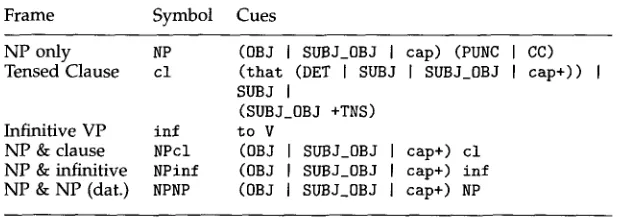
Now consider specific cues for identifying argument phrases. The phrase types for which data are reported here are noun phrases, infinitive verb phrases (VPs), and tensed clauses. These phrase types yield three syntactic frames with a single argument and three with two arguments, as shown in Table 1. The cues used for identifying these frames are shown in Tables 2 and 3. Table 2 defines lexical categories that are referred to in Table 3. The category V in Table 3 starts out empty and is filled as verbs are detected on the first pass. "cap" stands for any capitalized word and "cap+" for any sequence of capitalized words. These cues are applied by matching them against the string of words immediately to the right of each verb. For example, a verb V is
Michael R. Brent From G r a m m a r to Lexicon
Table 1
The six syntactic frames studied in this paper.
SF Description G o o d Example Bad Example
N P only greet them *arrive them tensed clause hope he'll attend *want he'll attend infinitive hope to attend *greet to attend N P & clause tell him he's a fool *yell him he's a fool NP & infinitive w a n t him to attend *hope him to attend NP & NP tell him the story *shout him the story
Table 2
Lexical categories used in the definitions of the cues.
SUBJ: I I he I she I we [ they OBJ: me [ him [ us [ them
SUBJ OBJ: you [ it [ yours [ hers [ ours [ theirs DET: a [ an [ the [ her [ hiS [ its [ my
[ our [ their [ your [ this [ that [ whose +TNS: has [ have[ had [ am [ is
[ are [ was [ were [ do [
does [ did [ can [ could [ may [ might [ must [ would
CC: when [ before [ after [ as [ while [ if
PUNC: [ ? [ ! [ , [ ; [ :
will [
Table 3
Cues for syntactic frames. The category V is initially e m p t y and is filled out d u r i n g the first pass. "cap" stands for any capitalized w o r d and "cap+" stands for any sequence of capitalized words.
Frame Symbol Cues
NP only NP (0BJ [ SUBJ_0BJ I cap) (PUNC i CC) Tensed Clause c l ( t h a t (DET ] SUBJ ] SUBJ_0BJ [ cap+))
SUBJ I
(SUBJ_0BJ +TNS) Infinitive VP i n f t o V
[image:5.468.84.361.119.223.2] [image:5.468.68.387.531.640.2]Computational Linguistics Volume 19, Number 2
Table 4
A sample of the data collected from the untagged Brown Corpus using the cues of Table 3.
V N P N P N P NPcl N P i n f cl inf V N P N P N P NPcl N P i n f cl inf
recall 42 3 4 recur 5
recede 5 r e d e e m 3
receive 106 4 redirect 2
reckon 10 rediscover 2
recognize 71 6 6 r e d u c e 85 2
r e c o m m e n d 32 2 1 reek 2
reconcile 5 reel 2
record 97 2 2 refer 43 1
r e c o u n t 5 refine 4
recover 14 4 1 reflect 41 1
recreate 2 refresh 4
recruit 11 refuel 3
refuse 22 1
recorded as having occurred with a direct object and no other argument phrase if V is followed by a pronoun of ambiguous case and then a coordinating conjunction, as
in I'll see y o u w h e n you return from Mexico. The coordinating conjunction makes it unlikely that the pronoun is the subject of another clause, as in I see you like champagne.
It also makes it unlikely that the verb has an additional NP argument, as in I'II tell you my secret recipe.
2.3 Summary and Sample Data
To summarize, the procedure for collecting observations from a corpus is as follows:
1. Go through the corpus once finding pairs of words such that one is the result of adding the suffix -ing to the other, applying appropriate morphological adjustment rules. List members of such pairs as verbs. 2. Go through the corpus again. At each word w that is on the list of verbs,
(a) If w is not preceded by a preposition or a determiner, increment the number of times that w appears as a verb.
(b) If any of the cues listed in Table 3 match the words immediately following w, increment the number of times that w appears to occur in the corresponding frame.
3. Combine the data for the stem form and the -ing form.
Michael R. Brent From Grammar to Lexicon
Table 5
Judgments based on the observations in Table 4, made by the method of Section 3.
recall NP, cl recognize NP, cl
recover NP
refuse inf
The cues are fairly rare, so v e r b s in Table 4 that occur f e w e r t h a n 15 times t e n d not to occur w i t h these cues at all. Further, these cues occur fairly often in structures other t h a n those t h e y are d e s i g n e d to detect. For e x a m p l e , record, recover, a n d refer all o c c u r r e d w i t h cues for a n infinitive, a l t h o u g h n o n e of t h e m in fact takes a n infinitive a r g u m e n t . The sentences responsible for these e r r o n e o u s o b s e r v a t i o n s are:
(2) (a)
(b)
(c)
(d)
But I shall c a m p a i g n on the M e y n e r r e c o r d to m e e t the n e e d s of the y e a r s ahead.
S p o s a t o n e e d e d a front, s o m e labor stiff w i t h a clean r e c o r d to act as b u s i n e s s a g e n t of the R e d h o o k local.
T h e n last s e a s o n the Birds t u m b l e d as l o w as 11-18 o n M a y 19 before r e c o v e r i n g to m a k e a race of it a n d total 86 victories. But I s u s p e c t that the old R o m a n w a s r e f e r r i n g to c h a n g e m a d e u n d e r m i l i t a r y o c c u p a t i o n - - t h e sort of c h a n g e w h i c h Tacitus w a s talking a b o u t w h e n . . . .
In (2a,b) record occurs as a n o u n . In (2c) recover is a v e r b b u t the infinitive VP, to make a race of it . . . . d o e s n o t a p p e a r to be a n a r g u m e n t . In a n y case, it d o e s n o t b e a r the s a m e relation to the v e r b as the infinitive a r g u m e n t s of v e r b s like try, want, hope, ask, a n d
refuse. In (2d) refer is a v e r b b u t to change is a PP r a t h e r t h a n a n infinitive.
The r e m a i n d e r of this p a p e r describes a n d e v a l u a t e s a m e t h o d for m a k i n g judg- m e n t s a b o u t the ability of v e r b s to a p p e a r in p a r t i c u l a r syntactic f r a m e s on the basis of n o i s y d a t a like that of Table 4. G i v e n the d a t a in Table 4, that m e t h o d yields the j u d g m e n t s in Table 5.
3. Statistical M o d e l i n g
As n o t e d above, the c o r r e s p o n d e n c e b e t w e e n syntactic structure a n d the cues that Lerner uses is n o t perfect. M i s m a t c h e s b e t w e e n cue a n d structure are p r o b l e m a t i c b e c a u s e n a t u r a l l y occurring l a n g u a g e p r o v i d e s n o n e g a t i v e evidence. If a V v e r b is f o l l o w e d b y a cue for s o m e syntactic f r a m e S, that p r o v i d e s e v i d e n c e that V does occur in f r a m e S, b u t there is n o a n a l o g o u s source of e v i d e n c e that V does not occur in f r a m e S.
Computational Linguistics Volume 19, Number 2
p r o v i d e d b y the cues will e v e n t u a l l y be w a s h e d out b y the noise. This p r o b l e m is inherent in learning from naturally occurring language, since infallible parsing is not possible. The only w a y to p r e v e n t it is to consider the f r e q u e n c y w i t h w h i c h each verb occurs with cues for each frame. In other w o r d s , to consider each occurrence of
V without a cue for S as a small bit of evidence against V b e i n g able to occur in frame S. This section describes a statistical technique for w e i g h i n g such evidence.
G i v e n a syntactic f r a m e S, the statistical m o d e l treats each verb V as analogous to a biased coin a n d each occurrence of V as analogous to a flip of that coin. A n occurrence that is followed b y a cue for S c o r r e s p o n d s to one o u t c o m e of the coin flip, say heads; an occurrence w i t h o u t a cue for S c o r r e s p o n d s to tails. 4 If the cues w e r e perfect predictors of syntactic structure t h e n a verb V that does not in fact occur in frame S w o u l d n e v e r a p p e a r w i t h cues for S - - t h e coin w o u l d n e v e r c o m e u p heads. Since the cues are not perfect, such verbs d o occur w i t h cues for S. The p r o b l e m is to d e t e r m i n e w h e n a v e r b occurs with cues for S often e n o u g h that all those occurrences are unlikely to be errors.
In the following discussion, a verb that in fact occurs in f r a m e S in the i n p u t is described as a +S verb; one that does not is described as a - S verb. The statistical m o d e l is b a s e d on the following approximation: for fixed S, all - S v e r b s h a v e equal probability of being followed b y a cue for S. Let ~r-s stand for that probability. ~r-s m a y v a r y from f r a m e to frame, b u t not from verb to verb. Thus, errors m i g h t be m o r e c o m m o n for tensed clauses than for NPs, b u t the w o r k i n g h y p o t h e s i s is that all intransitives, such as saunter a n d arrive, are a b o u t equally likely to be followed b y a cue for an N P argument. If the error probability ~r-s w e r e k n o w n , then w e could use the s t a n d a r d h y p o t h e s i s testing m e t h o d for binomial f r e q u e n c y data. For example, s u p p o s e 7r-s = . 0 5 - - o n average, one in t w e n t y occurrences of a - S verb is f o l l o w e d b y a cue for S. If some v e r b V occurs 200 times in the corpus, a n d 20 of those occurrences are followed b y cues for S, that o u g h t to suggest that V is unlikely to h a v e probability .05 of b e i n g followed b y a cue for S, a n d hence V is unlikely to be - S . Specifically, the chance of flipping 20 or m o r e h e a d s out of 200 tosses of a coin with a five p e r c e n t chance of c o m i n g u p h e a d s each time is less t h a n three in 1000. O n the other h a n d , it is not all that u n u s u a l to flip 2 or m o r e h e a d s out of 20 on such a c o i n - - i t h a p p e n s a b o u t one time in four. If a verb occurs 20 times in the c o r p u s a n d 2 of those occurrences are followed b y cues for S, it is quite possible that V is - S a n d that the 2 occurrences w i t h cues for S are explained b y the five p e r c e n t error rate on - S verbs.
The next section reviews the hypothesis-testing m e t h o d a n d gives the formulas for c o m p u t i n g the probabilities of various o u t c o m e s of coin tosses, g i v e n the coin's bias. It also p r o v i d e s empirical e v i d e n c e that, for some values of 7r_s, hypothesis-testing does a g o o d job of distinguishing +S verbs from - S verbs that occur w i t h cues for S because of m i s m a t c h e s b e t w e e n cue a n d structure. The following section p r o p o s e s a m e t h o d for estimating ~r-s a n d p r o v i d e s empirical e v i d e n c e that its estimates are n e a r l y optimal.
3.1 Hypothesis Testing
The statistical c o m p o n e n t of L e r n e r is d e s i g n e d to p r e v e n t the i n f o r m a t i o n p r o v i d e d b y the cues f r o m b e i n g w a s h e d out b y the noise. The basic a p p r o a c h is h y p o t h e s i s testing o n binomial f r e q u e n c y data (Kalbfleisch 1985). Specifically, a v e r b V is s h o w n to
Michael R. Brent From Grammar to Lexicon
be +S b y a s s u m i n g that it is - S a n d then s h o w i n g that if this w e r e true, the o b s e r v e d p a t t e r n of cooccurrence of V with cues for S w o u l d be e x t r e m e l y unlikely.
3.1.1 Binomial Frequency Data. In o r d e r to use the h y p o t h e s i s testing m e t h o d w e n e e d to estimate the probability ~r-s that an occurrence of a verb V will be followed b y a cue for S if V is - S . In this section it is a s s u m e d that 7r_s is k n o w n . The next section suggests a m e a n s of estimating Tr_s. In b o t h sections it is also a s s u m e d that for each +S verb, V, the probability that V will be followed b y a cue for S is greater than 7r_s. O t h e r than that, n o a s s u m p t i o n s are m a d e a b o u t the probability that a +S verb will be followed b y a cue for S. For example, t w o verbs with transitive senses, such as
cut a n d walk, m a y h a v e quite different frequencies of cooccurrence with cues for NP. It does not m a t t e r w h a t these frequencies are as long as they are greater than lr_Np.
If a coin has probability p of flipping heads, a n d if it is flipped n times, the prob- ability of its c o m i n g u p h e a d s exactly m times is given b y the binomial distribution:
n~
P(m,n,p) - m!(n - m)! pm(1 - p)n-m (1)
The probability of c o m i n g u p h e a d s m or more times is given b y the obvious sum:
n
P(m+, n, p) = ~ P(i, n, p) (2)
i=m
Analogously, P(m+, n, ~r-s) gives the probability that m or m o r e occurrences of a - S verb V will be followed b y a cue for S out of n occurrences total.
If m out of n occurrences of V are followed b y cues for S, a n d if P(m+, n, ~r-s)
is quite small, t h e n it is unlikely that V is - S . Traditionally, a threshold less than or equal to .05 is set such that a h y p o t h e s i s is rejected if, a s s u m i n g the h y p o t h e s i s w e r e true, the probability of o u t c o m e s as extreme as the o b s e r v e d o u t c o m e w o u l d be b e l o w the threshold. The confidence attached to this conclusion increases as the threshold decreases.
3.1.2 E x p e r i m e n t . The e x p e r i m e n t p r e s e n t e d in this section is a i m e d at d e t e r m i n i n g h o w well the m e t h o d p r e s e n t e d a b o v e can distinguish +S verbs from - S verbs. Let
p-s be an estimate of 7r_s. It is conceivable that P(m+,n,p-s) m i g h t n o t be a g o o d predictor of w h e t h e r or not a verb is +S, regardless of the estimate p-s. For example, if the c o r r e s p o n d e n c e b e t w e e n the cues a n d the structures they are designed to detect w e r e quite weak, then m a n y - S v e r b s m i g h t h a v e l o w e r P(m+,n,p-s) than m a n y +S verbs. This e x p e r i m e n t measures the accuracy of binomial h y p o t h e s i s testing on the data collected b y L e r n e r ' s cues as a function of p-s. In addition to s h o w i n g that
P(m+, n, P-s) is g o o d for distinguishing +S a n d - S verbs, these data p r o v i d e a baseline against w h i c h to c o m p a r e m e t h o d s for estimating the error rate 7r_s.
Method The cues described in Section 2 w e r e applied to the B r o w n C o r p u s (un- tagged version). Equation 2 was applied to the resulting data w i t h a cutoff of
Computational Linguistics Volume 19, Number 2
Table 6
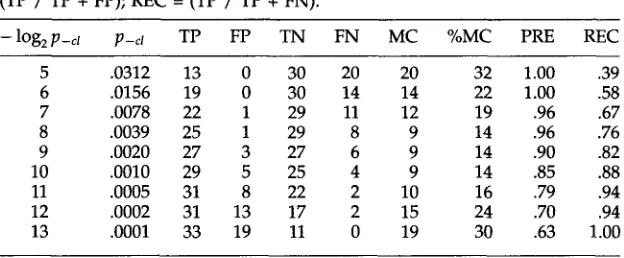
Comparison of automatic classification to hand judgments for tensed-clause complement as a function of estimated error rate p (Brown Corpus). PRE = (TP / TP + FP); REC = (TP / TP + FN).
- log2
p-ct
p-c1
TP FP TN FN MC %MC PRE REC5 .0312 13 0 30 20 20 32 1.00 .39
6 .0156 19 0 30 14 14 22 1.00 .58
7 .0078 22 1 29 11 12 19 .96 .67
8 .0039 25 1 29 8 9 14 .96 .76
9 .0020 27 3 27 6 9 14 .90 .82
10 .0010 29 5 25 4 9 14 .85 .88
11 .0005 31 8 22 2 10 16 .79 .94
12 .0002 31 13 17 2 15 24 .70 .94
13 .0001 33 19 11 0 19 30 .63 1.00
n o verb is i n c l u d e d m o r e t h a n once. Each v e r b was scored for a g i v e n f r a m e only if it cooccurs w i t h a cue for that f r a m e at least once. Thus, a l t h o u g h 193 verbs w e r e r a n d o m l y selected f r o m the c o r p u s for scoring, only the 63 that cooccur w i t h a cue for tensed clause at least once w e r e scored for the tensed-clause frame. This p r o c e d u r e m a k e s it possible to evaluate the hypothesis-testing m e t h o d o n data collected b y the cues, rather than evaluating the cues p e r se. It also m a k e s the j u d g m e n t task m u c h e a s i e r - - i t is not necessary to d e t e r m i n e w h e t h e r a verb can a p p e a r in a f r a m e in prin- ciple, only w h e t h e r it does so in particular sentences. There were, however, five cases w h e r e the j u d g m e n t s w e r e unclear. These five w e r e not scored. See A p p e n d i x C for details.
Results
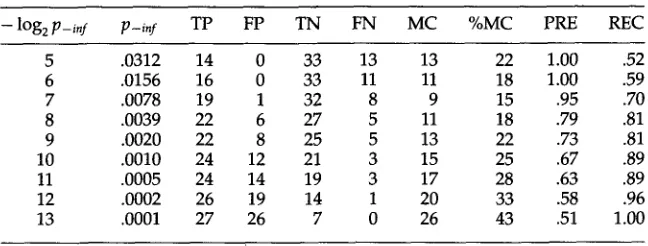
The results of these c o m p a r i s o n s are s u m m a r i z e d in Table 6 (tensed clause) a n d Table 7 (infinitive). Each r o w s h o w s the p e r f o r m a n c e of the hypothesis-testing p r o c e d u r e for a different estimate P-s of the error-rate 7r_s. The first c o l u m n s h o w s the negative logarithm ofP-s,
w h i c h is v a r i e d f r o m 5 (1 error in 32 occurrences) to 13 (1 error in 8192 occurrences). The second c o l u m n s h o w s P-s in decimal notation. The next four c o l u m n s s h o w the n u m b e r oftrue positives
( T P ) - - v e r b s j u d g e d +S b o t h b y m a c h i n e a n d b y h a n d ;false positives
( F P ) - - v e r b s j u d g e d +S b y machine, - S b y h a n d ; true negatives ( T N ) - - v e r b s j u d g e d - S b o t h b y m a c h i n e a n d b y h a n d ; a n d false negatives ( F N ) - - v e r b s j u d g e d - S b y machine, +S b y h a n d . The n u m b e r s represent distinct verbs, n o t occurrences. The s e v e n t h c o l u m n s h o w s the n u m b e r of v e r b s that w e r emisclassified
( M C ) - - t h e s u m of false positives a n d false negatives. The eighth c o l u m n shows thepercentage
of v e r b s that w e r emisclassified
(%MC). The next-to-last c o l u m n s h o w s theprecision
( P R E ) - - t h e true positives d i v i d e d b y all verbs that L e r n e r j u d g e d to be +S. The final c o l u m n shows therecall
(REC)--the true positives d i v i d e d b y all v e r b s that w e r e j u d g e d +S b y hand. [image:10.468.83.395.100.229.2]Michael R. Brent From Grammar to Lexicon
Table 7
Comparison of automatic classification to hand judgments for infinitive complement, as a function of estimated error rate p (Brown Corpus).
- log 2 p-i,/ p-i,f TP FP TN FN MC %MC PRE REC
5 .0312 14 0 33 13 13 22 1.00 .52
6 .0156 16 0 33 11 11 18 1.00 .59
7 .0078 19 1 32 8 9 15 .95 .70
8 .0039 22 6 27 5 11 18 .79 .81
9 .0020 22 8 25 5 13 22 .73 .81
10 .0010 24 12 21 3 15 25 .67 .89
11 .0005 24 14 19 3 17 28 .63 .89
12 .0002 26 19 14 1 20 33 .58 .96
13 .0001 27 26 7 0 26 43 .51 1.00
3.2 E s t i m a t i n g t h e Error Rate
As before, a s s u m e that an occurrence of a - S v e r b is f o l l o w e d b y a cue for S w i t h p r o b a b i l i t y 7r_s. Also as before, a s s u m e that for each + S v e r b V, the p r o b a b i l i t y that an occurrence of V is f o l l o w e d b y a cue for S is g r e a t e r t h a n 7r_s.
It is useful to think of the v e r b s in the c o r p u s as a n a l o g o u s to a large b a g of coins w i t h v a r i o u s biases, or probabilities of c o m i n g u p heads. The o n l y a s s u m p t i o n a b o u t the distribution of biases is that there is s o m e definite b u t u n k n o w n m i n i m u m bias 7r_s. 5 D e t e r m i n i n g w h e t h e r or n o t a v e r b a p p e a r s in f r a m e S is a n a l o g o u s to d e t e r m i n i n g , for s o m e r a n d o m l y selected coin, w h e t h e r its bias is greater t h a n ~r-s. The o n l y available e v i d e n c e c o m e s f r o m selecting a n u m b e r of coins at r a n d o m a n d flipping them. The p r e v i o u s section s h o w e d h o w this can be d o n e g i v e n a n estimate of ~r-s.
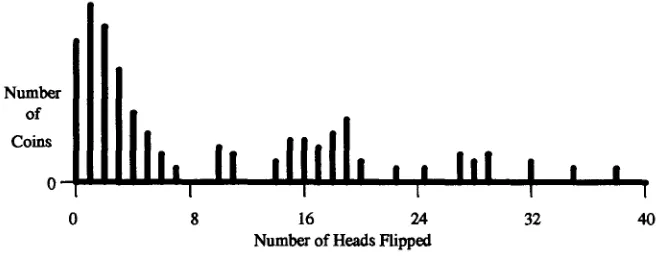
S u p p o s e a series of coins is d r a w n at r a n d o m f r o m the bag. Each coin is f l i p p e d N times. It is t h e n a s s i g n e d to a h i s t o g r a m bin r e p r e s e n t i n g the n u m b e r of times it c a m e u p heads. At the e n d of this s a m p l i n g p r o c e d u r e b i n i contains the n u m b e r of coins that c a m e u p h e a d s exactly i times o u t of N. Such a h i s t o g r a m is s h o w n in Figure 1, w h e r e N = 40. If N is large e n o u g h a n d e n o u g h coins are f l i p p e d N times, o n e w o u l d expect the following:
1. The coins w h o s e p r o b a b i l i t y of t u r n i n g u p h e a d s is ~r-s (the m i n i m u m ) s h o u l d cluster at the l o w - h e a d s e n d of the h i s t o g r a m . T h a t is, there s h o u l d be s o m e 0 __G j0 _< N such that m o s t of the coins that t u r n u p j0 h e a d s or f e w e r h a v e p r o b a b i l i t y 7r_s, and, conversely, m o s t coins w i t h p r o b a b i l i t y ~r-s t u r n u p j0 h e a d s or fewer.
2. S u p p o s e j0 w e r e k n o w n . T h e n the p o r t i o n of the h i s t o g r a m b e l o w j0 s h o u l d h a v e a r o u g h l y b i n o m i a l shape. In Figure 1, for e x a m p l e , the first eight bins h a v e r o u g h l y the s h a p e one w o u l d expect if j0 w e r e 8. In contrast, the first 16 bins d o n o t h a v e the s h a p e o n e w o u l d expect if j0
[image:11.468.67.391.98.221.2]Computational Linguistics Volume 19, Number 2
Number of Coins
0
0 8 16 24 32 40
Number of Heads Hipped
Figure 1
A histogram illustrating a binomially shaped distribution in the first eight bins.
.
were 16---their height drops to zero for two stretches before rising significantly above zero again. Specifically, the height of the i th histogram bin should be roughly proportional to
P(i, N, P-s),
w i t h N the fixed sample size a n d P-s an estimate of 7r_s.Suppose again that j0 were known. Then the average rate at which the coins in bins j0 or lower flip heads is a good estimate of ~r-s.
The estimation procedure tries out each bin as a possible estimate of j0. Each estimate of j0 leads to an estimate of ~r-s a n d hence to an expected shape for the first j0 histogram bins. Each estimate j of j0 is evaluated b y comparing the predicted distribution in the first j bins to the observed distribution--the better the fit, the better the estimate.
Moving from coins to verbs, the procedure works as follows. For some fixed N, consider the first N occurrences of each verb that occurs at least N times in the input. (A u n i f o r m sample size N is n e e d e d only for estimating 7r-s. Given an estimate of 7r-s, verbs w i t h a n y n u m b e r of occurrences can be classified.) Let S be some syntactic frame a n d let
H[i]
be the n u m b e r of distinct verbs that were followed b y cues for S exactly i times out of N--i.e., the height of the ith histogram bin. A s s u m e that there is some 1 ~ j0 _< N such that most - S verbs are followed b y cues for S j0 times or fewer, a n d conversely most verbs that are followed b y cues for S j0 times or fewer are - S verbs. For each possible estimate j of j0 there is a corresponding estimate of 7r_s; namely, the average rate at which verbs in the first j bins are followed b y cues for S. Choosing the most plausible estimate of 7r_s thus comes d o w n to choosing the most plausible estimate of j0, the b o u n d a r y b e t w e e n the - S verbs a n d the rest of the histogram. To evaluate the plausibility of each possible estimate j of j0, measure the fit b e t w e e n the predicted distribution of - S verbs, assuming j is the b o u n d a r y of the - S cluster, a n d the observed distribution of the - S verbs, also assuming j is the b o u n d a r y of the - S cluster. Given j, letp-s
stand for the average rate at which verbs in bins j or lower are followed b y cues for S. The predicted distribution for - S verbs is proportional toP(i,N,p-s)
for 0 < i < N. The observed distribution of - S verbs, assuming j is the [image:12.468.74.403.51.181.2]Michael R. Brent From G r a m m a r to Lexicon
Table 8
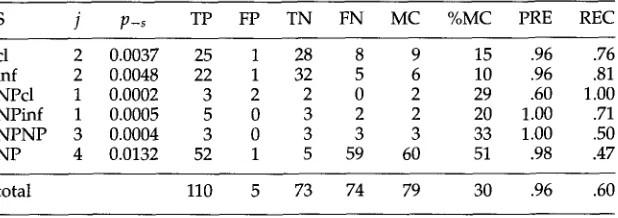
C o m p a r i s o n of automatic classification using the Brown Corpus to h a n d judgments. The estimate p-s is m a d e with N = 100. The probability threshold is .02.
S j p - s TP FP TN F N MC %MC PRE REC
cl 2 0.0037 25 1 28 8 9 15 .96 .76
inf 2 0.0048 22 1 32 5 6 10 .96 .81
NPcl 1 0.0002 3 2 2 0 2 29 .60 1.00
NPinf 1 0.0005 5 0 3 2 2 20 1.00 .71
N P N P 3 0.0004 3 0 3 3 3 33 1.00 .50
NP 4 0.0132 52 1 5 59 60 51 .98 .47
total 110 5 73 74 79 30 .96 .60
I n p s e u d o - c o d e , t h e p r o c e d u r e is a s f o l l o w s :
ESTIMATE-P(H [], N)
area := H[0], rain-sum-of-squares := oo, best-estimate := I;
Try each value of j from 1 to N as an estimate of jo
for
j
from I tO Np-s : = 0
a r e a : = a r e a + H ~ ]
f o r i f r o m 0 t o j
Normalize the - S bins to area 1. H[i]
H'[i] := a r e a
Estimate ~r-s by the average cooccurrence rate for the first j bins--those presumed to hold - S verbs P-s := p-s + (-~ , H'[i])
Check the fit, assuming j is the :kS boundary
sum-of-squares := 0
for i from 0 to N
Compute the predicted distribution/or bin i N! ~i /1
P := ~ H - s ~ - P - s ) N-i
Verbs in the first bins j and below are presumed - S
if i<_j
t h e n n o r m a l i z e d - o b s e r v e d := H'[i] e l s e n o r m a l i z e d - o b s e r v e d := 0
s u m - o f - s q u a r e s := s u m - o f - s q u a r e s + ( n o r m a l i z e d - o b s e r v e d -- p)2 Choose the p-s yielding the best~it
if sum-of-squares < min-sum-of-squares
then rain-sum-of-squares := sum-of-squares
best-estimate := P-s
return best-estimate
[image:13.468.77.386.111.220.2]Computational Linguistics Volume 19, Number 2
the results for each of the six frames. Varying N between 50 and 150 results in no significant change in the estimated error rates.
One way to judge the value of the estimation and hypothesis-testing methods is to examine the false positives. Three of the five false positives result from errors in verb detection that are not distributed uniformly across verbs. In particular,
shock, board,
andnear
are used more often as nonverbs than as verbs. This creates m a n y opportunities for nonverbal occurrences of these words to be mistaken for verbal occurrences. Other verbs, likeknow,
are unambiguous and thus are not subject to this type of error. As a result, these errors violate the model's assumption that errors are distributed uniformly across verbs and highlight the limitations of the model. The remaining false positives weretouch
andbelong,
both mistaken as taking an NP followed by a tensed clause. Thetouch
error was caused by the capitalization of the first word of a line of poetry:I knew not what did to a friend
belong
Till I
stood up, true friend, by thy true side;Till
was mistaken for a proper name. Thebelong
error was caused by mistaking a matrix clause for an argument in:With the blue flesh of night
touching him he
stood under a gentle hill caressing the flageolet with his lips, making it whisper.It seems likely that such input would be much rarer in more m u n d a n e sources of text, such as newspapers of record, than in the diverse Brown Corpus.
The results for infinitives and clauses can also be judged by comparison to the optimal classifications rates from Tables 6 and 7. In both cases the classification appears to be right in the optimal range. In fact, the estimated error rate for infinitives produces a better classification than any of those shown in Table 7. (It falls at a value between those shown.) The classification of clauses and infinitives remains in the optimal range when the probability threshold is varied from .01 to .05.
Overall the tradeoff between improved precision and reduced recall seems quite good, as compared to doing no noise reduction
(P-s
= 0). The only possible excep- tion is the NP frame, where noise reduction causes 59 false negatives in exchange for preventing only 5 false positives. This is partly explained by the different prior probabilities of the different frames. Most verbs can take a direct object argument, whereas most verbs cannot take a direct object argument followed by a tensed clause argument. There is no way to know this in advance. There m a y be other factors as well. If the error rate for the NP cues is substantially lower than 1 out of 100, then it cannot be estimated accurately with sample size N = 100. On the other hand, if the sample size N is increased substantially there m a y not be enough verbs that occur N times or more in the corpus. So a larger corpus might improve the recall rate forNP.
4. General D i s c u s s i o n
Michael R. Brent From Grammar to Lexicon
lexical syntactic i n f o r m a t i o n can be r e c o v e r e d using a few a p p r o x i m a t e cues along with statistical inference based on a simple m o d e l of the cues' error distributions.
4.1 Other Syntactic Frames
The lexical e n t r y of a verb can specify other syntactic frames in addition to the six studied here. In particular, m a n y v e r b s take prepositional phrases (PPs) h e a d e d b y a particular p r e p o s i t i o n or class of prepositions. For example, put requires a location as a second a r g u m e n t , a n d locations are often r e p r e s e n t e d b y PPs h e a d e d b y locative prepositions.
Extending L e r n e r to detect PPs is trivial. Since the set of prepositions in the lan- guage is essentially fixed, all prepositions can be i n c l u d e d in the initial lexicon. De- tecting a PP requires n o t h i n g m o r e than detecting a preposition. 6 The statistical m o d e l can, of course, be a p p l i e d w i t h o u t modification.
The problem, however, is d e t e r m i n i n g w h i c h PPs are a r g u m e n t s a n d w h i c h are adjuncts. There are clearly cases w h e r e a prepositional p h r a s e can occur in a clause not b y virtue of the lexical e n t r y of the verb b u t rather b y virtue of nonlexical facts of English syntax. For instance, almost a n y verb can occur w i t h a t e m p o r a l PP h e a d e d b y on, as in John arrived on Monday. Such PPs are called adjuncts. On the other h a n d , the sense of on in John sprayed water on the ceiling is quite different. This sense, it can be argued, is available only because the lexical e n t r y of spray specifies a location a r g u m e n t that can be realized as a PP. If a n y t h i n g significant is to be learned a b o u t individual words, the nonspecific cooccurrences of verbs with PPs (adjuncts) m u s t be separated from the specific ones (arguments). It is not clear h o w a m a c h i n e learning system could do this, a l t h o u g h f r e q u e n c y m i g h t p r o v i d e some clue. Worse, however, there are m a n y cases in w h i c h e v e n trained linguists lack clear intuitions. Despite a n u m b e r of attempts to f o r m u l a t e necessary and sufficient conditions for the a r g u m e n t / a d j u n c t distinction (e.g., Jackendoff 1977), there are m a n y cases for w h i c h the various criteria do not agree or the j u d g m e n t s are unclear (Adams a n d Macfarland 1991). Thus, the P e n n Treebank does not m a k e the a r g u m e n t / a d j u n c t distinction because their j u d g e s d o not agree often enough. Until a useful definition that trained h u m a n s can agree o n is d e v e l o p e d , it w o u l d seem fruitless to a t t e m p t m a c h i n e learning e x p e r i m e n t s in this domain.
4.2 Limitations of the Statistical Model
A l t h o u g h the results of this s t u d y are generally encouraging, they also p o i n t to some limitations of the statistical m o d e l p r e s e n t e d here. First, it does not take into account variation in the p e r c e n t a g e of verbs that can a p p e a r in each frame. For example, m o s t verbs can take an N P argument, while v e r y few can take an N P followed b y a tensed clause. This results in too few verbs being classified as +NP a n d too m a n y being clas- sified as +NPcl, as s h o w n in Table 8. Second, it does not take into account the fact that for some w o r d s w i t h verbal senses m o s t of their occurrences are verbal, w h e r e a s for others m o s t of their occurrences are nonverbal. For example, operate occurs ex- clusively as a verb while board occurs m u c h m o r e often as a n o u n t h a n as a verb. Since the cues are b a s e d on the a s s u m p t i o n that the w o r d in question is a verb, board
presents m a n y m o r e o p p o r t u n i t i e s for error than operate. This violates the a s s u m p - tion that the probability of error for a given frame is a p p r o x i m a t e l y u n i f o r m across verbs.
Computational Linguistics Volume 19, Number 2
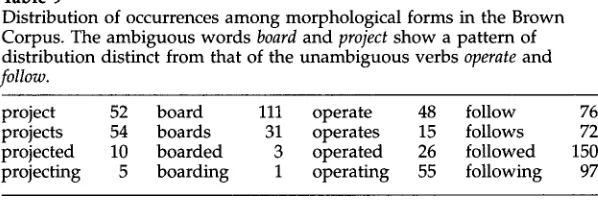
Table 9
Distribution of occurrences among morphological forms in the Brown Corpus. The ambiguous words
board
andproject
show a pattern of distribution distinct from that of the unambiguous verbsoperate
andfollow.
project 52 board 111 operate 48 follow 76
projects 54 boards 31 operates 15 follows 72
projected 10 boarded 3 operated 26 followed 150
projecting 5 boarding 1 operating 55 following 97
These limitations do not constitute a major impediment to applications of the cur- rent results. For example, an applied system can be provided with the rough estimates that 80-95 percent of verbs take a direct object, while 1-2 percent take a direct object followed by a tensed clause. Such estimates can be expected to reduce misclassifica- tion significantly. Further, an existing dictionary could be used to "train" a statistical model on familiar verbs. A trained system would probably be more accurate in clas- sifying new verbs. Finally, the lexical ambiguity problem could probably be reduced substantially in the applied context by using a statistical tagging program (Brill 1992; Church 1988).
For addressing basic questions in machine learning of natural language the solu- tions outlined above are not attractive. All of those solutions provide the learner with additional specific knowledge of English, whereas the goal for the machine learning effort should be to replace specific knowledge with general knowledge about the types of regularities to be found in natural language.
There is one approach to the lexical ambiguity problem that does not require giving the learner additional specific knowledge. The problem is as follows: words that occur frequently as, say, nouns are likely to have a different error rate from unambiguous verbs. If it were known which words occur primarily as verbs and which occur primarily as nouns then separate error rate estimates could be made for each. This would reduce the rate of false positive errors even without any further information about which
particular
occurrences are nominal and which are verbal. One w a y to distinguish primarily nominal words from primarily verbal words is by the relative frequencies of their various inflected forms. For example, Table 9 shows the contrast in the distribution of inflected forms betweenproject
andboard
on the one hand andoperate
andfollow
on the other.Project
andboard
are two words whose frequent occurrence as nouns has caused Lerner to make false positive errors. In both cases, the stem and -s forms are much more common than the-ed
and-ing
forms. Compare this to the distribution for the unambiguous verbsoperate and follow.
In these cases the diversity of frequencies is much lower and does not display the characteristic pattern of a word that occurs primarily as a n o u n - --ing
and-ed
forms that are much rarer than the -s and stem forms. Similar characteristic patterns exist for words that occur primarily as adjectives. Recognizing such ambiguity patterns automatically would allow a separate error rate to be estimated for the highly ambiguous words.4.3 Future W o r k
[image:16.468.86.385.70.170.2]Michael R. Brent From Grammar to Lexicon
phological adjustment rules according to which, for example, the final "e" of bite is deleted when the suffix -ing is added, yielding biting rather than ,"biteing." Lerner needs to know such rules in order to determine whether or not a given word occurs both with and without the suffix -ing. Experiments are under way on an unsupervised procedure that learns such rules from English text, given only the list of English verbal suffixes. This work is being extended further in the direction of discovering the mor- phemic suffixes themselves and discovering the ways in which these suffixes alternate in paradigms. The short-term goal is to develop algorithms that can learn the rules of inflection in English starting from only a corpus and a general notion of the nature of morphological regularities.
Ultimately, this line of inquiry m a y lead to algorithms that can learn much of the grammar of a language starting with only a corpus and a general theory of the kinds of formal regularities to be found in natural languages. Some elements of syntax may not be learnable in this way (Lightfoot 1991), but the lexicon, morphology, and phonology together make up a substantial portion of the grammar of a language. If it does not prove possible to learn these aspects of grammar starting from a general ontology of linguistic regularities and using distributional analysis then that, too, is an interesting result. It would suggest that the task requires a more substantive initial theory of possible grammars, or some semantic information about input sentences, or both. In any case this line of inquiry promises to shed light on the nature of language, learning, and language learning.
References
Adams, L., and Macfarland, T. (1991). "Testing for adjuncts." In Proceedings, Second Annual Meeting of the Formal Linguistics Society of Midamerica. Formal Linguistics Society of Midamerica. Brent, M. R. (1991a). Automatic acquisition of
subcategorization frames from unrestricted English. Doctoral dissertation,
Massachusetts Institute of Technology, Cambridge MA.
Brent, M. R. (1991b). "Automatic acquisition of subcategorization frames from
untagged text." In Proceedings, 29th Annual Meeting of the ACL. 209-214.
Brill, E. (1992). "A simple rule-based part of speech tagger." In Darpa Workshop on Speech and Natural Language. Harriman. Brill, E., and Marcus, M. (1992).
"Automatically acquiring phrase structure using distributional analysis." In Darpa Workshop on Speech and Natural Language.
Harriman.
Chomsky, N. (1965). Aspects of the Theory of Syntax. MIT Press.
Church, K. (1988). "A stochastic parts program and noun phrase parser for unrestricted text." In Proceedings, Second ACL Conference on Applied NLP.
Ellison, T. M. (1991). "Discovering planar segregations." In AAAI Spring Symposium on Machine Learning of Natural Language and Ontology.
Finch, S., and Chater, N. (1992).
"Bootstrapping syntactic categories using statistical methods." In Background and Experiments in Machine Learning of Natural Language: Proceedings of the 1st SHOE
Workshop. Katholieke Universiteit, Brabant, Holland.
Hindle, D. (1990). "Noun classification from predicate argument structures." In
Proceedings, 28th Annual Meeting of the ACL.
268-275.
Hindle, D. (1991). "Structural ambiguity and lexical relations." In Proceedings, 29th Annual Meeting of the ACL. 229-236. Jackendoff, R. (1977). X-bar Syntax: A Study
of Phrase Structure. Volume 2 of Linguistic Inquiry Monograph. MIT Press.
Kalbfleisch, J. G. (1985). Probability and Statistical Inference, Volume 2, Second Edition. Springer-Verlag.
Karttunen, L. (1983). "KIMMO: A general morphological processor." Texas Linguistics Forum, 22(22), 165-186.
Karttunen, L., and Wittenburg, K. (1983). "A two-level morphological analysis of English." Texas Linguistics Forum, 22(22), 217-223.
Lightfoot, D. W. (1991). How to Set Parameters. MIT Press.
Computational Linguistics Volume 19, Number 2
Magerman, D., and Marcus, M. (1991). "Distituent parsing and grammar induction." In AAAI Spring Symposium on Machine Learning of Natural Language and Ontology.
Pereira, F., and Schabes, Y. (1992). "Inside- outside reestimation from partially bracketed corpora." In Proceedings, 30th Annual Meeting of the Association for Computational Linguistics.
Appendix A: Test Words
The experiments described above used the following 193 verbs, selected at r a n d o m from the tagged version of the Brown Corpus. Forms of be and have were excluded, as were modal verbs such as must and should.
abandon account acquire act add announce anticipate appear arch ask attempt attend attest avoid bear believe belong bend board boil bring bristle brush build buzz call cap cast choose choreograph close come concern conclude consider contain convert culminate cut deal decrease defend delegate deliver denounce deny depend design determine develop die dine discourage dispatch disunite drink duplicate eliminate emerge end enter equate erect execute exist expect extend face fail fall feed feel fight figure find fly follow get give glow guide hear help hijack hire hope impart impede improve include increase indicate inform instruct inure issue keep learn let live look make mean measure meet mine miss mount mourn near offer open oppose organize own pardon pickle plan play plead prefer prepare present prevent progress project provide question quote range reappear receive recommend remember remind repeat report request resign retire return save say season seat see seem serve set settle shift ship shock sign sing speak spend spice sponsor stand start stay study succeed suffer suggest support surprise swept take talk tell term terminate think touch treat tremble trust try turn understand unite unload use visit weep wheel wipe wish wonder work write
Appendix B: Complete Output
Of the 193 verbs listed above, Lerner detects 174 in the untagged version of the Brown Corpus. Of these 174, there are 87 for which Lerner does not find sufficient evidence to prove that they have any of the six syntactic frames in question. Some of these genuinely do not appear in the corpus with cues for any of the six, while others do appear with cues, but not often enough to provide reliable evidence. Given more text, sufficient evidence might eventually accumulate for m a n y of these verbs.
The 87 that were detected but not assigned any frames are as follows:
account act anticipate arch attend bear bend boil bristle brush buzz cast close contain convert culminate deal decrease delegate deliver depend design de- termine develop dine discourage dispatch drink emerge end equate erect exist extend fall figure fly glow hire increase instruct issue live look measure mine miss mount mourn open oppose organize own present prevent progress project question quote range reappear receive recommend repeat report retire return season seat settle ship sign sing speak spend sponsor stand stay succeed suffer talk term terminate tremble turn weep wheel
M i c h a e l R. B r e n t F r o m G r a m m a r to L e x i c o n
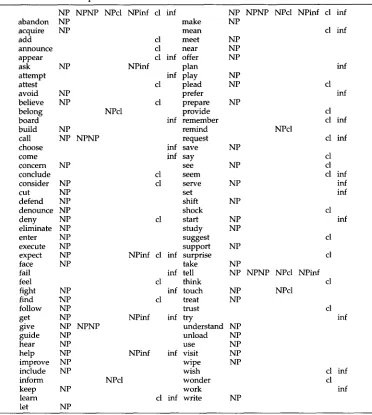
Table 10
T h e l e x i c o n t h a t L e r n e r p r o d u c e s w h e n r e s t r i c t e d to t h e 193 t e s t v e r b s .
NP NPNP NPcl NPinf cl inf
abandon NP make
acquire NP mean
add cl meet NP
announce cl near NP
appear cl inf offer NP
ask NP NPinf plan
attempt inf play NP
attest cl plead NP
avoid NP prefer
believe NP cl prepare NP
belong NPcl provide
board inf remember
build NP remind
call NP NPNP request
choose inf save NP
come inf say
concern NP see NP
conclude cl seem
consider NP cl serve NP
cut NP set
defend NP shift NP
denounce NP shock
deny NP cl start NP
eliminate NP study NP
enter NP suggest
execute NP support NP
expect NP NPinf cl inf surprise
face NP take NP
fail inf tell NP
feel cl think
fight NP inf touch NP
find N P cl treat NP
follow NP trust
get NP NPinf inf try
give NP NPNP understand NP
guide NP unload NP
hear NP use NP
help NP NPinf inf visit NP
improve NP wipe NP
include NP wish
inform NPcl wonder
keep NP work
learn cl inf write NP
let NP
NP NPNP NPcl NPinf cl inf NP
cl inf
NPcl
NPNP NPcl NPinf
NPcl
inf
cl inf
cl cl inf
cl inf
cl cl cl inf
inf inf cl inf cl cl inf
cl inf cl
inf
w h o s e s y m b o l s a p p e a r in its row. For e a s y reference b y frame, all the s y m b o l s for a g i v e n f r a m e are aligned in one c o l u m n .
Appendix C: Difficult Judgments
[image:19.468.49.421.83.498.2]Computational Linguistics Volume 19, Number 2
Provide with a tensed clause
Provided a n d providing, w h e n they occur w i t h o u t auxiliaries, clearly take a tensed clause, as in (3a).
. a.
b.
Squat-style lifters a n d leg-split lifters w o u l d b o t h benefit e n o r m o u s l y b y practicing those variations providing that they remember to m a k e alternate sets w i t h the left a n d right leg to the front.
There m u s t be a restriction in the d e e d to provide that the customer may not be charged m o r e t h a n the c u r r e n t m a r k e t price for the oil,
Provided a n d providing do not a p p e a r to be functioning as verbs w h e n t h e y take a t e n s e d clause. Tensed forms of provide do not take a t e n s e d clause, as in , " S h e { p r o v i d e d , provides} that he h a v e e n o u g h to live on." H o w e v e r , the infinitive f o r m of provide in
(3b) is clearly functioning as a verb. The best generalization of these observations is unclear.
Act w i t h an infinitive
(4) "E. B." c o m p a r e d John B r o w n to Moses in that they w e r e b o t h acting to deliver millions f r o m oppression.
In (4), it is not clear w h e t h e r the infinitive is an a r g u m e n t , as it w o u l d be in " t h e y w e r e b o t h t r y i n g to deliver . . . , " or a p u r p o s e adjunct, as in " t h e y w e r e b o t h b r e a k i n g the law to deliver . . . . "
Live w i t h an infinitive
Live o c c u r r e d twice in the expression live to see a n d once in the expression live to hear.
If this expression w e r e c o m p l e t e l y fixed, then its p r o p e r t i e s s h o u l d not be c o n s i d e r e d p r o p e r t i e s of the verb live. H o w e v e r , the infinitive can be a n y p e r c e p t i o n v e r b a n d possibly a few others. The expression is limited, b u t n o t frozen, so the a p p r o p r i a t e conclusion is unclear.
Work w i t h a single N P
Work takes a direct object in the sense m e a n i n g f o r m or mold. The cues d o not detect this sense of work in the corpus, b u t they d o find it followed b y adverbial N P s such as " e v e r y d a y " a n d in the expression work their will.
Give w i t h a single N P