A Column Generation Approach to
Scheduling of Real-Time Networks
Ernst Althaus, Sebastian Hoffmann, Joschka Kupilas, and Eike Thaden
Abstract—We present an algorithm based on column gen-eration for the real-time scheduling problem of allocating periodic tasks to electronic control units in multiple subsystems connected by a global bus.
The allocation has to ensure that tasks can be scheduled, and messages between tasks in different subsystems can be transmitted over the global bus and meet their deadlines. Also tasks and messages occurring in a task chain must be scheduled in a way such that the sequence of execution meets their end-to-end deadline.
We show that our approach computes the optimal allocation in our model and due to the column generation approach early provides lower bounds on the optimal value.
Index Terms—scheduling, real-time-networks, column-generation, task-chain, end-to-end-deadline.
I. INTRODUCTION
I
N this paper we look at the scheduling problem arisingin the f eld of manufacturing embedded systems. We are given a hardware architecture with a global bus system, e.g. a FlexRay bus, connecting several processing subsystemsS={s1, s2, . . . , sk}. Each electronic control unit (ECU) in a
subsystem can be of a specif c ECU type{et1, et2, . . . , etℓ},
see Figure 1.
Besides a set T = {t1, t2, . . . , tn} of tasks specif ed by
their worst-case execution time (WCET), deadline, period, and memory consumption, where the WCET and memory consumption depend on the ECU type, we are given a set
M ={m1, m2, . . . , mv} of messages specif ed by a single
source task, a set of destination tasks, a transmission time, and a deadline, see Figure 4. The scheduling problem arises in allocating every task to a specif c ECU in a subsystem such that every message regarding this task can be transmitted over the global bus and both tasks and messages meet their deadlines in every periodic cycle.
We assume that tasks and messages arrive with a f xed rate given as their period, which is greater than or equal to their deadline – the period of a message is determined by the source task – and that we are given deadline monotonic
Manuscript received July 18, 2012; revised August 9, 2012.
This work was partly supported by the German Research Council (DFG) as part of the Transregional Collaborative Research Center “Automatic Verif cation and Analysis of Complex Systems” (SFB/TR 14 AVACS, www.avacs.org).
Ernst Althaus is with the Max-Planck-Institut f¨ur Informatik, Saarbr¨ucken, Germany and the Institut f¨ur Informatik, Johannes Gutenberg-Universit¨at, Mainz, Germany (e-mail: [email protected]; [email protected]).
Sebastian Hoffmann is with the Institut f¨ur Informatik, Johannes Gutenberg-Universit¨at, Mainz, Germany (e-mail: [email protected]).
Joschka Kupilas is with the Max-Planck-Institut f¨ur Informatik, Saarbr¨ucken, Germany (e-mail: [email protected]).
Eike Thaden is with the Department f¨ur Informatik, Carl von Ossietzky-Universit¨at, Oldenburg, Germany (e-mail: [email protected]).
priorities, which was proven to be optimal in our setting [1]. Each task can only be assigned to one ECU and each ECU can execute exactly one task at a time by using preemptive f xed-priority scheduling. Furthermore, the WCET and mem-ory consumption of a task depend on the chosen ECU type of the ECU the task is allocated to. We call a schedule feasible if every task is entirely executed before its deadline.
We present two suff cient models to determine the feasi-bility of a schedule: f rst, the computation of the f rst idle time per ECU by Lehoczky et al. [2] and second, by the computation of the worst-case response time (WCRT) by the well-known f x-point equation by Joseph and Pandya [3].
There are three common bus systems that can be consid-ered for the communication: a token area network (TAN) bus, a controller area network (CAN) bus or a FlexRay bus. We assume that the message communication in every ECU and subsystem is guaranteed and specif c gateway ECUs are not necessary. We model a global FlexRay bus so that a message has to be sent over the FlexRay if at least one of the destination tasks is allocated to a different subsystem than the source task.
The problem at hand is of major importance in several industrial sectors, e.g. in aerospace, automotive, and automa-tion industries, as it can save a lot of costs by optimally allocating tasks that have to be def nitely executed.
In this paper we formulate the problem as an integer linear program (ILP) and solve it by a column generation approach within a branch and bound framework. We extend the ap-proach of Althaus et al. [4] by integrating the subsystems to the formulation, accelerating the computation if no response times are necessary, handling task chains with their end-to-end deadlines and modeling a global FlexRay bus.
II. PREVIOUSWORK
The complete design f ow from specif cation models to their distributed execution on hierarchical architectures with different approaches of pre-allocating tasks is described in B¨ucker et al. [5] and Clark et al. [6] whose repetitive two-tier approach f rst heuristically distributes the tasks to sub-systems, and second, exactly solves the scheduling problem in every subsystem.
ECU1
ARM3 ARM7 ECU1
ECU2
ARM3 ARM7 ECU2
ECU3
PPC ARM3 ECU3
(ECU4)
Subsystem 1
ECU1
ARM3 ARM7 ECU1
ECU2
ARM3 ARM7 ECU2
(ECU3)
ECU4
PPC ARM3 ECU4
Subsystem 2
ECU1
ARM3 ARM7 ECU1
(ECU2)
ECU3
ARM3 ARM7 ECU3
(ECU4)
Subsystem 3 FlexRay
FlexRay
Fig. 1. A hardware network with three subsystems connected by a global FlexRay bus via the specif c gateway ECUs in each subsystem. Upgrading the ECUs increases the cost that has to be minimized.
III. A COLUMNGENERATIONAPPROACH FOR THE
SCHEDULINGMODEL
In this section we describe our column generation ap-proach for solving the previously def ned scheduling problem by presenting an ILP formulation following Althaus et al. [4]. Given a set S ={s1, s2, . . . , sk} of subsystems, we call
a subsetp⊆T of tasks atask patternfor subsystems∈S
if all tasks in p can be scheduled in the subsystem s and
we denote by Ps⊆ P(T)the set of all task patterns for s,
wherePdenotes the power set. Associated with eachp∈Ps
in the ILP formulation we introduce a binary variableXs,p
indicating whether the task patternpis used for the schedule
in subsystem sor not.
The objective function (1) is to minimize the sum of costs cost(s, p) resulting from the choice of ECU types in each subsystem s needed to execute the allocated task pattern p. We impose two requirements for the task patterns: f rst,
exactly one task pattern is used in a subsystem (2), and second, each task has to be assigned to exactly one subsystem (3).
Similarly to the set of task patternsPswe def ne the set of message patterns Q⊆ P(M)whereq ∈Q if all messages
in q can be transmitted over the global bus with respect to
some bus protocol. We likewise introduce a binary decision variableZqfor everyq∈Qwith the requirement that exactly
one message pattern must be chosen (6).
Furthermore, we introduce binary variables Ym for every
messagem∈M indicating whether the messagemis sent
over the global bus. Therefore, Ym is 0 if and only if all
destination tasks mB ⊆ T of message m are in the same
subsystem as the source task ma ∈T (4). We also have to
ensure that the chosen message pattern contains all messages that have to be transmitted over the bus (5).
Thus, our scheduling problem can be formulated as the following ILP:
min X
s∈S
X
p∈Ps
cost(s, p)·Xs,p (1)
s.t. X
p∈Ps
Xs,p= 1 ∀s∈S (2)
X
s∈S
X
p∈Ps:t∈p
Xs,p= 1 ∀t∈T (3)
−Ym+
X
s∈S
X
p∈Ps
:
ma∈p∧mB\p6=∅
Xs,p= 0 ∀m∈M (4)
−Ym+
X
q∈Q:m∈q
Zq≥0 ∀m∈M (5)
X
q∈Q
Zq= 1 (6)
Xs,p∈ {0,1} ∀s∈S, p∈Ps (7)
Zq∈ {0,1} ∀q∈Q (8)
Ym∈ {0,1} ∀m∈M (9)
Applying a branch and bound approach, we get bounds from solving the LP relaxations of the ILPs occurring in the branching process. Since the pattern variables arise in exponential number, we use a column generation approach to solve the LP relaxations, see Figure 2.
The remainder of Section III is organized as follows. In Section III-A we expand on the LP relaxation. In Sec-tion III-B we explain the branch and bound algorithm. In Section III-C we present the models to scheduling periodic real-time tasks. In Section III-D we show how to handle task chains with end-to-end deadlines. In Section III-E we expand on the FlexRay bus for the global communication.
A. Solving the Relaxation
We relax the integrality constraints (7) of the task patterns
Xs,p ∈ R and add the lower bounds Xs,p ≥ 0 since the
upper boundsXs,p≤1are implied by the constraints (2).
To state the so-called master problem, we make the problem artif cially feasible by introducing asuper subsystem
˜
[image:2.595.70.541.53.249.2]P˜s = {T}. The feasibility of the original problem can
be decided by inspecting the objective value or the new pattern variableXs,T˜ , because we assign a cost higher than every optimal solution to it. To satisfy the message pattern constraint (6) we introduce an arbitrary message pattern, e.g. the empty message patternZ∅∈Q, where no message has to
be sent over the global bus. The constructed master problem is feasible by default with
Z∅=X˜s,T =Xs,∅= 1 and Ym= 0
for alls∈Sandm∈M with the objective valuecost(˜s, T). The master problem is solved with a state-of-the-art sim-plex method and the so-called pricing problems are solved to check if non-basic variables Xs,p or Zq with negative
[image:3.595.308.544.57.177.2]reduced cost can be produced. In this case, the solution of the master problem is not optimal for the original problem – apart from degeneracies – and we have to add the variable to the master problem by generating a new column. This step is repeated until there are no more non-basic variables with negative reduced cost and the last solution to the master problem is also optimal for the original problem, see Figure 2.
The structure of the problem allows us to partition the search for new variables into several independent pricing problems, namely into thetask pricing problems, the search for a variableXs,p with the most negative reduced cost for
a given subsystems(10), and the message pricing problem, the search for a variableZq with the most negative reduced
cost (15).
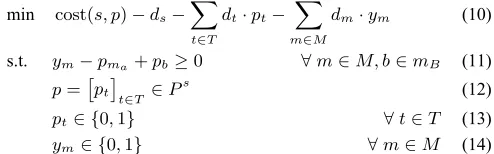
First, we generate the task pricing problem for a given subsystem s. By writingds fors∈S for the dual variables
corresponding to the subsystem constraints (2),dtfort∈T
corresponding to the task constraints (3), and dm for m ∈
M corresponding to the message constraints (4) the pricing
problem for a givens∈S reads as follows:
min cost(s, p)−ds−
X
t∈T
dt·pt−
X
m∈M
dm·ym (10)
s.t. ym−pma+pb≥0 ∀m∈M, b∈mB (11)
p=
pt t∈T∈P
s
(12)
pt∈ {0,1} ∀t∈T (13)
ym∈ {0,1} ∀m∈M (14)
with binary variables pt indicating whether task t is
rep-resented in the task pattern p, and ym indicating whether
messagemhas to be sent over the global bus. Notice that the
constraints (11) for a given message m= (ma, mB)∈ M
force ym to be 1, if the source task ma is assigned to this
subsystem and one of the destination tasksb∈mB is not.
Similarly, we generate the pricing problem for the message pattern by writingd′mfor the dual variable corresponding to
the message constraints (5), and dQ corresponding to the
message pattern constraint (6) to obtain
min − X
m∈M
d′m·qm−dQ (15)
s.t. q=qm
m∈M ∈Q (16)
qm∈ {0,1} ∀m∈M (17)
Column Generation Master Problem initial problem
Pricing Problems
du
al
va
ria
bl
es
Negative reduced cost?
Ye
s
new column
Integer?
No Ye
s
Optimal integer solution
N
o
Optimal fractional solution
Bound / Overall optimum
[image:3.595.46.293.488.565.2]branching
Fig. 2. Our column generation approach inside a branch and bound framework. Computed optimal integer solutions can be used as bounds in the master problems to prune the search tree and reduce the running time.
with binary variables qm indicating whether message m is
transmitted over the global bus.
The constraint (12) has to express the schedulability of the tasks in a subsystem, see Section III-C, as well as the constraint (16) has to ensure the global message transmission due to the different bus types, see Section III-E.
B. Branch and Bound
By solving the LP relaxation we obtain a lower bound on the optimal objective value of the ILP. If the cost of this solution is not smaller than the best integral solution found so far, we can stop. Otherwise, we branch by identifying a fractional assigned task to more than one subsystem and generate two branches: f rst, we predeploy this task to the specif c subsystem, and second, we forbid this task to run in this subsystem. The process sequence of the branches is given by a priority queue in the order of the smallest lower bound f rst.
We achieve a big improvement in the runtime if we reuse columns as starting solutions that do not contradict the branching rule. To interrupt the process of solving pricing problems early we use the Lagrangian bound of Althaus et al. [4] in case that the current objective value cannot be further improved. Additionally, we trade on the integrality of the objective function by rounding up the lower bounds.
C. Scheduling Periodic Tasks
We are given taskst∈T with WCETct, deadlinedt, and
periodπtsatisfyingct≤dt≤πt. Eisenbrand et al. [7] state
a necessary and suff cient schedulability test by computing the exact WCRTs of the tasks with an ILP formulation and bound them by the specif c deadlines due to the well-known recursive equation from Joseph and Pandya [3].
In the special case of implicit deadlines, i.e.dt=πt, the
DMS policy equals the rate monotonic scheduling (RMS) policy which is therefore also optimal under all FPS policies. In the given case of non-implicit deadlines, i.e. dt≤πt,
the deadline monotonic scheduling (DMS) policy, i.e. the priority is inversely proportional to its deadline, is proven to be optimal under all f xed priority scheduling (FPS) policies, see Burns and Wellings [8].
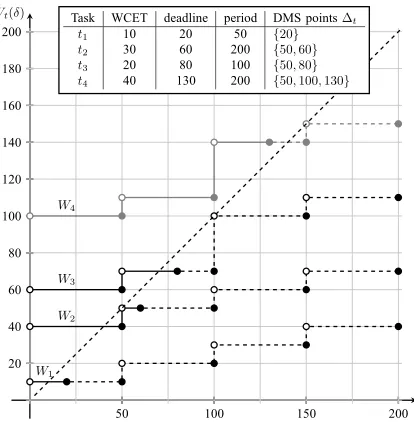
δ
50 100 150 200
Wt(δ)
20 40 60 80 100 120 140 160 180 200
W1 W2 W3 W4
Task WCET deadline period DMS points∆t t1 10 20 50 {20} t2 30 60 200 {50,60} t3 20 80 100 {50,80} t4 40 130 200 {50,100,130}
Fig. 3. Cumulative workload demand functionWt(δ)for some tasks in the
interval[0, δ]. It is obvious that (19) has to be checked only in the deadline
monotonic scheduling points ∆t for a schedulability analysis to see that
taskt4 cannot be added if the other three tasks are assigned.
necessary and suff cient scheduling test without computing the WCRTs which can also be stated as linear constraints.
The fact that the WCET and memory consumption depend on the chosen ECU type of the ECU the task is assigned to leads to high complexity for the occurring ILPs. To present the concept of Lehoczky et al. we ignore the latter dependencies and assume that there is only one ECU of a f xed ECU type.
For a given task t ∈ T we compute the cumulative workload demandson the ECU over an interval[0, δ], where 0 is a critical instant for the set{t′|t′ ∈hep(t)}, and where hep(t)denotes all tasks with priority higher than or equal to t, i.e.dt′ ≤dt, by
Wt(δ) = X
t′∈hep(t)
ct′·
δ πt′
. (18)
Lehoczky et al. [2] show that the entire task set can be scheduled if
max
t∈T δmin∈∆t X
t′∈hep(t)
ct′
δ ·
δ πt′
≤1 (19)
with the so-called deadline monotonic scheduling points
∆t={dt} ∪ {k·πt′ ≤dt|t′ ∈hep(t), k∈N} (20)
for task t, see Figure 3. To replace (12) in the task pricing
problem we express (19) by the following constraints (21) and (22):
−Mt·αδ,t+ X
t′∈hep(t)
ct′
δ ·
δ πt′
·pt′ ≤1 (21)
with binary variablesαδ,t∈ {0,1} for allt∈T andδ∈∆t
withMtsuff ciently big. The constraints X
δ∈∆t
αδ,t≤ |∆t| −1 ∀t∈T (22)
ensure that there has to be at least one pointδ∈∆twhere
it is not necessary to subtractMtfrom the demand to satisfy
(19), resp. (21).
t1 t2 t3 t4
t5 t6
(t2,
{t3, t 5})
(t3,
{t4, t 6}) (t1, t2)
(t5, t6) 120 ms
85 ms
Fig. 4. A network with two simple linear task chains and their end-to-end deadlines.
t1 t1
m1 m1 m1 m1 m1
t2 t2 t2
rt
1 πm1 rm1 πt2 rt2
Fig. 5. An example of the worst-case end-to-end latency occurring in the transmission of a message m1 = (t1, t2)over the global bus. Task t1
misses the f rst instance of messagem1, and the second instance ofm1
f nishes shortly after the start of task t2. The down arrows indicate the
activation times, the up arrows the WCRTs of tasks and messages.
D. End-to-end Deadlines for Task Chains
A task chain c ⊆ T is a set of related tasks with their
corresponding messages that has to be executed within a time restriction of an end-to-end deadline. We restrict to the case of simple linear task chains, i.e. |mB ∩c| ≤ 1 for every
messagemwithma∈c, which can always be obtained from
more complex ones, see Figure 4. In addition, we assume that every message between tasks in a task chain has to be considered in the end-to-end deadline.
Since tasks of a chain can be distributed over several subsystems, the upcoming messages have to be transmitted over the global bus and therefore the computation of the worst-case end-to-end latency has to take into account the WCRT of all involved tasks and global messages in the chain as well as the periods of the source and destination tasks of the messages. It is necessary to include the periods of the corresponding global messagesπm, i.e. the periods of their
source tasks, and their destination tasks, because in the worst case the source task misses the f rst instance of a message transmission, and the second instance arrives immediately after the start of a destination task, thus will not be read until the next instance of this task, as depicted in Figure 5.
According to the model of Zhu et al. [10] we expand the master problem (1) by
X
s∈S X
p∈Ps : t∈p∩c
rt,p·Xs,p+ X
m∈q: ma∈c∧
mB∈c
πm·Ym
+X
q∈Q X
m∈q: ma∈c∧
mB∈c
(rm,q+πmB)·Zq ≤dc (23)
for all task chainsc∈C, whereCdenotes the set of all task
chains, and their corresponding end-to-end deadlinesdc.
[image:4.595.71.278.52.263.2] [image:4.595.351.512.56.139.2] [image:4.595.311.547.180.244.2]TABLE I
RESULTS OF THE DIFFERENT APPROACHES.
without task chains with task chains scheduling model f rst LB best LB f rst LB best LB memory 24 1.0s 30 3.4s 28 5.3s 30 29.6s + slot control 24 0.6s 30 2.6s 28 4.8s 30 24.1s + FlexRay bus 24 0.9s 30 3.1s 28 4.9s 30 24.2s
heuristic 30 0.2s 30 0.2s
optimal value 30 30
E. The Global FlexRay Bus
There are three common bus systems that can be consid-ered for the global communication: f rst, a token area network (TAN) bus, in which a token is given to the subsystems in a round-robin fashion and the gateway ECU holding the token can send over the bus as discussed by Althaus et al. [4]. Second, a controller area network (CAN) bus, in which the messages gain a priority for a non-preemptive transmission by Davis et al. [11]. Third, a FlexRay bus consisting of a deterministic static segment resembling a time-division multiplexing access (TDMA) fashion, which is analyzed by Lukasiewycz [12], and a CAN bus-like dynamic segment, which we neglect as it is non-deterministic.
In a f rst underapproximation model we only ensure that the number of static slots is suff cient for every message transmitted unaccompanied by extension of the message pricing problem (15). For the FlexRay bus we highly abstract and assume that every slot is suff ciently dimensioned, and that multiplexing is not used. Then we compute a lower bound on the signal’s response timermin a straightforward
manner by bounding it with the maximum time distance between allocated slots for this message.
The local transmission within a subsystem and within the ECUs is neglected in both implemented approaches.
IV. PROOF-OF-CONCEPTEXPERIMENT A. Setting
As an example, we use a synthetic architecture of two subsystems with at most three ECUs of two different ECU types of cost 10 and 40 in each subsystem, and two copies of the task network of Figure 3 with the given WCETs on the ECU type of cost 10 and the halved WCETs on the ECU type of cost 40. Additionally, we created three signals and one taskchain for a global FlexRay bus of two slots, where one slot is already occupied to transmit one signal from two predeployed tasks to different subsystems.
The optimal allocation in every case uses three ECUs of the cheap ECU type with total cost of 30. More realistic constraints, e.g. that a group of tasks has to be executed on the same ECU, are not activated although they are already implemented.
All experiments were run on one core of a server with two six-core processors (IntelR CoreTM i7–970 at 3,2 GHz) with
12 GB RAM. For solving the generated LPs and ILPs we use the commercial LP solver Gurobi Optimizer 4.6.0 [13]. In Table I we show the values and running times of the f rst and best lower bounds obtained by different approaches. For the example without a task chain we used our LP formulation of the approach of Lehoczky et al. [2]. If we consider task
chains with end-to-end deadlines, we have to compute the exact response times, and thus use a reimplementation of the approach of Eisenbrand et al. [7]. The heuristic reference value is provided by the approach of Thaden et al. [14].
The approach is able to handle different degrees of under-approximation to fast provide lower bounds. In the memory case we only ensure the schedulability of the periodic tasks and their memory consumption. For the global message transmission we f rst give the results for the described simple slot control, then our abstraction of the FlexRay bus.
B. Evaluation
As expected, the quality of the lower bounds increases with the degree of the model and the runtime. The fact that the weaker model is solved slower will be compensable for larger instances as the ILPs will get larger. In this case a good lower bound is already expectable with a weaker model in less time.
The exact computation of the response times is very time consuming in the case of task chains, because of the more complex ILP formulation in the pricing problems.
A more detailed analysis with more examples is necessary to determine the limits and scalability of the approach.
V. CONCLUSION
We presented a column generation approach for scheduling of real-time networks which satisf es constraints concerning the subsystems, tasks, ECU types, ECUs and messages as well as task chains. This approach extends the approach of Althaus et al. [4] in the sense of a wider perspective of the real-time network.
Our approach can be integrated in a hybrid algorithm that smartly f nds heuristic solutions while proving their quality, and in the best case their optimality.
For solving larger task networks more eff ciently the number of variables and constraints in the pricing problems has to be reduced. We have in mind solving easier, non-exact relaxations of the pricing problems in a combinatorial way, and verify the results appropriately to improve the search for new variables in the column generation approach, provided that we pinpoint which constraints are responsible for the hardness of this problem.
REFERENCES
[1] J. Y. T. Leung and J. Whitehead, “On the complexity of f xed-priority scheduling of periodic, real-time tasks,” Performance Evaluation,
vol. 2, no. 4, pp. 237–250, 1982.
[2] J. P. Lehoczky, L. Sha, and Y. Ding, “The rate monotonic scheduling algorithm: Exact characterization and average case behavior,” inIEEE Real-Time Systems Symposium, 1989, pp. 166–171.
[3] M. Joseph and P. K. Pandya, “Finding response times in a real-time system.”The Computer Journal, vol. 29, pp. 390–395, 1986.
[4] E. Althaus, R. Naujoks, and E. Thaden, “A column generation ap-proach to scheduling of periodic tasks,” inExperimental Algorithms - 10th International Symposium, SEA 2011, Proceedings, ser. LNCS
6630, vol. 1. Springer Berlin, May 2011, pp. 340–351.
[5] M. B¨uker, W. Damm, G. Ehmen, A. Metzner, I. Stierand, and E. Thaden, “Automating the design f ow for distributed embedded automotive applications: Keeping your time promises, and optimizing costs, too,” inProc. International Symposium on Industrial Embedded Systems (SIES’11), 2011.
[6] B. Clark, I. Stierand, and E. Thaden, “Cost-minimal pre-allocation of software tasks under real-time constraints,” inProceedings of the 2011 ACM Symposium on Research in Applied Computation (RACS 2011),
[7] F. Eisenbrand, W. Damm, A. Metzner, G. Shmonin, R. Wilhelm, and S. Winkel, “Mapping task-graphs on distributed ecu networks: Eff cient algorithms for feasibility and optimality,” inProceedings of the 12th IEEE Conference on Embedded and Real-Time Computing Systems and Applications. IEEE Computer Society, 2006.
[8] A. Burns and A. Wellings,Real-time systems and programming lan-guages: Ada 95, real-time Java, and real-time POSIX, ser. International
computer science series. Addison-Wesley, 2001. [9] N. C. Audsley, “Deadline monotonic scheduling,” 1990.
[10] Q. Zhu, Y. Yang, M. D. Natale, E. Scholte, and A. L. Sangiovanni-Vincentelli, “Optimizing the software architecture for extensibility in hard real-time distributed systems,”IEEE Trans. Industrial Informat-ics, vol. 6, no. 4, pp. 621–636, 2010.
[11] R. I. Davis, A. Burns, R. J. Bril, and J. J. Lukkien, “Controller area network (CAN) schedulability analysis: Refuted, revisited and revised,”Real-Time Systems, vol. 35, no. 3, pp. 239–272, 2007.
[12] M. Lukasiewycz, M. Glaß, J. Teich, and P. Milbredt, “FlexRay sched-ule optimization of the static segment,” inCODES+ISSS, W.
Rosen-stiel and K. Wakabayashi, Eds. ACM, 2009, pp. 363–372. [13] Gurobi Optimization, Inc., “Gurobi optimizer reference manual,”
2012. [Online]. Available: http://www.gurobi.com
[14] E. Thaden, H. Lipskoch, A. Metzner, and I. Stierand, “Exploiting gaps in f xed-priority preemptive schedules for task insertion,” in Proceed-ings of the 16th (IEEE) International Conference on Embedded and Real-Time Computing Systems and Applications (RTCSA). (IEEE)