Abstract—Acceleratory and inhibitory cardio-regulator nerves innervate the heart of a living creature. The two nerves discharge concurrently to maintain an equilibrium state of the heart. The nerves change their frequency of discharge in a reflexive manner to meet the demand from the periphery, such as augmentation of oxygen supply or vice versa. Consequently, the heart exhibits a dynamic change in rate of pumping and force of contraction. If the control system fails, the heart exhibits an unhealthy state. However, an assessment of a healthy/unhealthy status is uneasy, because we are not able to monitor the nerve activities by non-invasive methods. Therefore, we challenged to detect a state of the heart without nerve-recordings. We used the Detrended Fluctuation Analysis (DFA) by applying it to a heartbeat interval time series because the DFA is to be believed, that it can quantify the state of heart. The objective of this research was to determine whether the analytical technology, DFA, could function as a useful method for the evaluation of the subject’s quality of a cardiovascular-related illness and transition to and from a normal healthy state. We performed DFA on the EKGs (Electrocardiograms) from various living organisms, including humans. We found that DFA could describe a brain-heart interaction quantitatively: The scaling exponents of (1) healthy, (2) sick-type (such as stressful or arrhythmic states), and (3) unpredictable-death type (such as ischemic heart disease) were corresponding to individuals who exhibited, (1) nearly one, (2) less than one, and (3) greater than one, respectively. We conclude that scaling exponents could determine whether the subjects are under sick or healthy conditions on the basis of cardiac physiology.
Index Terms—cardiac regulation, crustaceans, DFA, heartbeat, scaling exponent
I. INTRODUCTION
espite the development in the field of heart disease with pharmacotherapy and a device for resynchronization therapy, the number of hospitalizations for heart failure in the United States each year exceeds over 1 million, and the mortality still remains high [1]. Technology is required for much more improvement of our ability to issue early warnings. However, there is no straightforward theory that can predict when a heart failure might occur. We cannot hope to improve public health without a shift into early detection and prevention of a disease. The key question is how to make an
Manuscript received June 26, 2012; revised July 22, 2012. This work was supported in part by a Grant-in-Aid for Scientific Research No. 23500524 to TY. We also thank for financial support for our research No. 4DQ404 from DVX Co. Ltd. Tokyo, Japan, and No. 22DG405 from NOMS, Co. Ltd., Nagoya, Japan.
T. Yazawa is with the Tokyo Metropolitan University, Hachioji, Tokyo, 192-0397 Japan (corresponding author: 81-42-677-1111; fax: 81-46-239-2350; e-mail: [email protected]).
Y. Shimoda is with the Tokyo Women’s Medical University, Shinjuku, 162-0054 Tokyo, Japan, (e-mail: [email protected]).
early detection. We propose that a computation method on a heartbeat-interval time series is practically useful for distinguishing between a sick heart and a healthy heart. The Detrended Fluctuation Analysis (DFA) was originally developed by Peng et al. [2, 3], to check power-law characteristics of the heartbeats. Since Peng’s publication, it has been widely accepted that a healthy heart exhibits a healthy scaling-exponent, which is one (1.0). We here show results of DFA obtained from various living organisms, including humans. The present tests revealed that DFA could describe brain-heart interactions quantitatively. We conclude that scaling exponents could determine whether the subjects are under sick or healthy conditions on the basis of cardiac physiology. We believe that DFA is a new, useful numerical method for quantifying the degree of wellness and the transition from illness to wellness and vice versa.
II. MATERIALS AND METHODS A. Peak detection
Our heartbeat-interval analysis requires detection of the precise timing of the heartbeat. A consecutive and perfect detection without missing any beat is necessary. According to our preliminary tests, about 2,000 consecutive heartbeats were required for obtaining a reliable computation of scaling exponent. Peng [2] suggested that, in his e-mail to the author, longer recording of the heartbeats would give better results. However, we found that a long recording was not justifiably useful and a recording of about 2,000 consecutive heartbeats are preferable.
To detect the timing of the heartbeats, one may assume that a common EKG (Electrocardiograms) recording is sufficiently useful. However, the problem with a conventional EKG was the drifting of the baseline of the recording. Due to the drift and the contamination of an unexpected noise, recording failures may happen.
Another obstacle arose from the premature ventricular contraction (PVC). Among the “normal” subjects (age over 40 years old), about 60 % of subjects have PVC arrhythmic heartbeats. Normally, this PVC is believed to be a benign arrhythmia, and in fact during our recording, we found many healthy-looking individuals exhibited this arrhythmia. However, PVC is an obstacle to a perfect detection of accurate timing of the heartbeat, because the height of its signal varies often. If the baseline of EKG recording could be stable, the heartbeats would automatically be detectable, even when irregular beats appeared sporadically. Unfortunately, in commercial EKG recording devices, the baseline of the recording is not stable.
DFA Applied to the Neural-Regulation of the
Heart
Toru Yazawa and Yukio Shimoda
Fig.1. A, an example of the baseline-stable recording. One can see nine peaks that were captured automatically. Subject moved (pointed by arrows). B, a heartbeat-interval time series from the recording-A, about 3000 beats, was made at once.
B. Stable baseline
To capture heart beat peaks without missing any detection, we made an EKG amplifier that stabilizes the baseline of the recording (Fig. 1). The important issue was: we discovered that a time-constant for an input-stage of recording must be adjusted to an appropriate level (the ideal time would be, τ < 0.22 s).
Having a stable baseline recording was an advantage to our DFA research. However, in some cases, inevitable noises would ruin the recording. In such case, we removed the noises by identifying them visually on the PC screen, thus making a perfect (without miscounting) heartbeat-interval time series. We have already identified how this inconvenience occurred. Most of these cases were due to the sweat on the skin under the electrodes. We were able to overcome this problem by cleaning the skin with an appropriate solution.
C. DFA:Background
DFA is based on the concepts of “scaling” and “self-similarity” [5]. It can identify “critical” phenomena, because the systems near critical points exhibit self-similar fluctuations [2, 4], which means that recorded signals and their magnified/contracted copies are statistically similar. In general, statistical quantities, such as “average” and “variance,” of fluctuating signals can be calculated by taking the average of the signals through a certain section; however, the average is not necessarily a simple average. In this study, we took a squared average of the data. The statistical quantity calculation depended on the section size. The scaling exponent and DFA are well explained recently by T. Stadnitski [5]: Consult the article about fractal, scaling, Hurst-exponent, and power spectral density, regarding to fractality research [5]. Here, we used α as the “scaling exponent,” which characterizes self-similarity.
Stanley and colleagues considered that a scaling property can be detected in biological systems, because most of these systems are strongly nonlinear and resemble the systems in nature, which exhibit critical phenomena. They applied the DFA to DNA arrangement and EKG data and discovered the
usefulness of the scaling property [2, 6], and emphasized the potential utility of DFA in life sciences [6]. Although the practical medical use of DFA technology has not progressed to a great extent, nonlinear technology is now widely accepted [5], and rapid advances are being made in this technology.
D. DFA:Technique
We made our own computation program, based on the previous publication [2, 3, 5], which is described in one of the references [7].
E. Heartbeat recording
For heartbeat recordings, we used a Power Lab System (AD Instruments, Australia). For EKG electrodes, a set of ready-made three AgAgCl electrodes (+, -, and ground; Nihonkoden Co. Ltd. disposable Model Vitrode V) were used. Wires from EKG electrodes were connected to our newly made amplifier. These EKG signals were then connected to a Power Lab System. Finger pulse recordings were also used with a Power Lab System.
F. Volunteers and ethics
Heartbeats were recorded outside of the hospital; university laboratory, convention hall (Innovation Japan Exhibition) etc. All subjects were treated as per the ethical control regulations of our universities, Tokyo Metropolitan University, Tokyo Women’s Medical University.
III. RESULTS A. Fractal and scaling in biology
Numerous studies identified fractal noise in biology, including human behavior and heart physiology. According to the theory of Self Organized Criticality, a long 1/f scaling is a signature of complex dynamical systems [5]. The 1/f scaling of heartbeat time series is a typical signature of health, as shown by Kobayashi and Musha [8]. Technologically, we have confidence in this technique, with subjects, who exhibit 1/f scaling, are healthy. If the scaling exponents are not 1, the subjects are identified as unhealthy. This rule might be useful and valuable to test how it works in our biological data. To investigate 1 or not 1, we selected the method of DFA. Before that, among some popular estimators of fractal parameters, such as a spectral density and a scaling exponent, we first tried the best known method, the power spectral density (PSD), because Kobayashi and Musha used it [8].
a high exponent, spanned 1.2-1.5 [10].
We found that natural-death crabs experience a hyperkalemia. Biology can explain the mechanism. Cell death leads to puncture of the cells. The more cells die, the more potassium leaks into the circulation, where the concentration of potassium ions is ~27 times lower, than inside the cell. This potassium leakage from the dead cells causes depolarization of myocardial cell membrane. Depolarization increases the rate of discharge of pace-making heart muscle cells. The outcome of the chain reactions were detectable as a high rate of heartbeats. It is well known that a human, who is near an end exhibits a high heart rate over 200 beat per min (BPM). In our study, sea lice crustaceans, Ligia exotica, showed a high heart rate, over 300 BPM, when they died. The largest species of dragonflies, a native of Japan, Anotogaster sieboldii, also showed a high heart rate, over 250 BPM. Natural death proceeded gradually, resulting from a gradually increasing number of dead cells. Therefore, from the heart rate, one can notice that the subject is dying, so one can predict a near future event in case of natural death.
Surprisingly, in crab-heart experiments, we encountered an abnormal death, that was different from the above-mentioned predictable death; it was an unpredictable death at a high exponent. We noticed that a blood condition of unpredictable-death crabs was normal, because the heart rate did not increase until death. However, interestingly, we noticed that myocardial cells were partially injured by the penetration of EKG electrodes. We conceived the reason why sudden death occurred. In general, sudden death occurs while body cells are normal and heart muscle cells are partially damaged. In such a condition, the pump (heart) was not able to cope with the oxygen demand of body cells, including myocardial cells. The pump gave up working, especially when the acceleratory nerves commanded extraordinarily increased work. That is the heart attack: i.e., unpredictable-death. This unpredictable-death of model animals was comparable to the human ischemic hearts’ event. One can recall a sudden death, such as professional athletes. Through the experiments on invertebrate model animals, we learned and found that the scaling exponents are reliable parameters.
Exponentiation is a mathematical operation, written as nα, involving two numbers, the base n and the exponent (or power) α. In our study, the base is a box-size of a heartbeat. DFA calculates α, which is the scaling exponent. Theoretically, nis infinite. But it is impossible to record an infinite length of EKGs. Technologically, how long must we record an EKG for the practical use of DFA in medicine? Which size of box in DFA (see [2, 5]) is required? The answers were not given previously, especially for the field in biology and medicine, instead of in the field of nonlinear dynamic theory. We needed to solve the problems practically.
Dynamic systems are systems that change over time and that can autonomously generate complexity and form. The current state is a function of pervious states and in turn is the basis for future states. In biology, fractal and scaling exist everywhere [11] (Figs. 2 and 3). The figures show examples of scale-invariance in biology. One can see that this plant’s fractal is the results of plant-cells’ development over time (Figs. 3A and 3B). However, this scaling does not continue to
infinity (see Fig. 3C). Biological morphogenesis does not show an infinite feature. There is a limit in biological scale-invariance. When we use DFA in biology, box length (box size in DFA) is limited. In tree structure, the size is confined from 1 mm to 10 m, from leaf, branch, and to trunk (Fig. 3). Thereby, in case of a tree, a range of the values of n
was confined to [1; 10,000] in mm.
When conducting the DFA on the heartbeat data, at first, we did not know the value of n. We have investigated some hundreds of hearts by our DFA program and already found out that a proper n range was confined to [30; 270] [12]. As long as we use our DFA program, DFA computation with this length of heartbeat-numbers, n, guaranteed a good estimation of scaling in heartbeat analysis. The period length from 30 beats to 270 beats roughly corresponds to the length of recordings of EKG from 0.5 min to 3 min, respectively. This period of time indicates that it is the period for human keeping the memory in a stationary state. It is only during a restricted time-period, for 3 min.
B. Estimation accuracy
DFA is the idea of dividing the accumulated or integrated series into boxes of equal length, n, and to fit a regression line of each box to represent a local trend. This trend is then subtracted from the integrated time series. DFA calculates the corresponding fluctuations, F(n) (see [5] in details). This computation is repeated over all box sizes. A linear relationship between log F(n) and log nindicates the presence of a power law scaling F(n) nα, thus fractality. The slope of the regression line relating log F(n) to log nestimates the scaling exponent α.
DFA calculates the positive slope of the line relating to log
F(n) and log n. DFA calculates how much variance (F(n)) is accounted for by each box-size (n) (heartbeat number). However, it is essential to know whether or not our DFA program is accurately reflecting to the state of a real world data, because estimation accuracy depends on the order of transformation steps [5]. We therefore compared results of our computation program with those of “original idea” that is Peng’s program [2]. We confirmed accuracy of our DFA (Figs. 4 and 5). The two computations showed almost identical results.
[image:3.595.374.488.584.725.2]A B C
Fig. 3. Fern tree leaf pictures. Photo shows: A, scale-invariance structure develops over time. B, developed structure resembles with those shown in Fig. 1. C, fractal disconnects at the veins of a leaf. Photo: taken by an author at near the University drive, Berkeley, CA, USA.
[image:4.595.53.288.49.136.2]
Fig. 4. Results of our DFA. Female age 60s. The scaling exponent (α) was 0.95 with box size 30-270. Inset; Heartbeat-interval time series upon which DFA applied.
Fig. 5. Results of Peng’s DFA (see [2]) applied on the same data shown in Fig. 3. Female age 60s. The scaling exponent, (α) was 0.9434 with box size 30-270. n: box size.
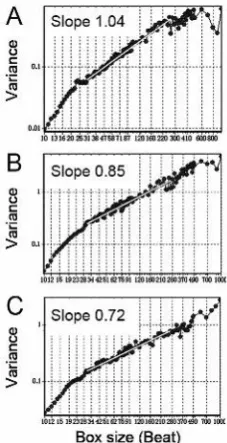
Fig. 6. Heartbeat-interval time series, simultaneously recorded from three male professors at the medical school office. Age: early 50s for A, 65 for B, and 61 for C. Subject C exhibited two premature ventricular contractions (*).
Fig. 7. Results of DFA on data shown in Fig. 6. Inset, Estimated scaling exponents, calculated the slope of the line. Box size 30-270.
C. Scaling in human heartbeat
Figures 6 and 7 show the results of DFA for three persons. EKGs were simultaneously recorded in a room sitting together side by side, with talking and laughing, for about 40 min. Subject-A exhibited a normal healthy value, 1.04. His heart was perfectly normal in terms of DFA. As for the subject-B, on first sight of time series (Fig. 6B), we could not find any significant symptoms. However, his α was 0.85, which was lower than normal value. He mentioned that he feels PVCs especially at mid night (no PVCs in Fig. 6B). Years ago, he was admitted to the hospital to checkup although no significant problem was found. We considered that he had not a perfect health condition in terms of DFA. As for subject-C, time series exhibits apparent PVCs (see asterisks, *). His value was very low, 0.72. He mentioned that the number of occurrence of PVCs sometimes increase up to 6 times per min. Although this value is a benign value according to a medical doctors’ guideline (exceeding 10 times per min is border line), our DFA seemed to be detecting a hidden abnormality in his system though, we did not identify it.
[image:4.595.368.482.52.274.2] [image:4.595.59.290.200.384.2] [image:4.595.110.235.428.540.2] [image:4.595.50.290.593.762.2]D. Quantification of stress
Stress is a physiological reaction of an organism to an uncomfortable or unfamiliar physical or psychological stimulus. The stimuli induce biological changes as the results from activation of the sympathetic nervous system, including a heightened state of alertness, increased heart rate, and so forth. We can define stress in this manner. However, we are not able to quantify stress efficiently. In fact, we can hardly determine if an organism is experiencing stress in response to the stimuli.
We have found that the Japanese spiny lobster, (15 to 25 cm in size) while in a relaxed condition in a shelter, exhibit, on/off switching patterns of heartbeat sequences; i.e., alternating heart rates from a high rate of 50 to 70 BPM to extremely low rate of 5 to 15 BPM [13] (see Fig. 8A). However, during stressful states, the lobster does not exhibit the alternating pattern of a heartbeat, but exhibits the continuous beating pattern of 70 BPM (see Fig. 8B). The continuous pattern lasts quite a while, as long as the stress stimuli exist. The continuous pattern is the physiological consequence of discharge of cardio-regulatory nerves, i.e., an increased cardio-accelerator discharge at about 60 Hz, and simultaneously occurring cessation of the inhibitory nerve discharge [13].
We therefore focused attention on the difference of pattern of heartbeats between relaxed and stressful states, and challenged to quantify stress by DFA. Figure 8 shows the pattern of heartbeats of relaxed lobsters and stressful lobsters. We measured heartbeat intervals of EKG data and constructed a time series of heartbeat-intervals. Figure 9 shows a part of time series (578 beats) corresponding to both, relaxed and stressful states. Then we conducted DFA and found that relaxed lobsters in shelter, exhibited a normal scaling exponent of 1. And stressful lobsters being handled by humans, exhibited a lower scaling exponent of 0.6 (Fig. 10).
[image:5.595.306.552.54.191.2]Fig. 8. EKGs of Japanese spiny lobster, Panulirus japonicus, for 20 min. A, Lobster was at rest in a shelter under the sea water tank. Lobsters’ heart at rest exhibits alternating on/off pattern. B, This lobster was receiving significant stress under the condition of the micro-dialysis blood sampling experiment.
[image:5.595.307.552.253.354.2]Fig. 9. Interval time series calculated from Fig. 8. A, Relaxed lobster. B, Stressful lobster. A and B correspond to AA and BB in Fig. 8. Only 578 beats shown.
Fig. 10. DFA profile. The same lobster shown in Figs. 8 and 9.
IV. DISCUSSION
Many people are introduced to the visual world of nonlinear dynamics through a never-ending stream of fractal patterns cascading towards them from deep within their computer screens [14]. The virtual space, generated by computers, seems to be an ideal environment for exhibiting their stunning properties [14].
[image:5.595.48.297.522.673.2]Unlike computer screens, empirical data in nature, such as fractals in tree-structure and in the heartbeat, is not generated in a never-ending ideal manner. Fractal patterns are found in limited space, indeed a tree fractality range was confined to [1; 10,000] in mm and heartbeat fluctuation fractality was confined to [30; 270] in beat numbers. We showed that DFA works under those limited environment, not under an infinite environment. Despite not infinite, using DFA, we discriminated a healthy heart, unhealthy heart, dying heart, and stressful heart. Stress, particularly its profound, long-lasting effects on behavior and health is a significant health concerns in our days. In the present article, we showed that stress is measurable by our DFA technology. The heart is an opening of mind.
It was in the 80s-90s when Goldberger, Amaral, Hausdorff, Ivanov, Peng, Stanley and colleagues have emphasized the potential utility of DFA in life sciences [6]. Numerous empirical studies identified a noise in human behavior, including noise in heartbeat behavior [5]. However, practical medical use of DFA technology has not progressed to a great extent. Our temporary guideline for determining the wellness of the heart by the scaling exponent, is that a value near 1.0 (specifically, 0.90–1.19) is healthy.
tool in medicine for the early identification or physiological disorders, as it reveals information that is not provided by an EKG. Unlike HRV [15] (i.e., heart rate variability, the power spectrum, PSD), the excelling point for DFA, is that it has a base line value persistence of one (1), like a standard body temperature (37ºC), a standard blood pH (7.4), and so on. DFA is simple as a tool that everyone could use. No two individuals are ever the same in terms of molecular biology, thus supporting the concept of providing individually tailored medicine and healthcare.
V. CONCLUSION
The scaling exponents could determine whether the subjects are under sick or healthy conditions on the basis of cardiovascular neurophysiology. DFA is practically a useful, numerical method for quantifying the degree of wellness and the transition from sickness to wellness and vice versa. DFA is a simple tool, such as a clinical thermometer and a blood-pressure gauge. Our temporary guideline for determining the wellness of the heart by the scaling exponent is, a value near 1.0 (specifically, 0.90–1.19) is healthy.
ACKNOWLEDGMENT
We thank G. Witte C. for English correction. REFERENCES
[1] Roger, V. L, Go A. S, Lloyd-Jones D. M, et al. 2012. “Heart disease and stroke statistics -- 2012 update: a report from the American Heart Association”, Circulation, 125, e2-e220.
[2] Peng, C. -K., S. Havlin, H. E. Stanley, and A. L. Goldberger, 1995, "Quantification of scaling exponents and crossover phenomena in nonstationary heartbeat time series," Chaos, 5, pp. 82-87.
[3] Stanley, H. E., Buldyrev, S. V., Goldberger, A. L., Havlin, S., Peng, C.-K., Simons, M., 1993, “Long-range power-law correlations in condensed matter physics and biophysics, Phys. A, 200, pp. 4-24. [4] Stanley, H. E., 1995, “Phase transitions. Power laws and universality,”
Nature, 378, pp. 554.
[5] Stadnitsuki, T., 2012, “Some critical aspects of fractality research,” Nonlinear Dynamics, Psychology, and Life Sciences, 16, pp. 137-158. [6] Goldberger, A. L., Amaral, L. A. N., Hausdorff, J. M., Ivanov, P. C.,
Peng, C.-K., and Stanley, H. E., 2002, “Fractal dynamics in physiology: Alterations with disease and aging,” PNAS, 99 (Suppl 1), pp. 2466-2472.
[7] Katsuyama, T., Yazawa, T., Kiyono, K., Tanaka, K., Otokawa, M., 2003, “Scaling analysis of heart-interval fluctuation in the in-situ and in-vivo heart of spiny lobster, Panulirus japonicus”, Bull. Housei Univ. Tama, 18, pp 97-108, (in Japanese).
[8] Kobayashi, M., Musha, T., 1982, “1/f fluctuation of heartbeat period,” IEEE Transactions on Biomedical Engineering, 29, pp. 456-457. [9] Yazawa, T., Kiyono, K., Tanaka, K., Katsuyama, T., 2004,
“Neurodynamical control systems of the heart of Japanese spiny lobster, Panulirus japonicus,” IzvestiyaVUZ Applied Nonlinear Dynamics, 12(1-2), pp. 114-121.
[10] Yazawa, T., Tanaka, K., Katsuyama, T., 2007, “DFA on Cardiac Rhythm: Fluctuation of the Heartbeat Interval Contain Useful Information for the Risk of Mortality in Both, Animal Models and Humans,” Journal of Systemics, Cybernetics and Informatics, 5(1), pages: 44-49.
[11] Barnsley, M., 1988, “Fractals everywhere” Academic press, San Diego, CA, USA.
[12] Yazawa, T., Tanaka, K., Kato, A., Nagaoka, T., Katsuyama, T., 2007, “Alternans lowers the scaling exponent of heartbeat fluctuation dynamics in animal models and humans,” WCECS2007 Proceedings, 1, pp. 1-6.
[13] Yazawa, T., Katsuyama, T., 2001, “Spontaneous and repetitive cardiac slowdown in the freely moving spiny lobster, Panulirus japnicus,” J. Comp. Physiol. A., 187, pp. 817-824.
[14] Taylor, R. P., 2012, “The transience of virtual fractals,” Nonlinear Dynamics, Psychology, and Life Sciences, 16, pp. 91-96.