©IJRASET: All Rights are Reserved
472
Hardware Implementation of Sun Tracking Solar
Panel Using 8051 Micro-Controller
Mr. Rohit Kumar Gupta
1, Mr. Sawan Kumar Sharma
2, Mr. Brijesh Kumar Dubey
31Scholar, Department of Electrical and Electronics Engineering, PSIT, Kanpur, Uttar Pradesh
2Assistant Professor, Department of Electrical and Electronics Engineering, PSIT, Kanpur, Uttar Pradesh 3Assistant Professor, Department of Electrical and Electronics Engineering, PSIT, Kanpur, Uttar Pradesh
Abstract: The Solar Panel consists of a number of solar cells If the solar panel is continuously aligned with Sun rotation, In this paper, a solar tracking hardware implementation is offered to the Sun's movement throughout the day. The affordable solar panel design is based on 8051 micro-controller, dc motor and light sensor aligned in a simple circuit. The main goal is to get the current solar panel output. The output of the proposed solar tracking panel is found to be 32.17% higher as compared to the static Flat solar panel.
Keywords: Solar Cell; DC Motor; 8051 micro-controller; LDR; solar tracker
I. INTRODUCTION
This Energy received from Sun is huge in amount and inexhaustible. Approximately 1.8 × 10¹¹ MW of power is received by the Mother Earth. This is the number of times of our present day requirement. Proper harnessing of this energy is [1-3] very important and need of the day The sun has the capability [4-8] to supply energy This makes it the one of the most promising unconventional sources of energy. The two other factors in flavors of solar energy are: Firstly, unlike fossil fuels it is environmentally very clean source of energy [9-11] and does not cause any kind of pollution. Secondly, it is free; available in abundance and enormous in quantity [12-15] Solar energy equipment does not require any heavy mechanical sections and is free from noise. This work proposes a comfortable design of a solar tracking device which tracks the movement of the Sun. Rotating platform mounted on the dc motor has been employed. When motor rotates; the platform also rotates and its direction changes This paper is organized as follows: Section II details the different components used, the solar implementation of solar panel is discussed in section III. Next section; Results and discussions about the effectiveness of the proposed scheme and the Solar Flat Panel.
II. MATERIALS USED
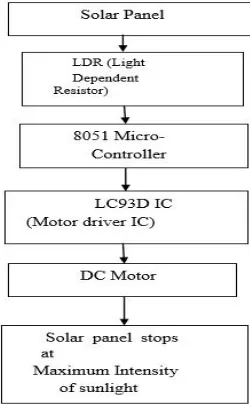
[image:1.595.229.354.532.734.2]While tracking sunlight, various methods could be used. In this work, the main components used are-solar panel, 8051 microcontroller, DC motor, LDR, L293D motor driver IC. The basic block diagram of the image shown in Fig. 1.
©IJRASET: All Rights are Reserved
473
A. Light Dependant Resistor (LDR)A.In an LDR or Light Dependent Resistant, the intensity of light and resistance is inversely related, when the light intensity is the maximum, resistance is minimal and vice-versa. The programming is being done in simple C language. Thereafter, the software used to convert the code into Hexa Decimal form.
B. Micro-Controller
To control the direction of the DC motor, micro controller with the proximity switches is employed. At the same time The Logic is sensed by IC 8051 controller. This micro controller has 20 pins unlike the micro micro controller which has 40 pins. This microcontroller is required as there are only 2 outputs for DC motor Two out of the three sensors change the direction while remaining sensor senses the sun's light received from the sun. This micro controller has 128 bytes of RAM and a flash memory of 2K byte.
C. L293 D
This is a motor driver IC in which half H driver with quadruple high current is designed for two motors at a time. It provides drive currents of 600 mA that are bi-directional and the value of voltage is in the range of 4.5v - 36v.
D. C Motor
A permanent DC motor whose speed is reduced by means of a gear box is employed. Thus, the Gear box reduces the speed of the moving platform. The 6-9 volts DC supplied to this D.C motor. When the voltage is varied the speed of the D.C motor also varies. The current drawn by the motor is 200 mA. The DC motor might be replaced by a stepper motor.
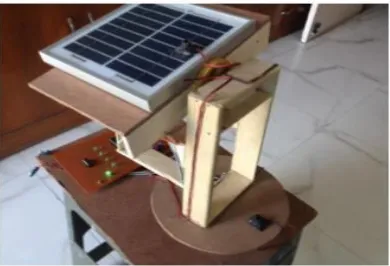
Fig. 2 Complete Hardware Module of Sun Tracking Solar Panel
However, the current consumption of a stepper motor is higher in comparison to a DC motor. In general, a stepper motor requires minimum 1A current.
III. SUN TRACKING SOLAR PANEL HARDWARE IMPLEMENTATION
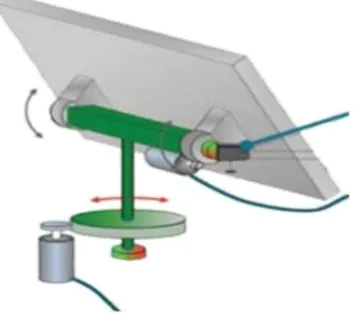
[image:2.595.212.407.368.501.2]The phenomenon of conversion of solar energy into electricity is called as photovoltaic effect. When ionizing radiations get absorbed, an electromotive force gets generated The solar panels were used in sunlight in electricity. The hardware for sunlight 3.
©IJRASET: All Rights are Reserved
474
The solar cells have been able to capture energy of Sun and provide renewable, versatile, pure and clean energy. There are no moving parts, low maintenance cost, and are pollution free. Captured solar energy from the Sun This is done when the electrons are separated out from atoms of their parent, then they are accelerated with one way electrostatic barrier formed due to the function of various semiconductor materials. The proposed assembly 4. In this work, LDR and photodiodes are mounted on the top of the platform. When the sensor senses the maximum light resistance of photodiode becomes very low and a 0 signal is provided in the micro intensity position. The motor remains standstill Whenever the photodiode is in dark position the platform rotates again and searches for the maximum light position.Fig. 4 Proposed Assembly for Sun Tracking Solar Panel
In this, the current to the battery gets boosted But, during the time when sunlight starts getting diminished during dusk or dawn time it is unable to produce the required wattage. The sunlight and rotates accordingly. It is able to harness 95% of the solar energy available throughout the day. This ability of the solar tracking panel makes it highly advantageous over flat panel.
IV. RESULTS AND DISCUSSION
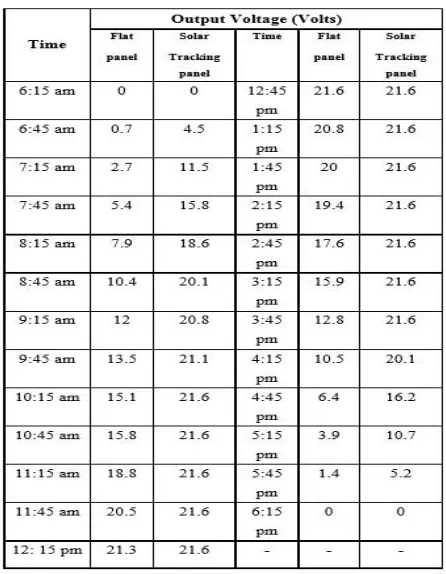
The Table I shows the output voltage variations over time for static. During most of the day time (8.45 am to 4.15 pm), the output voltage is more than 20 volts in a solar tracking panel whereas in a flat panel it is fluctuating and varies from 10.4 volts to 21.6 volts
Fig. 5 Solar Panel Output Voltage Vs Time
[image:3.595.181.433.501.655.2]©IJRASET: All Rights are Reserved
475
TABLE I: Voltage Measured During 24 –HoursV. CONCLUSION
Solar energy is the clean energy and is the upcoming boom in the field of renewable energy. The maximum usage of solar energy is undoubtedly important. The present work aims to the best possible way The effort has been developed to develop a solar panel, which has more output and increased electricity power all day. During the time when sunlight starts getting diminished solar tracker rotates accordingly and tracks maximum light of the sun. To control the DC motor in all directions, use 8051 microcontroller. The installing a sun tracking solar panel is a feasible technique to harness the optimum energy from the Sun. In the near future It is possible to employ more photo sensitive resistors and use another motor; to rotate This may be further added to the efficiency of the proposed sun tracker. If two motors were used
VI. ACKNOWLEDGMENT
The authors wish to thank Department of Electrical and Electronics Engineering, Amity School of Engineering and Technology, Amity University, Uttar Pradesh, Noida to provide their support and laboratory facilities.
REFERENCES
[1] Arindam Bose, Sounak Government and Sayan Das, "Helianthus - A Low Cost High Efficient Solar Tracking System Using AVR Microcontroller" International Journal of Scientific & Engineering Research, Volume 3, pp. 1-6, 2012.
[2] K.S.Madhu, B.R.Wadekar, Finavivya Chirag Kumar and Gagan.T.M "Intelligent Two Axis Solar Tracking System with Mechanical Application", International Journal of Scientific & Engineering Research, Volume 5, pp. 1-5, 2012.
[3] A. Yazidi, F. Betin, G. Notton and G. A. Capolino, "Low cost two-axis solar tracker with high precision positioning" First International symposium on Environment Identities in Mediterranean Area, pp. 211 - 216, 2006.
[4] P.R. Mukund, "Wind and Solar Power Systems", CRC Press, 1999.
[5] Meghana Sharma, "An Efficient Low Cost Solar Tracker Using Microcontroller" IOSR Journal of Electrical and Electronics Engineering (IOSR-JEEE), pp. 37-40, 2014.
[6] Mostefa Ghassoul, "Design of an Automatic Solar Tracking System to Maximize Energy Extraction", International Journal of Emerging Technology and Advanced Engineering, pp. 453-460, 2013.
©IJRASET: All Rights are Reserved
476
[8] D.L. King and W.E. Boyson, "Analysis of factors influencing the annual energy production of photosovoltaic systems" Conference of the Twenty-Ninth IEEE, 2012.
[9] C, Alexandru and C. Pozna, "Different tracking strategies for optimizing the energetic efficiency of a photovoltaics system" , IEEE International Conference on Automation, Quality and Testing, Robotics, pp. 434-439, 2008.
[10] A. Yazidi, F. Betin, G. Notton and G. A. Capolino, "Low cost two-axis solar tracker with high precision positioning," First International symposium on Environment Identities in Mediterranean Area, pp. 211 - 216, 2006.
[11] J. Beltran, et al. "Design, manufacturing and performance test of a solar tracker made by an embedded control," Proceedings of the Electronics, Robotics and Automotive Mechanics Conference, pp. 129-134, 2007.
[12] Ignacio Luque-Heredia, et al. "A sun tracking error monitor for photovoltaic concentrators," Electronics, Robotics and Automotive Mechanics Conference, pp. 129 - 134, 2007.
[13] O. Oltu, et al. "Solar panel energetic efficiency optimization method, based on a specific detector and orientation microsystem," International Semiconductor Conference, pp. 127 - 130, 2007.