YAI WBAStC
ANU
NUUt-BAStU
1NPtKtNLt
IN
StMAN
i I C
NETWORKS
S t u a r t C. S h p p i r o
9
partment of Cornpyter S c i e n c e S t a t e n i v e r s i t y of New York a t B u f f a l oAmherst, New Y o r k 1 4 2 2 6
A b s t r a c t
Two styles of performing i n f e r e h c s i n semantic networks are p r e s e n t e u and c o m - pared. P a t h - b a s d i n w x e n c e allows a n a r c
or a p a t h of
arcs
between two given-nodes t o be i n f e r r e d from t h e e x i s t e n c eof
an- o t h e r s p e c i f i e d p a t h between t h e same twonodes. Path-based i n f e x e n c e r u l e s may be w r i t t e n u s h g a b i n a r y relational c a l c u l u s
n o t a t i o n . Node-based i n f e r e n c e a l l o w s a s t r u c t u r e o f nodes t o be i n f e r r e d from t h e e x i s t e n c e of a n i n s t a c c e of a p a t t e r n of node s t r u c t u r e s . Node-based i n f e r e n c e
riles can be c o n s t r u c t e d i n a semantic network u s i n g a v a r i a n t o f ' a p r e d i c a t e c a l c u l u s n o t a t i o n . Path-based i n f e r e n c e i s more e f f i c i e n t , w h i l e node-based i n f e r - e n c e i s more g e n e r a l . A method i s de- s c r i b e d o f combining t h e t w o s t y l e s i n a s i n g l e system i n order t o take advantage o f t h e s t r e n g t h s of each. App&ications of path-based i n f e r e n c e r u l e s to t h e r e p r e - s e n t a t i o n of $he ex-sional e q u i v a l e n c e o f i n t e n s i o n a l c o n c e p t s , and t o t h e e x p l i - c a t i o n of i n h e r i t a n c e i n h i e r a r c h i e s are
sketched.
1. I n t r o d u c t i o n
Semantic networks have developed
s i n c e the mid s i x t i e s [ t o ; 11
I
as a formal- i s m for t h e r e p r e s e n t a t i o n of knowlEage. Methods have a l s o been developing f o r per-forming d e d u c t i v e i n f e r e n c e on t h e knowl- edge r e p r e s e n t e d i n t h e network. I n t h i s p a p e r , w e w i l l compare t w o s t y l e s o f i n - ference t h a t are used i n semantic networks, path-based i n f e x e n c e and node-based i n f e r - ence. Xn sections 2 and 3, t h e s e terms w i l l be e x p l a i n e d and r e f e r e n c e s to sys-
tems tibt use them w i l l be provided. Xn s e c t i o n s 4 and 5 , t h e advantages and dis-
advantages o f e a c h w i l l be discu8sed.
Section% 6 , 7 and 8 w i l l show how they can be used t o complement
each
o t h e r i n a s i n - g l e semantic network system, how path- b a s e d c k f e r e n c e c a n f a l p represent t h e ex- t e n s f a n a l e q u i v a l e n c e of i n t e n s i o n a l con- cepts, and how a f o r m a l i s m for writingpath-based i n f e r e n c e r u l e s c a n be used to
e x p l i c a t e t h e n o t i o n of " i n h e r i t a n c e a i n a semantic network.
2. Path-Based I n f e r e n c e
Let: u s r e f e x t o a r e l a t i o n (pegf~xce
b i n a r y ) t h a t - i s r e p r e s e n t e d by a n arc in a
network as a n
-
a r c - r e l a t i o n . I f R i s an a r c - r e l a t i o n , anarc
l a b e l l e d R from node a t o node b r e p r e s e n t s t h a t the r e l a t i o n -ship aRb h o l d s . I t may be t h a t this arc
is n o t p r e s e n t i n t h e network, b u t aRb may
be i n f e r r e d from other i n f o r m a t i o n p r e s e n t i n t h e network and one o r more i n f e r e n c e r u l e s . I f t h e other i n f o r m a t i o n i n t h e network is a specified path o f arcs ftom a t o b , w e w i l l r e f e r t o the i n f e r e n c e as path-based. The ways i n which such p a t h s may be s p e c i f i e d w i l l be developed as this
paper proceeds.
The two clearest examples of the gen- e r a l use of path-based i n f e r e n c e are i n
SAMENLAQ X I [ I 8 1 and P r o t o s y n t h e x I11 [13].
Both t h e s e systems use what might be c a l l -
ed " r e l a t i o n a l " networks
rather
t h a n"semantic" networks s i n c e a r c - r e l a t i o n s i n c l u d e c o n c e p t u a l r e l a t i o n s as well as s t r u c t u r a l r e l a t i o n s (see [ 1 4 1 for a d i s - c u s s i o n of the difference)
.
For example,i n Protoaynthex I11 t h e r e is a n arc label-
led COMMANDED from t h e node r e p r e s e n t i n g Napoleon t o t h e node r e p r e s e n t i n g t h e
French army, and i n SAMENLAQ I1 a n arc l a - belled EA$T.OF goes f r o m the node for
Albany to t h e node' for Buffalo. Both sya
t e m s u s e r e l a t i o n a l c a l c u l u s e x p r e s d i o n s
to form path-based - i n f e r e n c e r u l e s . The f o l l o w i n g r e l a t i o n a l operators are employ- ed (we h e r e u s e a v a r i a ' n t of t h e earlier n o t a t i o n s ) :
1. R e l a t i o n a l Converse
--
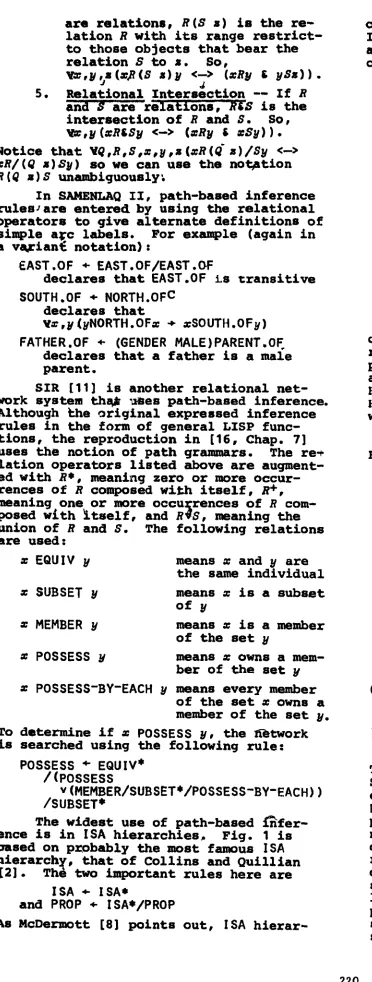
I f R i s a Ar e l a t i o n , R~ i s i t s c o n v e r s e . C
SO, V X , ~ ( X R <-, ~ R x ) ,
2 , R e l a t i o n a l Corn s i t i o n
--
If Rand S are re
T=--r
atxons R / S is Rcomposed with S, So,
V x , y ( x R / S y <-> a a ( x R x 5 a s p ) ) .
3 . Domain Restriction
--
If R and Sare r e l a t i o n s , (S a 1 R &a t h e re-
l a t i o n R w i € h V i t s domain re- stricted to those objects that b e a r t h e - r e l a t i o n S
t o
s. SO,Vz,y,.(z(S s)Ry <-> (zS. C l z ~ ~ ) ) .
axe r e l a t i o n s , R (S s) is t h e re-
l a t i o n R w i t h i t s range restrict- t o t h o s e o b j e c t s t h a t b e a r t h e r e l a t i o n S t o
r .
So,e e , g g ( + P ( S a ) # <-> (xRy 6 r s r l ) . 5. ~ e l a t i o n a l 1nter8;;ction
--
I f Rand S are r e l a t i o n s , R&S i s t h e i n t e r s e c t i o n o f R and S. So,
=,y ( x R Q S ~ <--> (XRY & ESY) )
Notice t h a t V Q , R , S , X , ~ ,x (XR(Q- a)/Sy <->
xR/ (Q a ) Sy ) so w e can u s e t h e n o t p t i o n
R
(4
a 1 S unambiguously:I n SAMENLAQ 11, path-based i n f e r e n c e r u l e r s ~ a r e e n t e r e d by u s i n g the r e l a t i o n a l o p e r a t o r s t o g i v e a1 t e r n a t e d e f i n i t i o n s o f simple a r c labels. For example (again i n a v w i a n e n o t a t i o n ) t
EAST ,OF 4 EAST.OF/EAST .OF
d e c l a r e s t h a t EAST .OF i.8 transitive
SOUTH .OF 4 NORTH .OF= declares t h a t
Y X , ~ (gNORTH.OFx + xSOUTH.OFr/)
FATHER.OF +- (GENDER MALE)PARENT.OF d e c l a r e s t h a t a f a t h e r is a male p a r e n t .
S I R [ l f ] i s a n o t h e r r e l a t i o n a l n e t -
work system th* Wes path-based inference. Although the o r i g i n a l expressed i n f e r e n c e
r u l e s i n the form of general. LISP func- t i o n s , the reproduction
i n
[16, Chap. 7 ) u s e s the n o t i o n of p a t h granunars. The re* l a t i o n o p e r a t o r s l i s t e d above are augment- e d with R*, meaning z e r o or more occur- r e n c e s of R composed w i E h i t s e l f , R + ,meaning one o r more occu r e n c e s o f R corn-
B
posed w i t h k t s e l f , and R S, meaning the
union of R and S. The following r e l a t i o n s
are used:
x EQUIV y means x and y are
t h e same i n d i v i d u a l x SUBSET y means x i s a s u b s e t
of Y
x MEMBER y means x i s a member
o f t h e set
3: POSSESS y means z owns a mem-
b e r of t h e set y x POSSESS-BY-EACH y means every member
o f t h e set x owns a member o f t h e set 8 ,
To determine if x POSSESS y , t h e -Work is searched u s i n g the following r u l e :
POSSESS
*
EQUIV*/(POSSESS
~ ( M E M B E R / ~ ~ B ~ E T * / P O ~ ~ E S S ~ B Y - E A C H ) )
/SUBSET*
The widest u s e of path-based afer- ence i s i n ISA h i e r a r c h i e s , Fig. 1 i s based on pxobably the most famous ISA h i e r a r c h y , t h a t of C o l l i n s and Q u i l l i a n
121
.
The two important r u l e s h e r e a r e ISA + ISA*and PROP 4 ISA*/PROP
A s McDermott 18) p o i n t s o u t , ISA h i e r a r -
c h i e s have been abused as w e l l as used.
I n
S e c t i o n 8 , w e w i l l propose a xnethod [image:2.862.73.445.85.1067.2]authQrtJ c&O us9 t o delscribe t h e i r h i e r - chies p r q c i s e l y .
FIGURE 1: ISA hierarchy based on t h a t of Collins
and Quxlllan
3. Node-Based Xnference
~ e v e r a i semantic network systems i n - c o r p o r a t e methods of r e p r e s e n t i n g general
r u l e s i n a s e m n t i c network v e r s i o n of predicate c a l c u l u s . Among t h e s e systems
are t h o s e of Shapiro [14;15;17], Kay [71, Hendrix 161
,
Schubert [ I 2),
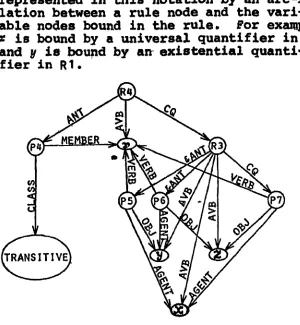
and F i k e s and ~ e n d r k x [ 3 ] . Figure 2 shows such a n e t - work d e d u c t i o n r u l e r e p r e s e n t i n g-
vx
[=EMAN +' 3 y (y WOMAN 6 xL0VESy)'l a,Figqre 3 shows a r u l e f o r ~ ~ [ ~ E T R A N S I T I V E +
Yx,y ,a ( x r y 5 yra + x r a ) 1
.
FZGURE - 2 : A semantic network deduction rule for
YxIxEMAN + ay(ycW0MAN 6 d O V E S y ) ]
for
8 m y be deduced., Q u a n t i f i c a t i o n i srepresented i n t h i s n o t a t i o n by an arc-re- l a t i o n between a r u l e node and t h e v a r i - able nodes bound i n t h e r u l e . For ex-le,
3: i s bound by a univexsall q u a n t i f i e r i n R2
[image:3.862.74.374.109.434.2] [image:3.862.74.393.490.880.2]and p
ie
bound by an e x i s t e n t i a l q u a n t i - f i e r i n R 1 .FIGURE 3: A semantic network deductlon rule for
VrlrcTRANSITIVE + Vx,y,a(xry t y r z + s p a ) 1
To see how a node-based i n f e r e n c e
proceeds, consider t h e n e t w k of Fig- 4
i n conjunction w i t h t h e r u l e of F t g u r e 3 , and say that we w i s h t o decide i f
4 S U P P ~ R T S C. The network t h a t would rep- r e s e n t t h a t A SUPPORTS C matches P7 w i t h t h e v a r i a b l e binding [%/A, r/SUPPORTS, a/C]. P4 i n t h e binding [r/SUPPORTS] i s matched a g a i n s t t h e network and is found
t o s u c c e s s f u l l y match
MI.
P5 [x/A,r/SUPPORTS, y/u] and P6 [y/u, r/SUPPORTS, a / C ] are then both matched a g a i n s t t h e qetwork and each succeeds with a consis- t e n t binding of 41 t o
B.
The r u l e t h u s succeeds and A SUPPORTS C is deduced.( D e t a i l s
nf
t h e bindings and the match r o u t i n e are given i n [I 51.
)FIGURE 4: A network data base asserting that
A SUPPORTS 0 , B SUPPORTS C and
SUPPORlS T R A N S I T I V E ,
It should be noted t h a t set i n c l u s i o n was represented by an arc ( I S A ) i n Section 2 , b u t s e t membership i s being represented by a node (with a MEMBER, CLASS "case
frame")
i n t h i s s e c t i o n , The nodal repre- s e n t a t i o n fs required by node-based i n f e r - ence r u l e s and i s c o n s i s t e n t w i t h t h e no- t i o n t h a t everything t h a t t h e hetwork"knows", and every concept t o which t h e
Yo
network canrefer
is xepresented by - - anode
.
4. Advantaqes of Node-Based I n f e r e n c e
The adfaFtZgees
or
node-base.# i n f e r - ence s t e m from t h e g e n e r a l i t y of t h e syn- t a xof
node-based i n f e r e n c e r u l e s , Path- based r u l e s are limited to b i n a r y r e l a - t i o n s , hav6 a r e s t r i c t e d q u a n t i f i c a t i o ns t r u c t u r e and r e q u i r q t h a t an
arc
between t w o nodes be implied by a path between t h e same t w o nodes. Rule R 2 of I!'iguree2 could n o t be w r i t t e n as a path-based r u l e , and, although t h e t r a n s i t i v i t y of SUPPORTS could be expreaaed bI
a path-based r u l e(SUPPORTS + SUPPORTS )
,
t h e "second o r d e r "r u l e R4 of Figure 3 could n o t .
L e t us b r i e f l y c o n s i d e r how r u l e R4 i s constructed, whether it r e a l l y i s o r i s n o t a second oeder r u l e , and why it could n o t be expressed as a path-based r u l g . Rule R4 s u p p l i e s a r u l e for use
with
t r a n s i t i v e r e l a t i o n s . I n o r d e r to assert t h a t a r e l a t i o n i s t r a n s i t i v e (e.g. a s s e r - t i o n node M 1 of Figure 4 ) , the r e l a t i o n
must be r e p r e s e n t e d as a node, rather than
as an
arc.
This a l s o allows quantifica-t i o n over such r e l a t i o n s , s i n c e i n a l l node-based i n f e r e n c e r u l e formalisms v a r i - ables may onLy be substituted f o r nodes, n o t for arcs. Since t h e r e l a t i o n i s a node, another node must be used to show t h e r e l a t i o n s h i p of t h e r e l a t i o n t o its arguments (e,g. nodes M2 and M3 i n Figure
4): Thus, R 4 i s r e a l l y a f i r s t order r u l e deri.ved from t h e second o r d e r r u l e
~ ~ [ P E T R A N S I T I V E
+ y x r g r a (srg 5 y r a + xra)1
by reducing r t o an i n d i v i d u a l v a r i a b l e and intzoducing a h i g h e r order relation,
AVO, whose second argument i s a conceptual r e l a t i o n and whose o t h e r arguments
are
conceptual i n d i v i d u a l s . So R4is
nore
a c c u r a t e l y seen as t h e f i r s t o r d e r rule
I n t h i s view, t h e p r e d i c a t e s of semantic networks a r e n o t the nodes r e p r e s e n t i n g
conceptual r e l a t i o n s , b u t t h e d i f f e r e n t case frames. Rule R4 cannot be repreaent-
ed as a path-based rule because it is a r u l e qbout t h e r e l a t i o n AVO, and AVO is a t r i n a r y , r a t h e r t h a n a binary r e l a t i o n .
Although some node-based i n f e r e n c e r u l e s cannot be expressed by path-based i n f e r e n c e r u l e s , it is easy to see t h a t any path-based i n f e r e n c e r u l e can be ex-
pressed by a node-based inference rule, as long as w e a r e w i l l i n g to r e p l a c e some a r c - r e l a t i o n s by nbdes and h i g h e r o r d e r p r e d i c a t e s .
5. Advantages of Path-Based I n f e r e n c e The major advantage of path-based in- ference i s e f f i c i e n c y , Carrying
out
a pith-based i n f e r e n c e involves merelyperhaps, 8ome s i d e paths t o s p e c i f i e d
nodes required by domain and range
rrsstric-
t i o n a ) . This f s a
well
understood andre-
l a t i v e l y e f f i c i e n t operation, e s p e c i a l l y comparedto
t h e backtracking, i n t e r s e c t i o n , o r u n i f i c a t i o n operations required t oW c , k the consistency of v a r i a b l e s u b s t i - t u t i o n e nin notSEX2seT
r?iference
rules,
Moreover, path following seems t o many people
t o
be what semantic networkswere
o k f g i n a l l y designedfor.
The major search algorithm of Q u i l l i a n ' s SemanticMemory
is
a
b i - d i r e c t i o n a l searchfor
apath connecting
two
nodes (1 0 , p. 2491.Also, t h e a b i l i t y t o do path t r a c i n g i s a motivation underlying I SA h i e r a r c h i e s , and
is why t h e C o l l i n s and Q u i l l f a n r e s u l t s
121 gained such a t t e n t i o n . Theae ef f i- c i e n c i e s a r e lost by replacing path-based
inference r u l e s by node-based inference
rules.
6 % Combining Path-Based and Node-Based Inference - - --- - --
We
begin the t a s k of unifying path- basad and node-based inferences by noting t h e formal equivalence between an arc-re-l a t i o n and a trro
case
c a s e frame.,
Figure 5 illustrates t h i s using ISA vs. SUB-SUP. Figure 5a shows t h e use of t h e ISA arc-re- l a t i o n t o r e p r e s e n t t h a t c a n a r i e s are-
b i r d s . Figure 5b r e p r e s e n t s t h e samare-
l a t i o n s h i p by a SUB-SUP c a s e frame, andhas
t h e advantage that t h e r e l a t i o n s h i p isrepresented by a node, M4. Figure 5c is a redrawing of Sb, using t K e a r c l a b e l
SUB-
t o r e p r e s e n t the r e l a t i o n SUBC. ( I t i sgenerally understood i n semantic network fonnalisma t h a t whenever-an a r c represent- i n g
a
r e l a t i o n R goes frod so- node n t~ some node m , t h e r e i s a l s o an a r c repre- s e n t i n g RC going from mt o
n).
Figure Scc l a r i f i e s t h e notion t h a t w e may t h i n k o f a0 i n l t a n c e of a two case c a s e frame (such
as M4) a s both an a r c and
a
node i f weare
w i l l i n g t o r e c a l i b r a t e t h e measurement of t i m e it t a k e s t o follow one a r c - r e l a t i o nto be t h e time it takes t o follovf %wo
arcs. We
can
replace a l l i n s t a n c e s 6% ISA i n t h e path-base8 Anterenee r u l e s ofSection 2 by t h e composition SUBn/SUP and still have v a l i d rules except t h a t w e now
have paths on t h e l e f t of t h e "+" syaabgl.
&
CANARY CANARY0
FIGUPE 5: An L l l u s t r a t i o n of the e q u i -
valence o f an a r c - r e l a k i o n to a two case
case frame. a) I b p r e s e n t i n g s e t member-
s h i p as the 1 SA arc-relation. b) Repre-
s e n t l n g set membership as a SUB-SOP case frame. c ) Redrawulg (b) so it looks l i k e
( a ) .
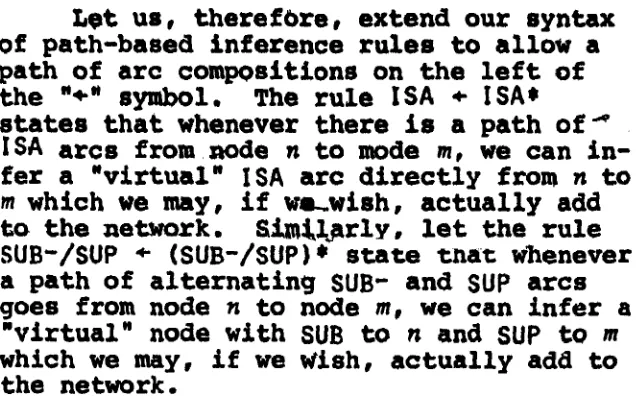
Let
u s , t h e r e f b r e , extend our syntaxof
path-based inferencerules
t o
allow
a41
path of a r c compositions on t h e l e f t oft h e "+" symbol. The r u l e I S A + 1 SA*
states t h a t whenever t h e r e
is
a path o f "1 a r c s
from
m d e n t o mode m, w e can in- fer a " v i r t u a l n I S A arc d i r e c t l y f r o m n t om which we may, if wkwish, a c t u a l l y add
to t h e network. S;tm&lply, let the r u l e SUB-/SUP 4- (SUB-/SUP)* s t a t e tnat whenever
a path of a l t e r n a t i n g SUB- and SUP a r c s goes from node n t o node m, w e can i n f e r a
" v i r t u a l n node with SUB
t o
n and SUPt o
mwhich w e may, if we Wish, a c t u a l l y add to t h e network.
We now have a formalism f o r specify- ing path-based inference r u l e s i n a nskt work formalism t h a t r e p r e s e n t s binary con- ceptual relations by two c a s e c a s e frames. This would allow, f o r example, for a more u n i f i e d r e p r e s e n t a t i o n i n t h e SNIFFER system [31,
i n
which node-based inferencerules
a r e implementedand
b u u l t - i n path based inference r u l e sare
used f o r set membership and set i n c l u s i o n , both of which a r e represented only by arc-rela-t i o n s . The formalism presented here
would allow set membership and set inclu- s i o n a s s e r t i o n s t o be represented by
nodes, permitting o t h e r a s s e r t i o n s t o reference them, without g i v i n g up t h e e f f i c i e n c y of b u i l t - i n r o u t i n e s to imple- ment t h e set i n c l u s i o n h i e r a r c h i e s .
We d e s i r e , however, a
more
general u n i f i c a t i o n of path-based and node-based inferences. There are two b a s i c r o u t i n e s used t o implement node-based inferences(although s p e c i f i c implementations may
d i f f e r ) . One i s t h e match r o u t i n e t h a t i s given a p a t t e r n node a n d f i n d s i n s t a n c e s of it i n t h e network, and t h e o t h e r i s t h e r o u t i n e t h a t intrtrpsets t h e q u a n t i f i e r s ana connectives to c a r r y o u t t h e a c t u a l deduction. The match r o u t i n e can be en-
hanced
t o
make use of path-basedinference
r u l e s . Consider a t y p i c a l match r o u t i n e used i n t h e dedubtion i n Section 3 ofA SUPPORTS C
from
the network of Figure 4 and t h e r u l e of Figure 3, q d l e t u s fn- troduce t h e n o t a t i o n t h a t i f P i s a path of arcs and n i s a node, P [ n ] r e p r e s e n t s t h e set of nodes found by following t h e p a t h P from t h e node n. I n t h e example,the match r o u t i n e was given t h e p a t t e r n
P 4 t o match i n t h e binding [rjSUPPORTS 1. I t waS 93;rle t o f i n d M 1 by i n t e r s e c t i n g
CLASS^
ITRANSITIVEI
w i t hM E M B E R ~ ~ S U P P O R T S I
.
Now, l e t u s suppose t h a t t h e path-baseainference rule CLASS f CLASS/ (SUB-&UP)
*
has been declared i n such a way tha t h e match r o u t i n e could use it. T t e match [image:4.862.428.747.79.283.2]nodes. This completes the general unifica- tion of path-based and node-based infer- egce we desired, Since path-based infer- ence is embedded in the match routine, while node-based inference requires the quantifier and connective interpreter, the diffexence is reminiscent of the differ- ence between subconscious inference and conscious reasoning,
7. Application to Extensional
- . Equivalence - of
Intensional Concepts
A basic assumption of semantic,net- works is that each concept is represented by a single node and that all information about a concept is reachable from its node.
Y e t , since Woods' discussion [ 2 0 ] , mast Semantic network authors have agreed that a node represents an intensional, rather than an extensional concept. How should we handle the inf~rmation that two differ-
ent intensional concepts are extensionally equivalent?
Let us illustrate this by a story (entirely fictiafial). For the last year we have heard of a renowned surgeon in
town, Dr. Smith, known for his brilliance and dexterity, who saved the life of the famous actress Maureen ~e'lt by a difficult heart transplant operation. ~ e a n w ~ i l e , at several social gatherings, we have met someone by the name of ~ o h n Smith, about five feet, six inches tall, black hair and beard, generally -d$sheveled and clumsy. We now discover, much to our ama~ement that John Smith and Dr. Smith are one and the samef In our semantic netwokk, we have one node for Dr. Smith connected to his attributes, and another for John Smith connected to his attributes. What are we
to do? Although we now know that John Smith saved the life of Maureen Gelt and that Dr. Smith has black hair, surely we cannot retrieve that infarmation as fast, as that Dr. Smith is a surgeon and that John Smith is 5 ' 6 " tall, If ye were to combine the two nodes by taking all the arcs from one node, tying them to the other and throwing away the firbt, we would lose this distinction, We dpust in-
troduce an assertion, say an E Q U I ~ E Q U I V
case frame, that represents the fact that
Dr. Smith and John Smith, different inten- sional concepts, are e x t e n s i ~ n ~ l y the same.1 Haw are we to use this assertion?
Ignoring for the moment referentially opaqtte contexts ("We didn't know that John Smith was Dr. Smith."), how can we express the ruledhat if n E Q U I V ~ / ' / E Q U I ~ m, than anything true of n is true of m? Our node based inference rules cannot express this rule because expressing "anything-true of
n n requires quantifying over those higher order case frame preaicates such as AVO
'lhe psychological plausibility of this discussion is supported by the experimees of Anderson and Hastie [ I ] and of McNabb
191
and
MEMBER'C~ASS.
One possibility is toYZ
use lambda abstraction as Schubert doesf12J. Each n-ary htgher order predicate involving some node becomes a unary predi- cate by replacing that nodle by a lambda vaxiab7e. Thus, "Dx, Smith saved Maureen Gelt 's life" becotnes ,an instance of the
unary predicate X ( x ) [a saved Maureen
Gelt's life] applied to Dr. Smith. Using
a
PRED-ARG
case frame, it is easy to rep- resent the ruleThe trouble with this solution is, how' are we to retrieve this information as a fact
about Maureen GeLt? Must we also store
A ( * ) [Dk. Smith saved x ' s life) (Maureen Gelt) 3
This duplication is unsatisfying, An al- ternative is to include in the path-based inference rule defining each arc-relation the path (EQUIV-/EQUIV)*. For example, AGENT +
AGENT/
(EQUIV-/EQUI V) % and CLASS+ CLASS/( (EQUIV-/EQUIV)
*/
(SUB-/SUP)
*
1*
.
Although this solution requires more rules than the lambda abstraction solution, and the rules look complichted, it avoids the duplication of the same assertion in dif-
ferent forms and the postulation of con-
ceptual predicates such as A (s) [ x saved Maureen Gelt's life].
Hays' cognitive networks [4;5] in- clude a scheme similar to the one proposed here. Each assertion about Dr, Smith
would refer to a different node, =each with an MST (manifestation) arc t o a common node. This node would represent the in tension of Dr. Smith, while the others represent Dr. Smith as surgeon, Dr. Smith as saviour of Maureen Gelt, etc. Presum- ably, when Hays' network learns of the identity of Dr. Smith with John Smith, a new node is introduced with MS arcs from both Dr. Smith and John Smith.3 Dr. Smith and John Smith are then seen as two mani- fes-tions of the newly integrated Dr. John Smith, Hays presumably uses an
M S T * / ( M S T ~ ) * path where we propose an (EQU 19-/EQUI V)
*
path.~ l ~ c k i n g referentially opaque con- texts seems to require introducing rsZa-
tionaZ oempZemen*. For any pat4 P and
nodes xaand y, let x& hold just in case a path P from x to y does not exist in the network.
*
We miqht blocg referentially opaque contexts-by including the domain or range restriction(OBJ'/VERB/MEMBER-/CLASS
OPAQUE) in the arc definitions.8. Application, to the Explicatian of Inheritance
- -
As was mentioned in section 2, many
'~ctuall~, Hays' networks have not yet been implemented, and I have been warned
semantic networks i n c l u d e i n h e r i t a n c e
(ISA) h i e r a r c h i e s . Often t h e s e are a t best vague and a t worst i n c o n s i s t e n t . We
propose t h a t t h e i n h e r i t a n c e p r o p e r t i e s o f t h e s e h i e r a r c h i e s be c l e a r l y defined by path-based i n f e r e n c e r u l e s using t h e syn- tax we a r e p t e s e n t i n g h e r e or some o t h e r
w e l l
d e f i n e d syntax. We do n o t say t h a ta l l
systems should be a b l e t o i n p u t and i n t e r p r e t such r u l e s , b u t only t h a t auth- ors use such r u l e st o
e x p l a i n c l e a r l y to t h e i r r e a d e r s how t h e i r h i e r a r c h i e s work.Before thia proposal i s f e a s i b l e , w e
must
be a b l e to handle two more s i t u a t i o n s * The f i r s t i s the exception p r i n c i p l e ,f i r s t expressed by Raphael [ ) 1, p.851 and s u c c i n c t l y s t a t e d by Winograd a s , "Any property t r u e of a concept i n t h e h i e r - archy i s i m p l i c i t l y t r u e of anything l i n k - ed below it, u n l e s s e x p l i c i t l y c o n t r a d i c t - ed a t t h e lower l e v e l n [19, p.1971. To allow f o r t h i s , l e t us i n t r o d u c e an e x c e p -
tton opera to^, X f P and Q are p a t h s and
x and y are nodes, l e t xP\Qy hold j u s t in
case t h e r e is a pa&h described by P from x
to y and no path of e q u a l o r s h o r t e r
[image:6.862.440.758.441.1029.2]length d e s c r i b e d by Q from x t o y . T o see t h a t t h i s s u f f i c e s t o handle t h e e x c e p t i o n p r i n c i p l e , c o n s i d e r t h e h i e r a r c h y of
Figure 6 , where, to make t h i n g s more i n - t e r e s t i n g , w e have p o s t u l a t e d a v a r i e t y of f l y i a g penguins. W e have a l s o t a k e n t h e l i b e r t y of e x p l i c i t l y r e p r e s e n t i n g t h a t
CAN-FLY and
CAN-NOT-FLY
are negations o f each o t h e r . "The r u l e f o r i n h e r i t a n c e i n t h i s h i e r a r c h y i sPROP *. (I SA*/PROP) \ ( I
SA*/PROP/NC~T).
FLY ING-PENGUI NS
An I S A hierarchy illustrating the exception
principle.
The o t h e r s i t u a t i o n w e must d i s c u s s
is "almost t r a n s i t i v e n r e l a t i o n s such as
SIBLING-
SIBLING
i s c e r t a i n l y symmetric, but it c a n n o t be t r a n s i t i v e s i n c e it isi r r e f l e x i v e . Yet your s i b l i n g ' s s i b l i n g i s your s i b l i n g a s long a s he/she is n o t y o u r s e l f . T h i s is what w e mean by "almost t r a n s i t i v e . " N o t e t h a t f o r any r e l a t i o n )
R , R* S ( F ) i s t h e i d e n t i t y r e l a t i o n . Lel us c a l l it 1. Then for any r e l a t i o n P, let PR be Pf
f.
pR i s t h e i r r e f Z e x ~ v eroetriotion of P W can u s e e this t o de-
f i n e
SIBLING
asSIBLING
*
( S T B L I N G V S I B L I N G ~ )We s u g g e s t t h a t t h e syntax f o r path- based i n f e r e n c e r u l e s is now complete
enough t o e x p l i c a t e the i n h e r i t a n c e rules
43
of v a r i o u s h i e r a r c h i e s . The complete syn-t a x w i l l be summarized i n t h e n e x t s e c t i o n
W e have presented and compared two s t y l e s o f i n f e r e n c e i n semantic networks, path-basgd i n f e r e n c e and node-based i n f e r - ence, The former is more e f f i c i e n t , while t h e l a t t e r is more g e n e r a l . W e showed t h e equivalence o f an a r c - r e l a t i o n t o a two case c a s e frame, and d e s c r i b e d how path- based i n f e r e n c e could be i n c o r p o r a t e d i n t o t h e match r o u t i n e o f a node-based i n f e r - ence mechanism, thereby combining t b e s t r e n g t h s of t h e two i n f e r e n c e s t y l e s . We discussed t h e u s e of equivalence p a t h s
t o
r e p r e s e n t t h e e x t e n s i o n a l equivalence of i n t e n s i o n a l concepts. F i n a l l y , w e urged a u t h o r s o f i n h e r i t a n c e h i e r a f c h i e s t o ex- p l i c a t e t h e i r h i e r a r c h i e s by d i s p l a y i n g t h e path-based i n f e r e n c e r u l e s t h a t governi n h e r i t a n c e in them.
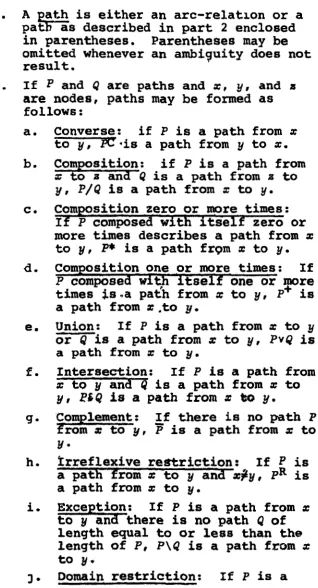
We a l s o presented a s y n t a x f o r path- based i n f e r e n c e r u l e s which can be summar-
i z e d a s follows:
1. A a t h i s e i t h e r an a r c - x e l a t l o n o r a
%-
p a t as d e s c r i b e d i n p a r t 2 enclosed i n parentheses. P a r e n t h e s e s may be o m i t t e d whenever an ambiquity does n o t r e s u l t .
2. I f P and Q are p a t h s and z, y
,
and aare
nodes, p a t h s may be formed a s f o l l o w s :a. Converse: i f P i s a p a t h from s
t o y , pd*is a p a t h from y t o x . b. Corn o s i t i o n : i f P i s a path from
-8 i s a path from a t o y
,
P/Q i s a p a t h from x t o y. c. Composition z e r oor
e r e t i m e s :I f P composed w i t h i t s e l f z e r o
o r
more t i m e s d e s c r i b e s a p a t h from xto g , PS is a p a t h ftgm x t o y .
d, Composition one o r more t i m e s : I f
P composed with itself
one
o r moretimes-$.sea pach from x t o y , P+ i s a p a t h from x . t o y.
e. Union:
-
If P i s a p a t h from x t o y or Q is a path from x to y , Pv6j is a p a t h from x t o y ,f. I n t e r s e c t i o n : If P is a p a t h from x
t o
y and Q is a p a t h from x t o y , P&Q is a path from x bo y eg. Corn leraent: I f t h e r e i s no p a t h P
by,
P
i s a path from r t oh. t r r e f l e x i v e restriction: I f P is
a p a t h from x t o y and x$y, pR i s a p a t h from x t o y.
i, Exce t i o n : If P is a p a t h from x *there is
no
p a t h Q of l e n g t h e q u a l t oor
less t h a n t h e l e n g t h of P, P \ Q i s a p a t h from xt o y.
Psychology Program, Department crf Psv- chology, I n d i a n a U n i v e r s i t y ,
~ i o o m i ~ g t o n , I N . August, 1 9 7 7 . * p a t h from s to # and'
Q is
a p a t hf r o m x t o s, (Q s ) P is a fiath from
x t o y .
k, Range r e a t r i a t i o n : I f P
is
a path from 3t t o 8 and4
is a p a t h f r o m yt o a , P ( Q r ) i s a path from x t o Y o
10. Q u i l l i a n , M.R. Semantic memry.
I n
M. Ninkay, ed. Semantic Information P r o c e s s i n
,
MIT Press, Cambd 2 7 0 . rid*, MA,
A path-based i n f e r e n c e r u l e i s of t h e
form < d e f i n e d path> + < d e f i n i n g paths
where <defining p a t h > i s any p a t h de-
scribed by p a r t s 1 or 2 above, and < d e f i n e d path> i s e i t h e r a) a s i n g l e a r c - r e l a t i o n , or b) a composition of n arc relations
for
q r a e
fixed n, i.0. u s i n g o n l y "/*, n o t"*"
o r"+".
The r u l e i s i n t e r p r e t e d t o mean t h a t i f t h e < d e f i n i n g p a t h , goes from some node x t o some node y t h e n : a ) t h eazc
t h a t id the < d e f i n e d p a t h > i a i n f e r r e d t o e x i s t from x t o #; b) t h e n arcst h a t are t h e <def.tnsd path, and n-1 new i n t e r m e d i a t e nodes a r e i n f e r r e d t o e x i s t f r o m x t o y.
l l . Raphael, B. SIR: s e m a n t i c informa- t i o n r e t r i e v a l . I n M. Minsky, ed.
S e m n t i c Information
Pkooesainy,
MITP r e s s , Cambridge, MA., 1968, 3 -145.
12. Schubert, L o K * Extending t h e expws- s i v e p o w e r o f semantic networks.
13. Schwarcz, R.M., Burger, J . P . , and Simmons, R.F. A d e d u c t i v e q u e s t i o n - answerer f o r n a t u r a l lanuuaqe i n f e r - ence. CACM 1 3 , 3 (March; 1570), 167-
183.
14. Shapiro, S .C. A
nett
s t r u c t u r e for semantic i n f o r m a t i o n storage, deduc- t i o n and r e t r i e v a l , Proc e - Second I n t.
Jt,. Conf,
on
A r t i f i c i a l I n t e l l i g e n c e , The BritYsh Computer Society, frondon, ReferencesAnderson, J, and Hastie, R e Individu- a t i o n and r e f e r e n c e b i n me&ry: proper names and d e f i n i t e d e s c r i p t i o n s . -
n i t i v e Psychology 6 , 4 (October,
.
15. Shapiro, i n g d e d u c t i o n males i n a S.C. Representing semantic and l o c a t -network. Proc. Workshop an P a t t e r n - Directed I n f e r e n c e Systems. I n SIGART N e w s l e t t e r , 63 (June, 7 9 n ) , 1 4 - 1 8 , C o l l i n s , A.M. and Q u i l l i a n , R. Re-
t r i e v a l - t i m e from semantic - memory. J.
o f Verbal Learninq and V e r b a l ~ e h a v i W
1969)
-
,
1 240 2 4-
16. Shapiro, S.C. Techniques of A r t i f i ;c i a 1 3 n t e l l i nce. D, Van Nastrand,
New York, 19
.
F i k e s , R. and Hendrix, G. A network-based knowledge r e p r e s e n t a t i o n and i t s 17. Shapiro, S.Ce The SNePS semantic n e t -
n a t u r a l d e d u c t i o n system. Proc. F i f t h
I n t . J t . Conf. on A r t i f i c i a k I n t e l l i - ~ o r k ed. p r o c e s s i n g system. Associative N e t w o r k s I n
--
&. Th!e F i n d l e r , R e p r e s e n t a t i o n and U s e of Knowledge i n Coqrputers, Academic P r e ' s s , N e w York, i n p r e s s .q e n c e , D e p t . of-Computer Science,
Hays, D. G. Coqnitfve S t r u c t u r e s
,'
un-published ms. Dept. of L i n g u i s t i c $ , 18. Shapiro, n e t s t r u c t u r e S.C. based and Woodmansee, r e l a t i o n a l G.H.
sues-
A SUNY a t ~ u f f a10,
~- Amherst,NY.
t i on answerer : d e s c r i p t i o n and -exam-
Hays, D O G 6 Types of processes
on
cog-n i t i v e networks. I n L.S. Olschki. e d .
ples. Proc. I n t . J t . ~ o n f
.
on ~ r t i f i c l a l I n t e l l i q e n c e , The MITRE Corp., Bedterd, MA., 1969, 325-346. Mathematical L i n q u i s t i c s , F f i e n z e ,~ i s a , 1 m 523
-
532.19. Winograd, T. Frame represmtatiens
and t h e d e c l a r a t S v e / p r o c e d u r a l Contro- versy. I n D.G. Bobraw and A. C o l l i n s , eds. ~ e p r e s e n t a t i o n and U n d e r s t a n d i q , Academic Press- I n c , , New York, 7975,
185-210. Hendrix, G.G. Expanding t h e u t i l i t y
o f semantic networks through p a r t i t i o n i n g . Advance Papers o f t h e F o u r t h
Int. J t . Conf
.
o n A r t i f i c i a l 1 n t e L l i - a e n c e . MIT A 1 L a b o r a t o m . Cambridcre.20. woods, w,A. What's i n a l i n k : Foqn- dations for semantic networks.
I n
D. G. Bobrow and A. Collins, eas. Repre- Kay, M e The M I N D system. I n R.R u s t i n , ed. N a t u r a l Eanguase Process-
*
~ l g o r i t h m i c s Press, New York,3, 155-188. s e n t a t i o n and ~ n d e r s t a n d i ~ , Press, Inc., N e w York, 19
,
~ca- 35-82. M c D e r m o t t , D. ~ r t i f i c i a l i n t e l l i g e n c emeets natural stupidity. SIGART N e w s l e t t e r , 57 ( A p r i l , 197$,-4-9.
h
McNabb, S.D. The e f f e c t s of encoding s t r a t e g i e s and age on t h e memory re- p r e s e n t a t i o n for s m t e n c e s c o n t a i n i n g p r o p e r names and -hit@ d e s c r i p t i o n s