American
Journal
of
Computational Linguistics
Microf i c h c 56P R O C E S S I N G
C A S E
Y O R I C K WILKS
PRESENT A D D R E S S : DEPARTMENT O F L A N G U A G E AND LINGUISTICS, UNIVERSITY OF E S S E X
COLCHESTER, E S S E X , ENGLAND
ABSTRACT
T h i s p a p e r h a s t h r e e p u r p o s e s : f i r s t l y , t o d e s c r i b e how c a s e i n f o r m a t i o n IS d i s t r i b u t e d i n t h e p r e f e r e n c e s e m a n t i c s system o f
language u n d e r s t a h d i n g , and t c show what p r a c t i c a l use i s made o f t h a t i n f o r m a t l o q . Second] y , t o a r g u e t h a t t h a t way of d o i n g t h l n g s h a s a d v , ~ n t a g e s o v e r t a o a l t e r n a t i v e s : ( a ) p u t t i n g a l l c a s e i n f o r m a t i o n I n one p l a c e , and (b) n o t u s i n g any c a s e i n f o r m a t i o n a t a l l , b u t o n l y t.he names of E n g l i s h p r e p o s i t i d n s . T h i r d l y , I wish t o - u s e t h e p o s i t i o n s
e s t a b l i s h e d e a r l l e r c o u n t e r some r e c e n t arguments by and
o t h e r s that t h e n o t i ~ n o f c a s e i s n o t i n f a c t functioning i n any
n a t u r a l l a n g u a g e u n d e r s t a n d i n g s y s t e m s t h a t f a l l w i t h i n what c o u l d b e c a l l e d the A r t i f i c i a l Intelligence p a r a d i g m . A theme t h a t r e c u r s i n
I 1
the p a p e r i s t h a t t e n d e n t l o u s d i s t l b 1 c t i o n s , such as s u r f a c e " , "deep" and " c o n c e p t u a l " c a s e , must b e expounded i n p r o c e s s i n g terms i f t b e y
a r e t o make s e n s e .
The p a p e r owes a g r e a t d e a l t o discussions w i t h Eugene C h a n l i a k , Graham R i t c s h i e , M a r g ~ r e t Klng and F r e d e r i c k Parker-Rhodes. The
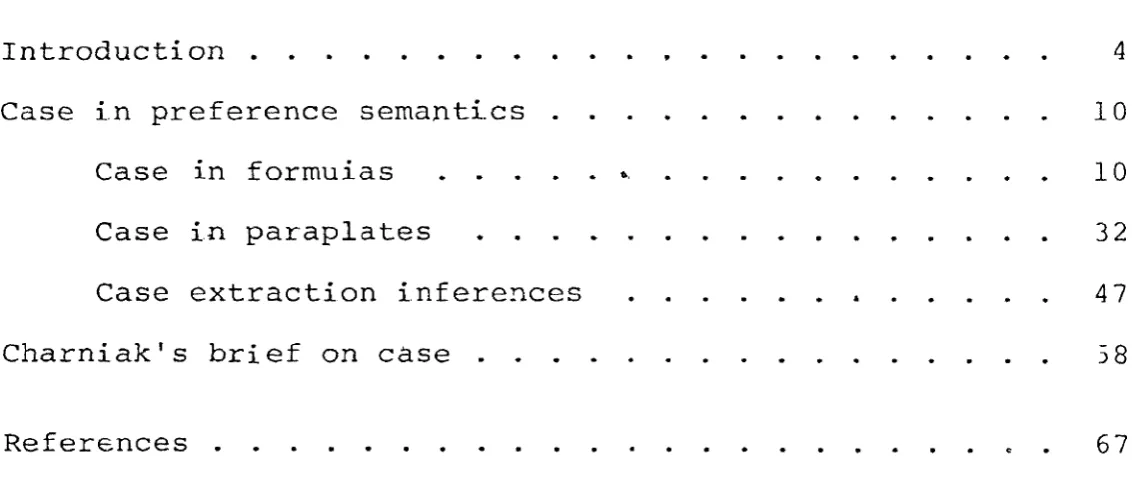
TABLE
OF CONTENFSI n t r o d u c t i o n
. . .
4. . .
C a s e i . n preference s e m a n t i . c s 1 0
.
.
..
C a s e i n f o r m u i a s
-
1 0C a s e
i n
p a r a p l a t e s. . .
3 2. . .
. . . .
Case e x t r a c t i o n i.nferences 4 7
C h a r n i a k ' s b r i e f o n c a s e
. . .
58 [image:3.706.70.639.151.393.2]I N T R O D U C T I O N
T h i s p a p e r i s I n t e n d e d t o d e s c r i b e t h e case h a n d l i n g procedures o f
t h e p r e f e r e n c e s e m a n t i c s (Wilks 1 9 7 2 , 1975a)system o f n a t u r a l language u n d e r s t a n d i n g b y g i v i n g a more complete account t h a n In p r e v l o u s p a p e r s , and I n p a r t i c u l a r I s h a l l d i s t i n g u i s h t h e application o f c a s e t o t h e p a r s i n g o f p r e p o s i t i o n s t r u c t u r e s I n E n g l ~ s h from subseqyent i n f e r e n c e s
u s i n g c a s e , Case i n f o r m a t i o n i n t h l s system I S s t o r e d i n t w o d l f f e r c n t p l a c e s : i n what a r e c a l l e d formulas and p a r a p l a t e s r e s p e c t i v e l y . I
s h a l l a r g u e a r e a s o n a b l e * p r o c e s s i n g account o f c a s e r e q u i r e s t h i s . I s h a l l w n t r a s t t h i s p o s i t l o n b r i e w w i t h t h o s e of Schank and Riesbeck, who seem t o m e t o a d v o c a t e a s i n g l e t y p e of c a s e i n f o r m a t i o n , and a no
c a s e view r e s p e c t i v e l y . More i m p o r t a n t l y , I h s h a l l a r g u e a g a i n s t a 9
r e c e n t p o s i t i o n of Charniak t h a t A r t i f i c i a l I n t e l l i g e n c e ( A I ) n a t u r a l language systems do n o t i n f a c t make any u s e
d
c a s e , I s h a l l d l s c u s s h i s arguments and u r g e t h a t , a l t h o u g h t h e r e a r e systems t o whlch h i sarguments do a p p l y , t h e y do n o t apply t o t h e one d e s c r i b e d h e r e , a t l e a s t
h o t i f c a s e i s t o have a n y t h ~ n g l i k e i t s normal meaning,
The u s e of c a s e i n f o r m a t ~ o n i n A 1 comes from t h e work of F ~ l l m o r e
(1968), i n which t h e u n d e r l y i n g s t r u c t u r , e of a s e n t e n c e i s d i s p l a y e d , i n e s s e n c e , a s an a r r a y of argument values far a p r e d i c a t e , where t h e
-redi,:ate i s t h e v e r b o f tk s e n t e n c e o The c o r r e s p o n d i n g v a l u e s a r e t h e c a s e p a r t s of t h e s e n t e n c e , each of a d i f f e r e n t case t y p e , and,
T h u s , i f t h e h o r i z o n t a l l i n e s d e n o t e t h e v e r b p r e d i c a t e , t h e c a s e
frame f o r "break" c o u l d b e w r i t t e n a s :
(
- - -- - - -
OBJECT (AGENT) (INSTRLJIENT) )which means t h a t t h i s v e r b m u s t t a k e an o b j e c t , and cen b u t need n o t t a k e an a g e n t and i n s t r u m e n t c a s e . These l a t t e r two c a s e s a r e o p t i o n -
a l h e r e and t h a t o p t i o n a l l t y i s indicated by t h e p a r e n t h e s e s round t h e
-
c a s e names. So, on t h i s view:
(1) John b r o k e
would b e i l l - f o r m e d b e c a u s e i t gives u s o n l y t h e ( o p t i o n a l ) a g e n t of
b r e a k i n g , which i s John, b u t o m i t s t h e o b l i g a t o r y o b j e c t t h a t i s broken.
Thls a n a l y s i s can b e c o n t r a s t e d w i t h " h i t " , whose frame would be
(
-
-
- -
-
-
-
OBJECT (AGENT1
INSTRUMENT) )where t h e o v e r l a p p i n g b r a c k e t s mean that t h e two c a s e s , a g e n t and
i n s t r u m e n t a l a r e s e m i - o p t i o n a l , i n t h a t a t l e a s t one of t h e two must appear. Thus
The window h i t
would b e i l l - f o r m e d on t h a t v i e w because, a l t h o u g h i t c o n t a i n s t h e o b l i g a t o r y o b j e c t , i t c o n t a i n s n e i t h e r t h e a g e n t nor the i n s t r u m e n t
would b e p e r f e c t l y well-formed w i t h r e s p e c t t o t h e frame f o r ' b r e a k ' ,
T h i s s o r t of c a s e a n a l y s i s 1s n o r m a l l y z a l l e d deep c a s e * t o distinguish
i t from t h e s u r f a c e c a s e m a n i f e s t a t i o n of word i n f l e c t i o n s i n Greek,
Lati'n and German e t c . It should b e n o t e d , t o o , t h a t h e r e , a s through-
o u t t h e p a p e r , no a t t e m p t i s made t o s t i c k t o t h e a c t u a l l i s t of c a s e
names used by any a u t h o r , s i n c e t h e s e v a r y s d much from one t o t h e n e x t ,
and no p o i n t of principle hangs on arYy p a r t i c u l a r l i s t o f c a s e s ,
~ i l l r n o r e ' s l i n g u l s t i c t h e o r y i s , n a t u r a l l y enough, a g e n e r a t i v e
one i n t h a t t h e p r o c e d u r e s i t s u g g e s t s would be t h o s e f o r g e n e r a t i n g s e n t e n c e s from an u n d e r l y i n g s t r u c t u r e o f a v e r b p l u s i t s c a s e argument
v a l u e s . What t h e s u r f a c e f o r m would be, g l v e n any p a r t l c ~ l a r under-
l y i n g s t r u c t u r e , i s d e t e r m i n e d B y what F i l l m o r e c a l l s t h e " s u b j e c t
s e l e c t i o n r u l e " , which s a y s t h a t , i f t h e r e i s a n a g e n t , t h a t w i l l b e
t h e s u b j e c t o f any a c t i v e s e n t e n c e produded; i f t h e r e i s no a g e n t b u t
t h e r e i s a n i n s t r u m e n t , t h e n t h a t w i l l b e t h e s u b j e c t and s o on.
I n t h i s p a p e r , I Ishall c o n c e n t r a t e , a s i s normal i f n o t d e s i r a b l e
i n A 1 and c o m p u t a t i o n a l l i n g u i s t i c s , Qn q u e s t i o n s of a n a l y s ~ s r a t h e r
t h a n g e n e r a t i o n . The g e n e r a l p r o b l e n i n a n a l y s i s ( t h a t i s n o t emphasised
i n g e n e r a t i o n ) i s t h a t of t h e s e l e c t i o n r e s t r i c t i o n s on t h e
c a s e s , which can be i l l u s t r a t e d by l o o k i n g a t t h e s i m p l e s t of t h e
systems u s i n g c a s e a n a l y s i s (Simmons 1973). Simmons w i s h e s t o map
a l l o f t h e s e n t e n c e s ( 4 ) (7) o n t o t h e same s e m a n t i c network
( 4 ) John broke t h e window w i t h a hammer
(5) John broke t h e window (6) The hammer broke t h e window ( 7 ) The window broke
A l l a r e p e r f e c t l y well-formed with r e s p e c t t o t h e f r a n c f o r "break1'
given e a r l i e r . Simmons p a r s e s s u c h s e n t e n c e s u s i n g an augmented t r a n s - i t i o n network (Woodst1970) and a n o t i o n of case p a r a d i g m d u e t o Celce- Murcia ( 1 9 7 2 ) . This paradigm, f o r a c t i v e f o r m s of a v e r b l l k e "break",
has the form:
(8) AGENT
*
OBJECT INSTRUMENTAGENI
*
CBJECTINSTRUMEIJT
*
OBJECTOBJECT A
The l i n e s of (8) a r e p a t t e r n s t h a t must match i n p u t word s t r i n g s i n l e f t r i g h t o r d e r s o a s t o a s s i g n t h e c a s e s they c o n t a i n , The l i n e s of (8) match e a c h of (4)
-
( 7 ) i n t u r n , where marks t h e p o s l t i o n oft h e v e r b ( b r e a k ) i n each l i n e of t h e paradigm, The l i n e s of (8) a r e no more t h a n t h e p o s s i b l e case combinations a l l o w e d by the case frame
11
f o r "break" t o g e t h e r with an a n a l y t i c v e r s i o n of t h e s u b j e c t s e l e c t i o n r u l e " , which a l w a y s makes the Agent t h e f i r s t ( s u b j e c t ) i t e m I n any l i n e o f t h e paradigm (8) i n which i t o c c u r s , There i s no need f o r t h e
although t h e r e i s one additional. item of information r e q u i r e d b e f o r e they can be a p p l i e d a t a l l : t h e s e l e c t i o n r e s t r i c t i o n s , These t e l l us what i t i s t o b e an agent of "break": i n S i m o n s ' s scheme a noun marked ANIMATE, The s e l e c t i o n r e s t r i c t i o n s a t t a c h e d t o t h e cases i n
(8) a r e e s s e n t i a l t~ t h e a p p l i c a t i o n of t h e paradlgrn, f o r only thus could w e know t h a t " ~ o h n " i n ( 4 ) was matched by ACZENT i n t h e f l r s t l i n e of (8). It should be noted t h a t t h e r e s t r i c t i o n of AGENT i n (8)
t o nouns m%rked ANIMATE i s n o t n e c e s s a r i l y a r e s t r i c t i o n p e c u l i a r t o
' b r e a k ' , b u t r a t h e r t o t h e c l a s s of v e r b s f o r which (8) i s t h e ( a c t i v e ) paradigm. Conversely, t h e ANIMATE r e s t r i c t i o n on AGEPU'Ts i n (8) I S
n o t n e c e s s a r i l y on AGENTS a s such although i t might t u r n o u t t o be so, These p o i n t s w i l l be important when we come t o C h a m i a k ' s arguments
l a t e r .
Notice t o o , t h a t t h e r e a r e n o t two d i f f e r e n t w a y s I n which a
s e n t e n c e can be ill-formed w i t h r e s p e c t to the paradigm: one with r e s p e c t t o s e l e c t i o n r e s t r i c t i o n s and one with r e s p e c t t o t h e case frame ( a s has been argued by Bruce 1 9 7 5 ) . The c a s e frame expressed by t h e paradigm, and the corresponding s e l e c t i o n r e s t r i c t i o n s a r e
i n d i v i s i b l e . So, for example,
(9) John broke
a s t h o s e p r o v i d e d by Simmons' paradigm, w e c a n n o t deem t h a t f a i l u r e a s
one of m a t c h i n g a l i n e o f (8) a s d i s t i n c t from ( B r u c e ' s v i e w ) n o t
m e e t i n g t h e s e l e c t ~ o n r e s t r ~ c t i o n s PHYSOB
,
s a y , on t h e c a s e OBJECTon t h e f o u r t h l i n e of (8). F o r t h e s e l e c t i o n r e s t r i c t i o n a s s o c i a t e d
w i t h a c a s e d e f i n e s what ~t i s t o match a c o r r e s p o n d i n g l i n e o f (8). The o n l y way i n which a sentence c o u l d i n d e p e n d e n t l y f a l l t o match any
l i n e i n t h e p a r a d i g m of (8) would b e t h e t r i v i a l o n e o f h a v i n g some
number o f a r g u m e n t s ( s a y , f o u r o r z e r o ) n o t c o r r e s p o n d i n g t o any l i n e
CASE I N PREFERENCE SEMANT?CS
Case i n formulas
T h i s system b u i l d s meaning s t r u c t u r e s and i n f e r e n c e r u l e s from
e i g h t y p r i m i t i v e semantic elements, These a r e of e i g h t types, one of
which c o n s i s t s of t h e c a s e elements a s f o l l o w s ;
*DIRE t h e g e n e r a l DIRECTION ca'se element. Like a l l t h e p r i m i t i v e
elements whose names a r e preceded by an a s t e r i s k , i t i s equivalent t o
a c l a s s of o t h e r p r i m i t i v e s , i n t h i s c a s e t h e f o l l o w i n g f o u r :
TO d i r e c t i o n towards
FROM d i r e c t i o n away from something
UP i n an upwards d i r e c t i o n
THRU d i r e c t i o n through some o t h e r thing.
INST t h e INSTRUMENT c a s e , i n d i c a t i n g t h e instrument used i n some
a c t i o n
FOR
t h e RECIPIENT c a s e , i n d i c a t i n g t h e normal r e c i p i e n t of ana c t i o n
I N t h e CONTAINMENT c a s e , i n d i c a t i n g what c o n t a i n s some o t h e r t h i n g
LOCA t h e SPATIAL LOCATION case, indicating t h e p l a c e of an a c t i v i t y
o r t h i n g
TLOCA 'the TIME LOCATION else, i n d i c a t i n g the time l o c a t i o n of an
a c t i v i t y
SOUR t h e SOURCE c a s e , i n d i c a t i n g t h e s u b s t a n c e f r o m which some
o b j e c t came
WAY t h e MANNER c a s e , ~ n d i c a t l n g t h e manner o r method by which an
a c t i v i t y was performed
OBJE t h e OBJECTIVE c a s e , i n d i c a t a n g t h e o b j e c t of an a c t i o n
SUBJ t h e AGENT c a s e , . i n d i c a t i n g t h e i n s t i g a t o r of an a c t i o n ,
' s u b j e c t ' h e r e b e i n g taken t o r e f e r t o a semantic, r a t h e r than
a s u r f a c e , s u b j e c t
WITH t h e ACCOMPANIMENT c a s e , i n d i c a t i n g t h e acco~npanier of an e n t i t y
POSS t h e POSSESSIVE c a s e , i n d i c a t i n g who owns some t h l n g
These c a s e p r i m i t i v e s a r e u l t i m a t e l y t h e names of r e l a t i o n s i n
t h e system of semantic r e p r e s e n t s t i o n , j u s t a s i n t h e f a m i l i a r semantlc
n e t r e p r e s e n t a t i o n s (Simmons 1973) t h a t i n d i c a t e t h e i n s t r u m e n t a l i t y of
say, t h e a c t i o n of s t r i k i n g by a l a b e l l e d a r c such as:
s t r i k e 'hammer
The representations d e s c r i b e d h e r e a r e n o t of t h i s s u p e r f i c i a l form
f o r t h r e e r e a s o n s :
a) Semantic n e t s do n o t immediately s u g g e s t t h e i r a s s o c i a t e d
p r o c e s s e s , whereas t h e r e p r e s e n t a t i o n s h e r e a r e intended t o be
d i r e c t e d towards t h e p r o c e s s e s t h a t o p e r a t e on them.
1 2
a t i o n between t h e knowledge s t o r e d and t h e p a t t e r n s sought i n language,
on t h e one hand, and t h e language t e x t a c t u a l l y r e p r e s e n t e d found, on
t h e o t h e r ; where t h e l a t t e r may n o t e x a c t l y match what was being looked
f o r , This d i s t i n c t i o n 1 s n o t always easy t o work i n t o
a
semantic n e ts t r u c t u r e .
c) The p r e s e n t system of r e p r e s e n t a t i o n i s intended t o be more
" h a b i t a b l e " i n W a t t ' s (1968) s e n s e o f providing
a
language o f semanticr e p r e s e n t a t i o n t h a t i s a p p r o p r i a t e t o t h e way humans express themselves.
That
i s
a h i g h l y s u b j e c t i v e n o t i o n , perhaps, b u t h e r e i t i s taken t or e q u i r e a t l e a s t a dynamrc, o r r e a d a b l e s t r u c t u r e , which n e t s do n o t
haverThj srequirement r e s t s upon another assuniption: t h a t our
r e p r e s e n t a t i o n
must
have t h e "one t h i n g a f t e r another" f e a t u r e t h a tt e x t , $ have, r a t h e r than b e i n g s t a t i c and t i m e l e s s l i k e most semantic
n e t s
(thoughdNorman and R u m e l h a r t(1975)
hdve c o n s t r u c t e d n e t sc o n t a i n i n g ordered a s s e r t i o n s , though t h e s e a r e no l o n g e r semantic
n e t s
i n
t h e c l a s s i c s e n s e ) .The
case
p r i m i t i v e s f u n c t i o n w i t h i na
semantic dependencygrammar (Hays ? 9 6 4 ) , intended t o express t h e meaning of word s e n s e s
and, by e x t e n s i o n , of t e x t s . Each of t h e casg p r i m i t i v e s above w i l l
have a dependent, which i s a t y p e of e n t i t y f o r a l l t h e case prirfi-
i t i v e s except WAY and GOAL, which t a k e an a s s e r t i o n a s dependent,
The
case p r i m i t i v e and i t s dependent ( e n t i t y o r a s s e r t i o n ) f o m af o r WITH and POSS which depended on an e n t i t y
,
and may t h e r e f o r e .be o n l y s e m i - c a s e s ) . This is best s e e n by example of t h e firsts t r u c t u r e i n the system, t h e f o r m u l a
-
which e x p r e s s e s word s e n s e i nt h e d i c t i o n a r y , The f o r m u l a f o r t h e action sense of "break" i s as
f o l l o w s :
The g e n e r a l structure o f such f o r m u l a s h a s been e x p l a i n e d In
Wifks (1968, 1972, 1975a, 1975b). They a r e i n t e n d e d t o e x p r e s s t h e
f n t e r l i n g u a l meaning o f t h e sense of t h e word, and t h e p r i m i t i v e s t h a t c o m p r i s e them a r e i n t e h d e d t o b e i n t e r l i n g u a l (as a r e F i l l m o r e ' s c a s e s )
even though they happen t o be m o s t l y Anglo-Saxon m o n o s y l l a b l e s .
We h a v e a l r e a d y mentioned t h e dependence o f a n e n t i t y ( o r a s s e r t i o n ) on a case p r i m r t i v e t o form a c a s e group, such a s (*'tIb% SUBJ), which means t h a t an a g e n t i s ( p r e f e r a b l y ) human. These c a s e groups ( e x c e p t
WITH and POSS) a11 depend r i g h t w a r d s on some a c t i o n , so t h a t (*HUM S U N ) i n (10) depends on t h e main p r i m i t i v e a c t i o h of t h e whole f o r m u l a STRTK,
The whole formula i s t o b e i n t e r p r e t e d a s "breaking" b e i n g a ~ ' k ~ ~ ~ i n g , done p r e f e r a b l y t o a *PHYSOSJect, and by
a
*HUMan SUBJect, u s i n g anINSTrument t h a t i s a T H I N G and w i t h t h e GOAL o f CAUSing t h e *PINSOBJect t o BE NOTWHOLE.
T h i s i n t e r p r e ~ a t i o n can b e c o n s t r u c t e d from t h e f o l l o w i n g _ g e n e r a L r u l e s f o r t h e b u i l d i n g and i n t e r p r e t a t i o n o f f o r m u l a s :
i)
Each subgroup i n t h e f o r m u l a c o n s ~ s t s of a left mernber depending on a r i g h t member, and l e f t o r r i g h t may b e e i t h e r a s i n g l e p r i m ~ t i v e element o r a n o t h e r group, Thus, i n (*EIUM SUBJ) w e have a c a s e group, known t o b e such b e c a u s e t h e r i g h t m o s t m e m b e r of i t s p a i r i s t h e gover- n o r and SUBJ i s t h e p r i m i t i v e element naming t h e Agent caqe. Onelevel h i g h e r (*HUM SUBJ)
.
depends on STRIK, t h e main p r i m i t i v e o f t h e whole f o r m u l a , to form an a s s e r t i o n group. S i m i l a r l y , each o f t h eother maln s u b p a r t s o f t h e formula (whose heads a r e r e s p e c t i v e l y O B J E , INST an6 GOAL) depends on STRIK t o form i n each c a s e an a c t i o n
group which always c o n s i s t s of an a c t i o n and any c a s e group that i s
ii) The dependency w i t h i n a group 1s i n t e r p r e t e d d i f f e r e n t l y accord-
i n g t o t h e t y p e of t h e group. Within an a c t i ~ n graup ((*PKYSOB OBJE)
STRIK) t h e dependepce i s t h a t of an a c t i o n ' s o b j e c t on t h e a c t i o n and
OWE does no more than name t h a t r e l a t i o n .
-
I n t h e cases group(*PHYGOB OBE) t h e r e l a t i o n i n t e r n a l l y i s no s o r e t h a n t h e p r e f e r r e d
t y p e of c a s e f L l l e r Cphysical o b j e c t ) on t h e name of t h e c a s e . With
a s u b s t a n t i v e group l i k e (LINE THIYG) t h e dependence i s i n t e r -
p r e t e d a s s p e c i f i c a t i o n , i . e . l i n e a r o b j e c t . *PHYSOB i s a name ~f a c l a s s of primitive elements which i n c l u d e s T H I N G , b u t a l s o o t h e r
p r i m i t i v e s l i k e MAN.
I n
c a s e subfarniulas, e&c@pt afid WAY,t h e l e f t m o s t item i s always t h e p r e f e r r e d e n t l t y t y p e , t o f u y c t l o n i n
t h e c o r r e s p o n d i n g rightwards-nwed c a s e . T h i s l e f trnost item 1 9 , i f
you w i l l , the ' s e l e c t i o n restriction' f o r t h a t c a s e r o l e f o r whatever
a c t i o n i s b e i n g coded:
i.
e. i n t h e formula above, f o r ' b r e a k ' . Ther e a d e r should n o t confuse t h i s w i t h b e i n g a r e s t r i c t i o n f o r t h e
a s s o c i a t e d p r i m i t i v e STRIK, T h i s p o i n t w i l l b e d i s c u s s e d l a t e r , b u t
f o r now t h e formula i s t o b e t a k e n as no more t h a n a formal e x p r e s s i o n
of t h e meaning o f t h e a c t i o n ' b r e a k ' t h a t can b e used i n subsequent
I t
i n f e r e n c e and p a r s i n g routines, However, s e l e c t i o n r e s t r i c t i o n "
h e r e i s t o b e r e a d as I p r e f e r r i n g t h e a g e n t of "break" t o b e hurnaa1,say,
I have d e s c r i b e d elsewhere (Wilks 1 9 7 c) how when t e x t r e p r e s e n t a t i o n s
are assembled t h a t w i l l b e o n l y a p r e f e r e n c e on t h e a g e n t o f "break",
and t h e system w i l l n o t b a u l k a t assembling a r e p r e s e n t a t i o n f o r "The
would p r e f e r a hwnan a g e n t i f i t could f i n d one.
I
write o f"assembling r e p r e s e n t a t i o n s u because t h e elements l i k e *Hull i n t h e formula above a r e n o t s l o t s t o be f i l l e d by, i n t h i s case, t h e a g e n t
of some breaking, The formulas a r e ' b l u e p r i n t s ' f o r how r e p r e s e n t - a t i o n s a r e t o b. assembled e l s e w h e r e from whole formulas. When a
r e p r e s e n t s t i o n f o r "The man b r o k e . t h e window" i s assembled t h e whole
f o r m u l a above ( t o g e t h e r w i t h a PAST element) w i l l s t a n d a t some app-
t o p r i a t e node of a h i g h e r - l e v e l r e p r e s e n t a t i o n .
It i s t h i s f e a t u r e of t h e system t h a t e x p l a i n s why t h e head, o r
p r i n c i p a l , element of a formula i s e a s i l y a c c e s s i b l e a t one end QE i t
- - r a t h e r t h a n b u r i e d i n t h e c e n t e r a s i t would b e i f t h e formula w2reL
i n SVO form, r a t h e r t h a n SOV form, a s above, Formulas e x i s t f o r a l l
p a r t s of speech s o , f o r ex@mple, a formula f o r a n e n t i t y w i l l have n o t
a p r i m i t i v e a c t i o n head l i k e STRIK, b u t an e n t i t y head l i k e T H I N G o r MAN
o r
STUFF
( f o r s u b s t a n c e ) . Note t o o , t h a t t h e p r e f e r e n c e r e s t r i c t i o n sfor case need n o t b e s i m p l e a s above b u t can be a s complex a s r e q u i r e d ,
i n c l u d i n g f u r t h e r c a s e r e s t r i c t i o n s r e c u r s i v e l y . So, f o r example, if
t o b e i n t e r p r e t e d a s : done w i t h an INSTrument t h a t i s p r e f e r a b l y a
LINEar T H I N G WITH (accompaniment case) an a p e r t u r e (THRU PART).
i i i ) I n o r d e r t o makc t h e formula " h a b i t a b l e t ' t h e a g e n t s and o b j e c t s
a r e compressed, i n t h a t t h e y can be agknts and o b j e c t s f o r more than one
p r i m i t i v e a c t i o n , Agents and o b j e c t s of a c t i o n s i n a formula a r e
normally sought t o t h e l e f t of t h e p r i m i t i v e a c t i o n element. I f t h e
whole formula i s f o r an a c t i o n ( a s above f o r 'break') t h e two l e § t -
most s u b p a r t s of t h e formula w i l l always be t h e p r e f e r r e d agent and
o b j e c t of t h e head p r i m i t i v e , i n t h a t o r d e r . For
any
a c t i o n sw i t h i n t h e formula (such as
CAUSE
i n t h e formula f o r 'break') i t sp r e f e r r e d a g e n t and o b j e c t
a r e normally t h e next agent and o b j e c t t o
i t s l e f t
--
which of course, a s i n t h e c a s e of 'break' may t u r n o u t-
t o y i e l d t h e same e n t i t y a s t h e p r e f e r r e d agent of t h e whole formula,
though t h i s need n o t b e t h e case. Moreover, i n t h e c a s e of a c t i o n s
w i t h i n a formula (i.e. n o t c o n s t i t u t i n g t h e head) t h e a g e n t need not be
marked though t h e o b j e c t m u s t be i f i t
i s
an e n t i t y type. T h i sp r o v i s o does n o t apply I n t h e formula above s i n c e t h e agent i s t h e
same f o r
CAUSE
andSTRIK,
and CAUSE t a k e s an a s s e r t i o n as o b j e c t , b u tw i t h i n a formula
a
group (MAN STRIK) would always be i n t e r p r e t e d a s angroup, MAN being
an
unmarked agent of STRIK, and n o t a sa
man being s t r u c k which would r e q u i r e a marked o b j e c t i n t h e a c t i o n
group
i
,
e , ((MAN
OBJE) STRIK).
break'
a r e
n o t t h e a p p a r e n t ones i . e , t h e dependent of GOAL, a smentioned e a r l i e r , must be an a s s e r t i o n , whereas i t
i s
brncketted t oonly
(((NOTWHOLE
K1ND)BE)CAUSE) which can only (during i n f e r e n c ep r o c e d u r e s , c a l l e d ' e x t r a c t i o n ' t o be d e s c r i b e d l a t e r ) become an
a s s e r t i o n group by t h e a d d i t i o n of a n agent found t o t h e l e f t namely
(*HUM
SUBJ),
CAUSE also r e q u i r e s a dependent o b j e c t t h a t i s ana s s e r t i a n (hence
(*PH'ISOB
OBJE)w i l l
n o t do a si t s a b j e c t
'taken a l o n e )and can t a k e , a,s dependent of t h a t group, an e n t i t y t o i t s l e f t marked
e i t h e r OBJE
o r
SUBJ kfnicheveri s
c l o s e s t , Hence t h e dependent of((NOTWHOLE
KIND)BE) i s *PHYSOB and t h e "'real" dependent ofCAUSE
(found by i n f e r e n c e )
i s
(*PHYSOB
((NOTWHOLE
KIND)
BE)
) and t h e r e a ldependent of
GOAL
i s ((*HUM
SUBJ)
(*PHYSOB ((NOTWHOLE KIND)
BE)
))CAUSE)
.
T h i s compresai& of expression can be argued t o b e "habitable"
f o r a formula maker, It a l s o avoids t o a l a r g e e x t e n t t h e d e f e c t
of some f u l l e r conceptual r e p r e s e n t a t i o n s of t h i s g e n e r a l type, pointed
out by
Sandewall (1972),
t h a tif
t h e e n t i t i e s l i k e(*HbM
SUBJ) a r e p u ti n t o t h e r e p r e s e n t a t i o n many times b u t a r e inteqded t o r e f e r t o THE
SAME IlUMAN, then t h i s must be i n d i c a t e d a s i t f r e q u e n t l y was n o t ,
Where such i d e n t i t y m u s t be s p e c i f i c i n formulas,but cannot be achieved
by t h e above compressed e x p r e s s i o n s , i t
i s obtained by means of t h e
p r i m i t i v e s SAME and
NOTSAME:
t h e same (or n o t ) , t h a t i s t o say, a st h e f i r s t encountered token of t h e a s s o c i a t e d p r i m i t i v e when working
from t h i s i s t h a t those.who want t o u s e c a s e names a s t h e names of
r e l a t i o n s ,
as
i n semantic n e t s , and a l s o d e a l w i t h s u r f a c e language,must be prepared t d e x t r a c t a number of such r e l a t i o n s from a s i n g l e
o c c u r r e n c e of c e r t a i n formula s u b p a r t s , Thus, t h e formula f o r ' b r e a k '
a b ~ v e would c o n t a i n n o t o n l y t h e n e t l i n k s :
\
--.,
*HUM
SUBJSTRIK
*HUM CAUSE
but a l s o t h e q u i t e o t h e r t y p e of l i n k
\
*HUMy
SUBJ
breakwhich a s s e r t s t h a t t h e p r e f e r r e d a g e n t of b r e a k i n g w i l l be human.
However t h e t o p l i n k must n o t be i n t e r p r e t e d a s saying t h z t t h e
p r e f e r r e d a g e n t of t h e p r i m i t i v e STRIK
i s
human, because t h a ti s
n o tan a s s e r t i o n i n t h e system a t a l l . A l l t h e t o p l i n k can s a y i s t h a t
the
primitive
a c t i o n STRIK sometines t a k e s human a g e n t s .I n
s o a eo t h e r formula, f o r a n o t h e r s u r f a c e a c t i o n whose underlying p r i m i t i v e
was a l s o STRIK, t h e p r e f e r r e d a g e n t might be "ANI, a wider c l a s s .
Hence,
i n
t h i s system t h e r e a r e n o t s p e c i f i c semantic r e s t r i c t i o n s on.t h e dependents of t h e p r i m i t i v e s , as i n , say Schank (1973),
I n
t h p p r e s e n t system, such a r e s t r i c t i o n could emerge o n l yi n d u c t i v e l y from a survey of a c o n s i d e r a b l e body of formulas, It i s
worth c l a r i f y i n g t h i s i s s u e here: what do u n d e r l y i n g r e p r e s e n t a t i o n s
f i r s t
,
t h e d i f f e r e n t r o l e s of c a s e frames i n a n a l y s i s and g e n * r a t i a n ,and s e c o t ~ d f y , t h e p r o c e d u r a l o p p o s i t i o n between c a s e frame b l u e p r i n t s ,
l i k e f o r m u l a s 3 and the ' f u l l e r * ' r e p r e s e n t a t i o n s o f g e n e r a t i v e s u n a n t i c - >
i s t s t r e e s and Schankian ~ c o n c e p t u a ~ i z a t i o n s ' .
First
,
l e t u s n o t e t h a t i t h a sneyer
beena s
c l e a r as mrght b ewished what c a s e frames awe f o r i n F i l l m o r e ' s work, The normal i n t r o -
d u c t o r y account g i v e n e a r l i e r s t a t e s t h a t they a r e f o r s u r f a c e v e r b s
l i k e ' b r e a k ' , b u t i n F i l l m o r e (1975) he argues t h a t i t i s n o t so s i m p l e
because h e would want t o admit s e n t e n c e s like:
(12) Noon found Harry s l e e p i n g
as p e r f e c t l y well-formed, w h i l e n o t t a k i n g account o f t h e usgge i n t h e
% e n t i v e p a r t of t h e case frame f o r ' f i n d ' . On t h e o t h e r hand, h e
wishes t o avoid t h e p o s i t i o n of s a y i n g t h a t c a s e frames a r e f o r under-
l y i n g v e r b s l i k e s e m a n t i c primitives i n formulas, o r t h e u n d e r l y i n g
v e r b s of G e n e r a t i v e Semanti~srepresentations which avoid c a s e s a l t o -
I have followed F i l l m o r e ' s (1975j device h e r e of making (13)
easier t o read by p u t t i n g ~t i n
SVO
r a t h e r t h a n t h e u s u a l VSO( p r e d i c a t e f i r s t ) form, It w i l l b e seen t h a t i t
i s
p r e t t y s i m i l a rto t h e above f n m u l a for "break1' except t h a t ,
i n
o r d e r to avoid casen o t a t i o n , they have had t o r e s o r t t o such p h i l o s o p h i c a l l y s u s p e c t
devices as s e p a r a t i n g t h e a c t of u s i n g from t h e b a s i c ' a c t ' i n s i d e
t h e tree, even though t h e r e was r e a l l y o n l y one a c t i o n i n t h e whole
b u s i n e s s
An extreme v e r s i o n of t h e view t h a t case frames belong o n l y t o
the u n d e r l y i n g s t r u c t u r e i s Schank's (1973) view t h a t c a s e frames awe
f o r underlying p r i m i t i v e a c t s and t h a t
all
c a s e s that a p r i m i t i v e a c ttakes, i t t a k e s o b l i g a t o r i l y .
u n d e r l y i n g c o n t e n t of s u c h a c t i o n s
as
"buy", " s e l l " and "take", and .kewould b e g i n t h e r e p r e s e n t a t i o n of
(14) The man t o o k a book
a s (Schank 1973, p. 196)
-to.
manQ
(15)
man TRANS+
book<4someone from
11 11 11 I1
where t h e a r r o w s l a b e l l e d R
and
0 i n d i c a t e R e c i p i e n t and O b j e c t i v e..-
-
c a s e r e s p e c t i v e l y , and t h e
-
Agentive c a s ei s
i n f a c t i n d i c a t e d by t h eI1
d o u b l e a r r o w l i n k i n g man", t h e a g e n t , t o t h e a c t TRANS. The d e t a i l s
h e r e need n o t c o n c e r n u s , t h e p o i n t b e i n g t h a t Schank i s s e t t i n g up
case f r a m e s , n o t f o r surface verbs of E n g l i s h , l i k e F i l l m o r e (1968),
b u t f o r t h e s e p r i m i t i v e a c t s , o f which h e h a s about twelve.
From t h e p o i n t of view o n c a s e e x p r e s s e d i n t h e system d e s c r i b e d
here, b o t h t h e s e s t r o n g p o s i t i o n s have drawbacks, indeed t h e y have
complementary o n e s ,
In
. t h e f i r s t p l a c e ,illm more's
(1968) system,w i t h t h e a i d of which
he
wants t o c o n t r a s t v e r b s by means of t h e i rframes, o n l y becomes s i g n i f i c a n t i f I n t e r p r e t e d w i t h t h e a i d of some
n o n - s u r f a c e ' r e p r e s e n t a t i o n of a c t i o n s . So, f o r example, Charniak h a s
p o i n t e d o u t ( p e r s o n a l communication) t h a t t h e e a r l i e r c o n t r a s t of t h e
frames f o r " h i t " and "break"
i s
s i g n i f i c a n t o n l y i f t h e r e i s Pomecommon, u n d e r l y i n g , a c t i o n t h a t t h e two v e r b s s h a r e , and which can b e
Eor, i f t h a t
i s
no& s o , theq t h e c o n t r a s t of t h e frames f o r "kT11" and11 murder" i s of no more i n k e r e s t t h a n t h e c o n t r a s t between " k i l l " and
I I remember", o r any o t h e r random v e r b ,
I n
o t h e r words, i t i s o n l ybecause t h e two v t r b s plready' have something i n common, o v e r and above
t h e i r c a s e frames, t h a t t h e comparison h a s p o i n t . Thus, t h e c o n t r a s t
of t h e c a s e frames of o n l y s u r f a c e v e r b s i s , i f unsupplemented, un-
s a t i s f a c t o r y ,
Conversely, t h e r e may be c e r t a i n problems i n h e r e n t I n Schank's
a t t e m p t t o b o t h (a) r e l a t e s u r f a c e v e r b s t o u n d e r l y i n g p r i m i t i v e
a c t i o n s , and t h e n d i s c u s s o n l y t h e l a t t e r , and (b) a t t h e same time
make a l l p a r t i c i p a n t s i n t h e c a s e frames f o r p r i m i t i v e s o b l i g a t o r y .
11
So, f o r example, F i l l m o r e would e x p r e s s t h e c a s e frame f o r see" a s
(OBJECT DATIVE) and f o r " l e a r n " (OBJECT AGENT). While Schank (1973
pp. 220-1) e x p r e s s e s both v e r b s by an u n d e r l y i n g p r i m i t i v e PITRANS
t o g e t h e r w i t h a c a s e frame, f o r t h e p r i m i t i v e , c o n t a i n i n g a t l e a s t A ,
0 and R ( F i l l m o r e would c a l l R by
D),
The i n d i v i d u a l l e t t e r s f o rcases a s s i g n e d by d i f f e r e n t a u t h o r s need n o t d e t a i n u s , nor need t h e i r
c o n t r a s t i n g i n t e r p r e t a t i o n of t h e c a s e names, f o r t h e p r e s e n t p o i n t i s
the
p e r £ e c t l y g e n e r a l one t h a t , whether o r n o t F i l l m o r e i s r i g h t w i t ht h i s p a r t i c u l a r v e r b p a i r , i t i s h i g h l y l i k e l y t h a t t h e r e are p a i r s
L_.
of s u r f a c e v e r b s l i k e t h i s one whose s u r f a c e c a s e frames a r e d i f f e r e n t
and whose Schankian p r i m i t i v e a c t i s t h e same,
frame must t h e r e f o r e be t h e same too. Since, f o r him, every s u r f a c e
v e t b h a s a main a c t e x p r e s s i n g i t , t h e r e i s c l e a r l y going t o be a
problem w i t h t h i s consequence of (b) u n l e s s he i s prepared t o say t h a t
t h e r e i s no n e c e s s a r y r e l a t i o n a t a l l between a v e r b ' s c a s e frame and
t h e c a s e frame of i t s corresponding p r i m i t i v e a c t . I t may well be
p o s s i b l e t o defend such a p o s i t i o n w i t h i n h i s theory, b u t h e w i l l s t i l l
be l e f t w i t h t h e d i f f i c u l t y that: v e r b s w i t h q u i t e d i f f e r e n t semantic
behaviour ( f o r F i l l m o r i a n c a s e d i f f e r e n c e s a t e not s u p e r £ ic i 8 1 ) have
i d e n t i c a l behaviour i n h i s system, There i s bound t o be a l a c k of
d i s c r i m i n a t i o n consequent upon Schank's a l l - c a s e s - a r e - o b l i g a t o r y view
u n l e s s some c a r e f u l a v o i d i n g a c t i o n i s taken, t h a t h e h a s n o t y e t , t o
my knowledge embarked upon,
However, Schank would probably n o t wish t o take advantage of t h i s
l a s t p o s s i b i l i t y because he does n o t himself hold t h e view t h a t
11
conceptual c a s e i s e n t i r e l y independent of s u r f a c e s t r u c t u r e consid-
e r a t i o n s " , a s was wrongly a t t r i b u t e d t o him by Bruce (ibid.p,338),
and f o r t h e simple reason t h a t he i n t e n d s t h a t c a s e s t r u c t u r e i n
c o n c e p t u a l i z a t i o n s s h a l l r e s o l v e t h e c a s e a m b i g u i t i e s p r e s e n t i n
E n g l i s h p r e p o s i t i o n c o n s t r u c t i o n s . Schank (1973) makes t h i s q u i t e
c l e a r , and
I
s h a l l r e t u r n tc~ ilt when d i s c u s s i n g p r e p o s i t i o n c o n s t r u c t -i o n s i n t h e n e x t s e c t i o n . Thus, s i n c e Schankian c a s e frames f o r
p r i m i t i v e s a r e
-
n o t independent o f a l l s u r f a c e s t r u c t u r e c o n s i d e r a t i o n s ,he does have t h e problem above p r e s e n t e d by t h e c o n t r a s t of "see" and
11
The burden o f t h e l a s t arguments have been t o show t h a t t h r e e
d i f f e r e n t p o s i t i o a s on t h e q u e s t i o n of "what a r e case frames
-
f o r ? "a r e u n s a t i s f a c t o r y :
( i ) t h a t they a r e simply f o r s u r f a c e verbs : Fillmore's 1968
p o s i t i o n , argued a g a i n s t along t h e l i n e s sketched above a s e a r l y a s
Schank (1969),
( ii) t h a t underlying s t r u c t u r e s containing p r i m i t i v e a c t i o n s do n o t
r e q u i r e c a s e frames a t a l l : t h e Generative Semaqtics p o s i t i o n , f o r
example, P o s t a l (1971),
( i i i ) t h a t underlying s t r u c t u r e s containing p r i m i t i v e a c t i o n s a r e case
frames f o r those p r i m i t i v e s and, moteover, a r e a l l o b l i g a t o r y case
frames: Schank's p o s i t i o n j u s t discussed.
Let m e now r e s t a t e t h e p o s i t i o n of t h e p r e s e n t system, a s i t
concerns formulas, Formulas a r e meaning s t r u c t u r e s f o r s u r f a c e word
senses, Formulas f o r s u r f a c e verbs
-
can be i n t e r p r e t e d a s case frame$f o r t h e verbs, i n t h a t they contain case subparts a t t h e top l e v e l
( i , e o depending d i r e c t l y on t h e head a c t i o n p r i m i t i v e ) t h d t t h e formula
maker
has considered necessary t o express a s p a r t o f t h e meaning ofthe verb. Thus, t h e formula f o r "break" given e a r l i e r (10) contains
c a s e s u b p a r t s a t t h e top l e v e l ( i . e o depending d i r e c t l y on t h e head
p r i m i t i v e STRIK) INSTrument,
GOAL,
OBJect and Agent(=underlylng SUBJect),The formula maker i s concerned only with specifying, as b e s t a s he can,
If i t were
a
verb he would s e m a n t i c a l l y s p e c i f y t h e p r e f e r r e d a g e n t ,say, of t h a t a c t i o n , w i t b n o i m p l i c i t r e f e r e n c e t o agenthood a s such.
The same goes f o r t h e o t h e r c a s e s : h e would a t t e m p t t o p u t t h o s e c a s e s
i n t o a f o p u l a t h a t he t h ~ u g h t n e c e s s a r y t o s p e c i f y t h e meaning of t h e
a c t i o n , Consider
(16) He l i v e s i n Lugano I
and
(17) H e drank some Barbera i n Lugano,
It i s l o g i c a l l y t r u e t h a t one must, i f one d r i n k s , do i t some-
where, b u t no one wohld hold t h a t t h e n o t i o n of l o c a t i o n yas involved
i n
e x p l a i n i n g t h e meaning of d r i n k i n g , However, one might w e l l hpldt h a t i t was i m p o s s i b l e t o e x p l a i n t h e n o t i o n of l i v i n g , i n t h e s e n s e
of i n h a b i t i n g , w i t h o u t making c l e a r t h a t i t was done i n some l o c a t i o n .
11
Thus
o n l y i n t h e formula f o r l i v e " would we expect a l o c a t i o n c a s es u b p a r t
(o.,..LOCA),
T h i s d e s c r i p t i o n of t h e i n s e r t i o n of c a s e s p e c i f i c a t i o n i n t o t h e
formula f o r some g i v e n s u r f a c e v e r b does n o t correspond i n any c l e a r
way t o F i l l m o r e ' s o b l i g a t o r y o r o p t i o n a l d i s t i n c t i o n , though i t seems
c l e a r t h a t any formula should c o n t a i n a t l e a s t
-
F i l l m o r e ' s o b l i g a t o r yc a s e s f o r t h a t s u r f a c e v e r b and, a s w e saw
,
(10) above, f o r "break",does t h i s , s i n c e t h e q n l y o b l i g a t o r y c a s e f o r "break" i s o b j e c t ,
The main reason f o r t h i s d i f f e r e n c e remains t h e e s s e n t i a l l y
l i n g u i s t i c argument i n t h e p a s t decade h a s gone i n t o aptempting t o
prove t h a t t h e term "gen'erate"
is
n e u t r a l Getween "analysetl and11 produce". One of t h e b e s t e f f o r t s i s t o b e found i n ~ y o n s ' (1968,
p.155), But, although i t i s easy t~ s e e t h e p r o d u c t i v e r o l e o f , s a y ,
illm more's
s u b j e c t s e l e c t i o n r u l e (SSR), i t i s v e r y h a r d t o s e e whata n a l y t i c s i g n r f i c a n c e it could have; t h e s u r f a c e s u b j e c t i s , a f t e r a l l ,
u s u a l l y r e v e a l e d by simple methods n o t r e q u i r i n g t h e n o t i o n of case.
The SSR t e l l s one how t o c h o ~ s e t h e s u b j e c t 8 i v e n
-
t h e c a s e s t r u c t u r e and i n t h a t s e n s e i s i n h e r e n t l y generative i n i t s non-neutral s e n s eJ
meaning ' p r o d u c t i v e ' . The system p r e s e n t e d h e r e however i s i n h e r e n t l y
a n a l y t i c ( i t s p r o d u c t i v e a s p e c t s have been d e s c r i b e d i n ( H e ~ s k o v i t s
(1973)), and t h i s accounts f o r a g r e a t d e a l of t h e d i f f e r e n c e of
approach t o t h e n o t i p n of meaning s t r u c t u r e 5 Those w i t h p r a c t i c a l
a c q u a i n t a n c e w i t h s e n t e n c e a n a l y s i s and p r o d u c t i o n w i l l need l i ~ t l e
p e r s u a s i o n t h a t t h e t w o p r o c e s s e s a r e n o t i n any s e n s e simple i n v e r s e s
of each o t h e r (nor does F i l l m o r e himself b e l i e v e they a r e , s e e
ill-
more 1972 p, 23).
Charniak h a s argued (1975) t h a t t h e method af formula coding
where t h e containment group (SELF I N ) i n d i c a t e s t h a t t h e l i q u i d o b j e c t
(FLOW
STUFF) i s moved i n t o t h e animate agent (SELF), and t h e d i r e c t l o ngroup ((MAN(Tmu
FART))TO)
i n d i c a t e s t h a t t h i s movement i s i n t h ed i r e c t i o n of a human a p e r t u r e , These two groups appear a t t h e t o p l e v e l
of t h e formula,
and
thus dependent on t h e head primitive a c t i o nC
~
~
~
~
.
However, l a t e r
i n f e r e n t i a l
procedures of e x t r a c t i o n ( s e e below) wouldshow, 8s w i t h "break" (10) e a r l i e r , t h a t t h e r e a l dependency of t h e two
groups
was
on
MOVE, However, t h e requirement1s
observed t h a t t h eFillmorean o b l i g a t o r y c a s e s (only Agent presumably) f o r " d r ~ n k " appear
a t t h e t o p l e v e l , and t h e o t h e r case groups
-
containment and d i r e c t l o n-
most c e r t a i n l y could appear a t t h e s u r f a c e with ' d r i n k ' a s i n :
(19)
John drank t h e b e e r up t h r w g h h i s nose w i t h a straw and i n t oh i s b r a i n ,
can appear a t t h e s u r f a c e
with
what i t would n o r m a l l x b e redundant t osay. The diifelrence i s made c l e a r i n (19) i f we choose t o say some-
t h i n g remarkable, and f a l s e .
I n t h i s s e c t i o n on formulas I have t r i e d t o j u s t i f y t h e i n t e r -
r o l e
of
case description formulas : by claiming BOTH t h a tthey give
a
meaning s t r u c t u r e t h a t , under i n f e r e n c e s processes, canprovide a r e a l underlying s t r u c t u r e f o r t e x t AND t h a t they must include
enough of t h e s u r f a c e case behaviour (of the v e r b meaning being expressed)
t o g i v e procedural power i n analyzing t h e i n p u t s u r f a c e sentences.
It
seems to m e e s s e n t i a l t o p r e s e r v e h o t h t h e s e r o l e s , and t o avoid t h e
p a t h taken, i n t h e i r d i f f e r e n t manners, by Schank, Fillmore and the
Generative S e m a n t i c i s t s , qf d i s p l a $ i n g a f u l l underlying s t r u c t u r e
d i r e c t l y without t h e processes t h a t reach i t . I argued e a r l i e r t h a t
each of t h o s e t h r e e gave only a f i l l e d - i n or- f i n a 1 , s t r u c t u r g which i n
i t s e l f g i v e s no h i n t s a s t o how you g e t there.
The g e n e r a t i v e l i n g u i s t argues, of course, t h a t he i s n o t t r y i n g
t o r e a c h such a s t f u c t u r e a t a l l , b u t t o g e n e r a t e s u r f a c e s t r u c t b r e s
C_
from i t , and the " a r t i f i c i a l i n t e l l i g e n c e c r i t i q u e " of t h i s a s p e c t of
-
g e n e r a t i v e l i n g u i s t i c s i s f a m i l i a r by now (my own v e r s i o n
i s
i nilks
"
1975~).
The wqyin
which Schank emphasises a f i l l e d - i n s t r u c t u r e i sa
q u i t e d i f f e r e n t and more i n t e r e s t i n g m a t t e r , His c o n c e p t u a l i z a t i o n sare f i l l e d - i n s t r u c t u r e s , with no procedural capacity. However, at
a r e d i c t i o n a r y e n t r i e s o r s k e l e t o n s f o r c o n c e p t u a l i z a t i o n s , which
c o n t a i n s e l e c t i o n r e s t r i c t i o n s on t h e s l o t s i n t h e conccp t u a l i z a t i o n s
(and i n (Schank 1973, p. 229)). These o b j e c t s a r e much more fund-
amental t o h i s approach t h a n i s g e n e r a l l y r e a l i z e d , f o r they do g i v e i t
more p r o c e d u r a l power t h a n one could e n v i s a g e from l o o k i n g o n l y a t t h e
f i n a l c o n c e p t u a l i z a t i o n s ,
T h e i r r o l e i s somewhat l i k e t h a t of t h e formulas f o r a c t i o n s : t h e y
a r e b l u e - p r i n t s showing what t h e system would l i k e t o be t h e usage and
c o n t e x t of
a
given a c t i o n . But t h e d i f f e r e n c e from f o r m u l a s i s this:t h e Schank d i c t i o n a r y e n t r y h a s s l o t s , marked, say, HUMAN which, when
t h e y a r e a l l f i l l e d by s u r f a c e v o r d s y i e l d the f i l l e d - i n concept-
u a l i z a t i o n , The formula too has c a s e s p e c i f i c a t i o n s , l i k e (*AN1 S U B J ) ,
b u t t h e s e a r e n o t s l o t s , t o b e f i l l e d i n , b u t d i r e c t i o n s a s t o how t o
f i l l i n a n a g e n t s l o t i n a h i g h e r o l d e r e n t i t y c a l l e d a t e m p l a t e whlch
c o n s i s t s of whole formulas: e s s e n t i a l l y , a network based on an a g e n t
formula, an a c t i o n formula and an o b j e c t fdrmula ( a l t h o u g h any of t h e s e
may be d u m i e s )
.
Schank has no e q u i v a l e n t t o formulas f o r nouns o ra d j e c t i v e s , o r
any
p a r t of speech o t h e r t h a n v e r b s .Thus, i f the formula (10) f o r "break" i s placed a t t h e a c t i o n n o d e
of a Lemplate, i t s a g e n t p r e f e r e n c e txies t o e n s u r e t h a t a formula f o r
an animate e n t i t y w i l l go a t t h e c o r r e s p o n d i n g a g e n t node. There i s
a
m e t r i c f o r t h i s i n i t i a l p a r s i n g and matching d e s c r i b e d i n (Wilks1972, 1975a,, 1975bJ. The r o l e of the formulas a s d a t a f o r p a r s i n g
h e r e
i s
a s f o l l o w s : templates, matched onto sentences and c l a u s e sexpressed a s s t r i n g s of formulas, t r y t o p i c k up s u r f a c e s u b j e c t s and
u s e t h e formulas
as
b l u e p r i n t s f o r electing t h e b e s t template, by t r y -i n g t o ensure t h a t t h e s u r f a c e s u b j e c t i s a l s o t h e agent.
I n
t h ei n i t i a l matching of t h e
he
harmner broke t h e window'' t h i s w i l l n o t be11
p o s s i b l e because t h e formula f o r hammer", t h e s u r f a c e s u b j e c t , w i l l be
placed a t t h e f i r s t ( o r agent) node of t h e template, However, s i n c e
t h e formula f o r "break1' w i l l b e a t t h e corresponding a c t i o n notle t h e
system w i l l know a t m y p o i n t i n l a t e r p r o c e s s i n g t h a t t h e s u r f a c e
s u b j e c t i s n o t t h e underlying (animate) agent as p r e f e r r e d by t h e
"break" formula a t t h e a c t i o n node.
of
khe same template, T h i s c l a s hw i l l , a s we shall s e e , lead t o l a t e r ext'raction i n f e r e n c i n g t h a t d e a l s
'with
t h e ei!"gatiw paradigm in a u n i k r m manner. But t h i s c l a s h-
isonly o b s e r v a b l e i n a system which b u i l d s s t r u c t u r e s t h a t r e t a i n t h e l r
p r e f e r e n c e s b u i l t
i n :
i.e. n o t i n one l i k e Schanks' t h a t j u s t f i l l sia
11
s l o t s
i n d i c t i o n a r y e n t r i e s .
F i l l m o r e ' s anomalous Naon found Harryt l
sleeping" causes no t r o u b l e here: t h e formula f o r find" e x p r e s s e s a
p r e f e r e n c e f o r
an
animate a g e n t , I n t h e template f o r t h i s s e n t e n c e ,I t
t h a t i s n o t s a t i s f i e d by t h e s u r f a c e s u b j e c t (a formula f o r noon",
w i t h a head ( W N
POINT))
b u tno
c a s e frame i s v i o l a t e d ,Formulas a r e n o t used a s p a r s i n g mechanisms t o d e a l w i t h
-
p r e p o s i t i o n s t r u c t u r e s i n E n g l i s h , This
i s
done by o t h e r s t r u c t u r e saccount of them than i n t h e p a s t , i n (Wilks 1975a), I n what f o l l o w s
templates w i l l b e w r i t t e n i n s h o r t form: n o t a s t r i p l e s of complex
formula t r e e s , b u t a s s q u a r e b r a c k e t s round t h e s u r f a c e p h r a s e o r
c l a u s e t h a t t h e t e m p l a t e i s f o r , The words a r e c l u s t e r e d w i t h i n
t h e b r a c k e t s so a s t o r e p r e s e n t t h e t h r e e nodes of t h e template,
Case i n p a r a p l a t e s
P a r a p l a t e s a r e s t r u c t u r e s employed t o a s s e r t a c o n n e c t i v i t y
between two t e m p l a t e s , t y p i c a l l y between a template r e p r e s e n t i n g a main
c l a u s e and one r e p r e s e n t i n g a p r e p o s i t i o n a l phrase, Thus, i f we were
a n a l y s i n g
(20) John l e f t h i s c l o t h e s a t t h e c l e a n e r s
which would be r e p r e s e n t e d i n i t i a l l y i n t h e system by two templates,
t h e c o r r e c t p a r a p l a t e , when a p p l i e d , would a s s e r t a s p a t i a l l o c a t i o n
c a s e (
LOCA)
t i e between t h e two templates a s follows:[John l e f t h i s
+
c l o t h e s ]LOCA
G[(
n
= Dumv A g m t ) a t the+
c l e a n e r s ]Each p a r a p l a t e corresponds t o one of t h e c a s e s i n t h e i n v e n t o r y , which
i s the same as t h e i n v e n t o r y used t o c o n s t r u c t formulas. Many para- p l a t e s , however, may correspond t o a s i n g l e case, A p a r a p l a t e has t h e
form of two template-skeletons connected by a l a b e l i n d i c a t i n g t h e
e n t i t y l i k e a t e p p l a t e except t h a t , i n s t e a d o f a formula a t each of i t s
t h r e e n o d e s , i t has a f u n c t i o n r a n g k g over formulas. Any template
t h a t ma?ches e i t h e r p a r t of t h e p a r a p l a t e m s t have formulas t h a t
s a t i s f y t h e f u n c t i o p s i n t h e corresponding p a r t of t h e p a r a p l a t e , I f t h e f u n c t i o n s i n both p a r t s of a p a r a p l a t e are s a t i s f i e d by a p a i r of
templates (and t h e template f o r t h e p r e p o s i t i o n a l phrase i s nlormally
considered t o be t h e right-hand p a r t , though t h i s need n o t correspond
t o a c t u a l o r d e r o f occurrence i n text') then t h e case l a b e l o f t h e para-
p l a t e i s a s s e r t e d i n the r e p r e s e n t a t i o n a s holding between t h e two
templates.
I n e a r l i e r d e s c r i p t i o n s I have d i s t i n g u i s h e d p a r a p l a t e s from
i n f e r e n c e r u l e s , b u t i n f a c t they can p e r f e c t l y w e l l be seen
a s
a formof i n f e r e n c e r u l e s a s Schanis has argued. However, the e s s e n t i a l r o l e of p a r a p l a t e s i s
as
p a r s i n g s t r u c t u r e s f o r p r e p o s i t i o n a l phrases.So, i f we were r e p r e s e n t i n g " ~ o h n picked up t h e s t a t u e made oul
o f wood on t h e t a b l e a f t e r lunch" we would expect p a r a p l a t e s f o r t h e
v a r i o u s c a s e dependencies t o c r e a t e t i e s a s follows:
[John picked + up t h e + s t a t u e 1
2
C
made + o u t + of wood1
c
on t h e + t a b l e 1Y
-~
c
[
a f t e rTLOCA
luach
I
The p r e f e r e n c e semantics system a p p l i e s p a r a p l a t e s immediately
a f t e r matching t e m p l a t e s and chaosing t h e ''most p r e f e r r e d " ones (Wilks
1975@). I n o p e r a t i o n ,
the
system i n p u t s small E n g l i s h paragrdphs on-l i n e , produces a semantic s t r u c t u r e f o r them, and from t h a t g e n e r a t e s a
French t r a n s l a t i o n (Wilks 197313, 1975a; ~ e l j S k o v i t s 1973), Thus, a s
r e g a r d s Engliqh, t h e system i s an a n a l y t i c one, and i s faced with t h e
s t a n d a r d problem t h a t a s i n g l e E n g l i s h p r e p o s i t i o n can i n t r o d u c e many
c a s e s (and can, of c o u r s e , o f t e n be t r a n s l a t e d by a number of French
p r e p o s i t i o r i s depending on t h e c a s e ) .
L e t u s c o n s i d e r "by", f u d c t i o n i n g i n t h e f o l l o w i n g s e n t e n c e s , a l l
of which may be considered t o s t a r t , l i k e ( 2 3 ) , with "He l e f t Lugano
by
..,",
whereI
have i n d i c a t e d t h e a p p a r e n t (though d i s p u t a b l e ) c a s eof t h e l a s t c l a u s e a t the r i g h t of each l i n e :
(23)
He l e f t Lugano by c o u r t e s y of t h e p o l i c e( 2 4 )
by Cornano(25) by c a r
(26) by s t e a l t h
(27) by Monday n i g Q t
(28) by f o l l o w i n g t h e arrows
( 2 9 ) by s t e z l i n g a b o a t
SOUR
-
TO
INST
WAY
TWCA
WAY
r n S T
P a r a p l a t e s a r e s i x - p l a c e e n t i t i e s , n o t a l l of whose p l a c e s need b e
f i l l e d , corresponding t o Agerit-of-first-template, Action-of-first-
Here
a r e
f o u r p a r a p l a t e s t h a t should match o n t o t h e t e m p l a t e s f o r t h es e n t e n c e s above w i t h c o r r e s p o n d i n g numbers, L i k e t h e s e n t e n c e s , t h e
p a r a p l a t e s w i l l a l l have t h e same l e f t - h a n d s i d e , which i s w r i t t e n o n l y
( 2 4 )
'
(*&I)
(MOVE) (WHERE POINT)-=>
1
1
WAY
-+
(WHERE
LINE)
(*DO)
(WHERE S I G N )The p a r e n t h e s e s c o n t a i n i n g t h e formula p a r t s a r e a l l t o b e i n t e r -
p r e t e d as matching o n t o c o r r e s p o n d i b g p a r t of
a
t e m p l a t e i f and o n l y ift h e l a t t e r has t h e mentioned s u b p a r t s a s i t s head of formula. Thus
p a r a p l a t e ( 2 4 ) ' matches (24) because t h e formula f o r
"he1' has head
MAN
i n c l u d e d by *AN1" l e f t " has as head MOVE
1 I Lugano" has
a
head c o n t a i n i n g s u b p a r t (WHERFLPOINT)
I1a u t o s t r a d a ' ' 11 (WHERE LINE)
$
and so on f o r t h e o t h e r correspondences of s e n t e n c e s and p a r a p l a t e s ,
which w i l l t h e n a s s e r t t h e c a s e l a b e l t i e w r i t t e n a t t h e r i g h t hand end
of the s e n t e n c e i n each case (and on t h e corresponding arrow i n t h e
p a r a p l a t e ) a s hcildipg between t h e correspon'ding t e m p l a t e p a i r ,