
Information analysis for website of amc linear disability score
75
0
0
Full text
(2) INFORMATION ANALYSIS FOR WEBSITE OF AMC LINEAR DISABILITY SCORE. BY QIWEI HE. SUBMITTED IN PARTIAL FULFILMENT OF THE REQUIREMENTS FOR THE RESEARCH MASTER DEGREE PROGRAMME SOCIAL SYSTEM EVALUATION AND SURVEY RESEARCH. AT. DEPARTMENT OF RESEARCH METHODOLOGY, MEASUREMENT, AND DATA ANALYSIS FACULTY OF BEHAVIORAL SCIENCE UNIVERSITY OF TWENTE. 2009.
(3) Acknowledgement This thesis is the result of 18 months spent in the Master Program of Social System Evaluation and Survey Research of Twente University, including over three months enjoyable internship with the department of Clinical Epidemiology and Biostatistics at the Academic Medical Center of Amsterdam University. Many people have supported me in this period and I would like to thank some of them personally. Firstly, I would like to thank my supervisors and co-supervisors. Prof. Cees Glas, I am amazed at your knowledge of item response theory and statistical methodology. Whenever I ask a question, you immediately pluck the appropriate book from the shelf. You are a really strict, creative and energetic professor. You keep me inspired to develop creative ideas in data analysis and encourage me to step into new field in the further studies. Dr. Hans Vos, you are the most enthusiastic teacher I have ever met. I am really glad that I have followed six courses from you in one short year. I enjoyed your active presentation and appreciated your prompt feedbacks on my questions every time. Prof. Rob de Haan, I am particularly grateful that you have taught me how to present complex statistical ideas in a clinical context. I have never thought that I could do something in medical science until you led me into the ALDS project. I would like to thank Dr. Marcel Dijkgraaf, the senior biostatistics expert in AMC, and Ms. Nadine Fleitour, the senior research nurse in Neurology Department in AMC, for taking the time to arrange my internship and give me lots of advice on the ALDS project. And I would also like to thank Dr. Bernard Veldkamp and Dr. Jean Paul Fox, the associate professors in the Department of Research Methodology, Measurement and Data Analysis (OMD), Faculty of Behavioral Science, University of Twente. I am really impressed your knowledge of the computerized adaptive testing and mathematical statistics. Furthermore, I am very grateful for the help from the Management of the Faculty of Educational Sciences. Special thanks go to Ms. Dionysia Loman, Ms. Frances Leusink and Ms. Astrid ten Peze. I would also like to thank my friends and classmates. It is you who make me feel at home and enjoy the happiness in studying. Maaike van Groen, I am really pleased to be classmate with you. You have given me a lot of advice in educational assessment studies and shared the best recipe of cooking witlof with me! Finally, I would like to thank my family for their great support during the 18 months. I am especially grateful to my mother and father. Although they are now living is China, more than 7,000 kilometers away, their strength is always an inspiration to me. Weihua Zhou, my dearest husband, you are the most fascinating person I have ever met. Your encouragement, supports, patience, considerate care and great love make me brave to confront various challenges and ultimately realize my ambition! Thank you dear, love you for ever!.
(4) Contents Abstract ...................................................................................................... 1 Chapter 1. Introduction.......................................................................... 2. 1.1 Item Response Theory .......................................................................................... 2 1.2 Purpose and Scope of the Study............................................................................ 2 1.3 Outline................................................................................................................... 3. Chapter 2. AMC Linear Disability Score (ALDS) Project ................. 4. 2.1 Brief Introduction.................................................................................................. 4 2.2 ALDS Item Bank .................................................................................................. 5 2.3 Application Scope of ALDS ................................................................................. 6 2.4 Current Measurement Procedures of ALDS ......................................................... 6 2.5 Comments on ALDS........................................................................................... 11. Chapter 3. ALDS Website Construction............................................. 12. 3.1 Objectives and Feasibility................................................................................... 12 3.2 Website Framework ............................................................................................ 12 3.3 Transforming ALDS Scores into IRT Terminology........................................... 15 3.4 Data Flows .......................................................................................................... 17 3.5 Data Storage........................................................................................................ 17 3.6 Safety and Maintenance...................................................................................... 17. Chapter 4. Computerized Adaptive Tests in ALDS .......................... 19. 4.1 Computerized Adaptive Tests............................................................................. 19 4.2 Rationale of CAT in ALDS ................................................................................ 21 4.3 CAT Approach.................................................................................................... 22 4.4 Problems of CAT Application in ALDS............................................................. 25. Chapter 5 A System of Power Analysis for Constructing Clinical Trials in ALDS ......................................................................................... 27 5.1 Background ......................................................................................................... 27 5.2 Objectives ........................................................................................................... 28 5.3 Methodology and Approach ............................................................................... 28. Chapter 6. Conclusions and Recommendations................................. 42. 6.1 Conclusions......................................................................................................... 42 6.2 Recommendations............................................................................................... 43. References................................................................................................. 44 Appendix A: Modified ALDS 73-Item Bank ........................................ 47 Appendix B: Workflow of Website for ALDS ...................................... 51 Appendix C: Setting Standards in Computerized Adaptive Testing in Clinical Measurement: A Field Study ................................................... 56.
(5) Abstract Taking the advantages in flexibility and accuracy, item response theory (IRT) has been popularly used in diversified fields besides educational tests. The Academic Medical Center (AMC) Linear Disability Score (ALDS) project is an efficient application in clinical measurements with IRT models. In contrast to numerous multi-item questionnaire constructed by using the classical test theory, the ALDS measures at the item level by placing the patients’ ability on the same linear scale with the item difficulty. This thesis introduces the framework and current measurement procedures of ALDS and proposes to build a website for ALDS aiming to help the researchers and doctors use the ALDS instrument in a more accurate, flexible and efficient way. On the base of information analysis, the website work flows, embedded computerized adaptive testing program, simultaneous statistical tool for power analysis and the automatic item selection modules are stressed in the ALDS website framework. Key words: item response theory, computerized adaptive testing, linear disability scores, power analysis, website construction. 1.
(6) Chapter 1. Introduction. An estimated 10% of the world’s population experience some form of disability. The number of people with disabilities is increasing due to population growth, aging, emergence of chronic diseases and medical advances that preserve and prolong life (World Health Organization, 2007). The severity of illness can be measured with a wide range of physiological parameters, for example blood tests and imaging techniques. However, these parameters cannot tell the whole story about how the disease process affects patient and their life. Thus, new instruments to describe the disease outcomes in a systematic and hieratical manner have been paid much attention in the recent decade. So far, numerous generic and diseases-specific instruments measuring disability have been developed, such as SF-36 (Brazier, Roberts & Deverill, 2002) and SIP (Bergner, Bobbitt, Carter & Gilson, 1981). Most of these instruments are multi-item questionnaires constructed by classical test theory (CTT). In spite of the popularity, there are several problems associated with their use. Firstly, responses to all items on a scale are required to calculate at a sum score. The long questionnaires cost patients, clinicians and researchers a great amount of time to complete. Secondly, since sum scores are dependent on the items included in the instrument, it is difficult to compare scores from different instruments, even if they measure the same disability concept (Lindeboom, Vermeulen, Holman & de Haan, 2003). 1.1 Item Response Theory In contrast to the CTT sum score methods, item response theory (IRT) measures at the item level. This means that disability status can be assessed in a much more flexible way and that each patient can be presented with a smaller selection of items than is possible using sum score based methods. IRT models are similar to logistic regression models. Using this approach it is possible to place items on a hierarchical difficulty with linear measurement properties. The units of the scale are the regression coefficients and are expressed in logits (Weisscher, 2008). The Academic Medical Center (AMC) Linear Disability Score (ALDS) project was an good example in implementation of IRT in clinical measurement. This project, developed by the AMC of Amsterdam University in the Netherlands, calibrated 77 items in the item bank to be used in daily patient care and clinical research. In the development phase of the ALDS, data was collected from over 4000 disabled patients with a broad range of conditions including stroke, Parkinson’s disease and chronic pain (Weisscher, 2008). 1.2 Purpose and Scope of the Study Although a great number of researchers, clinicians and patients have get benefits from the ALDS measurement system, there is still some inconvenience in application. For example, some researchers complain that a lot of repetitive work has to be done in ALDS project. Little guidance could be found for constructing randomized controlled clinical trials (RCT) in the context of IRT. Researchers proposed questions such as “how many items should be included in the trial”, “how many patients are required as. 2.
(7) sample”, “how much statistical power can the clinical trial acquire”…and so on. Moreover, nurses are also not satisfied to spend a lot of time in data collection for ALDS. They complain that some patients even become annoyed when being asked to answer “yes” or “no” to a too “easy” item. Therefore, for a further development in ALDS project, to construct a website with an embedded simultaneous statistical tool seems in an urgent necessity. The information analysis of ALDS website lasts 6 months, from March to September in the year of 2008, organized by the Academic Medical Center of Amsterdam University and the University of Twente. The main purpose for this study is to do the preparation for ALDS website and design the work flows for a website-based computerized adaptive testing for ALDS. The major tasks include: to collect information on ALDS current implementation procedures (e.g. item selection, questionnaire construction, latent variables estimation, and administration and monitoring of ALDS users), to design workflows of ALDS website, to investigate the feasibility of website-based CAT and to propose further scheme in improving accuracy and efficiency in ALDS application. 1.3 Outline The main subject of this thesis is the information analysis for website of AMC Linear Disability Score project. In Chapter 2, the framework of ALDS is introduced. The introduction focuses on the ALDS item bank calibration, measurement procedures, as well as strong and weak points of ALDS application. In Chapter 3, a construction plan for ALDS website is proposed. Besides the website workflows, the data flows, storage and safety and maintenance are also discussed in this part. Chapter 4 investigates the feasibility of computerized adaptive testing in ALDS website and illustrates how the CAT approaches in the program. For a better guidance for the clinicians and researchers in constructing clinical trials with ALDS, Chapter 5 proposes a statistical tool for power analysis, which will help the users select optimal items and define sample size within the IRT framework. Finally, Chapter 6 presents a conclusion on the ALDS website project and makes suggestions for the future research. In addition, three appendixes are attached in this thesis. Appendix A records the recent modified 73-item ALDS item bank. In Appendix B, the work flows for ALDS website are exhibited. The work flows are divided into four parts: registration page, patient page, assistant page and researcher page. Appendix C is a practice in setting performance standards for brain stroke patients by both ALDS and clinical instruments. The categorized standards of ALDS and mRs1 parameters are successfully linked to each other in this study, which helps the clinicians who are not familiar with ALDS make a relatively accurate estimate on patients’ ability when they try this new IRT instrument.. 1. mRs, modified Rankin scale, is a concise index of global disability, ranging from 0 (no symptom) to 6 (dead).. 3.
(8) Chapter 2. AMC Linear Disability Score (ALDS) Project. 2.1 Brief Introduction Taking the advantages in flexibility and accuracy, item response theory (IRT) has been popularly used in diversified fields besides educational tests. The Academic Medical Center (AMC) Linear Disability Score (ALDS) project is an efficient application in clinical measurements with IRT models. ALDS was created at the beginning of 2000’s aiming to construct an item bank regarding daily activities to measure the disability status of patients with a broad range of diseases. Nowadays, it has been used as a basis for computerized adaptive and other innovative testing procedures to assess the functional status of patients in a wide variety of clinical studies (Holman, 2005; Weisscher, 2008). In contrast to numerous multi-item questionnaire constructed by using the classical test theory (CTT) such as SF-36, the ALDS measures at the item level by placing the patients’ ability on the same linear scale with the item difficulty. This means that disability status can be assessed in a much more flexible way and that each patient can be presented a smaller selection of items than is possible using sum score based methods. The adaptive testing procedures is implemented as more difficult items (e.g. “bike for two hours”) are presented to less disabled patients while the easier items (e.g. “put on an T-shirt”) to more severely disabled patients. Items for inclusion in the ALDS item bank were obtained from a systematic review of generic and disease specific functional health instruments and supplemented by diaries of activities performed by healthy groups (Holman, 2005). The item bank has been calibrated by using the responses from over 4,000 patients with a broad range of stable chronic conditions. A total of 196 items were identified as clinically applicable items and then described in detail at the initial stage (Holman, 2005). But only 77 items are remained currently as applicable ones to be commonly used in measurements, with the range of difficulty level from -3.49 to +3.05 (Weisscher, 2008). Patients in ALDS project are asked whether they can, rather than do, carry out the activities. The ALDS uses dichotomous frame at present, the two response options are “I can carry out the activity” and “I cannot carry out the activity”2. If patients had never had the opportunity to experience an activity, the response of “not applicable”3 is recorded. The two-parameter logistic IRT model (2PL) was fitted collected data in the calibration phase of the ALDS project.. Pik (θ ik ) =. e ai (θk −bi ) 1 + e ai (θk −bi ). (2.1). 2. ALDS actually has three response options, “I can”, “I can but with difficulty” and “I cannot”. For a simple statistical calculation, the two positive options “I can” and “I can but with difficulty” are combined as one option “I can”. Responses in the category “not applicable” are regarded as missing data, which are statistically treated as if the items had not been presented to the individual respondent. 3. 4.
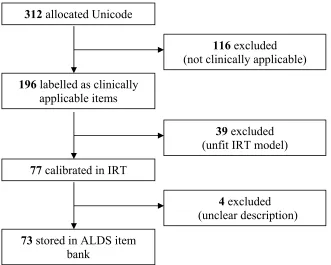
(9) This model was chosen because it allows a more realistic model for the data to be built than the more restrictive one-parameter logistic model. In 2PL model, both of the item difficulty and discrimination degree are required to take into consideration in order to get the “best selected” items for different groups of patients. To make the results easier to interpret, the logit scores are linearly transformed into values between 0 (bottom value) and 100 (ceiling value) after the sum of probabilities that the patient (theta) can give correct answer to each item in the bank is derived (Weisscher, 2008). 2.2 ALDS Item Bank Items for inclusion in the ALDS item bank were obtained from a systematic review of generic and disease specific functional health instruments and supplemented by diaries of activities performed by healthy adults. A total of 312 items were listed in the initial item bank with Unicode allocated to each one, among which 196 items were identified as clinically applicable ones and then described in detail. For example, the item “shopping” was expanded to “travelling to the shopping center on foot, by car, by bike or by other public transport, walking around the shopping center, getting into a number of shops, trying on clothes or shoes, buying a number of articles, paying for the bill, and returning home”. However, only 77 items from 196 were fit in two-parameter logistics model (2PL) and calibrated to have difficulty and discrimination item parameters. It is interesting to find that 25 items are often selected by doctors in clinical studies. A few items are complained because of confusion or unclear explanation. For example, the item “can you wash your face” can be understood in two ways: go to the sink by the patient himself and wash face; or cannot go to the sink by the patient himself but can wash face if taken to the sink. Thus, four items with unclear definitions and low discrimination parameters were eliminated from the latest version of ALDS item bank. (The latest version of ALDS 73-item bank is attached in Appendix A.) Figure 2.1 Summary of Calibration Process of ALDS Item Bank 312 allocated Unicode 116 excluded (not clinically applicable) 196 labelled as clinically applicable items 39 excluded (unfit IRT model) 77 calibrated in IRT 4 excluded (unclear description) 73 stored in ALDS item bank 5.
(10) The 77-item bank (item description and explanation) has been translated into English, Dutch, French and Chinese. 2.3 Application Scope of ALDS ALDS is firstly developed from neurology studies with the aim to use the daily activity to describe symptom. Nowadays, ALDS has been widely spread to diversified clinical studies. According to Weisscher’s report (2008), a total of 36 studies have been implemented via ALDS, among which 8 studies have been completed. Thousands of patients have responded to ALDS questionnaires so far. In addition, the application of ALDS is not only within the Netherlands, but also to other countries around Europe. ALDS is usually used to trace the progress of patients by comparing their previous and present status. On account that the clinical measurement instruments such as Rankin and mRs are often used to categorize patients, to have a linkage between the ALDS score and clinical measurement results seems also important for the further development of ALDS. 2.4 Current Measurement Procedures of ALDS The current measurement procedures of ALDS can be divided into four steps: item selection, data collection, data analysis and results output and storage. 2.4.1 Item Selection Item selection is the initial preparation for the adaptive measurement procedure. Due to the limited application of computerized adaptive testing in clinical trials, the ALDS item selection depends on the group’s average functional ability level, instead of individual level. For example, in the brain stroke trials, typically three booklets with various difficulty levels are in demand to testing patients in three functional statuses, less disabled, moderately disabled and severely disabled. The easiest booklet will be used in the severely disabled group while the most difficult booklet for the less disabled group. The booklets are normally constructed by researchers and clinical staffs together. Two questions are always focused on: “which items should be included” and “in which level of booklets should the selected items be placed”. The clinical staff (especially nurses/doctors in the related discipline) usually gives advices on item inclusion according to their clinical experience, while the researcher is responsible for considering the IRT statistical issues on the base of item parameters. For instance, items with the equivalent difficulty parameters around the patients’ group level have to be selected more than those located far away. And the researcher also has to consider that if only one booklet is in need in certain disease, the difficulty parameters of selected items should be spread out. Generally speaking, 20 to 25 items are included in each booklet. 5 to 10 items are usually contained in each booklet of one study as the common items. Different sets of booklets are used for different diseases. The booklets in various diseases are seldom copied from each other. However, if one set of booklets is well constructed in the same. 6.
(11) disease studies, it will be kept for repetitive implementation or readjusted by a small scale. Items with the following characteristics are favored in selection: (1) (2) (3). Items described in short term but with precise meaning; Items highly correlated with the diseases of the study; Items with little potential bias (differential item functioning, DIF) in gender, age, living conditions and etc.. 2.4.2 Data Collection Data collection is usually implemented by trained nurses via phone, mails or face-to-face interviews. During the interviews, nurses are required to ask items to patients and record answers by ticking the corresponding box. (e.g. “I can”, “I can but with help”, “I cannot”, and “not applicable”) Although the items listed on booklets rank in ascending difficulty order, the nurses prefer to reorganize items by their contents to make the communication with patients more reasonable. For example, the items about actions, such as walking, jogging and cycling, are categorized in one group, while items about washing, such as showering and washing face are categorized in another group. The item difficulty parameters are not taken into account in the reorganization procedure. Nurses often use different approaches to begin interviews when confronting patients with “zero” experience or “nonzero” experience in ALDS studies. As for the patients who are interviewed for the first time, nurses usually begin with greeting questions, e.g. “how are you these days” or basic functional items, e.g. “can you walk around or have to use a wheelchair”. Nurses are able to get a rough impression on the patients’ current disability status to a large extent according to their clinical experience and then decide which level of the booklet should be used for this specific patient. For instance, suppose there are 11 booklets constructed for one study, ranking in ascending difficulty order. When interviewing a patient for the first time, nurses typically start from the booklet 5 or 6. After asking 3 to 4 items in this booklet, nurses can have a further judgment on the patient’s status, and hence decide to change a harder or easier booklet in necessity. As for the patients who have been interviewed before, nurses have known some information about them, so the question as comparison with previous performance, for instance, “do you feel better these days?” or “how are you going these days, better or worse?” will be used as the beginning. After getting patients’ responses, nurses will decide to use more difficult or easier items than those they had used in the previous time. Most nurses usually keep on asking all the items to patients although they have known the answers. Depending on nurses’ clinical experience, if a patient can give positive answer to a more difficult answer, he can surely positively respond to an easier item in the same item group. Hence, some nurses sometimes may skip the easier items in this situation.. 7.
(12) During the phone interview, nurses always ask to talk with the patients themselves. The patients’ relatives or helpers are interviewed on behalf of patients only when patients are not able to answer the phone (e.g. deaf) by themselves. If the phone is answered by the patient himself, nurses will skip asking the item “can you answer the phone” if it is listed in the booklet. If the phone is not directly answered by the patient, the nurse with ask to change the phone-picker to the patient. The options “can (with difficulty)” and “cannot” are well distinguished. When the patient is able to perform the activity independently, without any help from anybody else, but aids or devices are allowed, the response “can” is recorded. If a person is physically not able to perform an activity, needs help from somebody else or if the symptoms would be badly increased without others’ help, the response should be “cannot”, because the patient cannot finish the activity independently. Nurses would like to control the answer “I don’t know” as low as possible because “not applicable” option will be calculated as missing data. In order to reduce the missing data rate in interview, nurses often add explanations on the items that patients give responses as “I don’t know”. For example, when patient says “I don’t know” to the item “vacuum a flight of stairs” (maybe the patient do not use vacuum or do not have stairs at home), the nurse will let the patients imagine the situation and give a relative accurate response. Different studies have different follow-up plans on patients. Typically, one to three times of follow-up interviews are implemented within one year. The same booklets are usually used in the follow-up studies. To avoid psychological impact on patients’ emotions, all the ALDS scores are kept blind and confidential to the patients. Only the patient PIN code and date of birth are shown on booklets and recognized by the computer. A majority of patients are glad to answer ALDS items because they would like to feel concerned by hospital and have a good opportunity to communicate with nurses. But sometimes patients may boast or overreport their performance as if they were better than before. On the contrary, a few patients may regard too easy items as an “insult”, hence they would like to underreport, refuse answering items or even give converse answers rather than telling the truth. Different approaches in data collection may generate measurement bias, which can be analyzed in four aspects: (1). (2). (3). Patients will get more information in face-to-face and phone interview than mail questionnaire. When patients are not clear about the items, the interview in the first two modes can make some further explanations, while the mail questionnaire cannot get such help. During the interviews via face-to-face and phone, patients usually do not give direct response “yes” or “no” on the items, but make lots of comments, which needs the nurses to deduce the final answer by their subjective judgment. However, the patients have to give direct answers in the mail questionnaire. During the phone interview and mail questionnaire, it is hard for nurses to judge whether the patient tells the true current disability status; while the face-to-face is easier to observe whether the patient is “lying”.. 8.
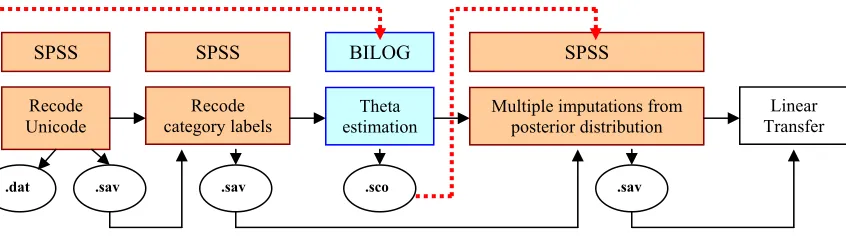
(13) (4). Interviews via phone and face-to-face may be influenced by the nurses’ tones or expressions, while the mail questionnaire avoid this problem.. In addition, different explanations provided by various interviewers may also generate bias. For example, in the description of item “can you get in/out of a car” should include the action of fastening seat belt, but some nurses forget to emphasize this point. Another example is that some nurses even replaced the item “go shopping” by the item “go to post office” when they get the “not applicable” responses from male patients in “shopping” item. But actually these two items have big difference in item parameters. Therefore, the bias in data collection process should arouse the researchers’ attention. Although a periodic item review has been implemented, the problem is still deserved more efforts in further research. 2.4.3 Data Analysis Data analysis is implemented with SPSS and BILOG4. The procedures can be divided into five steps: recode Unicode, recode category labels, theta estimation in BILOG, multiple imputations from posterior distribution of theta-hat with standard error and linear transfer to ALDS score. In the first step, raw data are input to computer by typing or scanning via computer recognition software. On account that only 77 from 312 items in the bank have been calibrated in IRT models, the Unicode has to be recoded to avoid the confusion in the further analysis. The recode process is implemented in SPSS, that is, to find the corresponding Unicode for items selected in booklets in the item bank. Items selected in the booklets will show the patients’ responses “0” or “1”, representing “cannot” and “can” respectively, the items not selected in the booklets are systematically labeled “9”. The recoded Unicode is saved into two separate files with the extension filename .sav and .dat to be recognized by SPSS and BILOG respectively. Secondly, category labels recoding is a big problem in previous ALDS analysis. Because the category label scoring was not unique, different studies adopted various labels for scales, which caused lots of confusion and mixture. For example, in the neurology studies, the categories were labeled as 1, 2, 3 and 4 for “I can” “I can but with difficulty”, “I cannot” and “not applicable”; while in other studies, the categories were labeled as 0, 1, 2 and 3 for “I cannot”, “I can”, “I can with difficulty” and “not applicable” respectively. Thus, the researchers had to recode category labels every time to keep a consistent standard in theta estimation. At present, the category scoring has been unified for all of the studies as 1, 2, 3 and 4 for “I can” “I can but with difficulty”, “I cannot” and “not applicable”. Consequently, this step can be omitted in the future studies. Thirdly, BILOG read in the newly generated .dat file in the first step and estimate theta by using formula (2.1) on the base of fixed item parameters stored in BILOG. The estimated theta-hat and its standard error are calculated by maximum likelihood. 4. BILOG implements an extension of item response theory. It has diversified functions in multistage analysis, especially in deriving theta and item calibration. Maximum likelihood method is majorly used in this program.. 9.
(14) method and the results are saved into an ASCII file with the extension filename .sco, which can be directly recognized by SPSS. Fourthly, SPSS reads in the estimated theta-hat ( θˆ ) and measurement standard error from .sco file generated in the third step. Because the theta-hat ( θˆ ) is an estimator of the true value, theta, the measurement error is unavoidable. In order to minimize the measurement error, multiple imputations drawn from the posterior distributions of the latent variable, theta-hat ( θˆ ) is randomly implemented by the “SEED”. But one problem in SPSS is that the “SEED” changes every time in execution. The estimated theta value for each patient in the same trial cannot be fixed, that is, the estimated theta-hat in the first execution is totally different from the second one, all the analysis on the theta-hat generated from the first execution will be in vain if a second execution has to be made. This problem has aroused high attention, which need to be solved in an urgent way. Finally, to make the estimation results easier to interpret, the logit scores are linearly transformed into values between 0 (bottom value) and 100 (ceiling value) after the sum of probabilities that the patient (theta) can give correct answer to each item in the bank is derived (Weisscher, 2008). 77 e a1 (θ − b1 ) e a 2 (θ − b2 ) e a n (θ − bn ) ˆ T = ∑ Pn = + + ... + 1 + e a1 (θ − b1 ) 1 + e a 2 (θ − b2 ) 1 + e a n (θ − bn ) n =1 80 ALDS = 10 + ⋅ Tˆ 77. (2.2) (2.3). where T̂ is the best estimate of the sum of probabilities that a certain patient can give positive response to each item in the bank. The ALDS score in the 77-item bank ranges from 11 to 89. Figure 2.2 Current Data Analysis Procedures of ALDS. SPSS. SPSS. BILOG. SPSS. Recode Unicode. Recode category labels. Theta estimation. Multiple imputations from posterior distribution. .dat. .sav. .sav. .sco. Linear Transfer. .sav. 2.4.4 Data Output and Storage. The output results are saved in SPSS, listing only three columns: patient ID, theta-hat and transferred ALDS score. The researcher is responsible to send the results back to doctors and nurses.. 10.
(15) It is a pity that no database has been constructed yet to store the data collected from various studies. Datasets are spread in the hands of ALDS users, only part of which are stored in AMC. 2.5 Comments on ALDS. On the base of information collected from patients, nurses, physicians and researchers, the ALDS project is concluded as “a highly welcomed scoring system but with a couple of inconvenience”. Its strong points and weak points can be summarized as following several aspects. Its strong points consist of: (1) (2) (3) (4). ALDS is very practical and easy to make communications with patients. ALDS is not very technical in implementation, thus it is easily accepted and welcomed by patients. In contrast to medical measurement, ALDS focuses on patients’ daily activities, helping patients to describe symptoms. ALDS stands on a new orientation to make clinical analysis, providing supplementary analysis for clinical information and patient-related outcomes.. Meanwhile, besides the advantages, ALDS project has also some inconvenience and problems in application. Here come its weak points: (1). (2) (3). (4) (5) (6) (7). The booklets contain too many items (approximately 20 to 30 items). It is time consuming especially when the item is not selected in an adaptive way. For instance, very easy items have to be asked to the less disabled patients. Actually, these relatively easy items can provide little information on the less disabled patients’ functional status. Some items are not described in a clear way, which causes unnecessary misunderstandings in interviews and generates bias in data collection process. Some items have different senses in various situations, e.g. in a telephone interview, nurses will never ask the item “can you pick up the telephone” although it is listed in the booklet. But this item is sensible in the face-to-face interview. Item selection process depends on researchers’ judgment and clinical staffs’ medical experience to a large extent, instead of patients’ performance. The arbitrariness may cause the errors in measurement. Researchers complain that lots of repetitive calculations have to do in data analysis process. They would like to focus on their interesting studies instead of doing all the calculations. Complicated software problem. Most of the ALDS users, except special researchers are not familiar with BILOG. The uncommonly used program prevents more users from implementing ALDS project. Few researches have been done in linking the ALDS scoring system with the clinical measurement. It is hard to interpret the ALDS result comparing with the widely used clinical scales such as Rankin and mRs.. 11.
(16) Chapter 3. ALDS Website Construction. As stated earlier, ALDS plays an important role in many aspects, but still needs improvement to be perfect from many aspects. With the development of network, it would be a good idea to solve the problems of ALDS by the intervention of computer programs. Thus, constructing a specific website for ALDS appears necessary and urgent. In this chapter, the proposal of an ALDS website construction will be discussed. 3.1 Objectives and Feasibility. The construction of ALDS website aims to help the researchers and doctors use the ALDS instrument in a more accurate, flexible and efficient way. Firstly, unlike the current measurement procedures, the ALDS website will provide a statistical tool for researchers following an automatic computerized item selection and store all the databases on ALDS in the server. Secondly, the website is flexible to the specialists to create their own clinical trials with the on-line statistical guidance. In addition, for the convenience of users, this website can offer both computerized adaptive testing (CAT) and pencil-and-paper (PP) versions of ALDS booklets. Thirdly, this website is built as a platform for ALDS users to exchange their ideas and propose problems they have met during the application of ALDS. ALDS instrument will be promoted through the website and attract more researchers to have a try. It will relax researchers and clinical staff from repetitive calculations. And with the integration of CAT module, the website may save 50 percent of the time and items compared with the traditional way. To avoid the complexity of statistical programs, the BILOG will not be used in the website, but the function of theta estimation will be embedded as a module into the network framework. The website construction is also feasible in the electronic era. Network and computer is very popular nowadays. Although it is hard for every senior people to possess a computer at home, this website will be welcomed by the young and middle-aged patients. For the convenience of patients, a computer can be installed at the waiting room. And the patients who are not able to answer the items at home can be informed to the hospital 10 minutes earlier and finish the item booklet on the computer with the help of nurses. Besides, because the pencil-and-paper is also available in the website, the doctor can choose to use the PP version for the senior patients. 3.2 Website Framework. To build up the ALDS website is a complex task. In order to clarify the functions of different modules, an ID Code identification system is designed to distinguish the users as patients, assistants and researchers. (The workflow of the whole website framework is attached in Appendix B.) 3.2.1 Registration Page. The layout of the website is divided into three blocks by different identity properties. ALDS users are asked to fill in personal information and email address for the first time. The system then judges the identity of the user, patient, assistant or 12.
(17) researcher, and save the user’s information on the server. Meanwhile, the system will allocate an ID code for the user according to his identity. For example, P12345 is identified as a patient, A12345 as an assistant and R12345 as a researcher. After the registration, the website ID code and password will be sent to the user by email immediately. After the registration for the first time, the user may change his password when logging into ALDS website. The old users who have already got the ID code and password can directly go to the LOGIN page. After inputting ID code and password, the user will get into the page special for his identity, that is, different ID code will lead into different webpage for the user. For example, the patient with ID code P12345 will directly get into the patient page, ID code A12345 will directly get into the assistant page and ID code R12345 will automatically get into the Researcher page. 3.2.2 Patient Page. The patient page has the simplest layout, which provides a platform for patients to practice the computerized adaptive testing in ALDS. The patient can get into the patient page after inputting his ID code and password. Then the system asks the patient to type in the code number for required test that has been informed by the doctor assistant via email. According to the patients’ gender and age, the items will be preselected, that is, the items with DIF for the specific patient will not be shown. For example, the item favored by the female, such as items regarding shopping will not be shown if the patient is a male. After patient getting into the CAT page, the system starts the computerized adaptive testing program immediately. Generally speaking, the first item displayed on the screen is often selected by collateral information, that is, to pick out an item that best fits the patient’s background with medium difficulty to start the computerized adaptive testing. From the second item, the computer will automatically select items according to the patient’s response to the previous one. Following the instruction on screen, the patient is required to click on the answer and then continue to the next item. If the patient wants to quit the process of CAT, he can click the button of “cancel”. No results will be saved in this situation. CAT will stop when the standard error becomes below a certain threshold or the maximum of items has been reached. (The stopping rule of CAT program is explained in details in Chapter 4.) The system will save the patient’s results into database under the code number of sub-item bank and email the data to the specified nurse or researcher automatically. But the patients cannot see their results to avoid unnecessary psychological impacts. 3.2.3 Assistant Page. Assistant page is more complicated than the patient one. As a helper for the doctor, the assistant can see the items in the sub-item bank and the summary report under the code number. After getting into the assistant page, the assistant is required to type in the code number for required test. Then three options will be displayed on the screen: to get into CAT test or PP test, show items in the sub-item bank under the code number, and show the summary report in .xls file stored on the website under the code number. Sometimes the assistant or nurse has to help the patients who are not able to implement the CAT test. (For example, the senior people may have problems in using 13.
(18) computer or websites.) The assistant can ask the patient’s ID code and get into the patient page as if he/she were the patient. Then the assistant can read the items on screen and click on the options responded by the patient during the interviews. This function can also be used when the patient has to do the CAT test in the waiting room. Furthermore, the assistant can also choose the pencil-and-paper version in necessity. The assistant can print out the sub-item bank in difficulty order or random order, collect data from patients via interviews and input the data into database under the code number on the website. 3.2.4 Researcher Page. Researcher page is the most complicated page that includes all the functions of ALDS website. After inputting the ID code and password, the researcher loges into the researcher page where four options are shown: full item selection process, severity disability category, function category and existed studies. In the full item selection approach, a thermometer-shaped score range with typical item description every 10 items will help users locate the level of target population. The researcher is asked to input the range of their patients, suppose from 30 to 50 as ALDS score, then the system will default the normal distribution and calculate the mean value and standard deviation for the group, and transfer it into IRT terminology, theta. (The statistical tool for item selection process is introduced in details in 3.3) The severity disability category and function category are both based on the previous studies. According to the distribution of patients in previous studies, we can set them as the default values, and offer researchers the categories. For example, in severity disability category, full range, high severity, medium severity and low severity will be listed. The researcher can make a peer item selection on the base of the selected items by the system. And some restrictions will be set, for instance, at least 25 items have to be included in the booklet, some items with the essential accuracy cannot be deleted. The full range will be directly linked to the automatic item selection part. Like the severity disability category, the function category with the sub-item banks also needs to be constructed in advance. Then the researcher can select which function he would like. For instance, finger function, lower body function and etc. After the item selection process, a new sub-item will be generated and system will allocate a systematic code number for this new sub-item bank. Afterwards, the researcher can also select to use the CAT or pencil-and-paper version. If CAT is selected, the code number of the test will be directly sent to the patient. If the researcher prefers the PP version, then the sub-item bank will be printed in difficulty order or in random order. The researcher can also select both of CAT and PP versions. After data collection from patients, the raw scores can be input into the database under the sub-item bank code number. If the CAT version is selected, the system will directly get the results and save it into the database. But if the PP version is selected, the procedure will be a little bit more complicated. The input data will be saved in .dat file, including the raw data and patient’ pin code. The category scores are labeled as cannot-0, 1-can, 2-can with difficulty, 9-not applicable, 8-systematic missing data (item does not selected). Then the options “cannot” and “not applicable” will be. 14.
(19) recoded into 0, “can” and “can but with difficulty” into 1, the systematic missing data will be remained as 8. A program of theta estimation is recommended to embed in website by using computer language, such as FORTRAN. Similar as BILOG-MG 3, the program reads in the response file .dat (data collected from patients) and the item parameter estimate file. The Maximum Likelihood (ML) method is adopted. ML estimates are computed by the Newton-Raphson method starting from a linear transformation of the logit of the percent-correct score for the subject. In those rare cases where the Newton iterations diverge, an interval-bisection method is substituted. Estimates for respondents with all correct or all incorrect responses are attributed by the half-item rule. That is, respondents who score all incorrect are assigned one-half a correct response to the easiest item; respondents who score all correct are assigned one-half a correct response to the hardest item. The estimate is then computed from this modified response pattern. Standard errors are computed as the square root of the negative reciprocal of the expected second derivative of the log likelihood at the estimate, i.e., square root of the reciprocal Fisher information (Zimowski, Muraki, Mislevy & Bock, 2003). After the theta is estimated, random draw from the posterior distribution of the measurement error should be done. The linear transform is made to get ALDS score at the last step. Afterwards, all the results will be saved as a summary report in .xls on the website under the code number. The newly generated file can be downloaded by the researcher. 3.3 Transforming ALDS Scores into IRT Terminology. In common sense, the most important transformation is from θ scale into true-score scale. Let X , the number-right score, be defined as. X =. n. ∑. U. j =1. (3.1). j. where U j is the 1 or 0 response of an examinee to item j . If the true score is denoted as τ , then n. n. j =1. j =1. τ = E ( X ) = E (∑U j ) = ∑ E (U j ). (3.2). Since U j takes on value 1 with probability Pj (θ ) and value 0 with probability. Q j (θ ) = 1 − Pj (θ ) , it follows that E (U j ) = 1 ⋅ Pj (θ ) + 0 ⋅ Q j (θ ) = Pj (θ ). (3.3). Thus,. 15.
(20) n. n. j =1. j =1. τ = ∑ E (U j ) = ∑ Pj (θ ). (3.4). that is the true score of an examinee with ability θ is the sum of the item characteristic curves. The true score, τ called the test characteristic curve because it is the sum of the item characteristic curves (Hambleton, 1991). The true score τ and θ are monotonically related; that is, the true score may be considered to be a nonlinear transformation of θ . Since Pj (θ ) is between 0 and 1,. τ is between 0 and n . Hence, τ is on the same scale as the number-right score, except that τ can assume non-integer as well as integer values. The transformation from θ to τ is useful in reporting the ability values; instead of the θ values, τ values that lie in the range 0 to n are reported (Hambleton, 1991). However, in the ALDS project, doctors may not be familiar with statistics, especially IRT models, thus we have to converse the above process, that is to make a transformation from the ALDS score (linearized true score) into θ scale. As Figure 3.1 exhibits, the 1-100 true score scale is easier for doctors to locate patients’ ability status. The data of reference population previously collected in various branches of diseases are expected to set as the default values for statistical tool. For instance, in brain stroke studies, we may set the default values of group mean ranging from 30 to 50 in ALDS scores. Doctors can either choose this default value or adjust as his requirement, for example, to enlarge the range as 10 to 50. Then the tool will automatically calculate the ALDS mean value as 30 with standard deviation as 6.67, defaulting the population following in a normal distribution. Figure 3.1 Input ALDS Score into Statistical Tool Put-on T-shirt. 10. Sit up from lying. 20 Wash lower body. 30. Have a shower. 40 Read newspaper. 50. Go to restaurant. 60 Go for a short walk. 70. Ride for 2 hours. 80. 90. Go for a walk in woods. Group Mean= 30, SD=6.67 Group Mean= 30, SD=6.67. Because of the linear association between ALDS score and the sum of probabilities that the patient can give positive responses to each item, we can use the algorithms in (2.2) and (2.3) to calculate the theta. Through Maximum Likelihood Method and Newton Raphson’s Method (van der Linden & Glas, 2000), the estimated ability of patient, theta-hat ( θˆ ), in IRT models, positioning at the same scale as item difficulty can be derived.. θ n +1 = θ n −. f (θ n ) f ' (θ n ). (3.5). 16.
(21) k ea (θ −b ) f (θ n ) = Tˆ − ∑ a (θ − b ) i =1 1 + e. (3.6). It is worthy to notice that the starting value of Newton Raphon’s method is one of the most essential steps in estimation of theta. Typically, all the items are supposed to be the same with the unique difficulty value as 0 and discrimination as 1. For the model in (3.5), the initial value θ0 is expected to: k. T =∑ i. eθ K ⋅ eθ = = KP(θ ) 1 + eθ 1 + eθ. K ⋅ eθ 1 K =K⋅ = = KQ(θ ) θ θ 1+ e 1+ e 1 + eθ T KP(θ ) = = eθ K − T KQ(θ ) T log( ) = log eθ = θ 0 K −T K −T = K −. (3.7) (3.8) (3.9) (3.10). where K indicates the total number of items in the bank; T is the sum of probabilities that the patient gives positive responses to each item with the same difficulty value 0 and discrimination value 1. 3.4 Data Flows. The response raw scores can be automatically saved as a .dat file in the CAT program as the input data for the website. However, if the pencil-and-paper version is adopted, the raw scores have to be typed or scanned into the computer first and then generate the .dat file. The .dat file is easily recognized as ASCII. After the calculations through the website, the output file will be produced also in an ASCII file, which can be read by the widely-used software MICROSOFT EXCEL. The contents of output file include: pin code of patient, theta (after random draw from posterior distribution), raw data for each item, total number of correctness and ALDS score. 3.5 Data Storage. It is wise to temporarily store all the datasets (e.g. at least six months after the researcher finish his project with ALDS) on the server. If the external researchers agree that their datasets can be used by the ALDS project team, then the dataset can be permanently stored in the server; otherwise, the dataset will be cleared after the temporary storage period. According to the time that datasets begin to store on the server, we can grasp the process of researcher’s studies with ALDS. For their convenience, it seems also good to remind the researchers keep on follow-up study by email. 3.6 Safety and Maintenance. It is very technical issue to keep the security of the network. Firewall should be taken into consideration. All the users need to fill in the authentic email address, which. 17.
(22) is the unique channel to get the website ID code and download the data results and sub-item bank. It is proposed to have certain person keep the website updated. A platform will be built up for users to ask questions and get instructions from the ALDS experts. Meanwhile, some comparisons with other health-care websites have been made. The SF-36 is a multi-purpose, short-form health survey with only 36 questions (Brazier et al., 2002). It yields an 8-scale profile of functional health and well-being scores as well as psychometrically-based physical and mental health summary measures and a preference-based health utility index (Nichol, Sengupta & Globe, 2001). The website, Sf-36 (http://www.sf-36.org/) with a very simple and clear style is unfortunately not based on IRT techniques whose statistical tool is totally different from ALDS. Patient Reported Outcomes Measurement Information System (PROMIS) in the United States shares the similar goals as ALDS, but its scope is much larger and has been constructing a global network currently. Its objectives are to develop and test a large bank of items measuring patient-reported outcomes, create a computerized adaptive testing system that allows for efficient, psychometrically robust assessment of patient-reported outcomes in clinical trial research involving a wide range of chronic diseases, and create a publicly available system that can be added to and modified periodically and that allows clinical researchers to access a common repository of items and computerized adaptive tests. The website of PROMIS (http://www.nihpromis.org/default.aspx) offers many an instrument based on IRT methods. It features in simultaneous statistical tools design and Q&A forum construction, which could be learned for ALDS website.. 18.
(23) Chapter 4. Computerized Adaptive Tests in ALDS. 4.1 Computerized Adaptive Tests. In principle, tests have always been constructed to meet the requirements of the test-givers and the expected performance-levels of the examinees as a group. It has always been recognized that giving a test that is much too easy for the examinees is likely to be a waste of time. On the other hand, questions that are much too hard, also produce generally uninformative test results, because examinees cease to seriously attempt to answer the questions, resorting to guessing, response sets and other forms of unwanted behavior (Linacre, 2000). It is a really tough problem in the classical test theory. As Hambleton said, any single test administered to a group of examinees could not provide the same precision of measurement for every examinee. Thus, the ideal testing situation would be to give every examinee a test that is “tailored”, or adapted, to the examinee’s ability level (Hambleton, Swaminathan, & Rogers, 1991). That is the reason that the “adaptive testing” aroused people’s attention. Weiss (1985) defined “an adaptive test is one in which different sets of test questions (items) are administered to different individuals depending on each individual’s status on the trait being measured”. The earliest application of tailored or adaptive testing was in the work of Binet on intelligence testing in 1908 (Weiss, 1985). However, little additional work on the adaptive testing took place until the advent of computers. As stated in chapter 1, item response models are particularly suitable for adaptive testing because it is possible to obtain ability estimates that are independent of the particular set of test items administered. In fact, adaptive testing would not be feasible without item response theory. Even though each examinee receives a different set of items, differing in difficulty, item response theory provides a framework for comparing the ability estimates of different examinees (Hambleton et al., 1991). In computerized adaptive testing (CAT), the sequence of items administered to an examinee depends on the examinee’s performance on earlier items in the test. The values of item probability and item information indicate how well an item differentiates between contiguous ability levels or how precisely the item measures at that point on the ability scale (Weiss, 1985). Based on the examinee’s prior performance, items that are maximally informative about the examinee’s ability level are administered. In this way, tests may be shortened without any loss of measurement precision. High-ability examinees do not need to be administered relatively easy items, and low-ability examinees do not need to be administered the most difficult items, because such items provide little or no information about the examinee’s ability (Hambleton et al., 1991). Two procedures are used currently for item selection in an adaptive mode (Kingsbury & Zara, 1989). The first, maximum information (Weiss, 1982), involves the selection of an item that provides maximum information (i.e., minimized the standard error) at the examinee’s ability level. The second method, Bayesian item. 19.
(24) selection (Owen, 1975), involves the selection of the test items that minimizes the variance of the posterior distribution of the examinee’s ability. Bayesian methods require specification of a prior belief about the examinee’s ability; hence, the success of the method depends in part on the appropriateness of the prior distribution. The impact of the prior distribution diminishes as more items are administered. The most apparent difference between these two methods is that: maximum likelihood estimation poses problems when the number of test items is small. Bayesian procedures overcome the problems encountered with maximum likelihood procedures but may produce biased estimates of ability if inappropriate prior distributions are chosen (Hambleton et al., 1991). The stopping rule of CAT was summarized by Linacre in 2000. There are three possibilities to stop the CAT besides the standard error method. First, the item bank is exhausted. This occurs, generally with small item banks, when every item has been administered to the examinee, the test has to be stopped. Secondly, the maximum test length is reached. There are a pre-set maximum number of items that are allowed to be administered to the examinees. This is usually the same number of items as on the equivalent paper-and-pencil test. Thirdly, as Weiss’s mentioned, the ability measure is estimated with sufficient precision. Each response provides more statistical information about the ability measure, increasing its precision by decreasing its standard error of measurement. When the measure is precise enough, test stops automatically. The procedure can be stopped when the standard error of the examinee’s ability estimate stops decreasing by a specified amount or reached below a certain threshold. Actually, we use a mixture of these stopping rules nowadays. For example, both of the precision measurement and maximum test length can be set before the test. The CAT will stop automatically when either of these criteria is reached. Meanwhile, a larger item pool is recommended to build up to avoid the first stopping rule used. The typical stopping rule for standard error threshold is .32, assuming the test reliability is around 90% (Linacre, 2000). This concept comes from classical test theory, in which the standard error is the square root of 1 minus reliability. SE = 1 − ρ = 1 − .90 ≈ .32. (4.1). In the IRT theory, the amount of information provided by a test at θ is inversely related to the precision with which ability is estimated at point. The test information equals to the sum of item information.. SE =. 1 I. n. I = ∑ Ii. (4.2) (4.3). i =1. Thus, the standard error .32, i.e. reliability 90% can be interpreted as approximate 10 items each with 1.0 item information in the Rasch model. In 2PL model, the item information defined as. 20.
(25) I = a 2 P (θ )Q (θ ). (4.4). Then the standard error .32 can be interpreted as 40 items have to be included in the test if the discrimination parameter equals to 1 and patient ability equals to the difficulty parameter in the 2PL-model. If we denote the item numbers as K , Q a = 1,θ = b ∴ I = a 2 P(θ )Q(θ ) = K ⋅ 1 ⋅ .50 ⋅ .50 = 10 ∴ K = 40. Obviously, if we increase the discrimination parameter ( a > 1 ), then less items are required to use in order to get the reliability 90%; however, if the discrimination parameter is even lower than 1, then more items have to be used to keep at the same level of standard error. In addition, Stoop added an idea in 2001 regarding mixing fixed and variable length test. He reckoned that all kind of mixtures between fixed-length and variable-length can be used in CAT. An advantage of the variable-length rule is that the measurement precision is guaranteed for each examinee, which may not always be the case when the fixed-length rule is used (Stoop, 2001). 4.2 Rationale of CAT in ALDS. As stated earlier, the ALDS project follows the IRT framework, which satisfies the premise of computerized adaptive testing. In addition to shortening tests without loss of measurement precision, the benefits of computerized adaptive testing in ALDS are numerous. First, following the CAT procedures, the item selection will no longer be arbitrarily undertaken by researchers or clinical staffs but by the patients’ responses to the items. What the researchers and physicians need to do is to build up a big item bank for various diseases. The CAT program successively selects questions so as to maximize the precision of the exam based on what is known about the patient from previous questions. From the patient’s perspective, the difficulty of the exam seems to tailor itself to their level of function status. For example, if the patient performs well on an item of intermediate difficulty, he will then be presented with a more difficult question. Or, if he performed poorly, he would be presented with a simpler question. Compared to the traditional questionnaire with a fixed set of items, computer-adaptive tests require fewer test items to arrive at equally accurate scores. Furthermore, the “cheating” problem is also an ignorable issue in interviews with patients. CAT can help doctors find the “authentic” results though some patients are willing to boast themselves sometimes. For example, the patients who are cheating may have to answer more questions than those who do not cheat, in order to get a relatively precise evaluation and minimize the standard errors. Thirdly, on the base of item response theory, the CAT can further relax doctors and nurses from the repetitive work. To be honest, although the patients have been categorized into different levels in ALDS, e.g. less disabled, medium disabled and. 21.
(26) severely disabled, the booklets that the project is now using still depends on the group ability mean instead of the patient individual ability. Thus, to a large extent, it is not the authentic adaptive testing. When following the CAT, doctors and researchers do not need to repetitively design tests, input patients’ data or calculate the ALDS score by themselves. The program will simultaneously do these all. Because of this advantage, the CAT is easily to trace the patients’ recovery progress, which will be convenient for doctors to build the profile for each patient. Fourthly, on account that power analysis on clinical trials mostly depends on the doctors’ prediction on patients’ ability, the wrong prior estimation is an inevitable problem in RCTs’ construction process. We can imagine if doctor has a wrong prior estimation on effect size, the mean value of alternative mean group will be predictable incorrect. As a result, the item selection for the alternative group will not be as accurate as expectation. However, the doctors’ clinical experience and their estimation are less vital factors in the CAT. The reason is that the computerized adaptive test calculates the individual’s ability based on the patient personal responses to each optimal item. Even though the doctors’ estimates deviate a bit, the result from CAT will still produce a relatively accurate estimate on the patient’s ability. Finally, as the computer era has been coming, the computerized adaptive testing is well feasible for patients to take at home, at office or at the waiting rooms of hospital. The module of CAT program is also not difficult to embed into the ALDS website if it is written into the standard web language, e.g. PHP. 4.3 CAT Approach. The CAT program is installed as a statistical tool in the ALDS website. As introduced earlier in chapter 3, the CAT program starts up after the patient or assistant type the test code number into the system. The program will read in two input files: the parameters file and response file. The former will be fixed in the program because of the stable item parameters of the ALDS at present. The response file records the patient’s responses (raw scores) to the items in his own computerized adaptive testing. CAT data is input by the patient to answer each item automatically selected by the system. The item selection follows maximum information procedure because of a small item bank consisting of 77 items as a total. The ALDS CAT program offers three options of stopping rule for the users: stopping when the maximum number of items is reached (default at 25), or when the gap between the current standard error compared with the previous stage is within a certain value (default at 0.01), or reach below a specified threshold of standard error (default at .32). The users can change the default value as they like, and can adopt the three stopping rules at the same time. The computer will automatically stop when any of the criteria is reached. The output file is directly saved as .xls and saved into the database under the code number. The contents in output file can be defined as the same as the pencil-and-paper version, including the patient ID code, theta (after random draw from posterior distribution), ALDS score, raw score, number of correctness and etc. A pre-selection of items based on patients’ gender and age will be made before the CAT starts. This process helps reduce the DIF error.. 22.
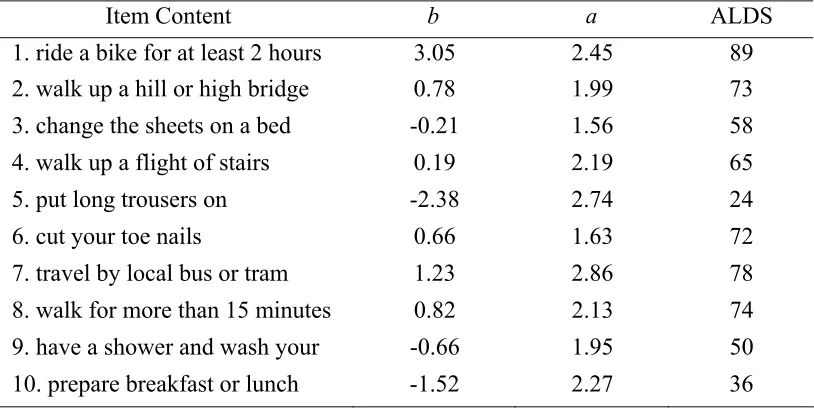
(27) For highlighting the features of CAT ability estimation and item selection, an example coming from brain stroke sub-item bank is used for demonstration. For the purpose of the example, the item bank listed here only contains of 10 items (Table 4.1). (The complete sub-item bank (26 items)5 for brain stroke studies has been attached in Appendix C.) Table 4.1 Item Parameters of Sub-Item Bank of ALDS for Brain Stroke Studies Item Content. b. a. ALDS. 1. ride a bike for at least 2 hours 2. walk up a hill or high bridge. 3.05 0.78. 2.45 1.99. 89 73. 3. change the sheets on a bed. -0.21. 1.56. 58. 4. walk up a flight of stairs. 0.19. 2.19. 65. 5. put long trousers on. -2.38. 2.74. 24. 6. cut your toe nails. 0.66. 1.63. 72. 7. travel by local bus or tram. 1.23. 2.86. 78. 8. walk for more than 15 minutes. 0.82. 2.13. 74. 9. have a shower and wash your. -0.66. 1.95. 50. 10. prepare breakfast or lunch. -1.52. 2.27. 36. Source: Weisscher, N. (2008). The AMC Linear Disability Score (ALDS): Measuring Disability in Clinical Studies. Academic Medical Center, University of Amsterdam, Amsterdam, the Netherlands.. Suppose a female patient with the age of 60 takes this brain stroke exam, a sequence of events that might occur in computerized adaptive testing is as follows: (1). Item 5 “put long trousers on” will be eliminated immediately in the pre-selection. The reason is that the old ladies in the Netherlands seldom wear long trousers, but skirts or dresses. Considering the potential problem in DIF, for the female patient, the program will skip out Item 5. Hence, only 9 items remain in the item bank.. (2). Item 4 is selected; this item is of average difficulty (0.19) and high discrimination (2.19). Suppose the patient answers Item 4 correctly. A maximum likelihood estimate of ability cannot be obtained until the examinee has answered at least one item correctly and one item incorrectly. (Zero or perfect scores correspond to − ∞ and + ∞ ability estimates, respectively.). (3). Another item is selected. Item 8 is chosen because it is more difficult ( b = 0.82 ) than the previously administered item ( b = 0.19 ). Suppose the patient correctly answers Item 8. Again, a maximum likelihood estimate of ability cannot be obtained.. 5. In practice, an item bank would consist of hundreds, and possibly thousands, of test items. The ALDS project only has 77 items calibrated. As for different diseases, doctors define the sub-item bank by selecting the items highly correlated with the disease discipline of their research. That is the reason why not many items are included in each sub-item bank.. 23.
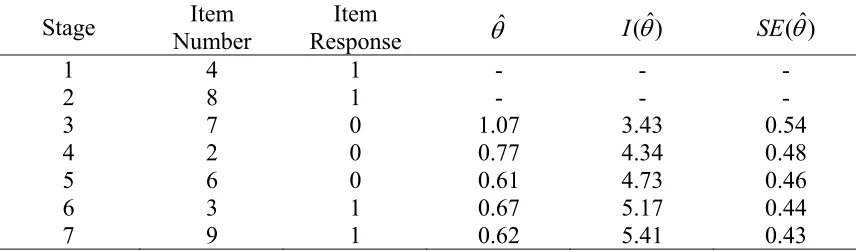
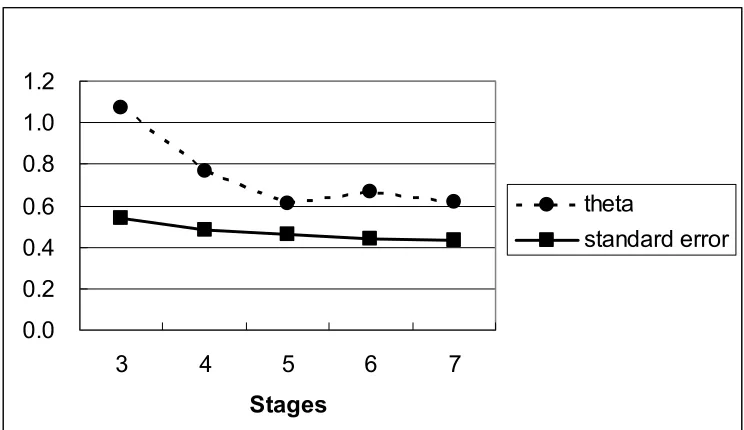
(28) (4). Item 7 is chosen next; it is more difficult than Item 4 and 8. Suppose the patient answers this item incorrectly. The patient’s item response vector for the three items may be represented as (1, 1, 0). Through use of the maximum likelihood procedure for estimating ability with known item parameters, an ability estimate can be obtained ( θˆ = 1.07 ). The test information for the three items at this ability level is I (θˆ = 1.07) = 3.43 , and the corresponding standard error is SE (θˆ = 0.54) . These values appear in Table 4.2.. (5). Next, the information provided by each of the remaining items in the bank is computed at θ = 1.07 . These values are reported in Table 4.3. Item 6 is selected next because it provides the most information ( I = 2.64 ) at θ = 1.07 . Suppose that Item 2 is administered and then is still answered incorrectly by the examinee. A new ability estimate is obtained for the response pattern (1, 1, ˆ 0, 0). The new ability estimate is θ = 0.77 .. (6). Then the item information at θ = 0.77 for the remaining items is computed. The process described above for administering an item, estimating ability, determining the information provided by unadministered items, and choosing an item to be administered next based on the information it provides is continued. To continue this procedure, Item 6 is chosen next, following by Item 3, and then finally Item 9. The procedure stops when the standard error of the patient’s ability estimate stops decreasing by 0.01. As can be seen from Table 4.2, the decrease in the standard error when Item 9 is administered in stage 7 compared with the standard error at stage 6 is 0.01. The procedure stops at this point. The estimate of the patient’s ability is taken as θˆ = 0.62 .. Figure 4.1 shows the trend of maximum likelihood ability estimates and standard error for this patient. It is apparently to see that the theta starts from a very sharp decrease from the first point to the third point and keep slight waves around 0.6. Similar status could also be found in the standard error curve. The standard errors keep decreasing from 0.54 to 0.43. Table 4.2 Maximum Likelihood Ability Estimates and Standard Error for One Patient at the End of Each Stage in ALDS CAT Program Stage 1 2 3 4 5 6 7. Item Number 4 8 7 2 6 3 9. Item Response 1 1 0 0 0 1 1. θˆ. I (θˆ). SE (θˆ). 1.07 0.77 0.61 0.67 0.62. 3.43 4.34 4.73 5.17 5.41. 0.54 0.48 0.46 0.44 0.43. Note: The ability estimate calculation based on the IRT program: Baker F. B. (1998) The Basics of Item Response Theory Windows Version 1.0. 24.
(29) Table 4.3 Information Provided by Unadministered Items at Each CAT Stage Stage. θˆ. 4 5 6 7 8. 1.07 0.77 0.61 0.67 0.62. 1 0.13 0.06 0.04 0.05 0.04. Information provided by Item 3 4 5 6 7 0.74 1.72 1.03 1.90 1.20 -. 2 2.64 -. 8 -. 9 0.35 0.60 0.79 0.71. 10 0.04 0.08 0.12 0.10 0.11. Figure 4.1 Maximum Likelihood Ability Estimates and Standard Error for One Patient in ALDS CAT Program. 1.2 1.0 0.8 0.6. theta. 0.4. standard error. 0.2 0.0 3. 4. 5. 6. 7. Stages Source: Data in Table 4.2 Column 4 and 6.. 4.4 Problems of CAT Application in ALDS. Although the computerized adaptive testing can function well in improving the efficiency and accuracy, it still has some problems in application. For example, some patients think the phone call interviews appear much friendlier than the CAT. Patients would like to communicate with nurses and doctors to get the feeling that they are well concerned, but the computerized testing is really not good at this point. Some patients even think the CAT is just as “teacher check pupils’ performance”, thus they don’t think it is an appropriate way to express their needs to the doctors. Furthermore, the CAT program will bring the financial problem. In order to implement the CAT, the Health Department, hospital, insurance company and maybe patients have to input money for the computers, website construction, program design and maintenance. In addition, because of the practical problems, the CAT and pencil-and-paper versions have to be parallel used in the transition period, which may generate the measurement bias. Because the CAT version is designed on individual level, not all the 25.
(30) items written in PP version could be administered for an individual patient. It implies that the items that are not administered for the certain patient should be recorded as missing data corresponding to the PP version. However, unlike the CAT procedure, the PP version follows the classical testing theory that is based on a group level. This essential difference between these two versions makes their results incomparable. But fortunately the measurement bias will not be substantial if the test is made to check the mean value of a group instead of an individual person. And group-based approach is commonly used in clinical trials.. 26.
Figure

+7

Outline
Related documents