GWO Optimized Single Machine Infinite Bus
System & Two Area Four Machine System
Tripti Kumawat1,Kapil Parkh2,Raunak Jangid3,Sagar Trivedi4
1
M.tech Scholar, 2,3,4Assistant Professor, Electrical Engineering, SITE Nathdwara
Abstract— Low frequency oscillations cause a disturbance in power system and it is very common. Hence it is important to study and present good solution for it. In the presented piece of work low frequency oscillation issue has been addressed with the help of two different model of power system i.e. with single machine infinite bus system (SMIB) and with multi machine system (MMPS). The first type of model utilizes the Static Synchronous Series Compensator (SSSC) as damping controller and it is then further optimized by the use of Grey Wolf Optimization (GWO) technique. It was analyzed under nominal, light and heavy loading conditions. Then it was simulated in MATLAB and its results were compared with SMIB with no controller and with CPSS based SMIB. In the second type of power system Kundur two area four machine system is considered. Each machine utilizes Power System Stabilizer (PSS) as its damping controller and is being optimized by GWO for better response. It was examined for Inter area mode of oscillation, Local area mode of oscillation & plus change in speed effect was observed for all the machines. The results after simulation of it are compared with MMPS using no controller and with CPSS only.
Keywords— Power System;Power System Stabilizers (CPSSs); Single Machine Infinite Machine System;Two Area Four Machine System: Grey Wolf Optimization (GWO)
I.INTRODUCTION
A. Introduction
Demand for power has increased rapidly and is difficult to meet. Therefore, the solution is to connect multiple power systems together. These are tied across the leashes and are usually inherently weak. This is the reason for the introduction of low frequency oscillations; if they persist, this may result in a loss of synchronization. To eliminate these vibrations, a damping controller is required. This has led to a more thorough inspection and analysis of the power system to ensure stability within limits and safety. Keeping the power system away from its stability limits allows for better dynamic control of the entire system. Other studies have been conducted in this area to study the stability of problems. One of the ways to deal with it is the use of conventionally used PSS (CPSS) foe damping this low frequency oscillation. But is has its disadvantages too. It was overcome with the help of optimizing PSS and using the other devices for damping. With advent in power electronics FACTS (Flexible AC transmission) devices has also found its place in it.[5]
FACTS increases the reliability of alternative networks and reduces power, quality and transmission costs.FACTS has several advantages, such as: Stabilization time, vibration damping, stability and tension. Depending on the type and equipment, as well as the specific voltage level and local network conditions, the FACTS installation can increase the transmission capacity from 40 to 50%. FACTS orders are not subject to wear and require less maintenance. [8]
In the present context SMIB has been developed which utilizes SSSC as its damping controller. As it has already been used for the similar purpose and is quite been optimized several times by Genetic algorithm, fuzzy logic like optimization techniques, this time a fresh technique is used which is Grey Wolf Optimization (GWO) technique. It was analyzed under nominal, light and heavy loading conditions. Then it was simulated in MATLAB and its results were compared with SMIB with no controller and with CPSS based SMIB.
To further study the low frequency oscillation issue the system is extended from single to multi area. Now it has two area and each area has 2 machine in it. It is basically a Kundur 2 are 4 machine system. Each machine utilizes PSS as its damping controller and is being optimized by GWO for better response. It was examined for Inter area mode of oscillation and Local area mode of oscillation plus change in speed effect was observed for all the machines.
B. Objective Function
For SMIB
J =∫ |Δω|dt (1)
For multi machine system
J =∫ (∑|Δω | +∑|Δω |) . t. dt (2)
Δω =inter area Δω,Δω =Oscillations local modes, tsim= Simulation time range
Therefore, the problem of design focuses on minimizing of both the fitness function at the same time which are bounded by the set of parameters as shown below[25][20],
Kimin ≤ Ki≤ Kimax (3)
T1imin ≤T1i≤T1imax (4)
T2imin ≤T21i≤T2imax (5)
T3imin ≤ T31i≤T3imax (6)
T4imin ≤ T4i≤T4imax (7)
II. SYSTEM MODEL
A. SMIB System with SSSC Controller
The proposed model of SMIB system with SSSC controller is shown in fig. 1 below. The system comprises a generator connected to an infinite bus. The generator presented by SG and generator terminal voltage is presented by Vt & infinite bus voltage presented by
Vb. The SSSC containing a transformer, voltage source inverter & dc-storage capacitor. The SSSC injected voltage to transformer is
VBt . The voltage source converter have two control variables as modulation index mb & phase angle .[8]
Fig.1: SMIB System with SSSC[3]
B. Kundur Two Area Four Machine System
Fig.6.4 shows two area and four generator G1, G2, G3 & G4 where area 1 connected generator G1, G2 & area2 connected generator
G3, G4 . Each generator connected with transformer. In this system two areas connected through tie lines. All the generators are
Fig.2: Single Line Diagram of Two Area Four Machine Systems [31]
C. Power System Stabilizer (PSS)
The power system considered here for study receives control command from PSS via exciter. The excitation system with PSS taken here is IEEE type STI.[4]
Fig.3: Structure of Excitation System with PSS
The output of PSS VPSS is provided to excitation system where it will add to Vref which is the reference voltage of excitation system.
III. PSS TUNED BY GWO
A. Grey Wolf Optimization (GWO)
This optimization technique is given by Mirjalili. It imitates the grey wolf hierarchy leadership as they are known for group hunting[11].
It is among the newest set of meta-heuristic optimization algorithms. It was developed for solving the double layer grids problem which takes into account the non linearity. Its results are superior to the other algorithms in set. For the first time to learn Multi Layer Perception (MLP) it was used.
B. Mathematical model and Algorithm
It is a versatile algorithm. Wolfs lives in social pack and hunts too in pack. This is the very appealing behavior of algorithm. GWO mimics this. Here is the outline of the process showing how it does it[1].
2) Prey Encircling:
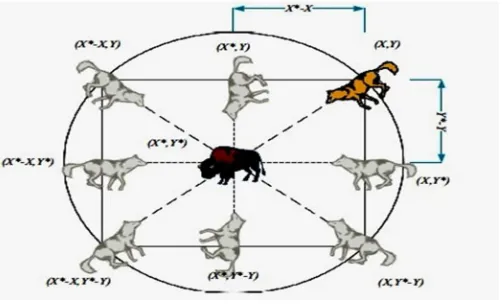
Fig. 4: 2D position vector with possible next location
In the above fig.4, it is clear that as the position of prey (X*, Y*) changes a grey wolf will also change its position (X, Y). Adjustment in A⃗ and C⃗ different places around the best agent is reached w.r.t. present position. Like, to reach (X*-X, Y*), A⃗=(1,0) and C⃗=(1,1) is set.
3) Hunting: To simulate the hunting by grey wolf mathematically, it is assumed that the Alphas i.e. best candidate solution; beta and delta have the better knowledge regarding prey possible location.
4) Attacking: The moment prey stop moving, grey wolf initiate attacking it i.e. the step after hunting. It is the process of exploitation. The value of ⃗is reduced so as to get mathematical realization of it.
[image:4.612.208.406.423.709.2]C. GWO Flow Chart
Fig.5 shows flow chart of gray wolf optimization technique
IV. RESULT AND DISCUSSIONS
The simulation studies are carried out is a single machine infinite bus (SMIB) system and multi-machine system. SMIB system the behavior of the system find out three conditions as no control, with CPSS & SSSC tuned by GWO technique, is tested under different operating conditions viz., nominal loading, light loading, heavy loading. In different loading conditions system tested with two cases. In multi-machine system we tested system with local area mode of oscillation and inter-area mode of oscillation & generator deviation without controller, with CPSSs & GWOPSS. SMIB and MMPS both systems developed in MATLAB/SIMULINK situation and system implement by GWO algorithm.
A. Condition-1 SMIB System
Table 1 & 2 shows the SSSC parameters optimized by GWO algorithm and different loading condition values. Table 1: SSSC Controller Parameters for SMIB System Tuned by GWO[6]
S.N. System SSSC Parameter Tuned by GWO
K T1 T2 T3 T3
1. SMIB System 700 10 2.4068 0.3246 0.759693
Table 2: Parameters of Various Loading Conditions
S.N. Loading Conditions Pe(p.u.) Qe(p.u.) Vt(p.u.)
1 Nominal 1.0 0.127 1.0
2 Light 0.8 0.0808 1.0
[image:5.612.128.490.484.639.2]3 Heavy 1.2 0.6068 1.1
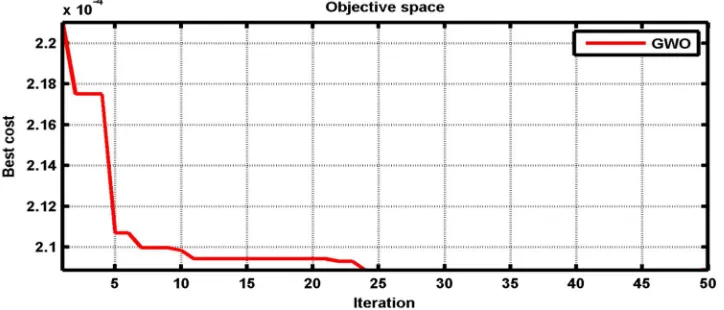
Fig.6 shows the convergence rate of objective functions of SMIB system.
Fig. 6: Convergence of Objective Function for Best Cost in SMIB System
optimized SSSC controller settle down very fast and result obtain at very good conditions. Table3 shows comparision table of various response.
[image:6.612.128.489.321.481.2]Fig. 7: Rotor Speed Response under Nominal Condition for Case-1
Fig. 8: Active Power Response under Light Loading Condition for Case-1
[image:6.612.126.487.517.705.2]Table-3 Various Response with Different Loading with Case-1
S.N. Types of
Response
Without SSSC (Settling Time)
Seconds
With CPSS
(Settling Time) Seconds
With GWO SSSC
(Settling Time) Seconds
1.
Rotor Speed Highly Oscillatory 2.6984 1.6839
Active Power Highly Oscillatory 3.0804 1.5385
Terminal Voltage Highly Oscillatory 2.8766 1.5913
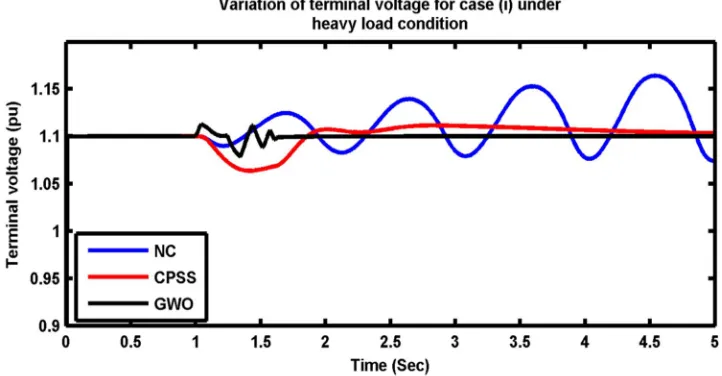
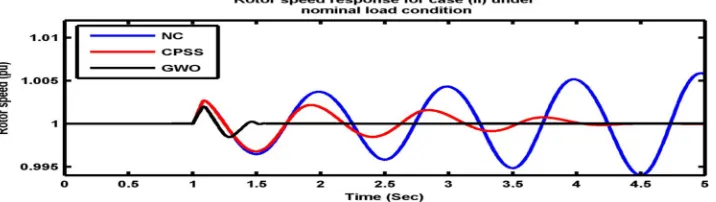
2) Case-2: Three Phase Short Circuit Fault Applied at The Middle of Transmission Line a 1.0 Second and the Fault Cleared at 1.083 Sec at Nominal,Light & Heavy Loading Condition: The various response as rotor speed response, active power response & terminal voltage response with time are shown in fig.10 to 12. We apply three phase fault at middle of transmission line. Without controller system not stable and show very high oscillatory response and then applied CPSS controller response better but not satisfied. Finally GWO SSSC controller system improve the system stability and settle very fast. Table 4 shows a comparison table of the different controller.
[image:7.612.131.489.327.428.2]Fig. 10: Rotor Speed Response under Nominal Condition for Case-2
Fig. 11: Active Power Response under Light Loading Condition for Case-2
[image:7.612.128.489.606.709.2]Table-4 Various Response with Different Loading with Case-2
S.N. Types of
Response
Without SSSC (Settling Time)
Seconds
With CPSS
(Settling Time) Seconds
With GWO SSSC
(Settling Time) Seconds
1.
Rotor Speed Highly Oscillatory 4.3264 1.5372
Active Power Highly Oscillatory 3.9130 1.4893
Terminal Voltage Highly Oscillatory 2.8766 1.5913
[image:8.612.124.486.275.459.2]B. Condition-2: Multi-Machine System(Kundur Two Area Four Machine System)
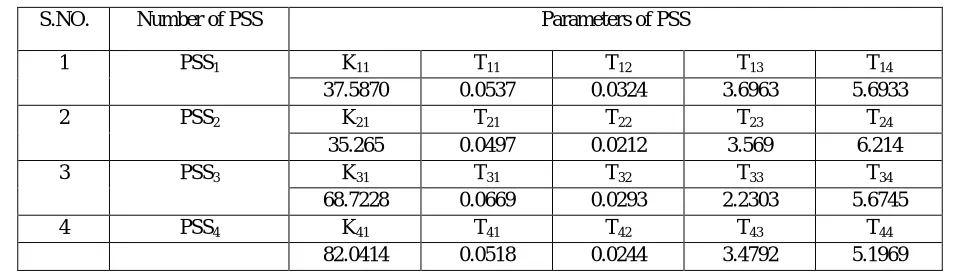
Fig. 13 shows the convergence rate of objective functions of MMPS system & table 5 shows PSS parameters optimized by GWO
Fig. 13: Convergence of Objective Function for Best Cost in Multimachine System Table 5: PSS Parameters Tuned by GWO in MMPS System
S.NO. Number of PSS Parameters of PSS
1 PSS1 K11 T11 T12 T13 T14
37.5870 0.0537 0.0324 3.6963 5.6933
2 PSS2 K21 T21 T22 T23 T24
35.265 0.0497 0.0212 3.569 6.214
3 PSS3 K31 T31 T32 T33 T34
68.7228 0.0669 0.0293 2.2303 5.6745
4 PSS4 K41 T41 T42 T43 T44
82.0414 0.0518 0.0244 3.4792 5.1969
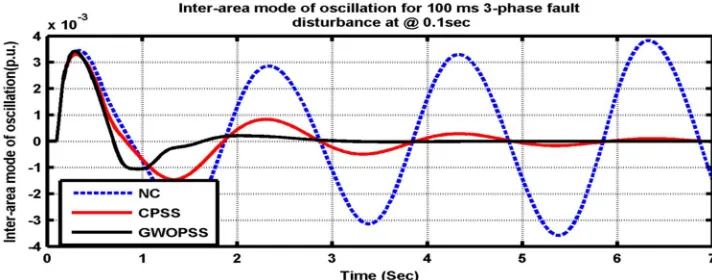
[image:8.612.66.546.514.651.2]Fig. 14: Inter-Area Mode of Oscillation in Three Machine System for 3-Phase Fault
[image:9.612.126.490.426.557.2]Fig. 15: Local-Area Mode of Oscillation in Three Machine System for 3-Phase Fault Disturbance
[image:9.612.132.487.587.718.2]Fig. 16: Speed Deviation of Generator G1 for 3 Phase-Fault Disturbance
Fig. 18: Speed Deviation of Generator G3 for 3 Phase-Fault Disturbance
Fig. 19: Speed Deviation of Generator G4 for 3 Phase-Fault Disturbance
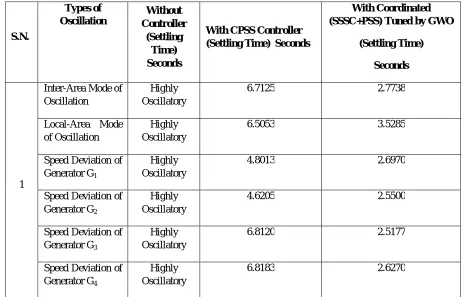
Table 6.: MMPS System under Three-Phase Fault Condition
S.N. Types of Oscillation Without Controller (Settling Time) Seconds
With CPSS Controller (Settling Time) Seconds
With Coordinated (SSSC+PSS) Tuned by GWO
(Settling Time)
Seconds
1
Inter-Area Mode of Oscillation
Highly Oscillatory
6.7125 2.7738
Local-Area Mode of Oscillation
Highly Oscillatory
6.5053 3.5285
Speed Deviation of Generator G1
Highly Oscillatory
4.8013 2.6970
Speed Deviation of Generator G2
Highly Oscillatory
4.6205 2.5500
Speed Deviation of Generator G3
Highly Oscillatory
6.8120 2.5177
Speed Deviation of Generator G4
Highly Oscillatory
[image:10.612.73.540.434.731.2]IV. CONCLUSIONS
In this paper, the results of the developed SMIB & multi machine system model under different contingencies are presented and discussed. The various types of waveform presented at SMIB system at different loading conditions at rotor speed response, active power & terminal voltage without & with CPSS & GWO SSSC controller. All loading as nominal, light & heavy loading cases system shows superior response when using GWO technique. In multi machine system apply two area four machine systems at various mode inter-area mode of oscillations, local area mode of oscillation, speed deviation of generator G1 to G4. Finally the
system show robust performance when apply various types of disturbances & loading. The SMIB System also tested with CPSS & GWO tuned SSSC controller. The MMPS system tested with CPSS & GWOPSS controller & so finally when the system tested with show fine response and improves stability of the system. Table 1 to 6 shows various comparison tables and also compare with a different controller. Table also proves that finally damping remove of the system very easily when planned proposed controller.
REFERENCES
[1] E Hadavandi, S Mostafayi and P Soltani, "A Grey Wolf Optimizer-based neural network coupled with response surface method for modeling the strength of siro-spun yarn in spinning mills." Applied Soft Computing 72, pp. 1-13, 2018.
[2] SR Paital, PK Ray and A Mohanty, "A review on stability enhancement in SMIB system using artificial intelligence based techniques." In 2018 IEEMA Engineer Infinite Conference (eTechNxT), pp. 1-6. IEEE, 2018.
[3] A Saxena, BP Soni, R Kumar and V Gupta, "Intelligent Grey Wolf Optimizer–Development and application for strategic bidding in uniform price spot energy market." Applied Soft Computing 69, pp. 1-13, 2018.
[4] T Guesmi, A Farah, HH Abdallah and A Ouali, "Robust design of multimachine power system stabilizers based on improved non-dominated sorting genetic algorithms." Electrical Engineering, pp. 1-13, 2017.
[5] Sreedivya KM, P A Jeyanthy and D Devaraj, "Fuzzy logic based power system stabilizer for damping low frequency oscillations in power system." In 2017 International Conference on Innovations in Electrical, Electronics, Instrumentation and Media Technology (ICEEIMT), pp. 201-205. IEEE, 2017.
[6] FD Murdianto, MZ Efendi, RE Setiawan and ASL Hermawan, "Comparison method of MPSO, FPA, and GWO algorithm in MPPT SEPIC converter under dynamic partial shading condition." In 2017 International Conference on Advanced Mechatronics, Intelligent Manufacture, and Industrial Automation (ICAMIMIA), pp. 315-320. IEEE, 2017.
[7] SP Singh, T Prakash, VP Singh and MG Babu, "Analytic hierarchy process based automatic generation control of multi-area interconnected power system using Jaya algorithm." Engineering Applications of Artificial Intelligence 60, pp. 35-44, 2017.
[8] RK Mallick and N Nahak, "Grey wolves-based optimization technique for tuning damping controller parameters of unified power flow controller." In 2016 International Conference on Electrical, Electronics, and Optimization Techniques (ICEEOT), pp. 1458-1463. IEEE, 2016.
[9] J Seekuka, R Rattanawaorahirunkul, S Sansri, S Sangsuriyan and A Prakonsant, "AGC using Particle Swarm Optimization based PID controller design for two area power system." In Computer Science and Engineering Conference (ICSEC), 2016 International, IEEE, pp. 1-4, 2016.
[10] A. Mohanty, R. Behera and B.P Panigrahi, “Fuzzified Philip-Heffron Model Power System Stabilizer for Improvisation of Voltage Stability”, International Conference on Electrical, Electronics, and Optimization Techniques (ICEEOT), pp. 1932-1935, 2016.
[11] L Rodríguez, O Castillo and J Soria, "Grey wolf optimizer with dynamic adaptation of parameters using fuzzy logic." In 2016 IEEE Congress on Evolutionary Computation (CEC), pp. 3116-3123. IEEE, 2016.
[12] D. Kumar, V. Gupta and R. C. Jha, “Implementation of FACTS Devices for Improvement of Voltage Stability using Evolutionary Algorithm”, 1st IEEE International Conference on Power Electronics; Intelligent Control and Energy Systems, pp. 1-6, 2016.