Current Signals based Wavelet Alienation
Approach Islanding Detection and Load changing
in a Distribution Line with Wind Distributed
Generation
K. Kamala Devi
1, Abdul Gafoor Shaik
2, K. Kamala Devi
31Department of Electrical and Electronics Engineering, Bapatla Engineering College, Bapatla-522101, India
2Department of Electrical Engineering, Indian Institute of Technology Jodhpur, Jodhpur-769008, India
3Assistant Professor, Department of Electrical and Electronics Engineering, Bapatla Engineering College, Bapatla-522101, India.
Abstract: Distributed generation is significantly gaining attention due to increase in the electricity demand. Distributed generations are mostly used with the association of power distribution systems to energize local loads and network. Islanding is technically an undesirable condition which demands necessary steps to reduce negative effects which helps in maintaining stability of the system. In the present work, alienation technique has been applied to detect and differentiate islanding, and sudden load change. A radial system with four Distributed Generations (DFIG wind generator) connected to the source through common coupling point (PCC) has been used for comprehensive study of this technique. The current signals were decomposed with Daubechies (db1) wavelet to obtain approximate coefficients at each bus. The approximate wavelet coefficient over a moving window of half cycle was used to compute alienation coefficients. The alienation coefficients were used to compute Islanding index and fault index. The same indices were compared with threshold to differentiate Islanding and sudden load change. The proposed algorithm has been tested for various incidence angles for both islanding condition and faults. This technique is found to be robust, effective to detect islanding condition and impact of sudden load change.
Keywords: Alienation coefficients, Distributed generation, Distribution network, Islanding index, Wavelet transform, load change.
I. INTRODUCTION
Penetration of distributed generation in power distribution networks increases rapidly in the present days. Distributed generation (DG) is also known as non centralized power generation or dispersed generation refers to the production of Electricity near the consumption place. The resources used in distributed generation are renewable energy sources and cogeneration i.e., production of heat and electricity simultaneously. DGs are having some advantageous characteristics like free location in the network area, relatively small generated power, increased reliability of the Grid, reduced transmission and distribution line losses, better voltage support and power quality improvement [1]. The backup (standby) generation, utility grid enhancement, peak shaving, load
management etc are the various applications of distributed generation. However many technical issues and difficulties arise in the association of DG units with the Grid. Islanding condition is one of the most undesirable conditions intentionally or accidentally takes place in DGs. According to IEEE STD 1547-2003, in islanding condition, the grid is accidentally or intentionally disconnected from distribution network system but the distributed generation continuously feed the local loads and network [2]. Due to this
Islanding condition, various operational problems arise related to power quality, safety hazard, voltage and frequency instability and damage to system equipment. The unsynchronized reclosing of the grid to the distribution system may cause damage to the power electronic conditioning equipment of the DG. IEEE 929-2000 standard specifies the disconnection of DG once it is islanded [3] and
IEEE STD 1547-2003 address this issue. Islanding detection techniques are broadly classified into remote (central) and local techniques. A detailed review on islanding has been given by Khamis, Aziah et al., [4]. Remote methods are associated with
islanding detection methods on the utility side where as local methods are associated with detection of islanding on DG side. Remote methods are used to detect unintentional islanding by monitoring voltage and frequency parameters [5]. Remote or central
harmonic distortion. Comparative analysis of anti islanding technique depends on application and cost and ability of occurrence of islanding on feeder has been presented by P. Deshbhratar, R. Somalwar and S. G. Kadwane. Local Islanding detection techniques are further classified into active technique methods, passive technique methods and hybrid technique methods [6, 7]. J. Yim, C.P.
Diduch, L. Chang introduced anti islanding technique based on the proportional power spectral density as a normalized measure [8].
S. R Samantha Ray and Trupti Mayee Pujhari presented a new approach to islanding detection by extracting the negative sequence component of the voltage and current [9]. K. Narayana presented a scheme on a priority based load shedding to detect islanding in
case of multiple DG units [10]. Ahmad G. Abd Elkadar reported a new islanding technique for DFIG wind turbine by using artificial
neural network [11]. R. K. Ray, N. Kishore et al., proposed a wavelet and S-transform based scheme by considering a negative
sequence component of the voltage signal extracted at point of common coupling. J. A. Laghari et al., developed an islanding detection technique by using average rate of change of reactive power and load shift strategy.[12] In deed there is a need to
investigate a protective scheme which requires fast detection with less computational complex. In this present work the proposed algorithm can detect islanding and faults within quarter cycle.In the present paper current signals at each bus are decomposed with Daubechies wavelet up to third level to get approximation coefficients. The alienation values of approximation coefficients over a half cycle clearly localize the islanding, and load change and are calculated to obtain the islanding and fault index. These indexes are compared with the predetermined threshold value of islanding and load change. The currents at each bus are sampled at a frequency of 6400Hz.
II. ALIENATION ALGORITHM BASED ON WAVELETS
A. Wavelet Transform
Wavelet transform is effectively used to analyze transients of current and voltage signals in both frequency and time-band. A set of basic functions called Wavelets, are used to decompose the signal in high frequency and low frequency bands, which are obtained from a mother wavelet by dilation and translation. Hence the amplitude and incidence of each frequency can be found precisely. Wavelet Transform is defined as a sequence of a function {h (n)} (high pass filter) and {g (n)} (low pass filter). The scaling function and wavelet function can be described in equations as follows.
∅( ) =√2 ∑ ℎ( ) (2 − ) (1)
Ψ( ) = √2 ∑ ( ) (2 − ) (2)
Where, g (n) = (-1) n h (1-n)
The factor √2 maintains the norm of the function for the time compression factor 2. The time compression factor generally
corresponds to the scale. The selection of mother wavelet is based on the type of application. This paper used Daubachies wavelet which is suited for this application to get best results.
B. Alienation Coefficients based on Approximation Coefficients
In the proposed algorithm current signals are sampled over a half cycle. Wavelets are applied to these samples and decomposed to obtain approximation coefficients. The alienation coefficient based on approximation decomposition (Coefficients) is calculated as:
= 1− (3)
Where, pa is the correlation coefficient calculated based on approximation coefficients. The correlation coefficient based on
approximation coefficient is calculated as
= (∑ ) (∑ ∑ )
[ ∑ (∑ ) ][ ∑ (∑ )
(4)
Where, Ns the number of samples per half cycle, absolute value of samples at t0 is denoted by ra. Absolute value of samples consider
in previous moving window of half cycle is denoted by sa. The variance between two signals is defined as the alienation coefficient.
Its value is between 0 and 1.
C. Weighted Alienation Coefficients
5 1
i i
x
avg
WiXi
(5)i= Total number of inputs.
Xi is alienation coefficient at each bus of four DGs and PCC where, i = 1,2,3,4,5.
Get Max (x1, x2, x3, x4, x5) = n.
Divide each alienation value of DGs and PCC by n to get weights. The weights will be xi/n=wi where i=1 to 5.
[image:3.595.101.495.216.419.2]Multiply every alienation coefficient of four DGs and PCC with their respective weights (wi). Then get average of these values for all three phases.
Figure 1: Line diagram of the system
III. PROPOSED ALGORITHM TABLE 1 Parameters adopted in the present work
S.NO COMPONENT SPECIFICATION
1. Generator Rated short circuit MVA=1000
Rated KV=120,Vbase=120kv,f=50Hz 2. Distributed generations(DGs)
(DG-1 to DG-4)
Six Doubly fed induction generators (9MW) of each 1.5MW wind turbines are connected to a 25kv grid through a30km,25kv feeder.
3. Distribution lines DL-1 to DL-4
PI-Section,30km each, rated MVA= 20, Rated KV=25,Vbase=25kv, R0= 0.1153Ω/km,R1=0.413Ω/km,L0=
1.05e-3H/km, L1=3.32e-3H/km, C0=11.33e-009F/km,X1=5.01e-009 F/km.
4. Transformer T1 Rated MVA=25,Vbase=25kv,Rated KV=120/25, X1=0.1p.u, R1=0.00375 p.u, Rm=500 p.u, Xm=500 p.u. 5. TransformerT2 to
Transformer T5.
Rated MVA=10,rated kv=575v/25kv, Vbase=25KV, X1=0.1, R1=0.00375
p.u, Rm=500 p.u, Xm=500 p.u,f=50hz
6. Load L-1 15MW,5MVAR.
The single line diagram of proposed system is shown in Fig. 1. The base power is 10 MVA. The studied system consists of radial distribution system with 4 DG units (wind farms), connected to the main supply system through Point of Common Coupling (PCC) and operates at a power frequency of 50 Hz. The DG units are placed at a distance of 30 km with distribution lines of pi-sections. The data of the generator, DGs, transformers, distribution lines and loads are considered.
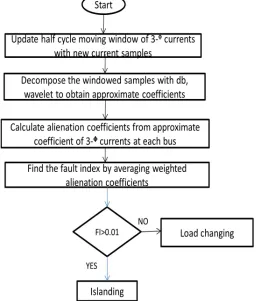
Three phase currents at DGs and point of common coupling of distribution line are sampled at 6400 Hz. These samples are obtained over a moving window of half cycle length. These current samples are decomposed with db1 wavelet to obtain approximation coefficients of third level (A3). Alienation coefficient CA is computed by comparing the approximate coefficients of current window,
with those of previous window of same polarity.
Under normal conditions, the two consecutive windows have similar set of approximations, hence Aa remains zero. But in case of
[image:4.595.171.430.259.560.2]islanding, fault or any other abnormal condition, the approximate coefficient of current window should differ from those of previous window of same polarity. Hence alienation coefficient would increase from zero to a certain value indicating disturbances.
Figure 2: Flow chart of the proposed algorithm.
IV. RESULTS AND DISCUSSIONS
A. Detection of Islanding
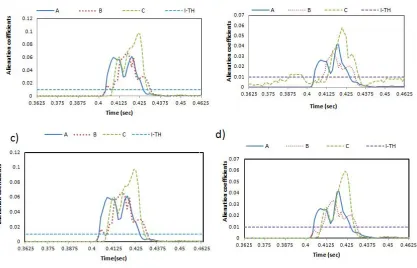
Figure 3: Variation of islanding indexes with time at a) DG-1 located at 30km from PCC, b) DG-2 located at 60km from PCC, c) DG-3 located at 30km from PCC and d) DG-4 located at 60km from PCC.
Figure 3: Variation of islanding indexes with time at e) DG-3 located at 35km from PCC
Figure 3: Variation of islanding indexes with time at f) DG-2 located at 50km from PCC.
0 0.02 0.04 0.06 0.08 0.1
0.3625 0.375 0.3875 0.4 0.4125 0.425 0.4375 0.45 0.4625
A
lie
n
at
ion
c
oe
ff
ic
ie
n
ts
Time(sec)
A B C I-TH
0 0.02 0.04 0.06 0.08 0.1
0.3625 0.375 0.3875 0.4 0.4125 0.425 0.4375 0.45 0.4625
B. Variation of Islanding Incidence Angle
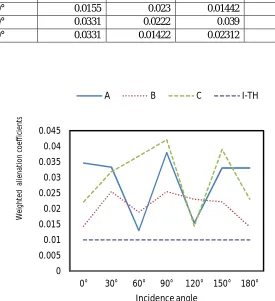
Islanding has been applied at regular interval of 300 to test the proposed algorithm. Fig.4 illustrates variation of islanding indexes of
[image:6.595.167.442.263.564.2]three phases with incidence angle. From graph it is evident that the islanding index is always greater than the threshold for various incidence angles at PCC which shows islanding condition.
TABLE 2 Islanding Incidence Angle Incidence
Angle PHASE A PHASE B PHASE C I-TH
0° 0.03466 0.0144 0.0222 0.01
30° 0.033375 0.0255 0.0319 0.01
60° 0.013 0.0189 0.0369 0.01
90° 0.038 0.0255 0.04215 0.01
120° 0.0155 0.023 0.01442 0.01
150° 0.0331 0.0222 0.039 0.01
180° 0.0331 0.01422 0.02312 0.01
Figure 4: Variation of islanding index for different incidence angle at four DGs.
C. Load Changing
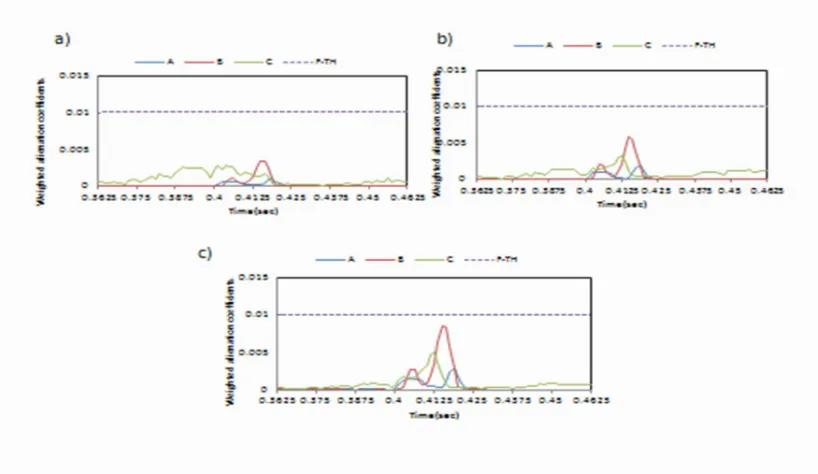
The effect of sudden change of load on distribution network at DG-1 is observed. Fig 5 shows effect of load changing in a distribution line at DG-1 at 0.4sec through a circuit breaker. System at different levels of load increment on 3 MVAR and 0.8 power factor base is added to the existing system load at similar time of 0.4 sec. Fig5 (a),5(b),5(c),5(d),5(e) show the load change of 5% , 10%, 20%, 25% and 30%. Figure 6 (a) indicates 15% load changing at DG-2, 6(b) 20% load changing at DG-3, 6(c) 25% load changing at DG-4. It is observed that the magnitude of disturbance is found to be less than that of threshold. But it is found that sudden increment of load has no impact on islanding.
0 0.005 0.01 0.015 0.02 0.025 0.03 0.035 0.04 0.045
0° 30° 60° 90° 120° 150° 180°
W ei gh ted al ie n at io n co ef fi ci en ts Incidence angle
Figure 5: Effect of load changing in a distribution line at DG-1: (a). 5% load changing at DG-1, (b). 10% load changing at DG-1, (c). 20% load changing at DG-1, (d). 25% load changing at DG-1, (e). 30% load changing at DG-1
Figure 6: Effect of load changing in a distribution line at DGs: (a). 15% load changing at DG-2, (b). 20% load changing at DG-3, (c). 25% load changing at DG-4.
V. CONCLUSION
[image:7.595.95.504.392.629.2]REFERENCES
[1] Dulău, Lucian Ioan, Mihail Abrudean, and Dorin Bică. "Effects of distributed generation on electric power systems." Procedia Technology 12 (2014): 681-686. [2] Kroposki, Benjamin, Thomas Basso, and Richard DeBlasio. "Microgrid standards and technologies." In Power and Energy Society General
Meeting-Conversion and Delivery of Electrical Energy in the 21st Century, 2008 IEEE, pp. 1-4. IEEE, 2008
[3] Recommended “Practice for Utility Interconnected Photovoltaic (PV) Systems”, IEEE Standard 929-2000, 2000.
[4] Khamis, Aziah, Hussain Shareef, Erdal Bizkevelci, and Tamer Khatib. "A review of islanding detection techniques for renewable distributed generation systems." Renewable and sustainable energy reviews 28 (2013): 483-493.
[5] Mahat, Pukar, Zhe Chen, and Birgitte Bak-Jensen. "A hybrid islanding detection technique using average rate of voltage change and real power shift." IEEE Transactions on Power delivery 24, no. 2 (2009): 764-771
[6] Funabashi, Toshihisa, Kaoruy Koyanagi, and R. Yokoyama. "A review of islanding detection methods for distributed resources." In Power Tech Conference Proceedings, 2003 IEEE Bologna, vol. 2, pp. 6-pp. IEEE, 2003.
[7] Mahat, Pukar, Zhe Chen, and Birgitte Bak-Jensen. "Review of islanding detection methods for distributed generation." In Electric Utility Deregulation and Restructuring and Power Technologies, 2008. DRPT 2008. Third International Conference on, pp. 2743-2748. IEEE, 2008.
[8] J. Yim, L. Chang, and C. Diduch. “Recent development in islanding detection for distributed power generation,” Large engineering Systems Conference on Power Engineering” (LESCOPE), pp. 124-128, 28-30 July 2004.
[9] S.R.Samantaray, Trupti Mayee Pujhari, B.D.Subudhi "A new approach to Islanding detection in Distributed Generations",2009 Third International Conference on Power Systems, Kharagpur, INDIA December 27-29, 978-1-4244-4331-4/09.
[10] Narayanan, K., Shahbaz A. Siddiqui, and Manoj Fozdar. "An Improved Islanding Detection Technique and priority based load shedding for distribution system with multiple DGs." In Power Systems Conference (NPSC), 2016 National, pp. 1-6. IEEE, 2016.
[11] Abd-Elkader, Ahmad G., Dalia F. Allam, and Elsayed Tageldin. "Islanding detection method for DFIG wind turbines using artificial neural networks." International Journal of Electrical Power & Energy Systems 62 (2014): 335-343.