Robust Anaphor Resolution Algorithm
Roland Stuckardt*
Knowbotic Systems GmbH & Co. KG
Syntactic coindexing restrictions are by now known to be of central importance to practical
anaphor resolution approaches. Since, in particular due to structural ambiguity, the assumption
of the availability of a unique syntactic reading proves to be unrealistic, robust anaphor resolution
relies on techniques to overcome this deficiency.
This paper describes the ROSANA approach, which generalizes the verification of coindexing
restrictions in order to make it applicable to the deficient syntactic descriptions that are provided
by a robust state-of-the-art parser. By a formal evaluation on two corpora that differ with respect
to text genre and domain, it is shown that ROSANA achieves high-quality robust coreference
resolution. Moreover, by an in-depth analysis, it is proven that the robust implementation of
syntactic disjoint reference is nearly optimal. The study reveals that, compared with approaches
that rely on shallow preprocessing, the largely nonheuristic disjoint reference algorithmization
opens up the possibility/or a slight improvement. Furthermore, it is shown that more significant
gains are to be expected elsewhere, particularly from a text-genre-specific choice of preference
strategies.
The performance study of the ROSANA system crucially rests on an enhanced evaluation
methodology for coreference resolution systems, the development of which constitutes the second
major contribution o/the paper. As a supplement to the model-theoretic scoring scheme that was
developed for the Message Understanding Conference (MUC) evaluations, additional evaluation
measures are defined that, on one hand, support the developer of anaphor resolution systems, and,
on the other hand, shed light on application aspects of pronoun interpretation.
1. I n t r o d u c t i o n
The interpretation of anaphoric expressions is known to be a difficult problem. In principle, a variety of constraints and preference heuristics, including factors that rely on semantic, pragmatic, and world knowledge, contribute to this task (Carbonell and Brown 1988). Robust, operational approaches to anaphor resolution on unrestricted discourse, however, are confined to strategies exploiting globally available evidence like morphosyntactic, syntactic, and surface information.
Beginning with the pioneering work of Hobbs (1978), many practical approaches rely on the availability of syntactic surface structure by employing coindexing re- strictions, salience criteria, and parallelism heuristics (e.g., Lappin and Leass 1994). However, even the assumption of the availability of a unique syntactic description is unrealistic since, in general, parsing involves the solution of difficult problems like at-
Computational Linguistics Volume 27, Number 4
tachment ambiguities, role uncertainty, and the instantiation of empty categories. Based on this observation, Kennedy and Boguraev (1996) have suggested an adaptation of Lappin and Leass's approach to the shallow analysis frontend of English Constraint Grammar (Karlsson et al. 1995), which provides a part-of-speech tagging compris- ing an assignment of syntactic function but no constituent structure. This information deficiency is partly overcome by the application of a regular filter that heuristically reconstructs parts of the constituent structure. An alternative solution, which is based on the possibly partial but potentially more comprehensive and reliable output of a conventional parser, has been suggested in Stuckardt (1997).
In the present paper, an approach to robust anaphor resolution is developed that enhances the latter work. The coreference resolution algorithm ROSANA l is devel- oped, the core of which consists of a set of rule patterns by means of which the verification of disjoint reference rules is generalized in order to make it applicable to deficient (fragmentary) syntactic descriptions. Based on this algorithm, the ROSANA system, which works on the partial syntactic descriptions generated by the robust FDG (Functional Dependency Grammar of English) parser of J~irvinen and Tapanainen (1997), is implemented. By a formal evaluation on two text corpora that differ with respect to genre and domain, it is proven that ROSANA achieves robust (truly opera- tional) high-quality coreference resolution on unrestricted texts. An in-depth analysis shows that the robust implementation of syntactic disjoint reference is nearly opti- mal. Compared with approaches that rely on a combination of shallow preprocess- ing and heuristic syntactic disjoint reference, the largely nonheuristic disjoint refer- ence algorithmization employed by ROSANA opens up the possibility for a slight improvement.
The performance study of the ROSANA system crucially rests on an enhancement of the evaluation methodology for coreference resolution systems, the development of which constitutes the second major contribution of the paper. As a supplement to the coreference class scoring scheme that was developed for the CO-task evaluation of the Message Understanding Conferences (Vilain et al. 1996), two additional eval- uation disciplines are defined that, on one hand, aim at supporting the
developer
of anaphor resolution systems, and, on the other hand, shed light onapplication aspects
of pronoun interpretation. The evaluation of ROSANA according to the refined scoring scheme gives evidence that the interpretation quality m a y be improved by a genre- specific choice of the preference factors and their relative weights. This demonstrates the usefulness of enhancing the evaluation methodology for coreference resolution systems.The paper is organized as follows. In Section 2, the robustness issue of natural language processing is briefly discussed at a general level, and two models of robust anaphor resolution are introduced. In Section 3, by deriving a set of disjoint refer- ence rule patterns for fragmentary syntax, the core component of a robust, operational anaphor resolution algorithm is developed. In Section 4, the ROSANA algorithm is designed, and an implementation, the ROSANA system, is described. In Section 5, an enhanced set of evaluation disciplines for coreference resolution systems is advo- cated for, and the respective formal measures are defined. In Section 6, the evaluation results of ROSANA are discussed. Finally, in section 7, ROSANA is compared with other approaches to anaphor resolution and, in particular, robust syntactic disjoint reference.
2. Anaphor Resolution and the Robustness Issue
2.1 Robustness in Natural Language Processing
In natural language processing in general, the robustness issue comprises the ability of a software system to cope with input that gives rise to deficient descriptions at some descriptive layer. 2 More or less implicit is the assumption that the system exhibits some kind of
monotonic behavior:
the less deficient the description, the higher the quality of the output (Menzel 1995).Following Menzel further, this intuitive characterization m a y be refined. The pro- cessing should exhibit
autonomy
in the sense that complete failures at one stage of analysis should not cause complete failures at other stages of analysis or even a fail- ure of the overall processing. Moreover, the processing model should ideally employ some kind ofinteraction
between different stages of analysis: deficiency at one stage of analysis should be compensated by evidence gained at other stages.2.2 Two Models of Robust Anaphor Resolution
In light of the above characterization, the robustness requirement for the anaphor resolution task m a y be rendered more precisely. In the aforementioned operational approaches, a
sequential processing model
is followed according to which anaphor resolu- tion is performed by referring to the result of analready completed
syntactic analysis. Un- der this architecture, evidence for structural disambiguation that m a y be contributed by strong expectations at the referential layer is not taken into account (Stuckardt 1996). In terms of the general goals of robust processing, since there is no interac- tion, this implies that the robustness requirement only shows up in the form of the monotonicity and autonomy demands: the anaphor resolution module has to cope with deficient or shallow syntactic information. Besides the trivial w a y of achieving this kind of robustness by simply not exploiting deficient syntactic descriptions, the following two models m a y be employed:the shallow description model: by employing heuristic rules to partially
reconstruct the syntactic description, the anaphor resolution strategies are adapted to
shallow input data
that are never defective; 3the deficient description model: by extending anaphor resolution
strategies to work on a possibly ambiguous or incomplete description,
syntactic evidence is exploited as far as available.
In contrast to the approach of Kennedy and Boguraev (1996), which follows the shallow description model, the ROSANA algorithm is based on the deficient description model. In principle, even a "complete" algorithm that establishes the conceptually superior degree of robustness by means of interaction between structural disambiguation and anaphor resolution is feasible (Stuckardt 1997). As will become evident, however, the technically less complex sequential strategy employed by ROSANA already yields high-quality results and does not leave much room for further improvement.
2 The deficiency may result either because the input itself is deficient or from shortcomings of the processing resources (e.g., lexicon, grammar/parser, or semantic/pragmatic disambiguation). 3 Here, the monotonicity d e m a n d of intuitive robustness virtually vanishes, since there is no longer a
Computational Linguistics Volume 27, Number 4
2.3 Fragmentary Syntax
The main phenomena that give rise to structural ambiguity of syntactic descriptions are
uncertainty of syntactic function
(involving subject and direct object) andattachment
ambiguities
of prepositional phrases, relative clauses, and adverbial clauses. In example (1),(1) Peter observed the man with the telescope.
depending on the availability of disambiguating information, it may be uncertain whether the underlined prepositional phrase
with the telescope
should be interpreted adverbially or attributively. From the configurational perspective, these ambiguities give rise tofragmentary syntactic descriptions
that consist of several tree-shaped components. With the exception of the topmost tree fragment, all components cor- respond to a constituent of type PP, S, or NP whose attachment or role assignment failed.In addition,
cases in which no reading exists
give rise to fragmentary syntactic de- scriptions comprising the constituents whose combination failed due to constraint violation.2.4 Fragmentary Syntax and Anaphor Resolution
Among the anaphor resolution strategies potentially affected by fragmentary syntax are both heuristics and constraints. Preference criteria like salience factors and syntactic parallelism are not affected b y all types of syntactic defects. Moreover, there are many heuristics that do not rely on syntactic function or structure. Structural coindexing constraints, however, may lose evidence in all the above cases of fragmentary syntax. Since they are known to be of central importance to the antecedent-filtering phase of operational anaphor resolution approaches, the subsequent discussion focuses on the impact of deficient surface structure description on disjoint reference restrictions.
By referring to Chomsky's Government and Binding (GB) Theory, the core of the syntactic coindexing restrictions may be stated as follows (Chomsky 1981): 4
Definition
Binding principles A, B, and C:
(A) A reflexive or reciprocal is b o u n d in its binding category. (B) A pronoun is free (i.e., not bound) in its binding category. (C) A referring expression 3 is free in any domain.
where
binding category
denotes the next surface-structural dominator containing some kind of subject, and b i n d i n g is defined ascoindexed and c-commanding:
4 Various theoretical models that cover disjoint reference phenomena have been stated. Since the disjoint reference conditions are descriptive principles of grammar, the choice of the theoretical model is, in this sense, arbitrary. In the subsequent discussion, the comprehensive and widely known GB Theory is referred to.
Definition
Surface structure node X
c-commands
node Y if and only if the next branching node that dominates X also dominates Y and it is not the case that X dominates Y, Y dominates X, or X = Y.The following examples illustrate the scope of the binding principles: (2) a. The barber/is shaving
himselfi/*himi.
b. The client/wants that the barberj shaves
,himselfi/himi.
c. ,The client/wants that the barberj shaves the client/.In sentence (2a), whereas the reflexive
himself
is required to be coindexed with the local subjectthe barber
(binding principle A), coindexing the pronounhim
with the subject is ruled out (binding principle B) because, otherwise, the pronoun would be locally bound in its binding category. Sentence (2b) illustrates the case of nonlocal binding (here: outside the embedded sentence), which is admissible only in the case of the nonreflexive pronoun. As illustrated by sentence (2c) and modeled by binding princi- ple C, referring expressions (e.g., common nouns and names) are not even allowed to be bound nonlocally.A further structural well-formedness condition, commonly called the i-within- i condition, aims at ruling out certain instances of referential circularity, that is, coin- dexings matching the pattern [c~ ... [fl...]i]i (Chomsky 1981, page 212). It is motivated by cases like (3):
(3) *Mary knows [the owner of hisi boat]/.
The following example illustrates that syntactic fragmentation may interfere with the application of syntactic disjoint reference conditions:
(4) Peter observed the owner of the telescope with it.
In (4), the i-within-i condition possibly applies: 6 the coindexing of
telescope
andit
is admissible only if the PP containingit
is not interpreted as an attribute totelescope--
otherwise, in violation of the i-within-i condition, the pronoun w o u l d be contained in the NP of the tentative antecedent. Hence, if the PP attachment ambiguity has not6 Since the (maximal projection of the) N P w i t h h e a d telescope d o m i n a t e s the N P of it, the former N P does not c - c o m m a n d the latter. Hence, coindexing the two NPs does not i n d u c e a relation of (local) binding, w h i c h implies that b i n d i n g principle B does not apply in this case.
If one assumes the applicability of the i-within-i condition defined as above, however, there are two classes of cases that do not seem to be appropriately distinguished:
(i) Peter observed the o w n e r of [the telescope near itsi factory]/.
(ii) *Peter destroyed [a picture of its/frame]i.
Whereas in (i), w h e r e the possessive occurs in a n adjunct p h r a s e of the telescope NP, coindexing m a y be
Computational Linguistics Volume 27, Number 4
been resolved prior to anaphor resolution, the fragmentary syntactic description does not contribute the configurational evidence necessary for definitely confirming the
antecedent candidate telescope.
3. Checking Binding Constraints on Fragmentary Syntax
3.1 Basic Observations
The first step t o w a r d the verification of b i n d i n g constraints on f r a g m e n t a r y syntax is
suggested b y the following observation: if both the anaphor and the antecedent candidate are
contained in the same connected component of the fragmentary syntactic description, no (direct) binding-theoretic evidence is lost. In this case, it will be possible to verify the binding restrictions of anaphor a n d antecedent in a nonheuristic manner, since the necessary positive (--* binding principle A) a n d negative (---+ b i n d i n g principles B, C) syntactic- configurational evidence is entirely available. 7 However, even in the disadvantageous case in which the anaphor a n d the antecedent candidate occur in different surface structure fragments, a closer look at the fragments m a y reveal additional information.
3.2 An Example
The following example illustrates a typical case: 8
(5)
Der M a n n hat d e n Pr~isidenten besucht, der ihn v o n sich i~berzeugte.the m a n has the president visited w h o h i m of himself convinced
'The m a n visited the president w h o convinced h i m of himself.'
Because of the intervening past participle, the relative clause m a y be interpreted as an
attribute to either Mann or Pr~sidenten. Hence, syntactic ambiguity arises, yielding a
surface structure description that consists of the following two fragments: 9
(S Mann
(VP Pr~sidenten) ) (S der
(VP ihn
(VP (PP sich))))
In addition, it is k n o w n that the second fragment is e m b e d d e d in the first. There are three p r o n o m i n a l anaphors to be resolved: the reflexive p r o n o u n sich of binding- theoretic type A, the nonreflexive p r o n o u n ihn of type B, a n d the relative p r o n o u n der of type B.
Regarding the reflexive p r o n o u n sich, it can be s h o w n that binding-theoretic ev-
idence is completely available. Clearly, this holds w i t h respect to the candidates der
a n d ihn, which are contained in the same surface structure fragment. However, even
regarding the two candidates Mann a n d Prf~sidenten that occur in the other fragment,
there is no loss of evidence: since the reflexive p r o n o u n is of binding-theoretic type A, a n d the fragment in which it occurs contains its b i n d i n g category (the S n o d e of the
7 However, this statement applies solely to the direct comparison of the involved occurrences, since in case of further, transitive coindexings, negative evidence stemming from decision interdependency may get lost (cf. Section 4.1).
relative clause), a c c o r d i n g to b i n d i n g principle A b o t h c a n d i d a t e s m a y be definitively
ruled out.
Similar o b s e r v a t i o n s can be m a d e r e g a r d i n g the p r o n o u n s ihn a n d der, for w h i c h b i n d i n g principle B applies: the t w o c a n d i d a t e s M a n n a n d Priisidenten are r e c o g n i z e d as configurationally admissible. In this case, besides the b i n d i n g c a t e g o r y condition, it is decisive that their f r a g m e n t is k n o w n to be embedded in the a n t e c e d e n t ' s f r a g m e n t s . 1°
3.3 R u l e Patterns
In the s u b s e q u e n t discussion, pairs of a n a p h o r s a a n d a n t e c e d e n t c a n d i d a t e s 3' are c o n s i d e r e d that occur in different surface syntactic fragments. The goal is to d e t e r m i n e w h e t h e r c o i n d e x i n g a a n d 3' (as in the case of actually c h o o s i n g 3' as the a n t e c e d e n t of a) c o m p l i e s w i t h the a b o v e - s t a t e d b i n d i n g - t h e o r e t i c conditions. Since, a c c o r d i n g to the definition of the b i n d i n g principles, n o a s y m m e t r i c distinction b e t w e e n a n a p h o r a n d c a n d i d a t e is d r a w n , the disjoint reference r e q u i r e m e n t s of b o t h a a n d 3' m u s t be t a k e n into account.
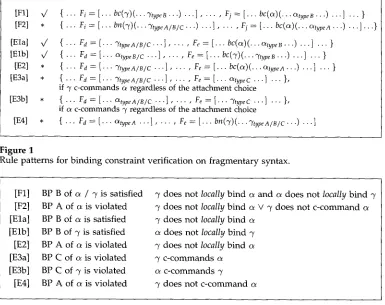
By a n abstraction o v e r cases like the ones discussed in Section 3.2, a set of r u l e p a t - terns can be d e s i g n e d b y m e a n s of w h i c h the verification of syntactic disjoint reference is g e n e r a l i z e d in o r d e r to m a k e it applicable to f r a g m e n t a r y syntactic d e s c r i p t i o n s (cf. Figure 1). 11 As illustrated b y e x a m p l e (5), there are t w o classes of patterns. 12 O n e class (five patterns, labeled " , " ) m a t c h e s cases in which, a c c o r d i n g to the b i n d i n g princi- ples, c o i n d e x i n g the a n a p h o r a a n d the a n t e c e d e n t c a n d i d a t e 3' is ruled out; the other class (three patterns, labeled " v / ' ) a p p l i e s in certain cases w h e r e n o b i n d i n g principle is v i o l a t e d a n d coindexing is therefore admissible. By the b i n d i n g principles, conditions regarding, o n o n e h a n d , the presence or absence of a c - c o m m a n d relation, a n d , o n the other h a n d , the locality or nonlocality of this relation, are stated. The rule p a t t e r n s are d e s i g n e d to m a t c h f r a g m e n t a r y cases in w h i c h at least o n e condition of either a n a p h o r or c a n d i d a t e is v i o l a t e d ( " , " patterns), or cases in w h i c h all conditions of a n a p h o r a n d c a n d i d a t e are satisfied ("v/" patterns). Figure 2 explicates the specific conditions the different p a t t e r n s a i m at. Three p a t t e r n s a p p l y in certain cases of b i n d i n g principle A violation ([E2]: m i s s i n g locality; [E4]: m i s s i n g c - c o m m a n d relation; [F2]: either miss- ing locality or m i s s i n g c - c o m m a n d relation). A n o t h e r t w o p a t t e r n s c o v e r instances of b i n d i n g principle C violation ([E3a], [E3b]: c - c o m m a n d relation). Three other p a t t e r n s m a t c h cases of b i n d i n g p r i n c i p l e B satisfaction (IF1], [Ela], [Elb]: nonlocality).
This collection of rules m a y be s u p p l e m e n t e d w i t h f u r t h e r p a t t e r n s e m p l o y i n g m o r e sophisticated conditions r e g a r d i n g the f r a g m e n t s to be m a t c h e d . 13 The actual choice of rule patterns, h o w e v e r , s h o u l d d e p e n d on the p a r s e r that is used. As will
10 It is evident that there are cases in which the latter condition does not hold and the coindexing would violate binding principle C.
11 The following notational conventions are used: round brackets delimit constituents; square brackets emphasize fragment boundaries; bc(X) denotes the binding category of surface structure node X; bn(X)
denotes the branching node dominating X according to the c-command definition; the subscript of
Xtype y denotes that the binding-theoretic class of the occurrence contributed by X is Y C {A, B, C}; for example, PtypeB is a pronoun. ~//* indicate the prediction of the particular pattern, that is, whether, in structural configurations matching the pattern, coindexing is admissible or ruled out.
12 Example (5) illustrates an instance of syntactic fragmentation that is due to structural ambiguity. The rule patterns, however, are general in the sense that they also cover cases of fragmentary syntactic description that are induced by parsing constraint violation (cf. Section 2.3).
13 For example, patterns may be added that match instances of binding principle B violation, that is, cases in which one occurrence of type B is locally c-commanded by the other occurrence. To recognize such cases,
two conditions must be verified, one requiring that one occurrence c-command the other (of type B) regardless of the attachment choice, the other requiring that the fragment of the latter occurrence not
Computational Linguistics Volume 27, N u m b e r 4
[F1] ,/
IF2] *
[Ela] x/
[Elb] ,/
[E2] *
[E3a] *
[E3b] *
[E4] *
( {
( (
{ . . , Fcl = [ . . . 3"typeA/S/C . . . ] . . . Fe = [ . . . b c ( a ) ( . . . O q y p e A . . . ) { " " Fd = [ ' ' " 3"typeA/B/C . . . ] . . . Fe = [ . . . atypeC . . . ] . . . },
if 3' c-commands a regardless of the attachment choice { . . . I:a = [ . . . atyp~A/B/C -..] . . . F~ = [... 3",yp~C .. ] .-. }, if a c-commands 3' regardless of the attachment choice
{ . . . Fd ~- [ . . . OqypeA . . . ] . . . Fe = [... bn(3")(,..3"typeA/B/C...)
. . . F i : [ . . . bc(3")(... 3"typeB...) • ..] . . . Fj ~- [ . . . bc(oL)(...~typeB . . . ) . . . ] . . . } ... Fi = [ . . . bn(3")(...3"typeA/B/c. .) ...] . . . r-j = [ . . . b e ( n ) ( . . . ~ p e A . . . ) . . . ] . . . )
. . . Fd = [ . . . 3"typeA/B/C . . . l . . . F~ = [ . . . bc(c~)(. . . ~typeB . . .) . . . ] . . . } • ., Fd : [ . . . OqypeB/C - . . ] . . . Fe : [ . . . bc(3")(...3"typeB...) . . . ] . . . }
..1 . . . }
Figure 1
Rule patterns for binding constraint verification on fragmentary syntax.
[F1] BP B of c~ / 3' is satisfied
[F2] BP A of c~ is violated
[Ela] BP B of c~ is satisfied
[Elb] BP B of 3" is satisfied
[E2] BP A of c~ is violated
[E3a] BP C of c~ is violated
[E3b] BP C of 3' is violated
[E4] BP A of c~ is violated
3" does not l o c a l l y bind c~ and c~ does not l o c a l l y bind 3" 3" does not l o c a l l y bind ct V "), does not c-command c~ 3" does not l o c a l l y bind c~
c~ does not l o c a l l y bind 3" ~' does not l o c a l l y bind c~ 3' c-commands c~ cr c-commands 3'
3' does not c-command c~
Figure 2
Binding-theoretic background of the rule patterns. (BP = binding principle)
b e c o m e e v i d e n t , t h e a b o v e basic set of p a t t e r n s m i g h t suffice w h e n the d e g r e e of f r a g m e n t a t i o n of the p a r s i n g results is low.
D i s c u s s i o n of s o m e e x a m p l e s will e x p l a i n these p a t t e r n s in m o r e detail.
R u l e p a t t e r n I F 1 ]
x~ { , . . Fi ~- [ . . . bc(3")(...3"typet3...) . . . ] . . . Fj = [ . . . b c ( o ~ ) ( . . . O q y p e B . . . ) . . . ] . . . }
is a p p l i c a b l e in cases w h e r e t w o n o n r e f l e x i v e ( t y p e B) p r o n o u n s c~ a n d -y are c o n t a i n e d in different s u r f a c e s t r u c t u r e f r a g m e n t s , a n d , in a d d i t i o n , e a c h f r a g m e n t c o n t a i n s t h e b i n d i n g c a t e g o r y ( b c ) of the r e s p e c t i v e p r o n o u n . U n d e r these c o n d i t i o n s , t h e coin- d e x i n g of the t w o p r o n o u n s is a d m i s s i b l e since, in a n y p o s s i b l e s y n t a c t i c r e a d i n g , it c a n n o t b e t h e case t h a t o n e of t h e p r o n o u n s l o c a l l y b i n d s t h e o t h e r ; t h a t is, the a p p l i c a - ble b i n d i n g p r i n c i p l e B will b e satisfied in a n y case. Typical i n s t a n c e s are s t r u c t u r a l l y a m b i g u o u s a d v e r b i a l clauses:
(6) T h e p r e s i d e n t left after h e_e h a d s p o k e n b e c a u s e h e w a s tired.
[image:8.468.53.438.51.199.2] [image:8.468.54.439.55.360.2]the b i n d i n g category, w h i c h is the t o p m o s t S n o d e of the respective adverbial clause, is contained in the respective fragment.
Rule pattern [F2]
* { . . . F i ~ - [ . . . bn(3")(.. ,3"typeA/B/C.. " ) . " "] . . . Fj = [... b c ( o z ) ( . . . O q y p e A , . . ) . . . J . . . }
applies in cases w h e r e a reflexive p r o n o u n a occurs in a syntactic f r a g m e n t that con- tains its b i n d i n g category: a n y c a n d i d a t e q¢ of arbitrary binding-theoretic t y p e (A, B, or C) that occurs in a different f r a g m e n t containing its b r a n c h i n g n o d e
(bn)
m a y be ruled out on configurational g r o u n d s since it is impossible to structurally conjoin the two fragments in such a w a y that % as required b y b i n d i n g principle A of ~, locally binds c~. Here, the condition that the b i n d i n g category be present in the a n a p h o r ' s f r a g m e n t ensures that, in case this f r a g m e n t is s u b o r d i n a t e d u n d e r the candidate's fragment, no relation oflocal
b i n d i n g holds; on the other h a n d , the condition that the b r a n c h i n g n o d e be present in the candidate's f r a g m e n t rules out, in the opposite case, the possibility of establishing a c - c o m m a n d relation. IF2] is applicable in the case of example (5). Since the relative clause contains a reflexive p r o n o u n (taken as a n a p h o r ~) and the respective b i n d i n g category, it matches the f r a g m e n tFj;
similarly, the m a i nclause instantiates
Fi
with respect to a n y of its type C occurrences (taken as candidates"~). Hence, according to the prediction of [F2], the immediate,
constructive TM
coindexingof the reflexive p r o n o u n with a n y of the candidates occurring in the m a i n clause is ruled out.
For certain adjacent syntactic fragments, the parsing result m a y comprise addi- tional i n f o r m a t i o n a b o u t i m m e d i a t e or transitive
embedding.
Based o n this evidence, further rule patterns m a y b e c o m e applicable (Fd = d o m i n a t i n g fragment, Fe = e m b e d - d e d fragment):Rule patterns [Elal and [Elb]
~/ { ' ' " Fd = [ ' ' " 3"typeA/B/C "" "] . . . Fe ~ [ . . . bc(oO(...O~typeB...) . . . ] . . . } ~/ { . . . F d = [ . . . OqypeB/C . . . J . . . Fe = [... bc(3")(... 3"typeB...) . . . ] . . . }
are the (enhanced) c o u n t e r p a r t s of p a t t e r n [F1]. If the f r a g m e n t of the t y p e B a n a p h o r is subordinated, coindexing with an outside candidate ,~ (here: arbitrarily of type A, B, or C) is admissible. If, on the other h a n d , the f r a g m e n t of the type B (or type C) a n a p h o r ~ is k n o w n to be the dominator, a candidate ~ of type B that occurs in a f r a g m e n t containing its b i n d i n g category is configurationally permitted, is Hence, because of the additionally available e m b e d d i n g information, it is possible to relax the d e m a n d s on the d o m i n a t i n g fragment, w h i c h is n o longer required to contain the b i n d i n g category of the respective occurrence. Typical cases in w h i c h [Ela] a n d [Elb] a p p l y are instances of structurally a m b i g u o u s relative clauses. In e x a m p l e (5), since the ( e m b e d d e d ) relative clause f r a g m e n t contains the b i n d i n g category of the nonreflexive (type B) p r o n o u n occurrences (taken as a n a p h o r s ~), f r a g m e n t
Fe
of rule [Ela] is instantiated; moreover, trivially, the (dominating) main clause instantiates Fa14 While binding principle A constructively demands the existence of at least one local binder, it does not preclude further, possibly nonlocal coindexings (cf. the example in Section 4.1). In this sense, the application of [F2] is confined to the
constructive
search for the antecedent required to fulfill binding principle A.Computational Linguistics Volume 27, Number 4
with respect to any of its (type C) occurrences (taken as candidates 3'). Hence, [Ela] applies, licensing the respective coindexings.
R u l e p a t t e r n [E2]
• { . . . 1% = [... 3"~ypeA/B/C ...1 . . . Fe = [... bc(~)(...~yp~A ...) ...] ... }
is the counterpart of pattern [F2]. Under the condition that the anaphor's fragment is known to be subordinated, the restriction that the candidate's fragment contain the respective branching node can be dropped; the presence of the reflexive pronoun's binding category in the e m b e d d e d fragment proves to be sufficient for ruling out the candidate as the constructive antecedent required according to binding principle A. Again, applied to example (5), [E2] rules out the constructive coindexing of the reflexive pronoun with any candidate occurring in the main clause.
R u l e p a t t e r n s lE3a] a n d [E3b]
* { "'" Fd = [ " " 3"typeA/B/C " ' ' ] . . . Fe = [ . . , OqypeC . . . ] . . . },
if 3" c - c o m m a n d s c~ r e g a r d l e s s of the a t t a c h m e n t choice
* { . . . Fd = [ . . . OqypeA/B/C . . . ] . . . Fe = [ . . . 3"typeC . . . ] . . . },
if c~ c - c o m m a n d s 3' r e g a r d l e s s of t h e a t t a c h m e n t choice
formally characterize a particular case in which binding principle C is violated: if a type C expression occurs in the e m b e d d e d fragment, and, in addition, it is known that the other occurrence will c-command the type C expression regardless of the attachment choice, then this coindexing can be definitively ruled out since, in any case, binding principle C will be violated. Typically, these rules apply if the expression occurring in the dominating fragment holds the structurally prominent role of the syntactic subject.
R u l e p a t t e r n [E41
• { . . . F~ = I . . . c~typeA ...] . . . I:e = [... bn('y)(...'YtypeA/B/C...) ...]
deals with another generic case of binding principle A violation. If the type A pronoun occurs in the dominating fragment, and, in addition, the subordinated fragment con- tains the branching node of a constructive candidate 3' of arbitrary binding-theoretic type, this candidate can be ruled out since, in any possible case of structural recombi- nation, 3" will not c-command c~; in particular, this implies that, as required b y binding principle A, 3" does not (locally) bind c~. Since the requirement on the constructive candidate's fragment is weak, pattern [E4] applies in virtually any case in which a reflexive pronoun occurs in a dominating fragment.
In general, there may be more than one rule pattern applying to a certain configura- tion. 16 However, the set of patterns is c o n s i s t e n t in the sense that, whenever this situa- tion arises, the predictions of all applicable rules are identical.
There are two further rule patterns that match certain syntactic configurations in which a coindexing w o u l d violate the i-within-i condition (cf. Figure 3). Both patterns are abstractions over cases of fragment embedding in which the root of the dominating fragment constitutes one of the relevant occurrences. Thus, the scope of the i-within-i patterns is rather restricted. As an example, if there is a dominating NP fragment (con- stituting an antecedent candidate 3") and a locally ambiguous PP fragment containing an anaphor a, [IEa] rules out coindexing the anaphor's NP with the overall NP.
[IEa] • { . . . F a = [ 7 ( . . . ) J . . . F ~ = [ . . . a ( . . . ) . . . ] . . . } [IEb] • { . . . Fa = [a(...)], ... ,
Fe-~ [... "g(...) ...] ... }
Figure 3
Rule patterns for i-within-i condition verification on fragmentary syntax.
4. Anaphor Resolution on Fragmentary Syntax: The ROSANA System
Based on the above set of rule patterns, an anaphor resolution algorithm can be de- signed that achieves robustness against fragmentary syntactic descriptions according to the deficient description model.
4.1 The ROSANA Algorithm
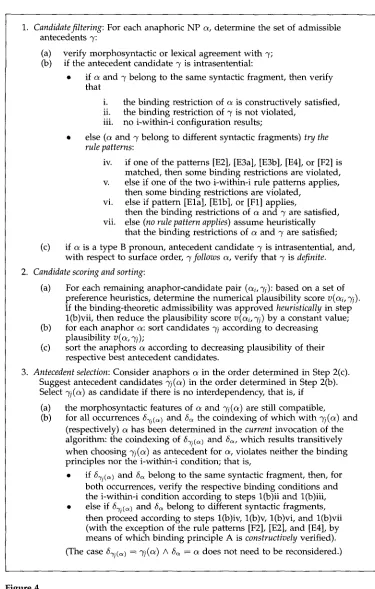
Figure 4 describes the ROSANA algorithm. By applying a set of
restrictions
(Step 1) prior to a set ofpreferences
(Step 2), this algorithm follows Carbonell and Brown's (1988) fundamental strategy by means of which the candidate set is narrowed d o w n as early as possible. In Step 3, the actualselection
of antecedents takes place. Among the strate- gies to be applied are restrictions (e.g., morphosyntactic and lexical congruence, dis- joint reference conditions) and a plethora of preference factors (subject/topicalization salience, syntactic obliqueness, recency, cataphor penalty, parallelism [inertia of syn- tactic function]). Since the goal is to design an anaphor resolutionalgorithm,
the choice is restricted to strategies that are operational.With respect to syntactic disjoint reference, the central goal of robustness against fragmentary syntax is achieved in Steps l(b) and 3(b). As described above, if the considered occurrences are situated in different syntactic fragments, the rule patterns come into play; the actual set of patterns to be applied depends on whether or not it is known that one of the fragments is embedded in the other. Patterns labeled " , " are used to eliminate candidates (Steps l(b)iv and l(b)v). Patterns marked "x/" are used to
definitively
admit candidates (Step l(b)vi), contrasting withheuristic
admittance (Step l(b)vii), which entails a decrement of the plausibility score in Step 2(a).One subtlety taken into account is interdependency between different antecedent decisions (cf. Step 3). In particular, decision interdependency may arise because of the transitivity of the coindexing relation. As illustrated by the following example, even regarding
intersentential
anaphora, antecedent decisions thatindividually
comply with the disjoint reference conditions maycollectively
induce a violation:(7) *Gropiusi discusses the plans with Behrens/. Hei meets himi in Dessau. For each of the two pronouns, candidate
Gropius
is configurationally admissible. In a formal sense, however, the binding principles state restrictions on (intrasentential) indexdistributions
rather than on single anaphor-candidate pairs in isolation: in the example, binding principle B of the pronounhim
istransitively
violated. In explicitly checking for the binding-theoretic admissibility of transitively induced coindexings, the algorithm guards against such cases (Step 3(b)). However, care must be taken not to apply the binding restriction for reflexives constructively in this test since, as illustrated in the following example, besides demanding constructively one local binder, binding principle A does not ruleout further
nonlocal coindexings:Computational Linguistics Volume 27, N u m b e r 4
1. Candidate filtering: For each anaphoric NP c~, determine the set of admissible antecedents 3':
(a) verify morphosyntactic or lexical agreement with "y;
(b) if the antecedent candidate ~, is intrasentential:
• if c~ and 3' belong to the same syntactic fragment, then verify
that
i. the binding restriction of c~ is constructively satisfied,
ii. the binding restriction of 3' is not violated,
iii. no i-within-i configuration results;
• else (c~ and ,y belong to different syntactic fragments) try the
rule patterns:
iv. if one of the patterns [E2], [E3a], [E3b], [E4], or [F2] is
matched, then some binding restrictions are violated,
v. else if one of the two i-within-i rule patterns applies,
then some binding restrictions are violated,
vi. else if pattern [Ela], [Elb], or [F1] applies,
then the binding restrictions of c~ and -y are satisfied,
vii. else (no rule pattern applies) assume heuristically
that the binding restrictions of c~ and 3' are satisfied;
(c) if c~ is a type B pronoun, antecedent candidate 3" is intrasentential, and,
with respect to surface order, 3' follows c~, verify that 3' is definite.
2. Candidate scoring and sorting:
(a) For each remaining anaphor-candidate pair (c~i,3'j): based on a set of
preference heuristics, determine the numerical plausibility score v(c~i, 3"j).
If the binding-theoretic admissibility was approved heuristically in step
l(b)vii, then reduce the plausibility score v(c~i, 3"j) by a constant value;
(b) for each anaphor c~: sort candidates 3"j according to decreasing
plausibility v(c~, 3'j);
(c) sort the anaphors c~ according to decreasing plausibility of their
respective best antecedent candidates.
3. Antecedent selection: Consider anaphors c~ in the order determined in Step 2(c). Suggest antecedent candidates -yj(c~) in the order determined in Step 2(b). Select 3"j(c~) as candidate if there is no interdependency, that is, if
(a) the morphosyntactic features of c~ and "~j(c~) are still compatible,
(b) for all occurrences ~j(~) and 6~ the coindexing of which with 3"j(c~) and
(respectively) c~ has been determined in the current invocation of the
algorithm: the coindexing of ~,j(~ and ~ , which results transitively w h e n choosing Vj(c~) as antecedent for c~, violates neither the binding principles nor the i-within-i condition; that is,
• if ~,j/~ and 6~ belong to the same syntactic fragment, then, for
both occurrences, verify the respective binding conditions and the i-within-i condition according to steps l(b)ii and l(b)iii,
• else if 6~j/~ ) and 6~ belong to different syntactic fragments,
then proceed according to steps l(b)iv, l(b)v, l(b)vi, and l(b)vii (with the exception of the rule patterns [F2], [E2], and [E4I, by
means of which binding principle A is constructively verified).
[image:12.468.46.421.47.636.2](The case ~,j(~) = ~,j(c~) /~ 6~ = c~ does not need to be reconsidered.)
Figure 4
The same distinction is d r a w n in Step l(b): whereas, r e g a r d i n g the anaphor, the b i n d i n g restriction is verified in the strong, constructive sense (Step l(b)i), the c a n d i d a t e ' s restriction is a p p l i e d in its w e a k version (Step l(b)ii). In the rule patterns for the f r a g m e n t a r y case, this subtlety is reflected implicitly in the sense that o n l y r e g a r d i n g occurrence c~ (taken as the a n a p h o r to be constructively resolved) is the strong version of b i n d i n g principle A checked; hence, in the i n t e r d e p e n d e n c y test Step 3(b), patterns IF2], [E2], a n d [E4] are n o t taken into consideration.
4.2 Implementation: The ROSANA System
Based on the algorithm described in Figure 4, the ROSANA a n a p h o r resolution sys- tem has been i m p l e m e n t e d (Stuckardt 2000). In p r i m a r i l y aiming at d e t e r m i n i n g the coreference classes of n o n z e r o linguistic expressions that specify entities, 17 the scope of ROSANA c o r r e s p o n d s to the coreference task of the Message U n d e r s t a n d i n g Con- ferences (cf. H i r s c h m a n 1998). R O S A N A h a n d l e s a b r o a d r a n g e of entity-specifying e x p r e s s i o n s - - i n particular, ordinary, possessive, reflexive/reciprocal, a n d relative pro- nouns, definite NPs, a n d names. The ROSANA s y s t e m has b e e n i m p l e m e n t e d in Com- m o n Lisp. In an evaluation on a set of n e w s a g e n c y press releases (cf. Section 6), the r u n t i m e of the ROSANA system (without parser) was 165 tokens p e r second on a P e n t i u m PC.
The FDG p a r s e r for English d e v e l o p e d b y Jarvinen a n d Tapanainen (1997) has b e e n chosen as the syntactic preprocessor, is In giving robustness a n d processing s p e e d pri- ority over n o r m a t i v i t y a n d syntactic coverage of the u n d e r l y i n g grammar, the parser meets the r e q u i r e m e n t s on a p r e p r o c e s s o r for robust a n a p h o r resolution o n unre- stricted texts29 Regardless of the typical p a r s i n g p r o b l e m s like structurally a m b i g u o u s or grammatically incorrect input, the parser always yields a result, c o m p r i s i n g one or m o r e syntactic fragments that cover the a n a l y z e d sentence. Hence, the p a r s e r is r e g a r d e d to be an ideal associate of robust a n a p h o r resolution a p p r o a c h e s that follow the deficient description model.
4.3 Anaphoric Occurrences and Antecedent Candidates
In the R O S A N A system, the above algorithm is s u p p l e m e n t e d b y a set of strategies for
identifying
occurrences (linguistic expressions that specify entities) andclassifying
t h e m as a n a p h o r s to be resolved a n d / o r as possible a n t e c e d e n t candidates. The criterion for the identification of specifying expressions is based on part of speech (as d e t e r m i n e d b y the FDG parser) and syntactic context (Stuckardt 2000, p a g e 249). 2o Also, the de- cision of a n a p h o r i c i t y is based o n evidence regarding the syntactic context: generally, occurrences of all three binding-theoretic types (A, B, C) are taken to be anaphoric; 21 however, there are some classes of anaphoric occurrences that may, in certain cases, be i n t e r p r e t e d in a d v a n c e (outside the ROSANA core algorithm) b y p u r e l y structural m e a n s (e.g., relative p r o n o u n s or occurrences i n d u c e d b y h e a d s of appositions). For n a r r o w i n g d o w n the search space, occurrences of type A (reflexive a n d reciprocal pro-17 In contrast to expressions that, for example, specify events.
18 Since the parser generates dependency descriptions rather than constituent structure (to which the formal definitions of the above GB-theoretic statement of syntactic disjoint reference refer), ROSANA applies a preprocessor that reconstructs the structural (e.g., subject-object) asymmetries of constituency that are vital to the verification of the disjoint reference conditions.
19 According to J/irvinen and Tapanainen (1997), the FDG parser processes an average of 350 words per second on modest hardware (Pentium PC, 166 MHz).
20 Syntactic context plays a role, for example, in deciding whether the expression
her
is a possessive or nonpossessive pronoun.Computational Linguistics Volume 27, Number 4
nouns) are not taken into account as antecedent candidates, since the existence of a cospecifying alternative in the same clause remains guaranteed.
4.4 Congruence Conditions
In Step l(a) of the ROSANA algorithm, the details regarding the congruence restric- tions are left unspecified. In the ROSANA system, depending on the specific type of anaphoric expression, different morphosyntactic or lexical agreement conditions are employed. For names, for example, a partial matching of the antecedent and anaphor expressions (in the sense of surname identity) is considered sufficient. Regarding third person pronouns (including possessives and reflexives/reciprocals), congruence of the
morphological features
number
andperson
is considered mandatory; however, congru-ence of the
gender
attribute is taken to be optional, since, on one hand, there are somewell-known exceptions, and, on the other hand, the available grammatical gender in- formation is not always correct. 22 In any case, candidates that also match the gender attribute of the anaphor are preferred.
4.5 Salience Factors and Weights
As in the approaches of Lappin and Leass (1994) and Kennedy and Boguraev (1996),
weighted salience factors are employed for scoring and choosing among the candi-
dates that remain after restriction application (cf. Step 2(a) of the ROSANA algorithm).
Since the goal is to develop an
operational
approach for unrestricted texts, the choice isrestricted to factors relying on information available in the scenario of knowledge-poor processing, that is, without extensive semantic domain modeling.
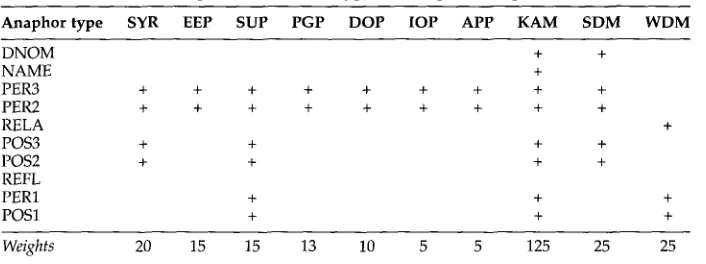
In the ROSANA system, the following factors are employed: SYR (contributed by occurrences with identical syntactic function), EEP (occUrrences realized in the syntactic position of existential emphasis), SUP (syntactic subject), PGP (possessive pronouns, saxonian genitives, and genitive attributes), D O P / I O P / A P P (salience of direct/indirect objects and adverbial PPs, respectively), KAM (negative preference of cataphoric resumptions), SDM (sentence recency; i.e., a factor of negative salience to be multiplied with the sentence distance between anaphor and antecedent), WDM (word recency). The main part of Table 1 indicates which subset of factors is used for scoring the candidate set of which class of anaphoric expression (DNOM = definite NP, PER{I,2,3} = first/second/third person pronouns, POS{1,2,3} = first/second/third person possessives, RELA = relative pronouns, REFL = reflexive/reciprocal pronouns). The assignment of the factors and the choice of the weights (shown in the lower part of the table) have been determined by a series of refinement experiments on a training corpus of 31 news agency press releases (11,808 words, 471 pronouns) for which key data were provided manually. As a proper base for the goal-directed re- finement of the factor assignments and weights, the interpretation results were scored according to two of the formal evaluation disciplines that will be defined in Sec- tion 5, namely, determination of coreference classes (model-theoretic scoring) and non- pronominal anchors. 23 The factor/weight relations determined by Lappin and Leass (1994) for third person pronouns were taken as the initial clue. For the other types of anaphoric expressions, sets of weighted factors were assigned based on an analysis of the referential context of typical occurrences in the training corpus. For example, the
22 This is partly due to lexical ambiguity (homonymy), or, regarding names, due to lack of the respective lexical information.
Table 1
Salience factors and weights for different types of anaphoric expressions.
Anaphor type SYR EEP SUP PGP DOP IOP APP KAM SDM W D M
DNOM + +
NAME +
PER3 + + + + + + + + +
PER2 + + + + + + + + +
RELA +
POS3 + + + +
POS2 + + + +
REFL
PER1 + + +
POS1 + + +
Weights 20 15 15 13 10 5 5 125 25 25
c o r p u s s t u d y r e v e a l e d t h a t first p e r s o n n o n p o s s e s s i v e a n d p o s s e s s i v e p r o n o u n s t y p i - cally r e s u m e d i s c o u r s e referents i n s t a n t i a t e d b y n e a r b y a n t e c e d e n t s t h a t o c c u r in the s y n t a c t i c subject role; c o n s e q u e n t l y , t h e factors SUP, W D M , a n d K A M w e r e c h o s e n . 24 D u r i n g a series of v a r i a t i o n a n d e v a l u a t i o n r u n s in w h i c h s o m e of the factors w e r e s y s t e m a t i c a l l y d e a c t i v a t e d , these initial a s s i g n m e n t s w e r e e m p i r i c a l l y v a l i d a t e d . 25
Finally, a series of e x p e r i m e n t s w i t h the f a c t o r w e i g h t s w e r e c a r r i e d out. Clearly, the a b s o l u t e size of the w e i g h t s is irrelevant. H o w e v e r , s o m e c o n d i t i o n s t h a t s e e m to g o v e r n the relative size of t h e f a c t o r w e i g h t s w e r e d e t e r m i n e d / c o n f i r m e d d u r i n g t h e t r a i n i n g runs. F o r e x a m p l e , in locally v a r y i n g the a s s i g n e d w e i g h t s in s u c h a w a y t h a t i n d i v i d u a l > relations of the s y n t a c t i c f u n c t i o n h i e r a r c h y S U P > D O P > I O P > A P P w e r e v i o l a t e d (e.g., b y s e t t i n g S U P = 10 < D O P = 15), it w a s e x p e r i m e n t a l l y v e r i f i e d t h a t the o r i g i n a l w e i g h t r e l a t i o n s y i e l d b e t t e r results. F u r t h e r f i n d i n g s are: S D M > SYR (syntactic p a r a l l e l i s m i n d u c e s local p r e f e r e n c e s only); SYR > S U P (if a n a n a p h o r o c c u r s in a s y n t a c t i c role o t h e r t h a n subject, t h e n c a n d i d a t e s w i t h t h a t s a m e role are p r e f e r r e d to c a n d i d a t e s in subject role); K A M large ( c a t a p h o r i c r e s u m p t i o n s are h e a v i l y p e n a l i z e d ) . For the m o s t part, these results c o i n c i d e w i t h , or p r o v i d e f u r t h e r s u p p o r t for, similar f i n d i n g s b y L a p p i n a n d Leass (1994, p a g e 549). 26
A s table I m a k e s e v i d e n t , the salience f a c t o r s p r o p e r ( d e t e r m i n e d b y s y n t a c t i c role) are e m p l o y e d o n l y in the case of p r o n o m i n a l a n a p h o r s . M o s t i m p o r t a n t l y , there is a s t r i k i n g difference b e t w e e n PER3 a n d POS3: w h e r e a s , in t h e f o r m e r case, a h i e r a r c h y of s y n t a c t i c roles (i.e., salience factors w i t h d e c r e a s i n g w e i g h t s ) is r e f e r r e d to, in t h e latter case, o n l y the factors of subject p r e f e r e n c e a n d s y n t a c t i c p a r a l l e l i s m are e m p l o y e d b e c a u s e it t u r n e d o u t t h a t p o s s e s s i v e p r o n o u n s t e n d to c o s p e c i f y w i t h a n t e c e d e n t s t h a t are either s y n t a c t i c subjects or, again, p o s s e s s i v e p r o n o u n s . Relative p r o n o u n s are c o n s i d e r e d to b e a n e x c e p t i o n : since, in m o s t cases, t h e y take their a n t e c e d e n t s in t h e n e a r e s t vicinity, the w o r d r e c e n c y f a c t o r p r o v e d to be sufficient.
24 Through this preference, cases are accounted for, too, in which appropriate third person antecedents occur outside a passage of quoted speech containing the first person pronoun. In particular, this renders possible the determination of nonpronominal anchors (cf. Section 5.3) for first person pronouns. 25 Whereas, in large part, the experiments confirmed the factor assignments for third person pronouns
suggested by Lappin and Leass, it turned out that the training corpus did not contain a sufficient number of occurrences realized in the syntactic position of existential emphasis for evaluating the contribution of the EEP factor. This should be addressed by further experiments on larger corpora. 26 One divergence regards the size of the syntactic parallelism factor SYR. According to the experimental
[image:15.468.33.386.86.218.2]Computational Linguistics Volume 27, Number 4
5. Enhancing the Evaluation Methodology for Anaphor Resolution Systems
For a proper evaluation of ROSANA, appropriate evaluation measures have to be chosen. In the following discussion, it will be advocated that, to obtain results that are expressive from the developer's as well as the application's point of view, several evaluation disciplines should be considered. 27
5.1 Model-Theoretic Coreference Scoring
Vilain et al. (1996) developed the model-theoretic scoring scheme according to which precision and recall values are computed b y a formal alignment of the coreference equivalence classes of system output and intellectually gathered key data. Basically, precision errors correspond to nontrivial partitions of system-generated equivalence classes induced b y key equivalence classes, whereas recall errors correspond to non- trivial partitions of key equivalence classes induced by system-generated equivalence classes.
Formally, let R s and R k be the coreference relations computed by the anaphor resolution system and specified b y the key, respectively; moreover, let [R s] and [Rk] be the respective sets of equivalence classes. Furthermore, with C s ~ [R s] and C k E IRk], let C s n O k and C k N 0 s be the equivalence classes (sets of occurrences) obtained b y restricting the original equivalence classes to the sets of occurrences & and O s over which the relations R k and R s, respectively, are defined; a8 analogously, let q~ (C s, R k) and • (C k, R ~) be the equivalence relations that result b y restricting the original relations R k and R S to the occurrences contained in the equivalence classes C ~ E [R s] and C k C IRk], respectively (cf. the discussion in Section 5.2.1). 29 In addition, let [~(C k, R~)] and [q)(C ~, Rk)] be the sets of equivalence classes of the restricted relations. The precision and recall measures are computed b y summing over the sets of equivalence classes of system response and key classes, respectively. For each class C, there is a maximum of ICN O] - 1 correct contributions; the actual number of errors, which equals the number of equivalence classes ][q~(C, R)][ of the restricted relation minus 1, has to be deducted. Hence, one obtains the measures
Pco :=
Rco :=
( I C n okl - c~[Rq
(Ic n Okl - 1)
Csc[R s]
( I d n - I[ (Ck,
C k c [R k]
(IC k n Osl - 1) ck ~ [a k]
5.2 Scoring from the Developer's Point of View
The above precision and recall measures refer to a formal, mathematical property of the structure of the results computed by coreference resolution systems, namely, the disjoint partitioning of the set of occurrences in equivalence classes of cospecifying
27 See also Mitkov 2001, in which, independently, similar proposals regarding the separate evaluation of anaphor resolution system components have been made. There are some further important
contributions of this paper that can be regarded as complementary to the work presented below,
particularly the definition of formal evaluation measures for determining the decision power and the
relative importance of individual salience factors. 28 This means t h a t R k C O k x O k a n d R s C 0 s x O s.
entities. Whereas the definitions are appealing from tile point of view of theoretical elegance, from the system developer's perspective they display certain shortcomings.
5.2.1 Supporting the Optimization of Component Algorithms. A first point of crit-
icism is the lack of expressiveness regarding the different typical subproblems to be solved by coreference resolution systems. One particular subtask that is usually handled by a preprocessor is the identification of relevant occurrences, that is, entity- specifying linguistic expressions. As a suitable base for evaluating and optimizing this module, it seems to be adequate to dedicate separate evaluation measures, the defini-
tion of which, in this case, is straightforward: let O s and O k be the sets of occurrences
computed/specified by the coreference resolution system/key, then set
rO s n O k]
poc . - los}
Lo s n okl Roc . - iokf
To ensure the expressiveness of the totality of evaluation measures, it is essential that
they be decoupled from each other in the sense that errors at one stage of processing
are exclusively reflected in the respective evaluation measure. Regarding the possible effects of precision and recall errors of occurrence identification on model-theoretic coreference scoring, this requirement is met by referring, in the definitions given in Section 5.1, to the restricted classes C ~ N O k and C k N O S, and to the restricted relations
• (C s, R k) and ~(C k, RS). Without this refinement of the model-theoretic measures, there
m a y be cases of scoring anomalies. If the cardinalities in the above definitions were determined by referring to the original (unreduced) equivalence classes and relations,
each additional occurrence o s E Cs\O k or o k c C k \ O s would lead to an (incorrect)
increase in precision or recall, respectively, because, trivially, these sets of occurrences
are not partitioned by the relations R k or R s, respectively.
5.2.2 Supporting the Refinement of Preferential Factors. As shown in Table 1, the
set of relevant salience factors depends on the specific type of anaphoric expression. Hence, the evaluation measures defined so far are considered insufficient for an opti- mization of factor assignments and weights. From the system developer's perspective,
there is a need for fine-grained information that distinguishes between different classes
of anaphoric expressions.
As will become evident during evaluation of the ROSANA system in Section 6, another reason for differentiating between types of anaphoric expressions is the lack of expressiveness of model-theoretic scoring regarding the interpretation quality achieved for pronouns (i.e., for the class of anaphors that is, from the perspective of typical applications, of central importance).
5.3 Scoring from an Application's Point of View: Nonpronominal Anchors
Regarding the requirements of typical applications, g° the task of pronoun interpreta- tion m a y be defined as determining a suitable nonpronominal substitute, that is, a
nonpronominal antecedent rather than an arbitrary cospecifying antecedent that again might be a pronoun.
Computational Linguistics Volume 27, Number 4
According to model-theoretic coreference scoring, n o distinction is m a d e b e t w e e n p r o n o m i n a l a n d n o n p r o n o m i n a l antecedents: w h a t is relevant are the sizes of the m a t c h i n g fractions of equivalence classes rather t h a n the presence of correct n o n - p r o n o m i n a l a n c h o r s suitable as substitute expressions. There are at least t w o reasons w h y the task of identifying correct n o n p r o n o m i n a l substitutes is considerably h a r d e r t h a n the task of finding an arbitrary correct antecedent. First, there is focus-theoretic evidence: typically, entities specified b y p r o n o u n s are in fOCUS 31 and, hence, m o s t prob- ably the antecedents of s u b s e q u e n t p r o n o u n s , w h i c h t e n d to r e s u m e the currently focused entity. 32 Second, a technical a r g u m e n t applies: the cospecification relation be- t w e e n a p r o n o m i n a l a n a p h o r a n d a n o n p r o n o m i n a l representative is algorithmically d e t e r m i n e d b y a n o n e m p t y chain of a n t e c e d e n t decisions that may, in general, be long:
G r o p i u s ~- he , + he ~ h i m +,Z_ h i m
W h e r e a s the h y p o t h e t i c a l single error (indicated b y " - ' ) implies incorrect n o n p r o n o - minal anchors for all p r o n o u n s , according to the model-theoretic m e a s u r e the precision a m o u n t s to 0.75. Consequently, the e v a l u a t i o n s c h e m e d e f i n e d so far s h o u l d be sup- p l e m e n t e d b y a m e a s u r e that is expressive w i t h respect to the application-relevant task of identifying n o n p r o n o m i n a l anchors.
To derive a suitable f o r m a l e v a l u a t i o n measure, one m a y start w i t h the o b s e r v a t i o n that the relevant linguistic entities to be resolved are p r o n o m i n a l occurrences P for w h i c h n o n p r o n o m i n a l a n c h o r occurrences A h a v e to be identified. Basically, an a n c h o r A shall be c o n s i d e r e d a correct substitute for P if a n d o n l y if A a n d P b e l o n g to the same equivalence class of the k e y coreference relation. F r o m a theoretical p o i n t of view, this definition m u s t be c o n s i d e r e d simplistic given the w e l l - k n o w n examples of o p a q u e (intensional) contexts in w h i c h the substitution of coreferring expressions is not a t r u t h - p r e s e r v i n g operation. These cases, h o w e v e r , are rare a n d d o not seem to p l a y a role in typical application scenarios of p r o n o u n interpretation algorithms, as Hence, the simple definition will be e m p l o y e d , which, in addition, entails the a d v a n t a g e that the k e y data p r o v i d e d for model-theoretic coreference scoring suffices for the scoring of n o n p r o n o m i n a l substitutes.
Let (P,A) be a pair consisting of a p r o n o m i n a l occurrence P a n d the a n c h o r oc- currence A d e t e r m i n e d b y the a n a p h o r resolution system. (If, for P, n o substitute has b e e n d e t e r m i n e d , t h e n A is c o n s i d e r e d empty.) A suitable base for scoring is o b t a i n e d b y classifying the pairs (P, A) according to the s c h e m e described in Table 2, b y w h i c h a total of s e v e n pairwise disjoint sets is defined. The classification d e p e n d s o n (1) w h e t h e r P a n d / o r A are tagged, in the key, as valid (entity-specifying) occurrences, (2) w h e t h e r A is n o n e m p t y , a n d (3) whether, in case A is n o n e m p t y a n d b o t h A a n d L are valid occurrences, A a n d L cospecify in the key. According to the a b o v e defini- tion, o n l y the pairs fulfilling condition (3) (which, hence, constitute the set 0++) are c o n s i d e r e d to be correct solutions.
31 Care should be taken not to confound two different notions of focus here. In terms of the classical topic-focus distinction, one would say that pronouns tend to specifiy entities constituting the topic.
32 Compare, for example, the predictions of the centering theory (Grosz, Joshi, and Weinstein 1995). 33 There is another argument that supports the choice of the simple definition. Probably the best
algorithmic strategy for determining correct anchors is the selection of the first nonpronominal cospecifying occurrence that topologically precedes the pronoun to be resolved (cf. the above decision chain argument). If, however, the distance between the determined substitute and the pronoun is small, from the point of view of conversational pragmatics it is implausible that the intension of the