Semi-supervised Clustering for Short Text via Deep Representation
Learning
Zhiguo Wang and Haitao Mi and Abraham Ittycheriah IBM T.J. Watson Research Center
Yorktown Heights, NY, USA
{zhigwang, hmi, abei}@us.ibm.com
Abstract
In this work, we propose a semi-supervised method for short text clus-tering, where we represent texts as dis-tributed vectors with neural networks, and use a small amount of labeled data to specify our intention for clustering. We design a novel objective to combine the representation learning process and the k-means clustering process together, and op-timize the objective with both labeled data and unlabeled data iteratively until conver-gence through three steps: (1) assign each short text to its nearest centroid based on its representation from the current neural networks; (2) re-estimate the cluster cen-troids based on cluster assignments from step (1); (3) update neural networks ac-cording to the objective by keeping cen-troids and cluster assignments fixed. Ex-perimental results on four datasets show that our method works significantly better than several other text clustering methods.
1 Introduction
Text clustering is a fundamental problem in text mining and information retrieval. Its task is to group similar texts together such that texts within a cluster are more similar to texts in other clus-ters. Usually, a text is represented as a bag-of-words or term frequency-inverse document fre-quency (TF-IDF) vector, and then the k-means al-gorithm (MacQueen, 1967) is performed to parti-tion a set of texts into homogeneous groups.
However, when dealing with short texts, the characteristics of short text and clustering task raise several issues for the conventional unsuper-vised clustering algorithms. First, the number of uniqe words in each short text is small, as a
re-(a) What’s the color of apples? (b) When will this apple be ripe? (c) Do you like apples?
(d) What’s the color of oranges? (e) When will this orange be ripe? (f) Do you like oranges?
Table 1: Examples for short text clustering.
sult, the lexcical sparsity issue usually leads to poor clustering quality (Dhillon and Guan, 2003). Second, for a specific short text clustering task, we have prior knowledge or particular intentions before clustering, while fully unsupervised ap-proaches may learn some classes the other way around. Take the sentences in Table 1 for exam-ple, those sentences can be clustered into different partitions based on different intentions: apple{a, b, c}andorange{d, e, f}with a fruit type inten-tion, or what-question{a, d}, when-question {b, e}, andyes/no-questioncluster{c, f}with a ques-tion type intension.
To address the lexical sparity issue, one direc-tion is to enrich text representadirec-tions by extracting features and relations from Wikipedia (Banerjee et al., 2007) or an ontology (Fodeh et al., 2011). But this approach requires the annotated knowledge, which is also language dependent. So the other direction, which directly encode texts into dis-tributed vectors with neural networks (Hinton and Salakhutdinov, 2006; Xu et al., 2015), becomes more interesting. To tackle the second problem, semi-supervised approaches (e.g. (Bilenko et al., 2004; Davidson and Basu, 2007; Bair, 2013)) have gained significant popularity in the past decades. Our question is can we have a unified model to in-tegrate neural networks into the semi-supervised framework?
In this paper, we propose a unified framework for the short text clustering task. We employ a
deep neural network model to represent short sen-tences, and integrate it into a semi-supervised al-gorithm. Concretely, we extend the objective in the classical unsupervised k-means algorithm by adding a penalty term from labeled data. Thus, the new objective covers three key groups of parame-ters: centroids of clusters, the cluster assignment for each text, and the parameters within deep neu-ral networks. In the training procedure, we start from random initialization of centroids and neu-ral networks, and then optimize the objective iter-atively through three steps until converge:
(1) assign each short text to its nearest centroid based on its representation from the current neural networks;
(2) re-estimate cluster centroids based on cluster assignments from step (1);
(3) update neural networks according to the ob-jective by keeping centroids and cluster as-signments fixed.
Experimental results on four different datasets show that our method achieves significant im-provements over several other text clustering methods.
In following parts, we first describe our neu-ral network models for text representation (Sec-tion 2). Then we introduce our semi-supervised clustering method and the learning algorithm (Section 3). Finally, we evaluate our method on four different datasets (Section 4).
2 Representation Learning for Short Texts
We represent each word with a dense vectorw, so that a short text sis first represented as a matrix
S = [w1, ..., w|s|], which is a concatenation of all
vectors ofwins, |s|is the length ofs. Then we design two different types of neural networks to ingest the word vector sequence S: the convolu-tional neural networks (CNN) and the long short-term memory (LSTM). More formally, we define the presentation function as x = f(s), where x
represents the vector of the text s. We test two encoding functions (CNN and LSTM) in our ex-periments.
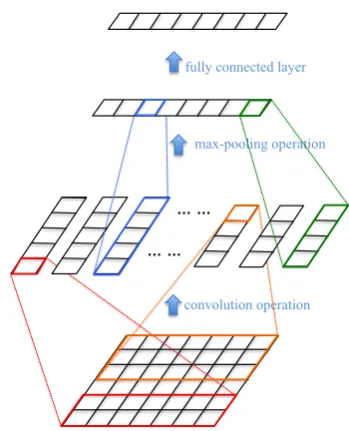
Inspired from Kim (2014), our CNN model views the sequence of word vectors as a matrix, and applies two sequential operations:convolution
andmax-pooling. Then, a fully connected layer is
… … … …
[image:2.595.328.503.64.280.2]convolution operation max-pooling operation fully connected layer
Figure 1: CNN for text representation learning.
LSTM LSTM …… LSTM
w1 w2 wn
[image:2.595.349.483.329.401.2]Mean
Figure 2: LSTM for text representation learning.
mean of the hidden states over the entire sentence is taken as the final representation vector.
3 Semi-supervised Clustering for Short Texts
3.1 Revisiting K-means Clustering
Given a set of texts {s1, s2, ..., sN}, we repre-sent them as a set of data points{x1, x2, ..., xN}, wherexican be a bag-of-words or TF-IDF vector in traditional approaches, or a dense vector in Sec-tion 2. The task of text clustering is to partiSec-tion the data set into some numberKof clusters, such that the sum of the squared distance of each data point to its closest cluster centroid is minimized. For each data pointxn, we define a set of binary variablesrnk ∈ {0,1}, wherek ∈ {1, ..., K} de-scribing which of the K clustersxnis assigned to. So that ifxnis assigned to clusterk, thenrnk = 1, andrnj = 0forj6=k. Let’s defineµkas the cen-troid of thek-th cluster. We can then formulate the objective function as
Junsup= N
X
n=1 K
X
k=1
rnkkxn−µkk2 (1) Our goal is the find the values of{rnk}and{µk} so as to minimizeJunsup.
The k-means algorithm optimizes Junsup through the gradient descent approach, and results in an iterative procedure (Bishop, 2006). Each it-eration involves two steps: E-stepandM-step. In the E-step, the algorithm minimizes Junsup with respect to{rnk}by keeping{µk}fixed.Junsupis a linear function for{rnk}, so we can optimize for each data point separately by simply assigning the
n-th data point to the closest cluster centroid. In theM-step, the algorithm minimizesJunsupwith respect to{µk}by keeping{rnk}fixed.Junsupis a quadratic function of{µk}, and it can be mini-mized by setting its derivative with respect to{µk} to zero.
∂Junsup
∂µk = 2 N
X
n=1
rnk(xn−µk) = 0 (2) Then, we can easily solve{µk}as
µk =
PN
n=1rnkxn
PN
n=1rnk (3)
In other words,µk is equal to the mean of all the data points assigned to clusterk.
3.2 Semi-supervised K-means with Neural Networks
The classical k-means algorithm only uses unla-beled data, and solves the clustering problem un-der the unsupervised learning framework. As al-ready mentioned, the clustering results may not be consistent to our intention. In order to acquire use-ful clustering results, some supervised information should be introduced into the learning procedure. To this end, we employ a small amount of labeled data to guide the clustering process.
Following Section 2, we represent each textsas a dense vectorxvia neural networksf(s). Instead of training the text representation model sepa-rately, we integrate the training process into the k-means algorithm, so that both the labeled data and the unlabeled data can be used for representation learning and text clustering. Let us denote the la-beled data set as{(s1, y1),(s2, y2), ...,(sL, yL)}, and the unlabeled data set as{sL+1, sL+2, ..., sN}, whereyi is the given label forsi. We then define the objective function as:
Jsemi=α N
X
n=1 K
X
k=1
rnkkf(sn)−µkk2
+ (1−α)XL
n=1
{kf(sn)−µgnk2+
X
j6=gn
[l+kf(sn)−µgnk2− kf(sn)−µjk2]+}
(4) The objective function contains two terms. The first term is adapted from the unsupervised k-means algorithm in Eq. (1), and the second term is defined to encourage labeled data being clustered in correlation with the given labels. α ∈ [0,1]
is used to tune the importance of unlabeled data. The second term contains two parts. The first part penalizes large distance between each labeled in-stance and its correct cluster centroid, wheregn=
G(yn)is the cluster ID mapped from the given la-bel yn, and the mapping function G(·) is imple-mented with the Hungarian algorithm (Munkres, 1957). The second part is denoted as a hinge loss with a margin l, where[x]+ = max(x,0). This
part incurs some loss if the distance to the correct centroid is not shorter (by the marginl) than dis-tances to any of incorrect cluster centroids.
clus-1. Initialize{µk}andf(·).
2.assign cluster: Assign each text to its nearest cluster centroid.
3.estimate centroid: Estimate the cluster centroids based on the cluster assignments from step 2. 4.update parameter: Update parameters in neural networks.
5. Repeat step 2 to 4 until convergence.
Table 2: Pseudocode for semi-supervised clustering
ter centroids{µk}, and the parameters within the neural network model f(·). Our goal is to find the values of{rnk},{µk}and parameters inf(·), so as to minimize Jsemi. Inspired from the k-means algorithm, we design an algorithm to suc-cessively minimize Jsemi with respect to {rnk},
{µk}, and parameters in f(·). Table 2 gives the corresponding pseudocode. First, we initialize the cluster centroids {µk}with the k-means++ strategy (Arthur and Vassilvitskii, 2007), and ran-domly initialize all the parameters in the neural network model. Then, the algorithm iteratively goes through three steps (assign cluster, esti-mate centroid, andupdate parameter) untilJsemi converges.
The assign cluster step minimizes Jsemi with respect to{rnk}by keepingf(·)and{µk}fixed. Its goal is to assign a cluster ID for each data point. We can see that the second term in Eq. (4) has no relation with {rnk}. Thus, we only need to min-imize the first term by assigning each text to its nearest cluster centroid, which is identical to the
E-stepin the k-means algorithm. In this step, we also calculate the mappings between the given la-bels{yi}and the cluster IDs (with the Hungarian algorithm) based on cluster assignments of all la-beled data.
The estimate centroid step minimizes Jsemi with respect to {µk} by keeping {rnk} andf(·) fixed, which corresponds to the M-step in the k-means algorithm. It aims to estimate the cluster centroids {µk} based on the cluster assignments
{rnk} from the assign cluster step. The second term in Eq. (4) makes each labeled instance in-volved in the estimating process of cluster cen-troids. By solving∂Jsemi/∂µk = 0, we get
µk=
PN
n=1Pαrnkf(sn) +PnL=1wnkf(sn) N
n=1αrnk+PLn=1wnk (5)
wnk = (1−α)(Ink0 +
X
j6=gn
Inkj00 − X
j6=gn
Inkj000 )
Ink0 =δ(k, gn)
Inkj00 =δ(k, j)·δ0nj Inkj000 = (1−δ(k, j))·δ0nj
δnj0 =δ(l+kf(sn)−µgnk2− kf(sn)−µjk2>0) (6) whereδ(x1, x2)=1 ifx1 is equal tox2, otherwise
δ(x1, x2)=0, and δ(x)=1 if x is true, otherwise
δ(x)=0. The first term in the numerator of Eq. (5) is the contributions from all data points, andαrnk is the weight ofsnforµk. The second term is ac-quired from labeled data, andwnkis the weight of a labeled instancesnforµk.
The update parameter step minimizes Jsemi with respect to f(·) by keeping {rnk} and{µk} fixed, which has no counterpart in the k-means al-gorithm. The main goal is to update parameters for the text representation model. We takeJsemi as the loss function, and train neural networks with theAdamalgorithm (Kingma and Ba, 2014).
4 Experiment
4.1 Experimental Setting
dataset class# total# labeled#
question type 6 5,953 595
ag news 4 4,000 400
dbpedia 14 14,000 1,400
[image:5.595.314.518.61.178.2]yahoo answer 10 10,000 1,000
Table 3: Statistics for the short text datasets
(2015). We use all the 5,952 questions for the
question typedataset. But the other three datasets contain too many instances (e.g. 1,400,000 in-stances in yahoo answer). Running clustering ex-periments on such a large dataset is quite inef-ficient. Following the same solution in (Xu et al., 2015), we randomly choose 1,000 samples for each classes individually for the other three datasets. Within each dataset, we randomly sam-ple 10% of the instances as labeled data, and eval-uate the performance on the remaining 90% in-stances 1. Table 3 summarizes the statistics of these datasets.
In all experiments, we set the size of word vec-tor dimension asd=3002, and pre-train the word vectors with theword2vectoolkit (Mikolov et al., 2013) on the English Gigaword (LDC2011T07). The number of clusters is set to be the same num-ber of labels in the dataset. The clustering per-formance is evaluated with two metrics: Adjusted Mutual Information (AMI) (Vinh et al., 2009) and accuracy (ACC) (Amig´o et al., 2009). In order to show the statistical significance, the performance of each experiment is the average of 10 trials.
4.2 Model Properties
There are several hyper-parameters in our model, e.g., the output dimension of the text representa-tion models, and theαin Eq. (4). The choice of these hyper-parameters may affect the final perfor-mance. In this subsection, we present some exper-iments to demonstrate the properties of our model, and find a good configuration that we use to eval-uate our final model. All the experiments in this 1We didn’t split dataset into train/dev/test portions which
is commonly used for classification tasks, because it is not the convention for clustering task. First, the goal of clustering is to group given instances into clusters, instead of applying the trained model to new instances. Second, the evaluation process requires the clustering result of the whole set to map the clustering labels to the annotated labels.
2We tuned different dimensions for word vectors. When
the size is small (50 or 100), performance drops significantly. When the size is larger (300, 500 or 1000), the curve flattens out. To make our model more efficient, we fixed it as 300.
num_dim
alpha
0.2 0.25 0.3 0.35 0.4 0.45
50 100 300 500 1000
AMI CNN
LSTM
0 0.05 0.1 0.15 0.2 0.25 0.3 0.35 0.4 0.45 0.5
0.00001 0.0001 0.001 0.01 0.1
AMI CNN
LSTM
0 0.05 0.1 0.15 0.2 0.25 0.3 0.35 0.4 0.45
0.01 0.02 0.03 0.04 0.05 0.06 0.07 0.08 0.09 0.1
AMI
CNN
LSTM Figure 3: Influence of the short text representation model, where the x-axis is the output dimension of the text representation models.
num_dim
alpha
0.2 0.25 0.3 0.35 0.4 0.45
50 100 300 500 1000
AMI CNN
LSTM
0 0.05 0.1 0.15 0.2 0.25 0.3 0.35 0.4 0.45 0.5
0.00001 0.0001 0.001 0.01 0.1
AMI CNN LSTM
0 0.05 0.1 0.15 0.2 0.25 0.3 0.35 0.4 0.45
0.01 0.02 0.03 0.04 0.05 0.06 0.07 0.08 0.09 0.1
AMI
CNN LSTM
Figure 4: Influence of unlabeled data, where the x-axis isαin Eq. (4).
subsection were performed on the question type
dataset.
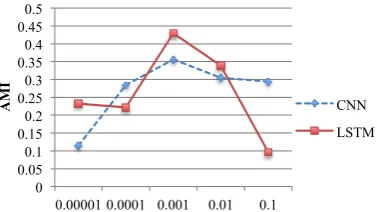
First, we evaluated the effectiveness of the out-put dimension in text representation models. We switched the dimension size among{50, 100, 300, 500, 1000}, and fixed the other options as: α = 0.5, the filter types in the CNN model includ-ing{unigram, bigram, trigram}and 500 filters for each type. Figure 3 presents the AMIs from both CNN and LSTM models. We found that 100 is the best output dimension for both CNN and LSTM models. Therefore, we set the output dimension as 100 in the following experiments.
[image:5.595.320.509.257.363.2]
num_dim
alpha
0.2 0.25 0.3 0.35 0.4 0.45
50 100 300 500 1000
AMI CNN
LSTM
0
0.05 0.1
0.15 0.2 0.25 0.3 0.35 0.4 0.45 0.5
0.00001 0.0001 0.001 0.01 0.1
AMI CNN
LSTM
0 0.05 0.1 0.15 0.2 0.25 0.3 0.35 0.4 0.45
0.01 0.02 0.03 0.04 0.05 0.06 0.07 0.08 0.09 0.1
AMI
[image:6.595.94.262.65.195.2]CNN LSTM
Figure 5: Influence of labeled data, where the x-axis is the ratio of data with given labels.ratio
pretrian
0 0.1 0.2 0.3 0.4 0.5 0.6 0.7 0.8
AMI
ACC
Figure 6: Influence of the pre-training strategy.
the following experiments. This results also indi-cate that the unlabeled data are useful for the text representation learning process.
Third, we tested the influence of the size of la-beled data. We tuned the ratio of lala-beled instances from the whole dataset among [1%, 10%], and kept the other configurations as the previous ex-periment. The AMIs are shown in Figure 5. We can see that the more labeled data we use, the bet-ter performance we get. Therefore, the labeled data are quite useful for the clustering process.
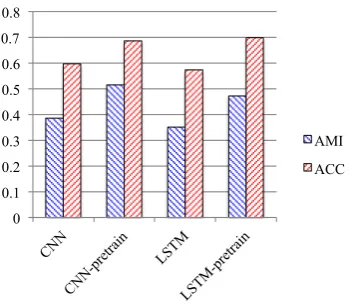
Fourth, we checked the effect of the pre-training strategy for our models. We added a softmax layer on top of our CNN and LSTM models, where the size of the output layer is equal to the number of labels in the dataset. We then trained the model through the classification task using all labeled data. After this process, we removed the top layer, and used the remaining parameters to initialize our CNN and LSTM models. The performance for our models with and without pre-training strategy are given in Figure 6. We can see that the pre-training
strategy is quite effective for our models. There-fore, we use the pre-training strategy in the follow-ing experiments.
4.3 Comparing with other Models
In this subsection, we compared our method with some representative systems. We implemented a series of clustering systems. All of these systems are based on the k-means algorithm, but they rep-resent short texts differently:
bow represents each text as a bag-of-words vec-tor.
tf-idf represents each text as a TF-IDF vector.
average-vec represents each text with the average of all word vectors within the text.
metric-learn-bow employs the metric learning
method proposed by Weinberger et al. (2005), and learns to project a bag-of-words vector into a 300-dimensional vector based on labeled data.
metric-learn-idf uses the same metric learning
method, and learns to map a TF-IDF vector into a 300-dimensional vector based on la-beled data.
metric-learn-ave-vec also uses the metric learn-ing method, and learns to project an averaged word vector into a 100-dimensional vector based on labeled data.
We designed two classifiers (cnn-classifier and lstm-classifier) by adding a softmax layer on top of our CNN and LSTM models. We trained these two classifiers with labeled data, and utilized them to predict labels for unlabeled data. We also built two text representation models (“cnn-represent.” and “lstm-represent.”) by setting parameters of our CNN and LSTM models with the correspond-ing parameters in cnn-classifier and lstm-classifier. Then, we used them to represent short texts into vectors, and applied the k-means algorithm for clustering.
[image:6.595.96.273.259.412.2]