Model Selection for Type-Supervised Learning
with Application to POS Tagging
Kristina Toutanova
Microsoft Research Redmond, WA, USA
Waleed Ammar∗
School of Computer Science Carnegie Mellon University
Pallavi Chourdhury Hoifung Poon
Microsoft Research Redmond, WA, USA
Abstract
Model selection (picking, for example, the feature set and the regularization strength) is crucial for building high-accuracy NLP models. In supervised learning, we can es-timate the accuracy of a model on a subset of the labeled data and choose the model with the highest accuracy. In contrast, here we focus on type-supervised learn-ing, which uses constraints over the pos-sible labels for word types for supervi-sion, and labeled data is either not avail-able or very small. For the setting where no labeled data is available, we perform a comparative study of previously proposed and one novel model selection criterion on type-supervised POS-tagging in nine lan-guages. For the setting where a small la-beled set is available, we show that the set should be used for semi-supervised learn-ing rather than for model selection only – using it for model selection reduces the er-ror by less than 5%, whereas using it for semi-supervised learning reduces the error by 44%.
1 Introduction
Fully supervised training of NLP models (e.g., part-of-speech taggers, named entity recognizers, relation extractors) works well when plenty of la-beled examples are available. However, manu-ally labeled corpora are expensive to construct in many languages and domains, whereas an al-ternative, if weaker, supervision is often read-ily available. For example, corpora labeled with POS tags at the token level are only available for around35languages, while tag dictionaries of the ∗This research was conducted during the author’s
intern-ship at Microsoft Research.
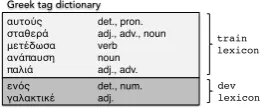
form displayed in Fig. 1 are available for many more languages, either in commercial dictionar-ies or community created resources such as Wik-tionary. Tag dictionaries provide type-level super-vision for word types in the lexicon. Similarly, while sentences labeled with named entities are scarce, gazetteers and databases are more readily available (Bollacker et al., 2008).
There has been substantial research on how best to build models using such type-level supervision, for POS tagging, super sense tagging, NER, and relation extraction (Craven et al., 1999; Smith and Eisner, 2005; Carlson et al., 2009; Mintz et al., 2009; Johannsen et al., 2014),inter alia, focussing on parametric forms and loss functions for model training. However, there has been little research on the practically important aspect of model selection for type-supervised learning. While some previ-ous work used criteria based on the type-level su-pervision only (Smith and Eisner, 2005; Goldwa-ter and Griffiths, 2007), much prior work used a la-beled set for model selection (Vaswani et al., 2010; Soderland and Weld, 2014). We are not aware of any prior work aiming to compare or improve ex-isting type-supervised model selection criteria.
For POS tagging, there is also work on us-ing both type-level supervision from lexicons, and projection from another language (T¨ackstr¨om et al., 2013). Methods for training with a small labeled set have also been developed (Søgaard, 2011; Garrette and Baldridge, 2013; Duong et al., 2014), but there have not been studies on the util-ity of a small labeled set for model selection ver-sus model training. Our contributions are: 1) a simple and generally applicable model selection criterion for type-supervised learning, 2) the first multi-lingual systematic evaluation of model se-lection criteria for type-supervised models, 3) em-pirical evidence that, if a small labeled set is avail-able, the set should be used for semi-supervised
αυτούς ' 'det., pron.' σταθερά' 'adj., adv., noun' μετέδωσα 'verb' ανάπαυση 'noun' παλιά ' 'adj., adv.'
Greek tag dictionary
ενός ' 'det., num.' γαλακτικέ 'adj.'
train!
lexicon!
dev !
[image:2.595.113.247.66.121.2]lexicon!
Figure 1: A tag dictionary (lexicon) for Greek. The splits intolextrainandlexdevare discussed in§2.
learning and not only for model selection.
2 Model selection and training for type-supervised learning
Notation. In type-supervised learning, we have
unlabeled textT = {x}of token sequences, and a lexiconlexwhich lists possible labels for word types. Model training finds the model param-eters θ which minimize a training loss function L(θ;lex,T,h). We usehto represent the config-urations and modeling decisions (also known as
hyperparameters). Examples include the depen-dency structure between variables, feature tem-plates, and regularization strengths. Given a set of fully-specified hyperparameter configurations
{h1, . . . ,hM}, model selection aims to find the
configuration hmˆ that maximizes the expected
performance of the corresponding model θmˆ
ac-cording to a suitable accuracy measure. xis a to-ken sequence,yis a label sequence, andlex[x]is the set of label sequences compatible with token sequencexaccording tolex.
Task. For the application in this paper, the task is type-supervised POS tagging, and the paramet-ric model family we consider is that of featurized first order HMMs (Berg-Kirkpatrick et al., 2010). The hyperparameters specify the feature set used and the strength of an L2 regularizer on the
pa-rameters.
Evaluation function. The evaluation function
used in model selection is the main focus of this work. We use a function eval(m,Tdev) to
esti-mate the performance of the model trained with hyperparametershmon a development setTdev. In
the following subsections, we discuss definitions ofevalwhen the development set Tdevis labeled
and when it is unlabeled, respectively.
2.1 Tdevis labeled
When the development setTdev is labeled, a
nat-ural choice ofevalis token-level prediction
accu-racy:
evalsup(m,Tdev) =
|TXdev|
i=1
1(ym[i] =ygold[i]) |Tdev|
Here, we useito index all tokens inTdev;ygold[i]
denotes thecorrectPOS tag, andym[i]denotes the
predictedPOS tag of thei-th token obtained with hyperparametershm.
2.2 Tdevis unlabeled
When token-supervision is not available, we can-not compute evalsup. Instead, previous work on
POS tagging with type supervision (Smith and Eisner, 2005) used:
evalcond(m,Tdev) =
X
x∈Tdev
log X
y∈lex[x]
pθm(y|x),
evaljoint(m,Tdev) =
X
x∈Tdev
log X
y∈lex[x]
pθm(x,y)
evalcond estimates the conditional log-likelihood
of “lex-compatible” labelsgiventoken sequences, while evaljoint estimates the joint log-likelihood
oflex-compatible labelsandtoken sequences.
The held-out lexicon criterion. We propose a
new model selection criterion which estimates pre-diction accuracy more directly and is applicable to any model type, without requiring that the model define conditional or joint probabilities of label se-quences. The idea behind this proposed criterion is simple: we hold out a portion of the lexicon en-tries and use it to estimate model performance as follows:
evaldevlex(m,T) =
|T |
X
i=1:xi∈lexdev
1(ym[i]∈lex[xi]) |lex[xi]| × |Tx∈lexdev|
wherelexdevis the held-out portion of the lexicon
entries, andxiis thei-th token inT.
The remainder of this section details the theory behind this criterion. The expected token-level ac-curacy of a model trained with hyperparameters
hm is defined asE(x,ygold,ym)∼D[1(ym =ygold)];
where D is a joint distribution over tokensx (in context), their gold labelsygold, and the predicted
labelsym(for the configurationhm). Since when
no labeled data is available we do not have access to samples fromD, we derive an approximation to this distribution usinglexandT.
lexiconlexdev(see Fig. 1), by sampling words
ac-cording to their token frequency c(x) in T, and placing them in the development or training por-tions of the lexicon such that lexdev covers 25%
of the tokens inT. The goal of the sampling pro-cess is to make the distribution of word tags for words in the development lexicon representative of the tag distribution for all words.
Given hm, we train a tagging model using
lextrain and use it to predict labels ym for all
to-kens inT. We then use the word tokens covered by the development lexicon and their predicted tagsym to approximateDby lettingP(ygold |x)
be a uniform distribution over gold labels consis-tent with the lexicon forx, resulting in the follow-ing approximationPD(x, ygold, ym)∝
c(x, ym)×1(x∈lexdev, ygold∈lexdev[x]) |lexdev[x]|
We then compute the expected accuracy as
evaldevlex = ED[1(ygold=ym)], and select
the hyperparameter configuration mˆ which max-imizes this criterion, then re-train the model with the full lexiconlex.1
3 How to best use a small labeled setTL?
Several prior works used a labeled set for super-vised hyper-parameter selection even when only type-level supervision is assumed to be available for training (Vaswani et al., 2010; Soderland and Weld, 2014). In this section, we want to an-swer the question: if a small labeled set is avail-able, what are the potential gains from using it for model selection only, versus using it for both model training and model selection?
A simple way to use a small labeled set for parameter training together with a larger unla-beled set in our type-supervised learning setting, is to do semi-supervised model training as follows (Nigam et al., 2000): Starting with our training loss function defined using a lexiconlexand unla-beled setTU L(θ;lex,TU,hm), we define a
com-bined loss function using both the unlabeled set
TU and the labeled setTL: L(θ;lex,TU,hm) +
λL(θ;lex,TL,hm). We then select parameters
θm to minimize the new loss function, where λ
is now an additional hyperparameter that usually
1Note that this criterion underestimates the performance
of all models in consideration by virtue of evaluating model versions trained using a subset of the full lexicon, but it can still be useful for ranking the models.
gives more weight to the labeled set. An advan-tage of this method is that it can be applied to any type-supervised model using less than 100 lines of code.2 We implement this method for semi-supervised training, and we use the labeled set both for semi-supervised model training and for hyper-parameter selection using a standard five-fold cross-validation approach.3
4 Experiments
We evaluate the introduced methods for model se-lection and training with type supervision in two type-supervised settings: when no labeled exam-ples are available, and when a small number of la-beled examples are available.
We use a feature-rich first-order HMM model (Berg-Kirkpatrick et al., 2010) with an L2 prior on feature weights.4 Instead of using a
multinomial distribution for the local emissions and transitions, this model uses a log-linear distri-bution (i.e.,p(xi |yi) ∝ expλ>f(xi, yi)) with a
feature vectorf and a weight vectorλ. We use the feature set described in (Li et al., 2012): transition features, word-tag features (hyi, xii) (lowercased
words with frequency greater than a threshold), whether the word contains a hyphen and/or starts with a capital letter, character suffixes, and whether the word contains a digit. We initialize the transition and emission distributions of the HMM using unambiguous words as proposed by (Zhang and DeNero, 2014). Data. We use the Danish, Dutch, German, Greek, English, Italian, Portuguese, Spanish and Swedish datasets from CoNLL-X and CoNLL-2007 shared tasks (Buchholz and Marsi, 2006; Nivre et al., 2007). We map the POS labels in the CoNLL datasets to the universal POS tagset (Petrov et al., 2012). We use the tag dictionaries provided by Li et al. (2012). Model configurations. For each
2The labeled data loss is the negative joint
log-likelihood of the observed token sequences and labels:
−P
x,y∈TLlogpθ(x,y).
3We split the labeled set into five folds, and for each
set-ting of the hyper-parameters train five different models on 4
5-ths of the data, estimating accuracy on the remaining15-th. We average the accuracy estimates from different folds and use this as a combined estimate of the accuracy of a model trained using the full labeled and unlabeled set, given these hyperparameters. After selecting a configuration of hyperpa-rameters using cross-validation, we then use this configura-tion and retrain the model on all available data.
4We used a first-order HMM for simplicity, but it is
83.70 85.05
84.75 85.20
76 78 80 82 84 86 88
Greek Danish Dutch Italian Spanish Portugese German English Swedish Average
[image:4.595.118.480.64.265.2]Conditional Likelihood Joint Likelihood Held-out Lexicon English Labeled
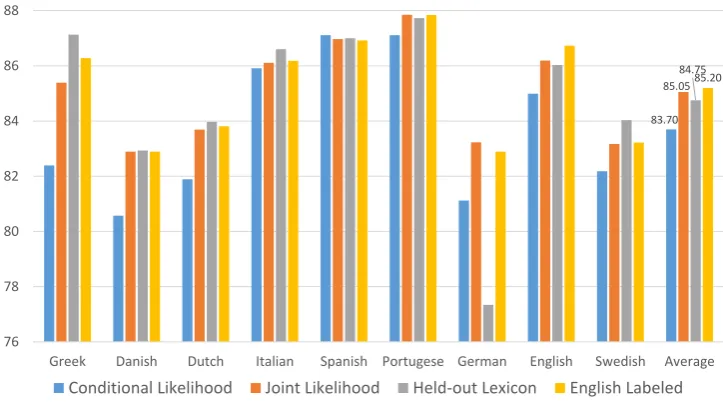
Figure 2:Token-level accuracy when doing training and model selection with no labeled data. Model selection with different criteria (left to right): conditional log-likelihood, joint log-likelihood, held-out lexicon, and English-labeled.
85.05 85.75
91.73
81 83 85 87 89 91 93 95 97
Greek Danish Dutch Italian Spanish Portugese German English Swedish Average
Joint Likelihood (0 labeled)
Supervised model selection (300 labeled)
Semi-supervised training and supervised model selection (300 labeled)
Figure 3: Token-level accuracy with (left to right): no labeled data, model selection on labeled data (300 sentences), semi-supervised training + model selection on labeled data (300 sentences).
language, we consider M = 15 configurations of the hyperparameters which vary in the L2
regularization strength (5 values), and the min-imum word frequency for word-tag features (3
values). When a small labeled set is available we additionally choose one of3values for the weight of the labeled set (see Section 3). We report final performance of models selected using different criteria using token-level accuracy on an unseen test set.
No labeled examples. When no labeled
exam-ples are available, we do model training and se-lection using only unlabeled textT and a tagging lexicon lex. We compare three type-supervised
model selection criteria: conditional likelihood, joint likelihood, and the held-out lexicon criterion
evaldevlex. Additionally, we include the
perfor-mance of a method which selects the hyperpa-rameters using labeled data in English and uses these (same) hyperparameters for English and all other languages (we call this method “English La-beled”). Fig. 2 shows the accuracy of the models chosen by each of the four criteria on nine guages, as well as the average accuracy across lan-guages. The lower (upper) bounds on average per-formance obtained by always choosing the worst (best) hyperparameters is82.77(85.83).evaljoint
[image:4.595.119.483.318.510.2]languages and achieved a significantly higher av-erage accuracy (85.05 vs83.70). evaldevlex
out-performedevaljointon six out of nine languages,
but did significantly worse on one language (Ger-man), which resulted in a slightly lower average accuracy. Choosing the hyper-parameters using English labeled data and using the same hyper-parameters for all languages performed compara-bly to evaljoint, with slightly higher average
ac-curacy even when limited to the non-English lan-guages (85.0vs84.9). Overall the results showed that the conditional log-likelihood criterion was dominated by the other three, which were com-parable in average accuracy. Looking at the eight languages excluding English (since one criterion uses labeled data for English), the newly proposed held-out lexicon criterion was the winning method on five out of eight languages, evalcondwas best
on one language, evaljoint was best (or tied for
best) on two, and English-labeled was tied for best on one language.
Few labeled examples. We consider two ways
of leveraging the labeled examples: (i) type-supervised model training + type-supervised model se-lection: only use unlabeled examples to optimize model parameters, then use the labeled exam-ples for supervised model selection withevalsup,
and (ii) semi-supervised model training + super-vised model selection (see Section 3 for details). Fig. 3 shows how much we can improve on the method with highest average accuracy from Fig-ure 2 (evaljoint), when a small number of
ex-amples is available. Using the 300 labeled sen-tences for semi-supervised training and model se-lection reduced the error by44.6%(comparing to the model with best average accuracy using only type-level supervision with average performance of85.05, the semi-supervised average is91.8). In contrast, using the300sentences to select hyper-parameters only reduced the error by less than5%
(the average accuracy was85.75). Even when only
50labeled sentences are used for semi-supervised training and supervised model selection, we still see a boost to average accuracy of 89% (results not shown in the Figure).
5 Conclusion
We presented the first comparative evaluation of model selection criteria for type-supervised POS-tagging on many languages. We introduced a novel, generally applicable model selection
cri-terion which outperformed previously proposed ones for a majority of languages. We evaluated the utility of a small labeled set for model selection versus model training, and showed that when such labeled set is available, it should not be used solely for supervised model selection, because using it additionally for model parameter training provides strikingly larger accuracy gains.
Acknowledgments
We thank Nathan Schneider and the anonymous reviewers for helpful suggestions.
References
Taylor Berg-Kirkpatrick, Alexandre Bouchard-Cˆot´e, John DeNero, and Dan Klein. 2010. Painless unsu-pervised learning with features. InProc. of NAACL.
Kurt Bollacker, Colin Evans, Praveen Paritosh, Tim Sturge, and Jamie Taylor. 2008. Freebase: A col-laboratively created graph database for structuring human knowledge. InProceedings of the 2008 ACM SIGMOD International Conference on Management of Data, SIGMOD ’08, pages 1247–1250.
Sabine Buchholz and Erwin Marsi. 2006. CoNLL-X shared task on multilingual dependency parsing. In
CoNLL-X.
Andrew Carlson, Scott Gaffney, and Flavian Vasile. 2009. Learning a named entity tagger from gazetteers with the partial perceptron. In AAAI Spring Symposium: Learning by Reading and Learning to Read, pages 7–13.
Mark Craven, Johan Kumlien, et al. 1999. Construct-ing biological knowledge bases by extractConstruct-ing infor-mation from text sources. In ISMB, volume 1999, pages 77–86.
Long Duong, Trevor Cohn, Karin Verspoor, Steven Bird, and Paul Cook. 2014. What can we get from 1000 tokens? a case study of multilingual pos tagging for resource-poor languages. In Proc. of EMNLP.
Dan Garrette and Jason Baldridge. 2013. Learning a part-of-speech tagger from two hours of annotation. InProc. of NAACL-HLT, pages 138–147.
Sharon Goldwater and Tom Griffiths. 2007. A fully bayesian approach to unsupervised part-of-speech tagging. InAnnual meeting-association for compu-tational linguistics.
Shen Li, Jo˜ao Grac¸a, and Ben Taskar. 2012. Wiki-ly supervised part-of-speech tagging. In Proc. of EMNLP.
Mike Mintz, Steven Bills, Rion Snow, and Dan Ju-rafsky. 2009. Distant supervision for relation ex-traction without labeled data. InProceedings of the Joint Conference of the 47th Annual Meeting of the ACL and the 4th International Joint Conference on Natural Language Processing of the AFNLP: Vol-ume 2-VolVol-ume 2, pages 1003–1011. Association for Computational Linguistics.
Kamal Nigam, Andrew Kachites McCallum, Sebastian Thrun, and Tom Mitchell. 2000. Text classifica-tion from labeled and unlabeled documents using em. Machine learning, 39.
Joakim Nivre, Johan Hall, Sandra Kubler, Ryan Mc-Donald, Jens Nilsson, Sebastian Riedel, and Deniz Yuret. 2007. The CoNLL 2007 shared task on de-pendency parsing. InProc. of CoNLL.
Slav Petrov, Dipanjan Das, and Ryan McDonald. 2012. A universal part-of-speech tagset. InProc. of LREC, May.
Noah A. Smith and Jason Eisner. 2005. Contrastive estimation: Training log-linear models on unlabeled data. InProc. of ACL.
Mitchell Koch John Gilmer Stephen Soderland and Daniel S Weld. 2014. Type-aware distantly
super-vised relation extraction with linked arguments. In
Proc. of EMNLP.
Anders Søgaard. 2011. Semisupervised condensed nearest neighbor for part-of-speech tagging. In Pro-ceedings of the 49th Annual Meeting of the Associ-ation for ComputAssoci-ational Linguistics: Human Lan-guage Technologies: Short Papers - Volume 2, HLT ’11, pages 48–52, Stroudsburg, PA, USA. Associa-tion for ComputaAssocia-tional Linguistics.
Oscar T¨ackstr¨om, Dipanjan Das, Slav Petrov, Ryan McDonald, and Joakim Nivre. 2013. Token and type constraints for cross-lingual part-of-speech tag-ging. Transactions of the Association for Computa-tional Linguistics, 1:1–12.
Ashish Vaswani, Adam Pauls, and David Chiang. 2010. Efficient optimization of an mdl-inspired ob-jective function for unsupervised part-of-speech tag-ging. InProceedings of the ACL 2010 Conference Short Papers, pages 209–214. Association for Com-putational Linguistics.