Looking for Hyponyms in Vector Space
Marek Rei
SwiftKey
95 Southwark Bridge Rd London, UK
Ted Briscoe
Computer Laboratory University of Cambridge
Cambridge, UK
Abstract
The task of detecting and generating hy-ponyms is at the core of semantic under-standing of language, and has numerous practical applications. We investigate how neural network embeddings perform on this task, compared to dependency-based vector space models, and evaluate a range of similarity measures on hyponym gener-ation. A new asymmetric similarity mea-sure and a combination approach are de-scribed, both of which significantly im-prove precision. We release three new datasets of lexical vector representations trained on the BNC and our evaluation dataset for hyponym generation.
1 Introduction
Hyponymy is a relation between two word senses, indicating that the meaning of one word is also contained in the other. It can be thought of as a type-of relation; for example car, ship andtrain
are all hyponyms of vehicle. We denote a hy-ponymy relation between wordsaandbas (a→b), showing thatais a hyponym ofb, andbis a hyper-nym ofa. Hyponymy relations are closely related to the concept of entailment, and this notation is consistent with indicating the direction of infer-ence – ifais true,bmust be true as well.
Automatic detection and generation of hy-ponyms has many practical applications in nearly all natural language processing tasks. Information retrieval, information extraction and question an-swering can be improved by performing appropri-ate query expansions. For example, a user search-ing forarthritis treatmentis most likely also inter-ested in results containing the hyponyms of treat-ment, such as arthritis therapy, arthritis medica-tion, and arthritis rehabilitation. Summarisation systems can increase coherence and reduce repe-tition by correctly handling hyponymous words in
the input text. Entailment and inference systems can improve sentence-level entailment resolution by detecting the presence and direction of word-level hyponymy relations. Distributionally simi-lar words have been used for smoothing language models and word co-occurrence probabilities (Da-gan et al., 1999; Weeds and Weir, 2005), and hy-ponyms can be more suitable for this application.
We distinguish between three different tasks related to hyponyms. Given a directional word pair, the goal of hyponym detectionis to deter-mine whether one word is a hyponym of the other (Zhitomirsky-Geffet and Dagan, 2009; Kotlerman et al., 2010; Baroni and Lenci, 2011). In con-trast,hyponym acquisitionis the task of extract-ing all possible hyponym relations from a given text (Hearst, 1992; Caraballo, 1999; Pantel and Ravichandran, 2004; Snow et al., 2005). Such sys-tems often make use of heuristic rules and patterns for extracting relations from surface text, and pop-ulate a database with hyponymous word pairs. Fi-nally, the task of hyponym generation is to re-turn a list of all possible hyponyms, given only a single word as input. This is most relevant to practical applications, as many systems require a set of appropriate substitutes for a specific term. Automated ontology creation (Biemann, 2005) is a related field that also makes use of distributional similarity measures. However, it is mostly focused on building prototype-based ontologies through clustering (Ushioda, 1996; Bisson et al., 2000; Wagner, 2000; Paaß et al., 2004; Cimiano and Staab, 2005), and is not directly applicable to hy-ponym generation.
While most work has been done on hyponym detection (and the related task of lexical substitu-tion), barely any evaluation has been done for hy-ponym generation. We have found that systems for hyponym detection often perform poorly on hy-ponym generation, as the latter requires returning results from a much less restricted candidate set,
and therefore a task-specific evaluation is required. In this paper we focus on hyponym generation and approach it by scoring a very large candidate set of potential hyponyms. Distributional similar-ity methods are especially interesting for this task, as they can be easily applied to different domains, genres and languages without requiring annotated training data or manual pattern construction. We perform a systematic comparison of different vec-tor space models and similarity measures, in order to better understand the properties of a successful method for hyponym generation.
The main contributions of this paper are:
1. Systematic evaluation of different vector space models and similarity measures on the task of hyponym generation.
2. Proposal of new properties for modelling the directional hyponymy relation.
3. Release of three lexical vector datasets, trained using neural network, window-based, and dependency-based features.
2 Vector space models
In order to use similarity measures for hyponym detection, every word needs to be mapped to a point in vector space. The method of choosing appropriate features for these vectors is crucial to achieving the optimal performance. We compare five different approaches:
Window:As a simple baseline, we created vec-tors by counting word co-occurrences in a fixed context window. Every word that occurs within a window of three words before or after is counted as a feature for the target word. Pointwise mutual information is then used for weighting.
CW:Collobert and Weston (2008) constructed a neural network language model that is trained to predict the next word in the sequence, and simul-taneously learns vector representations for each word. The vectors for context words are concate-nated and used as input for the neural network, which uses a sample of possible outputs for gra-dient calculation to speed up the training process. Turian et al. (2010) recreated their experiments and made the vectors available online.1
HLBL:Mnih and Hinton (2007) created word representations using the hierarchical log-bilinear
1http://metaoptimize.com/projects/wordreprs/
model – a neural network that takes the concate-nated vectors of context words as input, and is trained to predict the vector representation of the next word, which is then transformed into a prob-ability distribution over possible words. To speed up training and testing, they use a hierarchical data structure for filtering down the list of candidates. Both CW and HLBL vectors were trained using 37M words from RCV1.
Word2vec: We created word representations using the word2vec2 toolkit. The tool is based
on a feedforward neural network language model, with modifications to make representation learn-ing more efficient (Mikolov et al., 2013a). We make use of the skip-gram model, which takes each word in a sequence as an input to a log-linear classifier with a continuous projection layer, and predicts words within a certain range before and after the input word. The window size was set to 5 and vectors were trained with both 100 and 500 dimensions.
Dependencies: Finally, we created vector rep-resentations for words by using dependency rela-tions from a parser as features. Every incoming and outgoing dependency relation is counted as a feature, together with the connected term. For ex-ample, given the dependency relation(play, dobj, guitar), the tuple(>dobj, guitar)is extracted as a feature forplay, and(<dobj, play)as a feature for guitar. We use only features that occur more than once in the dataset, and weight them using point-wise mutual information to construct feature vec-tors for every term. Features with negative weights were retained, as they proved to be beneficial for some similarity measures.
The window-based, dependency-based and word2vec vector sets were all trained on 112M words from the British National Corpus, with pre-processing steps for lowercasing and lemmatis-ing. Any numbers were grouped and substituted by more generic tokens. For constructing the dependency-based vector representations, we used the parsed version of the BNC created by Ander-sen et al. (2008) with the RASP toolkit (Briscoe et al., 2006). When saved as plain text, the 500-dimensional word2vec vectors and dependency-based vectors are comparable in size (602MB and 549MB), whereas the window-based vectors are twice as large (1,004MB). We make these vector
sets publically available for download.3
Recently, Mikolov et al. (2013b) published in-teresting results about linguistic regularities in vector space models. They proposed that the rela-tionship between two words can be characterised by theirvector offset, for example, we could find the vector for word “queen” by performing the op-eration “king - man + woman” on corresponding vectors. They also applied this approach to hy-ponym relations such as (shirt → clothing) and (bowl→dish). We evaluate how well this method applies to hyponym generation with each of the vector space models mentioned above. Using the training data, we learn a vector for the hyponymy relation by averaging over all the offset vectors for hyponym-hypernym pairs. This vector is then added to the hypernym during query time, and the result is compared to hyponym candidates us-ing cosine similarity. For sparse high-dimensional vector space models it was not feasible to use the full offset vector during experiments, therefore we retain only the top 1,000 highest-weighted fea-tures.
3 Similarity measures
We compare the performance of a range of simi-larity measures, both directional and symmetrical, on the task of hyponym generation.
Cosine similarity is defined as the angle be-tween two feature vectors and has become a stan-dard measure of similarity between weighted vec-tors in information retrieval (IR).
Linsimilarity, created by Lin (1998), uses the ratio of shared feature weights compared to all fea-ture weights. It measures the weighted proportion of features that are shared by both words.
DiceGen2is one possible method for generalis-ing the Dice measure to real-valued weights (Cur-ran, 2003; Grefenstette, 1994). The dot product of the weight vectors is normalised by the total sum of all weights. The same formula can also be con-sidered as a possible generalisation for the Jaccard measure.
WeedsPrec and WeedsRec were proposed by Weeds et al. (2004) who suggested using precision and recall as directional measures of word simi-larity. In this framework, the features are treated similarly to retrieved documents in information re-trieval – the vector of the broader termbis used as the gold standard, and the vector of the narrower
3http://www.marekrei.com/projects/vectorsets/
termais in the role of retrieval results. Precision is then calculated by comparing the intersection (items correctly returned) to the values of the nar-rower term only (all items returned). In contrast, WeedsRec quantifies how well the features of the breader term are covered by the narrower term.
Balprec is a measure created by Szpektor and Dagan (2008). They proposed combining Weed-sPrec together with the Lin measure by taking their geometric average. This aims to balance the WeedsPrec score, as the Lin measure will penalise cases where one vector contains very few features.
ClarkeDE, proposed by Clarke (2009), is an asymmetric degree of entailment measure, based on the concept of distributional generality (Weeds et al., 2004). It quantifies the weighted coverage of the features of the narrower termaby the features of the broader termb.
BalAPInc, a measure described by Kotlerman et al. (2010), combines the APInc score with Lin similarity by taking their geometric average. The APInc measure finds the proportion of shared fea-tures relative to the feafea-tures for the narrower term, but this can lead to unreliable results when the number of features is very small. The motivation behind combining these measures is that the sym-metric Lin measure will decrease the final score for such word pairs, thereby balancing the results.
4 Properties of a directional measure Finding similar words in a vector space, given a symmetric similarity measure, is a relatively straightforward task. However finding hyponyms is arguably more difficult, as the relation is asym-metric, and looking at the distance or angle be-tween the two words may not be enough.
Kotlerman et al. (2010) investigate the related problem of detecting directional lexical entail-ment, and they propose three desirable properties that a directional distributional similarity measure should capture:
1. The relevance of the shared features to the narrower term.
2. The relevance of the shared features to the broader term.
Given a term pair (a → b) we refer toa as the narrower term andbas the broader term. The fea-tures ofathat are also found inb(have non-zero weights for bothaandb) are referred to asshared features.
They show that existing measures which cor-respond to these criteria perform better and con-struct the BalAPInc measure based on the princi-ples. However, it is interesting to note that these properties do not explicitly specify any directional aspects of the measure, and symmetric similarity scores can also fulfil the requirements.
Based on investigating hyponym distributions in our training data, we suggest two additions to this list of desired properties, one of which specif-ically targets the asymmetric properties of the de-sired similarity measures:
4. The shared features are more important to the directional score calculation, compared to non-shared features.
5. Highly weighted features of the broader term are more important to the score calculation, compared to features of the narrower term. Most existing directional similarity scores mea-sure how many features of the narrower term are present for the broader term. Ifa entails b, then it is assumed that the possible contexts ofaare a subset of contexts for b, but b occurs in a wider range of contexts compared toa. This intuition is used by directional measures such asClarkeDE,
W eedsP recandBalAP Inc. In contrast, we found that many features of the narrower term are often highly specific to that term and do not generalise even to hypernyms. Since these features have a very high weight for the narrower term, their ab-sence with the broader term will have a big nega-tive impact on the similarity score.
We hypothesise that many terms have certain individual features that are common to them but not to other related words. Since most weighting schemes reward high relative co-occurrence, these features are also likely to receive high weights. Therefore, we suggest that features which are not found for both terms should have a decreased im-pact on the score calculation, as many of them are not expected to be shared between hyponyms and hypernyms. However, removing them completely is also not advisable, as they allow the measure to estimate the overall relative importance of the shared features to the specific term.
We also propose that among the shared features, those ranked higher for the broader term are more important to the directional measure. In the hy-ponymy relation(a→b), the termbis more gen-eral and covers a wider range of semantic con-cepts. This also means it is more likely to be used in contexts that apply to different hyponyms ofb. For example, some of the high-ranking fea-tures forfood areblandly-flavoured,high-calorie and uneaten. These are properties that co-occur often with the termfood, but can also be applied to most hyponyms offood. Therefore, we hypoth-esise that the presence of these features for the nar-rower term is a good indication of a hyponymy re-lation. This is somewhat in contrast to most previ-ous work, where the weights of the narrower term have been used as the main guideline for similarity calculation.
5 Weighted cosine
We now aim to construct a similarity measure that follows all five of the properties mentioned above. Cosine similarity is one of the symmetric similar-ity measures which corresponds to the first three desired properties, and our experiments showed that it performs remarkably well at the task of hy-ponym generation. Therefore, we decided to mod-ify cosine similarity to also reflect the final two properties and produce a more appropriate asym-metric score.
The standard feature vectors for each word con-tain weights indicating how important this feature is to the word. We specify additional weights that measure how important the feature is to that spe-cific directional relation between the two terms. Weighted cosine similarity, shown in Table 1, can then be used to calculate a modified similarity score. Fa denotes the set of weighted features for
worda,wa(f)is the weight of featuref for word
a, andz(f)is the additional weight for featuref, given the directional word pair(a, b).
Based on the new desired properties we want to downweight the importance of features that are not present for both terms. For this, we choose the simple solution of scaling them with a small constantC ∈ [0,1]. Next, we also want to assign higherz(f)values to the shared features that have high weights for the broader term b. We use the relative rank of featuref inFb,rb(f), as the
W eightedCosine(Fa, Fb) = P
f∈Fa∩Fb(z(f)×wa(f))×(z(f)×wb(f))
qP
f∈Fa(z(f)×wa(f))2×qP
f∈Fb(z(f)×wb(f))2
z(f) =
(
(1−|Fbrb(f)|+1)×(1−C) +C iff ∈Fa∩Fb
C otherwise
Table 1: Weighted cosine similarity measure
function decreasing linearly as the rank number increases, but the weights for the shared features always remain higher compared to the non-shared features. Tied feature values are handled by as-signing them the average rank value. Adding 1 to the denominator of the relative rank calculation avoids exceptions with empty vectors, and also en-sures that the value will always be strictly greater than C. While the basic function is still the sym-metric cosine, thez(f)values will be different de-pending on the order of the arguments.
The parameter C controls the relative impor-tance of the ‘unimportant’ features to the direc-tional relation. Setting it to 0 will ignore these features completely, while setting it to 1 will result in the traditional cosine measure. Experiments on the development data showed that the exact value of this parameter is not very important, as long as it is not too close to the extreme values of 0 or 1. We use the valueC= 0.5for reporting our results, meaning that the non-shared features are half as important, compared to the shared features.
6 Dataset
As WordNet (Miller, 1995) contains numerous manually annotated hyponymy relations, we can use it to construct suitable datasets for evaluat-ing hyponym generation. While WordNet terms are annotated with only the closest hyponyms, we are considering all indirect/inherited hyponyms to be relevant – for example, given relations (genomics→genetics) and (genetics→ biology), then genomicsis also regarded as a hyponym of
biology. WordNet relations are defined between synsets, but we refrain from the task of word sense disambiguation and count word a as a valid hy-ponym for wordbif it is valid for any sense ofb.
Synonymy can be thought of as a symmetric is-arelation, and most real-world applications would require synonyms to also be returned, together with hyponyms. Therefore, in our dataset we con-sider synonyms as hyponyms in both directions. We also performed experiments without synonyms
and found that this had limited effect on the re-sults – while the accuracy of all similarity mea-sures slightly decreased (due to fewer numbers of correct answers), the relative ranking remained the same. As shown in the next section, the number of synonyms is typically small compared to the num-ber of all inherited hyponyms.
To construct the dataset, we first found all single-word nouns in WordNet that are contained at least 10 times in the British National Corpus (BNC). Next, we retained only words that have at least 10 hyponyms, such that they occur 10 or more times in the BNC. This selection process aims to discard WordNet hypernyms that are very rare in practical use, and would not have enough examples for learning informative vector represen-tations. The final dataset contains the remaining terms, together with all of their hyponyms, includ-ing the rare/unseen hyponyms. As expected, some general terms, such as group or location, have a large number of inherited hyponyms. On average, each hypernym in the dataset has 233 hyponyms, but the distribution is roughly exponential, and the median is only 36.
In order to better facilitate future experiments with supervised methods, such as described by Ba-roni et al. (2012), we randomly separated the data into training (1230 hypernyms), validation (922), and test (922) sets, and we make these datasets publically available online.4
7 Experiments
We evaluate how well different vector space mod-els and similarity measures perform on the task of hyponym generation. Given a single word as in-put, the system needs to return a ranked list of words with correct hyponyms at the top. As the list of candidates for scoring we use all words in the BNC that occur at least 10 times (a total of 86,496 words). All the experiments are performed using tokenised and lemmatised words.
Cosine Cosine+offset
MAP P@1 P@5 MAP P@1 P@5
Window 2.18 19.76 12.20 2.19 19.76 12.25
CW-100 0.66 3.80 3.21 0.59 3.91 2.89
HLBL-100 1.01 10.31 6.04 1.01 10.31 6.06
Word2vec-100 1.78 15.96 10.12 1.50 12.38 8.71
Word2vec-500 2.06 19.76 11.92 1.77 17.05 10.71
[image:6.595.78.522.63.177.2]Dependencies 2.73 25.41 14.90 2.73 25.52 14.92
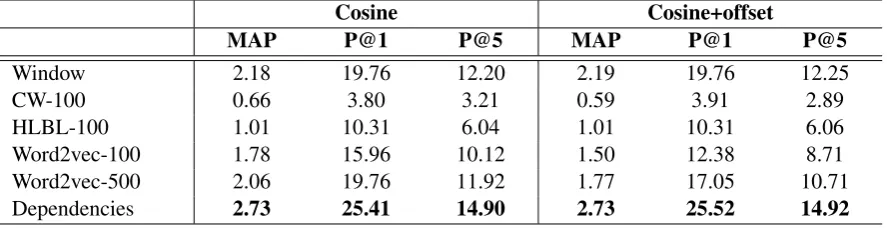
Table 2: Experiments using different vector space models for hyponym generation on the test set. We report results using regular cosine similarity and the vector offset method described in Section 2.
Mean Average Precision (MAP), which averages precision values at various recall points in the re-turned list. It combines both precision and recall, as well as the quality of the ranking, into a sin-gle measure, and is therefore well-suited for com-paring different methods. The reported MAP val-ues are very low – this is due to many rare Word-Net hyponyms not occurring in the candidate set, for which all systems are automatically penalised. However, this allows us to evaluate recall, making the results comparable between different systems and background datasets. We also report precision at top-1 and top-5 returned hyponyms.
As a baseline we report the results of a tra-ditional hyponym acquisition system. For this, we implemented the pattern-based matching pro-cess described by Hearst (1992), and also used by Snow et al. (2005). These patterns look for ex-plicit examples of hyponym relations mentioned in the text, for example:
X such as{Y1, Y2, ... , (and|or)}Yn
whereXwill be extracted as the hypernym, andY1
toYn as hyponyms. We ran the patterns over the
BNC and extracted 21,704 hyponym pairs, which were then ranked according to the number of times they were found.
7.1 Evaluation of vector spaces
Table 2 contains experiments with different vector space models. We report here results using cosine, as it is an established measure and a competitive baseline. For our task, the HLBL vectors perform better than CW vectors, even though they were trained on the same data. Both of them are out-performed by word2vec-100 vectors, which have the same dimensionality but are trained on much more text. Increasing the dimensionality with
word2vec-500 gives a further improvement. In-terestingly, the simple window-based vectors per-form just as well as the ones trained with neural networks. However, the advantage of word2vec-500 is that the representations are more compact and require only about half the space. Finally, the dependency-based vectors outperform all other vector types, giving2.73%MAP and25.41% pre-cision at the top-ranked result. While the other models are built by using neighbouring words as context, this model looks at dependency relations, thereby taking both semantic and syntactic roles into account. The results indicate that word2vec and window-based models are more suitable when the general topic of words needs to be captured, whereas dependency-based vectors are preferred when the task requires both topical and functional similarity between words. Our experiments also included the evaluation of other similarity mea-sures on different vector space models, and we we found these results to be representative.
Validation Test
MAP P@1 P@5 MAP P@1 P@5
Pattern-based 0.53 7.06 4.58 0.51 8.14 4.45
Cosine 2.48 21.06 12.96 2.73 25.41 14.90
Lin 1.87 16.50 10.75 2.01 21.17 12.23
DiceGen2 2.27 18.57 12.62 2.44 21.82 14.55
WeedsPrec 0.13 0.00 0.09 0.12 0.11 0.04
WeedsRec 0.72 0.33 2.45 0.69 0.54 2.41
BalPrec 1.78 15.31 10.55 1.88 17.48 11.34
ClarkeDE 0.23 0.00 0.02 0.24 0.00 0.09
BalAPInc 1.64 14.22 9.12 1.68 15.85 9.66
WeightedCosine 2.59 21.39 13.59 2.85 25.84 15.46
[image:7.595.77.525.61.246.2]Combined 3.27 23.02 16.09 3.51 27.69 18.02
Table 3: Evaluation of different vector similarity measures on the validation and test set of hyponym generation. We report Mean Average Precision (MAP), precision at rank 1 (P@1), and precision at rank 5 (P@5).
[image:7.595.314.521.469.608.2]7.2 Evaluation of similarity measures
Table 3 contains experiments with different sim-ilarity measures, using the dependency-based model, and Table 4 contains sample output from the best system. The results show that the pattern-based baseline does rather poorly on this task. MAP is low due to the system having very lim-ited recall, but higher precision at top ranks would have been expected. Analysis showed that this system was unable to find any hyponyms for more than half (513/922) of the hypernyms in the vali-dation set, leading to such poor recall that it also affects Precision@1. While the pattern-based sys-tem did extract a relatively large number of hy-ponyms from the corpus (21,704 pairs), these are largely concentrated on a small number of hyper-nyms (e.g.,area,company,material,country) that are more likely to be mentioned in matching con-texts.
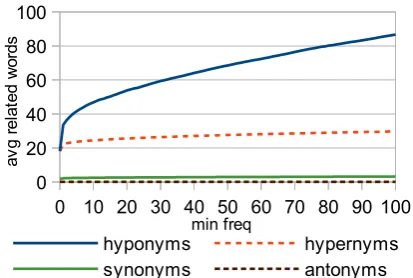
Cosine, DiceGen2 and Lin – all symmetric similarity measures – perform relatively well on this task, whereas established directional measures perform unexpectedly poorly. This can perhaps be explained by considering the distribution of hy-ponyms. Given a word, the most likely candi-dates for a high cosine similarity are synonyms, antonyms, hypernyms and hyponyms of that word – these are words that are likely to be used in simi-lar topics, contexts, and syntactic roles. By def-inition, there are an equal number of hyponym and hypernym relations in WordNet, but this ra-tio changes rapidly as we remove lower-frequency words. Figure 1 shows the number of relations
ex-tracted from WordNet, as we restrict the minimum frequency of the main word. It can be seen that the number of hyponyms increases much faster com-pared to the other three relations. This also applies to real-world data – when averaging over word in-stances found in the BNC, hyponyms cover85%of these relations. Therefore, the high performance of cosine can be explained by distributionally sim-ilar words having a relatively high likelihood of being hyponyms.
0 10 20 30 40 50 60 70 80 90 100 0
20 40 60 80 100
hyponyms hypernyms synonyms antonyms
min freq
av
g
re
la
te
d
w
or
ds
Figure 1: Average number of different relations per word in WordNet, as we restrict the minimum word frequency.
scientist researcher,biologist,psychologist,economist, observer,physicist,sociologist
sport football,golf, club,tennis,athletics,rugby,cricket, game, recreation, entertainment treatment therapy,medication, patient, procedure, surgery, remedy, regimen, medicine
Table 4: Examples of top results using the combined system. WordNet hyponyms are marked in bold.
is supported by WeedsRec outperforming Weed-sPrec, although the opposite was intended by their design.
Another explanation for the low performance is that these directional measures are often devel-oped in an artificial context. For example, Kotler-man et al. (2010) evaluated lexical entailment de-tection on a dataset where the symmetric Lin sim-ilarity measure was used to select word pairs for manual annotation. This creates a different task, as correct terms that do not have a high symmetric similarity will be excluded from evaluation. The BalAPInc measure performed best in that setting, but does not do as well for hyponym generation, where candidates are filtered only based on mini-mum frequency.
The weighted cosine measure, proposed in Sec-tion 5, outperformed all other similarity measures on both hyponym generation datasets. The im-provement over cosine is relatively small; how-ever, it is consistent and the improvement in MAP is statistically significant on both datasets (p <
0.05), using the Approximate Randomisation Test (Noreen, 1989; Cohen, 1995) with106iterations.
This further supports the properties of a directional similarity measure described in Section 4.
Finally, we created a new system by combining together two separate approaches: the weighted cosine measure using the dependency-based vec-tor space, and the normal cosine similarity using word2vec-500 vectors. We found that the former is good at modelling the grammatical roles and di-rectional containment, whereas the latter can pro-vide useful information about the topic and seman-tics of the word. Turney (2012) also demonstrated the importance of both topical (domain) and func-tional vector space models when working with se-mantic relations. We combined these approaches by calculating both scores for each word pair and taking their geometric average, or0if it could not be calculated. This final system gives considerable improvements across all evaluation metrics, and is significantly (p<0.05) better compared to cosine or weighted cosine methods individually. Table 4 contains some example output from this system.
8 Conclusion
Hyponym generation has a wide range of pos-sible applications in NLP, such as query expan-sion, entailment detection, and language model smoothing. Pattern-based hyponym acquisition can be used to find relevant hyponyms, but these approaches rely on both words being mentioned together in a specific context, leading to very low recall. Vector similarity methods are interesting for this task, as they can be easily applied to differ-ent domains and languages without any supervised learning or manual pattern construction. We cre-ated a dataset for evaluating hyponym generation systems and experimented with a range of vector space models and similarity measures.
Our results show that choosing an appropriate vector space model is equally important to using a suitable similarity measure. We achieved the high-est performance using dependency-based vector representations, which outperformed neural net-work and window-based models. Symmetric sim-ilarity measures, especially cosine simsim-ilarity, per-formed surprisingly well on this task. This can be attributed to an unbalanced distribution of hy-ponyms, compared to other high-similarity words. The choice of vector space can be highly depen-dent on the specific task, and we have made avail-able our vector datasets created from the same source using three different methods.
We proposed two new properties for detecting hyponyms, and used them to construct a new di-rectional similarity measure. This weighted co-sine measure significantly outperformed all others, showing that a theoretically-motivated directional measure is still the most accurate method for mod-elling hyponymy relations. Finally, we combined together two different methods, achieving further substantial improvements on all evaluation met-rics.
References
Interna-tional Language Resources and Evaluation Confer-ence (LREC08), Marrakech, Morocco.
Marco Baroni and Alessandro Lenci. 2011. How we BLESSed distributional semantic evaluation. In Proceedings of the GEMS 2011 Workshop on GE-ometrical Models of Natural Language Semantics, Edinburgh.
Marco Baroni, Raffaella Bernardi, Ngoc-Quynh Do, and Chung-chieh Shan. 2012. Entailment above the word level in distributional semantics. In Proceed-ings of the 13th Conference of the European Chap-ter of the Association for Computational Linguistics, pages 23–32.
Chris Biemann. 2005. Ontology learning from text: A survey of methods.LDV Forum, 20(2002):75–93.
Gilles Bisson, Claire N´edellec, and Dolores Ca˜namero. 2000. Designing clustering methods for ontology building-The Mo’K workbench. InECAI Ontology Learning Workshop.
Ted Briscoe, John Carroll, and Rebecca Watson. 2006. The second release of the RASP system. In Pro-ceedings of the COLING/ACL 2006 Interactive Pre-sentation Sessions, number July, pages 77–80, Syd-ney, Australia. Association for Computational Lin-guistics.
Sharon A. Caraballo. 1999. Automatic construction of a hypernym-labeled noun hierarchy from text. Pro-ceedings of the 37th annual meeting of the Asso-ciation for Computational Linguistics on Computa-tional Linguistics, pages 120–126.
Philipp Cimiano and Steffen Staab. 2005. Learning concept hierarchies from text with a guided hierar-chical clustering algorithm. InICML-Workshop on Learning and Extending Lexical Ontologies by using Machine Learning Methods.
Daoud Clarke. 2009. Context-theoretic semantics for natural language: an overview. In Proceedings of the Workshop on Geometrical Models of Natural Language Semantics, number March, pages 112– 119. Association for Computational Linguistics.
Paul R Cohen. 1995. Empirical Methods for Artificial Intelligence. The MIT Press, Cambridge, MA.
Ronan Collobert and Jason Weston. 2008. A unified architecture for natural language processing: Deep neural networks with multitask learning. Proceed-ings of the 25th international conference on Ma-chine learning.
James R. Curran. 2003.From distributional to seman-tic similarity. Ph.D. thesis, University of Edinburgh.
Ido Dagan, Lillian Lee, and Fernando C. N. Pereira. 1999. Similarity-based models of word cooccur-rence probabilities.Machine Learning, 31:1–31.
Gregory Grefenstette. 1994. Explorations in Auto-matic Thesaurus Discovery. Kluwer Academic Pub-lishers, Norwell, MA, USA.
Marti A. Hearst. 1992. Automatic acquisition of hy-ponyms from large text corpora. In Proceedings of the 14th conference on Computational linguistics (COLING ’92), number July, page 539, Morristown, NJ, USA. Association for Computational Linguis-tics.
Lili Kotlerman, Ido Dagan, Idan Szpektor, and Maayan Zhitomirsky-Geffet. 2010. Directional distribu-tional similarity for lexical inference. Natural Lan-guage Engineering, 16(04):359–389.
Dekang Lin. 1998. Automatic retrieval and clustering of similar words. InProceedings of the 17th inter-national conference on Computational linguistics-Volume 2, pages 768–774. Association for Compu-tational Linguistics.
Tomas Mikolov, Kai Chen, Greg Corrado, and Jeffrey Dean. 2013a. Efficient Estimation of Word Repre-sentations in Vector Space. ICLR Workshop, pages 1–12.
Tomas Mikolov, Wen-tau Yih, and Geoffrey Zweig. 2013b. Linguistic Regularities in Continuous Space Word Representations. (June):746–751.
George A. Miller. 1995. WordNet: a lexical database for English. Communications of the ACM, 38(11):39–41.
Andriy Mnih and Geoffrey Hinton. 2007. Three new graphical models for statistical language modelling. Proceedings of the 24th international conference on Machine learning - ICML ’07, pages 641–648.
Eric W. Noreen. 1989. Computer Intensive Methods for Testing Hypotheses: An Introduction. Wiley, New York.
Gerhard Paaß, J¨org Kindermann, and Edda Leopold. 2004. Learning prototype ontologies by hierachical latent semantic analysis.
Patrick Pantel and Deepak Ravichandran. 2004. Auto-matically labeling semantic classes. InProceedings of HLT/NAACL.
Rion Snow, Daniel Jurafsky, and Andrew Y. Ng. 2005. Learning syntactic patterns for automatic hypernym discovery. InAdvances in Neural Information Pro-cessing Systems.
Joseph Turian, Lev Ratinov, and Y Bengio. 2010. Word representations: a simple and general method for semi-supervised learning. InProceedings of the 48th Annual Meeting of the Association for Compu-tational Linguistics.
Peter D. Turney. 2012. Domain and function: A dual-space model of semantic relations and compositions. Journal of Artificial Intelligence Research, 44:533– 585.
Akira Ushioda. 1996. Hierarchical clustering of words and application to NLP tasks. InFourth Workshop on Very Large Corpora, pages 28–41.
Andreas Wagner. 2000. Enriching a lexical semantic net with selectional preferences by means of statisti-cal corpus analysis. InECAI Workshop on Ontology Learning.
Julie Weeds and David Weir. 2005. Co-occurrence retrieval: A flexible framework for lexical distribu-tional similarity. Computational Linguistics. Julie Weeds, David Weir, and Diana McCarthy. 2004.
Characterising measures of lexical distributional similarity. Proceedings of the 20th international conference on Computational Linguistics - COLING ’04.