Redefining part-of-speech classes with distributional semantic models
Andrey Kutuzov
Department of Informatics University of Oslo
Erik Velldal
Department of Informatics University of Oslo
Lilja Øvrelid
Department of Informatics University of Oslo
Abstract
This paper studies how word embeddings trained on the British National Corpus in-teract with part of speech boundaries. Our work targets the Universal PoS tag set, which is currently actively being used for annotation of a range of languages. We ex-periment with training classifiers for pre-dicting PoS tags for words based on their embeddings. The results show that the in-formation about PoS affiliation contained in the distributional vectors allows us to discover groups of words with distribu-tional patterns that differ from other words of the same part of speech.
This data often reveals hidden inconsisten-cies of the annotation process or guide-lines. At the same time, it supports the notion of ‘soft’ or ‘graded’ part of speech affiliations. Finally, we show that infor-mation about PoS is distributed among dozens of vector components, not limited to only one or two features.
1 Introduction
Parts of speech (PoS) are useful abstractions, but still abstractions. Boundaries between them in nat-ural languages are flexible. Sometimes, large open classes of words are situated on the verge between several parts of speech: for example, participles in English are in many respects both verbs and ad-jectives. In other cases, closed word classes ‘inter-sect’, e.g., it is often difficult to tell a determiner from a possessive pronoun. As Houston (1985) puts it, ‘Grammatical categories exist along a con-tinuum which does not exhibit sharp boundaries between the categories’.
When annotating natural language texts for parts of speech, the choice of a PoS tag in many
ways depends on the human annotators them-selves, but also on the quality of linguistic con-ventions behind the division into different word classes. That is why there have been several at-tempts to refine the definitions of parts of speech and to make them more empirically grounded, based on corpora of real texts: see, among others, the seminal work of Biber et al. (1999). The aim of such attempts is to identify clusters of words occurring naturally and corresponding to what we usually call ‘parts of speech’. One of the main distance metrics that can be used in detecting such clusters is a distance between distributional fea-tures of words (their contexts in a reference train-ing corpus).
In this paper, we test this approach using pre-dictive models developed in the field of distribu-tional semantics. Recent achievements in training distributional models of language using machine learning allow for robust representations of nat-ural language semantics created in a completely unsupervised way, using only large corpora of raw text. Relations between dense word vectors (em-beddings) in the resulting vector space are as a rule used for semantic purposes. But can they be employed to discover something new about gram-mar and syntax, particularly parts of speech? Do learned embeddings help here? Below we show that such models do contain a lot of interesting data related to PoS classes.
The rest of the paper is organized as follows. In Section 2 we briefly cover the previous work on the subject of parts of speech and distributional models. Section 3 describes data processing and the training of a PoS predictor based on word em-beddings. In Section 4 errors of this predictor are analyzed and insights gained from them described. Section 5 introduces an attempt to build a full-fledged PoS tagger within the same approach. It also analyzes the correspondence between
ular word embedding components and PoS affilia-tion, before we conclude in Section 6.
2 Related work
Traditionally, 3 types of criteria are used to distin-guish different parts of speech: formal (or mor-phological), syntactic (or distributional) and se-mantic (Aarts and McMahon, 2008). Arguably, syntactic and semantic criteria are not very differ-ent from each other, if one follows the famous dis-tributional hypothesis stating that meaning is de-termined by context (Firth, 1957). Below we show that unsupervised distributional semantic models contain data related to parts of speech.
For several years already it has been known that some information about morphological word classes is indeed stored in distributional models. Words belonging to different parts of speech pos-sess different contexts: in English, articles are typ-ically followed by nouns, verbs are typtyp-ically ac-companied by adverbs and so on. It means that during the training stage, words of one PoS should theoretically cluster together or at least their em-beddings should retain some similarity allowing for their separation from words belonging to other parts of speech. Recently, among others, Tsuboi (2014) and Plank et al. (2016) have demonstrated how word embeddings can improve supervised PoS-tagging.
Mikolov et al. (2013b) showed that there also exist regular relations between words from dif-ferent classes: the vector of ‘Brazil’is related to ‘Brazilian’ in the same way as ‘England’ is re-lated to ‘English’ and so on. Later, Liu et al. (2016) demonstrated how words of the same part of speech cluster into distinct groups in a distri-butional model, and Tsvetkov et al. (2015) proved that dimensions of distributional models are cor-related with different linguistic features, releasing an evaluation dataset based on this.
Various types of distributional information has also played an important role in previous work done on the related problem of unsupervised PoS acquisition. As discussed in Christodoulopou-los et al. (2010), we can separate at least three main directions within this line of work: Disam-biguationapproaches (Merialdo, 1994; Toutanova and Johnson, 2007; Ravi and Knight, 2009) that start out from a dictionary providing possible tags for different words; prototype-driven approaches (Haghighi and Klein, 2006; Christodoulopoulos
et al., 2010) based on a small number of pro-totypical examples for each PoS; induction ap-proaches that are completely unsupervised and make no use of prior knowledge. This is also the main focus of the comparative survey provided by (Christodoulopoulos et al., 2010).
Work on PoS induction has a long history – in-cluding the use of distributional methods – going back at least to Schütze (1995), and recent work has demonstrated that word embeddings can be useful for this task as well (Yatbaz et al., 2012; Lin et al., 2015; Ling et al., 2015a).
In terms of positioning this study relative to pre-vious work, it falls somewhere in between the tinctions made above. It is perhaps closest to dis-ambiguation approaches, but it is not unsupervised given that we make use of existing tag annotations when training our embeddings and predictors. The goal is also different; rather than performing PoS acquisition or tagging for its own sake, the main focus here is on analyzing the boundaries of dif-ferent PoS classes. In Section 5, this analysis is complemented by experiments with using word embeddings for PoS prediction on unlabeled data, and here our approach can perhaps be seen as re-lated to previous so-called prototype-driven ap-proaches, but in these experiments we also make use of labeled data when defining our prototypes.
It seems clear that one can infer data about PoS classes of words from distributional models in general, including embedding models. As a next step then, these models could also prove useful for deeper analysis of part of speech boundaries, leading to discovery of separate words or whole classes that tend to behave in non-typical ways. Discovering such cases is one possible way to im-prove the performance of existing automatic PoS taggers (Manning, 2011). These ‘outliers’ may signal the necessity to revise the annotation strat-egy or classification system in general. Section 3 describes the process of constructing typical PoS clusters and detecting words that belong to a clus-ter different from their traditional annotation.
em-beddings do contain PoS-related data, the properly trained classifier will correctly predict PoS tags for the majority of words: it means that these lexical entities conform to a dominant distributional pat-tern of their part of speech class. At the same time, the words for which the classifier outputs incor-rectpredictions, are expected to be ‘outliers’, with distributional patterns different from other words in the same class. These cases are the points of linguistic interest, and in the rest of the paper we mostly concentrate on them.
To test the initial hypothesis, we used the XML Edition of British National Corpus (BNC), a bal-anced and representative corpus of English lan-guage of about 98 million word tokens in size. As stated in the corpus documentation, ‘it was [PoS-]tagged automatically, using the CLAWS4 auto-matic tagger developed by Roger Garside at Lan-caster, and a second program, known as Template Tagger, developed by Mike Pacey and Steve Fligel-stone’ (Burnard, 2007). The corpus authors re-port a precision of 0.96 and recall of 0.99 for their tools, based on a manually checked sample. For this research, it is important that BNC is an es-tablished and well-studied corpus of English with PoS-tags and lemmas assigned to all words.
We produced a version of BNC where all the words were replaced with their lemmas and PoS-tags converted into the Universal Part-of-Speech Tagset (Petrov et al., 2012)1. Thus, each
to-ken was represented as a concatenation of its lemma and PoS tag (for example, ‘love_VERB’ and ‘love_NOUN’ yield different word types). The mappings between BNC tags and Universal tags were created by us and released online2.
The main motivation for the use of the Univer-sal PoS tag set was that this is a newly emerg-ing standard which is actively beemerg-ing used for an-notation of a range of different languages through the community-driven Universal Dependencies ef-fort (Nivre et al., 2016). Additionally, this tag set is coarser than the original BNC one: it simpli-fies the workflow and eliminates the necessity to merge ‘inflectional’ tags into one (e.g., singular and plural nouns into one ‘noun’ class). This con-forms with our interest in parts of speech proper, not inflectional forms within one PoS. We worked with the following 16 Universal tags: ADJ, ADP, ADV, AUX, CONJ, DET, INTJ, NOUN, NUM,
1We used the latest version of the tagset available at http://universaldependencies.org
2http://bit.ly/291BlpZ
PART, PRON, PROPN, SCONJ, SYM, VERB, X (punctuation tokens marked with the PUNCT tag were excluded).
Then, a Continuous Skipgram embedding model (Mikolov et al., 2013a) was trained on this corpus, using a vector size of 300, 10 negative samples, a symmetric window of 2 words, no down-sampling, and 5 iterations over the training data. Words with corpus frequency less than 5 were ignored. This model represents the seman-tics of the words it contains. But at the same time, for each word, a PoS tag is known (from the BNC annotation). It means that is is possible to test how good the word embeddings are in grouping words according to their parts of speech.
To this end, we extracted vectors for the 10 000 most frequent words from the resulting model (roughly, these are the words with corpus fre-quency more than 500). Then, these vectors were used to train a simple logistic regression multino-mial classifier aimed to predict the word’s part of speech.
It is important that we applied classification, not clustering here. NaiveK-Meansclustering of word embeddings in our model into 16 groups showed very poor performance (adjusted Rand index of 0.52 and adjusted Mutual Information score of 0.61 in comparison to the original BNC tags). This is because PoS-related features form only a part of embeddings, and in the fully unsupervised set-ting, the words tend to cluster into semantic groups rather than ‘syntactic’ ones. But when we train a classifier, it locates exactly the features (or com-binations of features) that correspond to parts of speech, and uses them subsequently.
re-stored and the classifier model has enough train-ing instances to learn to predict closed PoS classes as well. As an additional benefit, by this modi-fication we make frequent words from all classes more ‘influential’ in training the classifier.
The resulting classifier showed a weighted macro-averaged F-score (over all PoS classes) and accuracy equal to 0.98, with 10-fold cross-validation on the training set.
This is a significant improvement over the one-featurebaseline classifier (classify using only one vector dimension with maximum F-value in re-lation to class tags), with F-score equal to only 0.22. Thus, the results support the hypothesis that word embeddings contain information that allows us to group words together based on their parts of speech. At the same time, we see that this infor-mation is not restricted to some particular vector component: rather, it is distributed among sev-eral axis of the vector space. After training the classifier, we were able to use it to detect ‘out-lying’ words in the BNC (judging by the distri-butional model). So as not to experiment on the same data we had trained our classifier on, we compiled another test set of 17 000 vectors for words with the BNC frequencies between 100 and 500. They were weighted by word frequencies in the same way as the training set, and the resulting test set contained 30 710 instances. Compared to the training error reported above we naturally ob-serve a drop in performance when predicting PoS for this unseen data, but the classifier still appears quite robust, yielding an F-score of 0.91. How-ever, some of the drop is also due to the fact that we are applying the classifier to words with lower frequency, and hence we have somewhat less train-ing data for the input embeddtrain-ings.
Furthermore, to make sure that the results can potentially be extended to other texts, we ap-plied the trained classifier to all lemmas from the human-annotated Universal Dependencies En-glish Treebank (Silveira et al., 2014). The words not present in the distributional model were omit-ted (they sum to 27% of word types and 10% of word tokens). The classifier showed an F-Score equal to 0.99, further demonstrating the robustness of the classifier. Note, however, that part of this performance is because the UD Treebank contains many words from the classifier training set. Es-sentially, it means that the decisions of the UD hu-man annotators are highly consistent with the
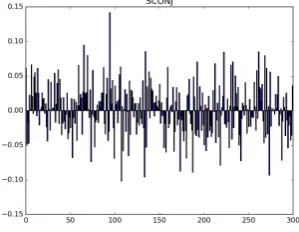
[image:4.595.338.491.102.219.2]dis-Figure 1. Centroid embedding for coordinating conjunctions
Figure 2. Centroid embedding for subordinating conjunctions
tributional patterns of words in the BNC. In sum, the vast majority of words are classified correctly, which means that their embeddings enable the de-tection of their parts of speech. In fact, one can visualize ‘centroid’ vectors for each PoS by sim-ply averaging vectors of words belonging to this part of speech. We did this for 10 000 words from our training set.
Plots for centroid vectors of coordinating and subordinating conjunctions are shown in Figures 1 and 2 respectively. Even visually one can notice a very strongly expressed feature near the ‘100’ mark in the horizontal axis (component number 94). In fact, this is indeed an idiosyncratic feature of conjunctions: none of the other parts of speech shows such a property. More details about what vector components are relevant to part of speech affiliation are given in Section 5.
[image:4.595.341.491.279.395.2]Table 1.Distributional similarity between parts of speech (fragment)
Cosine similarity PoS pair
0.81 NOUN ADJ
0.77 ADV PRON
0.73 DET PRON
0.73 ADV ADJ
... ...
... ...
0.37 INTJ NUM
0.36 AUX NUM
prepositions and subordinating conjunctions; quite in accordance with linguistic intuition. Proper nouns are not very similar to common nouns, with cosine similarity between them only 0.67 (even adverbs are closer). Arguably, this is explained by co-occurrences together with the definite arti-cle, and as we show below, this helps the model to successfully separate the former from the latter.
Despite generally good performance of the clas-sifier, if we look at our BNC test set, 1741 word types (about 10% of the whole test set vocabu-lary) were still classified incorrectly. Thus, they are somehow dissimilar to ‘prototypical’ words of their parts of speech. These are the ‘outliers’ we were after. We analyze the patterns found among them in the next section.
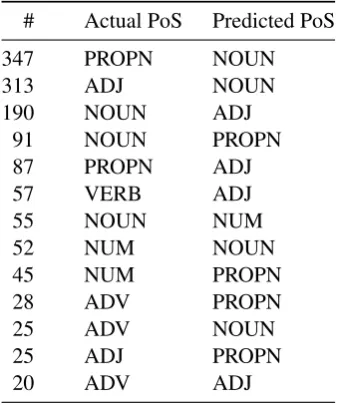
4 Not from this crowd: analyzing outliers First, we filtered out misclassified word types with ‘X’ BNC annotation (they are mostly foreign words or typos). This leaves us with 1558 words for which the classifier assigned part of speech tags different from the ones in the BNC. It proba-bly means that these words’ distributional patterns differ somehow from what is more typically ob-served, and that they tend to exhibit behavior sim-ilar to another part of speech. Table 2 shows the most frequent misclassification cases, together ac-counting for more than 85% of errors.
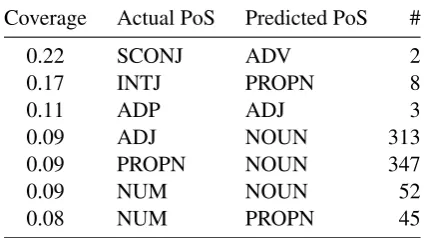
Additionally, we ranked misclassification cases by ‘part of speech coverage’, that is by the ratio of the words belonging to a particular PoS for which our classifier outputs this particular type of mis-classification. For example, proper nouns misclas-sified as common nouns constitute the most nu-merous error type in Table 2, but in fact only 9% of all proper nouns in the test set were
misclassi-Table 2. Most frequent PoS misclassifications of the distributional predictor. The # column lists the number of word types.
# Actual PoS Predicted PoS
347 PROPN NOUN
313 ADJ NOUN
190 NOUN ADJ
91 NOUN PROPN
87 PROPN ADJ
57 VERB ADJ
55 NOUN NUM
52 NUM NOUN
45 NUM PROPN
28 ADV PROPN
25 ADV NOUN
25 ADJ PROPN
20 ADV ADJ
fied in this way. There are parts of speech with a much larger portion of word-types predicted er-roneously: e.g., 22% of subordinate conjunctions were classified as adverbs. Table 3 lists error types with the highest coverage (we excluded error types with absolute frequency equal to 1, as it is impos-sible to speculate on solitary cases).
We now describe some of the interesting cases. Almost 30% of error types (judging by absolute amount of misclassified words) consist of proper nouns predicted to be common ones and vice versa. These cases do not tell us anything new, as it is obvious that distributionally these two classes of words are very similar, take the same syntac-tic contexts and hardly can be considered differ-ent parts of speech at all. At the same time, it is interesting that the majority of proper nouns in the test set (88%) was correctly predicted as such. It means that in spite of contextual sim-ilarity, the distributional model has managed to extract features typical for proper names. Errors mostly cover comparatively rare names, such as ‘luftwaffe’, ‘stasi’, ‘stonehenge’, or ‘himalayas’. Our guess is that the model was just not pre-sented with enough contexts for these words to learn meaningful representations. Also, they are mostly not personal names but toponyms or orga-nization names, probably occurring together with the definite articlethe, unlike personal names.
[image:5.595.332.501.113.316.2]patterns in English: nouns can be modified by both (it seems that cases where a proper noun is mis-taken for an adjective are often caused by the same factor). Words like ‘materialist_NOUN’, ‘ star-board_NOUN’ or ‘hypertext_NOUN’ are tagged as nouns in the BNC, but they often modify other nouns, and their contexts are so ‘adjectival’ that the distributional model actually assigned them se-mantic features highly similar to those of adjec-tives. Vice versa, ‘white-collar_ADJ’ (an adjec-tive in BNC) is regarded as a noun from the point of view of our model. Indeed, there can be con-tradicting views on the correct part of speech for this word in phrases like ‘and all the other white-collar workers’. Thus, in this case the distribu-tional model highlights the already known simi-larity between two word classes.
The cases of verbs mistaken for adjectives seem to be caused mostly by passive participles (‘was overgrown’, ‘is indented’, ‘’), which intuitively are indeed very adjective-like. So, this gives us a set of verbs dominantly (or almost exclusively, like ‘to intertwine’ or ‘to disillusion’) used in pas-sive. Of course, we will hardly announce such verbs to be adjectives based on that evidence, but at least we can be sure that this sub-class of verbs is clearly semantically and distributionally differ-ent from other verbs.
The next numerous type of errors consists of common nouns predicted to be numerals. A quick glance at the data reveals that 90% of these ‘nouns’ are in fact currency amounts and percent-ages (‘£70’, ‘33%’, ‘$1’, etc). It seems reasonable to classify these as numerals, even though they contain some kind of nominative entities inside. Judging by the decisions of the classifier, their contexts do not differ much from those of sim-ple numbers, and their semantics is similar. The Universal Dependencies Treebank is more consis-tent in this respect: it separates entities like ‘1$’ into two tokens: a numeral (NUM) and a sym-bol (SYM). Consequently, when our classifier was tested on the words from the UD Treebank, there was only one occurrence of this type of error.
[image:6.595.310.523.128.247.2]Related to this is the inverse case of numer-als predicted to be common or proper nouns. It is interesting that this error type also ranks quite high in terms of coverage: If we combine numer-als predicted to be common and proper nouns, we will see that 17% of all numerals in the test set were subject to this error. The majority of these
Table 3. Coverage of misclassifications with dis-tributional predictor, i.e., ratio of errors over all word types of a given PoS. The absolute type count is given by #.
Coverage Actual PoS Predicted PoS #
0.22 SCONJ ADV 2
0.17 INTJ PROPN 8
0.11 ADP ADJ 3
0.09 ADJ NOUN 313
0.09 PROPN NOUN 347
0.09 NUM NOUN 52
0.08 NUM PROPN 45
‘numerals’ are years (‘1804’, ‘1776’, ‘1822’) and decades (‘1820s’, ‘60s’ and even ‘twelfths’). Intu-itively, such entities do indeed function as nouns (‘I’d like to return to the sixties’). Anyway, it is difficult to invent a persuasive reason for why ‘fifty pounds’ should be tagged as a noun, but ‘the year 1776’ as a numeral. So, this points to possible (mi-nor) inconsistencies in the annotation strategy of the BNC. Note that a similar problem exists in the Penn Treebank as well (Manning, 2011).
Adverbs classified as nouns (53 words in total for both common and proper nouns) are possibly the ones often followed by verbs or appearing in company of adjectives (examples are ‘ultra’ and ‘kinda’). This made the model treat them as close to the nominative classes. Interestingly, most ‘ad-verbs’ predicted to be proper nouns are time indi-cators (‘7pm’, ‘11am’); this also raises questions about what adverbial features are really present in these entities. Once again, unlike the BNC, the UD Treebank does not tag them as adverbs.
documen-tation states that in such cases the first variant is al-ways more likely. Thus, distributional models can actually detect outright errors in PoS-tagged cor-pora, when incorrectly tagged words strongly tend to cluster with another part of speech. In the UD treebank such examples can also be observed, but they are much fewer and more ‘adverbial’, like ‘it goesclearthrough’.
Turning to Table 3, most of the entries were already covered above, except the first 3 cases. These relate to closed word classes (functional words), which is why the absolute number of in-fluenced word types is low, but the coverage (ratio of all words of this PoS) is quite high.
First, out of 9 distinct subordinate conjunctions in the test set, 2 were predicted to be adverbs. This is not surprising, as these words are ‘seeing’ and ‘immediately’. For ‘seeing’ the prediction seems to be just a random guess (the prediction confi-dence was as low as 0.3), but with ‘immediately’ the classifier was actually more correct than the BNC tagger (the prediction confidence was about 0.5). In BNC, these words are mostly tagged as subordinate conjunctions in cases when they oc-cur sentence-initially (‘Immediately, she lowered the gun’). The other words marked as SCONJ in the test set are really such, and the classifier made correct predictions matching the BNC tags.
Interjections mistaken for proper names do not seem very interpretable (examples are ‘gee’, ‘oy’ and ‘farewell’). At the same time, 3 prepositions predicted to be adjectives clearly form a separate group: they are ‘cross’, ‘pre’ and ‘pro’. They are not often used as separate words, but when they are (‘Did anyone encounter any trouble from Hibs fans in Edinburgh pre season?’), they are very close to adjectives or adverbs, so the predictions of the distributional classifier once again suggest shifting parts of speech boundaries a bit.
Error analysis on the vocabulary from the Universal Dependencies Treebank showed pretty much the same results, except for some differences already mentioned above.
[image:7.595.343.489.98.193.2]There exists another way to retrieve this kind of data: to process tagged data with a conven-tional PoS tagger and analyze the resulting confu-sion matrix. We tested this approach by process-ing the whole BNC with the Stanford PoS Tagger (Toutanova et al., 2003). Note that as an input to the tagger we used not the whole sentences from the corpora, but separate tokens, to mimic our
Table 4. Most frequent PoS misclassifications with the Stanford tagger (counting word types).
# Actual Predicted
172675 NNP NN
47202 VB NN
40218 JJ NN
24075 NN JJ
9723 JJ VB
workflow with the distributional predictor. Prior to this, BNC tags were converted to the Penn Tree-bank tagset3to match the output of the tagger. As
we are interested in coarse, ‘overarching’ word classes, inflectional forms were merged into one tag. That was easy to accomplish by dropping all characters of the tags after the first two (exclud-ing proper noun tags, which were all converted to NNP).
Analysis of the confusion matrix (cases where the tag predicted by the Stanford tagger was dif-ferent from the BNC tag) revealed the most fre-quent error types shown in Table 4. Despite simi-lar top positions of errors types ‘proper noun pre-dicted as common noun’ and ‘nouns and adjec-tives mistaken for each other’, there are also very frequent errors of types ‘verb to noun’ and ‘ ad-jective to verb’, not observed in the distributional confusion matrix (Table 2). We would not be able to draw the same insights that we did from the dis-tributional confusion matrix: the case with verbs mistaken for adjective is ranked only 12th, adverbs mistaken for nouns - 13th, etc.
Table 5 shows top misclassification types by their word type coverage. Once again, interest-ing cases we discovered with the distributional confusion matrix (like subordinating conjunctions mistaken for adverbs and prepositions mistaken for adjectives) did not show up. Obviously, a lot of other insights can be extracted from the Stan-ford Tagger errors (as has been shown in previous work), but it seems that employing a distributional predictor reveals different error cases and thus is useful in evaluating the sanity of tag sets.
Table 5. Coverage of misclassifications (from all word types of this PoS) with the Stanford tagger.
Coverage Actual Predicted #
0.91 NNP NN 172675
0.8 UH NN 576
0.79 DT NN 217
0.78 EX JJ 11
0.78 PR NN 517
inconsistencies in PoS annotations, whether they be automatic or manual. Thus, discussions about PoS boundaries would benefit from taking this kind of data into consideration.
5 Embeddings as PoS predictors
In the experiment described in the previous sec-tion, we used a model trained on words concate-nated with their PoS tags. Thus, our ‘classifier’ was a bit artificial in that it required a word plus a tag as an input, and then its output is a judgment about what tag is most applicable to this combina-tion from the point of view of the BNC distribu-tional patterns. This was not a problem for us, as our aim was exactly to discover lexical outliers.
But is it possible to construct a proper predictor in the same way, which is able to predict a PoS tag for a word without any pre-existing tags as hints? Preliminary experiments seem to indicate that it is. We trained a Continuous Skipgram distribu-tional model on the BNC lemmas without PoS tags. After that, we constructed a vocabulary of all unambiguous lemmas from the UD Tree-bank training set. ‘Unambiguous’ here means that the lemma either was always tagged with one and the same PoS tag in the Treebank, or has one ‘dominant’ tag, with frequencies of other PoS assignments not exceeding 1/2 of the dominant assignment frequency. Our hypothesis was that these words are prototypical examples of their PoS classes, with corresponding prototypical features most pronounced; this approach is conceptually similar to (Haghighi and Klein, 2006). We also removed words with frequency less than 10 in the Treebank. This left us with 1564 words from all Universal Tag classes (excluding PUNCT, X and SYM, as we hardly want to predict punctuation or symbol tag).
Then the same simple logistic regression classi-fier was trained on the distributional vectors from
the model for these 1564 words only, using UD Treebank tags as class labels (the training in-stances were again weighted proportionally to the words’ frequencies in the Treebank). The result-ing classifier showed an accuracy of 0.938 after 10-fold cross-validation on the training set.
We then evaluated the classifier on tokens from the UD Treebank test set. Now the input to the classifier consisted of these tokens’ lemmas only. Lemmas which were missing from the model’s vo-cabulary were omitted (860 of a total of 21759 to-kens in the test set). The model reached an ac-curacy of 0.84 (weighted precision 0.85, weighted recall 0.84).
These numbers may not seem very impres-sive in comparison with the performance of cur-rent state-of-the-art PoS taggers. However, one should remember that this classifier knows abso-lutely nothing about a word’s context in the current sentence. It assigns PoS tags based solely on the proximity of the word’s distributional vector in an unsupervised model to those of prototypical PoS examples. The classifier was in fact based only on knowledge of what words occurred in the BNC near other words within a symmetric window of 2 words to the left and to the right. It did not even have access to the information about exact word order within this sliding window, which makes its performance even more impressive.
It is also interesting that one needs as few as a thousand example words to train a decent classi-fier. Thus, it seems that PoS affiliation is expressed quite strongly and robustly in word embeddings. It can be employed, for example, in preliminary tag-ging of large corpora of resource-poor languages. Only a handful of non-ambiguous words need to be manually PoS-tagged, and the rest is done by a distributional model trained on the corpus.
Note that applying a K-neighborsclassifier in-stead of logistic regression returned somewhat lower results, with 0.913 accuracy on 10-fold cross-validation with the training set, and 0.81 ac-curacy on the test set. This seems to support our hypothesis that several particular embedding com-ponents correspond to part of speech affiliation, but not all of them. As a result, K-neighbors
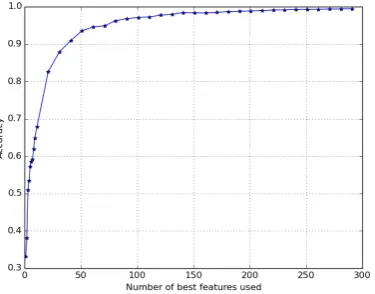
atten-Figure 3. Classifier accuracy depending on the number of used vector components (k)
tion to the relevant features, neglecting unimpor-tant ones.
To find out how many features are important for the classifier, we used the same training and test set, and ranked all embedding components (fea-tures, vector dimensions) by their ANOVA F-value related to PoS class. Then we successively trained the classifier on increasing amounts of top-ranked features (topkbest) and measured the training set accuracy.
The results are shown in Figure 3. One can see that the accuracy smoothly grows with the number of used features, eventually reaching almost ideal performance on the training set. It is difficult to define the point where the influence of adding fea-tures reaches a plateau; it may lie somewhere near
k = 100. It means that the knowledge about PoS
affiliation is distributed among at least one hun-dred components of the word embeddings, quite consistent with the underlying idea of embedding models.
One might argue that the largest gap in perfor-mance is betweenk = 2 andk = 3 (from 0.38 to 0.51) and thus most PoS-related information is contained in the 3 components with the largest F-value (in our case, these 3 features were compo-nents 31, 51 and 11). But an accuracy of 0.51 is certainly not an adequate result, so even if im-portant, these components are not sufficient to ro-bustly predict part of speech affiliation for a word. Further research is needed to study the effects of adding features to the classifier training.
Regardless, an interesting finding is that part of speech affiliation is distributed among many com-ponents of the word embeddings, not concentrated
in one or two specific features. Thus, the strongly expressed component 94 in the average vector of conjunctions (Figures 1 and 2) seems to be a soli-tary case.
6 Conclusion
Distributional semantic vectors trained on word contexts from large text corpora can learn knowl-edge about part of speech clusters. Arguably, they are good at this precisely because part of speech boundaries are not strict, and even some-times considered to be a non-categorical linguistic phenomenon (Manning, 2015).
In this paper we have demonstrated that seman-tic features derived in the process of training a PoS prediction model on word embeddings can be employed both in supporting linguistic hypotheses about part of speech class changes and in detect-ing and fixdetect-ing possible annotation errors in cor-pora. The prediction model is based on simple logistic regression and the word embeddings are trained using Continuous Skip-Gram model over PoS-tagged lemmas. We show that the word em-beddings contain robust data about the PoS classes of the corresponding words, and that this knowl-edge seems to be distributed among several com-ponents (at least a hundred in our case of 300-dimensional model). We also report preliminary results for predicting PoS tags using a classifier trained on a small number of prototypical mem-bers (words with a dominant PoS class) and ap-plying it to embeddings estimated from unlabeled data. A detailed error analysis and experimental results are reported for both the BNC and the UD Treebank.
[image:9.595.87.275.113.260.2]References
Bas Aarts and April McMahon. 2008. The handbook of English linguistics. John Wiley & Sons.
Bas Aarts. 2012. Small Clauses in English. The Non-verbal Types. De Gruyter Mouton, Boston.
Douglas Biber, Stig Johansson, Geoffrey Leech, Su-san Conrad, Edward Finegan, and Randolph Quirk. 1999.Longman grammar of spoken and written En-glish, volume 2. MIT Press.
Lou Burnard. 2007. Users Reference Guide for British National Corpus (XML Edition). Oxford University Computing Services, UK.
Christos Christodoulopoulos, Sharon Goldwater, and Mark Steedman. 2010. Two decades of unsu-pervised POS induction: How far have we come? In Proceedings of the 2010 Conference on Empiri-cal Methods in Natural Language Processing, pages 575–584. Association for Computational Linguis-tics.
John Firth. 1957. A synopsis of linguistic theory, 1930-1955. Blackwell.
Aria Haghighi and Dan Klein. 2006. Prototype-driven learning for sequence models. In Proceedings of the main conference on Human Language Technol-ogy Conference of the North American Chapter of the Association of Computational Linguistics, pages 320–327. Association for Computational Linguis-tics.
Ann Celeste Houston. 1985. Continuity and change in English morphology: The variable (ING). Ph.D. thesis, University of Pennsylvania.
Chu-Cheng Lin, Waleed Ammar, Chris Dyer, and Lori Levin. 2015. Unsupervised POS in-duction with word embeddings. arXiv preprint arXiv:1503.06760.
Wang Ling, Lin Chu-Cheng, Yulia Tsvetkov, and Silvio Amir. 2015a. Not all contexts are created equal: Better word representations with variable attention. InProceedings of the 2015 Conference on Empirical Methods in Natural Language Processing.
Wang Ling, Chris Dyer, Alan W. Black, and Isabel Trancoso. 2015b. Two/too simple adaptations of word2vec for syntax problems. In Proceedings of the 2015 Conference of the North American Chapter of the Association for Computational Linguistics – Human Language Technologies, pages 1299–1304, Denver, Colorado.
Quan Liu, Zhen-Hua Ling, Hui Jiang, and Yu Hu. 2016. Part-of-speech relevance weights for learning word embeddings. arXiv preprint arXiv:1603.07695.
Christopher D Manning. 2011. Part-of-speech tag-ging from 97% to 100%: is it time for some linguis-tics? In Computational Linguistics and Intelligent Text Processing, pages 171–189. Springer.
Christopher D Manning. 2015. Computational linguis-tics and deep learning. Computational Linguistics, 41:701–707.
Bernard Merialdo. 1994. Tagging english text with a probabilistic model. Computational Linguistics, 20(2):155–172.
Tomas Mikolov, Ilya Sutskever, Kai Chen, Greg S Cor-rado, and Jeff Dean. 2013a. Distributed represen-tations of words and phrases and their composition-ality. InAdvances in neural information processing systems, pages 3111–3119.
Tomas Mikolov, Wen-tau Yih, and Geoffrey Zweig. 2013b. Linguistic regularities in continuous space word representations. In Proceedings of NAACL-HLT 2013, pages 746–751.
Joakim Nivre, Marie-Catherine de Marneffe, Filip Gin-ter, Yoav Goldberg, Jan Hajiˇc, Christopher D. Man-ning, Ryan McDonald, Slav Petrov, Sampo Pyysalo, Natalia Silveira, Reut Tsarfaty, and Daniel Zeman. 2016. Universal Dependencies v1: A multilingual treebank collection. InProceedings of the Interna-tional Conference on Language Resources and Eval-uation (LREC).
Slav Petrov, Dipanjan Das, and Ryan McDonald. 2012. A universal part-of-speech tagset. InLREC 2012. Barbara Plank, Anders Søgaard, and Yoav Goldberg.
2016. Multilingual part-of-speech tagging with bidirectional long short-term memory models and auxiliary loss. arXiv preprint arXiv:1604.05529. Sujith Ravi and Kevin Knight. 2009. Minimized
mod-els for unsupervised part-of-speech tagging. In Pro-ceedings of ACL-IJCNLP 2009, pages 504–512, Sin-gapore.
Hinrich Schütze. 1995. Distributional part-of-speech tagging. In Proceedings of the seventh conference on European chapter of the Association for Compu-tational Linguistics, pages 141–148. Morgan Kauf-mann Publishers Inc.
Natalia Silveira, Timothy Dozat, Marie-Catherine de Marneffe, Samuel Bowman, Miriam Connor, John Bauer, and Christopher D. Manning. 2014. A gold standard dependency corpus for English. In Proceedings of the Ninth International Conference on Language Resources and Evaluation (LREC-2014).
Kristina Toutanova and Mark Johnson. 2007. A Bayesian LDA-based model for semi-supervised part-of-speech tagging. In Proceedings of the Neural Information Processing Systems Conference (NIPS).
Yuta Tsuboi. 2014. Neural networks leverage corpus-wide information for part-of-speech tagging. In Pro-ceedings of the 2014 Conference on Empirical Meth-ods in Natural Language Processing (EMNLP), pages 938–950.