Abstract— A series of polyurethane elastomers (PUs) was achieved with similar structures but changing the polyaddition procedure: the ‘one-shot’ or prepolymer synthesis routes. A major structural feature that has been explored was the relationship between hard segment (crystallizing or not). The materials were investigated by wide angle X-ray experiments. PUs tensile responses were studied revealing significant differences between the materials. By using the ‘one shot’ synthesis route, and the isocyanate of variable geometry 4,4’-dibenzyl diisocyanate (DBDI) it obtained polyurethane blends of variable crystallinity.
Index Terms—polyurethanes, flexible hard segments, one shot route, two-step prepolymer technique, structural studies, tensile behaviour.
I. INTRODUCTION
HE microstructure and mechanical behaviour of polyurethane elastomers (PUs) are strongly dependent on the synthesis method employed. The various methods for producing PUs can be differentiated according to the medium of preparation (bulk, solution, water) and the addition sequence of reactants (one-step or prepolymer synthesis routes).
The main difference between the materials prepared by the prepolymer and the one-step methods involves the chain build-up. The PUs obtained via the prepolymer method are statistically more regular in the chain sequence of the polyester-diisocyanate-glycol-diisocyanate-polyester, whereas PUs obtained by using the one-step method, (assuming the polyester and the glycol are of equal activity), have a more random sequence. A higher order of crystallinity is obtained in the step polymers. The one-step route begins with the slightly favored reaction between glycol and diisocyanate which produces highly crystalline, mobile chain elements. These areas of crystallinity, acting as crosslinks, increase the tensile strength data of the one-step PUs.
Manuscript received March 21, 2011. C. Prisacariu (presenting author), is with the Institute of Macromolecular Chemistry Petru Poni, Iasi, Romania, (phone: 40-232-217454; fax: 40-232-211299; e-mail: [email protected]).
E. Scortanu is with the Institute of Macromolecular Chemistry Petru Poni Iasi, Romania, (phone: 40-232-217454; fax: 40-232-211299; e-mail: [email protected]).
B. Agapie is with the Institute of Macromolecular Chemistry Petru Poni Iasi, Romania, (phone: 40-232-217454; fax: 40-232-211299; e-mail: [email protected]).
In the one-shot polyaddition procedure all reagents (soft segment macrodiol, diisocyanate and chain extender) are added at once during the initial reaction. Although this is a commonly used industrial technique, this procedure does not have the control required to yield regular block sequences [1-3]. However the process is faster, easier and more reproducible and can be used to best advantage where the reaction rates of the diol components with the diisocyanate are comparable, [1-4]. If the reactivity of both groups in an isocyanate are the same, then the ratio of relative reaction rates will be 2, since the concentration of the second NCO group is half that of the original. Since the diisocyanate and macrodiol components are usually incompatible at lower temperatures, the reaction will take place at the phase interface and the stoichiometric balance could be changed. Incompatibility results in structural heterogeneity, in a change of the average HS length, in segregation during processing and in lower solubility in solvents, [1-3]. Incompatibility has the same effect on the prepolymer process too, but a greater regularity.
A higher order of crystallinity in the one-step polymers is also important. The one-step polymers begin with the slightly favored reaction of glycol and diisocyanate which produces highly crystalline, mobile chain elements. Therefore, order can be established before extended polymer growth has occurred. These areas of crystallinity, acting as crosslinks, increase the tensile strength of the one-step elastomers. Although materials are molded at high temperatures, the melting point of the one-step elastomer is still higher [1]. Complete random disorder is not attained during short exposure to temperatures below the melting point and therefore the crystalline order persists in the one-step polymer.
In the one-shot method, factors like the different reactivity of isocyanate groups and different hydroxyl groups of a polyol and chain extender may affect the distribution of the hard segments on the macromolecular chain or even produce a mixture (oligomer) of diisocyanate-chain extender and diisocyanate-macrodiol homopolymers, [1,4-7].
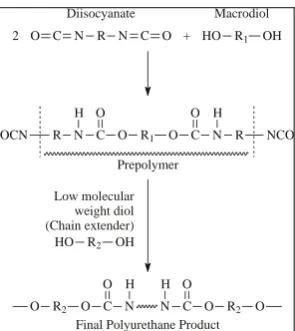
In contrast, in the two-step polymerization technique (Fig. 1), in the first step of the reaction a prepolymer is produced through the reaction of a soft segment oligomer with an excess diisocyanate, followed by chain extension with a short diol(urethane or ester) or a diamine (urea, urethaneurea, amide, or ester-amide) to form the hard segments and also to increase the overall molecular weight of the polymer.
New Insights Into Polyurethane Elastomers
Obtained by Changing the Polyaddition
Procedures
C. Prisacariu, E. Scortanu, and B. Agapie
As the two-step method is more controlled, it produces linear PU chains, fewer side reactions and polydispersities near 2, which is an expected result of step-growth polymers [1-4].
O C N R N C O
2 + HO R1 OH
OCN R N C O R1 O C N R NCO
H O O H
Prepolymer
HO R2 OH
O R2 O C N N C O R2 O
O H H O
Diisocyanate Macrodiol
Low molecular weight diol (Chain extender)
Final Polyurethane Product
Fig. 1. Schematic of the PUs two-step polymerization synthesis route based on diol chain extenders
An ideal PU primary structure assumes a perfect alternating block copolymer. However, under practical conditions, the soft segment structure, as well as the urethane reaction, follows a statistical Flory distribution, which is why the hard segments formed is not perfectly alternating and the block length may vary [2].
The bonding of soft and hard microphases in the PU copolymer structure (either by homoselection or by heteroselection) is possible only by joining the isocyanic (NCO) rest of one of the soft (S) or hard (H) elements to the free hydroxyl (OH) group of another S or H element, (Scheme 1). The total number of isocyanic groups taken into reaction equals the total number of OH groups so to ensure theoretically the formation of infinite macromolecule lengths. In principle there may appear regular structures where the order of S and H segmented repeats periodically (type 1), or irregular structures (types 2,3 etc), as shown in Scheme 1:
SHHSHHSHHSHH HHHSSHHSHHHS HHHHHHSSSHHS
8H - 4S ordered 8H - 4S unordered 8H - 4S unordered (1)
(2) (3)
Scheme 1. Hard and soft segment distribution on the PU macromolecular chain.
If the reaction rates of the soft and hard segment inclusion on the increasing macromolecular chain are equal, it results a hard segment – soft segment statistical sequential distribution. If the two reaction rates are unequal, accumulations appear initially on the increasing chain of the sequences characteristic to the quickest process, followed by the bonding of the sequences which form with a slower rate.
To assess the effect of sequential distribution on PUs with the same chemical structure but with different orders, in the Romanian laboratory we synthesized three series of analogous materials by using different synthesis routes: (a) a sub-set of materials with a complete uncontrolled ordering obtained by the one-step route; (b) similar materials as in case (a), but with a normal quasi ordered structure obtained by the diisocyanate prepolymer synthesis followed by
extension with a low molecular diol chain extender, by using the conventional two-step polymerization technique; (c) similar polymers as in the cases (a) and (b) but achieved with an increased sequential ordering of the type -S-HH-S-HH-S-HH- made up by a special inverse step by step synthesis that started with the construction of a hard ordered reactive intermediate OCN-HH-NCO, or more detailed an isocyanate (I) – chain extender (CE) structure of the type I-CE-I-CE-I, which was only then reacted with the macrodiol. As previously shown [7], such materials with a more regular structure have a more rigid network which requires higher initial strain energies. However this results in lower tensile strengths along with higher values of elongation and hysteresis. A high sequential ordering of the soft and hard domains of the type (c) resulted in a higher tendency of phase separation and crystallization and in a moderate decrease in the material elastomeric performance [7].
In the present work we compared two sub-sets of materials with similar structures but achieved via the „one-shot‟ and prepolymer routes respectively. PUs were obtained with the soft segment macrodiol polytetrahydrofuran (PTHF) of molar mass 2000 g/mol and extended with 1,4-butanediol (BDO). Hard segments were generated from 4,4‟-methylene bis(phenyl isocyanate) (MDI), or 4,4‟-dibenzyl diisocyanate (DBDI). As reported [5-7], the MDI molecule introduces the rigid - Ph-CH2-Ph- moiety in the elastomeric PUs hard segments. In contrast when using DBDI, the specific - Ph-CH2-CH2-Ph- moiety introduces a variable geometry into the hard segments due to the possibility of internal rotation of this isocyanate around the -CH2-CH2- ethylene bridge. This leads to the appearance of both “syn” and “anti” rotational conformations, which coexist in the DBDI based PUs macromolecules. As a result, in this latter case the PUs macromolecules can adopt a more compact packing which enhances significantly the ability to order in crystalline structures involving predominantly the “anti” form [5-7]. Rotation around the central –CH2–CH2– bridge in DBDI allows alignment of aromatic rings and hence crystallization within the hard phase, which is not available with other conventional rigid isocyanates as it is MDI in melt-cast polyurethanes.
II. EXPERIMENTAL METHODS
II.1.MATERIALS
A. PUs obtained by the prepolymer polyaddition procedure
A series of PUs based on dibenzyl (DBDI) monomers (Fig. 2) has been obtained by us. These monomers belong to a large category of diaromatic compounds with a variable geometry which induces significant effects in the macromolecular chains, especially those in connection to the rearranging capacity of the molecular fragments and thus to the increase in the degree of crystallinity [5-7].
The 4,4‟-DBDI materials were compared with similar polymers but obtained with the conventional rigid diisocyanate (MDI).
An investigation was made of the effects of varying the hard segment crystallinity and the synthesis route, on the PUs morphology and mechanical response. The PUs chemical structure is shown in Fig. 3.
2,4'-DBDI
CH2CH2
OCN NCO
4,4'- DBDI
CH2CH2
NCO OCN
OCN CH2CH2
OCN
1 2 3 4
1 2 3 4
1 2 3 4
2,2'- DBDI
1'
2' 3'
4'
1'
2' 3'
4' 1'
2' 3'
4'
Fig. 2. Schematic of dibenzyl isomers: 2,2‟, 2,4‟ and 4,4‟ –dibenzyl diisocianate (DBDI).
C N
O
H
O
Macrodiol (MD) (soft
segment)
Hard segment (HS) Chain extender
(CE) MDI
or
DBDI
[image:3.595.92.263.147.223.2]PTHF BG
Fig. 3. Chemical structure of PUs subjected to uniaxial tensile experiments.
The family of polymers was synthesized in the Romanian laboratory. They were all three-component systems combined in stoichiometric proportions, and consisting of: (1) a diisocyanate generating hard segment (HS), (MDI or DBDI); (2) a soft segment macrodiol (MD) - polytetrahidrofurane (PTHF) of molar mass Mw = 200050 g mol-1, and (3) a small molecule diol as chain extender (CE) - anhydrous buthylene glycol (BDO). The three components were always mixed in the proportions HS:CE:MD = 4:3:1, giving hard segment mass fractions in the region of 40%, and isocyanic index I =100. The synthesis procedure
followed was the prepolymer route described previously by Prisacariu et al. (2003) [5]. The HS and MD components were reacted together with vigorous mixing under vacuum at 100C, to give prepolymer terminated by HS. This was then thoroughly mixed with the CE at 90C, and cast into closed sheet moulds for curing at 110C for 24 hours. The final result was polymer with Mw in the range 60-120 kg mol-1, in the form of sheets with thickness in the range 0.3-0.6 mm.
B. PUs obtained via the ‘one-shot’ synthesis route.
A family of PUs based on the diisocyanates MDI and DBDI respectively, was obtained by us. The materials were also synthesized in the Romanian laboratory. The following structure was adopted:
(MD) (CE) (DI)
PTHF — BG — DBDI or MDI
1 n n+1 (n = 1 ÷ 10)
MD
PUs were synthesized both by the „one shot‟ technique in melt and in solution. The isocyanate index was I = 100 where I = {[NCO]/ ([OH]Macrodiol + [OH]CE)} 100; The ratio between the reactants is summarized in Table 1. Details
regarding the PU synthesis are given elsewhere [4-6]
.
II.2.STRUCTURE STUDIES
Information on the nanometre-scale physical structures of the materials achieved by the two step prepolymer technique, was gained by X-ray scattering, using synchrotron radiation at the UK Daresbury Laboratory. Wide-angle X-ray scattering (WAXS) studies were carried out using Station 16.2 SMX, with X-ray wavelength 82 pm.
The WAXS data of the PUs obtained by the „one shot‟ synthesis route, were collected using an URD 63 diffractometer (FPM-Seifert, Germany), which was equipped with a scintillation detector. Ni-filtered Cu K radiation of wavelength 1.5418 Å was used, and operated the machine in transmission mode. The counting time and the angular increment in data collection were 5 s and 0.05° (2), respectively.
II.3MECHANICAL TESTS
The sheet materials were cut into rectangular strips of dimensions 6 mm 0.3-0.6 mm, and tested in tension at ambient temperature and humidity (50% RH) using an Instron model 4204 testing machine, with 50 mm between the grips. Extension was measured using an Instron “elastomer” extensometer, with a gauge length of 20 mm. All the tests reported here were conducted at a nominal extension-rate of 310-2 s-1. The data were processed to quantify specific inelastic features in the mechanical responses of the materials: stress-strain data, and hysteretic energy dissipation.
III. RESULTS AND DISCUSSION
III.1.PUS OBTAINED BY THE TWO –STEP PREPOLYMER POLYADDITION PROCEDURE
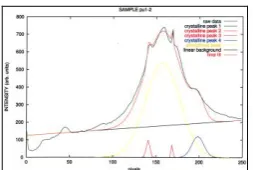
In all cases the more mobile DBDI structure lead to hard segments with a higher tendency to self associate evidenced by higher melting points [5] and crystallization tendency (Fig. 4.b) which was visible even when such structures are included in the polyurethane soft segment matrix.
The X-ray diffraction patterns of Fig. 4.b show that crystallizability of DBDI based PU largely remains even after of inclusion of soft segments as compared to PUs with MDI (Fig. 4.a.). As previously shown [5, 7], the crystallinity is however, considerably reduced with the incorporation of MDI in the case of PUs made with mixtures of the diisocyanates DBDI/MDI, [5].
[image:3.595.95.242.257.357.2] [image:3.595.364.491.680.765.2]Fig. 4.b. WAXS patterns of a PU based on the flexible diisocyanate DBDI
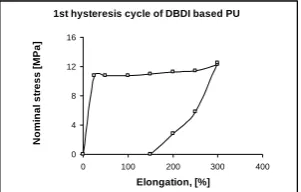
Systematic differences between the DBDI and MDI materials were observed in the frame of tensile cyclic experiments (Fig. 5 and 6).
1st hysteresis cycle of MDI based PU
0 4 8 12 16 20 24
0 100 200 300
Elongation, [%]
N
o
m
in
a
l
s
tr
e
s
s
,
[M
Pa
]
Fig. 5 .Tensile load/unload cycles for material based on MDI: (BDO-PTHF-MDI, I=100) at strain rate 0.03 s-1.
1st hysteresis cycle of DBDI based PU
0 4 8 12 16
0 100 200 300 400
Elongation, [%]
N
o
m
in
a
l
s
tr
e
s
s
[
M
P
a
]
Fig. 6. Tensile load/unload cycles for material based on DBDI:(BDO-PTHF-DBDI, I=100) at strain rate 0.03 s-1.
PUs based on DBDI have a higher flow stress than that those achieved with MDI. As seen in Fig. 5 and 6 and as also reported elsewhere for other structures, the presence of DBDI hard segments instead of MDI lead to increases in: the input strain energy to a given elongation, hysteresis and residual strain under cyclic loading, and stress relaxation. Polymers based on DBDI hard segments, displayed higher stiffness and strength than the conventional MDI based PUs.
III.2.POLYURETHANE ELASTOMERS OBTAINED BY THE “ONE SHOT” SYNTHESIS ROUTE.POLYURETHANE BLENDS BASED ON
DBDI
When employing MDI, irrespective of the synthesis route it always obtained homogeneous soluble polymers inseparable in fractions, by selective dissolution in DMF. Certainly, the sequence of ordering on the macromolecular chain differed from a PU synthesis route to another.
In the case of the DBDI based PU synthesis, the situation changed: due to the possible intramolecular rotation of the DBDI skeleton, the incipient growing oligomer -[DBDI - BDO]- adopted a plan parallel structure as in the simple dibenzyl derivatives [4] which allowed a more compact intermolecular packing of the growing oligomers. The
interaction between oligomer-oligomer became preponderant towards the interaction between oligomer and DMF and in solution appeared life species in suspension which continued to grow by interphasic reactions. In parallel, the kinetic - statistically determined incipient reaction of DBDI with MD lead to soluble oligomers with a good solubility, having sufficiently long soft segments so to maintain the formed polymer in solution till the end of the process.
If in these syntheses the DMF solvent was replaced by 1-methyl-2-pyrrolidinone (NMP) the situation changed to the “normal” behaviour similar to the MDI based PU reaction in solution. In this case the interaction between oligomer - solvent was always higher than the interaction between oligomer – oligomer (polymer - polymer), and it obtained only a single type of soluble copolymer.
Overall, when using DBDI, and approaching the „one shot‟ synthesis in solution, it obtained a suspension containing 2 copolymers simultaneously one of which was soluble in DMF (70.8%), the other is insoluble in DMF (20.2% -Table.1). When replacing DMF by NMP, it obtained a homogeneous viscous solution which contained one single copolymer. A similar situation appeared in the case when the syntheses were performed in melt (Table 1).
For the DBDI based materials obtained by the ‘one shot ‘synthesis route in melt, it obtained opaque solid elastomer
blends which also contained two copolymers
simultaneously, one of which was soluble in DMF (86%), while the other one was insoluble in DMF (14%).
Depending on the diisocyanate conformation (rigid or flexible), significant differences in the PU cristallinity, from amorphous to semi-crystalline elastmers with a crystallinity of about 50% were revealed by means of WAXS experiments. There were large differences between the materials achieved by the „one shot‟ sintehsis route. Shown in Fig. 7 are the WAXS patterns of the series of polymers (denoted as PU98 to PU103 respectively, as illustrated in Table 1.
0 10 20 30 40
Scattering Angle 2
PUC1
PUC2
PUC3
PUD
PUM
In
te
n
si
ty
Fig. 7 WAXS of polyurethanes based on MDI and DBDI obtained by the „one-shot‟ technique, accordingto Table 1.
[image:4.595.88.252.224.332.2] [image:4.595.94.245.367.463.2] [image:4.595.323.526.525.684.2]III.3TENSILE RESPONSES
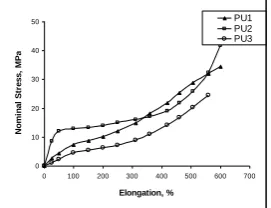
The tensile responses were compared for selected PUs achieved by the prepolymer or „one shot‟ procedures. Shown in Fig. 8 are example stress-strain curves for three materials.
0 10 20 30 40 50
0 100 200 300 400 500 600 700
Elongation, % N o m in a l S tr e s s , M P a PU1 PU2 PU3
Fig. 8. PUs stress-strain curves: PU1 - DBDI material obtained by the prepolymer route; PU2 - MDI material obtained by the prepolymer route; PU3 - DBDI polymer blend obtained by the „one shot‟ route (PU100 in Table 1)
By using the „one shot‟ synthesis route, for the polymer blend obtained with DBDI it obtained the lowest stresses, whereas for the polymer with DBDI hard segments achieved by the prepolymer procedure it obtained the highest stresses data. The MDI based material obtained by the prepolymer polyadditon procedure occupied an intermediate position. PU1 shows more pronounced strain-stiffening than PU2. As shown elsewhere, the same pattern was observed in polymers based on PEA soft segments [5].
IV. CONCLUSIONS
In the first phase of this study, a series of PUs were obtained with similar structures. Only the type of diisocyanates differed: DBDI (crystyallizing); MDI (non-crystallizing). The effects of hard segment (crystallizing or non-crystallizing) was studied by following the PUs tensile response. The presence of DBDI hard segments instead of the conventional MDI hard segments led to increases in the stress – strain data, input strain energy to a given elongation, hysteresis and residual strain under cyclic loading. These differences between DBDI and MDI were attributed to the
greater flexibility of DBDI allowing a higher tendency to self-associate by hydrogen bonding.
In the second phase of this work, materials with similar structures were obtained by using the „one shot‟ synthesis route. This means that the three main components, (diisocyanate, macrodiol and chain extender) were mixed together at once, in a random fashion. A series of PUs blends was obtained, based on the flexible diisocyanate DBDI.
On employing the „one shot‟ technique either in solution or in melt and using DBDI, it obtained PU blends made up by two copolymers with different compositions, separable by selective dissolution in dimethylformamide (DMF). In contrast, when using the conventional rigid diisocyanaye MDI, under the same conditions it obtained homogeneous soluble polymers inseparable in fractions.
As shown [4], although DBDI displays approximately the same reactivity as MDI against n – butanol, the behaviour of these diisocyanates in the PUs polyaddition process is different, especially if the „one shot‟ synthesis route is performed. DBDI which displays an internal variable geometry tends to adopt a rotation conformation which favors the intermolecular association to ordinate in crystalline domains.
The materials obtained by the two step polyaddition procedure were observed be more regular than the corresponding polymers obtained via the one step route. This was because the prepolymer route caps the polyol with the diisocyanate and then connects these oligomers with the chain extenders. This provides a more regular hard-soft-hard-soft sequence than in the one-step synthesis route where the HS size distribution is narrower.
The structural regularity resulted in better mechanical properties in the case of PUs achieved by the prepolyemr polyaddition procedure, since the hard segments (especially those of DBDI) are able to aggregate and crystallize much easier to form physical cross-linking points. The DBDI based PUs obtained by using the two-step polymerization procedure displayed reduced residual elongation and higher tensile strength, resulting in a product of a narrower HS molecular weight distribution on the macromolecular chain.
The behaviour of the two diisocyanates, MDI and DBDI in the PUs polyaddition process is different, especially if the „one shot‟ synthesis route is performed. DBDI which displays an internal variable geometry tends to adopt a rotation conformation which favors the intermolecular association to ordinate in crystalline domains.
REFERENCES
[1] Z. S. Petrovic, J. Ferguson, “Polyurethane Elastomers”, Prog. Polym. Sci., 16, 1991, p. 695
[2] P. Krol‚ “Synthesis methods, chemical structures and phase structures of linear polyurethanes. Properties and applications of linear polyurethanes in polyurethane elastomers, copolymers and ionomers”.
Prog. Mat. Sci., 52:2007, p. 915
[3] D. J. Lyman, J. Heller, M. Barlow, “Polyurethanes. III. The effects of aromatic rings on the structure and properties of polyurethanes based on ethylene glycol”, Makromol. Chem., 84, 1965, 64
[4] A. A. Caraculacu, G. Caraculacu, “Dibenzyl structures in macromolecular chains”, J. Macromol. Sci.Chem., A22, 1985, p. 631. TABLE 1.PU TYPE AND ADOPTED SYNTHESIS ROUTES.
PU # Synthesis
Route CE MD DI Observations PU 98
One shot DMF T = 600 C
BDO 3 PTHF 1 DBDI 4
insoluble in DMF (26.4%) soluble in DMF
(73.6%) PU 100
One shot melt t = 600 C
BDO 3 PTHF 1 DBDI 4 14.7% insoluble 85.3% soluble PU 101 One shot DMF, T = 600 C
BDO 3
PTHF 1
MDI
4 100% soluble PU 102
One shot DMF, t = 1100 C
BDO 3 PTHF 1 DBDI 4
Insoluble in DMF (20.2%) Soluble in DMF
(70.8%) PU 103
One shot NMP t = 1150 C
BDO 3 PTHF 1 DBDI 4
Insoluble in DMF (3.9%) Soluble in DMF
(96.1%) PU 104 Prepolymer
Melt BDO 3 PTHF 1 DBDI
4 soluble in DMF PU 105 Prepolymer
Melt BDO 3 PTHF 1 MDI
[image:5.595.49.290.61.306.2] [image:5.595.102.238.370.474.2][5] C. Prisacariu , R. H. Olley, A. Caraculacu, D.C. Bassett, C. Martin, “The effect of hard segment in copolyurethane elastomers obtained by using simultaneously two types of Diisocyanates”, Polymer 44, 2003, p. 5407
[6] C. Prisacariu, C.P. Buckley, A. Caraculacu, “Mechanical response of dibenzyl-based polyurethanes with diol chain extension” Polymer, 46, 2005, p. 3884
[7] C. Prisacariu, E. Scortanu, “Structural studies and the correlation with the stress-strain response in polyurethanes”, in Encyclopedia of
Analytical Chemistry, ISBN: 978-04-7002-731-8, a9150, 1-24