Proceedings of the 22nd Conference on Computational Natural Language Learning (CoNLL 2018), pages 54–64 54
Corpus-driven Thematic Hierarchy Induction
Ilia Kuznetsov and Iryna Gurevych
Ubiquitous Knowledge Processing Lab (UKP-TUDA) and Research Training Group AIPHES Department of Computer Science
Technische Universit¨at Darmstadt http://www.ukp.tu-darmstadt.de/
Abstract
Thematic role hierarchy is a linguistic tool used to describe interactions between semantic roles and their syntactic realizations. Despite decades of dedicated research and numerous thematic hierarchy suggestions in the litera-ture, this concept has not been used in NLP so far due to incompatibility and limited scope of existing hierarchies. We introduce an empir-ical framework for thematic hierarchy induc-tion and evaluate several role ranking strate-gies on English and German corpus data. We hypothesize that inducing a thematic hierar-chy is feasible, that a hierarhierar-chy can be induced from small amounts of data and that resulting hierarchies apply cross-lingually. We evaluate these assumptions empirically.
1 Introduction
Semantic roles are one of the core concepts in NLP, and automatic semantic role labeling (SRL) is a major task with applications in question an-swering (Shen and Lapata,2007), machine trans-lation (Liu and Gildea,2010) and information ex-traction (Christensen et al., 2010). The goal of SRL is to label the semantic arguments of a pred-icate (e.g. a verb) with roles from a pre-defined role inventory. Conceptually, role assignment in SRL can be split in two steps: local labeling es-timates the likelihood of a certain semantic argu-ment bearing a certain role; global optimization takes context-dependentrole interactionsinto ac-count and enforces certain theoretically motivated constraints (e.g. “each role must appear only once per predication”).
State of the art in SRL is held by the systems based on deep neural networks (Marcheggiani and Titov, 2017; He et al., 2017). While achieving remarkable quality on benchmark datasets, mod-ern systems show a considerable ≈10-point per-formance drop when applied out-of-domain. This
issue is aggravated by the fact that deep neural net-works require significant amounts of training data, and SRL annotations are expensive to produce. While local role assignment can be augmented us-ing unlabeled data (e.g. via pre-trained word and character embeddings), context-dependent role in-teraction is an SRL-specific phenomenon and can only be learned from annotated SRL corpora.
Aiming to reduce the training data requirements for SRL, we revisit the notion ofthematic hierar-chy (TH), a compactdelexicalized way to model context-dependent role interactions. Thematic hi-erarchies assume that given a syntactic hierarchy (e.g. subject≺1object≺oblique) semantic roles
can be ranked in a way that higher ranked roles take higher ranked syntactic positions. One exam-ple of phenomena captured by THs is the choice of subject: given a thematic hierarchyAgent ≺ ... ≺Instrument, anInstrumentcan only become subject if theAgent is not present, e.g.
“[John]Ag broke the window with a [hammer]In”
→“A [hammer]Inbroke the window”.
THs have received considerable attention in lin-guistic literature, but were so far impractical for use in NLP and SRL due to incompatibility and limited scope of the existing hierarchies. As a first step towards including THs into the NLP tool ventory we suggest an empirical framework for in-ducing THs from role-annotated corpora. Since VerbNet (Schuler, 2006) is the only SRL frame-work that operates with thematic roles, we choose it as our basis and perform experiments on the PropBank corpus (Palmer et al., 2005) enriched with VerbNet role labels via SemLink (Bonial et al.,2013).
The contributions of this paper are as follows:
• We suggest a method for global thematic hi-erarchy induction from corpus data;
• We propose several thematic and syntactic ranking models and evaluate them on English and German data;
• We show that thematic hierarchies can be in-duced and applied cross-lingually while leav-ing room for improvement; we further show that thematic hierarchy induction is data-efficient and can produce a high-quality hi-erarchy using just a fraction of training data.
2 Related work
2.1 Semantic roles and the Lexicon
Semantic roles in the modern sense have been in-troduced in 1960s as a way to account for variation in syntactic behavior of verbs which can not be ex-plained by purely syntactic means (Gruber,1965; Fillmore, 1968). A commonly used motivational example contrasts the use of verbs hitandbreak: while both are regular transitive verbs,hitdoes not allow construction (4); and construction (5) is un-grammatical in both cases.
(1) [John]X broke/hit the [window]Y with a [stone]Z.
(2) [John]Xbroke/hit the [window]Y. (3) A [stone]Zbroke/hit the [window]Y. (4) The [window]Ybroke/*hit.
(5) The [window]Y*broke/*hit with a [stone]Z.
There exist several principled ways to describe the syntactic behavior of arguments in the lexicon. Available constructions can be defined individu-ally on verb sense basis. This strategy is pre-cise but highly redundant, since verbs show sub-stantial similarities in syntactic behavior; besides, it does not generalize to the out-of-vocabulary (OOV) predicates.
A step towards a more general representation is verb class grouping (Levin, 1993): verbs senses can be grouped into verb classes with syntactic be-havior shared among the members of the class. For example, syntactically break behaves like crash,
shred and split, while hit behaves like bash and
whackin the corresponding verb senses. This sig-nificantly reduces the lexicon redundancy and al-lows treatment of the OOV verbs if the verb class can be determined. A similar level of granularity is used by the major SRL frameworks: FrameNet SRL (Das et al.,2010) and, to some extent, Prop-Bank SRL (Roth and Woodsend,2014).
Semantic arguments share similarities across verb classes, giving rise to the notion of
gen-eral semantic roles. While there exists no con-sensus on the inventory of semantic roles, a sub-set shared by the most theoretical approaches in-cludes roles such as Agent (the active sentient initiator of the event), Theme (the most affected participant),Result(the outcome of the event), Instrument(the instrument used) etc. Seman-tic roles show similar behavior across languages and can be thought of as grammatically relevant universal categories humans use to conceptual-ize real-world events. Following common ter-minology, we further refer togeneral, predicate-independent semantic roles as thematic roles. This level of granularity is, for example, used by VerbNet (Schuler,2006).
Thematic roles’ syntactic behavior depends on the presence of other thematic roles in the sen-tence: as our example above demonstrates, an Instrument can only take the subject posi-tion if theAgentis not present (3); andTheme can only become subject if both Agent and Instrumentare not expressed (4-5). A widely used modeling tool to account for context de-pendency is the thematic hierarchy(TH): given a syntactic prominence scale (e.g. subject ≺ oblique...≺object), one can assume that there ex-ists a universal ranking of thematic roles, which is homomorphic to the syntactic ranking (e.g. Agent ≺ Instrument ≺ Theme). The top-ranking semantic argument gets assigned to the highest available syntactic position, the second-ranking gets the second-highest position, etc.
THs are a compact delexicalized way to de-scribe semantic roles’ syntactic behavior at the grammar level, which could reduce data require-ments and improve generalization capability of SRL systems. However, THs from the literature come from varying theoretical backgrounds, are based on different syntactic formalisms and oper-ate with different role inventories. Most of these THs are justified via basic (often synthetic) lan-guage examples, aiming to verify a certain the-ory cross-lingually rather than to describe the lan-guage use in a compact way.
2.2 Major SRL Frameworks
of general, predicate-independent adjunct roles (AM-TMP, AM-LOCetc.). Core roles are defined on verb sense level. An effort is made to en-sure consistency in assigningA0(Agent-like) and A1(Patient-like). The rest of the core arguments (A2-5) are verb sense-specific; no finer-grained distinctions between roles are made.
PropBank annotation is closely tied to syntax. FrameNet (Baker et al., 1998) takes a different stance and focuses on accurate and detailed rep-resentation of event semantics. Verbs (as well as lexemes from other categories) are grouped into
frames so that members of the same frame share a set of fine-grained frame-specific semantic roles (e.g.Impactee,Force,Buyer,Goods).
Both PropBank and FrameNet SRL operate on the verb sense/verb class generalization level. VerbNet (Schuler,2006) groups verbs into Levin-inspired verb classes and defines sets of general, lexicon-level thematic roles and constructions for each class. It is the only SRL formalism that operates with a thematic role set. VerbNet role sets and verb class information are mapped to the PropBank corpus annotations via SemLink ( Bo-nial et al.,2013).
2.3 Thematic roles in SRL
So far only few studies have considered VerbNet-level granularity in SRL and we are not aware of SRL systems specifically designed to exploit the thematic role generalizations. Zapirain et al. (2008) compare PropBank and VerbNet perfor-mance using a simple SRL system and conclude that PropBank labels generally perform better; however, they do not use any additional mod-eling possibilities offered by VerbNet’s general, predicate-independent role set.Loper et al.(2007) show that replacing verb-specific PropBank roles A2-5 with the corresponding VerbNet roles im-proves the SRL performance. Merlo and van der Plas (2009) report a statistical analysis of Prop-Bank and VerbNet annotations and conclude that while PropBank role inventory better correlates with syntax and is therefore easier to learn, Verb-Net thematic roles are more informative and bet-ter generalize to new verb instances. Finally, a recent comparison on German data by Hartmann et al. (2017) positions VerbNet inventory above FrameNet and below PropBank in terms of com-plexity and generalization capabilities; however, the experiment is again based on themateplus
sys-tem (Roth and Woodsend, 2014) designed with PropBank generalization level in mind.
2.4 Semantic Proto-Roles
A related line of work is Semantic Proto Role Labeling (SPRL) (Reisinger et al., 2015; White et al.,2017) which, followingDowty(1991), dis-cards the notion of atomic semantic role inven-tory and replaces it with Proto-Agent and Proto-Patient property sets. While our study utilizes traditional atomic role inventories, we see SPRL as a compatible parallel line of work and believe that additional benefits can be gained by combining the two views on syntax-semantics interface. In particular, Reisinger et al. (2015) investigate the alignment between Dowty-style role properties and VerbNet thematic roles and show that VerbNetAgentstend to bear Dowty’s instigated,awareness andvolitional properties, while Themes are more likely to change posession,change state, etc.
2.5 Thematic hierarchies
Numerous THs have been proposed in the linguis-tic literature, e.g. Agent ≺ Instrument ≺
Theme (Fillmore, 1968); see (Levin and Rappa-port Hovav,2005) for an overview. These hierar-chies are rarely applicable for NLP since they orig-inate from different theoretical backgrounds and are usually focused on a narrow set of linguistic phenomena (e.g. subject selection), aiming to pro-vide a cross-linguistically valid hierarchy based on a set of manually constructed examples. In con-trast, our approach is data-driven and aims to de-scribe the general syntactic behavior of thematic roles. While an optimal TH that would success-fully describe semantic roles’ behavior across lan-guages might not exist (and would imply the exis-tence of a universal role inventory and grammar), our evidence suggests that this concept is at least partially applicable.
2.6 Syntactic formalisms
Cross-lingual applicability has traditionally been a strong component in semantic role theory, and universality is one of the common desiderata for a thematic hierarchy. This, however, implies the ex-istence of a universal syntactic prominence scale.
From the NLP perspective, the closest to uni-versal syntactic representation for which auto-matic parsers are available is the Universal pendencies (UD) representation. Universal De-pendencies (Nivre et al.,2016) is a recent initia-tive aimed at creating a single dependency-based formalism suited for describing syntactic structure in a language-independent way. It encompasses freely available treebanks for more than 60 lan-guages, and universal dependency parsing is an ac-tive research area (Zeman et al.,2017). Based on that, we make an effort to ground our study in UD syntax for English. Since neither gold UD anno-tations, nor a deterministic converter are available, for German we use the TIGER dependency syntax representation (Dipper et al.,2001).
3 Hierarchical Linking model
3.1 Model
We suggest a simple model to describe the inter-face between syntactic and thematic rankings. An SRL corpus can be seen as a collection of sen-tences with corresponding predications, where each predication has atarget(e.g. verb) and a set ofargumentslabeled with semantic roles.
Leta1...an ∈ Abe the set of arguments in the
predicationp;r(ai) be the role label af the argu-mentai, andd(ai)be the path between the predi-cate and the argument in the dependency parse tree of the sentence. Asyntactic rankerS provides a syntactic ranksi =S(d(ai))for each argumentai inAbased on the path, and athematic rankerT provides a thematic rankti = T(r(ai))based on the argument’s role. For each pair of arguments (ai, aj) we expect their syntactic ranks to align with their thematic ranks, i.e.
∀i6=j:sign(ti−tj) =sign(si−sj)
The model per se does not imply the existence of a global ranking and allows flexible ranker defini-tion. It allows ties in both syntactic and thematic rankings.
We use accuracy to assess how well a given syntactic-semantic ranker pair reflects the actual
Ag In Pa Th Va
Ag
In
Pa
Th
Va
1.00 1.00 1.00 0.98
0.00 0.500.75
0.000.50
0.00 0.25 0.75
0.02 0.25
[image:4.595.339.489.64.212.2]0.0 0.2 0.4 0.6 0.8 1.0
Figure 1: Preference matrix
argument ranks found in data. Given a set of test predications p1, p2...pk ∈ P with the argument setsA1, A2...Ak, we measure the correspondence between syntactic and semantic ranking over the argument pairs(aki, akj)via accuracy defined as
#(sign(tk
i −tkj) =sign(ski −skj)) #total pairs
To avoid the majority class bias, we measure ac-curacy for each role pair and use macro-averaged accuracy over pairs as the final score. A straight-forward alternative to our evaluation metric would be the Kendall rank correlation coefficient, which, based on our preliminary experiments, tends to overemphasize the performance on most frequent role pairs.
4 Thematic Hierarchy Induction
This paper investigates several thematic rank-ing strategies. As a running example we use a small role set: Agent (Ag), Patient (Pa), Instrument (In), Theme (Th) and Value (Va). For now we assume the following syntac-tic hierarchy:subj≺iobj≺nmod≺obj≺other.
Local ranker The simplest way to model role ranking is to extract the average syntactic rank for each role based on the data, and then, given a test pair, assign ranks based on average syntactic rank.
role Ag Pa In Th Va
mean(s) 1.01 2.58 1.72 3.95 3.74
Table 1:Mean syntactic rank per role (1-5)
0.98 1.00
1.00
1.00 0.75
0.75
Va Ag
Pa
[image:5.595.92.243.65.232.2]Th In
Figure 2: Preference graph
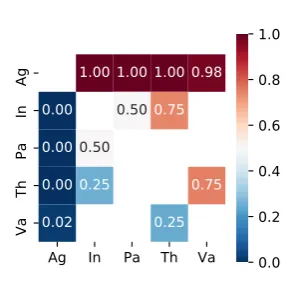
et al., 2016)), local ranking is a reasonable base-line strategy. However, it fails to account for the context dependency of thematic roles’ syntactic realization. The next step is to construct a pair-wise preference matrix: for each pair of roles encountered in training data we calculate the pro-portion of times rolerireceives a higher syntactic rank than rolerj. For our role set this results in the matrix shown on Fig.1.
The preference matrix, for example, shows that Agent clearly dominates all the roles, Instrumentranks overTheme, andValueis belowTheme.
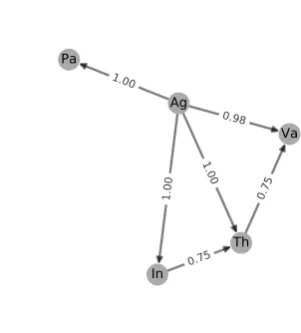
Global ranker The pairwise ranking approach takes context into account. However, some role pairs only co-occur rarely. In such cases no pair-wise ranking information is available to the model. Finding a global TH based on pairwise prefer-ences is an example of arank aggregation prob-lem which can be solved via constrained ILP op-timization on apreference graph(Conitzer et al., 2006). We represent the pairwise preference ma-trix as a graph G = (v, e) where each vertex v represents a role, the edge weight is the preference strength measured as#(ri ≺ rj)/#(ri, rj). The edge direction is from higher- to lower-ranking role. If we assume a global ordering of the roles, we can induce the global ranking via transitivity relations. For example (Fig. 2), Instrument never appears with Value in our training data; however, by transitivity viaThemewe can assume thatInstrumentranks overValue.
Given the preference graphG = (v, e), letwij be the weight of the edge betweenvi andvj. Let xij ∈0,1denote that we rank verticeviabovevj.
The goal is then to maximizeP
i,jxijwij subject to two groups of constraints. First, we prohibit two nodes to rank above each other, but allow ties, by enforcing∀i,j :xij+xji≤1. Second, we enforce transitivity, i.e. ifri is ranked aboverj, andrj is ranked aboverk, thenrimust be ranked aboverk, formally∀i,j,k, i6=j 6= k:xij +xjk −xik ≤1. We solve the ILP problem using the off-the-shelf
pulpoptimizer (Mitchell et al.,2011).
For our restricted example, optimization pro-duces the following global hierarchy:Ag≺In≺
Th≺Va/Pa. This hierarchy ranksInstrument aboveValueby transitivity, however, in case of Patient and Value no preference can be in-ferred from the graph, so they receive the same thematic rank.
5 Experiments
5.1 Datasets and Restrictions
For our experiments on English, we use SemLink (Bonial et al., 2013), a manually constructed re-source that enriches PropBank’s (Palmer et al., 2005) semantic role annotations with VerbNet’s (Schuler, 2006) thematic role labels. We use the Universal Dependencies converter (Schuster and Manning, 2016) to transform original PropBank syntactic annotation to UD. PropBank semantic role annotation and the corresponding SemLink reference are constituents-based. However, UD is a dependency formalism, and we employ a number of heuristics to align original PropBank annota-tions with the CoNLL-2009 datasets (Hajiˇc et al., 2009) to recover the head node positions. We em-ploy additional transformations, filtering out the predications in which not all PropBank core roles got aligned to the VerbNet thematic roles.
For German, we use the recently introduced SR3de dataset (M´ujdricza-Maydt et al., 2016; Hartmann et al.,2017) which explicitly provides VerbNet annotations on top of SALSA corpus (Burchardt et al.,2006). There exist no gold UD annotations for the SALSA corpus, and we use the SALSA’s default TIGER syntactic formalism (Dipper et al.,2001) in our experiments.
con-dataset #sent #tok #pred #arg EN (PropBank→SemLink)
train 16 603 446 641 21 276 44 333 test 1 031 27 751 1 336 2 761
dev 550 15 157 684 1422
DE (SR3de VerbNet)
train 898 20 277 905 1 992
test 240 4 738 245 532
[image:6.595.71.290.62.189.2]dev 117 2 429 119 266
Table 2: Dataset statistics
text dependency, we only consider the predica-tions where all arguments are direct dependents of the verb in the UD dependency tree. Since we are interested in relative ranking, only predications that contain more than one semantic argument are considered in the study.
Dataset statistics for English and German (after filtering) are summarized in Table2. In all exper-iments we induce a TH and related statistics from the training data and evaluate it on the test data, using the split from the CoNLL SRL shared tasks.
5.2 Syntactic ranker
For simplicity in this paper we only experiment with two syntactic rankers per language. A com-mon syntactic prominence scale assumed in lin-guistic literature issubject≺object≺indirect ob-ject ≺ oblique. This scale has to be adapted to the UD and TIGER labeling schemes. For each language we evaluate two syntactic rankings: one that positions objects above indirect objects and
obliques, and one that positionsobjectsbelow. For English, we rank the UD syntactic relations as follows (SE1): nsubj /csubj ≺ iobj ≺ nmod ≺ccomp/dobj≺other; wherenmodcorresponds to oblique andotheris used for any other syntac-tic relation. An alternative ranking positionsdobj
directly after the subject (SE2): nsubj /csubj ≺ ccomp/dobj≺iobj≺nmod≺other.
For German, the following ranking of TIGER syntactic relations is employed (SD1): SB ≺DA
≺ OP / MO / OG/ OC ≺ OA / OA2 / CVC ≺
other; where SB is the subject, DA is dative ob-ject, OP / MO / OG / OCcorrespond to oblique relations, andOA / OA2 / CVCto direct object re-lations (see (Dipper et al., 2001) for detailed de-scription). Similarly, we evaluate the performance of the ranking that positions the direct object after the subject (SD2):SB≺OA / OA2 / CVC≺DA≺ OP / MO / OG / OC≺other.
synt glob pair loc RND UB EN SE1 .869 .887 .867 .509 .927 EN SE2 .930 .929 .913 .500 .932 DE SD1 .655 .726 .637 .471 .818 DE SD2 .790 .820 .820 .456 .920
Table 3:Thematic ranker evaluation, incl. random ranker (RND) and upper bound (UB); bold - best result over syntactic rankers, underlined - best re-sult over thematic rankers
5.3 Bounds
We construct the upper boundfor the hierarchy induction by evaluating a global ranker trained on the test dataset. The upper bound reflects the data properties, as well as the maximal alignment ac-curacy that can be achieved with the selected syn-tactic ranker. The lower bound is constructed by evaluating 100 random thematic rankers which rank roles according to a random (but consistent) hierarchy, and averaging the result.
5.4 Data utilization setup
To evaluate how effective the proposed rankers use the training data, we conduct a series of experi-ments with reduced dataset sizes using the follow-ing protocol. The trainfollow-ing dataset is shuffled and split inton= 100slices. A ranker is consecutively trained on the firstm ∈ 1..nslices and evaluated against the full test dataset. The procedure is re-peated k = 100 times to eliminate the effect of data order, and the results per slice are averaged.
6 Results
6.1 General Accuracy and Syntactic Ranker
To get an overall impression of the ranking qual-ity, we first compare the performance of thematic rankers with respect to syntactic rankers and avail-able datasets. The results of this comparison are summarized in Table 3 and show that syntactic rankers positioning the object second in the hier-archy (SE2 and SD2) lead to better alignment on both datasets and have a higher upper bound. We report the results on these rankers for the rest of the paper.
[image:6.595.307.531.62.132.2]EN Agent ≺ Cause/Instrument/Experiencer ≺ Pivot ≺ Theme ≺ Patient ≺ Ma-terial/Source/Asset ≺ Product ≺ Recipient/Beneficiary/Destination/Location ≺
Value/Stimulus/Topic/Result/Predicate/Goal/InitialLocation/Attribute/Extent
DE Agent≺Experiencer≺Stimulus/Pivot≺Cause≺Theme≺Patient≺Topic≺Instrument≺
Beneficiary/InitialLocation ≺ Result≺Product/Goal ≺ Destination/Attribute≺Recipient ≺
[image:7.595.321.512.184.332.2]Value/Time/CoAgent/Locus/Manner/Source/Trajectory/Location/Duration/Path/Extent
Table 4:Induced hierarchies
EN-test DE-test
UB .932 .920
EN-train .930 .787 DE-train .852 .790
[image:7.595.106.253.184.252.2]RND .500 .456
Table 5:Cross-lingual evaluation, global ranker
6.2 Qualitative analysis
The result of hierarchy induction is a global rank-ing of thematic roles. Table 4 shows full rank-ings extracted for English and German data. While some correspondence to the hierarchies proposed in literature is evident (e.g. for English Agent
≺Instrument≺Theme, similar to (Fillmore, 1968)), a direct comparison is impossible due to the differences in role definitions and underlying syntactic formalisms. Notice the high number of ties: some roles never co-occur (either by chance or by design) or occur on the same syntactic rank (e.g. oblique) so there is no evidence for prefer-ence even if we enforce transitivity.
6.3 Cross-lingual hierarchy induction
The induced hierarchies for English and German bear certain similarities, which raises the question on cross-lingual applicability of the hierarchies. This analysis is only possible because the VerbNet and SR3de role inventories are mostly compati-ble with few exceptions (M´ujdricza-Maydt et al., 2016). Table5contrasts the performance of THs induced from English and German training data, and evaluated on German and English test data re-spectively. While the cross-lingual performance is expectedly lower than the monolingual perfor-mance, it outperforms the random baseline by a large margin, suggesting the potential for cross-lingual hierarchy induction.
6.4 Data utilization
One can assume that constructing a global hierar-chy should require less training data due to the
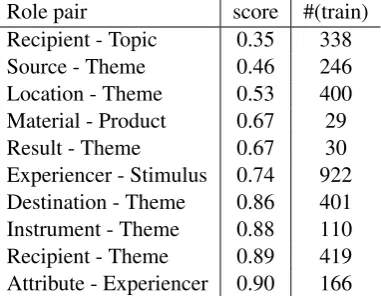
ef-Role pair score #(train) Recipient - Topic 0.35 338 Source - Theme 0.46 246 Location - Theme 0.53 400 Material - Product 0.67 29 Result - Theme 0.67 30 Experiencer - Stimulus 0.74 922 Destination - Theme 0.86 401 Instrument - Theme 0.88 110 Recipient - Theme 0.89 419 Attribute - Experiencer 0.90 166
Table 6: Global ranker accuracy, English
fective utilisation of transitivity. We evaluate this assumption empirically. Fig. 3reports the perfor-mance of rankers with access to different amounts of training data for English and German. The re-sults on English data show that global hierarchy-based ranker effectively utilizes the training data and can be trained using just fractions of the orig-inal training dataset.
The accuracy measurements on German are less conclusive: the local ranker generally performs best and learns fastest. We attribute this to the fact that filtered SR3de is an order of magnitude smaller than the PropBank/SemLink dataset. For pairwise and global rankers as many role pairs as possible should be observed at least once to es-tablish the pairwise preference. This holds for PropBank/SemLink (all role pairs from test data seen at least once after observing 20% of the train-ing data, on average), however, for filtered SR3de, even given the full training data, only 83% of role pairs from the test set have been seen at least once.
6.5 Error analysis
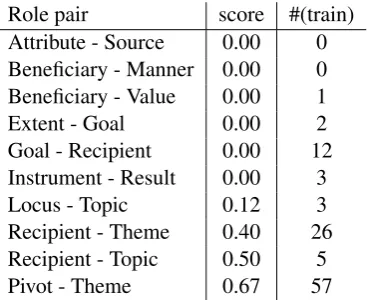
Our evaluation procedure allows detailed insights into the performance of the models. To illustrate, we extract the role pairs from English and German data with ranking accuracy below 1.0.
0 20 40 60 80 100 data %
0.55 0.60 0.65 0.70 0.75 0.80 0.85 0.90 0.95
mean acc
0 20 40 60 80 100
data % 0.2
0.3 0.4 0.5 0.6 0.7 0.8 0.9
[image:8.595.123.477.64.233.2]global pairwise local upper
Figure 3: Data utilization for English (left) and German (right) along with max/min values
Role pair score #(train) Attribute - Source 0.00 0 Beneficiary - Manner 0.00 0 Beneficiary - Value 0.00 1
Extent - Goal 0.00 2
Goal - Recipient 0.00 12 Instrument - Result 0.00 3
Locus - Topic 0.12 3
Recipient - Theme 0.40 26 Recipient - Topic 0.50 5 Pivot - Theme 0.67 57
Table 7:Global ranker accuracy, German
see that false ranking might be caused by the lack of training examples (e.g. Material vs. Product, Theme vs. Result). We also ob-serve complications with positioning the Theme on the hierarchy. In many cases the misalign-ment is due to non-standard use of thematic roles, e.g. Locationas subject inwsj 2322:7[the
delayLoc resulted from difficultiesTh]. Another
common reason for false alignments is the syn-tactic ranker. For example, in wsj 2372:1 [the SenateAg voted 87-7Res to approveTh...] the
Resultis connected to the predicate via an ad-vmod relation, andThemeisxcomp, both ranked equally (other) by our syntactic ranker.
Error analysis on the much smaller German dataset (Table 7) reveals the sparsity-related is-sues: most of the role pairs that tend to get mis-aligned do not, or only rarely appear in the training data, heavily influencing the score. As on English data, many misalignments are due to simplicity of the syntactic ranker.
7 Discussion
7.1 Importance of the syntactic ranker
The choice of syntactic ranking has a drastic ef-fect on the resulting TH and the alignment quality, even if only direct syntactic dependents and a lim-ited set of relations are taken into account. Real-istically there might exist an arbitrary set of paths connecting arguments to predicates. UD as syn-tactic formalism is also subject to rapid change. Inducing ajoint syntactic and thematic hierar-chy that maximizes the overall alignment quality is a crucial direction for future work with potential benefits for SRL and syntactic parsing. Although we show that THs can be induced with an arbitrary dependency formalism, across-lingual UD-based studywould be another extension to our work.
7.2 SRL integration
To utilize and evaluate the potential of thematic hierarchies for role interaction modeling,SRL in-tegration is necessary. This, however, is not a trivial task: the absolute majority of semantic role labeling systems are designed with PropBank or FrameNet SRL formalism in mind and are not tailored to general VerbNet-style semantic roles and verb class-level disambiguation. A dedicated VerbNet SRL system would enable this assess-ment, and applying THs to such a system is an important future work direction.
7.3 Robustness to parsing errors
[image:8.595.89.273.280.430.2]prac-tical applications and for the cases when an SRL corpus is provided without syntactic annotations, it would be important to evaluate how effectively THs can be induced given parsing errors in train-ingandin test data.
7.4 Data selection
We have demonstrated that THs can be induced from small portions of training data. The large dis-crepancy in the scores on the first data slices seen on Fig. 3 suggests that some data instances are more informative for TH induction. This raises the question whether it is possible to automati-callyselect useful training instances, supported by the evidence from previous work in SRL ( Pe-terson et al.,2014). One obvious strategy would be to make sure that the hierarchy inducer is pre-sented as many role pairs as early as possible. Ap-proximating this objective in an unsupervised way would reduce the amount of data needed to induce a high-quality thematic hierarchy.
7.5 The need for a global hierarchy
Our results regarding thenecessity of a global hi-erarchywhich ranksallthe roles are inconclusive. While global ranking reaches the best quality for English, on the German data pairwise and local ranking approaches perform best. Although we attribute the latter to sparsity, more German data would be needed to evaluate this hypothesis. In particular, this can be achieved by relaxing some of the constraints we impose on the data.
8 Conclusion
This paper has presented an empirical framework for thematic hierarchy induction and evaluation. We have suggested several syntactic and thematic ranking strategies and a method to induce global thematic hierarchies from corpus data. Analysis on English and German data shows that hierarchy induction is feasible, data-efficient and has poten-tial for cross-lingual applications. Promising di-rections for future work include joint modeling of syntactic and thematic ranking, selecting informa-tive training instances and evaluating the utility of global hierarchies on extended language material.
Acknowledgements
This work has been supported by the German Re-search Foundation as part of the ReRe-search Training
Group AIPHES (grant No. GRK 1994/1), QA-EduInf project (grant GU 798/18-1 and grant RI 803/12-1) and FAZIT Stiftung.
References
Collin F. Baker, Charles J. Fillmore, and John B. Lowe. 1998. The Berkeley FrameNet project. In Pro-ceedings of the 17th International Conference on Computational Linguistics, volume 1, pages 86–90, Montreal, Quebec, Canada. Association for Compu-tational Linguistics.
Claire Bonial, Kevin Stowe, and Martha Palmer. 2013. Renewing and revising SemLink. In Proceedings of the 2nd Workshop on Linked Data in Linguistics (LDL-2013): Representing and linking lexicons, ter-minologies and other language data, pages 9–17. Association for Computational Linguistics.
Aljoscha Burchardt, Katrin Erk, Anette Frank, An-drea Kowalski, Sebastian Pado, and Manfred Pinkal. 2006. The SALSA corpus: A German corpus re-source for lexical semantics. In Proceedings of the Fifth International Conference on Language Resources and Evaluation (LREC’06), pages 969– 974. European Language Resources Association (ELRA).
Janara Christensen, Mausam, Stephen Soderland, and Oren Etzioni. 2010. Semantic role labeling for open information extraction. InProceedings of the NAACL HLT 2010 First International Workshop on Formalisms and Methodology for Learning by Read-ing, FAM-LbR ’10, pages 52–60, Stroudsburg, PA, USA. Association for Computational Linguistics.
Vincent Conitzer, Andrew Davenport, and Jayant Kalagnanam. 2006. Improved bounds for comput-ing kemeny rankcomput-ings. InProceedings of the 21st Na-tional Conference on Artificial Intelligence - Volume 1, AAAI’06, pages 620–626. AAAI Press.
Dipanjan Das, Nathan Schneider, Desai Chen, and Noah A. Smith. 2010. Probabilistic frame-semantic parsing. In Human Language Technologies: The 2010 Annual Conference of the North American Chapter of the Association for Computational Lin-guistics, HLT ’10, pages 948–956, Stroudsburg, PA, USA. Association for Computational Linguistics.
Stefanie Dipper, Thorsten Brants, Wolfgang Lezius, Oliver Plaehn, and George Smith. 2001. The TIGER treebank. InProceedings of the Workshop on Tree-banks and Linguistic Theories, pages 24–41.
David Dowty. 1991. Thematic proto-roles and argu-ment selection. Language, 76(3):474–496.
Jeffrey S. Gruber. 1965. Studies in Lexical Relations. Ph.D. thesis, MIT, Cambridge, MA.
Jan Hajiˇc, Massimiliano Ciaramita, Richard Johans-son, Daisuke Kawahara, Maria Ant`onia Mart´ı, Llu´ıs M`arquez, Adam Meyers, Joakim Nivre, Sebastian Pad´o, Jan ˇStˇep´anek, Pavel Straˇn´ak, Mihai Surdeanu, Nianwen Xue, and Yi Zhang. 2009. The CoNLL-2009 Shared Task: Syntactic and Semantic Depen-dencies in Multiple Languages. InProceedings of the Thirteenth Conference on Computational Natu-ral Language Learning: Shared Task, CoNLL ’09, pages 1–18, Stroudsburg, PA, USA. Association for Computational Linguistics.
Silvana Hartmann, Eva´ M´ujdricza-Maydt, Ilia Kuznetsov, Iryna Gurevych, and Anette Frank. 2017. Assessing SRL frameworks with automatic training data expansion. InProceedings of the 11th Linguistic Annotation Workshop, pages 115–121. Association for Computational Linguistics.
Luheng He, Kenton Lee, Mike Lewis, and Luke Zettle-moyer. 2017. Deep semantic role labeling: What works and what’s next. InProceedings of the 55th Annual Meeting of the Association for Computa-tional Linguistics (Volume 1: Long Papers), pages 473–483. Association for Computational Linguis-tics.
Beth Levin. 1993. English Verb Classes and Alterna-tions: A Preliminary Investigation. University of Chicago Press.
Beth Levin and Malka Rappaport Hovav. 2005. Argu-ment Realization. Research Surveys in Linguistics. Cambridge University Press.
Ding Liu and Daniel Gildea. 2010. Semantic role features for machine translation. In Proceedings of the 23rd International Conference on Computa-tional Linguistics (Coling 2010), pages 716–724. Coling 2010 Organizing Committee.
Edward Loper, Szu ting Yi, and Martha Palmer. 2007. Combining lexical resources: Mapping between propbank and verbnet. InProceedings of the 7th In-ternational Workshop on Computational Linguistics, Tilburg, the Netherlands.
Diego Marcheggiani and Ivan Titov. 2017. Encoding sentences with graph convolutional networks for se-mantic role labeling. In Proceedings of the 2017 Conference on Empirical Methods in Natural Lan-guage Processing, pages 1507–1516, Copenhagen, Denmark. Association for Computational Linguis-tics.
Paola Merlo and Lonneke van der Plas. 2009. Abstrac-tion and generalisaAbstrac-tion in semantic role labels: Prop-bank, verbnet or both? InProceedings of the Joint Conference of the 47th Annual Meeting of the ACL and the 4th International Joint Conference on Natu-ral Language Processing of the AFNLP, pages 288– 296. Association for Computational Linguistics.
Stuart Mitchell, Michael OSullivan, and Iain Dun-ning. 2011. Pulp: a linear programming toolkit for python.
´
Eva M´ujdricza-Maydt, Silvana Hartmann, Iryna Gurevych, and Anette Frank. 2016. Combining se-mantic annotation of word sense & sese-mantic roles: A novel annotation scheme for VerbNet roles on German language data. InProceedings of the Tenth International Conference on Language Resources and Evaluation (LREC 2016). European Language Resources Association (ELRA).
Joakim Nivre, Marie-Catherine de Marneffe, Filip Ginter, Yoav Goldberg, Jan Hajiˇc, Christopher D. Manning, Ryan T. McDonald, Slav Petrov, Sampo Pyysalo, Natalia Silveira, Reut Tsarfaty, and Daniel Zeman. 2016. Universal dependencies v1: A multi-lingual treebank collection. In Proceedings of the Tenth International Conference on Language Re-sources and Evaluation LREC 2016. European Lan-guage Resources Association (ELRA).
Martha Palmer, Daniel Gildea, and Paul Kingsbury. 2005. The proposition bank: An annotated cor-pus of semantic roles. Computational Linguistics, 31(1):71–106.
Daniel Peterson, Martha Palmer, and Shumin Wu. 2014. Focusing annotation for semantic role la-beling. In Proceedings of the Ninth International Conference on Language Resources and Evaluation (LREC’14), Reykjavik, Iceland. European Language Resources Association (ELRA).
Drew Reisinger, Rachel Rudinger, Francis Ferraro, Craig Harman, Kyle Rawlins, and Benjamin Van Durme. 2015. Semantic Proto-Roles. Transactions of the Association for Computational Linguistics, 3:475–488.
Michael Roth and Kristian Woodsend. 2014. Composi-tion of word representaComposi-tions improves semantic role labelling. InProceedings of the 2014 Conference on Empirical Methods in Natural Language Processing (EMNLP), pages 407–413. Association for Compu-tational Linguistics.
Karin Kipper Schuler. 2006. VerbNet: A Broad-Coverage, Comprehensive Verb Lexicon. Ph.D. the-sis, University of Pennsylvania.
Sebastian Schuster and Christopher D. Manning. 2016. Enhanced English universal dependencies: An im-proved representation for natural language under-standing tasks. InProceedings of the Tenth Interna-tional Conference on Language Resources and Eval-uation (LREC 2016). European Language Resources Association (ELRA).
Weiwei Sun, Zhifang Sui, and Meng Wang. 2009. Pre-diction of thematic rank for structured semantic role labeling. InProceedings of the ACL-IJCNLP 2009 Conference Short Papers, pages 253–256. Associa-tion for ComputaAssocia-tional Linguistics.
Aaron Steven White, Kyle Rawlins, and Benjamin Van Durme. 2017. The Semantic Proto-Role Linking Model. In Proceedings of the 15th Conference of the European Chapter of the Association for Com-putational Linguistics, volume 2, pages 92–98. As-sociation for Computational Linguistics.
Aaron Steven White, Drew Reisinger, Rachel Rudinger, Kyle Rawlins, and Benjamin Van Durme. 2016. Computational linking theory. arXiv, abs/1610.02544.
Benat Zapirain, Eneko Agirre, and Llu`ıs Marquez. 2008. Robustness and generalization of role sets: PropBank vs. VerbNet. InProceedings of the 46th Annual Meeting of the Association for Computa-tional Linguistics, June, pages 550–558. Association for Computational Linguistics.
Daniel Zeman, Martin Popel, Milan Straka, Jan Hajiˇc, Joakim Nivre, Filip Ginter, Juhani Luotolahti, Sampo Pyysalo, Slav Petrov, Martin Potthast, Fran-cis Tyers, Elena Badmaeva, Memduh Gokirmak, Anna Nedoluzhko, Silvie Cinkova, Jan Hajiˇc jr., Jaroslava Hlavacova, V´aclava Kettnerov´a, Zdenka Uresova, Jenna Kanerva, Stina Ojala, Anna Mis-sil¨a, Christopher D. Manning, Sebastian Schuster, Siva Reddy, Dima Taji, Nizar Habash, Herman Le-ung, Marie-Catherine de Marneffe, Manuela San-guinetti, Maria Simi, Hiroshi Kanayama, Valeria de-Paiva, Kira Droganova, H´ector Mart´ınez Alonso, C¸ a˘grı C¸ ¨oltekin, Umut Sulubacak, Hans Uszkor-eit, Vivien Macketanz, Aljoscha Burchardt, Kim Harris, Katrin Marheinecke, Georg Rehm, Tolga Kayadelen, Mohammed Attia, Ali Elkahky, Zhuoran Yu, Emily Pitler, Saran Lertpradit, Michael Mandl, Jesse Kirchner, Hector Fernandez Alcalde, Jana Str-nadov´a, Esha Banerjee, Ruli Manurung, Antonio Stella, Atsuko Shimada, Sookyoung Kwak, Gustavo Mendonca, Tatiana Lando, Rattima Nitisaroj, and Josie Li. 2017. Conll 2017 shared task: Multilingual parsing from raw text to universal dependencies. In