WAX SECRETION IN T H E COCKROACH
BY J. W. L. BEAMENT
Agricultural Research Council, Unit of Insect Physiology, Department of Zoology, University of Cambridge
{Received i December 1954)
The production of massive quantities of waxy materials by bees and similar insects has been known for a very long time, but it was not until 1938 that Bergmann showed the existence of smaller quantities of wax in the cuticle of Bombyx. Ramsay (1935) was the first to demonstrate that a greasy material on the surface of the cuticle was responsible for waterproofing the cockroach, and subsequently the work of Wigglesworth (1945) and Beament (1945) produced evidence for believing that the existence of a thin layer of wax in the epicuticle was widespread throughout the insects, and was the chief mechanism for restricting water-loss. It is now known that wax layers are also present in ticks (Lees, 1947) and in many arthropod egg-shells (Beament, 1946, 1951, etc.), while Chibnall, Piper, Pollard, Williams & Sahai (1934) have carried out a detailed analysis of beeswax and of the wax of the white pine chermes. These waxes consist of long chain alcohols, paraffins and acids; the aliphatic chains always appear to be saturated. The similarity of the physico-chemical behaviour of cuticular waxes with beeswax, as outlined by Beament (1945), seems to leave little doubt that the minute but essential amounts of wax in typical insect cuticle are composed of the same type of chemical components as those found in beeswax. The range of melting-points of these materials shows that relative changes in the chain length of the component would be sufficient to account for the differences between the specific properties of waxes derived from different species.
THE SECRETION OF WAX
Wax secretion in the cockroach 515
secrete, but with no eggs to receive its secretion, wax accumulates on its surface with much inferior spreading properties.
Even more remarkable in this respect is the plastic waxy substance with which the red spider mite Metatetranyckus coats its egg (Beament, 1951). This can be shaped into the long spike which surmounts the egg, by the soft ovipositor of the female, as it is withdrawn. Yet after an hour, the extremely brittle wax has a high melting-point, and it is not long before it melts at 1700 C. These are outstanding examples of the type of change which is believed to go on in insect waxes immediately following their secretion.
INITIAL EXPERIMENTS
The starting-point of this investigation was a chance observation by Prof. V. B. Wigglesworth (to whom I wish to express my thanks). Grease obtained by washing the external surface of many cockroaches (Periplaneta), was stored in a cupboard for several months. Now in its natural state on the animal, this grease is a vaseline-like substance which has no true melting-point; it ceases to be a waterproofing material at about 330 C. But the stored sample had changed to a solid hard material, looking very like a white wax. It had a melting-point of the order of 560 C , it was readily soluble in chloroform, benzene and similar solvents, and its general properties were very similar to those of, for example, the cuticular waterproofing wax of Rhodnius (Beament, 1945). When this material was deposited from chloroform on to a mem-brane of lipoid free locust wing in a memmem-brane holder, it produced reasonable waterproofing, with a transition temperature of the order of 500 C. Generally speaking, therefore, it appeared to be a wax composed of long-chain paraffinic com-ponents. Now paraffins, and their related alcohols and acids, are known to be chemically extremely inert materials. Nevertheless, it seemed very necessary to examine all the possible processes by which a change such as this could come about. It is possible that slow chemical change, such as oxidation or reduction, could have altered the materials present; polymerization of shorter components might have produced a wax of larger molecular weight, and therefore higher melting-point: or some enzymic, or even bacterial, process may have gone on.
Accordingly, small samples of grease were obtained by washing living late nymphal cockroaches with cold chloroform, and allowing the solvent to evaporate for 24 hr. Chloroform is readily detected by its smell, and this was used as a crude but pro-bably quite sensitive test for the freedom of the sample from solvent. (It is later shown that these samples might have contained traces of chloroform, but it is most unlikely that this would in any way affect the validity of the results, for one does not expect chloroform to combine with these natural greases, or cause them to change.) These grease samples were then placed in small sealed glass tubes, in atmospheres of nitrogen, hydrogen, oxygen and argon; some were stored in darkness and others in sunlight and, in some tubes, the volume of gas was very small. They were left for periods of several weeks before being opened and examined.
In no case did any hard wax form in these tubes. To check that the process of change had not proceeded at least partially, it would be necessary to determine the
516 J. W. L. BEAMENT
melting-point of the samples, but for such a grease this is not possible. It is known (Beament, 1945) that the transition temperature of the grease sample would be a more reliable indication of changes, but again, there is appreciable wastage in making up standard membranes, the amounts of material to be tested were very small, and some micro-method was sought. Now it is known (Ramsay, 1935) that a droplet of water, placed on the cockroach, is rapidly waterproofed by a film of the grease spreading over it. These circumstances cannot be reproduced on clean glass cover-slips which had been coated with grease by being wiped over the surface of a living cockroach; a water droplet, added to the cover-slip, was apparently covered by grease, but very soon made contact with the underlying glass, whence it spread rapidly through the glass-grease interface to the edge of the cover-slip and there evaporated. One needs a surface with different wetting properties.
Now if the glass is replaced by polythene, or polytetrafluorethylene sheet, with which water has a contact angle of 900, waterproofing can be obtained, and a drop so covered will remain for a very long time at room temperature. If these plastic sheets are then sealed on to the end of a wide glass tube, the other end of which is open, and then suspended vertically so that the sheet is in the surface of a water-bath, the film can be heated slowly, while at the same time preventing its being exposed to the almost saturated air above the bath.The temperature must be raised slowly, for such plastics are very poor conductors of heat, but at the transition temperature, as shown by samples removed directly from living animals, droplets of 1 mm.3 disappear in about a minute. This gives a rapid and reliable method for determining transition temperatures for very small samples of grease, and the material from the sealed tubes was so tested. The results are shown in Table 1; this
Table 1. The temperatures at which 1 m.z droplets of water on polythene sheeting evaporate, after covering with various grease films; transition
temperatures by membrane holders are given for comparison
Treatment Living roach O, dark 3 months O, light 3 months H, dark 3 months H, light 3 months N , dark 3 months N , light 3 months AT small volume Ar large volume Rapid heating S5° C. High vacuum, room
temperature 2 weeks
Transition temp. by droplet (° C.)
34 35 38 35
37-5
38 35 36
41
4i(?)
Transition temp. by membrane (° C.)
33
— — — 37
—
4 2 49. 5i
44
Wax secretion in the cockroach 517
higher temperatures for considerable periods; it is possible, in fact, that these values are not as reliable as those obtained from the droplets.
It will be seen from the table that some small changes have taken place in the transition temperatures of the grease samples in the sealed tubes, but none of them have even approached the figure of 50° C. although they have been stored for a period during which complete transformation to hard wax would occur in a freely exposed sample. From our original hypothesis we can certainly eliminate the possibility that direct oxidation is responsible. It also seems most unlikely that the mere operation of sealing the grease in a tube would have prevented polymerization, where every precaution was taken to avoid heating the material; equally well, reduction processes would not have been eliminated, and as no antiseptic precautions were taken, it is hardly likely that bacterial action would have been prevented in this way.
The only evidence of any possible significance is that the samples with the highest transition temperatures come from tubes of greatest enclosed gas space. Is it possible that evaporation is taking place? A sample was heated on a glass slide to ioo° C.; the grease was rapidly transformed into one with a higher transition tem-perature. It was soon discovered that mere prolonged heating would produce a material which would not spread over water at all at room temperature. Subse-quently, a large sample of grease kept for several hours on a glass plate at 6o° C , changed to a 'wax' with a melting-point between 50 and 550 C. If a sample was rapidly heated to a much higher temperature (bearing in mind the possibility of structural change or decomposition which this treatment might induce) a vapour could sometimes be detected which carried the distinctive odour of cockroaches, but which was not so pungent as to give the impression that it was composed entirely, or even mainly, of this aromatic material; equally, it was not chloroform. In further tests, grease samples were stored at room temperature under high vacuum, and again small but significant increases in the transition temperature were noted; a wax with a melting-point of 500 C. could be obtained in this way much more rapidly than by exposure at the same temperature to the atmosphere.
EVIDENCE FOR VOLATILE COMPONENTS
518 J. W. L. BEAMENT
be of a low order of molecular weight, especially as compared with wax molecules whose carbon chain may be 24-32 atoms long. The determination of molecular weights of solvent and wax is therefore a valuable approach.
MOLECULAR WEIGHT BY VAPOUR DENSITY (1) Vapour density
It seems likely, from the evidence given above, that most of the volatile materials present would vaporize in a vacuum at temperatures above 6o° C. A sample of grease, obtained from chloroform washings of living animals, was allowed to eva-porate until no smell of chloroform could be detected. It was divided into two roughly equal parts, one of which was weighed and then heated under reduced pressure at 64° C , thus giving an indication of the weight of volatile material present in the sample. The other portion was weighed and injected into the Torricellian vacuum of a mercury barometer, jacketed with methyl alcohol vapour at 64° C. From the volume occupied by the volatile part of this sample, its vapour density could be calculated: its mean molecular weight is of course twice this figure.
The results showed considerable variation; values for molecular weight varying from 100 to 200 were obtained. It is, however, obvious that if the sample is stored for a long time, solvent and chloroform are both lost, whereas the determination of molecular weight on a fresh sample must include some chloroform vapour. But even if one cannot make a direct suggestion as to the nature of the solvent, these experiments do at least provide concrete evidence for the presence of a volatile component in the grease. Clearly a different method for determining molecular weights is needed.
(2) Cryoscopic method
Wax secretion in the cockroach
519
under glycerine. Samples were then drawn from either tube, and their freezing-points determined by Ramsay's method. The freezing-point of pure recrystallized benzene, after storage in glycerine, was also taken, which by subtraction gives the depression caused by the wax or grease in solution. It is appreciated that any inter-solubility between benzene and glycerine might have an effect on the results obtained, but the values for pure benzene after storage in glycerine are very close to those quoted by the manufacturers, using a standard salt solution for calibration of the Beckman thermometer. Certainly, the concentrations of waxes used cause a large depression in freezing-point, as compared with the possible variation in the ' pure' benzene through dissolved glycerine.
From the depression of freezing-point of the sample containing the hard, non-volatile wax component, its mean molecular weight was obtained. The other sample gives the freezing-point of a solution containing a known molecular amount of wax, together with solvent molecules. From this, one can calculate the mean molecular weight of the solvent, for various proportions of solvent to wax. The results are shown in Table 2. On p. 522, the amounts of volatile component present
Table 2. The molecular weights of various waxes by the depression of the freezing-point of benzene
g. wax 4000 I M.W. •
g. benzene depression freezing-poiot,iot/
Material
Hard cockroach wax (see p. 522) Stearic acid
(M.W. 284) Beeswax Vaporized grease Whole grease Sample A B C D % volatile material _ 4i 37 29 27 Molecular weight from freezing-point 420-255 265-280 360-390 295-35° 315 345 355 37° Molecular weight of volatile components 139 184 148 176 Equivalent carbon chain
C 27-C 29 C18 C 25-C 27 C 22-C 25
Cio Ci3 C 11 C12
are given, and it is now possible to indicate the range of molecular weight possible for the volatile material; it must lie between 140 and 190. Estimates are also given for the molecular weight of beeswax by this method, and it will be seen that they agree very well with the results published by Cbibnall et al. (1934).
INFRA-RED ANALYSIS
520 J. W. L. BEAMENT
compound. Grease could not be obtained in sufficient quantity to make this approach of further practical value.
If the articular grease does contain some volatile materials however, these would be evaporating continuously—though probably in minute quantity—from the surface of living animals. Accordingly, a culture of several hundred cockroaches was established in a glass tank, kept as clean as possible, and fed on sugar, dry bread and water, thus attempting to reduce to a minimum the volatile materials from the food. The tank was sealed, except for one air inlet through which air was drawn via a filter; at the other end, air was removed through a polythene tube and passed through a trap immersed in solid carbon dioxide. A further filter was used to guard against any oil vapour diffusing back from the pump moving the air stream. A small volume of a watery fluid was collected each day for about 3 weeks, and kept in a sealed container; it smelled very strongly of cockroaches. The odour could be removed by adding an absorbent material such as a clean piece of porous pot or activated animal charcoal; by subsequent chloroform extraction of the absorbent, and evaporation in a micro-distillation apparatus, a small quantity of an acrid, tarry substance was obtained. This appeared to have no wax-solvent properties when a small fragment of beeswax was added; it was very slowly volatile, and it seemed most unlikely that it could be the component responsible for the dilution of the wax to a grease.
The remaining liquid appeared to consist almost entirely of water; it was re-peatedly extracted with chloroform in a separating funnel, and the residues were distilled to a small volume at room temperature in a micro-distillation apparatus under reduced pressure. This material was again subjected to infra-red spectral analysis; apart from chloroform, it showed only the presence of long paraffin chains, CH3 and OH groups.
SUGGESTED NATURE OF SOLVENT
Chibnall et al. (1934) have shown that two insect hard waxes consist of entirely saturated long-chain paraffins, alcohols and smaller quantities of acids and esters. Beament's comparative study (1945) of beeswax with other epicuticular waxes indi-cates that most of these could consist of a similar series of compounds, i.e. the even-numbered members of the aliphatic series, covering a wide range from perhaps C16 to C 36.
Wax secretion in the cockroach
only ones which insects would produce, and that plants produce the alternate members of the series (Chibnall et al. 1936):
Chain • length C4 C 6 C 8 C 10 C 1 2
C 1 4
Paraffin Butane Hexane Octane Decane Dodecane Tetradecane M.w.» S8 86 114 143 170 198 B.p. (°C.) Gas 69 125 174
2 1 4 Melts at s°C. Alcohol Butyl Hexyl Octyl Decyl Dodecyl ~ M.w. 74 1 0 2
130 158 186 B.p. (°C.) 117 •57 I9S 231 Solid Acid Butyric Caproic Caprylic Capric — M.w. 88 116 114 172 B.p. (°C.) 163 205 Solid Solid —
• M.w. = molecular weight.
In addition to these properties, one must of course, bear in mind the water solubility of the compounds, for unless their lipoid solubility is most pronounced, they will not in all probability be useful in a grease directly in contact with a water-saturated cuticle. It is immediately seen that if the acids are part of the solvent material, they would have to be of very short-chain length to be liquid at biotic temperatures. They are then very water-soluble, and it is shown below that the lower members of the acid series are not good wax solvents.
It is further interesting that long-chain acids do not make up more than a few per cent of beeswax, according to Chibnall's analysis, and that COOH groups were not recognizable from infra-red analysis. Perhaps most important is the very strong and characteristic smell of the lower aliphatic acids—this is certainly not detectable when the grease is heated, and weighs most strongly against the presence of acids in the solvent.
Of the alcohols and paraffins, hexanol is appreciably soluble in water, but octyl alcohol has a much greater affinity for oily materials; decyl alcohol is the highest member of the series which would be sufficiently liquid at room temperatures to 'liquefy' a wax. On the other hand, higher chain lengths of the paraffins are still liquid, and even tetradecane is just liquid in the biotic range of temperatures. Hexane, on the other hand, is extremely volatile, and octane would seem the lowest member of the series to be of possible interest.
If it is true that in the cockroach, the manufacture of paraffins and alcohols extends in each series down to chain lengths sufficiently short to be liquids, then the production of a 'solvent' is not at all difficult to understand. Whether the grease contains similar amounts of each of a series, or whether there are larger amounts of particular members is not clear. It does, however, seem that there is a dispropor-tionate amount of short-chain materials in the grease—on the evidence of molecular weights, and it is possible that they are derived from intermediates in the process of building up the long-chain waxes.
522 J. W. L. BEAMENT
under identical conditions, one can allow for the evaporation of chloroform from the grease, and thus obtain an indication of the pattern of the rate of evaporation of the solvent. Grease samples varied quite considerably in the amounts of volatile material which they produced. It was quite obvious that evaporation of two kinds took place: a larger quantity evaporating less quickly and representing up to 40 % by weight of the grease, and a more volatile one which might be 15 % in a solvent-rich sample.
MODEL EXPERIMENTS
The further investigation of this problem is made difficult by the lack of micro-chemical methods for the identification of waxes and the minute amounts of fresh materials available, especially as they must always be contaminated with the substance used to extract them. A comparison of the properties of the natural grease with those of a synthetic grease compound from a readily available wax— beeswax—and paraffins and alcohols of suitable length as solvents will provide another approach. Such a comparison would be more justified if even the hard waxy part of the cockroach grease could be obtained in larger quantity; although what little evidence we have suggests that Chibnall's analyses for beeswax do apply to other epicuticular waxes, the peculiarities of the cockroach grease might make it a little dangerous to assume that this also consists only of compounds such as are found in beeswax.
COCKROACH WAX IN QUANTITY
Wax secretion in the cockroach 5
23
come from the excreta of the animals, or from the food which is placed in the tank. This material is therefore considered to be the cuticular wax in the experiments which follow, but as an additional check, a sample of beeswax, similarly prepared by recrystallization, has been included in these tests. It will be seen that there are no fundamental differences in behaviour between the two substances.SYNTHETIC GREASE
It was first decided to investigate the properties of solutions of waxes dissolved in various combinations of octane, decane, octyl and decyl alcohols.
Solubility. When either beeswax, or the cockroach wax obtained as indicated above, are added in excess to chloroform, benzene, carbon disulphide or diethyl ether, saturated solutions are obtained, in which the liquid portion is not greatly different in viscosity from the pure solvent. Any excess wax remains undissolved, and if evaporation is allowed to take place, wax is correspondingly thrown out of solution. An accurate figure for the solubility of the wax in the solvent can be determined. But no such figure is possible when any of the four supposed solvent materials are used. Both insect waxes appear to be completely miscible with each of these solvents, either alone or with mixtures of alcohols and paraffins. There is no such thing as a 'saturated solution', and if the wax is present in excess, a gelatinous mass is formed. The process of solution is slow at room temperatures.
A long-chain alcohol or paraffin as a solvent has thus a unique property in relation to these insect waxes, which are turned into greases similar to that found on the surface of the cockroach. Furthermore, as evaporation occurs, a grease made up of beeswax and octyl alcohol, for example, merely becomes more viscous; if left at room temperatures the melting-point of the mass rises and approaches that of the original wax asymptotically. Only a material miscible in all proportions can behave in this way. It is even more striking that a sample of pure paraffin wax, m.p. 560 C. does not form a grease in octane/octyl alcohol mixtures, but behaves as beeswax in chloroform, etc.
So far as beeswax was concerned, there seemed to be little difference between the behaviour of the paraffin or of the alcohol, or of mixtures of the two, though probably due to its greater viscosity, the corresponding alcohol formed solutions rather less rapidly; there was no significant difference in solution rates at 500 C. The cockroach wax, on the other hand, was certainly more soluble in a mixture of alcohol and paraffin than in either alone. The rate of invasion of a solid wax block is perhaps a poor indication of the affinity of the materials concerned, but it is most important to note that in a corresponding series of experiments, the saturated acids are not efficient solvents as compared with the alcohols and paraffins, nor do they form 'greases' when the wax is present in excess.
524 J- W. L. BEAMENT
wax. Standard samples of greases containing various solvents were spread on sheets of clean aluminium foil and allowed to evaporate under controlled conditions at 2O° C. The rate of evaporation of natural grease initially obtained from chloroform washings was also recorded under these conditions, but a correction was made for the amount of chloroform evaporating, using as controls solutions of beeswax in chloroform and of beeswax in chloroform and octane. From regular weighing of the foils, the following conclusions were reached.
The rate of evaporation of octane when present in about equal proportion to wax, i.e. the same proportion as the natural solvent at its maximum, is still rapid as com-pared with the loss from natural grease under similar conditions. The evaporation of decane is appreciably slower, while that of octyl and decyl alcohols is well within the range of the natural materials. However, there is already evidence for believing that in the natural grease there are two components, one of which evaporates more rapidly than the other. A solution of beeswax in octyl alcohol and decane, in which the proportions are 4:1:4 shows a similar pattern of evaporation, and the loss of solvents is only about twice as rapid as the loss from fresh samples of natural material.
If the original assumption—that the solvent consists of a series of compounds of the two species, paraffin and alcohol, running continuously into the range where they are solid waxes—is correct, then the addition of higher members, such as dode-cane, dodecyl alcohol, to the eight and ten carbon solvents would certainly give a pattern of evaporation almost identical with the natural materials. Unfortunately pure dodecane and dodecyl alcohol were not available.
Synthetic grease and water. The grease of the cockroach is found on a cuticular surface saturated with water; it is also known (Ramsay, 1935; Beament, 1945) that it will spread rapidly over water. Since the hard wax part of the grease cannot do this, the effect of adding solvent on the spreading of our synthetic grease on water is obviously of importance. In view of the evidence (Lees & Beament, 1948) for the dispersion of wax in water in Gene's organ of the tick, by its association with a protein, one must also discover whether these materials could act as dispersants, for the wax in Gen6's organ seems likely to contain solvent materials, but no water-dispersion takes place once the linkage to the protein has been broken.
All the materials investigated are lighter than water; solutions of the waxes, either in octane or in octyl alcohol alone, merely form a floating mass. In neither case does vigorous shaking produce an emulsion. But a solution of wax in both alcoholic and parafHnic components behaves remarkably when added to water in a test-tube.
Wax secretion in the cockroach 525
one must realize that the typical wax molecule in beeswax for example, is two, and even three times as long as the octyl alcohol molecule. Where the alcohol is present in comparatively small proportion it is likely that almost the whole of it will be held in the water film, and one could suggest that such a situation would not be sufficient to disrupt the whole length of the residual attraction between the longer wax mole-cules. This disruption is, perhaps, the part played by the paraffin component of the solvent.
SURFACE BALANCE EXPERIMENTS
It is obvious from this evidence that a more detailed comparison of the properties of the synthetic materials, as compared with the natural grease, could be made with a surface balance. This might also enable direct measurements of molecule size to be made. The apparatus used for these experiments is believed to be of a novel design, and a detailed description of it is given in the Appendix to this paper; it does, how-ever, record surface pressures for given areas of film spread on a water-trough exactly as in the conventional torsion wire models.
The various materials were added to the water-surface in solution in benzene. Compression/area curves for samples of natural grease, cockroach wax, various synthetic greases and of stearic acid are shown in Fig. 1. It will at once be noted that cockroach natural grease is capable of exerting a very high surface pressure, and that its compression/area curve is not smooth. At a pressure of 35 dynes/cm, a break occurs; this is usually interpreted, in a 'mixture', as showing that some ele-ment of a compound film has been 'squeezed out' of the monolayer. It is particu-larly important to note that at about this pressure, a film of decane/decyl alcohol col-lapses ; it would presumably be reasonable to infer that such a solvent would have been squeezed out of a complex film at that point. On the other hand, the materials which are left, and which are presumably the longer chain components, collapse at a very high pressure, above the collapse point of stearic acid, for example, but very close to the collapse point of the beeswax and cockroach wax films. Solvent may be squeezed out at above 35 dynes/cm, pressure and the film collapses above 80 dynes/ cm. It will at once be obvious that these pressures, on the living cockroach, would be quite sufficient to promote spreading over the whole animal, regardless of whence the grease and solvent appear, and over a wet surfaced cuticle as well as over any small droplets of water on it; it is significant that, because these droplets are rapidly prevented from evaporating, they must be covered by a compressed monolayer.
STABILITY OF FILMS
526 J. W. L. BEAMENT
If a powerful emulsifier, such as the polyethylene glycol, C. 09993, is injected in minute amount into the water beneath the film, its collapse is immediate and dramatic, but the sprinkling of an elutriate of activated charcoal on to the surface (large particles may not be supported) does not seem to alter the film at all. This is surprising, but again it points to the extreme affinity between the orientated grease, with its solvent, and the underlying water (cf. Holdgate,
1955)-Area (arbitrary units)
Fig. 1. Graph showing relation of surface pressure to area of monolayers of true cockroach grease, a synthetic grease of hard cockroach wax with decane and decyl alcohol, and the separate com-ponents of the synthetic grease. Stearic acid is shown as a standard. The scales of the abscissae
have been chosen arbitrarily for each graph, in order to display them.
DETERMINATION OF MOLECULAR SIZE IN THE FILM
Wax secretion in the cockroach
527
[image:14.451.53.399.118.265.2]the sample, and thus the area and depth occupied by them when arranged in a monolayer. Results are shown in Table 3.
Table 3. Average length and area of molecules of various waxes, determined from the area of a known quantity of wax at zero compression on a surface balance
Material
Hard cockroach wax
(see p. 522)
Beeswax Vaporized grease Vapour in whole grease
Sample E F G
Cross-section area at zero compression
(A.«)
24
22-1 22-4 21-9
23
22-1
Molecular length calculated from area
(A.)
41-5
36 33 198 i8-s
30-1
Nearest whole number carbon
chain
29
25 23
14 13 14
First, it will be seen that a very reasonable figure has been obtained by this method for beeswax, bearing in mind the results of Chibnall's analysis. That the 'hard' portion of the cockroach wax is of shorter average length, is not surprising if we are right in assuming that the range of compounds in the grease may run con-tinuously from hard wax to liquids at biotic temperatures. There would in fact be no sharp dividing line between 'wax' and 'solvent'. The mean figure for the length of natural grease molecules, as compared with a hard wax sample, supports the idea that the solvent molecules are of the order of C12-C14 in length. It must, however, be remembered that while the alcohol portion of the solvent may always be occu-pying its full area in this film, the paraffin part, having no polar group, may well not be arranged in the monolayer, but lie between the upper parts of the longer molecules. This may make the values obtained above rather higher than is the true state of affairs. It has not, on the other hand, been possible to determine whether the distribution of chain lengths within the grease is uniform, or whether there are two ' peaks', one at short lengths, and the other at a much longer aliphatic chain size.
EFFECT OF SOLVENT VAPOUR ON PERMEABILITY
528 J. W. L. BEAMENT
especially so if the membrane is kept water saturated. The wax from the tick Omithodorus (Lees & Beament, 1948) cannot be made to waterproof a membrane by deposition at room temperatures from chloroform, although a relatively more im-permeable layer can be formed in an atmosphere saturated with chloroform at high temperatures.
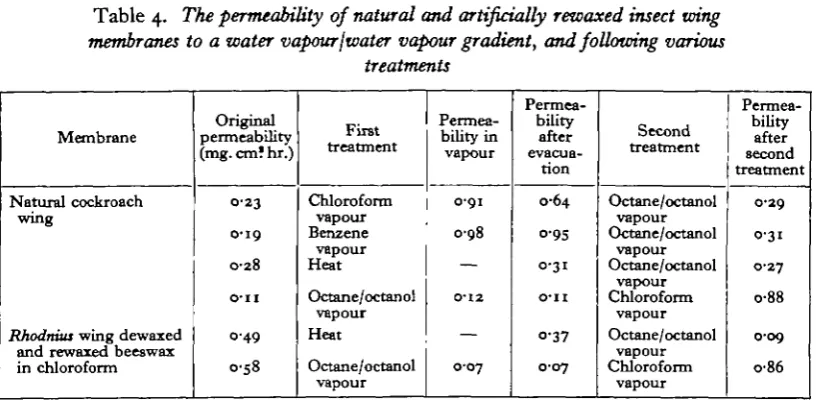
In view of this evidence, it is of particular interest to discover what effect the materials believed to be natural solvents in the cockroach would have on natural waterproofing layers of the cuticle, and on less efficient layers deposited on
wax-Table 4. The permeability of natural and artificially rewaxed insect wing membranes to a water vapour{water vapour gradient, and following various
treatments
Membrane
Natural cockroach wing
Rhodnius wing dewaxed
and rewaxed beeswax in chloroform
Original permeability (mg. cm! hr.)
0 2 3
0-19 0-28 O-II 0-49 0-58 First treatment Chloroform vapour Benzene vapour Heat Octane/octanol vapour Heat Octane/octanol vapour Permea-bility in vapour 0-91
0 9 8 — 0-12 — O-O7 Permea-bility after evacua-tion 0-64 o-95 0-31
O ' l l
o-37 0-07 Second treatment Octane/octanol vapour Octane/octanol vapour Octane/octanol
trnavM 1 r
VUpUUT Chloroform vapour Octane/octanol vapour Chloroform vapour Permea-bility after second treatment 0-29 0-31 0-27 o-88 0-09 o-86
free cuticles from chloroform. The information required is best obtained by using insect wings as membranes, for Beament (1954) has shown that water transport through normal cuticle may be appreciably complicated by the phenomenon of asymmetry. Preliminary experiments showed that cockroach wings, either before or after chloroform extraction were not asymmetrically permeable in a water gradient. Some of the experiments reported here were carried out in the type of membrane holder described by Beament (1954); the apparatus has the great advantage that the membrane can be reversed, or otherwise treated without being subject to any kind of mechanical change. However, this apparatus is for liquid/vapour gradients, and the investigation was extended here by using an apparatus to measure transport in vapour/vapour gradients; it is shown in Fig. 2.
[image:15.451.23.433.191.392.2]frame-Wax secretion in the cockroach
529 [image:16.451.70.378.202.426.2]work of electron metal (for extreme lightness) also carries two adjustable case-hardened points on a balance beam. Adjustment of the height of these points relative to the beam will bring the centre of gravity of the apparatus to the point of maximum sensitivity, just below the pivots. This adjustment must be made after suitable quantities of liquid have been introduced into the two bulbs, by means of pipettes passed through the bore hole of the taps. After counterweighting the apparatus to a balance point, a steel rod projecting from the beam is rested on the hook of a sensitive torsion balance, so placed that its distance from the pivots is the
Fig. 2. Orthogonal projection of a balance to record the water permeability of membranes placed between two vapour concentrations, b, beam; etc., counter-weight ;/.c.p., flask clamping plates;
h., hook attached to torsion balance; hj., solution providing required humidity; k.e.s., knife
edge supports; m.h.c, membrane-holding capsule.
same as that between the centres of the two spheres comprising the bodies of the flasks. Transfer of liquid through the membrane will thus behave as though moving from the centre of one sphere to the other, and will cause the same change in moment at the measuring point of the torsion balance. The apparatus is therefore null-point and direct reading.
530 J. W. L. BEAMENT
sides. Following the determination of the vapour/vapour permeability of a mem-brane, one of the various solvent materials was added in equal minute quantity to both flasks. In this way it was hoped that the weight changes recorded would not include the transport of any solvent, which would be present as 'saturated vapour' on both sides. After such recordings, either the membranes, or the humidity controlling solutions could be reversed, the membrane evacuated to remove solvent, and then recordings repeated. (See Table 4.)
So far as any topical fat solvents are concerned—chloroform, benzene, ether, etc.—their vapour makes a normal insect wing cuticle more permeable, whether this be a membrane of the cockroach or of a hard-waxed insect such as Rhodnius. After exposure to the treatment, even if the membranes are kept in a high vacuum for several days in the hope of removing all traces of the vapours, their permeability is still permanently increased, presumably due to a permanent disorientation of their innermost monolayer. But the vapours of octane, and of octyl alcohol do not produce any detectable change in permeability, either when experiments are con-ducted in their vapour, or when the membrane has been evacuated following ex-posure to either. There can be no doubt of the ability of these substances to pene-trate into the lipoid layer of the cuticle, and even if they transform this into a' grease' it is still apparently quite as impermeable as the original wax. The results obtained with cuticles where wax has been laid down from chloroform on a lipoid-free insect wing membrane are perhaps even more significant. These become more impermeable to water, and approach more closely the order of impermeability of their natural counterparts after they have been exposed to the vapour of the aliphatic solvents. That this is not due merely to the formation of a layer of grease above the solid wax deposit is again shown by the impermeability of such membranes after they have been subjected to high vacuum to remove as much aliphatic solvent as possible. It would be difficult to consider the efficiency of octane as compared with octyl alcohol in these experiments, but there is no doubt that a mixture of the two is most efficient.
Thus again, out of the range of solvents used here, it is only the vapour of a long-chain paraffin (or alcohol) that does not upset the impermeable structure of a natural cuticular wax layer. Further, such materials appear capable of producing orientation in longer wax molecules, and of reorientating a lipoid layer after the vapour of other solvents has caused misalignment. It must be remembered however (see discussion), that this evidence has been obtained with membranes, one side of which is exposed to saturated water vapour, and which therefore might contain a large amount of water.
CHEMISTRY OF GREASE
Wax secretion in the cockroach 531
the same pattern as that of beeswax, and that they were entirely saturated com-pounds. Since the behaviour of beeswax (which is entirely saturated) dissolved in saturated solvents, is so close to that of the grease, and as there are no signs of the phenomena usually to be associated with the ' drying oils' in the grease, it may be suspected that the reducing materials are secondary products, and not components playing any important part in the formation or composition of the grease. The hard white cockroach wax, obtained after recrystallization from the flowerpots in the culture tanks has no reducing properties; an attempt to determine an iodine number for a sample of this wax left no doubt that it was a saturated substance. A few initial experiments, using unsaturated alcohols of the order of C8 chain
length, again indicated that these were by no means as efficient as solvents as their saturated counterparts. A sample of grease obtained by washing large nymphs or adults with chloroform would reduce ammoniacal silver nitrate, giving a brownish deposit. It would also blacken rapidly in solutions of osmic acid. Following either treatment on the grease, if chloroform was added, a grey 'solution'—probably a dispersion—was formed which would pass through a fine-grade filter-paper. The dispersion could not readily be aggregated by centrifuging. A sample of grease which has been obtained freshly and changed to a hard material by heating in a vacuum— so that no oxidation could take place—still has strong reducing properties. This is of particular importance for it must surely eliminate any possibility that the solvent is also the unsaturated material. It was first thought that polyphenols and quinones might be responsible, for Pryor (1940) has shown that these are the main precursors of the tanning of the cuticle of the cockroach. Polyphenols are much more lipoid-soluble than water-lipoid-soluble, and it would not be surprising if they dissolved in the grease from the underlying epicuticle substrate which is so rich in them. But no reaction could be obtained with ferric chloride, which is a most sensitive test.
It was therefore decided to try to fractionate and test for reducing materials at each stage. A large sample of grease was extracted with chloroform from flowerpots; the odoriferous material was removed by adding charcoal and filtering. Apart from the difficulty of obtaining large quantities by washing living insects, the pot extrac-tion ensures that one does not wash reducing materials out from underlying living cuticle. From the brown residue, obtained after the chloroform had been evapo-rated, the wax was taken up in boiling acetone, and the brown residues were con-centrated by hot filtration. This material was soluble in warm ethyl alcohol, and showed very strong reducing properties. About 100 mg. were obtained. On cooling, and allowing the alcohol to evaporate, such a solution would form a delicate pale brown skin over the surface of a dish. It was insoluble in the cold in many lipoid solvents, such as chloroform, diethyl ether, benzene and carbon disulphide, and only slightly soluble when they were boiled, though cloudy dispersions could be formed.
The properties of this material were to some extent reminiscent of shellac, and a series of tests were carried out comparing the reducing residue with a sample of pure shellac from Laccifer lacca. The solubilities, forms of precipitate produced when water or acetone was added to an alcohol solution of similar concentration,
532 J. W. L. BEAMENT
were so completely similar as to leave little doubt that this material was a form of shellac. A micro determination of the iodine number gave a reading of 12, which compares with 10 for a sample from L. lacca (Parry, 1948); the material was strongly acid which is true of shellac. Finally, treatment with warm methyl alcohol and 3 % hydrochloric acid, followed by solution in ethyl alcohol to which diethyl ether is added, produced a fine white crystalline precipitate, with a melting-point of about 140° C. Parry (1935) outlines this test for a dihydroxycarboxylic acid in shellac which has a melting-point of 1490 C.
SHELLAC
Shellac is a material whose properties are far better known than is its composition, and such analyses as have appeared (Parry, 1935, 1948) indicate that it is a very complex substance. It is best regarded as a 'molecule for molecule' secretion of carbohydrate—laccose—with wax. The term laccose certainly includes a number of compounds, at least four of which have been identified, in the secretion of L. lacca. The amount of wax in the shellac of that animal is given as 3-5 %, but one is left in doubt as to whether this is wax, integral to the shellac secretion, or whether at least some part of it is an extraction of the waterproofing layer of L. lacca. The literature does not give any indication of the part of the epicuticle with which the shellac secretion is to be homologized, but it is here suggested that it is the cement layer of the epicuticle.
Wax secretion in the cockroach 533
Now many of these problems can be solved if one assumes that the cement layer is a shellac. Presuming that only a boiling efficient wax solvent can penetrate into the wax component of shellac, it breaks up the cement by mechanical action, thus allowing the main underlying wax layer to be dissolved. The laccose is dispersed, and as we have seen in the cockroach, it is so finely divided that it will readily pass through a filter-paper; it would therefore eventually settle in the extract. The reac-tion of the carbohydrate porreac-tion of lac with ammoniacal silver nitrate (the argentaffin test of Lison 1936) is so similar to the reaction of polyphenols as to suggest that it might be the cuticular tanning material, in the absence of a ferric chloride test. It is no wonder, therefore, that if cement is generally composed of shellac-like substances it has not been obtained as an intact lamina by using a wax solvent. The effect of shellac on artificially waxed membranes might yield valuable additional evidence here, but in the absence of micro-chemical tests for laccose, the development of this thesis must be an extremely difficult matter. Nevertheless, it is so typical of nature that what one insect—L. lacca—produces in quantity, others produce in minute amount, and certainly no other source of these materials in the cockroach can be envisaged.
DISCUSSION
The oenocytes in the blood of, for example, Rhodnius which has a hard, cuticular wax, are cyclicly active cells (Wigglesworth, 1933). They appear to be responsible for the secretion of the lipoprotein and wax of the cuticle at moulting, but they are quiescent at other times in the moulting cycle, unless wound-healing and repair processes are going on. But in the cockroach, Kramer & Wigglesworth (1950) have described how these cells differ in their behaviour as compared with the 'typical' insect by becoming permanently re-incorporated into the epidermis at an early stage of the animal's nymphal life, and apparently remaining active continuously. Are we to conclude that in the cockroach the wax is produced only discontinuously, at the moment in ecdysis where the typical insect is secreting its wax, and that these cells then feed further solvents to the surface, to make up for evaporational loss throughout the instar? A grease can of course be made up from a small number of compounds of intermediate molecular size, which are just solid at room temperatures, or by the admixture of hard waxes (larger molecules) with liquid solvents (smaller molecules). The latter is certainly the case in the cockroach and the duration of the adult stage, and very probably, that of the nymph, is sufficient to lead to a large amount of evaporation of solvent, with a detectable change in transition point; yet preliminary work does not indicate that this takes place, and the replacement of solvent seems most likely. The continuous production of wax and solvent would equally lead to an increase in transition temperature, and the accumulation of large amounts of wax on the surface of the animal.
Before we consider the implication of wax solvents on the general problem of wax secretion, it is perhaps worth considering briefly whether the presence of a fluid grease has any particular significance to the cockroach. Fluid greases— particularly the egg waterproofing material of ticks (Lees & Beament, 1948) could
534 J- W. L. BEAMENT
be considered as biologically essential; for the egg this is obvious, and for the adult it may well assist in re-waterproofing the surface after the enormous distortion caused by engorgement. But as we have every reason for believing that the cock-roach secretes its grease over its entire surface, just as other insects do, there is no reason why its wax should be more mobile initially. If the animal is subjected to temperatures above its transition point, one can attribute some importance to the fluid grease as a survival mechanism, for the grease becomes permeable and evapora-tion ensues, with consequent cooling (Edney, 1953). When lower temperatures prevail, the importance of the solvent in promoting reorientation has already been demonstrated. While the advantage of instantaneous repair from abrasion is obvious, such a phenomenon is not widely found, and the cockroach does not live normally in circumstances where it is liable to this sort of damage. Again, though Wiggles-worth & Beament (1950) have shown that the ootheca is not waterproofed, and it now seems likely that the spreading of grease over this structure from the female, aug-mented by her repeated rubbing of the limbs over it, provides its only water-proofing, surely this is an adventitious process, and not one which requires a fluid grease to be present at all stages in the life of both sexes.
Wax secretion in the cockroach 535
SUMMARY
An investigation has been made into the properties of the grease layer which water-proofs the cuticle of the cockroach Periplaneta americana. This grease changes slowly into a hard wax if stored in air. The melting-point rises during this process by 2O° C.
It is shown that the grease consists of a hard wax (m.p. 560 C.) dissolved in a 'solvent* which is liquid at room temperatures; there may be equal amounts of wax and of solvent. It is suggested that the series of paraffins and alcohols which probably compose the wax extend into the short-chain lengths, Cg-C^ to provide the solvent.
A micro-freezing-point method for determining the molecular weight of wax samples is described (based on Ramsay's method for aqueous solutions); the molecu-lar weight of the solvent lies between 120 and 170, and of the hard wax—300-350. A method is also outlined for collecting large quantities of cockroach wax.
Of a large range of lipophilic liquids, which dissolve waxes, only octane, decane, octyl and decyl alcohols are miscible in all proportions with insect waxes, and form synthetic greases with beeswax and with the hard wax of the cockroach. The surface-active properties of the natural and synthetic greases have been compared on a surface balance of novel design which is described in the Appendix. The two materials are remarkably similar; the surface balance has been used to confirm the size of the solvent molecules.
An apparatus is described which enables the continuous measurement of water transport through an insect membrane in a water vapour/vapour gradient, and in the presence of other vapours. As opposed to the effect of the most organic wax solvents, the vapour of an octane-octyl alcohol mixture does not alter the perme-ability of a natural insect cuticle to water; exposure of an artificially waxed membrane to this vapour and water increases its impermeability. Evidence is provided for believing that octane-octyl alcohol mixtures will improve the waterproofness of most ' imperfectly' waxed membranes.
The natural grease of the cockroach is a strong reducing agent, and evidence is produced for believing that the lipoid part is entirely saturated, but that it contains a small portion of substances resembling shellac. It is suggested that this represents the 'cement' layer of the cockroach cuticle.
The importance of spreading agents with wax solubility in the formation of insect waterproof layers is discussed; it is suggested that the presence of a water-saturated substrate is an essential part of this process.
536 J. W. L. BEAMENT
APPENDIX
A surface balance for investigating the properties of monolayers
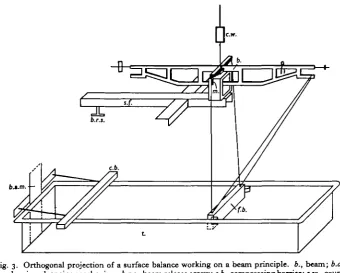
Following the original work of Pockels (1891), Langmuir (1917), Adam & Jessup (1926) and Lyons & Rideal (1929) have been mainly responsible for the develop-ment of' surface balances'. In all their models, the principle adopted has been that of a very delicate float against which the monolayer film exerts its pressure. Measurement is carried out by a null-point method, the counterbalancing of the pressure on the float by the rotation of the torsion wire on which the float is suspended. Workers in this field are agreed that the principle is not without its disadvantages: the torsion fibre is temperature-sensitive; the calibration of the float involves loading it in a different way from its normal measuring constraint; the robustness of the float system is inversely proportional to the sensitivity of the fibre; the eventual measurement is subject to the interpretation of a geared tensioning device. Further, this is a measuring system which is very sensitive to unbalanced pressure with respect to the centre of suspension of the float, and any such unbalance is going to alter the overall tension in the measuring system. It seemed possible that many of these objections could be overcome by using a beam and knife-edge principle for measurement. The apparatus described below is shown in Fig. 3, and was used to determine the surface pressure information which is given on page 526. A frame, constructed throughout in 1 x 1 x | in. brass angle, rigidly brazed at all joints, carries the trough of water on the surface of which measurements are to be made. Three levelling screws enable the trough edge to be made horizontal. The frame also carries the main pivot mechanism: an agate plate, carried in an aligning cage, and operated by a lever system spring-loaded against a fine pitch screw. The pivot can thus be adjusted to a given height; the beam is then freed to swing by dropping away the side supports, but it is essential (see below) that the actual vertical travel of the beam, in this process, be as small as possible. It is also an advantage for the beam to have a small swing. The beam centring and dropping devices must be placed well away from the knife edge (as opposed to typical balance design) in order that it shall be completely free of interference for small angles of swing. All parts are constructed of brass throughout, to minimize corrosion in the damp atmosphere over the trough. The beam carries the float against which the film exerts pressure. Now a knife edge can safely carry a load in excess of 200 g., so that the float could be robustly constructed of a casing of o-ooi in. brass shim, filled and coated with pure 65° C. m.p. paraffin wax, bonded on to the smooth metal with a layer of dried dilute Bostick. It is supported by an entirely triangulated frame-work of thin-walled \ in. diameter stainless steel tubing, attached so as to allow vertical and horizontal alignment of the float with the line of the knife edge. The float-supporting structure meets the float entirely above the water line of the trough; thus the float presents vertical waxed surfaces at all points of contact with the water surface. The best barriers between the ends of the float and the side of the trough were found to be the thinnest tissue paper impregnated with warm pure petroleum
Wax secretion in the cockroach 537
The beam is notched at accurate intervals, and forces are applied to the film by adding riders of known weight to the beam. A simple calculation of moments about the knife edge gives the force per unit length of float for a known load on the beam. The compression barrier is moved by a double screw and chain drive and the beam carries a plain mirror, to obtain zero positions by lamp and scale.
[image:24.451.51.392.199.472.2]Experimental procedure. After cleaning and sweeping the trough, the beam counterweights are adjusted to obtain a zero under free swinging conditions. The balance is clamped, barriers placed in position, the surface checked for contamina-tion and the sample, in its volatile solvent, applied with an 'Agla' micrometer
Fig. 3. Orthogonal projection of a surface balance working on a beam principle, b., beam; b.a.m., barrier advancing mechanism; b.r.s., beam release screw; c.b.,compressing barrier; etc., counter-weight; f.b., floating barrier; m., mirror for lamp and scale; s.f., supporting framework; /., trough.
syringe. A suitable weight is added to the beam, the balance arm freed, and the compression barrier screwed along until the light spot returns to zero; the area of film is then measured. The rider is moved to produce a greater moment and the operation repeated, thus giving the normal force/area curve. Restriction of the vertical movement of the beam is essential, since it is well known that dipping a vertical surface through a compressed monolayer will produce deposition of films on it, and thus remove an area of film from the surface at each operation.
equiva-538 J. W. L. BEAMENT
lent, in this model, to 0-45 dyne over an 18 cm. float, i.e. 0-025 dyne/cm. This is, of course, well beyond the required accuracy of measurements of the kind indicated below; it is perhaps more important to note that 4 g. at the beam counterbalances a film of 100 dynes/cm., which can be measured accurately within 1:1000.
REFERENCES
ADAM, N. K. (1941). The Physics and Chemistry of Surfaces. O.U.P.
ADAM, N. K. & JESSUP, G. (1926). The structure of thin films. VII. Critical evaporation phenomena at low compressions. Proc. Roy. Soc. A, n o , 423.
BEAMENT, J. W. L. (1945). The cuticular lipoids of insects. J. Exp. Biol. 21, 115.
BEAMENT, J. W. L. (1946). The waterproofing process in eggs of Rhodnius prolixus StShl. Proc. Roy.
Soc. B, 133, 407.
BEAMENT, J. W. L. (1951). The structure and formation of the egg of the fruit tree red spider mite,
Metatctrajtychus ulmi Koch. Arm. Appl. Biol. 38, 1.
BEAMENT, J. W. L. (1954). Water transport in insects. Symp. Soc. Exp. Biol. 8 (in the Press). BERGMANN, W. (1938). The composition of ether extractives from exuviae of the silkworm Bombyx
mori. Ann. Ent. Soc. Amer. 31, 315.
CHIBNALL, A. C , PIPER, S. H., POLLARD, A., WILLIAMS, E. F. & SAHAI, P. N. (1934). The
constitu-tion of the primary alcohols, fatty acids and paraffins present in plant and insect waxes. Biochem.
J. 28, 2189.
EDNEY, E. B. (1953). The temperature of woodlice in the sun. J. Exp. Biol. 30, 331. HOLDOATE, M. W. (1955). J. Exp. Biol. 33, 591.
KRAMER, S. & WIGGLESWORTH, V. B. (1950). The outer layers of the cuticle in the cockroach,
Periplanata americana, and the function of the oenocytes. Quart. J. Micr. Sci. 91, 63.
LANGMUIR, I. (1917). The constitution and fundamental properties of solids and liquids. II. Liquids. J. Amer. Chem. Soc. 19, 1848.
LEES, A. D. (1947). Transpiration and the structure of the epicuticle in ticks. J. Exp. Biol. 23, 291. LEES, A. D. & BEAMENT, J. W. L. (1948). An egg-waxing organ in ticks. Quart. J. Micr. Sci. 89, 291. LlSON, L. (1936). Histochimie Animate. Paris: Gauthier-Villars.
LYONS, C. G. & RIDBAL, E. K. (1929). On the stability of unimolecular films. III. Dissolution in alkaline solutions. Proc. Roy. Soc. A, 124, 344.
PARRY, E. J. (1935). Shellac. Pitman: London.
PARRY, E. J. (1948). Lac: in Thorpe's Dictionary of Applied Chemistry, 7, 156. POCKELS, E. (1891). Surface tension. Nature, Lond., 43, 437.
PRYOR, M. G. M. (1940). On the hardening of the cuticle of insects. Proc. Roy. Soc. B, 128, 393. RAMSAY, J. A. (1935). The evaporation of water from the cockroach. J. Exp. Biol. 12, 373. RAMSAY, J. A. (1949). A new method of freezing-point determination for small quantities. J. Exp.
Biol. 26, 57.
WIGGLESWORTH, V. B. (1933). The physiology of the cuticle and of ecdysis in Rhodnius prolixus with special reference to the function of the oenocytes and of the dermal glands. Quart. J. Micr. Sci.
76, 269.
WIGGLESWORTH, V. B. (1945). Transpiration through the epicuticle of insects. J. Exp. Biol. 21, 97. WIGGLESWORTH, V. B. (1947). The epicuticle of an insect Rhodnius prolixus (Hemiptera). Proc. Roy.
Soc. B, 134, 163.
WIGGLESWORTH, V. B. (1948). The structure and deposition of the cuticle in the adult mealworm
Tenebrio molitor (Coleoptera). Quart. J. Micr. Sci. 89, 197.
WIGGLESWORTH, V. B. & BEAMENT, J. W. L. (1950). The respiratory mechanisms of some insect eggs.