The Acquisition and Use of
Context-Dependent Grammars for English
Robert E Simmons*
University of Texas
Yeong-Ho Yu t
University of Texas
This paper introduces a paradigm of context-dependent grammar (CDG) and an acquisition
system that, through interactive teaching sessions, accumulates the CDG rules. The resulting
context-sensitive rules are used by a stack-based, shift~reduce parser to compute unambiguous
syntactic structures of sentences. The acquisition system and parser have been applied to the phrase
structure and case analyses of 345 sentences, mainly from newswire stories, with 99% accuracy.
Extrapolation from our current grammar predicts that about 25 thousand CDG rule examples
will be sufficient to train the system in phrase structure analysis of most news stories. Overall,
this research concludes that CDG is a computationally and conceptually tractable approach for
the construction of sentence grammar for large subsets of natural language text.
1. Introduction
An enduring goal for natural language processing (NLP) researchers has been to con- struct computer programs that can read narrative, descriptive texts such as newspaper stories and translate them into knowledge structures that can answer questions, clas- sify the content, and provide summaries or other useful abstractions of the text. An essential aspect of any such NLP system is parsing--to translate the indefinitely long, recursively embedded strings of words into definite ordered structures of constituent elements. Despite decades of research, parsing remains a difficult computation that often results in incomplete, ambiguous structures; and computational grammars for natural languages remain notably incomplete. In this paper we suggest that a solution to these problems may be found in the use of context-sensitive rules applied by a deterministic shift/reduce parser.
A system is described for rapid acquisition of a context-sensitive grammar based on ordinary news text. The resulting grammar is accessed by deterministic, bottom- up parsers to compute phrase structure or case analyses of texts that the grammars coven The acquisition system allows a linguist to teach a CDG grammar by showing examples of parsing successive constituents of sentences. At this writing, 16,275 ex- ample constituents have been shown to the system and used to parse 345 sentences ranging from 10 to 60 words in length achieving 99% accuracy. These examples com- press to a grammar of 3,843 rules that are equally effective in parsing. Extrapolation from our data suggests that acquiring an almost complete phrase structure grammar for AP Wire text will require about 25,000 example rules. The procedure is further demonstrated to apply directly to computing superficial case analyses from English sentences.
Computational Linguistics Volume 18, Number 4
One of the first lessons in natural or formal language analysis is the Chomsky (1957) hierarchy of formal grammars, which classifies grammar forms from unre- stricted rewrite rules, through context-sensitive, context-free, and the most restricted, regular grammars. It is usually conceded that pure, context-free grammars are not powerful enough to account for the syntactic analysis of natural languages (NL) such as English, Japanese, or Dutch, and most NL research in computational linguistics has used either augmented context-flee or ad hoc grammars. The conventional wisdom is that context-sensitive grammars probably would be too large and conceptually and computationally untractable. There is also an unspoken supposition that the use of a context-sensitive grammar implies using the kind of complex parser required for parsing a fully context~sensitive language.
However, NL research based on simulated neural networks took a context-based approach. One of the first hints came from the striking finding from Sejnowski and Rosenberg's NETtalk (1988), that seven-character contexts were largely sufficient to map each character of a printed word into its corresponding phoneme---where each character actually maps in various contexts into several different phonemes. For ac- complishing linguistic case analyses McClelland and Kawamoto (1986) and Miikku- lainen and Dyer (1989) used the entire context of phrases and sentences to map string contexts into case structures. Robert Allen (1987) mapped nine-word sentences of En- glish into Spanish translations, and Yu and Simmons (1990) accomplished comparable context-sensitive translations between English and German simple sentences. It was apparent that the contexts in which a word occurred provided information to a neural network that was sufficient to select correct word sense and syntactic structure for otherwise ambiguous usages of language.
In order to solve a problem of accepting indefinitely long, complex sentences in a fixed-size neural network, Simmons and Yu (1990) showed a method for training a network to act as a context-sensitive grammar. A sequential program accessed that grammar with a deterministic, single-path parser and accurately parsed descriptive texts. Continuing that research, 2,000 rules were accumulated and a network was trained using a back-propagation method. The training of this network required ten days of continuous computation on a Symbolics Lisp Machine. We observed that the training cost increased by more than the square of the number of training examples and calculated that 10,000-20,000 rules might well tax a supercomputer. So we decided that storing the grammar in a hash table would form a far less expensive option, provided we could define a selection algorithm comparable to that provided by the trained neural network.
In this paper we describe such a selection formula to select rules for context- sensitive parsing, a system for acquiring context-sensitive rules, and experiments in analysis and application of the grammar to ordinary newspaper text. We show that the application of context-sensitive rules by a deterministic shift/reduce parser is a conceptually and computationally tractable approach to NLP that may allow us to accumulate practical grammars for large subsets of English texts.
2. Context-Dependent Parsing
Robert E Simmons and Yeong-Ho Yu Context-Dependent Grammars for English
Transition Networks (J. Allen 1987). Gazdar (1988) calls attention to a subcategory of context-sensitive grammars called indexed languages and illustrates some applicability to natural languages, and Joshi illustrates an application of "mild context-sensitivity" (Joshi 1987), but in general, NL computation with context-sensitive grammars is a largely unexplored area.
While a few advanced NLP laboratories have developed grammars and parsing capabilities for significantly large subsets of natural language, 1 it cannot be denied that massive effort was required and that the results are plagued by ambiguous interpreta- tions. These grammars are typically a context-free form, augmented by complex feature tests, transformations, and occasionally, arbitrary programs. The combination of even an efficient parser with such intricate grammars may greatly increase computational complexity of the parsing system (Tomita 1985). It is extremely difficult to write and maintain such grammars, and they must frequently be revised and retested to ensure internal consistency as new rules are added. We argue here that an acquisition sys- tem for accumulating context-sensitive rules and their application by a deterministic shift/reduce parser will greatly simplify the process of constructing and maintaining natural language parsing systems.
Although we use context-sensitive rules of the form
u X v ~ u Y v
they are interpreted by a shift/reduce parser with the result that they can be applied successfully to the LR(k) subset of context-free languages. Unless the parser is aug- mented to include shifts in both directions, the system cannot parse context-sensitive languages. It is an open question as to whether English is or is not context-sensitive, but it definitely includes discontinuous constituents that may be separated by indefi- nitely many symbols. For this reason, future developments of the system may require operations beyond shift and reduce in the parser. To avoid the easy misinterpretation that our present system applies to context-sensitive languages, we call it Context- Dependent Grammar (CDG).
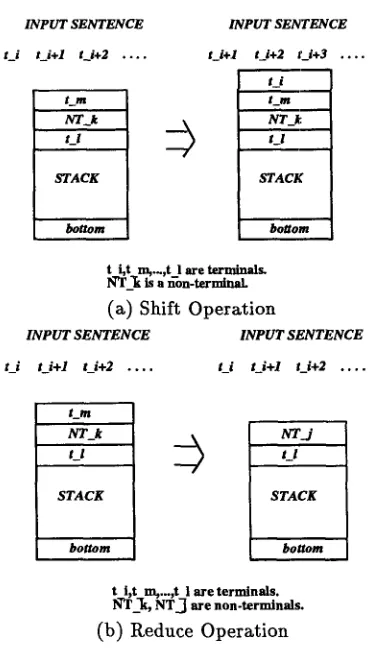
We begin with the simple notion of a shift/reduce parser. Given a stack and an input string of symbols, the shift/reduce parser may only shift a symbol to the stack (Figure la) or reduce n symbols on the stack by rewriting them as a single symbol (Figure lb). We further constrain the parser to reduce no more than two symbols on the stack to a single symbol. The parsing terminates when the stack contains only a single root element and the input string is empty. Usually this class of parser applies a CFG to a sentence, but it is equally applicable to CDG.
2.1 C D G Rule Forms
The theoretical viewpoint is that the parse of a sentence is a sequence of states, each composed of a condition of the stack and the input string. The sequence ends success- fully when the stack contains only the root element (e.g. SNT), and the input string is
Computational Linguistics Volume 18, Number 4
I N P U T S E N T E N C E
t._i Ci+l t__i+2 . . . .
t. tn N r k
S T A C K
bottom
I N P U T S E N T E N C E
t.i+l t 1+2 f_i+$ . . . .
t_ln NT._~, t l
S T A C K
bottom
t i,t m,.~,t I are terminals. N'T_'~ is a ~on-terminal_ (a) Shift Operation
I N P U T S E N T E N C E I N P U T S E N T E N C E
t i t i+1 t_i+2 . . . . t_i t_i+l t__i+2 . . . .
t . m A~'_t
S T A C K
bottom
a~rd U
S T A C K
bottom
[image:4.468.148.332.47.377.2]t i,t m,...,t I are terminals. N'T_~, N T ~ are non-terminals. (b) Reduce Operation
Figure 1
Shift/reduce parser.
empty. Each state can be seen as the left half of a context-sensitive rule whose right half is the succeeding state.
stacksinputs ~ stacks+ l inputs+ l
Robert F. Simmons and Yeong-Ho Yu Context-Dependent Grammars for English
T h e o l d m a n f r o m S p a i n a t e f i s h
a r t a d j n p n v n
* a r t a d j n p n
a r t * a d j n p n v
_ _ _ a r t a d j * n p n v n
_ _ a r t a d j n * p n v n _
_ _ _ a r t n p * p n v n _
. . . . n p * p n v n _
_ _ _ n p p * n v n _ _
_ _ n p p n * v n _ _ _
_ _ _ n p p p * v n _ _ _
. . . . n p * v n _ _ _
_ _ _ n p v * n
_ _ n p v n *
_ _ _ n p v p *
s n t *
The analysis t e r m i n a t e s w i t h an e m p t y i n p u t string a n d the single s y m b o l "snt" on the stack, successfully c o m p l e t i n g the parse. N o t e that the first four o p e r a t i o n s can be described as shifts f o l l o w e d b y the t w o reductions, adj n ~ np, a n d art n p ~ np. S u b s e q u e n t l y the p a n d n w e r e shifted onto the stack a n d t h e n r e d u c e d to a pp; t h e n the n p a n d p p on the stack w e r e r e d u c e d to an np, f o l l o w e d b y the shifting of v a n d n, their reduction to vp, a n d a final reduction of n p v p ---* snt. Illustrations similar to this are often u s e d to introduce the c o n c e p t of p a r s i n g in AI texts on n a t u r a l l a n g u a g e (e.g.J. Allen 1987).
We could perfectly well record the g r a m m a r in pairs of successive states as follows:
_ _ _ n p p * n v n __--* __ n p p n * v n _ _ _ __ n p p n * v n _ _ _ 7 _ _ _ n p p p * v n _ _ _
b u t s o m e e c o n o m y can be a c h i e v e d b y recording the o p e r a t i o n a n d possible label as the right half of a rule. So for the e x a m p l e i m m e d i a t e l y above, w e record:
_ _ _ n p p * n v n _ _ - - + ( S ) _ _ n p p n * v n _ _ _ - - * ( R p p )
w h e r e S shifts a n d (R p p ) replaces the t o p t w o e l e m e n t s of the stack w i t h p p to f o r m the next state of the parse.
T h u s a windowed context of ten s y m b o l s is created as the left half of a rule a n d a n o p e r a t i o n as the right half. N o t e that if the stack w e r e limited to the t o p t w o elements, a n d the i n p u t to a single element, the rule s y s t e m w o u l d r e d u c e to a b i n a r y rule CFG.
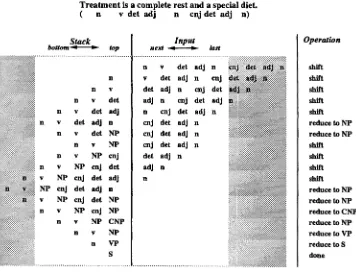
The e x a m p l e in Figure 2 s h o w s h o w a sentence " T r e a t m e n t is a c o m p l e t e rest a n d a special diet" is p a r s e d b y a context sensitive s h i f t / r e d u c e parser. Terminal s y m b o l s are lowercase, while n o n t e r m i n a l s are uppercase. The s h a d e d areas r e p r e s e n t the p a r t s
Computational Linguistics Volume 18, Number 4
T r e a t m e n t is a c o m p l e t e r e s t a n d a s p e c i a l d i e t . ( n v d e t a d j n c n j d e t a d j n)
I
I n p u t bottom-~---~ ~ top n e ~ ~ lastN!i..
. . . ...-.-...-...-.iiiiiiiiiii!iliiii
ii
iii~iiii::i::i::i::~iiiiiiiiiiiiiii !ii o
i !{{{ii{iiiiiiiiiN{{!;!{,
n
n
n v
n v det n v det adj v det adj n n v det NP
n v NP
n v NP cnj v NP cnj det NP cnj det adj cnj det adj n NP cnj det NP v NP cnj NP n v NP CNP
n v NP
n V P S
n v det adj n v det adj n cnj det adj n cnj det adj n cnj det adj n cnj det adj n cnj det adj n cnj det adj n cnj det adj n det adj n adJ n
n
W i n d o w e d C o n t e x t
O p e r a t i o n
shift shift shift shift shift reduce to NP reduce to NP shift shift shift shift reduce to NP reduce to NP reduce to CNP reduce to NP reduce to VP reduce to S done
F i g u r e 2
An example of windowed context.
of the context invisible to the system. The next operation is solely d e c i d e d b y the w i n d o w e d context. It can be o b s e r v e d that the last state in the analysis is the single s y m b o l S N T - - t h e d e s i g n a t e d root symbol, on the stack along with an e m p t y i n p u t string, successfully c o m p l e t i n g the parse.
A n d this is the CDG f o r m of rule u s e d in the p h r a s e structure analysis.
2 . 2 A l g o r i t h m f o r t h e S h i f t / R e d u c e P a r s e r
The parser accepts a string of syntactic w o r d classes as its i n p u t and forms a ten- s y m b o l vector, five symbols each from the stack a n d the i n p u t string. It looks u p this vector as the left half of a p r o d u c t i o n in the g r a m m a r and interprets the right half of the p r o d u c t i o n as an instruction to m o d i f y the stack a n d i n p u t sequences to construct the next state of the parse. To accomplish these tasks, it maintains two stacks, one for the i n p u t string a n d one for the syntactic constituents. These stacks m a y be arbitrarily large.
[image:6.468.59.415.58.330.2]Robert E Simmons and Yeong-Ho Yu Context-Dependent Grammars for English
CD-SR-Parser(Input,Cdg)
Input is a string of syntactic classes for the given sentence. Cdg is the given CDG grammar rules.
Stack := empty
do until(Input = empty a n d Stack = (SNT))
Windowed-context := Append(Top-five(stack),First-ilve(input)) Operation := Consult_CDG(Window-context,Cdg)
if First(Operation) = SHIFT
t h e n Stack := Push(First(Input),Stack) Input := Rest(Input)
else Stack := Push(Second(Operation),Pop(Pop(Sta~k)))
end do
The functions, Top_five and First-five, return the lists of top (or first) five elements of the Stack and the Input respectively. I f there are not enough elements, these procedures pad
with blanks. The function Append concatenates two lists into one. Consult_CDG consults
the given CDG rules to find the next operation to take. The details of this function are the subject of the next section. Push and Pop add or delete one element to/from a stack while
First and Second return the first or second elements of a list, respectively. Rest returns the given list minus the first element.
Figure 3
Context-sensitive shift reduce parser.
2.3 Consulting the CDG Rules
There are two related issues in consulting the CDG rules. One is the computational representation of CDG rules, and the other is the method for selecting an applicable rule.
In the traditional CFG paradigms, a CFG rule is applicable if the left-hand side of the rule exactly matches the top elements of the stack. However, in our CDG paradigm, a perfect match between the left side of a CDG rule and the current state cannot be assured, and in most cases, a partial match must suffice for the rule to be applied. Since many rules may partially match the current context, the best matching rule should be selected.
One way to do this is to use a neural network. Through the back-propagation algorithm (Rumelhart, Hinton, and Williams 1986), a feed-forward network can be trained to memorize the CDG rules. After successful training, the network can be used to retrieve the best matching rule. However, this approach based on ~ neural network usually takes considerable training time. For instance, in our previous experiment (Simmons and Yu 1990), training a network for about 2,000 CDG rules took several days of computation. Therefore, this approach has an intrinsic problem for scaling up, at least on the present generation of neural net simulation software.
Computational Linguistics Volume 18, Number 4
We use no more than 64 word and phrase class symbols, so there can be no more than 4,096 possible pairs. The effect is to divide the large number of rules into no more than 4,096 subgroups, each of which will have a manageable subset. In fact, with 16,275 rules we discovered that we have only 823 pairs and the average number of rules per subgroup is 19.8; however, for frequently occurring pairs the number of rules in the subgroups can be much larger. The problem is to determine what scoring formula should be used to find the rule that best matches a parsing context.
Sejnowski and Rosenberg (1988) analyzed the weight matrix that resulted from training NETtalk and discovered a triangular function with the apex centered at the character in the w i n d o w and the weights falling off in proportion to distance from that character. We decided that the best matching rule in our system would follow a similar pattern with maximum weights for the top two elements on the stack with weights decreasing in both directions with distance from those positions. The scoring function we use is developed as follows:
Let T4 be the set of vectors {RI~R2,... ,Rn} where Ri is the vector [rl, r2,..., rl0] Let C be the vector [Cl, Ca,..., c10]
Let #(ci, ri) be a matching function whose value is 1 if ci = ri, and 0 otherwise.
TZ is the entire set of rules, Ri is (the left half of) a particular rule, and C is the parse context.
Then/-4' is the subset of T4 where if Ri E T~ I then #(ri4,c4) • #(ris~cs) = 1.
Access of the hash table with the top two elements of the stack, c4, c5 produces the set T4'.
We can now define the scoring function for each Ri C T~ I.
3 i0
Score = ~_, t~(ci, ri) . i + ~_, #(ci, ri)(11 - i )
i=1 i=6
The first summation scores the matches between the stack elements of the rule and the current context, and the second summation scores the matches between the elements in the input string. If two items of the rule and context match, the total score is increased by the weight assigned to that position. The maximum score for a perfect match is 21 according to the above formula.
From several experiments, varying the length of vector and the weights, particu- larly those assigned to blanks, it has been determined that this formula gave the best performance among those tested. More importantly, it has worked well in the current phrase structure and case analysis experiments.
It was an unexpected surprise to us 3 that using context-sensitive productions, an elementary, deterministic, parsing algorithm proved adequate to provide 99% correct, unambiguous anAalyses for the entire text studied.
3. Grammar Acquisition for CDG
Constructing an augmented phrase structure grammar of whatever type unification, GPSG, or ATN--is a painful process usually involving a well-trained linguistic team of several people. These types of grammar require that a CFG recognition rule such
Robert F. Simmons and Yeong-Ho Yu Context-Dependent Grammars for English
as n p v p ~ snt be s u p p o r t e d b y such additional i n f o r m a t i o n as the fact that the n p a n d v p agree in n u m b e r , that the n p is characterized b y particular features such as
count, animate,
etc., a n d that the v p can or c a n n o t accept certain t y p e s of c o m p l e m e n t s . The additional features m a k e the rules e x c e e d i n g l y c o m p l e x a n d difficult to p r e p a r e a n d debug. College s t u d e n t s can be t a u g h t easily to m a k e a p h r a s e structure tree to r e p r e s e n t a sentence, b u t it requires considerable linguistic training to deal successfully w i t h a feature g r a m m a r .We h a v e seen in the p r e c e d i n g section that a CFG is d e r i v e d f r o m recording the successive states of the p a r s e s of sentences. T h u s it w a s n a t u r a l for us to d e v e l o p an interactive acquisition s y s t e m that w o u l d assist a linguist (or a student) in constructing such p a r s e s to p r o d u c e easily large sets of e x a m p l e CFG rules. 4 The s y s t e m c o n t i n u e d to e v o l v e as a c o n s e q u e n c e of o u r u s e until w e h a d i n c l u d e d capabilities to:
• r e a d in text a n d data files
• c o m p i l e dictionary a n d g r a m m a r tables f r o m c o m p l e t e d text files
• select a sentence to continue processing or revise
• look u p w o r d s in a dictionary to s u g g e s t the syntactic class for the w o r d in context w h e n assigning syntactic classes to the w o r d s in a sentence
• c o m p a r e each state of the p a r s e w i t h rules in the c u r r e n t g r a m m a r to predict the s h i f t / r e d u c e operation. A carriage r e t u r n signals that the user accepts the p r o m p t , or the t y p i n g in of the desired o p e r a t i o n o v e r r i d e s it.
• c o m p u t e a n d d i s p l a y the p a r s e tree f r o m the local g r a m m a r after c o m p l e t i o n of each sentence, or f r o m the global total g r a m m a r at a n y t i m e
• p r o v i d e b a c k i n g u p a n d editing capability to correct errors
• p r i n t h e l p m e s s a g e s a n d g u i d e the user
• c o m p i l e dictionary a n d g r a m m a r entries at the c o m p l e t i o n of each sentence, insuring no duplicate entries
• s a v e c o m p l e t e d or partially c o m p l e t e d g r a m m a r files.
The resulting tool, G R A M A Q , enables a linguist to construct a context-sensitive g r a m m a r for a text c o r p u s at the rate of several sentences p e r hour. T h o u s a n d s of rules are a c c u m u l a t e d w i t h only w e e k s of effort in contrast to the years required for a c o m p a r a b l e s y s t e m of a u g m e n t e d CFG rules. A b o u t ten w e e k s of effort w e r e required to p r o d u c e the 16,275 rules on w h i c h this s t u d y is based. Since G R A M A Q ' s p r o m p t s b e c o m e m o r e accurate as the dictionary a n d g r a m m a r g r o w in size, there is a positive acceleration in the s p e e d of g r a m m a r a c c u m u l a t i o n a n d the linguist's task g r a d u a l l y c o n v e r g e s to o n e of alert s u p e r v i s i o n of the s y s t e m ' s p r o m p t s .
A slightly different v e r s i o n of G R A M A Q is Caseaq, w h i c h uses o p e r a t i o n s that create case constituents to a c c u m u l a t e a context-sensitive g r a m m a r that t r a n s f o r m s
Computational Linguistics Volume 18, Number 4
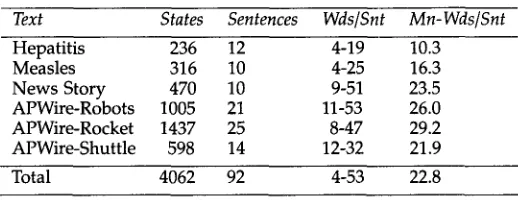
Text States Sentences Wds/Snt Mn-Wds/Snt
Hepatitis 236 12 4-19 10.3
Measles 316 10 4-25 16.3
News Story 470 10 9-51 23.5 APWire-Robots 1005 21 11-53 26.0 APWire-Rocket 1437 25 8-47 29.2 APWire-Shuttle 598 14 12-32 21.9
[image:10.468.107.366.59.159.2]Total 4062 92 4-53 22.8
Table 1
Characteristics of a sample of the text corpus.
sentences directly to case structures with no intermediate stage of p h r a s e structure trees. It has the same functionality as G R A M A Q b u t allows the linguist user to specify a case a r g u m e n t and v a l u e as the transformation of syntactic elements on the stack, a n d to r e n a m e the h e a d of such a constituent b y a syntactic label. Figure 9 in Section 7.3 illustrates the acquisition of case grammar.
4. Experiments with CDG
There are a n u m b e r of critical questions that n e e d be a n s w e r e d if the claim that CDG g r a m m a r s are useful is to be s u p p o r t e d .
• Can they be used to obtain accurate parses for real texts?
• Do they r e d u c e a m b i g u i t y in the parsing process?
• H o w well do the rules generalize to n e w texts?
• H o w large m u s t a CFG be to e n c o m p a s s the syntactic structures for most n e w s p a p e r text?
4.1 Parsing and Ambiguity with CDG
O v e r the course of this s t u d y w e a c c u m u l a t e d 345 sentences m a i n l y from n e w s w i r e texts. The first t w o articles w e r e brief disease descriptions from a y o u t h encyclopedia; the remaining fifteen were n e w s p a p e r articles from F e b r u a r y 1989 using the terms "star wars," "SDI," or "Strategic Defense Initiative." Table 1 characterizes typical articles b y the n u m b e r of CDG rules or states, n u m b e r of sentences, the range of sentence lengths, a n d the average n u m b e r of w o r d s per sentence.
We d e v e l o p e d o u r a p p r o a c h to acquiring a n d parsing context-sensitive g r a m m a r s on the first two simple texts, a n d then u s e d G R A M A Q to r e d o those texts a n d to construct p r o d u c t i o n s for the news stories. The total text n u m b e r e d 345 sentences, w h i c h a c c u m u l a t e d 16,275 context-sensitive r u l e s - - a n average of 47 per sentence.
Robert F. Simmons and Yeong-Ho Yu Context-Dependent Grammars for English
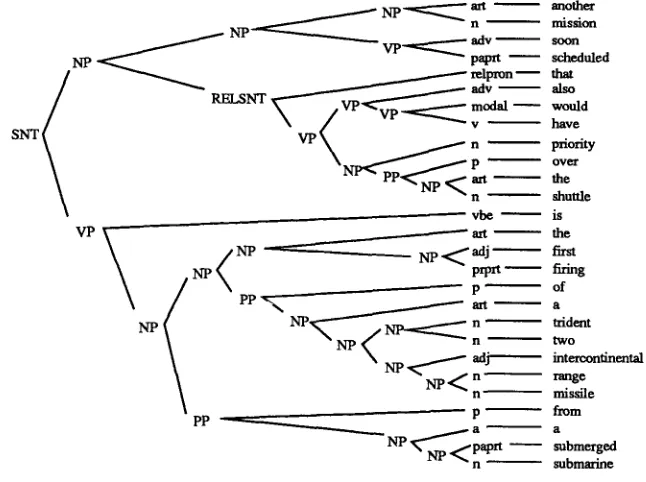
Another mission soon scheduled that also would have priority over the shuttle is the first firing of a trident two intercontinental range missile from a submerged submarine.
~
N
P
~
art
eazotb~
n
mis~on
~
NP
adv
s o o nV P ~ palm scheduled
N P
. ~ - xeapron ~ that
v ~ have
SNT VP n ~ l~iority
p ~ over
art the
n ~ shuttle
- - vbe
VP ~ ~ _ _ ~ - ~ ~ ~ the
prprt firing
I
o_
'
°'
P P ~ - % a r t ~ a
NP NP n trident
n t w o
x / adj intercontinental
< n range
NP missile
PP ~ p - from
a
~ - " NP N - ~ ~ p a p r t submerged
r~t" N n submarine
Figure 4
Sentence parse.
the linguist 97% of the time and c o m p l e t e d correct parses in 99.7% of the 345 sentences from w h i c h it was derived. Since o u r p r i m a r y interest was in evaluating the effective- ness of the CDG, all these evaluations were based on using correct syntactic classes for the w o r d s in the sentences. The context-sensitive dictionary l o o k u p p r o c e d u r e de- scribed in Section 7.3 is 99.5% accurate, but it assigns 40 w o r d classes incorrectly. As a consequence, using this p r o c e d u r e w o u l d result in a reduction of a b o u t 10% accuracy in parsing.
An o u t p u t of a sentence from the parser is displayed as a tree in Figure 4. Since the w h o l e m e c h a n i s m is c o d e d in Lisp, the actual o u t p u t of the system is a nested list that is then printed as a tree.
Notice in this figure that the PP at the b o t t o m modifies the N P c o m p o s e d of "the first firing of a trident two intercontinental range missile" not just the w o r d "firing." Since the parsing is b o t t o m - u p , left-to-right, the constituents are f o r m e d in the natural o r d e r of w o r d s e n c o u n t e r e d in the sentence and the terminals of the tree can be read top-to-bottom to give their ordering in the sentence.
[image:11.468.64.387.95.336.2]Computational Linguistics Volume 18, Number 4
5. Generalization of CDG
The purpose of accumulating sample rules from texts is to achieve a grammar gen- eral enough to analyze new texts it has never seen. To be useful, the grammar must generalize. There are at least three aspects of generalization to be considered.
How well does the grammar generalize at the sentence level? That is, how well does the grammar parse new sentences that it has not previously experienced?
How well does the grammar generalize at the operation level? That is, how well does the grammar predict the correct Shift/Reduce operation during acquisition of new sentences?
How much does the rule retention strategy affect generalization? For instance, when the grammar predicts the same output as a new rule does, and the new rule is not saved, how well does the resulting grammar parse?
5.1 Generalization at the Sentence Level
The complete parse of a sentence is a sequence of states recognized by the grammar (whether it be CDG or any other). If all the constituents of the new sentence can be recognized, the new sentence can be parsed correctly. It will be seen in a later para- graph that with 16,275 rules, the grammar predicts the output of new rules correctly about 85% of the time. For the average sentence with 47 states, only 85% or about 40 states can be expected to be predicted correctly; consequently the deterministic parse will frequently fail. In fact, 5 of 14 new sentences parsed correctly in a brief experiment that used a grammar based on 320 sentences to attempt to parse the new, 20-sentence text. Considering that only a single path was followed by the deterministic parser, we predicted that a multiple-path parser would perform somewhat better for this aspect of generalization. In fact, our initial experiments with a beam search parser resulted in successful parses of 15 of the 20 new sentences using the same grammar based on the 320 sentences.
5.2 Generalization at the Operation Level
This level of generalization is of central significance to the grammar acquisition system. When GRAMAQ looks up a state in the grammar it finds the best matching state with the same top two elements on the stack, and offers the right half of this rule as its suggestion to the linguist. H o w often is this prediction correct?
Robert E Simmons and Yeong-Ho Yu Context-Dependent Grammars for English
50
40
r ~
-]
3020
10
. . . ~ " . . . t . . . t . . . t . . . t . . . t . . . ! . . . ! . . . + . ' " ' " t . . . t . . . ! . . . t . . . ! . . . ! . . . !
i . . ~ . I I I I I I l I I l : I -' I ;
I , | I I I I : I I l I , I l
; I ; ; ! ' I I " | ; ", ' I I I
I i I I I I I , l , , , I ' ' '
[image:13.468.41.424.51.273.2]. . . i ... ; ... ~ ... i ... i ... ~ ... 1 ... i ... 4 ... 4 ... ~- ... i ... ; ... i ... i ... i
...
...
i
...
i
...
i
...
J
...
L ...
i
...
i
...
i
...
J
... ...
i
... * ... G.,,--.~ ... i ... J ... ! ... ! ... i ... i ... 4 ... 4 ... 4 ... ! ... ! ... ! ... i ...
i
i
i i i I i I -:
1 2 3 4 5 6 7 8 9 10 11 12 13 14 15 16 17
Accumulated Rules by Thousands
Figure 5
Generalization of CDG rules.
5.3 R u l e R e t e n t i o n and G e n e r a l i z a t i o n
If two parsing g r a m m a r s account equally well for the same sentences, the one with f e w e r rules is less r e d u n d a n t , m o r e abstract, and the one to be preferred. We used the
union-grammar
p r o c e d u r e to p r o d u c e and s t u d y the minimal g r a m m a r for the 16,275 rules (rule-examples) d e r i v e d from the sample text. U n i o n - g r a m m a r records a n e w rule for a rule-example: s1. if best matching rule has an operation that d o e s n ' t match
2. if best matching rule ties with a n o t h e r rule w h o s e operation does not m a t c h
3. if 2 is true, and score = 21 w e have a full contradiction and list the rule as an error.
Six contradictions occurred in the g r a m m a r ; five were inconsistent treatments of "SNT" followed b y one or more p u n c t u a t i o n marks, while the sixth offered both a shift and a " p p " for a p r e p o s i t i o n - n o u n followed b y a preposition. The latter case is an a t t a c h m e n t ambiguity not resolvable b y syntax.
In the first pass as s h o w n in Table 2, the text resulted in 3,194 rules c o m p a r e d with 16,275 possible rules. That is, 13,081 possible CDG rules were not retained because already existing rules w o u l d m a t c h and predict the operation. H o w e v e r , using those rules to parse the same text gave v e r y p o o r results: zero correct parses at the sentence level. Therefore, the process of compiling a minimal g r a m m a r was repeated starting with those 3,194 rules. This time only 619 n e w rules were added. The p u r p o s e of this
Computational Linguistics Volume 18, Number 4
Pass UntWined Retained Total Rules
1 13081 3194 16275
2 15656 619 16275
3 16245 18 16275
4 16275 0 16275
Table 2
Four passes with minimal grammar.
repetition is to get rid of the effect that the rules a d d e d later change the predictions m a d e earlier. Finally, in a f o u r t h repetition of the process no rules w e r e new.
The resulting g r a m m a r of 3,843 rules succeeds in parsing the text with only occa- sional m i n o r errors in attaching constituents. It is to be e m p h a s i z e d that the u n r e t a i n e d rules are similar b u t not identical to those in the minimal grammar.
We can observe that this technique of minimal retention b y " u n i o n i n g " n e w rules to the g r a m m a r results in a c o m p r e s s i o n of the o r d e r 16,275/3,843 or 4.2 to 1, w i t h o u t increase in error. If this ratio holds for larger g r a m m a r s , t h e n if the linguist accu- mulates 40,000 training-example rules to account for the syntax of a given subset of language, that g r a m m a r can be c o m p r e s s e d automatically to a b o u t 10,000 rules that will accomplish the same task.
6. Predicting the Size of CDGs
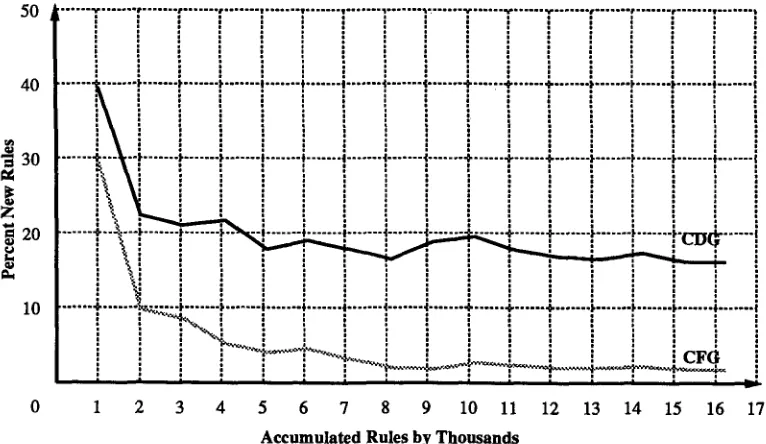
W h e n a n y kind of acquisition system is used to a c c u m u l a t e k n o w l e d g e , one v e r y interesting question is, w h e n will the k n o w l e d g e be c o m p l e t e e n o u g h for the i n t e n d e d application? In o u r case, h o w m a n y CDG rules will be sufficient to cover almost all n e w s w i r e stories? To a n s w e r this question, an extrapolation can be u s e d to find a point w h e n the solid line of Figure 5 intersects with the y-axis. H o w e v e r , the CDG c u r v e is d e s c e n d i n g too slowly to m a k e a reliable extrapolation.
Therefore, a n o t h e r question was investigated instead: w h e n will the CDG rules include a complete set of CFG rules? N o t e that a CDG rule is equivalent to a CFG rule if the context is limited to the top two elements of the stack. W h a t the other elements in the context accomplish is to m a k e one rule preferable to a n o t h e r that has the same top t w o elements of the stack, b u t a different context.
We allow 64 symbols in o u r phrase structure analysis. That means, there are 642 possible combinations for the top two elements of the stack. For each combination, there are 65 possible operations: 6 a shift or a r e d u c t i o n to a n o t h e r symbol. A m o n g 16,275 CDG rules, w e studied h o w m a n y different CFG rules can be d e r i v e d b y elim- inating the context. We f o u n d 844 different CFG rules that used 600 different left-side pairs of symbols. This shows that a given context free pair of symbols averages 1.4 different operations. 7
Then, as w e did with CDG rules, w e m e a s u r e d h o w m a n y n e w CFG rules w e r e a d d e d in an accumulative fashion. The s h a d e d line of Figure 5 shows the result.
6 Actually, there are fewer than 65 possible operations since the stack elements can be reduced only to nonterminal symbols.
[image:14.468.145.326.59.121.2]Robert E Simmons and Yeong-Ho Yu Context-Dependent Grammars for English
100 . . . ~. . . . :
! !
! !
I
_m° • . . .
o r ,
Z 1 0 . . . l
1
1 0 0 1 , 0 0 0 1 0 , 0 0 0 25,000 1 0 0 , 0 0 0
N b r of A c c u m u l a t e d R u l e s
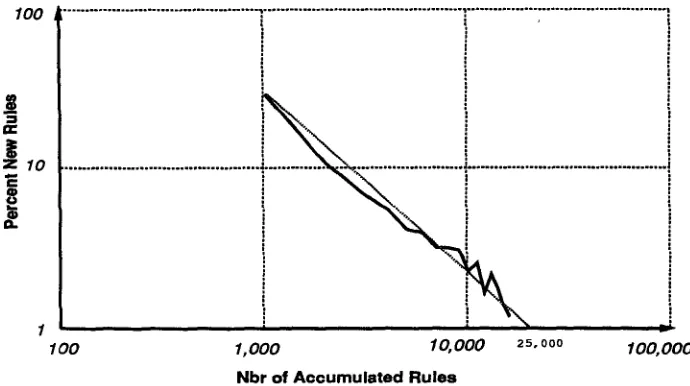
Extrapolation thegray line, predicts that 99% of the context free pairs will be achieved with the accumulation of 25,000 context sensitive rues.
Figure 6
Log-log plot of new CFG rules.
Notice that the line has descended to about 1.5% errors at 16,000 rules. To make an extrapolation easier, a log-log graph shows the same data in Figure 6. From this graph, it can be predicted that, after about 25,000 CDG rules are accumulated, the grammar will encompass a CFG component that is 99% complete. Beyond this point, additional CDG rules will add almost no new CFG rules, but only fine-tune the grammar so that it can resolve ambiguities more effectively.
Also, it is our belief that, after the CDG reaches that point, a multi-path, beam- search parser will be able to parse most newswire stories very reliably. This belief is based on our initial experiment that used a beam search parser to test generalization of the grammar to find parses for fifteen out of twenty new sentences.
7. Acquiring Case Grammar
[image:15.468.59.404.56.249.2]Computational Linguistics Volume 18, Number 4
7.1 Case Structure
Cook (1989) reviewed twenty years of linguistic research on case analysis of natural language sentences. He synthesized the various theories into a system that depends on the subclassification of verbs into twelve categories, and it is apparent from his review that with a fine subcategorization of verbs and nominals, case analysis can be accomplished as a purely syntactic operation--subject to the limitations of attachment ambiguities that are not resolvable by syntax. This conclusion is somewhat at variance with those AI approaches that require a syntactic analysis to be followed by a semantic operation that filters and transforms syntactic constituents to compute case-labeled propositions (e.g. Rim 1990), but it is consistent with the neural network experience of directly mapping from sentence to case structure, and with the AI research that seeks to integrate syntactic and semantic processing while translating sentences to propositional structures.
Linguistic theories of case structure have been concerned only with single propo- sitions headed by verb predications; they have been largely silent with regard to the structure of noun phrases and the relations among embedded and sequential proposi- tions. Additional conventions for managing these complications have been developed in Simmons (1984) and Alterman (1985) and are used here.
The central notion of a case analysis is to translate sentence strings into a nested structure of case relations (or predicates) where each relation has a head term and an indefinite number of labeled arguments. An argument may itself be a case relation. Thus a sentence, as in the examples below, forms a tree of case relations.
The old man from Spain ate fish.
(eat Agt (man Mod old From spain) Obj fish)
(is Objl
Obj2
Another mission scheduledsoonisthefirstfiringofatrident missile
from a submerged submarine.
(mission Mod another Obj* (scheduled Vmod soon))
(firing Mod first Det the Of (missile Nmod trident Det a) From (submarine Mod submerged Det a)))
Note that
mission
is inObj*
relation toscheduled.
This means the object ofscheduled
ismission,
and the expression can be read as "another missionsuch that
mission is scheduled soon." An asterisk as a suffix to a label always signals the reverse direction for the label.There is a small set of case relations for verb arguments, such as
verbmodifier,
agent, object, beneficiary, experiencer, location, state, time, direction,
etc. For nouns there aredeterminer, modifier, quantifier, amount, nounmodifier, preposition,
and reverse verb relations,agt*, obj*, ben*,
etc. Prepositions and conjunctions are usually used directly as argument labels while sentence conjunctions such asbecause, while, before, after,
etc. are represented as heads of propositions that relate two other propositions with the labelspreceding, post, antecedent,
andconsequent.
For example, "Because she ate fish and chips earlier, Mary was not hungry."(because Ante (ate Agt she Obj (fish And chips) Vmod earlier) Conse (was Vmod not Objl mary State hungry))
Robert E Simmons and Yeong-Ho Yu Context-Dependent Grammars for English
subcategory of
time
has been necessary in subcategorizing nouns to accomplish this form of case analysis, but in general, a lexical semantics is required to resolve syntactic attachment ambiguities. The complete set of case relations is presumed to be small, but no one has yet claimed a complete enumeration of them.Other case systems such as those taught by Schank (1980) and Jackendoff (1983) classify predicate names into such primitives as
Do, Event, Thing, Mtrans, Ptrans, Go,
Action,
etc., to approximate some form of "language of thought" but the present ap- proach is less ambitious, proposing merely to represent in a fairly formal fashion the organization of the words in a sentence. Subsequent operations on this admittedly superficial class of case structures, when augmented with a system of shallow lexi- cal semantics, have been shown to accomplish question answering, focus tracking of topics throughout a text, automatic outlining, and summarization of texts (Seo 1990; Rim 1990). One strong constraint on this type of analysis is that the resulting case structure must maintainall
information present in the text so that the text may be exactly reconstituted from the analysis.7.2 Syntactic Analysis of Case Structure
We've seen earlier that a shift/reduce-rename operation is sufficient to parse most sentences into phrase structures. Case structure, however, requires transformations in addition to these operations. To form a case structure it is frequently necessary to change the order of constituents and to insert case labels. Following Jackendoff's principle of
grammatical constraint,
which argues essentially that semantic interpretation is frequently reflected in the syntactic form, case transformations are accomplished as each syntactic constituent is discovered. Thus when a verb, saythrow
and an NP, saycoconuts
are on top of the stack, one must not only create a VP, but also decide the case,Obj,
and form the constituent,(throw Obj coconuts).
This can be accomplished in customary approaches to parsing by using augmented context free recognition rules of the form:V P ~ V P N P / l o b j 2
where the numbers following the slash refer to the text dominated by the syntactic class in the referenced position, (ordered left-to-right) in the right half of the rule. The resulting constituents can be accumulated to form the case analysis of a sentence (Simmons 1984).
We develop augmented context-sensitive rules following the same principle. Let us look again at the example "The old man from Spain ate fish," this time to develop case relations.
* a r t adj n f r o m n v a o n ; s h i f t a r t * a d j n f r o m n v a o n ; s h i f t a r t a d j * n f r o m n v a o n ; s h i f t a r t a d j n * f r o m n v a o n ; i m o d a r t n * f r o m n v a o n ; 1 d e t
n * f r o m n v a o n ; s h i f t
n f r o m * n v a o n ; s h i f t
n f r o m n * v a o n ; 3 2 1
n * v a o n ; s h i f t
n v a o * n ; 2 a g t
v a o * n ; s h i f t
v a o n * ; 1 o b j
2 ( m a n M o d o l d )
2 ( m a n M o d o l d D e t t h e )
( m a n M o d o l d D e t t h e F r o m s p a i n )
1 ( a t e A g t ( m a n M o d o l d ... )
Computational Linguistics Volume 18, Number 4
Stack Case-Transform
V..
n vpasv
adj n
nl n2
n vao
n vo
vbe v
vabo n
n vpasv
prep n prep n
by n
snt because because snt
and n
snt after after snt
n mod adj n2 nmod nl 1 agt 2 1 obj 2 1 vbe 2 vpasv 2 ben 1 vao 1 obj 2
3 2 1
3 2 1
1 prep 2 1 conse 2 2 ante 1
1 2 3
1 pre 2 2 post 1
Table 3
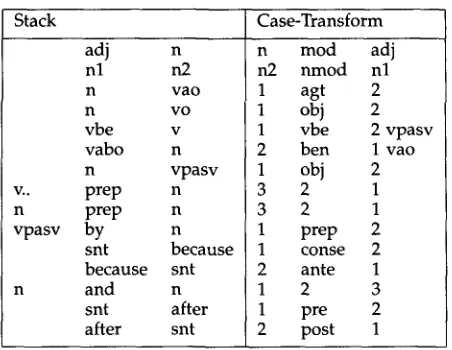
Some typical case transformations for syntactic constituents
In this e x a m p l e the case t r a n s f o r m a t i o n i m m e d i a t e l y follows the semicolon, a n d the result of the t r a n s f o r m a t i o n is s h o w n in p a r e n t h e s e s f u r t h e r to the right. The result in the final constituent is:
(ate A g t ( m a n M o d old Det the F r o m spain) Obj fish).
N o t e that w e d i d not r e n a m e the syntactic constituents as N P or VP in this e x a m p l e , b e c a u s e w e w e r e not interested in s h o w i n g the p h r a s e structure tree. R e n a m i n g in case analysis n e e d o n l y be d o n e w h e n it is n e c e s s a r y to p a s s o n i n f o r m a t i o n a c c u m u l a t e d f r o m an earlier constituent.
For e x a m p l e , in "fish w e r e eaten b y birds," the CS p a r s e is as follows:
* n vbe p p a r t by n ; shift n * vbe p p a r t by n ; shift n vbe * p p a r t by n ; shift
n vbe p p a r t * by n ; I vbe 2, v p a s v ( e a t e n Vbe were) n v p a s v * by n ; I obj 2 ( e a t e n Vbe w e r e Obj fish) v p a s v * by n ; shift
v p a s v by * n ; shift
v p a s v b y n * ; i p r e p 2 (birds P r e p by)
v p a s v n * ; 2 agt 1 ( e a t e n Vbe w e r e Obj f i s h Agt (birds P r e p by))
H e r e , it w a s n e c e s s a r y to r e n a m e the c o m b i n a t i o n of a p a s t participle a n d its auxiliary as a p a s s i v e verb,
vpasv,
so that the syntactic subject a n d object could be r e c o g n i z e d asObj
a n dAgent,
respectively. We also chose to u s e the a r g u m e n t n a m ePrep
to f o r m(birds Prep by)
so that w e could t h e n call that constituentAgent.
[image:18.468.126.352.60.235.2]Robert E Simmons and Yeong-Ho Yu Context-Dependent Grammars for English
C S - C A S E - P a r s e r ( i n p u t , c d g )
Input is a string of syntactic classes for the given sentence. Cdg is the given CDG grammar rules.
stack := empty
outputstack := empty
d o until(input = empty a n d 2nd(stack) = blank)
window-context := append(top-.five(stack),first_five(input)) operation := consult_CDG(window-context,cdg)
if first(operation) = SHIFT
t h e n stack := push(first(input),stack) input := rest(input)
e l s e stack := push(select(operation),pop(pop(stack)))
outputstack := make_constituent(operation,outputstack)
e n d d o
Figure 7
Algorithm for case parse.
entries in the table refer literally b y symbol rather than b y reference to the stack. The symbols vao and vabo are subclasses of verbs that take, respectively, agent and object; and agent, beneficiary, and object. The symbol v.. refers to a n y verb. Forms of the verb
be are referred to as vbe, a n d passivization is m a r k e d b y relabeling a verb b y a d d i n g the suffix -pasv.
P a r s i n g case structures
From the discussion above w e m a y observe that the flow of control in accomplishing a case parse is identical to that of a phrase structure parse. The difference lies in the fact that w h e n a constituent is recognized (see Figure 7):
in p h r a s e structure, a n e w n a m e is substituted for its stack elements, and a constituent is f o r m e d b y listing the n a m e and its elements
in case analysis, a case transformation is applied to designated elements on the stack to construct a constituent, a n d the head (i.e. the first element of the transformation) is substituted for its e l e m e n t s - - u n l e s s a n e w n a m e is p r o v i d e d for that substitution.
C o n s e q u e n t l y the algorithm used in phrase structure analysis is easily a d a p t e d to case analysis. The difference lies in interpreting and a p p l y i n g the operation to m a k e a n e w constituent a n d a n e w stack.
Computational Linguistics Volume 18, Number 4
with behavior essentially the same as the phrase structure parser. But this version accomplishes transformations to construct a case structure analysis.
7.3 Acquisition System for Case Grammar
The acquisition system, like the parser, required only minor revisions to accept case grammar. It must apply a shift or any transformation to construct the new stack-string for the linguist user, and it must record the shift or transformation as the right half of a context-sensitive rule--still composed of a ten-symbol left half and an operation as the right half. Consequently, the system will be illustrated in Figure 9 rather than described in detail.
Earlier we mentioned the context-sensitive dictionary. This is compiled by associ- ating with each word the linguist's in-context assignments of each syntactic word class in which it is experienced. When the dictionary is built, the occurrence frequencies of each word class are accumulated for each word. A primitive grammar of four-tuples terminating with each word class is also formed and hashed in a table of syntactic paths. The procedure to determine a word class in context,
,, first obtains the candidates from the dictionary.
,, For each candidate wc, it forms a four-tuple, vec, by adding it to the cdr of each immediately preceding vec, stored in IPC.
• Each such vec is tested against the table of syntactic paths;
if it has been seen previously, it is added to the list of IPCs, otherwise it is eliminated.
If the union of first elements of the IPC list is a single word class, that is the choice. If not, the word's most frequent word class among the union of surviving classes for the word is chosen.
The effect of this procedure is to examine a context of plus and minus three words to determine the word class in question. Although a larger context based on five- tuple paths is slightly more effective, there is a tradeoff between accuracy and storage requirements.
The word class selection procedure was tested on the 8,310 words of the 345- sentence sample of text. A score of 99.52% correct was achieved, with 8,270 words correctly assigned. As a comparison, the most frequent category for a word resulted in 8,137 correct assignments for a score of 97.52%. Although there are only 3,298 word types with an average of 3.7 tokens per type, the occurrence of single word class usages for words in this sample is very high, thus accounting for the effectiveness of the simpler heuristic of assignment of the most frequent category. However, since the effect of misassignment of word class can often ruin the parse, the use of the more complex procedure is amply justified. Analysis of the 40 errors in word class assignment showed 7 confusions of nouns and verbs that will certainly cause errors in parsing; other confusions of adjective/noun, and adverb/preposition are less devastating, but still serious enough to require further improvements in the procedure.
The word class selection procedure is adequate to form the prompts in the lexical acquisition phase, but the statistics on parsing effectiveness given earlier depend on perfect word class assignments.
Robert E Simmons and Yeong-Ho Yu Context-Dependent Grammars for English
L e x i c a l A c q u i s i t i o n : T h e s y s t e m p r o m p t s f o r s y n t a c t i c c l a s s e s a r e i n c a p i t a l s . T h e u s e r a c c e p t s t h e
system's p r o m p t w i t h a c a r r i a g e r e t u r n , c r o r t y p e s i n a s y n t a c t i c c l a s s i n l o w e r c a s e . W e s h o w u s e r ' s r e s p o n s e s i n b o l d - f a c e , u s i n g c r f o r c a r r i a g e r e t u r n . O t h e r a b b r e v i a t i o n s a r e w c f o r w o r d c l a s s , y o r n f o r y e s o r n o , a n d b f o r b a c k u p .
( T H E L A U N C H O F D I S C O V E R Y A N D I T S F I V E A S T R O N A U T S H A S B E E N D E L A Y E D A T - L E A S T T W O D A Y S U N T I L M A R C H E L E V E N T H B E C A U S E - O F A C R U S H E D E L E C T R I C A L P A R T O N A M A I N E N G I N E C O M M A O F F I C I A L S S A I D )
p r o c e s s t h i s o n e ? - y o r n y
T H E c r f o r d e f a u l t else w e o r b d e f a u l t is: A R T c r
L A U N C H c r f o r d e f a u l t else w c o r b c r ; u s e r m a d e a n e r r o r s i n c e t h e r e w a s n o d e f a u l t L A U N C H c r f o r d e f a u l t else w c o r b n ; s y s t e m r e p e a t e d t h e question
O F c r f o r d e f a u l t else w c o r b d e f a u l t is: O F c r D I S C O V E R Y c r f o r d e f a u l t else w e o r b n
A N D c r f o r d e f a u l t else w c o r b d e f a u l t is: C O N J e r I T S c r f o r d e f a u l t else w c o r b b ; u s e r d e c i d e d t o r e d o " a n d " A N D c r f o r d e f a u l t else w c o r b d e f a u l t is: C O N J a n d I T S c r f o r d e f a u l t else w c o r b p p r o n
i ! s k i p p i n g m o s t o f t h e s e n t e n c e . . .
A c r f o r d e f a u l t else w c o r b d e f a u l t is: A R T cr
M A I N c r f o r d e f a u l t else w c o r b n E N G I N E c r f o r d e f a u l t else w c o r b n
C O M M A c r f o r d e f a u l t else w c o r b d e f a u l t is: C O M M A c r O F F I C I A L S c r f o r d e f a u l t else w c o r b n
S A I D c r f o r d e f a u l t else w c o r b v a o
Figure 8
Illustration of dictionary acquisition.
and transformation rules for the sentence. What we notice in this second protocol is that the stack shows syntactic labels but the input string presented to the linguist is in English. As the system constructs a CS rule, however, the vector containing five elements of stack and five of input string is composed entirely of syntactic classes. The English input string better enables the linguist to maintain the meaningful context he or she uses to analyze the sentence. About five to ten minutes were required to make the judgments for this sentence. Appendix A shows the rules acquired in the session.
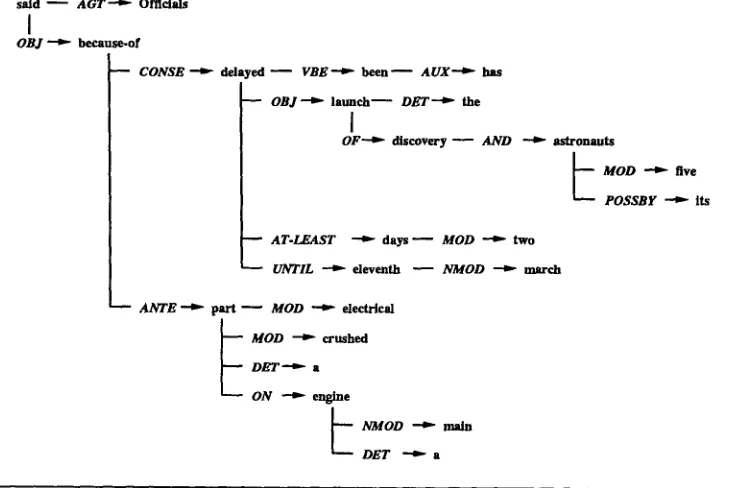
When rules for the sentence were completed, the system added the new syntactic classes and rules to the grammar, then offered to parse the sentence. The resulting parse is shown in Figure 10.
The case acquisition system was used on the texts described earlier in Table 1 to accumulate 3,700 example CDG case rules. Because the case transformations refer to three stack elements and the number of case labels is large, we expected and found that a much larger sample of text would be required to obtain the levels of generalization seen in the phrase structure experiments.
C o m p u t a t i o n a l L i n g u i s t i c s V o l u m e 18, N u m b e r 4
C a s e - G r a m m a r A c q u i s i t i o n : The options are h for a help message, b for backup one state, s for shift, case-trans for a case transformation, and cr for carriage r e t u r n to accept a system p r o m p t . System p r o m p t s axe capitalized in parentheses, user responses are in lower case. Where no appaxent response is shown, the user did a carriage r e t u r n to accept the p r o m p t . The first line shows the syntactic classes for the words in the sentence.
(ART N O F N AND P P R O N A D J N VHAV V B E VAO A T - L E A S T A D J N U N T I L N N B E C A U S E - O F ART P P A R T AD3 N ON A R T N N C O M M A N VAO)
(* T H E L A U N C H OF D I S C O V E R Y AND ITS F I V E A S T R O N A U T S HAS B E E N D E L A Y E D A T - L E A S T T W O DAYS U N T I L MARCH E L E V E N T H B E C A U S E - O F A CRUSHED E L E C T R I C A L P A R T ON A MAIN E N G I N E C O M M A O F F I C I A L S SAID)
options-axe h b s case-trans or cr for default: (S) ( A R T * L A U N C H O F D I S C O V E R Y AND ITS ... SAID) options-axe h b s case-trans or cr for default: (S) (ART N * O F D I S C O V E R Y AND ITS F I V E ... SAID) options-axe h b s case-trans or cr for default: (S) 1 det 2 (N * O F D I S C O V E R Y AND ITS F I V E ... SAID) options-axe h b s case-trans or cr for default: (S)
i s k i p p i n g s e v e r a l s h i f t s
(N O F N A N D P P R O N AD3 N * HAS BEEN DELAYED A T - L E A S T ... SAID) options-axe h b s case-trans or cr for default: (S) 1 rood 2
(N OF N A N D P P R O N N * HAS B E E N DELAYED A T - L E A S T ... SAID) options-axe h b s case-trans or cr for default: NIL 1 possby 2
(N OF N AND N * HAS B E E N DELAYED A T - L E A S T ... SAID) options-axe h b s case-trans or cr for default: NIL 3 2 1
(N O F N * HAS B E E N DELAYED A T - L E A S T T W O ... SAID) options-axe h b s case-trans or cr for default: (3 2 1)
(N * HAS B E E N D E L A Y E D A T - L E A S T T W O ... SAID) options-axe h b s case-trans or cr for default: (S)
(N VHAV * B E E N DELAYED A T - L E A S T T W O DAYS ... SAID) options-axe h b s case-trans or cr for default: ( 1 0 B J 2) s
(N VHAV V B E * DELAYED A T - L E A S T T W O DAYS ... SAID) options-axe h b s case-trans or cr for default: (S) 1 anx 2 (N V B E * D E L A Y E D A T - L E A S T T W O DAYS U N T I L ... SAID) options-axe h b s case-trans or cr for default: (S)
(N V B E VAO * A T - L E A S T T W O DAYS U N T I L MARCH ... SAID) options-axe h b s case-trans or cr for default: (1 V B E 2 VAOPASV) (N VAOPASV * A T - L E A S T T W O DAYS U N T I L MARCH ... SAID) options-axe h b s case-trans or cr for default: ( 1 0 B J 2 /
! s k i p p i n g n o w t o B E C A U S E
(VAOPASV U N T I L N * B E C A U S E - O F A CRUSHED E L E C T R I C A L ... SAID) options-axe h b s case-trans or cr for default: (S) 3 2 1
(VAOPASV * B E C A U S E - O F A CRUSHED E L E C T R I C A L PART ... SAID) options-axe h b s case-trans or cr for default: (S)
(VAOPASV B E C A U S E - O F * A C R U S H E D E L E C T R I C A L PART ON .. SAID) options-are h b s case-trans or cr for default: NIL 1 conse 2
( B E C A U S E - O F * A C R U S H E D E L E C T R I C A L PART ON ... SAID) options-axe h b s case-trans or cr for default: NIL s
: s k i p p i n g n o w t o t h e e n d ( B E C A U S E - O F C O M M A N VAO *)
options-are h b s case-trans or cr for default: (1 OB3 2) 1 agt 2 ( B E C A U S E - O F C O M M A VAO *)
options-axe h b s case-trans or cr for default: NIL 1 obj 3
Figure 9
I l l u s t r a t i o n o f c a s e g r a m m a r a c q u i s i t i o n .
8. D i s c u s s i o n and Conclusions
I t s e e m s r e m a r k a b l e t h a t a l t h o u g h t h e t h e o r y o f c o n t e x t - s e n s i t i v e g r a m m a r s a p p e a r e d
Robert E Simmons and Yeong-Ho Yu Context-Dependent Grammars for English
s a i d ~ A G T - ' ~ Officials
I
OBJ ~ because-of
m CONSE ~ d e l a y e d ~ VBE ''¢~ b e e n ~ A U X ' - ~ has O B J - ' ~ l a u n c h - - D E T - ' - ~ the
I
O F " - ~ d i s c o v e r y ~ A N D ~ ~ . r o n ~ o J t s
~ MOD " ~ five POSSBY " ~ its
AT-LEAST ~ d a y s - MOD ~ two
UNTIL ~ eleventh ~ NMOD - - ~ march A N T E ~ part ~ MOD ~ electrical
~ MOD ~ crushed DET ''4t" a
ON " - ~ engine
L NMOD - ~ m a i n
DET - ' ~ a
[image:23.468.46.415.61.305.2]The launch of discovery and its five astronauts has been delayed at-least two days until march eleventh because-of a crushed electrical part on a main engine comma officials said.
Figure 10
Case analysis of a sentence.
viously in computational parsing. As researchers we seem simply to have assumed, without experimentation, that context-sensitive grammars would be too large and cumbersome to be a practical approach to automatic parsing. In fact, context-sensitive, binary phrase structure rules with a context composed of the preceding three stack symbols and the next five input symbols,
stack1_3
binary-ruleinput1_5 ---*
operationprovide several encouraging properties.
The linguist uses the full context of the sentence to make a simple decision: either shift a new element onto the stack or combine the top two elements into a phrase category.