Embedded based Food Quality Detection with
Sensor Technology
Rajani K V1, Aaliya Ashfaq2, Akshay Kumar Nayaka R3
1Asst. Professor, Department of Electronics and communication, New Horizon College of Engineering. 2, 3Student, Department of Electronics and communication, New Horizon College of Engineering. Outer Ring Road,
Marathalli, Bengaluru-560103.
Abstract: Food plays an important role in our lives and with the advent of globalization, the need to create consumer products for efficient usage has become a necessity. In recent trends consumption of various altered, preserved and contaminated food has given rise to food poisoning and other diseases. This paper describes the use of various sensors to detect the quality of food. A comprehensive research to develop a system that can make use of sensors to determine the state and quality of food has been conducted. This system uses pH, gas sensors along with a thermostat. The conclusive values help us determine the condition of the food. This sensor system can be implemented in common households also.
Keywords: Food quality, contaminated food, pH sensor, gas sensors, sensor system.
I. INTRODUCTION
In order to produce high-quality food products, everyone involved with food products needs to understand their role in the process. In the last few years many scientists, technologists and managers, contributed largely to the thinking about food quality. The described quality concepts range from simple illustrations to complex models reflecting factors that might influence quality expectation by consumers or customers. There are many definitions for product quality, such as conformance to specifications and requirements, and fitness of a product for any use. There is an open research problem in the field of health and nutrition on accurate measurement of dietary intake. The increased focusing on obesity among the youth is great concern. Not only nutrient content of food, the quality of food is much more important, it should be free from bacterial contamination and other foreign bodies. The intake of contaminated food causes various health issues like food poisoning, etc. Food poisoning has been the source of innumerable diseases and illnesses over the years. In a country like India, where majority of the population struggles for their daily bread, efficient preservation of existing food resources is critical. The great amount of money spent on diagnosis and treatment of diseases is also a cause for concern. So, food quality detection plays a major role in the present modern society. In order to achieve long-term and on- demand wireless monitoring of food quality a sensor tag and reader system is used particularly for more-quantity applications and monitoring from place of manufacturing to retail stores is a loss of time, not suitable for small quantity applications. A special technique, the system captures a photo of the food before and after eating in order to estimate the consumption calorie of the food and its nutrients components. Diet can consists two major components, ingredient detection and food classification. This paper is intended to develop a prototype to collect the food intake sensor data. This data is updated, transmitted and displayed on a webpage.
II. CONTAMINATION OF FOOD
Human sicknesses caused by food borne microorganisms are famously alluded to as harmful. The normal utilization of a solitary characterization is expected basically to likeness of side effects of different sustenance related ailments. Aside from ailments because of nourishment hypersensitivity or sustenance affectability, food borne disease might be partitioned into two noteworthy classes, sustenance contamination and sustenance inebriation. Nourishment disease comes about when sustenance tainted with pathogenic, obtrusive, sustenance harming microscopic organisms are eaten. These microscopic organisms at that point multiply in the human body and in the long run result in diseases. Sustenance inebriation takes place after the ingestion of preformed harmful substances which collect amid the development of certain bacterial sorts in nourishments.
than 1 billion cells in 5 hours. Spore frames save the microbes from starvation, drying, solidifying, chemicals, and warmth. At the point when conditions end up positive, the spores develop, with every spore again turning into a vegetative cell with the capacity to recreate. Viruses are the smallest and simplest microorganisms. Unlike bacteria, yeasts, and moulds, viruses are incapable of reproducing independently. Instead, they must first invade the cells of another living organism called the host, before they can multiply.
A. Spoilage
The most common microbiological issue confronting the nourishment business is straightforward waste by microscopic organisms, yeasts, or moulds that are not perilous to wellbeing. Chilling moderates decay, appropriate solidifying, drying, canning, and pickling capture it totally. Chilled sustenance must be transported to the customer before waste microorganisms make them unfit for utilization. The issues of waste in alternate procedures emerge just upon take- off from built up strategies. The frequency of item waste can be significantly decreased and time span of usability stretched out by avoiding potential risk.
B. Canned foods
The shelf-life of canned foods results from the destruction of microorganisms capable of growth within the container during normal handling and storage.
C. Refrigerated foods
Some of these products are partially cooked or processed prior to chilling. This heat reduces the microbial population but does not render it “commercially sterile.” Because of this, refrigerated foods have a limited shelf-life. That is affected by temperature and customer abuse.
III. EXISTING SYSTEM
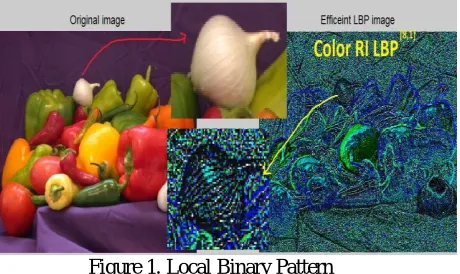
[image:2.612.201.431.411.548.2]The texture analysis gives whether the given food is in solid, liquid form or semi-solid form. Texture value calculated hrough LBP(local binary pattern) Then modelling process with regression can detect the approximate nutrient content in the food In this method only the recognition of nutrient in food is alone done.
Figure 1. Local Binary Pattern
IV. PROPOSED METHOD
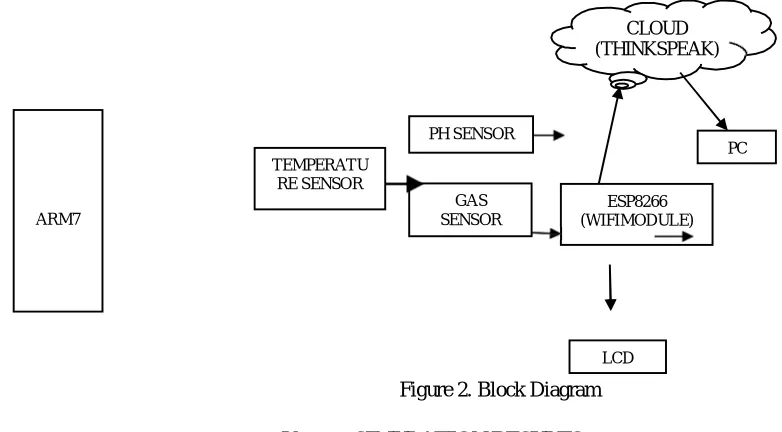
In the proposed system we are using the Temperature, gas and pH value of the food item computed by Temperature sensor, gas sensor, PH Sensor which works based on the transducer type. It may be electrochemical, optical, mass and calorimetric.
In this system we use a 32-bit ARM7TMI-S Microcontroller to interface the pH sensor, gas sensors and temperature sensor along with a LCD. The combined values from the sensors will help detect whether the food present is spoiled or not. A set of threshold values will be set for each sensor and when these values are crossed then it signifies that the food is contaminated. Also a Wi-Fi module is used to display the result on a web page.
A. pH sensor
LCD B. Gas Sensor
The gas sensor used in this method is a MQ-135 gas sensor. MQ-135 is manufactured by lead oxide (SnO2). This has a high sensitivity to Ammonia and Sulphide. It is also sensitive to smoke and other harmful gases.
C. Temperature sensor
The temperature sensor used is the LM35. Its output voltage is linearly proportional to the Celsius temperature. In this sensor the
[image:3.612.99.490.191.407.2]temperature is calibrated in terms of 0K (kelvin).
Figure 2. Block Diagram
V. SIMULATION RESULTS
The below figure shows the simulation result of the proposed method. It reads the sensor value and then triggers the controller to display the quality of the food.
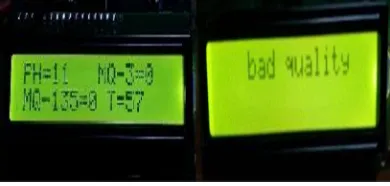
CASE 2: Te When the proposed system was tested on tea the values were found to be as follows:
pH 11
MQ-3 0
MQ-135 0
[image:3.612.208.401.476.542.2]Temperature 57
Table 2: Sensor Results for Case 2
Figure 3: Hardware Implementations
CLOUD (THINKSPEAK)
ESP8266 (WIFIMODULE)
PC
GAS SENSOR PH SENSOR
ARM7
[image:3.612.180.411.580.712.2]The above shown figure is the hardware implementation of the proposed system which includes an ARM7 TDMI-S microcontroller, a pH sensor, a temperature sensor, a gas sensor, a Wi-Fi module and LCD.
In working the pH sensor is dipped into the food to be checked for contamination. Since the gas sensor, pH sensor and the temperature sensors are interfaced to the ARM7 microcontroller, the microcontroller displays these values on the LCD and also sends these values onto a webpage via a Wi- Fi module. On doing so it is possible to determine whether the given food is contaminated or not.
Three food samples have been tested in order to determine its quality which are shown in the following cases. CASE 1: Tomato curry
When the proposed system was tested on tomato curry the values were found to be as follows:
pH 6
MQ-3 0
MQ-135 0
Temperature 60
[image:4.612.215.409.202.386.2]Table 1: Sensor Results for Case 1
Figure 4: Display results for case 1
In this case, the pH value and the gas sensor values satisfy the given threshold but the temperature is above the given threshold due to this the given tomato curry is termed as a bad quality food.
Figure 5: Display results for case 2
As seen, in this case the gas value is within the given threshold but the pH value and the temperature values are not within the given threshold value, which eventually means that the tea is of a bad quality
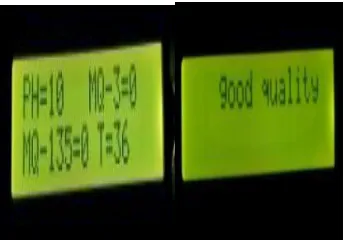
CASE 3: Fruit Pudding
When the proposed system was tested on fruit pudding the values were found to be as follows:
pH 10
MQ-3 0
MQ-135 0
Temperature 36
[image:4.612.230.425.432.525.2]Figure 6: Display results for case 3
In this case, the pH value and the gas sensor values satisfy the given threshold but the temperature is above the given threshold due to this the given pudding is termed as a good quality food.
VI. CONCLUSION
The proposed embedded system can help to determine spoilage of food. This device was basically developed to help people detect contamination of food. With the implementation of pH sensor, gas sensor and temperature sensor interfaced to the ARM7 microcontroller, the obtained values is displayed on LCD screen and also a webpage. The values formulated can help to check whether the quality of food is good or bad. The proposed system can be implemented in restaurants, households and even small scale factories. This system provides a direct and convenient method to monitor the quality of food and also reduce potential wastage. Food poisoning and other diseases can be prevented up to an extent. The implemented system can be improved by the use of other sensors such as biosensor etc.
REFERENCES
[1] Wen-ding Huang, Sanchali Deb, Young-Sik Seo, Smitha Rao, Mu Chiao“A Passive Radio-Frequency pH- Sensing Tag for Wireless Food-Quality Monitoring”IEEE Sensors Journal, Vol. 12, No. 3, March 2012
[2] K. K. Adhikari; N. Y. Kim “Ultrahigh-Sensitivity MediatorFree Biosensor Based on a Microfabricated Microwave Resonator for the Detection of Micromolar Glucose Concentrations” IEEE Transactions on Microwave Theory and Techniques 2016, Volume: 64, Issue: 1
[3] Yin Bi, Mingsong Lv, Chen Song, Wenyao Xu, Nan Guan and Wang Yi “AutoDietary: A Wearable Acoustic Sensor System for Food Intake Recognition in Daily Life IEEE Sensors Journal Vol.PP,issue.99,2015
[4] Hong sheng He, Fanyu Kong, and Jin dong “Diet Cam Multi-View Food Recognition Using a Multi-Kernel SVM” Published in “IEEE Journal of Biomedical and Health Informatics” Vol pp,No 99, jan 2015
[5] P. Sangeetha; A. V. Juliet “Readout method for pathogen detection using biosensor” Information Communication and Embedded Systems (ICICES), IEEE Conference Publications 2014 pages:1-4