Gender Classification from Facial Images -
Performing the classification of Gender from the
facial Images and implementing the same on the
Real Time
Aakash Rastogi1, Manish Aneja2, Narina Thakur3, Mayur Dhingra4, Naman Gupta 5
1, 2, 3, 4, 5
Bharati Vidyapeeth’s College of Engineering, New Delhi Delhi, India
Abstract: Gender recognition is one of the aspects which is of massive interest for many industries, be it surveillance, biometrics or information gain. As a result of its immense importance, many techniques were proposed in the last years. Different methods have been accessible depending on the benchmark they set for further research in the same area. In this context, this paper gives an overview of the techniques, datasets, and classifiers required to reach the same goal.
Keywords: Face Detection, Gender Classification, Haar Cascade, Adaboost, SVM, CNN
I. INTRODUCTION
II. LITERATURESURVEY
A. Binary Classification using Haar Cascade
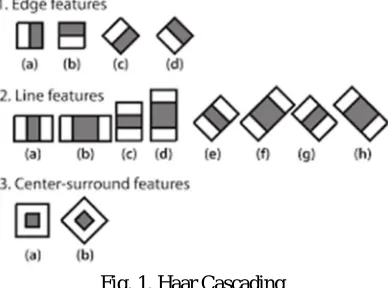
[image:2.612.210.404.230.374.2]Various techniques for detecting gender from facial images focus on extracting features and training the classifier on a dataset. Then, the classifier is tested on test dataset, and it outputs the predicted gender. For performing the detection of the facial image, it is required to pick the features from the face present in that Image. To achieve the extraction of facial features, most common approach is Geometry based. According to which, a face is bounded by an eclipse and distance of eyes for the central line, length of eyebrows, position of other landmarks. The calculated distances and ratios are used to identify the images and classify them [2]. Mustafa et al. [1] used a simple method by detecting a region of interest(ROI) by assigning positive to the facial images and negative to other areas in a still image. This way, it becomes a simple binary problem. This technique uses a detector (Haar classifier detector) found in OpenCV. It uses INRIA and CVC CER 01 dataset to train the classifier. It does not guarantee high accuracy rate, which is usually an issue when we make it a binary problem [1][6].
Fig. 1. Haar Cascading
B. K-Nearest Neighbour
One of the techniques for detecting gender is K-NN algorithm also known as the Nearest Neighbor algorithm. In this algorithm, the model is not trained according to the dataset of the feature [7]. Instead of that every time the input feature data is compared to the data present in training data, and the result is made according to that. In this algorithm, as the name suggests K nearest neighbor of the feature data is found from the already presented dataset [20]. And the probability of all the class is found. Here class refers to the number of different classification which is to be made. In the case of gender recognition, the classification is to be done in between two classes ‘Male’ and ‘Female’. So, in this classification, if more than k/2-data sets of any the class is present then that class will be our output [7].
Fig. 2. KNN
1) Advantages
a) Robust to noisy training data. b) Effective if the training data is large. 2) Disadvantages
a) Need to determine of parameter K (number of interest neighbors).
b) No clarification on Distance-based learning, which type of distance to use and which attribute to use for best results.
[image:2.612.214.404.497.609.2]C. SVM with Local Binary Patterns (LBP)
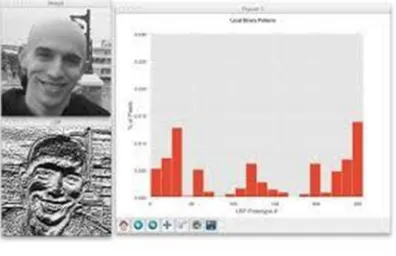
[image:3.612.207.405.109.237.2]The Local Binary Patterns, LBP is the technique of Computer Vision, which provides the ability to read Texture Spectrum Models.
Fig. 3. Local Descriptors
Moghaddam et al. [3] proposed a method in which they used Support Vector Machine(SVM) for gender classification based on facial images. Use of SVM [10] [12] [14] proved to be a real boost in increasing accuracy in determining gender and achieved the error rate of 3.4% [19]. It led to a lot of other researchers in the same field by combining it with other descriptors which encode gender-related information. One of the most popular descriptors was Local Binary Pattern(LBP) used by Yang et al. [3]. The immense popularity of LBP was due to its excellent discriminative power and computational simplicity. LBP along with Discrete Cosine Transform provide results with 78.91% accuracy only [5] [13].
Fig. 4. Classification
D. SVM with AdaBoost
Much more improvised method to perform the same task of detecting Gender is using SVM and AdaBoost [8]. Zhang et al. [9] improved the accuracy up to 92.5% using the same. It is a binary process of classification and follows the same methodology of including face detection in the image and perform face alignment [6] [11]. The process of texture normalization is done to improve the results. In texture normalization, a part of the face separated and operations are performed for enhancing the texture [14] [18]. Mesh filter is applied to the face using the basic features like eyes, nose and other facial points. After the Real AdaBoost, a statistical two layered learning algorithm is applied to the images to perform classification even on the marginal differences [18]. The algorithm trains on 11500 Chinese faces having a neutral expression and without any beard or strange hairstyle. The dataset includes 7000 male faces and 4500 female faces. It gains the high efficiency of detecting gender with the error rate of 3.13% [18]. Even with high accuracy this technique unable to maintain its performance in real time as it requires on neutral faces as mentioned.
E. Convolutional Neural Networks (CNN)
In our studies, it was found out that one of the latest techniques being used in vision-based gender detection in using Convolutional Neural Networks. There are majorly two methods of extracting features from the given face image to predict the gender. First is appearance-based which uses about 72 facial points as key features and second, is geometry based using specific regions of the face as local features. Using both these methods simultaneously minimizes the margin or error. Previously CNN was used with HOG [4] for performing classification. FERET Dataset was used giving an Accuracy of 96% [4].
Datasets used to test the methods/algorithm were LFW, FERET, and SoF (Specs on Faces) with 200 images each.
[image:3.612.185.429.343.446.2]Fig. 5. Layers of CNN followed by Linear Classifier
The technique applies the lighting-invariant functions like SSR (Single Scale Retinex) to improve the low contrast possibility of an image to improve the accuracy of results. Then Cascaded Deformable Shape Model (CDSM) is used to detect and extract facial features like estimated landmarks of nose, eyes, mouth, lips, etc. Each “patch” or feature then becomes an input for a pre-trained CNN to the individual outputs of which, AdaBoost based score fusion mechanism is applied. It finally goes through a Linear Discriminant Classifier, and the final result is predicted.
This technique produces a lot better results than any of the previous methods currently in use with an error margin of 0.5% using FERET dataset.
III. OURMETHODOLOGY
We are using the best of the techniques studied above. The used technique uses CNN as its base for detecting faces.
Using dataset from IMDb, we have trained our model with 2500 labeled images and tested on 500 images. To implement the neural networks, we are using TensorFlow Framework and Keras Deep Learning Open Source Library.
Firstly, we train the model using the dataset images. This is a time taking process. During this training part, a model for identifying gender and detecting faces is created, if not already existing, otherwise the previous model is enhanced using backtracking. Then the model details are saved in a separate file. We use this file for testing our model so that we won't have to train the model every time we test it.
Our Neural Network Model has 2 hidden / intermediate layers with first hidden layer containing 128 nodes and second hidden layer containing 256 nodes.
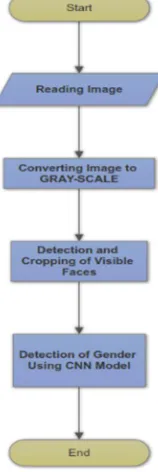
[image:4.612.265.344.476.712.2]During testing period, the image is passed as input to the code. And the image is converted to GRAYSCALE from COLOR in order to provide better illumination and contrast for better face detection. This image is passed to a CNN based face detector which returns the cropped face on which we can do processing.
face is then input to another neural network which classifies the face as a male or a female face by passing the results through hidden layers of CNN.
IV. CONCLUSION
After studying various techniques for classification of gender, we decided to use the best technique. The results of our technique using mentioned datasets achieve results of up to 78% accuracy rate in very suave/mild training and limited resources.
REFERENCES
[1] Mustafa E. Yildirim, J. S. Park, J.Song and B. W. Yoon “General Classification Based on Haar Cascade” presented at International Journal of Computer and
Communication Engineering, Vol. 3 N0. 2, March 2014
[2] Eman Fares Al Mashagba, Computer Science Department, Zarqa University, Zarqa, Jordan “Real-Time Gender Classification by Face” presented at (IJACSA)
International Journal of Advanced Computer Science and Application Vol. 7, No. 3,201
[3] Baback Moghaddam Ming-Hsuan Yang “Learning Gender with Support Faces” presented at MERL – Mitsubishi Electric Research Lab
[4] Lemley, Sami Abdul-Wahid, Dipayan Banik, Razvan Andonie “Comparison of Recent Machine Learning Techniques for Gender Recognition from Facial
Images” presented at MAICS 2016
[5] Emon Kumar Dey, Mohsin Khan & Md Haider Ali “Computer Vision-Based Gender Detection from Facial Image” presented at International Journal of
Advanced Computer Science. Vol. 3, No. 8, Aug 201
[6] Vandna Singh, Dr. Vinod Shokeen, Mr. Bhupendra Singh “Comparison of Feature Extraction Algorithm For Gender Classification From Facial Images”
presented at International Journal Of Engineering Research & Technology (IJERT) Vol.2, May 201
[7] Deepak Deshmukh “Gender Recognition from Model’s Face Using SVM Algorithm” presented at International Journal of Engineering Research & Technology
(IJERT) Vol.10 Number 1, Apr 2014
[8] Ms.Dhanashri Shirkey, Prof.Dr.S.R.Gupta “An Image Mining System for Gender Classification & Age Prediction Based on Facial Features” presented at IOSR
Journal of Computer Engineering (IOSR-JCE), Vol.10, May – June 201
[9] M. Mayo, E. Zhang “Improving Face Gender Classification By Adding Deliberately Misaligned Faces To The Training Data
[10] Pin Liao, Sensen Wang, Xin Zhang, Kunlun Li, Mingyan Wang “Nesting Differential Evolution to Optimize the Parameters of Support Vector Machine for
Gender Classification of Facial Images” presented at International Conference on Intelligent Systems Research and Mechatronics Engineering (ISRME 201
[11] Vladimir Khryashchev, Andrey Priorov, Lev Shmaglit and Maxim Golubev “Gender Recognition via Face Area Analysis” presented at Proceedings of the
World Congress on Engineering and Computer Science 2012 Vol I, October 2012, San Francisco, USA
[12] Mr. Raghvendra, Prof.Sandeep Sahu “Gender Recognition & Age Prediction” presented at International Journal of Engineering and Computer Science Vol. 3
September 2014
[13] Hadeel Fahad Alrashed and Mohamed Abdou Berbar, “Facial Gender Recognition Using Eyes Images” presented at International Journal of Advanced
Research in Computer and Communication Engineering Vol. 2, Issue 6, June 2013
[14] Miss.P.Sasikala, Miss.N.Nirosha, Mr.E.Gurumoorthi, Mrs.J.VijayaBarathi “Identification Of Gender And Face Recognition Using Adaboost And SVM
Classifier” presented at International Journal of Advanced Research in Computer and Communication Engineering Vol. 3, Nov 2014.
[15] Anushri Jaswante, Dr. Asif Ullah Khan, Dr. Bhupesh Gour “Gender Classification Technique Based on Facial Features using Neural Network” presented at
International Journal of Computer Science and Information Technologies, Vol. 4, 2013.
[16] Gil Levi and Tal Hassner “Age and Gender Classification using Convolutional Neural Networks” presented at CVPR2015.
[17] Shivaji J Chaudhari, Ramesh M Kagalkar “Methodology for Gender Identification, Classification, and Recognition of Human Age” presented at International
Journal of Computer Applications, National Conference on Advances in Computing,2015.
[18] Zhiguang YANG, Ming Li, Haizhou AI “An Experimental Study on Automatic Face Gender Classification”
[19] S.Ravi, S.Wilson “Face Detection with Facial Features and Gender Classification Based On Support Vector Machine” presented at International Journal of Imaging Science and Engineering 2010
[20] Chih-Min Ma, Wei-Shui Yang and Bor-Wen Cheng, 2014. How the Parameters of K-nearest Neighbor Algorithm Impact on the Best Classification Accuracy:
In Case of Parkinson Dataset. Journal of Applied Sciences, 14: 171-176.
[21] Aakash Rastogi, Manish Aneja, Mayur Dhingra, Naman Gupta, Anshu Malhotra, 2018. “Gender Classification using Facial Images” presented at IndiaCOM