Statistical Machine Translation into
Compounding Languages
Sara Stymne
Uppsala University∗Nicola Cancedda
Xerox Research Centre Europe∗∗
Lars Ahrenberg
Link ¨oping University†In this article we investigate statistical machine translation (SMT) into Germanic languages, with a focus on compound processing. Our main goal is to enable the generation of novel compounds that have not been seen in the training data. We adopt a split-merge strategy, where compounds are split before training the SMT system, and merged after the translation step. This approach reduces sparsity in the training data, but runs the risk of placing translations of compound parts in non-consecutive positions. It also requires a postprocessing step of compound merging, where compounds are reconstructed in the translation output. We present a method for increasing the chances that components that should be merged are translated into contiguous positions and in the right order and show that it can lead to improvements both by direct inspection and in terms of standard translation evaluation metrics. We also propose several new methods for compound merging, based on heuristics and machine learning, which outperform previously suggested algorithms. These methods can produce novel compounds and a translation with at least the same overall quality as the baseline. For all subtasks we show that it is useful to include part-of-speech based information in the translation process, in order to handle compounds.
1. Introduction
In many languages including most of the Germanic (German, Swedish, etc.) and Uralic (Finnish, Hungarian, etc.) language families, so-called closed compounds are used
∗Department of Linguistics and Philology, Uppsala University, Box 635, 751 26 Uppsala, Sweden. E-mail:[email protected].
∗∗Xerox Research Centre Europe, 6 chemin de Maupertuis, 38240 Meylan, France. E-mail:[email protected].
†Department of Computer and Information Science, Link ¨oping University, 58183 Link ¨oping, Sweden. E-mail:[email protected].
Submission received: 25 April 2012; revised submission received: 30 November 2012; accepted for publication: 8 January 2013.
productively. Closed compounds are written as single words without spaces or other word boundaries, as in GermanGoldring. We will refer to these languages as compound-ing languages. In English, on the other hand, compounds are generally open, that is, written as two words as ingold ring.
This difference in compound orthography leads to problems for statistical ma-chine translation (SMT). For translation into a compounding language, often fewer compounds than in normal texts are produced. This can be due to the fact that the desired compounds are missing in the training data or that they have not been aligned correctly. When a compound is the idiomatic word choice in the translation, systems often produce separate words, genitive or other alternative constructions, or translate only one part of the compound. For an SMT system to cope with the productivity of the phenomenon, any effective strategy should be able to correctly process compounds that have never been seen in the training data as such, although possibly their components have, either in isolation or within a different compound.
Previous work (e.g., Koehn and Knight 2003) has shown that compound splitting improves translation from compounding languages into English. In this article we ex-plore several aspects of the less-researched area of compound treatment for translation into such languages, using three Germanic languages (German, Swedish, and Danish) as examples.1The assumption is that splitting compounds will also improve translation
for this translation direction and lead to more natural translations. The strategy we adopt is to split compounds in the training data, and to merge them in the translation output. Our overall goal is to improve translation quality by productively generating compounds in SMT systems.
The main contributions of the article are as follows:
r
Demonstrating improvedcoalescence(adjacency and order) of compoundparts in translation through the use of sequence models based on customized part-of-speech sets and count features
r
Designing and evaluating several heuristic methods for compoundmerging that outperforms previous heuristic merging methods
r
Designing and evaluating a novel method for compound merging basedon sequence labeling
r
Demonstrating the ability of these merging methods to generate novelunseen compounds
In addition, we report effects on translation performance from a number of variations in the methods for compound splitting and merging.
The rest of the article is structured as follows. Section 2 gives an overview of compound formation in the three target languages used in this work. Section 3 reports related work on compound processing for machine translation. Section 4 describes the compound processing strategy we use and Section 5 describes compound splitting. Section 6 addresses compound coalescence, followed by compound merging in Sec-tion 7. In SecSec-tion 8 we present experimental results and in SecSec-tion 9 we state our conclusions.
2. Closed Compounds in German, Swedish, and Danish
Compounds in German, Swedish, and Danish are generally closed, written without word boundaries, as exemplified for German in Example (1). Compounds can be made up of two (1a) or more (1b) parts where parts may also be coordinated (1c). In a few cases compounds are written with a hyphen (1d), often when one of the parts is a proper name or an abbreviation. Most compounds are nouns (1a–1e), but they can also be adjectives (1f), verbs (1g), and adverbs (1h). English translations of compounds can be written as open compounds with separate words (1a) or with hyphens (1f), as other constructions, possibly with inserted function words (1g) and reordering (1b), or as single words (1e). Generally the last part of the compound is the compound head, that is, it conveys the main meaning of the compound, and determines its part of speech. The other parts, compound modifiers, modify the meaning of the com-pound head in some way and need not have the same part of speech as the full compound.
(1) a. Regierungskonferenzintergovernmental conference Regierung+Konferenzgovernment conference b. Friedensnobelpreistr¨agerNobel Peace Prize laureate
Frieden+Nobel+Preis+Tr¨agerpeace Nobel prize bearer c. See- und Binnenh¨afensea and inland ports
See- und Binnen+H¨afensea and interior ports d. EU-MitgliedstaatenEU member states
EU-Mitglied+StaatenEU member states e. Jahrtausendmillennium
Jahr+tausendyear thousand f. dunkelblaudark-blue
dunkel+blaudark blue g. kennenlernenget to know
kennen+lernenknow learn h. gr ¨osstenteilsin most instances
gr ¨ossten+teilslargest partly
(2) 0 Kind+phase (child-caring period) +s Kinds+lage (fetal position) +es Kindes+unterhalt (child support) +er Kinder+film (children’s film) +- Ein-Kind-Politik (one-child policy)
In some cases concatenating two words would lead to three identical consecutive consonants. In the Scandinavian languages, there is a spelling rule that does not allow this, and three identical consonants are reduced to two, as in Example (3SV). This spelling
[image:4.486.54.431.307.660.2]rule was also used for some German compounds before 1996, when it was changed by a spelling reform, so that nowadays three identical consecutive consonants are never reduced to two at compound boundaries in German (Institut f ¨ur Deutsche Sprache 1998), as shown in Example (3DE).
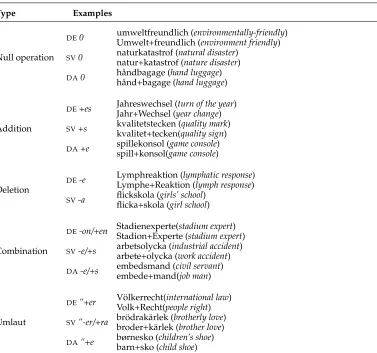
Table 1
Operations used for forming compounding forms with examples.
Type Examples
Null operation
DE0 umweltfreundlich (environmentally-friendly)
Umwelt+freundlich (environment friendly)
SV0 naturkatastrof (natur+katastrof (natural disasternature disaster))
DA0 h˚andbagage (h˚and+bagage (hand luggagehand luggage))
Addition
DE+es Jahreswechsel (Jahr+Wechsel (year changeturn of the year) )
SV+s kvalitetstecken (kvalitet+tecken(quality signquality mark))
DA+e spillekonsol (spill+konsol(game consolegame console))
Deletion
DE-e Lymphreaktion (Lymphe+Reaktion (lymphatic responselymph response))
SV-a flickskola (girls’ school)
flicka+skola (girl school)
Combination
DE-on/+en Stadienexperte(stadium expert)
Stadion+Experte (stadium expert)
SV-e/+s arbetsolycka (industrial accident)
arbete+olycka (work accident)
DA-e/+s embedsmand (civil servant)
embede+mand(job man)
Umlaut
DE”+er V ¨olkerrecht(international law)
Volk+Recht(people right)
SV”-er/+ra br ¨odrak¨arlek (brotherly love)
broder+k¨arlek (brother love)
DA”+e børnesko (children’s shoe)
(3) SV tullagstiftningcustoms legislation tull+lagstiftningcustom legislation DE Zellliniecell line
Zell+Liniecell line
Compounding is common and productive; new compounds can be readily formed and understood. This is confirmed in a number of corpus studies. In German, com-pounds have been shown to make up 5–7% of tokens and 43–47% of types in news text (Baroni, Matiasek, and Trost 2002; Schiller 2005). If function words are removed, an even higher number of the tokens are compounds; in both Swedish and German 10% of the content words in a news text have been found to be compounds (Hedlund 2002). That compounding is productive means that it is likely that a high number of compounds have a very low frequency in texts. Baroni, Matiasek, and Trost (2002) found that 83% of the compounds in a large German news corpus occur less than five times. In Swedish, compounds are the most common type of hapax words, that is, words that occur only once in a text (Carlberger et al. 2005). The most common type of compound is the noun+noun compound, which makes up 62% of the compounds in the German news corpus of Baroni, Matiasek, and Trost.
3. Related Work
The problems arising from differences in compounding strategies in translation from German into English have been addressed by several authors. The most common archi-tecture for translation from German is to split compounds in a preprocessing step prior to training and translation using some automatic method, which has been suggested both for SMT (Nießen and Ney 2000; Koehn and Knight 2003; Popovi´c, Stein, and Ney 2006; Holmqvist, Stymne, and Ahrenberg 2007) and example-based MT (Brown 2002). German compounds are split into their component parts in a preprocessing step and the translation model is then trained between modified German and English. At translation time, the German source text is also run through a compound splitter. In the studies cited here, only one splitting option is given as input to the decoder, which can be problematic in case the splitting is wrong, or if any of the parts are unknown. In Dyer (2009) several splitting options were given to the decoder in the form of a lattice. It is, however, not straightforward to use lattices during training, and in order to solve this, the training corpus was doubled, one part being without splits and the other part having the best splitting option for each word.
Fraser (2009) merged split German compounds after translation from English, by applying a second phrase-based SMT (PBSMT) system trained on German with split compounds and normal German. No separate results were presented for this extension alone, but in combination with other morphological processing the strategy led to worse results than the baseline. This method also suffers from the same drawbacks as that of Popovi´c, Stein, and Ney (2006), that novel compounds cannot be merged and words that should not be merged can still be.
Koehn, Arun, and Hoang (2008) discussed the treatment of hyphenated compounds for translation into German. They used a separate mark-up token for hyphened com-pounds, where the hyphen was split into a separate token, and marked by a symbol. The impact on the translation result was small.
Botha, Dyer, and Blunsom (2012) discussed the approach of using customized language models to target German compounds. They presented hierarchical Pitman-Yor language models, where the compound head is conditioned on the words pre-ceding the full compound, and the compound modifiers are modeled by a reverse compound language model. They used this model as a replacement of a standard language model for SMT and found that although the perplexity of the language model was reduced, there were only minor improvements on Bleu for the SMT task. In this case the SMT pipeline was left unchanged, meaning that novel compounds were not considered.
Compound merging has also been performed for speech recognition. An example of this is Berton, Fetter, and Regel-Brietzmann (1996), who extended the word graphs output by a German speech recognizer with possible compounds by combining edges of words during a lexical search. The final hypotheses were then identified from the graph using dynamic programming techniques. Compound merging for speech recog-nition is a somewhat different problem than for machine translation, however, because coalescence is not an issue, as compared with SMT, where there is no guarantee that the order of the parts in the translation output is correct.
Another somewhat related problem to compound merging is that of detection of er-roneously split compounds in human text, which is faced by grammar checkers. Writing compounds as separate words, with spaces between parts, is a common writing error in compounding languages. Carlberger et al. (2005) described a system for Swedish that used handwritten rules to identify, among other errors, erroneously split compounds. The rules used parts of speech and morphological features. On a classified gold standard of writing errors they had a recall of 46% and a precision of 39% for identifying split compounds, indicating that it is a difficult problem to find split compounds in free, unmarked text.
There is also work on morphological merging, which is needed when the target words have been split into morphs in the training corpus. Virpioja et al. (2007) marked morphs with a symbol and merged all marked words with the next word for translation between Finnish, Swedish, and Danish, without showing any improvements over an unmarked baseline. This strategy does have the advantage of being able to merge novel word forms, but has a drawback in that it can merge parts into non-words if the parts are misplaced in the translation output.
where forms were picked from the corpus for known combinations of morphs and words, and generated based on handwritten recombination rules otherwise, which led to improvements over the baseline. They also used the morphs+POS as factors in a factored translation model (Koehn and Hoang 2007) where surface forms were generated from this information; this gave a small improvement on a large corpus, but at the cost of high runtime. El Kholy and Habash (2010) extended the merging scheme of Badr, Zbib, and Glass (2008) by using the conditional probability and a language model score to pick the best known merging option. They showed a small effect of this on an MT task, even though this strategy was the best option in an intrinsic evaluation based on human reference translations.
Compound splitting has been addressed in many articles, as a separate task (Schiller 2005) or targeted for applications such as information retrieval (Holz and Biemann 2008), speech recognition (Larson et al. 2000), grammar checking (Sj ¨obergh and Kann 2004), lexicon acquisition (Kokkinakis 2001), word prediction (Baroni, Matiasek, and Trost 2002), and machine translation (Koehn and Knight 2003; Dyer 2009; Fritzinger and Fraser 2010; Macherey et al. 2011).
The most successful strategies that address compound processing for MT apply compound splitting as a preprocessing step before training the translation models. Koehn and Knight (2003) presented an empirical splitting algorithm targeted at SMT from German to English. They split words in all possible places, and considered a splitting option valid if all its parts had been seen as words in a monolingual corpus. They allowed the addition of -sor -esat all splitting points. If there were several valid splitting options they chose one based on the number of splits, the geometric mean of part frequencies, or based on alignment data. They evaluated the splitting algorithms intrinsically on a gold standard of manually split noun phrases and on machine trans-lation of noun phrases. The best results for PBSMT were achieved by using either the geometric mean, or the highest number of splits. There were no correlations between translation results and the intrinsic evaluation.
Several other researchers have also explored compound splitting for translation from German to English. Nießen and Ney (2000) used a morpho-syntactic analyzer for splitting German compounds prior to translation. Popovi´c, Stein, and Ney (2006) used the geometric mean version from Koehn and Knight (2003) as well as the mor-phosyntactic algorithm from Nießen and Ney (2000) for splitting, with similar posi-tive results for both options. Fritzinger and Fraser (2010) combined linguistic analysis with corpus-driven scoring and showed an improvement compared to using only a corpus-driven approach. Macherey et al. (2011) described a corpus-driven method that learns compounding form transformations of a language in addition to just compound splitting, and showed an improvement for translation from several languages into English compared to a baseline without compound treatment. Dyer (2010) suggested a compound splitting method based on sequence labeling, which gave good results for lattice-based translation from German.
4. Compound Translation
For translation into a compounding language, we adopt the compound processing strategy suggested by Popovi´c, Stein, and Ney (2006). The process is:
2. Learn a translation model from source (e.g., English) into decomposed-target (e.g., decomposed-German).
3. At translation time, translate using the learned model from source into decomposed-target.
4. Apply a postprocessingmergestep to reconstruct compounds.
The merging step must solve two problems: Identify which words should be merged into compounds, and choose the correct compounding form for the compound mod-ifiers. The first problem can become hopelessly difficult if the translation did not put components nicely side by side and in the correct order. Preliminary to merging, then, the problem of coalescence needs to be addressed, that is, translations where compound elements are correctly positioned should be promoted.
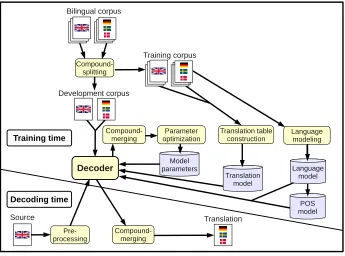
Figure 1 gives an overview of the translation process with compound processing. Compounds are split before training the translation system, and merged after transla-tion. We use factored decoding (Koehn and Hoang 2007), where features other than just surface words can be used by the system. In our case we tag the data with parts of speech and use a factored model with POS-tags on the target side, which allows us to have a POS-sequence model, beside the standard language model. This configuration has a very small overhead compared with decoding without factors. As we show, using part-of-speech tags on the target side helps to improve the coalescence of compound parts, and can be used to guide the merging process.
[image:8.486.50.395.380.636.2]For the tuning step there are two options: either we can split the development set and tune with a translation with split compounds compared with a reference with split
Figure 1
compounds, or we can merge compounds in the translation output, before performing the optimization. We found empirically that we got the best results using the second approach, of performing compound merging during the tuning process. When we tuned on split texts, the results were more unstable, and especially the number of words in the translation output varied substantially. We thus use merging also during the tuning process in all experiments, as shown in Figure 1.
5. Compound Splitting
Our method for compound splitting is based on Koehn and Knight (2003) and Stymne (2008). For each word all possible segmentations are explored, with the restrictions that all parts must have at least three characters, and the last part, the compound head, must have the same part-of-speech tag as the word itself. Hyphens are treated as additions to compound modifiers, just as+sor+e. Segmentations are scored with the arithmetic mean of frequencies for each part in the training corpus and the segmentation with the highest score is chosen.
We have investigated several variants of the basic method and their effects on compound translation. The variants investigated are:
r
Using geometric or arithmetic mean for choosing the highest frequencycandidate split
r
Restricting the length of each split part, either to three or four charactersr
Restricting the highest number of parts per compound to two, or allowingany number of compound parts
r
Allowing all known compounding forms (c.f. Table 1), or restricting themto the most common ones
r
Restricting the last part of the compound to be known from the corpuswith the same part-of-speech tag as the full compound, or allowing all possible parts-of-speech tags
6. Promoting Coalescence of Compounds
In this section we describe our approach to improve the coalescence of compounds, which is based on POS-sequence models. We first present the representation schemes we use for compounds, which form the basis of the sequence model approach, and then describe the sequence modeling approach in more detail. Finally, we discuss how POS-tags can be used for count features.
6.1 Representation of Compound Parts
As a result of compound splitting the segmentation of words is changed, and we know from Table 1 that compounding forms often do not coincide with any forms that can be used as standalone words. This raises several design decisions:
2. Should compound modifiers be marked with a special symbol? Or should the separation between compound parts be marked?
3. How should compound parts be tagged in a factored system?
Although apparently innocuous, these decisions do have some influence on the whole process. In this work we have used three combinations of marking and normalization, and three different tagsets.
In Example (4a), called theunmarkedscheme, compound modifiers are normalized (kamps->kamp) and the words carry no special marking. In Example (4b), called the marked scheme, compound modifiers are not normalized, but they are marked with the symbol “#”. For these two marking schemes, an extended tagset,EPOS, is used. It contains tags for compound modifiers that also indicate the part of speech of the head word, such as “N-modif” if the head is a noun (N) or “ADJ-modif” if the head is an adjective (ADJ).
In Example (4c), called thesepmarkedscheme, the split itself is marked, by using the special token “@#@” to mark split points, and compound modifiers are normalized. In this case we use a standard POS-tagset with the addition of a COMP-tag for the inserted split-token, and use the POS-tags that were found for the compound modifiers when they were looked up in the monolingual corpus during splitting. We call this tagset theSPOS-tagset.
(4) a. fem+kamps+seger:N (pentathlon (five battle) victory) fem:N-modif kamp:N-modif seger:N
b. fem+kamps+seger:N (pentathlon (five battle) victory) fem#:N-modif kamps#:N-modif seger:N
c. fem+kamps+seger:N (pentathlon (five battle) victory) fem:NUM @#@:COMP kamp:N @#@:COMP seger:N
As a third alternative tagset we use a modified variant of the EPOS-tagset, where distinctions among parts of speech that are not relevant to the formation of compounds are blurred. This reduces the tagset to only a few tags, as in the case where only nouns are split:
r
N-modif – all parts of a split compound except the lastr
N – the last part of the compound (its head) and all other nounsr
X – all other tokens6.2 Part-of-Speech–Based Sequence Models
If compounds are split in the training data, then there is no guarantee that translations of components will end up in contiguous positions and in the correct order. This is primarily a language model problem, and we will model it as such by applying sequence models on the customized part-of-speech sets. These sequence models can be either standard language models trained on texts where split compound modifiers are marked with symbols, or they can be POS-sequence models trained on the specially designed tagsets, such as EPOS. Both these types of models can encourage compound parts to occur in the correct order; the former, however, is a more lightweight approach, because it relies on surface words.
A language model solution to compound coalescence could be viewed as a soft constraint in the decoder, which encourages good sequences of compound parts over bad sequences. An alternative to this would have been a hard constraint in the decoder that prohibits compound parts to be placed in an incorrect order. We opted for a soft constraint approach because we found that it gave sufficiently good results, and because previous work on soft versus hard constraints for other areas has shown that soft constraints give more stable and generally better results, for instance, for phrase cohesion (Cherry 2008).
As described in the previous section, we can add special POS tags and symbols to identify compound modifiers. Table 2 shows examples of the different representation schemes. We can then train a *POS n-gram sequence model using any of the *POS-tagsets, which naturally steers the decoder towards translations with good relative placement of these components.
A lightweight model that gives some additional information of the order of com-pound parts compared to a language model on unmarked data is to train language mod-els on texts where compounds are represented either using the marked or sepmarked schemes but without parts-of-speech tags. These models are, however, not as strong as the *POS-based models, since they cannot generalize from surface words, and mainly can aid in keeping known compounds together.
6.3 Sequence Models as Count Features
[image:11.486.54.443.582.662.2]We expect a *POS-based n-gram sequence model to learn to discourage sequences unseen in the training data, such as the sequence of compound parts not followed by a suitable head. Such a generative LM, however, might also have a tendency to bias
Table 2
Examples of representation schemes for the German phrasedie Fremdsprachenkenntnisse
[the knowledge of foreign languages/ foreign language knowledge], originally tagged as
DET N(oun).
Original die Fremdsprachenkenntnisse
Unmarked die fremd sprache kenntnisse
Marked die fremd# sprachen# kenntnisse
Sepmarked die fremd @#@ sprache @#@ kenntnisse
EPOS DET N-Modif N-Modif N
RPOS X N-Modif N-Modif N
Table 3
Tag combinations in the translation output.
Combination Judgment Boost Punish
N-Modif N Good 1 0
N-Modif N-Modif Good 1 0
N-Modif</s> Bad 0 1
N-Modif X Bad 0 1
all other combinations Neutral 0 0
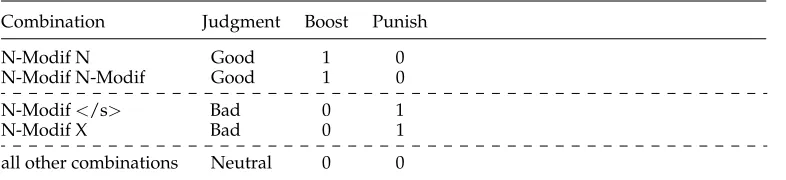
lexical selection towards translations with fewer compounds, since the corresponding tag sequences might be more common in text. To compensate for this bias, we experi-ment with injecting a little dose of a priori knowledge, and add a count feature, which explicitly counts the number of occurrences of RPOS-sequences that we deem good and bad in the translation output. Table 3 gives an overview of the possible bigram combinations, using the three-symbol tagset, plus sentence beginning and end markers, and their judgment as good, bad, or neutral.
We define two new feature functions: the boost model counting the number of occurrences of Good sequences, and the punish model, counting the occurrences of Bad sequences, as indicated in Table 3. In the punish model we want to punish the two bad combinations, where compound modifiers are placed in isolation without a suitable head. In the boost model, we want to support the formation of compounds by rewarding the two good combinations. We definitely want to boost the combination of a compound part with its head. In addition, we can boost the formation of long compounds by boosting the combination of two compound modifiers as well. The boost and punish models can be used either in isolation or combined, with or without a further *POS n-gram sequence model.
To exemplify the two models, consider the translation hypothesis given in Exam-ple (5). The word pairs skogs bruks and bruks plan, marked in bold in the example, constitute good sequences of a modifier followed by another modifier or a head, and would give the count 2 with a boost model. The word sequence in italics, skogs av, constitutes a bad sequence, since the prepositionav(of) cannot be a compound head, and would give the count 1 to a punish model. The other word sequences do not influence either of these models because they do not involve any compound modifiers.
(5) En|Xskogs|N-Modif bruks|N-Modif plan|Nger|X en|X ¨oversikt|Nskogs|N-Modif av|X
A forest cultivation plan gives an overview forest of
7. Compound Merging
Figure 2
Overview of the reverse normalization algorithm, exemplified using the compound
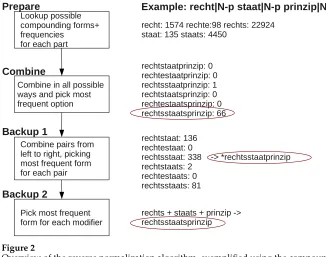
Rechtsstaatsprinzip[rule-of-law principle/ right-state principle]. The chosen option for each strategy is circled.
In this section we first describe reverse normalization, then we describe our new heuristic merging methods and modifications to existing heuristics. Finally we describe a novel sequence-labeling formulation for compound merging.
7.1 Reverse Normalization
For compound modifiers that were normalized in the training data the reverse process (reverse normalization) is needed at merging time to recreate the correct form for the specific compound. We designed a method for reverse normalization that is based on corpus frequencies of compound modifiers and compounds that can be collected during compound splitting.
The strategy is illustrated and exemplified in Figure 2.2First we look up all known
compounding forms, and their frequencies for all the compound modifiers. In Figure 2, for instance, we found three options for the wordrecht[right], withrechtsbeing the most common option. Next, we try all combinations of forms to form a full compound, and if any matches are found we pick the most frequent match. If this fails we have two back-up strategies. First, we try to find known compounding forms for pairs of parts, starting from left to right, looking up frequencies of the resulting forms from adding two parts. If that fails we use our second back-up strategy, which is to use the most common form of each modifier, and concatenate those. For binary compounds, the second strategy is
superfluous, because there is only one pair of compound parts, and the second strategy is always used.
7.2 Heuristic Approaches to Compound Merging
We have investigated three major approaches to heuristic compound merging. Our major contribution is a novel merging method based on part-of-speech matching. We contrast this method with adaptations of previous merging suggestions based on sym-bols and word lists. We also suggest improvements to these methods, and combination methods that combine the strengths of word lists and parts of speech.
7.2.1 POS-Based Merging.The POS-match algorithm uses the fact that it is possible to have several output factors besides surface form in a factored translation system. It merges words that are marked as compound modifiers in either the EPOS or RPOS tagsets if the next POS-tag matches. As described in Section 6.1, the part of speech of a compound modifier is based on the part of speech of its head word, so a word is consid-ered matching if the next word is a compound modifier of the same type, or a head with a matching part of speech. In addition, if the next word does not match, the modifier could be part of a coordinated compound, which is checked by seeing if the next word is a conjunction, in which case a hyphen is added to the modifier. We investigated versions of the algorithm both with and without treatment of coordinated compounds.
If a compound modifier is followed by anything other than a matching part of speech or a conjunction it has most likely been misplaced in the translation process. These items are left as they are in the translation output, which is often fine, because only compound parts that occur as separate words in a corpus are split. When two matching compound modifiers are merged, the process is iterated to see if the next word is a matching compound modifier, head, or conjunction. This allows compounds with an arbitrary number of parts to be merged.
In summary, the POS-based merging algorithm has the following steps:
r
Step through each word+POS pair from left to right3r
If a compound-POS,X-MODIF, is found:– Remove mark-up of the part if present – Store the compound part
– When the next POS is a matching part,X-MODIF: Remove mark-up of the part if present
Store the compound part
– If the next POS is a matching head,X: Store the compound head
– If at least two parts have been found (either several modifiers or a head):
Perform reverse normalization on the stored parts if parts are normalized
Merge all parts
For Swedish and Danish: remove a consonant if any of the merges resulted in three identical consecutive consonants
– If the next POS is a conjunction and no head was found: Add a hyphen at the end of the compound part
This heuristic has the advantage over previous merging algorithms that it can form novel compounds while reducing the risk of erroneous merging through the matching constraint. It is also the only merging method we are aware of that addresses coordi-nated compounds. However, it requires a factored decoder that can carry part-of-speech tags through the translation process. It also requires tagsets where compound modifiers are marked based on the compound head, such as EPOS or RPOS. In the current form the POS-match strategy cannot be used for the SPOS-tagset that does not use head-based tags for compound modifiers, because we cannot enforce the matching constraint in this way. It would be possible to design a POS-match strategy based on standard tags, which for instance allowed merging of noun+noun, but not of noun+preposition. Such a strategy requires linguistic knowledge and customization for each language, however.
7.2.2 Other Merging Heuristics.The symbol-based method is inspired by work on mor-phology merging (El-Kahlout and Oflazer 2006; Virpioja et al. 2007). It merges words that are marked with a symbol with the next word in the marked scheme. In the sepmarked scheme, when a standard symbol is found, the words on both sides of it are merged. These algorithms have the disadvantage, compared with the POS-match algorithm, that it is more likely that words are merged into non-compounds, since no matching check is carried out.
We have also investigated methods based on word lists, proposed by Popovi´c, Stein, and Ney (2006). These methods use frequency word lists compiled at split time. Three types of lists were used: lists of compound modifiers, of compounds, and of words. If a compound modifier is encountered, it is checked whether merging it with the next word results in either another compound modifier, or a compound or word. Unlike Popovi´c, Stein, and Ney (2006), we perform this process recursively, to allow compounds with several parts. Again, reverse normalization is performed when needed. Still, no novel compounds can be formed, and coordinated compounds are not handled. The method does not merge words into non-words, but there is another risk, that of merging words that should be separate in a specific context, but that happen to form a valid compound or other word when combined, such as the examples in Example (6). It has the advantage over the other proposed methods that it can be used on output from any MT decoder, without the use of customized POS-tags or symbols in the output. We investigate the usage of two types of frequency lists for this strategy, either a list of compounds, which can be created as a byproduct of the splitting algorithm, like Popovi´c, Stein, and Ney (2006), or by using a list of all words in a corpus.
(6) DE bei der (at the) beider (both) SV f ¨or sm˚a (too small)
f ¨orsm˚a (spurn)
potentially block both examples in Example (6). Compound and bigram frequencies can be computed on any available monolingual corpus in the domain of interest. We also investigated combinations of the heuristics by using either the union or intersection of merges from two different strategies.
7.3 Compound Merging as Sequence Labeling
Besides extending and combining existing heuristics, we propose a novel formulation of compound merging as a sequence labeling problem. The opposite problem, compound splitting, has successfully been cast as a sequence labeling problem before (Dyer 2010), but here we apply this formulation in the opposite direction.
Depending on choices made at compound splitting time, this task can be either a binary or multi-class classification task. If compound parts were kept as-is, the merging task is a simple concatenation of two words, and each separation point must receive a binary label encoding whether the two tokens should be merged. If compounds were normalized at splitting time, the compound form has to be restored before concatenat-ing the parts. This can be modeled either as a multi-class classifier that has the possible boundary transformations as its classes or in a two-step process where the form of words are modeled in a separate step after the binary merging decision. In the latter case it is possible to use the reverse normalization process described in Section 7.1. In this work we limited our attention to binary classification.
Consider for instance translating into German the English in Example (7).
(7) Europe should promote the knowledge of foreign languages
Assuming that the training corpus did not contain occurrences of the pair (knowledge of foreign languages,‘fremdsprachenkenntnisse’) but contained occurrences of ( knowl-edge,‘kenntnisse’), (foreign,‘fremd’), and (languages,‘sprachen’), then the translation model from English into decomposed German could be able to produce Example (8).
(8) Europa sollte fremd sprachen kenntnisse f ¨ordern
We cast the problem of merging compounds as one of making a series of correlated binary decisions, one for each pair of consecutive words, each deciding whether the whitespace between the two words should be suppressed (label 1) or not (label 0). In the example case, the correct labeling for the sentence would be{0,0,1,1,0}, reconstructing the correct German as shown in Example (9).
(9) Europa sollte fremdsprachenkenntnisse f ¨ordern
Although in principle one could address each atomic merging decision indepen-dently, it seems intuitive that a decision taken at one point should influence merging decisions in neighboring separation points, especially because compounds can be made up of more than two parts. For this reason, instead of a simple (binary or n-ary) classification problem, we prefer a sequence labeling formulation.
a compound if a modifying element (non-head) has been observed and tagged as such in the training data.
The array of sequence labeling algorithms potentially suitable to our problem is fairly broad, including hidden Markov models (Rabiner 1989), conditional random fields (CRFs) (Lafferty, McCallum, and Pereira 2001), Semi-CRFs (Sarawagi and Cohen 2004), structured perceptrons (Collins 2002), structured support vector machines (Tsochantaridis et al. 2005), Max-Margin Markov networks (Taskar, Guestrin, and Koller 2003), and more. Because the focus of this work is on the application rather than on a comparison among alternative structured learning approaches, we limited ourselves to a single implementation. Considering its good scaling capabilities, capability to handle strongly redundant and overlapping features, and widespread recognition in the NLP community, we chose to use CRFs.
7.3.1 Features.Each sequence item (i.e., each separation point between words) is repre-sented by means of a vector of features. Our aim was to include features representing the knowledge available to the heuristics, such as part-of-speech tags, frequencies for compounds and bigrams, as well as comparisons between them. Features were also inspired by previous work on compound splitting, with the intuition that features that are useful for splitting compounds could also be useful for merging. Charactern-grams have successfully been used for splitting Swedish compounds, as the only knowledge source by Brodda (1979), and as one of several knowledge sources by Sj ¨obergh and Kann (2004). Friberg (2007) tried to normalize letters, besides using the original letters. Although she was not successful, we still believe in the potential of this feature. Larson et al. (2000) used frequencies of prefixes and suffixes from a corpus as a basis of their method for splitting German compounds. We used the following features where -N refers to the nth position before the merge point, and +N to the nth position after the merge point:
r
Previous tagr
Surface words: word-2, word-1, word+1, bigram word-1–word+1r
Parts of speech: POS-2, POS-1, POS+1, bigram POS-1–POS+1r
Charactern-grams around the merge point– three-character suffix of word-1 – three-character prefix of word+1
– Combinations crossing the merge points: 1+3, 3+1, 3+3 characters
r
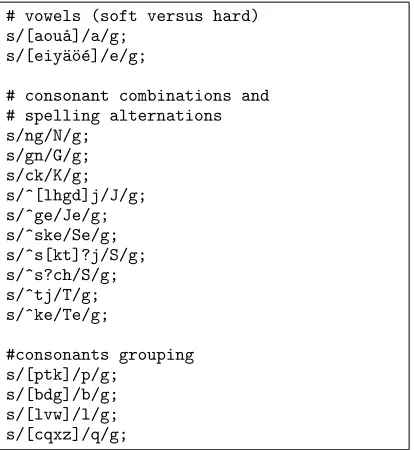
Normalized charactern-grams around the merge point, where charactersare replaced by phonetic approximations and grouped according to phonetic distribution, see Figure 3 (only for Swedish)
r
Frequencies from the training corpus, binned by the following method:¯ f =
10log10(f) iff>1
f otherwise
for the following items: – Bigram: word-1,word+1
# vowels (soft versus hard) s/[aou˚a]/a/g;
s/[eiy¨a¨o´e]/e/g;
# consonant combinations and # spelling alternations s/ng/N/g;
s/gn/G/g; s/ck/K/g; s/^[lhgd]j/J/g; s/^ge/Je/g; s/^ske/Se/g; s/^s[kt]?j/S/g; s/^s?ch/S/g; s/^tj/T/g; s/^ke/Te/g;
#consonants grouping s/[ptk]/p/g;
[image:18.486.50.257.63.288.2]s/[bdg]/b/g; s/[lvw]/l/g; s/[cqxz]/q/g;
Figure 3
Transformations performed for normalizing Swedish characters (Perl notation).
– Word-1 as a true prefix of words in the corpus – Word+1 as a true suffix of words in the corpus
r
Frequency comparisons of two different frequencies in the training corpus,classified into four categories: freq1=freq2=0, freq1<freq2, freq1=freq2, freq1>freq2
– word-1,word+1 as bigram vs. compound – word-1 as true prefix vs. single word – word+1 as true suffix vs. single word
7.3.2 Training Data for the Sequence Labeler. Because features are strongly lexicalized, a suitably large training data set is required to prevent overfitting, ruling out the possibil-ity of manual labeling.
We created our training data automatically, using a subset of the compound merg-ing heuristics described in Section 7.2.2, plus an additional heuristic enabled by the availability, when estimating parameters for the CRF, of a reference translation: Merge if two tokens are observed combined in the reference translation (possibly as a sub-sequence of a longer word). We compared multiple alternative combinations of heuris-tics on a validation data set. The validation and test data were created by applying all heuristics, and then manually having the positive instances checked.
of it, and then label decision points according to the heuristics. This would, however, imply making a large fraction of the data unavailable to the training of the SMT system.4 We thus settled for a compromise: We trained the SMT system on the whole training data, translated the whole source side, and then labeled decision points according to the heuristics. The translations we obtain are thus biased, of higher quality than those we should expect to obtain on unseen data. Nevertheless they are substantially more similar to real SMT output than the reference translations with automatic splits.
8. Experiments
In this section we report experimental results for the strategies proposed in this article. We first describe, in Section 8.1, the overall experimental set-up. We then report on the experiments, as follows:
r
In Section 8.2 we report on general effects of compound processing.r
Section 8.3 reports effects on coalescence of different representationschemes. Here we do not vary merging or splitting.
r
Section 8.4 reports on compound splitting and the way different parametersettings affect translation quality. Here we do not vary representation scheme or merging.
r
Section 8.5 reports results from varying the merging process. In particularwe compare the novel sequence labeling method with the heuristic methods. Here we do not vary representation scheme or splitting.
r
In Section 8.6 we apply the overall best strategies to corpora of differentsizes and to out-of-domain data.
8.1 Experimental Set-up
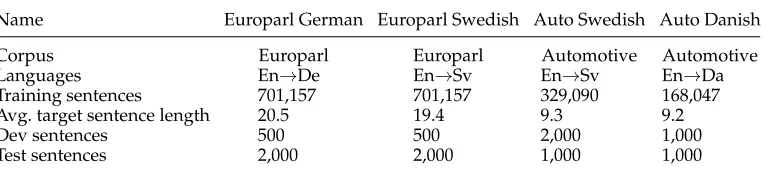
We performed experiments on translation from English into German, Swedish, and Danish, all of which have closed compounds. We tested all experimental conditions on Europarl (Koehn 2005) for translation from English to German. We also give contrasting results on English–Swedish Europarl and for an automotive corpus for translation from English to Swedish and Danish. The automotive corpus was gathered from translation memory data. The two corpora are quite different. The automotive corpus is from a limited domain, and of a homogeneous nature, whereas Europarl is more diverse, and tends to have a more complex language than the automotive corpus. Table 4 summa-rizes the sizes for the corpora that we used in Sections 8.2–8.5. The German test set is thetest2007set from the WMT 2008 workshop.5We have chosen to use a smaller part
of Europarl, to reduce runtimes and allow more experiments. In Section 8.6 we report results from scaling experiments and on out-of-domain data.
Table 4
Overview of the experimental settings for the experiments in Sections 8.2–8.5.
Name Europarl German Europarl Swedish Auto Swedish Auto Danish
Corpus Europarl Europarl Automotive Automotive
Languages En→De En→Sv En→Sv En→Da
Training sentences 701,157 701,157 329,090 168,047
Avg. target sentence length 20.5 19.4 9.3 9.2
Dev sentences 500 500 2,000 1,000
Test sentences 2,000 2,000 1,000 1,000
We used factored translation (Koehn and Hoang 2007) in our experiments, with both surface words and part-of-speech tags on the target side, with a sequence model on parts-of-speech. For part-of-speech tagging we used TreeTagger (Schmid 1994) for German, an in-house hidden Markov model tagger based on Cutting et al. (1992) for Danish and Swedish, and for Swedish also the Granska tagger (Carlberger and Kann 1999). For the majority of experiments we used the Moses decoder (Koehn et al. 2007), which is a standard phrase-based statistical decoder, which allows factored decoding. For word alignment, Giza++ (Och and Ney 2003) was used and for language modeling we used SRILM (Stolcke 2002). For parameter optimization we used minimum error rate training (Och 2003). For each experiment we ran minimum error rate training three times in order to reduce the effect of optimizer instability, and report the average result and standard deviation. In the merging experiments based on sequence labeling we used the CRF++ toolkit.6For the merging experiment with sequence labeling, we used
the Matrax decoder (Simard et al. 2005) on the automotive corpus. Matrax is a phrase-based decoder that allows discontiguous phrases, and parameter optimization phrase-based on gradient descent for smoothed NIST. We extended the original Matrax decoder with factored decoding on the target side.
Compounds were split before training using the corpus-based method described in Section 5. Except for the experiments comparing different compound merging methods, we used the POS-match merging algorithm developed by us.
We report results on three metrics: Bleu (Papineni et al. 2002), NIST (Doddington 2002), and Meteor. For Meteor we use the version tuned on adequacy and fluency (Lavie and Agarwal 2007) for German, and the original version with default weights (Banerjee and Lavie 2005) for Swedish and Danish, since there is no tuned version for those languages. For Bleu and Meteor we use the %-notation. Significance testing was performed using approximate randomization (Riezler and Maxwell 2005), with 10,000 iterations, on output based on three optimizer runs, as recommended by Clark et al. (2011).
8.2 General Effects of the Compound Processing Strategy
One effect of compound splitting is that the number of word types is reduced. Tables 5 and 6 show the number of types (number of unique words) and tokens (total number of words) and the type/token ratio for Europarl in the different representation schemes. The type count and the type/token ratio in the baseline system are much higher in
Table 5
Type and token counts and ratio for the German Europarl corpus.
System Tokens Types Ratio
German
baseline 14,356,051 184,215 1.28%
marked 15,674,728 93,746 0.60%
unmarked 15,674,728 81,806 0.52%
sepmarked 17,007,929 81,808 0.48%
[image:21.486.51.444.243.325.2]English 15,158,429 63,692 0.42%
Table 6
Type and token counts and ratio for the Swedish Europarl corpus.
System Tokens Types Ratio
Swedish
baseline 13,603,062 182,000 1.34%
marked 14,401,784 107,047 0.74%
unmarked 14,401,784 100,492 0.70%
English 15,043,321 67,044 0.45%
German and Swedish than in English, and is drastically reduced after compound splitting in all markup schemes, even though it is still higher than in English. One reason for the type count still being higher in German and Swedish than in English is morphological complexity, which is low in English and higher in German and Swedish. The type count is higher in the marked representation scheme than in the other schemes due to the fact that compound modifiers are marked, and do not coincide with other words as they do in the other schemes.
We believe that the fact that compound splitting leads to both type and token counts that are more similar to English is a positive thing, because it likely contributes to making the two languages structurally more similar, which makes the SMT pro-cess easier. This is supported by Birch, Osborne, and Koehn (2008), who showed that morphological complexity of a target language correlates negatively with Bleu scores. A lower type/token ratio translates into fewer out of vocabulary (OOV) words, and can give more accurate probability estimates for the SMT translation and language models.
Table 7
Average phrase lengths and English/German length ratios in the phrase table and during translation for German Europarl. German-m is German with merged compounds, where we calculated the phrase length as if compounds were merged using the POS-match method.
Baseline Unmarked
English German English German German-m
Phrase table Phrase lengthPhrase ratio 1.95 2.760.86 1.91 2.880.81 2.680.86
[image:22.486.51.430.268.342.2]Translation Phrase lengthPhrase ratio 2.46 2.291.19 2.48 2.511.10 2.331.17
Table 8
Average phrase lengths and English/Swedish length ratios in the phrase table and during translation for Swedish Europarl. Swedish-m is Swedish with merged compounds, where we calculated the phrase length as if compounds were merged using the POS-match method.
Baseline Unmarked
English Swedish English Swedish Swedish-m
Phrase table Phrase length 1.95 2.76 1.96 2.81 2.70
Phrase ratio 0.86 0.85 0.88
Translation Phrase length 2.51 2.22 2.61 2.38 2.29
Phrase ratio 1.21 1.75 1.22
8.3 Promoting Compound Coalescence
In this section we describe three sets of experiments that investigate the use of the *POS-tagsets in sequence models and as count features. In the first experiment we explore the effect of different representation schemes for translation into German, and in the second experiment we do the same, on a smaller scale, for Swedish. In the third experiment we investigate the effect of the RPOS-tagset and the boost and punish models. In all experiments merging was performed using the POS-match heuristic (see Section 7.2.1), except for the sepmarked scheme that used the SPOS-tagset that does not allow this type of POS-match, and for which the symbol merging algorithm (see Section 7.2.2) was used.
Table 9
Translation results for different representation schemes on German Europarl. Significant differences (positive or negative) from the baseline are marked *(5% level) and **(1% level), and differences from baseline+POS are marked similarly with #.
Bleu NIST Meteor
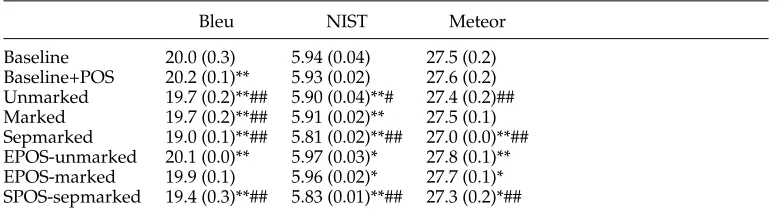
Baseline 20.0 (0.3) 5.94 (0.04) 27.5 (0.2)
Baseline+POS 20.2 (0.1)** 5.93 (0.02) 27.6 (0.2)
Unmarked 19.7 (0.2)**## 5.90 (0.04)**# 27.4 (0.2)##
Marked 19.7 (0.2)**## 5.91 (0.02)** 27.5 (0.1)
Sepmarked 19.0 (0.1)**## 5.81 (0.02)**## 27.0 (0.0)**##
EPOS-unmarked 20.1 (0.0)** 5.97 (0.03)* 27.8 (0.1)**
EPOS-marked 19.9 (0.1) 5.96 (0.02)* 27.7 (0.1)*
SPOS-sepmarked 19.4 (0.3)**## 5.83 (0.01)**## 27.3 (0.2)*##
say which of these classification systems are preferable, but at least it is clear that the use of EPOS-tags are useful.
A more detailed analysis was performed of the compound parts in the output. The outcomes of the merging process were classified into four groups: known compounds; novel compounds; parts of coordinated compounds; and unmerged, single parts. They were further classified into good or bad outcomes. Compounds were judged as bad if they formed non-words or had the wrong form, and compound parts were judged as bad if they should have been merged with the next word, or did not work as a standalone word.
[image:23.486.57.438.533.663.2]Table 10 shows the results of this analysis. The majority of the merged compounds are known from the training corpus for all representation schemes. There is, again, a marked difference between the systems that use POS-match merging and the sep-marked systems that do not have that information. The sepsep-marked system found the highest number of novel compounds, but also had the highest error rate, which shows that it is useful to match POS-tags. The EPOS systems have a higher number of novel compounds than the marked and unmarked options without an EPOS model. All these systems had a low error rate of the novel compounds, however. Very few errors were due to reverse normalization; In the EPOS-unmarked system there were only three such errors.
Table 10
Analysis of merged compounds from different representation schemes. The sepmarked systems do not do any matching, and can thus not leave any single parts.
EPOS- EPOS- SPOS- unmarked marked sepmarked
unmarked marked sepmarked
Known 3,339 3,375 3,594 3,747 3,587 3,762
Novel Good 168 105 176 104 93 245
Bad 20 8 97 10 7 64
Coordinated GoodBad 439 423 439 4222 445 377
Single part Good 6 5 – 136 33 –
Bad 11 16 – 52 46 –
Generally, the percentage of bad parts or compounds is lower for the systems with a *POS-sequence model, which shows that the sequence model is useful for the ordering of compound parts. The number of single compound parts is also much higher for the systems without a POS sequence model.
The number of compounds found by the splitting algorithm in the German ref-erence text was 4,472. All systems produce fewer compounds than this number. The numbers in Table 10 cannot be directly compared to the baseline system, however, because we do not know which words in its output are compounds.
[image:24.486.52.432.535.662.2]An indication of how many compounds there are in a text is the number of long words. In the reference text there are 231 word types with at least 20 characters and 1,178 word types with at least 15 characters, which we used as the limits for long words. Other length limits give similar results. Table 11 gives data on absolute numbers of these long word types and recall, precision, and F-score compared with long words found in the reference for the different systems. The distribution of long words in the systems with compound processing generally follows the distribution of compounds from Table 10, which indicates that this is a good indicator of the number of compounds. Both baseline systems have fewer long words than all compound processing systems, indicating that the split-merge strategy does indeed help in increasing the number of compounds in the translation output. The SPOS systems had the highest number of long words; for up to 15 characters there are even more long words than in the reference. The EPOS systems have the same number for up to 15 characters, but a bit lower for up to 20 characters. The EPOS systems also have the highest recall of all systems for both character lengths. The F-scores are similar for the baseline systems and the EPOS systems, with the baseline higher on precision, and the EPOS systems higher on recall. Although the baseline has a higher precision, the absolute number of overlapping words is still higher in many of the systems with compound processing—for instance, for words of up to 20 characters there are 431 in EPOS-unmarked compared with 388 in baseline+POS. It is important to notice, however, that the reference is not a trustworthy gold standard, because there are many possible alternative good translations, and the real quality of long words are likely underestimated. Thus, as can be seen in Table 10, the clear majority of produced compounds in the EPOS systems are judged acceptable, even though the precision of overlap for long words with the reference is at most 47% for the EPOS models.
Table 11
Number of long word types in the translations, and R(ecall), P(recision), and F(-score) compared with long word types in the reference.
≥20 chars ≥15 chars
Number R P F Number R P F
Reference 231 – – – 1,178 – – –
Baseline 157 .27 .49 .35 743 .33 .53 .41
Baseline+POS 151 .26 .49 .34 733 .33 .53 .41
Unmarked 192 .27 .40 .32 826 .34 .49 .40
Marked 217 .29 .38 .33 862 .35 .48 .40
Sepmarked 279 .28 .28 .28 1,031 .33 .38 .35
EPOS-unmarked 231 .30 .37 .33 936 .36 .46 .40
EPOS-marked 233 .30 .37 .34 895 .36 .47 .41
Table 12
Results for Swedish Europarl. Significant improvements over baseline+POS are marked **(1% level).
System Bleu NIST Meteor
Baseline+POS 21.6 (0.0) 6.11 (0.00) 57.8 (0.1)
EPOS-unmarked 22.0 (0.1)** 6.14 (0.01) 58.3 (0.1)**
EPOS-marked 21.9 (0.0) 6.21 (0.00)** 58.3 (0.0)**
8.3.2 Experiment 2. To further test whether a compound processing strategy using a customized tagset is useful, we performed experiments on an additional language pair, English–Swedish. In this case we always used the successful EPOS-tagset, in combina-tion with either the marked or unmarked representacombina-tion of compounds.
Table 12 shows the results for translation into Swedish. Both systems with com-pound processing have higher scores on all metrics. The difference is significant on Meteor, and on either Bleu or NIST for the two systems with compound processing. The only significant differences between using marked and unmarked representations is that the marked system is better on NIST.
To investigate compound translation specifically, we manually classified the system translations corresponding to the first 100 compounds in the reference text that had a clear counterpart in the English source text. As good translations we considered identical translations to the reference, and alternative translations with the same mean-ing, which we also distinguished between other compounds, single words, or other constructions. We also had a category for word groups that were translated as separate words, but should have been compounded, split compounds.
The result of this evaluation can be seen in Table 13. There are more translations that are identical to the reference in the two systems with splitting, but the total number of identical and alternative translations is approximately the same in the three systems. The number of split compounds is higher in the baseline system. The unmarked system produces more split compounds and partial translations than the marked system. This can be seen as an indication of marking having an effect, which, however, is not clear in the automatic evaluation.
[image:25.486.53.438.557.664.2]We also investigated the quality of the merged compounds, especially with regard to the reverse normalization that is needed in the unmarked systems, where compound-ing forms were normalized. There were no mergcompound-ing errors in the marked system. In the
Table 13
Analysis of the translations of 100 source items yielding compounds in a Swedish reference text.
Baseline+POS EPOS-Unmarked EPOS-Marked
Identical comp. 48 53 57
Alt. compound 14 9 10
Alt. word 16 16 12
Alt. other 9 8 9
Split compound 7 5 3
Partly transl. 4 7 4
No equivalent 0 0 2
Table 14
Results of coalescence experiment on the automotive corpus. Scores that are significantly different from the baseline are marked *(5% level), and differences from Baseline+POS are marked with #.
Auto Danish Auto Swedish
Bleu NIST Meteor Bleu NIST Meteor
Baseline 81.3 (0.0) 9.74 (0.01) 89.5 (0.1) 67.7 (0.3) 9.96 (0.02) 85.4 (0.1)
Baseline+POS 81.4 (0.1) 9.73 (0.02) 89.5 (0.1) 67.8 (0.1) 9.94 (0.03) 85.1 (0.1)
EPOS 80.6 (0.2)* 9.67 (0.02) 89.1 (0.2) 68.5 (0.2) 10.06 (0.01)* 85.5 (0.2)
RPOS 80.9 (0.2) 9.69 (0.03) 89.4 (0.2) 68.5 (0.2)* 10.07 (0.02)*# 85.8 (0.1)#
boost 81.0 (0.3) 9.72 (0.03) 89.7 (0.2) 68.3 (0.1) 10.05 (0.01)* 85.7 (0.0)#
punish 80.7 (0.1) 9.70 (0.01) 89.4 (0.1) 68.3 (0.2) 10.04 (0.01)* 85.7 (0.1)#
RPOS+boost 81.0 (0.1) 9.73 (0.01) 89.7 (0.2) 68.2 (0.2) 10.04 (0.02) 85.7 (0.2)
RPOS+punish 81.0 (0.1) 9.71 (0.03) 89.6 (0.2) 68.2 (0.2) 10.04 (0.03)* 85.6 (0.2)#
unmarked system there were only two minor errors due to failed reverse normalization. The first error is a missing insertion of an+sformedlem/+s/l¨ander(member countries) and in the second case, *samh¨all/-e+s/politiska(socio-political), a combination change-e/+sis wrong.
8.3.3 Experiment 3.In the third set of experiments with factored translation models we investigated the RPOS tagsets and the use of count features for the Danish and Swedish automotive corpus and German Europarl. Compound parts were merged using the POS-match heuristic.
Results on the two automotive corpora are shown in Table 14. The scores are very high, which is due to the fact that it is an easy domain with many repetitive sentence types. In this case there are no significant differences between the two baselines when using a POS-model. For Swedish, the results are overall higher for the systems with compound splitting, a difference that is significant for some systems and metrics. Over-all, the RPOS system performs best for Swedish, with results significantly better than at least one baseline on all metrics. For Danish, on the other hand, the only significant difference between any baseline and system with splitting is for the EPOS system, which is slightly worse than the baseline with POS. For the other systems there are no significant differences to the baseline.
[image:26.486.49.434.589.662.2]Table 15 shows results using RPOS for German Europarl. For this corpus neither the RPOS model nor the boost and punish models works well. They all give significantly worse results than the baseline. As we have seen before, however, the EPOS model gives competitive results to the baseline for this corpus.
Table 15
Results of coalescence experiment on German Europarl. Scores that are significantly different from the Baseline+POS are marked with **(1% level).
System Bleu NIST Meteor
Baseline+POS 20.2 (0.1) 5.93 (0.02) 27.6 (0.2)
EPOS 20.1 (0.1) 5.97 (0.03) 27.7 (0.1)
RPOS 16.5 (0.1)** 5.32 (0.03)** 25.0 (0.2)**
boost 16.3 (0.2)** 5.29 (0.03)** 24.8 (0.3)**
Overall, we found that it was successful to use *POS-sequence models in a factored translation model in order to handle compound coalescence. Our best models with compound splitting perform at least on par with the baseline, and sometimes better. We also showed that there are other advantages to using compound processing, especially that the number of long words are similar to the baseline, which is not the case for our baseline systems, which have too few long words. We also showed that *POS-sequence models are essential for the compound processing approach to be successful. On Europarl the EPOS-tagset was the most successful, whereas the RPOS-tagset and count features could help for the automotive domain.
8.4 Influence of Splitting Strategies
In the following experiments we investigated how compound splitting strategies of different quality influenced the suggested compound processing method. In order to do this we performed an intrinsic evaluation of several splitting methods, and compared it to translation results using the same splitting strategies. In this experiment we used German Europarl.
We used a modified version of the splitting strategy of Koehn and Knight (2003) as a basis for the comparison, and applied it to all nouns, adjectives, adverbs, and verbs of minimum length six characters into parts of minimum three characters, by allowing all splits where the parts were found in a corpus, and were tagged as content words. Parts were allowed to be modified by all compound suffixes from Langer (1998). The best splitting option, which can be no split, was chosen based on the arithmetic mean of the corpus frequencies of the parts. We also imposed the restriction on the compound head that its part-of-speech tag needs to be the same as for the full word. We call this system arith. In other variants of splitting strategies, one feature at the time was changed, based on the arith system:
geom – using the geometric mean instead of the arithmetic mean
eager – choosing the split with the highest number of parts, instead of using the arithmetic mean
part4 – limiting the length of compound parts to four characters max2 – limiting the maximum number of parts per compound to two common – only allowing the common compound suffixes-s, -es, -n, -nen
anypos – not using part-of-speech tags
The corpus frequencies were gathered from the target side of the training corpus. We compared the systems with compound splitting with a factored baseline system without any compound processing.
one-to-one evaluation is shown in Table 16. The same metrics and categories as in Koehn and Knight (2003) were used:
correct split: words that were correctly split
correct not: words that should not be split and were not wrong not: words that should be split but were not
wrong faulty: words that were split but in an incorrect way wrong split: words that should not be split but were
precision: (correct split) / (correct split + wrong faulty + wrong split) recall: (correct split) / (correct split + wrong faulty + wrong not) accuracy: (correct) / (correct + wrong)
The splitting options have their strengths on different metrics, with three different methods having the best results for the three metrics used. Compared to the arith method it can be seen that both imposing length restrictions and using the geometric mean increases the results on all three metrics. Limiting the number of parts gives the highest recall. Using only common compound suffixes gives higher precision, and not using part-of-speech gives lower precision. The baseline system without splitting actually has the highest accuracy. To a large extent this is due to the fact that the test set is taken from running text, with a high number of non-compounds.
Overall, the results for all splitting variations are quite low. However, most of the strategies tend to split too much rather than too little, which is preferable, because the phrase-based translation system has the possibility of recovering from over-splitting by handling compounds that are split into too many parts in consistent phrase pairs. Evaluation towards a one-to-one gold standard is rather harsh because the splitting algorithm has no knowledge of the corresponding English structure. If we instead use a gold standard of linguistically motivated compounds, which are many more (545 for the 5,000 word set), precision is much higher for all systems, with mostly a lower recall. For the arith system, for instance, the precision is more than doubled at .597 with a slightly lower recall of .522.
[image:28.486.53.434.552.663.2]The results for the translation task from English into German are shown in Table 17. In this experiment we used a different selection of 701K training sentences from Europarl than in Section 8.3, which resulted in overall lower scores both for the baseline and for the systems with compound processing. Overall, there are very small differences between both the baseline system and the systems with different types of splitting, and most of the small differences between the systems are not significant. The
Table 16
One-to-one correspondence of split compounds compared with a manually annotated gold standard for the different splitting methods.
Correct Wrong Metrics
split not not faulty split Precision Recall Accuracy
baseline 0 4,826 174 0 0 – 0 .966
arith 99 4,504 22 52 323 .209 .572 .921
geom 109 4,614 33 31 213 .309 .630 .945
eager 43 4,243 18 112 584 .058 .249 .857
part4 120 4,692 36 17 135 .441 .693 .962
max2 133 4,546 29 11 281 .313 .769 .936
common 99 4,714 58 16 113 .434 .572 .963
![Table 2Examples of representation schemes for the German phraseDET N(oun)[ die Fremdsprachenkenntnissethe knowledge of foreign languages / foreign language knowledge], originally tagged as.](https://thumb-us.123doks.com/thumbv2/123dok_us/1270568.655107/11.486.54.443.582.662/examples-representation-phrasedet-fremdsprachenkenntnissethe-knowledge-languages-knowledge-originally.webp)