Original Article
Effects of evidence-based nursing on compliance
behavior and quality of life of elderly patients
after artificial femoral head replacement
Jie Liu1, Fengjuan Wang2, Yu Yao2, Zhenzhong Wu3
Departments of 1Nursing, 2Anesthesiology, Affiliated Hospital of Changchun University of Traditional Chinese Medi-cine, Changchun 130021, Jilin Province, China; 3Department of Pain Treatment, Qianwei Hospital of Jilin Province,
Changchun, Jilin Province, China
Received May 22, 2019; Accepted August 5, 2019; Epub September 15, 2019; Published September 30, 2019
Abstract: Objective: This study aims to analyze the effects of evidence-based nursing (EBN) on compliance behavior and quality of life of elderly patients after artificial femoral head replacement (AFHR). Methods: Eighty-six elderly patients with femoral neck fracture (FNF) were included in the study, and randomized into a control group (routine nursing) and a study group (EBN) according to random number table. The two groups of patients were compared in terms of postoperative recovery, compliance behavior, complications, quality of life and nursing satisfaction. Results: The anal exhaust time, time to get out of bed and hospitalization time in the study group were signifi -cantly shorter than those in the control group. Compared with the control group, patients in the study group had significantly higher compliance behavior, quality of life and nursing satisfaction, and significantly lower incidence of complications (all P < 0.05). Conclusion: EBN for elderly patients with FNF during AFHR can shorten the patients’ treatment time, improve their cooperation, compliance behavior and nursing satisfaction, and reduce the incidence of complications, as well as improve their quality of life.
Keywords: Artificial femoral head replacement for the elderly, evidence-based nursing, compliance behavior, qual -ity of life
Introduction
Femoral neck fracture (FNF) is a common dis-ease accounting for 3.58% of all fractures and mostly seen in the elderly. Most elderly patients have fragile sclerotin and low reaction ability, so they are easy to develop FNF after subjected to external forces [1, 2]. The disease is current-ly treated by artificial femoral head replace -ment (AFHR), but the patients usually need to stay in bed for a long time after operation and suffer from various complications, which signifi -cantly prolong their treatment time and are not conducive to their rehabilitation [3]. Traditional nursing is single, fixed and passive, which lacks initiative and neglects mental nursing. There- fore, it easily leads to nurse-patient disputes and cannot meet patients’ needs.
Evidence-based nursing (EBN), also called “em- pirical nursing”, is the sublimation and reform
Materials and methods
Baseline information
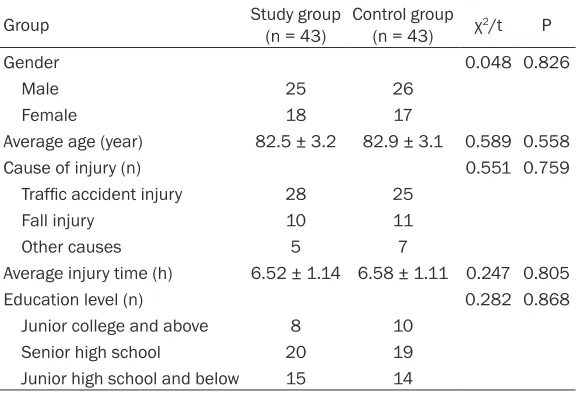
A total of 86 elderly patients with FNF admitted to Affiliated Hospital of Changchun University of Traditional Chinese Medicine from December 2016 to December 2018 were included in the study, all of whom were treated with AFHR. The patients were randomized into the control and study groups (n = 43 for each group) according to the random number table. In the study group, there were 18 females and 25 males, 78-86 years old with an average age of 82.5 ± 3.2 years. This group consisted of 28 cases of traf-fic accident injury, 10 cases of fall injury and 5 cases of other causes. The injury time was 3-10 hour with an average injury time of 6.52 ± 1.14 hour. There were 8 cases of junior college and above, 20 cases of senior high school and 15 cases of junior high school and below. In the control group, there were 17 females and 26 males, 75-85 years old with an average age of 82.9 ± 3.1 years. This group consisted of 25 cases of traffic accident injury, 11 cases of fall injury and 7 cases of other causes. The injury time was 4-9 hour with an average injury time of 6.58 ± 1.11 hour. There were 10 cases of junior college and above, 19 cases of senior high school and 14 cases of junior high school and below. There was no statistically signifi-cant difference in baseline information betwe- en the two groups (P > 0.05), which are compa-rable. More details are shown in Table 1. This study was approved by the Ethics Committee of Affiliated Hospital of Changchun University of
Patients with incomplete clinical data. (6) Pa- tients with surgical contraindications and blood and immune systems diseases. (7) Patients with depression and schizophrenia.
Methods
Patients in the control group received routine nursing. The patients were assisted to improve admission procedures, and complete relevant examinations (electrocardiogram, color Doppler ultrasound, biochemical tests, blood examina-tion, urine routine and stool routine) on the day of admission and the next day. Their conditions, changes of vital signs and incisions were moni-tored. They should follow the doctor’s advice strictly. In addition, the patients were informed of matters needing attention after admission, so that they and their families could adapt to the treatment environment as soon as possi- ble.
[image:2.612.91.379.85.283.2]Patients in the study group received EBN. (1) An EBN group composed of head nurses and nurs-ing staffs was established. The members had been professionally trained and exactly knew the purpose and content of EBN. They put for-ward evidence-based questions, searched key-words using the computer network according to the specific conditions of hospitals and pa-tients, and consulted relevant literatures, so as to analyze the causes of complications and slow recovery rate of patients with FNF during AFHR. (2) Evidence-based approach. The mem -bers searched in combination with the ques-tions raised, evaluated the scientificity and ef- Table 1. Comparison of baseline information
Group Study group (n = 43) Control group (n = 43) χ2/t P
Gender 0.048 0.826
Male 25 26
Female 18 17
Average age (year) 82.5 ± 3.2 82.9 ± 3.1 0.589 0.558
Cause of injury (n) 0.551 0.759
Traffic accident injury 28 25
Fall injury 10 11
Other causes 5 7
Average injury time (h) 6.52 ± 1.14 6.58 ± 1.11 0.247 0.805
Education level (n) 0.282 0.868
Junior college and above 8 10
Senior high school 20 19
Junior high school and below 15 14
Traditional Chinese Medicine. Patients and their families were informed and signed an informed consent form. Inclusion criteria: (1) Patients diagnosed by MRI and CT. (2) Patients whose onset was the first time.
Table 2. Comparison of postoperative recovery
Group Anal exhaust time (h) out of bed (d)Time to get Hospitalization time (d) Study Group (n = 43) 7.26 ± 0.94 4.26 ± 0.52 9.92 ± 0.94 Control Group (n = 43) 12.88 ± 1.84 7.88 ± 1.15 13.25 ± 1.97
t 17.836 18.808 10.004
[image:3.612.91.354.202.279.2]P 0.000 0.000 0.000
Table 3. Comparison of compliance behavior score (_x± sd) Group interventionBefore interventionAfter t P Study group (n = 43) 5.26 ± 0.35 10.02 ± 1.25 24.046 0.000 Control group (n = 43) 5.28 ± 0.32 8.25 ± 0.64 8.265 0.000
t 0.277 27.218
P 0.783 0.0000
fectiveness of the searched data, and then dis-cussed in groups, so as to determine the best nursing plan. (3) Specific nursing contents: 1) Health education. The nursing staffs explained the knowledge of the disease and the opera-tion to the patients and their families and ca- refully answered their questions, in order to im- prove their awareness of the disease and the operation. 2) Mental nursing. The nursing staffs carried out personalized psychological inter-vention on the patients based on various fac-tors, such as their education levels, occupa-tions, incomes and conditions. Successful cas- es of rescue were added into intervention con-tents to set an example for the patients and enhance their desire for survival [6]. 3) Pos- toperative basic nursing. The changes of the patients’ vital signs were closely monitored. In case of arrhythmia and elevated blood pres-sure, first aid medicine should be prepared for accurate rescue at any time. 4) Diet nursing. After operation, the patients had slow gastroin-testinal function because of staying in bed for a long time, so they should have bland diet and eat more foods containing protein, cellulose, calories, vitamins, etc. Raw, cold, spicy and stimulating foods were forbidden to keep defe-cation unobstructed. 5) Nursing of complica-tions. Elderly patients had poor immune func-tion so they were prone to incision infecfunc-tion. The nursing staffs closely observed changes of incision and regularly changed dressings to keep incision clean and dry. They strengthened the monitoring of skin temperature and color of the patients’ lower limbs, assisted the patients to turn over regularly, and massaged their lower
quality of life and nursing satisfaction were compared. Postoperative recovery included an- al exhaust time, time to get out of bed and hos-pitalization time.
Statistical methods
SPSS 25.0 was used to process the data. Measurement data were tested by t and ex- pressed as _x ± sd. Count data were tested by χ2 and expressed as n (%). P < 0.05 indicates a statistically significant difference.
Results
Comparison of baseline information
There was no statistically significant difference between the study and control groups in gen-der, age, cause of injury, injury time, education-al level and other baseline information (P > 0.05). More details are shown in Table 1. Comparison of postoperative recovery
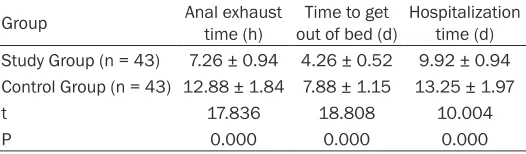
The postoperative recovery in the study group was significantly better than that in the control group (P < 0.05). More details are shown in Table 2.
Comparison of compliance behavior score
Before intervention, there was no statistically significant difference between the study and control groups in compliance behavior score (P > 0.05). After intervention, the score in the study group was significantly higher than that in
limbs timely and regularly, so as to avoid venous thrombosis. The nursing staffs guided the patients to carry out effective cough and deep-breathing exercises, in order to prevent lung infection [7]. (4) Work summary. The department regularly evaluated and reviewed the implementation of EBN, timely analyzed and summarized the pro- blems during nursing, and put for-ward targeted improvement pro- grams.
Outcome measures and evalua-tion criteria
the control group (P < 0.05). In the two groups, the score after intervention was significantly higher than that before intervention (P < 0.05). More details are shown in Table 3.
Comparison of incidence of complications
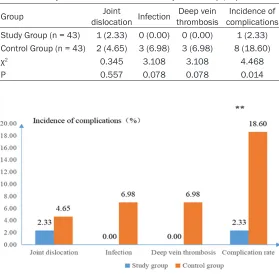
The incidence of complications in the study group was significantly lower than that in the
[image:4.612.92.371.81.355.2]ed, their femoral neck is easy to fracture, and FNF accounts for about 54% of hip fractures [10, 11]. AFHR can relieve the patients’ condi -tions in a short time. However, elderly patients need to stay in bed for a long time after opera-tion due to their old age, so they are prone to infections, lower limb thrombosis and dearticu-lation, which hinders their compliance behav-ior, significantly prolongs their hospitalization Table 4. Comparison of incidence of complications (n, %)
Group dislocation InfectionJoint thrombosisDeep vein complicationsIncidence of Study Group (n = 43) 1 (2.33) 0 (0.00) 0 (0.00) 1 (2.33) Control Group (n = 43) 2 (4.65) 3 (6.98) 3 (6.98) 8 (18.60)
χ2 0.345 3.108 3.108 4.468
P 0.557 0.078 0.078 0.014
control group (P < 0.05). More details are shown in Table 4 and Figure 1.
Comparison of quality of life score
Before intervention, there was no statistically significant dif -ference between the study and control groups in quality of life score (P > 0.05). After intervention, the score in the study group was significantly higher than that in the control group (P < 0.05). In the two groups, the score after inter-vention was significantly high -er than that before int-erven- interven-tion (P < 0.05). More details are shown in Table 5.
Comparison of nursing satis-faction
The nursing satisfaction in the study group was significantly higher than that in the control group (P < 0.05). More details are shown in Table 6.
Discussion
With the advancement of China’s aging population in recent years, the incidence of FNF has significantly in-creased, which aggravates burdens on society and fami-lies [8, 9]. Due to the gradu- al degeneration of muscle gr- oups around the hip joint, el- derly patients are generally complicated with coronary he- art disease and diabetes, wi- th slow responses and osteo-porosis. After greatly
impact-Figure 1. Comparison of the incidence of complications between the two groups. Compared with the control group, **P < 0.05.
Table 5. Comparison of quality of life score (_x± sd)
Group interventionBefore interventionAfter t P Study group (n = 43) 62.62 ± 5.04 83.86 ± 9.85 12.588 0.000 Control group (n = 43) 62.59 ± 5.08 70.04 ± 6.01 6.183 0.000
t 0.028 7.871
[image:4.612.90.378.86.161.2]P 0.978 0.000
Table 6. Comparison of nursing satisfaction (n, %)
Group satisfiedVery Satisfaction satisfiedNot satisfactionTotal Study group (n = 43) 16 (37.21) 25 (58.14) 2 (4.65) 41 (95.35) Control group (n = 43) 10 (23.26) 20 (46.51) 13 (30.23) 30 (69.77)
χ2 9.719
[image:4.612.92.375.420.497.2] [image:4.612.90.372.532.610.2]time, increases their treatment expenses, and aggravates their own and their families’ psy -chological burden and pressure [12, 13]. In a study, nearly 22%-75% of patients with FNF cannot recover their hip joint function within 6 months after operation, and perioperative nur- sing greatly affects the postoperative recovery of the hip joint function [14].
In this study, the anal exhaust time, time to get out of bed and hospitalization time in the stu- dy group were significantly shorter than those in the control group. Compared with the control group, patients in the study group had signifi -cantly higher compliance behavior, quality of life and nursing satisfaction, significantly lower incidence of complications. In a study by Wang Xiaomei, the incidence of complications in the evidence-based group is 7.50%, significantly lower than 24.32% in the routine group, which is consistent with the results of this study [15]. This indicates that EBN is safe and effective in nursing after AFHR. The analysis is as follows. (1) EBN is a new nursing method. Nursing staffs discover the potential or existing health prob-lems of service objects through consultation, communication, examination and observation. Based on these problems, they look for credi-ble and valuacredi-ble scientific basis and carry out targeted nursing on patients, which makes up for single, passive and fixed traditional nursing [16-18]. (2) EBN strengthens the mental nurs-ing and carries out psychological intervention in multiple ways and methods, to urge patients to correctly treat FNF and AFHR and positively face treatment, which greatly reduces the stre- ss responses of patients during the peritive period and contributes to smooth opera-tion [19, 20]. (3) EBN helps patients adjust their diet structure and lifestyles, improves the pre-dictability of nursing staffs for perioperative risk events, and urges nursing staffs to adopt targeted and reliable nursing methods as early as possible, so as to minimize the incidence of complications and promote patients’ postoper -ative recovery [21, 22].
Small sample size and short research time in this study affect the reliability and generality of the results. Therefore, the sample size needs to be enlarged and the research time needs to be extended, to provide more scientific references for evaluating the feasibility of EBN in patients with FNF during AFHR.
In conclusion, EBN for elderly patients with FNF during AFHR can shorten the patients’ treat
-ment time, reduce the incidence of complica-tions, and improve the patients’ compliance behavior, quality of life and prognosis, so it is worthy of clinical trust.
Disclosure of conflict of interest
None.
Address correspondence to: Fengjuan Wang, De- partment of Anesthesiology, Affiliated Hospital of Changchun University of Traditional Chinese Medi- cine, No. 1478 Gongnongda Road, Chaoyang Dis- trict, Changchun 130021, Jilin Province, China. Tel: +86-0431-86177205; E-mail: wangfengjuan9x5@ 163.com
References
[1] Shi H, Xiao L, Wang Z. Curative effect of artifi -cial femoral head replacement and its effect on hip joint function and complications of se-nile patients with femoral intertrochanteric fracture. Exp Ther Med 2018; 16: 623-628. [2] Kitayama A, Hida M, Takami H, Hirata N, Degu
-chi Y, Miyagu-chi K, Nakazono M, Nakagawa R, Fukumoto N, Hamaoka K. Factors associated with psycho-cognitive functions in patients with persistent pain after surgery for femoral neck fracture. J Clin Med Res 2017; 9: 771-775.
[3] Ni LY, Sun CZ, Li BB. Application of iliac fascia block composite laryngeal mask anesthesia in elderly patients udergoing hip arthroplasty. Academic Journal of Second Military Medical University 2017; 38: 452-457.
[4] Wang Q. Application of evidence-based nurs-ing in laparoscopic surgery for colorectal can-cer. Guide of China Medicine 2016; 14: 216-217.
[5] Nandi S, Austin MS. Choosing a femoral head: a survey study of academic adult reconstruc-tive surgeons. J Arthroplasty 2017; 32: 1530-1534.
[6] Al-Ani AN, Cederholm T, Sääf M, Neander G, Blomfeldt R, Ekström W, Hedström M. Low bone mineral density and fat-free mass in younger patients with a femoral neck fracture. Eur J Clin Invest 2015; 45: 800-806.
[7] Seki N, Okuyama K, Kamo K, Chiba M, Shima-da Y. Negative magnetic resonance imaging in femoral neck stress fracture with joint effu-sion: a case report. Skeletal Radiol 2016; 45: 843-846.
[8] Bartlett CS 3rd, Birch CE. Femoral head reduc-tion osteoplasty for fracture dislocareduc-tion: a sur-gical technique. Injury 2015; 46: 1689-1694. [9] Yoo JH, Kim KT, Kim TY, Hwang JH, Chang JD.
dis-placed femoral neck fracture: necessity of rou-tine workup? Injury 2017; 48: 441-446. [10] Affatato S, Zavalloni M, Spinelli M. Long-term
in vitro wear performance of an innovative thermo-compressed cross-linked polyethyl-ene. Tribology International 2016; 43: 22-28. [11] Massironi S, Ulivieri FM, Marchelli D, Basilisco
G. Reduced bone mineral density in chronic intestinal idiopathic pseudo-obstruction. Am J Gastroenterol 2008; 103: 1579-1581. [12] Zhao D, Qiu X, Wang B, Wang Z, Wang W,
Ouy-ang J, Silva RM, Shi X, KOuy-ang K, Xu D, Li C, Zhong S, Zhang Y, Pinkerton KE. Epiphyseal arterial network and inferior retinacular artery seem critical to femoral head perfusion in adults with femoral neck fractures. Clin Orthop Relat Res 2017; 475: 2011-2023.
[13] Stoner R, Strambi F, Bohacek I, Smoljanovic T. Femoral head avascular necrosis is not caused by arthroscopic posterolateral femoroplasty. Orthopedics 2016; 39: 330.
[14] Sandiford NA, Misur P, Garbuz DS, Greidanus NV, Masri BA. No difference between trabecu-lar metal cones and femoral head allografts in revision TKA: minimum 5-year follow up. Clin Orthop Relat Res 2017; 475: 118-124. [15] Wang XM. The application effect of
evidence-based nursing in senile osteoporosis femoral neck fracture. Journal of Clinical Medicine in Practice 2015; 19: 174-175.
[16] Kloß H, Woydt M, Willmann G. Berechnung der Blitztemperaturen der Mikrokontakte in kün-stlichen Hüftgelenken unter Benutzung des Kontaktmodells von Greenwood-Williamson. Materialwissenschaft Und Werkstofftechnik 2015; 33: 534-543.
[17] Lazaro LE, Dyke JP, Thacher RR, Nguyen JT, Helfet DL, Potter HG, Lorich DG. Focal osteone -crosis in the femoral head following stable an-atomic fixation of displaced femoral neck frac -tures. Arch Orthop Trauma Surg 2017; 137: 1529-1538.
[18] Kester BS, Williams J, Bosco JA, Slover JD, Iorio R, Schwarzkopf R. The association between hospital length of stay and 90-day readmission risk for femoral neck fracture patients: within a total joint arthroplasty bundled payment initia-tive. J Arthroplasty 2016; 31: 2741-2745. [19] Samsami S, Saberi S, Sadighi S, Rouhi G.
Com-parison of three fixation methods for femoral neck fracture in young adults: experimental and numerical investigations. J Med Biol Eng 2015; 35: 566-579.
[20] Tannast M, Jost LM, Lerch TD, Schmaranzer F, Ziebarth K, Siebenrock KA. The modified Dunn procedure for slipped capital femoral epiphy-sis: the Bernese experience. J Child Orthop 2017; 11: 138-146.
[21] Kang JS, Jeon YS, Ahn CH, Roh TH. Osteosyn -thesis versus endopros-thesis for the treatment of femoral neck fracture in Asian elderly pa-tients. BMC Musculoskelet Disord 2016; 17: 264.