The development of a brief measure of learner autonomy in
university students
MACASKILL, Ann <http://orcid.org/0000-0001-9972-8699> and TAYLOR, Elissa
Available from Sheffield Hallam University Research Archive (SHURA) at: http://shura.shu.ac.uk/5766/
This document is the author deposited version. You are advised to consult the publisher's version if you wish to cite from it.
Published version
MACASKILL, Ann and TAYLOR, Elissa (2010). The development of a brief measure of learner autonomy in university students. Studies in Higher Education, 35 (3), 351-359.
Copyright and re-use policy
See http://shura.shu.ac.uk/information.html
1 Running Head: A. Macaskill & E. Taylor
The development of a brief measure of learner autonomy in university students
Ann Macaskill & Elissa Taylor
Psychology Research Group, Sheffield Hallam University, Sheffield, UK1
Received 25th March 2009
1
2 Abstract
A great deal of attention is paid to the requirement for university students to become
autonomous learners. A review of the literature revealed a lack of relatively short
psychometrically sound measures of autonomous learning despite its purported importance.
This study aimed to develop a brief psychometrically sound measure of autonomous learning
to facilitate empirical research in this area. Items for the scale were selected from reviewing
the literature and face validity was confirmed by experienced academics. In the first study,
first year psychology students (N =214) completed the measure. Principal components
analysis produced a 12 item measure with 2 subscales that appeared to be psychometrically
sound. The factor structure was reproduced with a more diverse group of undergraduates (N
=172) in a second study. The internal reliability and the concurrent validity of the scale were
both found to be satisfactory suggesting that this measure may prove useful to educational
researchers.
3 Introduction
It is frequently suggested that study at university requires students to become autonomous
learners (Bryde and Milburn 1990; Chemers, Hu, and Garcia 2001; Stephenson and Laycock
1993). However, there does not appear to be a single consensual definition of what is meant
by autonomous learning and indeed many articles appear to discuss autonomous learning
without defining exactly what they mean by it. In the early literature it is often referred to as
self-directed learning (Long 1989).
Autonomous learning is variously described as the learner's ability to acquire
knowledge or skills of value independently by processes that he/she determines (Chene 1983),
or as being a psychological characteristic of individuals who are able to independently direct
their learning (Knowles 1980; Merriam and Caffarella 1999; Ponton 1999). It has been
hypothesized that autonomous learning involves the application of personal initiative in
engaging with learning and finding resources and opportunities for learning, persistence in
learning, and resourcefulness (Ponton, Carr, and Confessore 2000). This latter definition
stresses the psychological characteristics of autonomous learners and follows from Long's
(1998) analysis that this psychological conceptualization is essential and sufficient to explain
what he termed self-directed learning and is more frequently now labeled autonomous
learning or independent learning.
As well as a history of competing definitions there was an apparent lack of any
relatively short, psychometrically sound measure of autonomous learning. Most research has
been undertaken on the processes associated with the facilitation of autonomous learning
rather than on the characteristics of autonomous learners and this may explain the dearth of
measures (Merriam and Caffarella 1999). The small amount of research on the characteristics
4 learning such as motivation to learn and perceived competence (Fazey and Fazey 2001)
rather than directly measure autonomous learning.
Historically, the most widely used measure is Guglielmino's (1977) Self-directed
Learning Readiness Scale but problems have been reported with the construct validity of this
scale and the recommendation is to discontinue using it (Candy 1991; Field 1989, 1991;
Straka and Hinz 1996). A full discussion on the short-comings of this measure is contained in
Fisher, King, and Tague (2001). A more recently developed measure is the Self-directed
Learning Readiness Scale for Nursing Education (Fisher et al. 2001). This is a fairly long
scale developed with a specific group of students in mind. It was felt that a shorter generic
scale designed specifically to measure what is currently understood as autonomous learning
in university students would be beneficial for research in this area. Frequently researchers
want to assess several variables hence the benefit of shorter measures so we do not
overburden our research participants. The aim was to develop a short psychometrically sound
measure with one group of students and validate it with a second more diverse student group
(Kline 2000).
Method Study 1
Participants
The participants were 214 first year psychology students (170 women and 44 men, mean age
= 19.11 years, SD =3.33), 197 were white British, 17 were British Asians and two were
Greek. They volunteered to complete the questionnaire during small group induction sessions
on their first day at university. The questionnaire was developed as part of a larger study
exploring characteristics of students that might influence autonomous learning.
5 The literature on autonomous learning was extensively surveyed with a particular focus on
how autonomous learning was conceptualized as described in the introduction. Statements
were then generated independently by the authors to reflect what was felt to be the core
components of autonomous learning as reflected in the existing literature. With the removal
of items that obviously duplicated each other, this produced a list of 16 items. The list was
further refined after consultation with a group of four experienced academics with expertise
in autonomous learning who judged that there was still duplication in the list. Three
additional statements were generated by one member but the consensual view was that these
statements were paraphrases of existing statements. This procedure ensured a satisfactory
level of face validity for the scale in an expert sample. The scale is presented as 14 statements
against which participants are asked to rateeach statement as it relates to them using a five
pointLikert scalewith Very like me at one end and Not at all like me at the other.
Results
The 14 items of the Learner Autonomy Scale were subjected to exploratory factor
analysis (principal components) in SPSS16.0. In the initial run, two items failed to load
substantially on any factor, using the Cohen (1988) criterion of a factor loading less than .40.
These two items were dropped from the scale. A solution was sought with the remaining 12
items after assessing suitability of the data set for factor analysis. Inspection of the correlation
matrix revealed many coefficients equal to or greater than .3 as recommended by Tabachnik
and Fidell (2001). The sample size was adequate with a Kaiser-Meyer-Oklin value of .83
(Kaiser 1970, 1974) and the Bartlett's Test of Sphericity (Bartlett 1954) was statistically
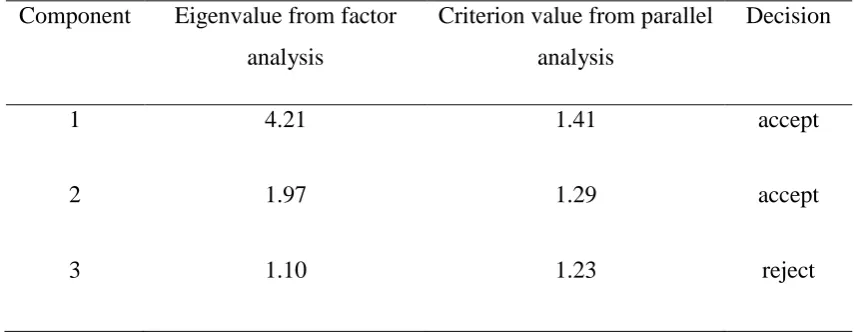
significant as required. The initial analysis revealed three components with eigenvalues
6 the Scree Test (Catell 1966) suggested two components. This was confirmed by a Parallel
Analysis using a Monte Carlo Principal Components Analysis for Parallel analysis.
-insert Table 1 about here-
As shown in Table 1, only two of the observed eigenvalues were greater than the
corresponding criterion values generated from with 100 randomly generated data samples of
the same size. Simple structure was sought on the remaining 12 items using varimax rotation
as the correlation between the factors was low varimax and oblim rotation produced the same
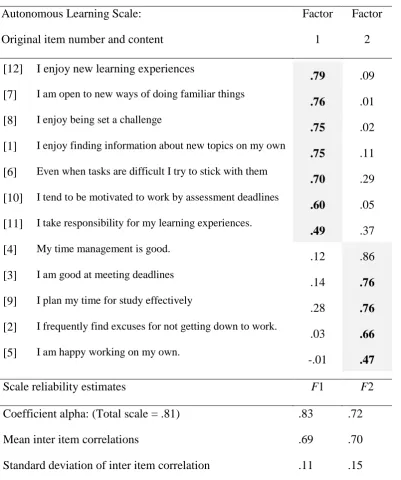
structure (Jennrich and Sampson 1966). The emergent factor loadings and scale reliability
estimates are shown in Table 2. A clear two-factor solution converged in three iterations. The
factors accounted for 29.29% and 22.21%of the variance respectively. While the factors
themselves were correlated (r = .26), the mean interitem correlations for each factor are
substantially larger than the correlations between each factor providing initial support for the
discriminant validity of a two-factor solution (Clark and Watson 1995). The Cronbach's
alphas are satisfactory for the scale and the 2 subscales as shown in Table 2.
-insert Table 2 about here-
Factor 1 consists of seven items which we have labelled Independence of Learning as
it reflects elements of responsibility for learning, openness to experience, intrinsic motivation,
with an element of self-confidence in tackling new activities, all core components of
autonomous learning. Factor 2 relates more to learning and study practices reflecting issues
of time management, procrastination, and attitude to lone working. Consequently, we have
labelled it StudyHabits.
7 To further test the validity of the measure we collected data from a different sample of
university students to see whether the factor structure would replicate and to measure the
concurrent validity of the scales using some other related measure (Kline 2000). From the
research literature the Self -directed Learning Readiness Scale (Fisher, King, and Tague 2001)
was located. This scale was developed to measure how prepared nurses were for self-directed
learning but the nursing related items had been removed and the authors suggested that the
scale could be used to measure general readiness to undertake independent learning. The
definition of self-directed learning associated with the scale relates to the amount of
responsibility the learner is prepared to take for their own learning and this obviously relates
to the requirements of autonomous learning. However, self-directed learning is
conceptualised as a method of instruction much used within nursing, where students on their
own have to undertake problem-based learning packages, complete reflective diaries, clinical
logs and the like. In this way it is more context specific than autonomous learning focussed as
it is on readiness to undertake individual independent learning projects but the underlying
demands on the learner should be similar. Scores on the Self-directed Learning Readiness
Scale should correlate with scores on the brief measure of learner autonomy in university
students being developed here. The decision was to use the Self-directed Learning Readiness
Scale as it appeared to be the most suitable measure available to test the concurrent validity
of the new scale.
Method
Participants and procedure
The participants were 172 undergraduate university students (143 women and 29 men, mean
age = 21.47 years, SD = 5.62), 162 were white British and 10 were British Asians. They came
8 on campus and in the library and asked whether they would complete the paper based
questionnaire. Other students received an email message advertising the study and asking
them to volunteer. For this group the data were collected anonymously through an online
survey through an electronic web link supplied in the email. It was made clear in the advert
that pressing the submit button on the questionnaire was taken as giving informed consent to
their participation. For the students completing the paper questionnaire, they were told that
the data collection was anonymous but returning the completed questionnaire to the
researcher was taken as providing informed consent. Ethical approval for the study was
obtained from the University Research Ethics Committee.
Measures
Self -directed Learning Readiness Scale (SDLRS), (Fisher, King, and Tague 2001)
consists of 40 items with three subscales assessing Self-management, I manage my time well
[item 1], Desire for Learning, I enjoy a challenge [item 17], and Self-control, I am
responsible for my own actions/decisions [item 23]. Items are rated on a five point Likert
scale from 1 (very unlike me) to 5 (very like me) with higher scores indicating higher levels of
readiness for independent learning. The alpha coefficients for the complete scale is .92, the
Self-management subscale is .85, the Desire for Learning subscale is .85, and the Self-control
subscale is .83. No other reliability data on the scale is currently available.
Autonomous Learning Scale is now a 12-item measure with two subscales
measuring Independence of Learning,I tend to be motivated to work by assessment deadlines,
[item 10] and Study habits, I frequently find excuses for not getting down to work,[item 2].
Responses are recorded on a 5-point Likert scale from 1 (very unlike me) to 5 (very like me)
9 positive attitudes to learning. Two items were negatively worded to help prevent response
bias in participants.
Results
The 12 items of the Learner Autonomy Scale were subjected to principal components
analysis in SPSS16.0 as described previously. This sample size was shown to be adequate
with a Kaiser-Meyer-Oklin value of .83 (Kaiser 1970, 1974) and the Bartlett's Test of
Sphericity (Bartlett 1954) was statistically significant as required and the correlation matrix
revealed many coefficients equal to or greater than .3 as recommended by Tabachnik and
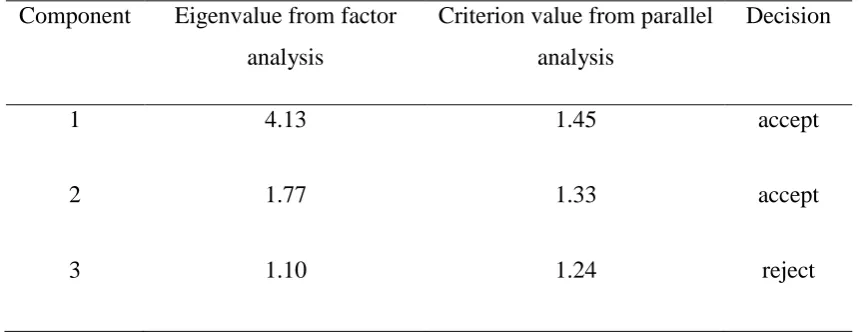
Fidell (2001). As in the previous study, the initial analysis produced three components with
eigenvalues greater than 1; however, the Scree Test (Catell 1966) suggested two components.
This was confirmed by a Parallel Analysis using a Monte Carlo PCA for Parallel analysis.
The observed eigenvalues and the corresponding criterion values generated in the parallel
analysis are shown in Table 3.
-insert Table 3 about here-
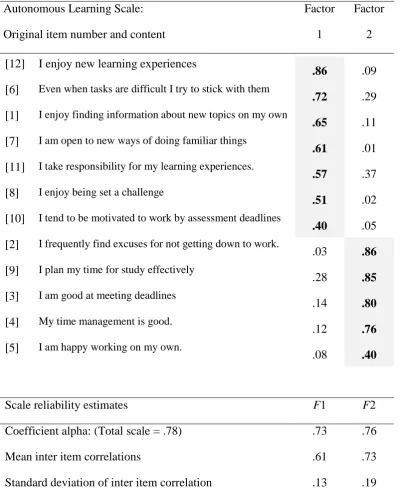
Using varimax rotation the same two- factor solution as found in the first study converged in
three iterations with this new sample and is shown in Table 4. The factors accounted for
25.55% and 24.04% of the variance respectively. Again the factors were correlated (r = .26),
with the mean interitem correlations for each factor being substantially larger than the
correlations between each factor providing additional support for the discriminant validity of
a two-factor solution (Clark and Watson 1995).
-insert Table 4 about here-
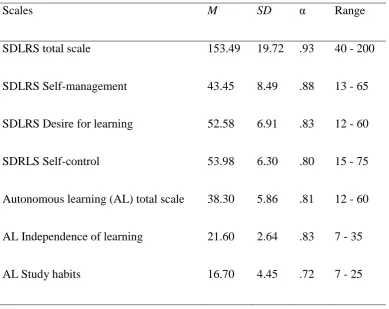
10 The means, standard deviations, ranges, and Cronbach's alphas for the variables
measured are shown in Table 5. The alpha levels for all the scales were satisfactory being
greater than the recommended .70, although the Cronbach's alphas for the new autonomous
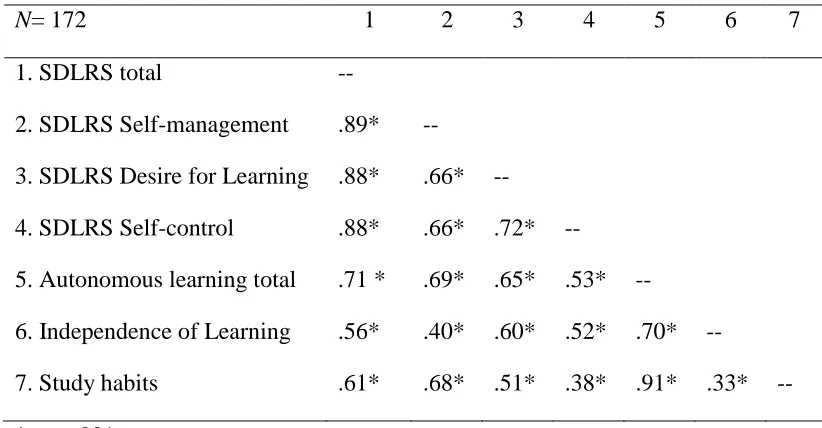
learning scale and the 2 subscales are lower than those reported in study 1. A Pearson product
moment correlation was computed to examine the associations between the variables as a test
of the concurrent validity of the new scale and the results are shown in Table 6. Kline (2000)
suggests that correlations > 0.4 indicate satisfactory levels of concurrent validity. The
hypothesis was that the overall scales are measuring very similar concepts and this is
reflected in a satisfactorily high correlation between the total scores on the two scales as
shown in Table 6. The subscales purport to measure slightly different aspects of autonomous
learning but even here, with the exception of the study habits subscale and the SDLRS
self-control subscale, all the other scales demonstrate satisfactory concurrent validity.
- Table 6 about here -
Discussion
There is a lack of relatively brief measures of autonomous learning. The most widely used
scale historically; the Self-directed Learning Readiness Scale (Guglielmino 1977) has been
shown to be psychometrically unsound. The more recently developed measure, the
Self-directed Learning Readiness Scale for Nursing Education (Fisher et al. 2001) was designed to
be context specific and is a relatively long measure with only limited psychometric data
available to support its use. It is argued that a brief measure of autonomous learning will be
beneficial to research in education. If the development of autonomous learners is one of the
11 Stephenson and Laycock 1993) then it is important that we develop tools to assist in its
assessment.
The 12 item scale that has been developed is psychometrically sound demonstrating
the same structure across two different samples of students. The items selected for the scale
all have a high degree of face validity with experienced academics. The factor structure and
the internal reliability of the scale have been confirmed using two different groups of
university students. The concurrent validity of the scale was measured against the
Self-directed Learning Readiness Scale for Nursing Education (Fisher et al. 2001) and found to be
satisfactory. There was however little cultural diversity in the participant groups in both
studies and the applicability of the measures across different cultural groups still needs to be
examined. We made no attempt to measure test-retest reliability, arguing that if university
education is aiming to promote learner autonomy we would expect to see changes in scores
so what we are measuring is the student's current state of autonomous learning.
The operational definition that is implicit in the measure suggests that autonomous
learners take responsibility for their own learning, are motivated to learn, gain enjoyment
from their learning, are open-minded, manage their time well, plan effectively, meet
deadlines, are happy to work on their own, display perseverance when encountering
difficulties and are low in procrastination when it comes to their work. Experienced
colleagues with an interest in autonomous learning have concurred with this
conceptualization of autonomous learning, although it is open to debate. We would argue that
the inclusion of such a specific definition of the autonomous learner will help to bring more
clarity to exactly what is being developed and measured.
We have not yet had the opportunity to test the predictive power of the scale. As
12 that they value it highly in graduates (Confederation of British Industry 1994) suggesting that
students who possess this ability will perform at a higher level. This still requires to be
assessed with reference to the measure in a future study when the data becomes available.
Acknowledgements
This research was supported by a grant from the Centre for Excellence in Teaching and
Learning, Centre for Promoting Learner Autonomy, Sheffield Hallam University. Thanks to
Yvonne Needham and Adam Sawczuk for their help with data collection and all the students
13 References
Bartlett, M. S. (1954). A note on the multiplying factors for various chi-square
approximations. Journal of the Royal Statistical Society 16 (Series B):296-298.
Bryde, J. F., and Milburn, C. M. (1990). Helping to make the transition from school to
college. In R. L. Emans (Ed.) Understanding undergraduate education (pp. 203-213).
Vermillion, SD: University of South Dakota Press.
Candy, P. C. (1991). Self-direction for life-long learning: A comprehensive guide to theory
and practice. San Francisco, CA: Jossey-Bass Publishers.
Catell, R. B. (1966). The Scree Test for the number of factors. Multivariate Behavioural
Research 1: 140-161.
Chemers, M. M., Hu, L., and Garcia, B. F. (2001). Academic self-efficacy and first-year
college student performance and adjustment. Journal of Educational Psychology 93:
55-64.
Chene, A. (1983). The concept of autonomy in adult education: a philosophical discussion.
Adult Education Quarterly 34 (1): 38-47.
Clark, L. A., and Watson, D. (1995). Constructing validity: Basic issues in objective scale
development. Psychological Assessment 7: 309-319.
Cohen, J. (1988). Statistical power analysis for the behavioral sciences. London: Lawrence
Erlbaum Associates.
Confederation of British Industry, (CBI) (1994). Thinking ahead: Ensuring the expansion of
14 Fazey, D. M. and Fazey, J. A. (2001). The potential for autonomy in learning: perceptions of
competence, motivation and locus of control in first-year undergraduate students.
Studies in Higher Education 26 (3): 345-361.
Field, L. (1989). An investigation into the structure, validity, and reliability of Guglielmino's
Self-directed Learning Readiness Scale. Adult Education Quarterly 39 (3): 125-139.
Field, L. (1991). Guglielmino's Self-directed Learning Readiness Scale: Should it continue to
be used? Adult Education Quarterly 41 (2): 100-103.
Fisher, M., King, J., and Tague, G. (2001). Self -directed Learning Readiness Scale. Nurse
Education Today 21: 516–525.
Guglielmino, L. M. (1977). Development of the Self-directed Learning Readiness Scale.
Unpublished doctoral dissertation, University of Georgia. Dissertation Abstracts
International 38:6467.
Jennrich, R. I., and Sampson, P. F. (1966). Rotation for simple loadings. Psychometrika 31:
313-323.
Kaiser, H. (1970). A second generation Little Jiffy. Psychometrika 35: 401-415.
Kaiser, H. (1974). An index of factorial simplicity. Psychometrika 39: 31-36.
Kline, P. (2000). A psychometrics Primer. London: Free Association Books.
Knowles, M. S. (1980). The modern practice of adult education: From pedagogy to
andragogy. New York: Cambridge Books.
Long, H. B. (1989). Self-directed learning: emerging theory and practice. In H.B. Long &
15 Norman: University of Oklahoma, Oklahoma Research Centre for Continuing
Professional and Higher Education.
Long, H. B. (1998). Theoretical and practical implications of selected paradigms of
self-directed learning. In H.B. Long & Associates (Eds.), Developing paradigms for
self-directed learning (pp.1-14). Norman: University of Oklahoma, Public Managers Centre,
College of Education.
Merriam, S. B., and Caffarella, R. S. (1999). Learning in adulthood: A comprehensive guide
(2nd ed.). San Francisco: Jossey-Bass.
Ponton, M. K., (1999). The measurement of an adult's intention to exhibit personal initiative
in autonomous learning (Doctoral dissertation, George Washington University).
Dissertation Abstracts International, 60:3933.
Ponton, M. K., Carr, P. B., and Confessore, G. J. (2000). Learning conation: A psychological
perspective of personal initiative and resourcefulness. In H.B. Long & Associates
(Eds.), Practice and theory in self-directed learning (pp.65-82). Schaumburg, IL:
Motorola University Press.
Stephenson, J., and Laycock, M. (1993). Using learner contracts in higher education.
London: Kogan Page.
Straka, G.A. and Hinz, I. M. (1996). The original Self-directed Learning Readiness Scale
reconsidered. Conference proceedings 10th International Self-Directed learning
Symposium. West Palm Beach, Fl. (March 6-10), p.18.
Tabachnik, B. G. and Fidell, L. S. (2001). Using multivariate statistics (4th edn.). New York:
16 Table 1. Comparison of eigenvalues from factor analysis and the corresponding criterion
values obtained from parallel analysis.
Component Eigenvalue from factor analysis
Criterion value from parallel analysis
Decision
1 4.21 1.41 accept
2 1.97 1.29 accept
17 Table 2. Principal components analysis results: Factor loading and reliability estimates.
Autonomous Learning Scale: Original item number and content
Factor 1
Factor 2
[12] I enjoy new learning experiences
.79 .09
[7] I am open to new ways of doing familiar things
.76 .01
[8] I enjoy being set a challenge
.75 .02
[1] I enjoy finding information about new topics on my own
.75 .11
[6] Even when tasks are difficult I try to stick with them
.70 .29 [10] I tend to be motivated to work by assessment deadlines
.60 .05 [11] I take responsibility for my learning experiences.
.49 .37
[4] My time management is good.
.12 .86
[3] I am good at meeting deadlines
.14 .76
[9] I plan my time for study effectively
.28 .76
[2] I frequently find excuses for not getting down to work.
.03 .66
[5] I am happy working on my own.
-.01 .47
Scale reliability estimates F1 F2
Coefficient alpha: (Total scale = .81) .83 .72
Mean inter item correlations .69 .70
18 Table 3. Comparison of eigenvalues from principal components analysis and the
corresponding criterion values obtained from parallel analysis in Study 2.
Component Eigenvalue from factor analysis
Criterion value from parallel analysis
Decision
1 4.13 1.45 accept
2 1.77 1.33 accept
19 Table 4. Principal components analysis study 2: Factor loading and reliability estimates.
Autonomous Learning Scale: Original item number and content
Factor 1
Factor 2
[12] I enjoy new learning experiences
.86 .09
[6] Even when tasks are difficult I try to stick with them
.72 .29
[1] I enjoy finding information about new topics on my own
.65 .11
[7] I am open to new ways of doing familiar things
.61 .01 [11] I take responsibility for my learning experiences.
.57 .37
[8] I enjoy being set a challenge
.51 .02 [10] I tend to be motivated to work by assessment deadlines
.40 .05
[2] I frequently find excuses for not getting down to work.
.03 .86
[9] I plan my time for study effectively
.28 .85
[3] I am good at meeting deadlines
.14 .80
[4] My time management is good.
.12 .76 [5] I am happy working on my own.
.08 .40
Scale reliability estimates F1 F2
Coefficient alpha: (Total scale = .78) .73 .76
Mean inter item correlations .61 .73
20 Table 5. Means, Standard Deviations, Alpha Coefficients, Ranges for the Scales and
Subscales (N = 172).
Scales M SD α Range
SDLRS total scale 153.49 19.72 .93 40 - 200
SDLRS Self-management 43.45 8.49 .88 13 - 65
SDLRS Desire for learning 52.58 6.91 .83 12 - 60
SDRLS Self-control 53.98 6.30 .80 15 - 75
Autonomous learning (AL) total scale 38.30 5.86 .81 12 - 60
AL Independence of learning 21.60 2.64 .83 7 - 35
21 Table 6. Correlations between Self -directed Learning Readiness Scale (SDLRS), the Autonomous Learning Scale and their subscales.
N= 172 1 2 3 4 5 6 7
1. SDLRS total --
2. SDLRS Self-management .89* --
3. SDLRS Desire for Learning .88* .66* --
4. SDLRS Self-control .88* .66* .72* --
5. Autonomous learning total .71 * .69* .65* .53* --
6. Independence of Learning .56* .40* .60* .52* .70* --
7. Study habits .61* .68* .51* .38* .91* .33* --
* p < .001