Agents for educational games and simulations
BEER, Martin <http://orcid.org/0000-0001-5368-6550>, BROM, Cyril,
DIGNUM, Frank and SOO, Von-Wun
Available from Sheffield Hallam University Research Archive (SHURA) at:
http://shura.shu.ac.uk/3731/
This document is the author deposited version. You are advised to consult the
publisher's version if you wish to cite from it.
Published version
BEER, Martin, BROM, Cyril, DIGNUM, Frank and SOO, Von-Wun (2011). Agents for
educational games and simulations. In: Agents for Educational Games and
Simulations, Taipei, May 2011. Taipei, ROC, AAMAS.
Copyright and re-use policy
See http://shura.shu.ac.uk/information.html
Tenth International
Conference on Autonomous
Agents and Multi-Agent
Systems (AAMAS)
at the Taipei International
Convention Center (TICC) in Taipei,
Taiwan
Workshop on the uses of
Agents for Education,
Games and Simulations
Monday 2nd May 2011
Organisers:
Martin Beer, UK. email: [email protected] Cyril Brom, CZ.
email: [email protected] Von-Wun Soo, TW
Preface
Training for complex situations in human societies such as in
edu-cation, business transactions, military operations, medical care and
crisis management can be provided effectively using serious games
and simulations. In these types of games and simulations the role
of agents to model and simulate naturally behaving characters
be-comes more and more important. Especially in situations where the
games are not just meant to provide fun, but are used to support
the learning process it is important that the games achieve their
goal and do not just distract (or entertain) the trainee. This
work-shop bringe sogether several strands that have been developing in
a number of different workshops at AAMAS over recent years, and
provides an opportunity to discuss common issues and to develop
common understanding.
A major aim of this workshop is to discuss how to model
ra-tional (or non-rara-tional, but natural) behaving agents who are
em-bedded in a social context with other characters and humans. This
is especially important when both characters and humans can be
pro-active but also have to react to the behaviour of others in their
environment. Thus these characters should have some social
con-science of themselves and others and base their decisions for actions
on this knowledge. Of course social knowledge may consist of
de-tailed knowledge such as that some person has been your long time
friend and thus can be trusted to help you, but also general
knowl-edge such as that society looks bad at people that cheat but adores
people that grasp opportunities. Thus we aim to model also different
levels of action and interactions. Both the operational ones such as
gestures and general way of animating characters, the tactical
deci-sions such as negotiation tactics when trying to get some help and
long term strategies such as behaving cooperative towards your boss
in order to secure a promotion. One of the interesting questions is
how these should be modelled and how they interact? And how do
current agent architectures support these models?
of concerns. Where game engines focus on real-time aspects and
thus propagate efficiency and central control, multi-agent platforms
assume autonomy of the agents. And while the multi agent platforms
offer communication facilities these can or should not be used when
the agents are coupled to a game. So, although increased autonomy
and intelligence may offer benefits for a more compelling game play
and may even be necessary for serious games, it is not clear whether
current multi agent platforms offer the facilities that are needed to
accomplish this.
The workshop therefore four main themes:
1. Technical
What techniques are suitable for agents that are incorporated
in educational contexts, games and simulations. How to balance
intelligence and efficiency? How to couple the agents to the game
or simulation and manage this couplings information flow? How
to deal with the inherent real time nature of the game engine
environment? How to couple long and short time interactions?
2. Conceptual
What information is available for the agents’ use, either through
the educational context, or from the system, through for
exam-ple, the game or simulation engine? How can reaction to events
be balanced with goal directed behaviour? How are ontological
differences between information used by agents and information
from the domain handled? How do we choose the actions of an
agent? Too high level gives little control; too low level makes the
agent inefficient.
3. Design
How do we design interactive systems containing intelligent agents?
How do we determine what agents should do and should not do,
such that local autonomy and story line are well balanced. How do
we design the agents themselves that are embedded in other
(pos-sibly diverse) systems (including the behaviour authoring tools
and methodologies)?
4. Education
It is also important that we introduce both the design and
con-struction of these collaborative autonomous systems into the
com-puter science curriculum and develop ways of encouraging their
effective utilisation across the curriculum. Contributions to the
workshop will be welcomed that provide a mixture of relevant
theoretical and practical understanding of both the teaching and
use of multi-agent systems in educational and entertainment
re-search, together with practical examples of the use of such
sys-tems in real application scenarios. These will be written for
stu-dents, teachers, producers, directors and other professionals who
want to improve their understanding of the opportunities offered
by the use of multi-agent systems in teaching and entertainment
scenarios of all types.
These are all issues that will become increasingly important as
agents are used increasingly to assist interactions with social and
other media. One interesting trend in the papers presented is the
interaction of agents with cooperative immersive environments, such
as Second Life, which raises a number of technical and social issues
that will need to be explored further in later workshops.
March 2011
Martin Beer
Cyril Brom
Von-Wun Soo
Frank Dignum
Organization
Organisers
Martin Beer, Communications and Computing Research Centre, ACES, Sheffield Hal-lam University, UK.
email: [email protected]
Cyril Brom, Department of Software & Computer Science Education, Faculty of Math-ematics and Physics, Charles University in Prague, CZ.
email: [email protected]
Von-Wun Soo, Department of Computer Science, Institute of Information Systems and Applications, National Tsing Hua University, Taiwan
email:[email protected]
Frank Dignum, Department of Information & Computing Sciences, Utrecht Univer-sity, NL.
email: [email protected]
Programme Committee
Elisabeth Andre (DFKI, GER)
Juan Carlos Augusto (University of Ulster, UK)
Paul Shueh-Min Chang, (National Tsing Hua University, TW) Vincent Corruble (LIP6, FR)
Virginia Dignum (Technical University Delft, NL) Hiromitsu Hattori (Kyoto University, JP) Dirk Heylen (Univ of Twente, NL) Koen Hindriks (Delft University, NL) Stefan Kopp (University of Bielefeld, GER) Mike van Lent (SOAR technology, USA) Michael Lewis (University of Pittsburg, USA) Simon Lynch (Univ. of Teeside, UK)
Emma Norling (MMU, UK) Anton Nijholt (UT, NL) Joost van Oijen (VSTEP, NL) Jeff Orkin (MIT, USA) Ana Paiva (IST, PT)
David Pynadath (USC, USA) Geber Ramalho (UFPE, BR)
Debbie Richards(Macquarie University, AUS) Avi Rosenfeld (JCT, IR)
Ilias Sakellariou (UOM, GR)
David Sarne (Bar Ilan University, IR) Barry Silverman (UPenn, USA)
Pieter Spronck (Tilburg University, NL)
Rainer Unland (University of Duisburg-Essen, GER) Joost Westra (UU, NL)
Contents
Preface
i
Organisation
v
Contents
vii
Middleware Architectures
Interfacing a Cognitive Agent Platform with Second Life
1
Surangika Ranathunga, Stephen Cranefield & Martin Purvis
CIGA: A Middleware for Intelligent Agents in Virtual Environments
17
Joost Van Oijen, Los Vanhe & Frank Dignum
How to compare usability of techniques for the specification of virtual
agents behavior? An experimental pilot study with human subjects
33
Jakub Gemrot, Cyril Brom, Joanna Bryson & Michal Bida
Agent Architectures
ADAPT: Abstraction Hierarchies to Better Simulate Teamwork
59
Meirav Hadad & Avi Rosenfeld
An Architecture for Affective Behaviours Based on Conservation of
Re-sources
75
Sabrina Campano, Etienne De Sevin, Vincent Corruble & Nicolas
Sabouret
Adaption and Emergance
Socially-aware emergent narrative
83
Sergio Alvarez-Napagao, Ignasi Gmez-Sebasti, Sofia Panagiotidi, Arturo
Tejeda, Luis Oliva & Javier Vzquez-Salceda
Organizing Scalable Adaptation in Serious games
91
Inferring Prgamatics from Dialogue Contexts in Simulated Virtual Agent
Games
109
Yu-Hung Chien & Von-Wun Soo
Dialogues and Learning
Dialog Designs in Virtual Drama: Balancing Agency and Scripted Dialogs 125
Edward C.-C. Kao, Von-Wun Soo
Collection and Analysis of Multimodal Interaction in Direction
Giv-ing Dialogues: Towards an Automatic Gesture Selection Mechanism for
Metaverse Avatars
141
Takeo Tsukamoto, Yumi Muroya, Masashi Okamoto & Yukiko Nakano
Learning by Playing in Agent-oriented Virtual Learning Environment
151
Yundong Cai & Zhiqi Shen
Interfacing a Cognitive Agent Platform with
Second Life
Surangika Ranathunga, Stephen Cranefield, and Martin Purvis
Department of Information Science, University of Otago, PO Box 56, Dunedin 9054, New Zealand
{surangika,scranefield,mpurvis}@infoscience.otago.ac.nz
Abstract. Second Life is a popular multi-purpose online virtual world that provides a rich platform for remote human interaction. It is in-creasingly being used as a simulation platform to model complex human interactions in diverse areas, as well as to simulate multi-agent systems. It would therefore be beneficial to provide techniques allowing high-level agent development tools, especially cognitive agent platforms such as belief-desire-intention (BDI) programming frameworks, to be interfaced to Second Life. This is not a trivial task as it involves mapping poten-tially unreliable sensor readings from complex Second Life simulations to a domain-specific abstract logical model of observed properties and/or events. This paper investigates this problem in the context of agent in-teractions in a multi-agent system simulated in Second Life. We present a framework which facilitates the connection of any multi-agent platform with Second Life, and demonstrate it in conjunction with an extension of the Jason BDI interpreter.
1
Introduction
Second Life [1] is a popular multi-purpose online virtual world that is increasingly being used as a simulation platform to model complex human interactions in diverse areas such as eduction, business, medical and entertainment. This is mainly because of the rich platform it provides for remote human interactions, including the possibility of enabling software-controlled agents to interact with human-controlled agents. Second Life is more sophisticated than conventional 2D simulation tools, and is more convenient than cumbersome robots, thus it has started to gain attention as a simulation platform for testing multi-agent systems and other AI concepts. It would therefore be beneficial to provide techniques allowing high-level agent development tools, especially cognitive agent platforms such as belief-desire-intention (BDI) programming frameworks, to be interfaced with Second Life.
the high volumes of potentially unreliable sensor readings an agent receives. As for the latter, it is important to identify ways of correctly interfacing the agents with their representation module inside Second Life (the Second Life avatar), because Second Life may have synchronization issues with respect to carrying out the actions specified by the agent model.
With the use of theLIBOMV client library [2], we have developed a frame-work that facilitates the connection of any multi-agent frameframe-work with Second Life and addresses the above challenges. The main focus of this paper is to high-light the importance and difficulty of creating an abstract logical model of the sensory inputs of an agent deployed in Second Life, and to present the solution we developed in our connection framework to address this problem.
Creating a high-level abstract logical model of agent sensory data involves two main steps: extracting sensory readings from Second Life accurately, and formulating a high-level domain-specific abstract logical model to be passed to an agent’s cognitive module. The latter has not gained much attention in the related research with respect to deploying intelligent agents inside Second Life.
In our framework, an agent deployed in Second Life can sense the Second Life environment around it with the use of its LIBOMV client, and the framework records these sensor readings. There are some difficulties in obtaining accurate sensor readings from Second Life simulations. Therefore we have introduced a novel technique in our framework, which extracts sensor readings from Second Life more accurately than the commonly used data extraction methods.
The extracted sensory data result in a high volume of low-level informa-tion (avatar and object posiinforma-tion informainforma-tion and avatar animainforma-tion informainforma-tion), making it difficult to directly use these data in an agent’s reasoning process. In order to convert this low-level information into a form that can be used by the multi-agent system, we employ a complex event processing mechanism and identify the high-level domain-specific complex events embedded in the re-trieved low-level data. The output of the framework is a snapshot of the Second Life environment that contains all the low-level and high-level events and other contextual information that took place in a given instant of time, encoded as propositions. This provides an agent a complete view of the environment around it, thus eliminating the possibility of having to base its reasoning on a partial set of data.
With the extended functionality of the Jason platform, we demonstrate how a Jason agent deployed in Second Life using our framework can take part in complex simulations and respond to the received percepts from Second Life, as well as to the identified fulfilments and violations of its expectations. The fulfilments and violations of an agent’s expectations are detected by an expec-tation monitor [4] that is integrated with the framework through an interface, and the agent’s expectations are defined as temporal logic formulae to be moni-tored by the expectation monitor. The framework forwards the processed sensory readings from Second Life to both the Jason environment and the expectation monitor. Therefore, in parallel to a Jason agent being able to respond to the observed changes in the environment, the expectation monitor matches these changes with the monitored formulae and identifies the fulfilment or violation of the defined expectations. The notifications of the identified fulfilments or vi-olations are also passed to the Jason agent, and the agent can have plans that respond to these identified fulfilments and violations.
The rest of the paper is organized as follows. Section 2 describes the poten-tial of Second Life as a simulation environment and the related implementation problems. Section 3 describes the developed framework and in Section 4, we demonstrate this developed system by means of an example. Section 5 discusses some related work. Section 6 concludes the paper.
2
Second Life as a Simulation Environment
Second Life provides a sophisticated and well developed virtual environment for creating simulations for different domains and to test AI theories, including agent-based modelling. With the average monthly repeated user logins at around 8000001, and with the virtual presence of many organizations, Second Life con-tains many interaction possibilities, which inherently lead to the provision of new scenarios to be used in simulations. Second Life is not restricted to a spe-cific gaming or training scenario. Developers can create a multitude of scenarios as they wish, using the basic building blocks that are provided. For example, in Second Life, these scenarios could be in the areas of education, business, enter-tainment, health or games. The significance of using Second Life scenarios lies in the fact that they can be carried out between software-controlled agents, and also between software-controlled agents and human-controlled agents.
Second Life has been identified as a good simulation platform for testing AI theories [5] and specifically multi-agent systems [6]. A detailed analysis on the benefits of using Second Life over traditional 2D simulations and physical robots has also been done [5], with the main advantage reported being the ability to create sophisticated test beds in comparison to 2D simulations, and more cost effective test beds when compared to physical robots.
Despite this, still we do not see Second Life being used for complex simula-tions of AI theories or multi-agent systems modelling. The lack of use of Second
1
Life as a simulation environment for AI research can be, to a certain extent, attributed to the previous lack of a convenient programming interface. Tradi-tional programming in Second Life is done using in-world scripts created using the proprietaryLinden Scripting Language (LSL). These scripts are associated with objects, and in order to use them to control an agent inside Second Life, the objects should be attached to the agent. This approach has many limitations when used for AI simulations, for reasons such as the limited control over the agent wearing the scripted object. We discuss this in more detail in Section 2.1. With the development of the third party library LibOpenMetaverse (LI-BOMV), Second Life can now be accessed through a more sophisticated pro-gramming interface. LIBOMV is a “.Net based client/server library used for accessing and creating 3D virtual worlds” [2], and is compatible with the Second Life communication protocol. Using the LIBOMV client-side API, “bots” can be defined to control avatars in Second Life. With appropriate programming techniques, the LIBOMV library can be used to create avatars that have be-havioural abilities similar to those controlled by humans. This includes moving abilities such as walking, running or flying, performing animations such as cry-ing, or laughcry-ing, communication abilities using instant messaging or public chat channels, and the ability to sense the environment around it.
2.1 Challenges in Monitoring Agent Interactions in Second Life
For Second Life simulations that contain a lot of agents and objects moving at speed, there is a challenge in retrieving accurate position information at a high frequency to make sure that important events are not missed out.
Although an in-world sensor created using an LSL script can retrieve accurate position information of avatars and objects, it has limitations when extracting position and animation information of fast moving objects and avatars. A sensor can detect only 16 avatars and/or objects in one sensor function call, and the maximum sensor range is 96 metres. One approach to overcoming this problem is to employ multiple sensors; however multiple scripts operating for long du-rations at high frequency introduce “lag” to the Second Life servers, i.e. they slow the rate of simulation. For the same reason and because of the imposed memory limitations on scripts, an LSL script cannot undertake complex data processing, and since there is no provision to store the recorded data in-world at runtime, recorded data must be communicated outside the Second Life servers using HTTP requests which are throttled to a maximum of only 25 requests per 20 seconds. Moreover, there is a possibility that avatar animations with a shorter duration (e.g. crying or blowing a kiss) may go undetected, because a sensor can record only animations that are played during the sensor operation.
However, this approach does have its own limitations which affect the ac-curacy of recorded information. As with other viewer clients, the Second Life server sends information to the LIBOMV client only if there is any change in the environment perceived by the LIBOMV client. This means that the client has to “assume” its perceived environment. For objects and avatars that are moving, the client has to keep on extrapolating their position values based on the previously received velocity and position values until it receives an update from the server. Extrapolated position values may not be completely in tally with the server-sent values and this situation is evident when extrapolating po-sition values for objects and avatars that move fast. Moreover, it was noted that there is an irregularity in the recorded position data for small objects that may easily go out of the viewing range of the LIBOMV client, which directly affects the recording of accurate position information for small objects.
In order to overcome these challenges, we introduce a combined approach (described in Section 3) based on attaching an object containing an LSL script to a LIBOMV client deployed in Second Life. These communicate with each other and produce near-accurate position information about avatars and objects that move at speed.
This data extraction mechanism can only generate low-level position and animation information, making it difficult for a multi-agent system to directly utilize the retrieved data. Therefore the retrieved data should be further pro-cessed to identify the high-level domain-specific information embedded in the low-level data. In doing this, it is important that the data collected using the LIBOMV client and the LSL script are formed into one coherent snapshot which resembles the state of the Second Life environment. When deducing the high-level domain-specific information, it is important that these coherent snapshots are used, in order to make use of all the events and other related information that took place in a given instant of time. Otherwise an agent’s decision may be based on partial information.
3
System Design
Fig. 1.Overall System Design
3.1 The Extended Jason Platform
The Jason platform we have integrated with the framework is an extended ver-sion [3] of Jason. The Jason agent platform contains an environment interface that facilitates the easy integration of Jason agents with other simulations. With this interface, it is possible to execute agent actions in an external simulated en-vironment and it is also possible to retrieve the sensory readings of the simulated environment to be presented as percepts for agents.
The extended version of the Jason architecture used in this work implements a tight integration of expectation monitoring with the Jason BDI agent model. With this Jason extension, domain-specific individual agents can directly react to the identified fulfilments and violations of their expectations, by specifying plans that are executed in response to those fulfilments and violations. The Jason interpreter is extended with built-in actions to initiate and terminate monitoring of expectations, and with these built in actions, any expectation monitoring tool can be “plugged in” to the Jason environment.
3.2 Interface Between the LIBOMV Client and the Jason Agent
client to log into the Second Life server, uttering something in the public chat channels, sending instant messages to other avatars, moving to a given location and executing an animation. It also defines how an agent platform can interpret a message sent by the LIBOMV client. These messages are formulated based on the environment information recorded and processed by the data processing modules of the framework. The Jason environment class makes use of this pro-tocol and converts the agent actions into the corresponding propro-tocol constructs and passes them to the LIBOMV client. Similarly, it interprets the messages sent by LIBOMV clients to generate percepts for the Jason agents.
The module that contains LIBOMV clients is capable of handling multiple concurrent LIBOMV clients and socket connections. Therefore if the correspond-ing multi-agent system is capable of creatcorrespond-ing concurrently operatcorrespond-ing agents, this can easily create a multi-agent simulation inside Second Life. Consequently, the module that contains the Jason platform is designed in such a way that it is ca-pable of handling multiple concurrent instances of socket connections connected to the Jason agents. As shown in Figure 1, a Jason agent connects to its in-terface socket through the Jason Environment class, and the Jason Connection manager interface. The Jason connection manager and the LIBOMV connection manager together ensure that all these individual Jason agents are connected to the correct LIBOMV client, through the interface sockets.
3.3 Interface Between the LIBOMV Client and the Second Life Server
As an attempt to overcome the limitations of data extraction using LSL and LIBOMV, we have implemented a combined approach to extract data from Sec-ond Life. In this new approach, a scripted object is attached to the bot deployed in Second Life, as shown in Figure 1. Detection of the avatars and objects to be monitored is done by the LIBOMV client, using their initial animation and movement updates that are received. Identification information for these identi-fied avatars and objects is then sent to the script. As the script already knows what is to be tracked, a more efficient, light-weight function can be used to record movement information instead of the normal LSL sensor function. Position and velocity data recorded by the script are sent back to the LIBOMV client, while avatar animation updates are directly captured by the LIBOMV client to make sure animations with short durations are not missed. Any messages received as instant messages or in the public chat channels are also directly captured by the LIBOMV client. With this combined approach, the LSL script guarantees the retrieval of accurate movement information, while the LIBOMV client takes the burden of complex data processing off the Second Life servers, thus providing an accurate and efficient data retrieval mechanism.
3.4 Data Processing Module
The responsibility of the data processing module is to map the received sensor readings from complex Second Life environments to a domain-specific abstract logical model. In essence, it creates snapshots of the system which include low-level movement and animation information of avatars and movement information of objects in the given Second Life environment in a given instant of time, along with the identified high-level domain-specific information and other contextual information, which are encoded as propositions.
Data Pre-Processor: First, the low-level data received from Second Life are used to deduce basic high-level information about the avatars and objects, e.g. whether an avatar is moving, and if so, in which direction and the movement type (e.g. walking, running or flying), and whether an avatar is in close proxim-ity to another avatar or an object of interest. Other contextual information such as the location of the avatar or the role it is playing can also be attached to this retrieved information as needed.
As mentioned above, the LIBOMV client receives movement information of objects and avatars from the script, and updates corresponding to avatar anima-tions and communication messages are directly captured by the LIBOMV client. This means that a received movement information update does not contain the information about the current animation of the avatars, and the received ani-mation and message updates do not contain the inforani-mation about the current position or velocity of the avatar. Moreover, these animation and communication updates do not contain the movement information of other avatars and objects in the environment, or animation information of avatars. However, whenever an update is received by the LIBOMV client (whether it be the movement updates from the script, or an animation or a communication update), it is important that we create a snapshot that contains movement and animation information of all the avatars and objects of interest, in order to make it a complete snapshot representing the Second Life environment.
contain any information related to other avatars and objects in that simulation as mentioned earlier. Whenever, a communication message is received by the LI-BOMV client, the movement and animation information of avatars and objects are generated for the time instant corresponding to that communication update, using the cached information. Thus, for every set of movement information sent by the script and every animation and communication message update sent by the Second Life server, the data pre-processor generates a complete snapshot of the environment that contains the avatar and object movement information and avatar animation information. These snapshots can be easily distinguished from each other with the use of the associated timestamp.
These processed data are then sent to another sub-component of the data pre-processor which prepares data to be sent to the complex event detection module. We specifically extracted this sub-component from the main data pre-processing logic in order to make it possible to easily customize the data preparation logic according to the selected complex event detection module. For example, for the complex event detection module we have employed currently, this sub-component decomposes the generated snapshot into the constituent data structures corre-sponding to individual avatars and objects, and sends the information related to objects to the complex event detection module before those corresponding to avatars.
Complex Event Detection Module: An event stream processing engine called Esper [8] is used to identify the complex high-level domain-specific events embedded in the data streams generated by the data pre-processor. The Esper engine allows applications to store queries and send the low-level data streams through them in order to identify the high-level aggregated information. Esper keeps the data received in these data streams for time periods specified in these queries, thus acting as an in-memory database. Esper also has the ability to process multiple parallel data streams.
Esper provides two principal methods to process events: event patterns and event stream queries. We make use of both these methods when identifying the high-level domain-specific events. The received data streams are sent through the event stream queries first, to filter out the needed data. Then these filtered data are sent through a set of defined patterns which correspond to the high-level events that should be identified. Event identification using patterns is done in several layers to facilitate the detection of events with a duration. The output of each layer is subsequently passed on to the layer that follows, thus building up hierarchical patterns.
The output of the complex event detection module is sent to the data post-processor.
The detected low-level data, as well as high-level events and other context information are converted to propositions and are grouped into states to be sent to the multi-agent system. Essentially, a state should represent a snapshot of the Second Life environment at a given instant of time. Therefore the times at which the basic events (e.g. receipt of avatar animation, or receipt of movement information from the script) were received by the system were selected as the instants modelled in the output state sequence. This creates separate states consisting all the low-level events that took place at the same basic event, high-level events as well as the related contextual information.
Expectation Monitor Interface: The expectation monitor interface shown in Figure 1 is an optional sub-component that processes the output of the data post-processor a step further by adding a reference to the dependent state for those events that depend on previous other high-level events. It sends these data to an expectation monitor attached to it, and in this work we use an expec-tation monitor that was developed in previous research [4]. The responsibility of the expectation monitor is to identify the fulfilments and violation of agent expectations that are defined using the extended version of the Jason platform explained in Section 3.1.
When an expectation monitor is initially started, it receives a rule (a con-dition and an expectation) and its type (fulfilment or violation) through the expectation monitor interface to start monitoring. The rule’s condition and re-sulting expectation are provided as separate arguments using a specific form of temporal logic, with the expectation expressing a constraint on the future se-quence of states [4]. When the monitor starts receiving the output of the data post-processor as a sequence of states, it matches these against the rule’s con-dition to determine if the expectation has become active. It also evaluates any active expectations (created by a condition evaluating to true), progressively simplifies the monitored expectation and finally deduces fulfilment or violation of the expectation2.
The fulfilments and violations of agent expectations add a new level of ab-straction above the state descriptions generated by the data post-processor, where the expectations are introduced by the agent dynamically and the ful-filments and violations of those expectations are detected based on the already identified information in the snapshots. Therefore, in addition to the continu-ous stream of domain-specific high-level events and state information that our framework supplies to the agent from Second Life, an agent developed using this extended version of the Jason platform can dynamically subscribe to fulfilment and violation events for specific rules of expectation that are appropriate to its personal or social context.
2 The system employs multiple expectation monitor instances in parallel in order to
4
Example - A Jason Agent Engaged in the Football
Team Play Scenario “Give and Go”
In this section we demonstrate how a Jason agent can engage in a SecondFoot-ball [9] virtual footSecondFoot-ball training scenario with a human controlled player3, and how it can reason based on received percepts and the detected fulfilments and violations of its expectations.
SecondFootball is an interesting simulation in Second Life which enables playing virtual football. It is a multi-avatar, fast-moving scenario which promises to be a hard test case to test our framework when compared with most of the publicly accessible environments in Second Life. This system provides scripted stadium and ball objects that can be deployed inside Second Life, as well as a “head-up display” object that an avatar can wear to allow the user to initiate kick and tackle actions.
In this example, we implement a simplified version of the football team play scenario “give and go”. Here, the Jason agent Ras Ruby is engaged in the team play scenario with the player Su Monday, who is controlled by a human. When Ras Ruby receives the ball, she adopts the expectation that Su Monday will run until she reaches the PenaltyB area, so that she can pass the ball back to Su Monday, to attempt to score a goal.
In order to implement this team-play scenario, the high-level complex events of the SecondFootball domain we wanted to detect were whether the ball was in the possession of a particular player, whether the ball is being advanced towards a goal, and successful passing of the ball among players by means of up-kicks and down-kicks. Though not used in the example, the framework is also capable of detecting goal scoring by up-kicks and down-kicks, dribbling the ball over the goal line, and successful or unsuccessful tackles. The developed framework had to be customised to achieve these requirements, and in the future we intend to introduce options(e.g. configuration files and run-time scripts) that can be utilized to customize the framework for a given Second Life simulation more easily.
When the system starts, the Jason agent corresponding to Ras Ruby is ini-tialized. When the Jason agent starts executing, it first tries to log itself in Second Life. The following Jason plan initiates the login process.
// The ‘+!’ prefix resembles a new goal addition +!start
<-connect_to_SL("xxxx", "Manchester United, 88, 118, 2500"); !check_connected.
The parameters specify the login password and the login location, respectively. After sending this login request to the LIBOMV client, the agent has to wait till it gets the confirmation of the successful login from the LIBOMV client, as shown in the following plan:
3 One of our agents is currently controlled by a human as our Jason agents are still
+!check_connected: not connected
<-.wait(2000);
// ‘!!’ means tail-recursion optimised posting of a goal !!check_connected.
When it finally receives the successful login notification, the agent instructs the LIBOMV client to run the avatar to the area MidfieldB2 using the plan shown below.
+!check_connected: connected
<-action("run","MidfieldB2").
Once in the area MidfieldB2, the agent Ras Ruby waits for Su Monday to kick and pass the ball to it. Once it successfully receives the ball the agent gets the “successful kick(su monday, ras ruby)” percept (which is generated by the framework and states that Su Monday successfully passed the ball to Ras Ruby through a kick), and this generates a new belief addition event (‘+success-ful kick’) which triggers the corresponding plan given below.
In this plan, we have used the internal action start monitoring defined in the extended version of the Jason platform [3], and initiate monitoring for the fulfilment and violation of the expectation. Here, in the first parameter we define the type of expectation; whether it is a fulfilment or a violation. The second parameter assigns a name for the expectation. The third parameter is the name of the expectation monitor used. The fourth parameter is the triggering condition for the expectation, and in this example, it is a keyword with a special meaning (#once). For this scenario the initiating agent wants the rule to fire precisely once, as soon as possible, and this can be achieved in our current expectation monitor by using a ‘nominal’ (a proposition that is true in exactly one state) for the current state as the rule’s condition. However, the BDI execution cycle only executes a single step of a plan at each iteration, and any knowledge of the current state of the world retrieved by the plan may be out of date by the time the monitor is invoked. The#oncekeyword instructs the monitor to insert a nominal for the current state of the world just before the rule begins to be monitored. Here, the actual expectation formula is given by the fifth parameter, and the sixth parameter is a list of optional context information, which we do not utilize in this example.
The fulfilment of this expectation occurs when Su Monday advances towards GoalB (’advanceToGoalB(su monday)’), until (’U’) she reaches PenaltyB, denoted by ’penaltyB(su monday)’. Similarly, the violation of this expectation occurs if Su Monday stopped somewhere before reaching penaltyB, or she moves in the opposite direction before reaching PenaltyB area4.
4
//The ‘+’ prefix resembles an event relating to belief addition +successful_kick(su_monday,ras_ruby)
<-//internal actions
.start_monitoring("fulf", "move_to_target", "expectation_monitor", "#once",
"(’U’,
’advanceToGoalB(su_monday)’, ’penaltyB(su_monday)’)", []);
.start_monitoring("viol", "move_to_target", "expectation_monitor", "#once",
"(’U’,
’advanceToGoalB(su_monday)’, ’penaltyB(su_monday)’)", []).
If Su Monday fulfilled Ras Ruby’s expectation, the expectation monitor de-tects this and reports back to the Jason agent. The following plan handles this detected fulfilment and instructs the avatar to carry out the kick action5.
+fulf("move_to_target", X)
<-//Calculate kick direction and force, turn, then ... action("animation", "kick").
On the other hand, if Su Monday violated the expectation, the expectation monitor reports the violation to the Jason agent, and the agent uses the first plan below to decide the agent’s reaction to the detected violation, which creates a goal to choose a new tactic for execution. The second plan (responding to this new choose and enact new tactic) is then triggered, and the agent adopts the tactic of attempting to score a goal on its own by running towards the PenaltyB area with the ball6 .
+viol("move_to_target",X)
<-!choose_and_enact_new_tactic.
5 Due to technical problems the Second Life avatar cannot currently perform the actual
‘kick’ animation
6 When an avatar is in possession of the ball and the avatar starts moving, the ball
+!choose_and_enact_new_tactic : .my_name(Me)
<-action("run", "penaltyB").
5
Related Work
Research involved with programming with Second Life has focused either on extracting sensory readings from Second Life, or controlling avatar movement and conversational behaviours to create Intelligent Virtual Agents (IVA). Not much research has attempted to model reactive agents that generate behavioural responses to their observations on the Second Life environment, or addressed the issue of mapping low-level sensory data to high-level domain-specific information. Most of the research that worked on extracting sensory readings from Sec-ond Life has utilized this retrieved information for statistical purposes. It can be seen that both LSL scripts and LIBOMV clients have been used for sensory data extraction from Second Life servers, but the latter had been more effective in collecting large amounts of data. LIBOMV clients have been successfully used to create crawler applications that collected large amounts of data about avatars and user-created content, to statistically analyze the number of avatars and ob-jects present in various different Second Life regions over periods of time [10, 11]. There has also been an attempt to exploit the power of both these approaches in designing a multi-level data gathering tool which collected more than 200 mil-lion records over a period of time [12]. There have also been several attempts to collect data from Second Life to examine social norms related to gender, inter-personal distance, dyantic interaction proximities and spatio-temporal dynamics of user mobility in a virtual environment [13–15].
Cranefield and Li presented an LSL script-based framework that sensed the Second Life environment and tried to identify the fulfilments and violations of rules defined in structured virtual communities [16]. However, this research had been conducted in a narrow scope which dealt only with animations of human-controlled avatars.
Burden provided a theoretical proposal for creating IVAs inside Second Life with the sophisticated abilities of concurrent perception, rational reasoning and deliberation, emotion and action, and also pointed out the complexities of a practical implementation [17]. A theoretical framework has also been proposed which integrates different modules that handle these different capabilities [6], but the practical implementation of both of these is still limited to simple sensory, movement and conversational abilities.
There have been several research attempts on creating IVAs inside Second Life using LIBOMV clients, but their main focus had been on improving the conversational and animation abilities of virtual agents [18, 19].
institu-tion” middleware [20]. In contrast, our research focused on developing a frame-work that supports connecting multi-agent systems with existing Second Life environments. Moreover, they have not much focused on how to create coher-ent snapshots that provide a complete view of a given Second Life environmcoher-ent at a given instant of time to be presented to the multi-agent system, or how the extracted low-level data can be used to identify much complex high-level information, which was the main focus of our work.
6
Conclusion
In this paper we presented a framework that can be used to deploy multiple concurrent agents in complex Second Life simulations, and mainly focused on how the potentially unreliable data received by an agent deployed in a Second Life simulation should be processed to create a domain-specific high-level ab-stract model to be used by the agent’s cognitive modules. This problem has not gained much attention from the past research on Second Life. We hope the implementation details we provided would be a valuable road map for future researchers hoping to use Second life for multi-agent simulations in various dif-ferent paradigms, apart from the developed framework being a potential starting point for further research in integrating multi-agent systems with Second Life.
We note that any multi-agent platform can be connected with Second Life using our framework, and demonstrated this with an extended version of the Jason BDI interpreter. With the use of an example, we demonstrated how a Jason agent can execute actions inside Second Life and how it can respond to the observed changes in the environment. We also integrated an expectation monitor with our framework and demonstrated how Jason agents can use the sensory data to identify higher level events associated with fulfiled and violated personal expectations, based on the complex interactions that they take part in. Although the current framework is customized for the SecondFootball simu-lation, in the future we plan to enhance this framework to be more generalized, and experiment with it in various simulations such as medical training scenarios. Moreover, we intend to enhance the capabilities of Jason agents, so that they will be able to actively participate in more complex scenarios.
References
1. Linden Lab. Second Life Home Page. http://secondlife.com
2. OpenMetaverse Organization. libopenmetaverse developer wiki. http://lib. openmetaverse.org/wiki/Main_Page
3. Ranathunga, S., Cranefield, S., Purvis, M.: Integrating Expectation Handling into Jason. Discussion Paper 2011/03, Department of Information Science, University of Otago (2011). http://eprints.otago.ac.nz/1093/
5. Veksler, V.D.: Second Life as a Simulation Environment: Rich, high-fidelity world, minus the hassles. In: Proceedings of the 9th International Conference of Cognitive Modeling (2009)
6. Weitnauer, E., Thomas, N., Rabe, F., Kopp, S.: Intelligent agents living in social virtual environments bringing Max into Second Life. In: H. Prendinger, J. Lester, M. Ishizuka (eds.) Intelligent Virtual Agents,Lecture Notes in Computer Science, vol. 5208, pp. 552–553. Springer Berlin / Heidelberg (2008)
7. Bordini, R.H., Hubner, J.F., Wooldridge, M.: Programming Multi-Agent Systems in AgentSpeak using Jason. John Wiley & Sons Ltd, England (2007)
8. EsperTech. Esper Tutorial. http://esper.codehaus.org/tutorials/tutorial/ tutorial.html
9. Vstex Company. SecondFootball Home Page. http://www.secondfootball.com 10. Varvello, M., Picconi, F., Diot, C., Biersack, E.: Is there life in Second Life? In:
Proceedings of the 2008 ACM CoNEXT Conference, CoNEXT ’08, pp. 1:1–1:12. ACM, New York, NY, USA (2008)
11. Eno, J., Gauch, S., Thompson, C.: Intelligent crawling in virtual worlds. In: Pro-ceedings of the 2009 IEEE/WIC/ACM International Joint Conference on Web In-telligence and Intelligent Agent Technology - Volume 03, WI-IAT ’09, pp. 555–558. IEEE Computer Society, Washington, DC, USA (2009)
12. Kappe, F., Zaka, B., Steurer, M.: Automatically detecting points of interest and social networks from tracking positions of avatars in a virtual world. In: Proceed-ings of the 2009 International Conference on Advances in Social Network Analysis and Mining, pp. 89–94. IEEE Computer Society, Washington, DC, USA (2009) 13. Friedman, D., Steed, A., Slater, M.: Spatial social behavior in Second Life. In:
C. Pelachaud, J.C. Martin, E. Andr, G. Chollet, K. Karpouzis, D. Pel (eds.) Intel-ligent Virtual Agents,Lecture Notes in Computer Science, vol. 4722, pp. 252–263. Springer Berlin / Heidelberg (2007)
14. Yee, N., Bailenson, J.N., D, P., Urbanek, M., Chang, F., Merget, D.: The unbear-able likeness of being digital; the persistence of nonverbal social norms in online virtual environments. Cyberpsychology and Behavior10, 115–121 (2007) 15. La, C.A., Michiardi, P.: Characterizing user mobility in Second Life. In:
Proceed-ings of the first workshop on Online social networks, WOSP ’08, pp. 79–84. ACM, New York, NY, USA (2008)
16. Cranefield, S., Li, G.: Monitoring social expectations in Second Life. In: J. Padget, A. Artikis, W. Vasconcelos, K. Stathis, V. Silva, E. Matson, A. Polleres (eds.) Coordination, Organizations, Institutions and Norms in Agent Systems V,Lecture Notes in Artificial Intelligence, vol. 6069, pp. 133–146. Springer (2010)
17. Burden, D.J.H.: Deploying embodied AI into virtual worlds. Knowledge-Based Systems22, 540–544 (2009)
18. Ullrich, S., Bruegmann, K., Prendinger, H., Ishizuka, M.: Extending MPML3D to Second Life. In: H. Prendinger, J. Lester, M. Ishizuka (eds.) Intelligent Virtual Agents,Lecture Notes in Computer Science, vol. 5208, pp. 281–288. Springer Berlin / Heidelberg (2008)
19. Jan, D., Roque, A., Leuski, A., Morie, J., Traum, D.: A virtual tour guide for virtual worlds. In: Proceedings of the 9th International Conference on Intelligent Virtual Agents, IVA ’09, pp. 372–378. Springer-Verlag, Berlin, Heidelberg (2009) 20. Bogdanovych, A., Rodriguez-Aguilar, J.A., Simoff, S., Cohen, A.: Authentic
CIGA: A Middleware for Intelligent Agents in
Virtual Environments
Joost van Oijen1,2, Lo¨ıs Vanh´ee3,1, and Frank Dignum1 1
University of Utrecht
PO Box 80.089, 3508 TB Utrecht, the Netherlands
{oijen,lois,dignum}@cs.uu.nl
2
VSTEP
Weena 598, 3012 CN Rotterdam, the Netherlands
3
ENS de Cachan - Antenne de Bretagne
Abstract. Building intelligent behavior in (educational) games and sim-ulations can greatly benefit from the use of agent technology. Intelligent agents within a multi-agent system can be developed for controlling vir-tual characters in a simulation environment within a game engine. Cou-pling a multi-agent system to a game engine is not a trivial task and introduces several conceptual design issues concerning embodied agent design. In this paper we present CIGA, a middleware to facilitate this coupling tackling the design issues in a structured approach, not only for embodied agent design but also for the system as a whole.
Key words: Middleware, Multi-Agent Systems, Virtual Environments, In-telligent Agents, Simulation
1
Introduction
As the technology to create more realistic, complex and dynamic virtual environ-ments advances, there is an increasing interest to create intelligent virtual agents (IVAs) to populate these environments for the purpose of games, simulations or training. Designing an IVA, game engine technology can be employed to simulate its physical embodiment, equipped with sensors and actuators interacting with the virtual environment. The use of agent technology in the form of multi-agent systems (MASs) is a good fit to realize the cognitive and decision-making aspects of an IVA.
environment are non-durative. When embodied in a real-time environment, ac-tions become durative and low-level reasoning over their execution is required. MASs are generally not designed to handle this aspect. Third, the designs of an agent’s embodiment in a game engine and its cognitive counterpart in the MAS are highly depend on each other. An agent’s view on the environment is depen-dent on his sensory capabilities provided by its embodiment whereas its ability to influence the environment through its embodiment is bounded by the possible control over an avatar in the game engine. This, in turn, has implications on an agent’s deliberation on possible goals, plans and actions. Last, the required con-nection between the two specialized software systems introduces some technical issues concerning software engineering.
Current attempts in combining these technologies often use a pragmatic ap-proach when tackling these design issues. A direct connection between a game engine and a MAS is created either with or without the help of standard tech-nologies or interfaces that may provide access to a specific game engine [1] or range of MASs [3]. Although such an approach can be a productive solution, design decisions are often influenced and bounded by the individual capabilities of the employed technologies. There is often no structured approach in bridging the conceptual gap between the two systems. There are systems that focus more on the conceptual issues attempting to employ agent technology by translating the physical world model to a social world model suitable for cognitive reasoning [5, 16]. Though, these systems don’t pretend to give a structured approach for tackling the technical issues when using their system with alternative MASs or game engines.
In this paper we present CIGA1
, a middleware to facilitate the coupling be-tween agent technology and game engine technology, tackling the inherent design issues in a structured way. An architecture for using this middleware is presented to solve technical issues when connecting agents in a MAS to their embodiments in a game engine. Additionally we show the need for using ontologies to provide a design contract between not only an agent’s mind and body connection but also for the system as a whole. This can lead to a new methodology for game design using agent technology. An initial fully functional version of CIGA has been implemented and currently undergoes evaluation.
The paper is organized as follows. In the following section we outline the motivation for introducing CIGA. Section 3 describes the architectural design of the proposed middleware. In section 4 we compare the middleware with related technologies. Finally, section 5 we conclude and discuss results.
2
Bridging the Conceptual Gap
Designing an embodied agent with current game engine and agent technology, one must overcome several inherent conceptual design issues. In this section, we provide a description of each issue and present the functional role CIGA plays to overcome these issues.
1
2.1 Social World Model
In a MAS, an agent’s interpretation of the environment is based on semantic concepts forming an abstraction of the virtual physical world. The data repre-sentations of these concepts in a game engine often are at a different abstraction level than what is suitable for agents in a MAS to work with. For example, an agent’s concept of ”a person sitting on a chair” may be represented in the game engine by a character’s location in the vicinity of a chair in combination with the positions of each skeletal bone, forming a sitting posture. Instead of the physi-cal world state representations in a game engine, agents work with (high-level) semantics concepts. The use of rich semantic concepts is particularly important for the more socially-oriented simulations with communicating agents like in se-rious games. Though, the demand for rich semantics in the more action-oriented games is getting increasingly important [17].
CIGA overcomes the difference of data representation by translating the phys-ical simulation to a social simulation for agents. To accomplish this, semantic data is generated during agent sensing which is translated from raw data of game objects or events. This semantic information forms the basis for an agent’s view and interpretation of the environment. Inferences can be made to provide agents with semantic concepts relevant for the social simulation. For example, the meaning of a certain gesture performed by an embodied agent can be in-ferred from an animation in the game engine. Making higher-level information directly available for agents is efficient as agents don’t have to infer these them-selves. CIGA employs domain ontologies to specify a formal representation of the semantic concepts. The ontologies are accessible in both the game engine to perform the required translations and in the MAS representing the agent’ssocial world model.
The risk of translating raw data to semantic data is the problem of over-inference. As implemented inferences are the same for all agents we might make an inference we don’t want a certain agent to be able to make. Further, we might loose the ability for an agent to interpret perceived information in his own way. For example, how an agent interprets the meaning of a perceived gesture can be dependent on an agent’s cultural identity. This makes it important to design the semantic concepts in the domain ontology at the right abstraction level such that agents don’t have to perform too much low-level inferences on their own, but can still make different interpretations based on their individual context. CIGA doesn’t enforce the use of any abstract level as this is dependent on the application domain.
2.2 Perception
above, but there’s also the risk for an agent to become flooded with percepts that are irrelevant with respect to his current state of mind. An agent should have the ability to direct his attention to selected information from the envi-ronment such that irrelevant information can be filtered, though still allowing an agent to be susceptible to unexpected events. Filtering sensory information should not be performed in the game engine as this process is dependent on the agent’s mind in a MAS. On the other hand, delegating this process to the MAS is not ideal as the cost of communicating the unfiltered information can have a negative performance impact on the system as a whole. Additionally, MASs generally don’t provide standard facilities implementing perception filtering.
CIGA tackles this problem by introducing a filtering mechanism located closely to an agent’s sensors in the game engine. Agents in a MAS can show their interest in the environment in the form of subscriptions that define how sensory information has to be filtered. Using the environment semantics defined in the domain ontology introduced before, powerful subscriptions can be made to give an agent full control over the range of percepts to receive. A description of this mechanism can be found in [20] and falls out of the scope of this paper.
2.3 Action
In a MAS, an agent’s capability to influence the environment is defined by a set of actions designed to change the state of an environment. The success or failure of an action denotes that the desired state of the environment was reached or could not be reached respectively. In a typical MAS environment, actions are instantaneous and the result is known immediately. When an agent becomes embodied in a virtual environment, its capability to influence the environment becomes bounded by the available actuators of the embodiment. Since these ac-tuators work in real-time, actions become durative and the environment may change during the execution, possibly preventing the action from finishing suc-cessfully. For example, an action likeopen door can fail during execution if the door is opened from the other side by another agent. Further, this raises ques-tions about the meaning of the success or failure of an action performed by an embodied agent. Is an action said to be successfully executed if the body performed the action or if the desired state of the environment was reached?
To deal with this different view onactions, CIGA provides a genericaction monitoring facility to deliver action requests from an agent to its embodiment and communicate feedback about the realization of the action, allowing an agent to follow the progress and intervene if necessary. The meaning of the success or failure of an action is left to the designer where he can use the feedback mechanism to specify the state of the action and how it was reached (E.g. the agent didn’t fully perform the action in the environment, but we still consider the action to be succeeded as the desired environment state defined by the semantics for the action was reached). A more elaborate overview is given in section 3.2.
agent design and system performance. The use of more low-level, physically-oriented actions gives an agent more control over its body but increases the communication cost of delivering the instructions to the game engine. Using more high-level, cognitive-oriented actions delegates more control to the game engine, but the ability is lost to take an agent’s individuality into account. For example, it becomes harder to reflect an agent’s own personality or mental state on his behavior if this information is defined in the MAS (E.g. drunk and sober agents will walk in the same way). Although the communication cost for sending instructions is decreased, agents are more dependent on perception to see if the intents of their actions have been achieved. The aim is to find the rightbalance of intelligence distributed between the mind and body of an agent in the MAS and game engine respectively. CIGA doesn’t enforce the use of any abstraction level for actions as this is dependent on the specific application domain.
2.4 Communication
MASs often provide an inter-agent communication mechanism for agents to com-municate. The messages being communicated usually adhere to standards like FIPA ACL where content can be represented using formal semantics understood by both agents. Simulating human-like communication requires agents to per-form (non)verbal communicative behavior and perception through their body’s actuators and sensors in the environment. Like actions, communication becomes durative. Further, the desired effect of the communication cannot easily be de-termined as this is dependent on mental processes within the receiving agent. Successful reception of a communicative act is not trivial as this depends on the available medium from sender to receiver, bounded by the simulated laws of physics in the environment. For example, two agents may not be able to hear each other in a noisy bar when they are at different sides of the room.
CIGA facilitates in the communication process between embodied agents by introducing its own communication mechanism taking into account both the durative nature of communication and environmental factors. For example, the delivery of a communication message is only performed when the correspond-ing action realizcorrespond-ing the communicative act in the environment is successfully achieved and the receiving agent is physically able to perceive this act. This mechanism is briefly mentioned later in this section but an elaborate functional overview falls outside the scope of this paper.
3
CIGA Framework
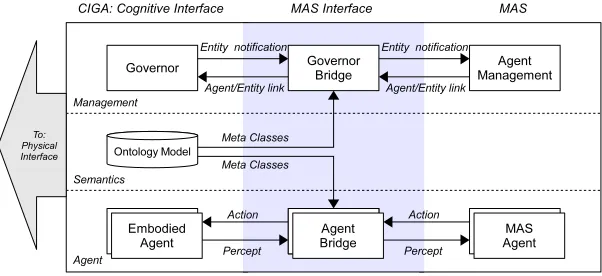
In this section we present an architectural framework for integrating the CIGA middleware with both game engine and agent technology. An illustration of the main framework is given in figure 1.
Fig. 1.Middleware Framework.
engine whereas theCognitive Interface layer connects to a MAS. Both compo-nents are internally connected using a communication mechanism. TheOntology Model provides access to domain ontologies specified for a specific application domain containing formal representations of the communicated content between an agent’s mind and body.
This internal distributed design several advantages. First, it helps to bridge the conceptual gap between a game engine and a MAS by dedicating separate components for the integration with the technologies. Second, from a technical point of view, it allows both components to be implemented in different pro-gramming languages. It is often the case that the used game engine and MAS are written in different languages. For the middleware as a whole to be able to interface with both technologies while matching the language of that technology results in an easy integration process and an efficient, tight connection. Last, the design introduces connection transparency since the game engine and MAS can run in different processes or distributed over different computers or platforms, depending on the used internal connection mechanism.
Next we’ll first describe the role of ontologies within the middleware after which we’ll look at the individual components connecting to game engine and MAS respectively.
3.1 The Role of Ontologies
TheOntology Model represents a storage facility for semantic concepts. It con-sists of domain ontologies designed for a specific application domain to capture an agent’s perceptual and interactional capabilities within an environment. The use of ontologies forces an agreement between a game engine and a MAS on the required domain concepts. This is known as adesign by contract [14], increasing robustness and reusability within the system.
agreement on the actions agents can perform in an environment, (parameterized) action classes should be specified in the domain ontology.
Domain ontologies can be created using an ontology editor like Prot´eg´e. An interesting feature is the ability to change and extend meta-classes for objects, events or actions. This allows the ontology to support custom data fields for specific types of concepts. For example, a perceptibility type can be assigned to an object property to specify its perceivability (e.g. visual, auditory or tactile) which use will be described later. Additionally,affordances can be specified for object classes which can facilitate agents in understanding their world in terms of interactions they can have with it. The use of Affordance Theory has been previously explored in [6, 4]. Related to affordances, information associated with
smart objects can be stored [11, 15]. A small example showing the possibilities of a simple domain ontology is illustrated in figure 2.
Fig. 2.Domain Ontology Example.
The left side of the illustration shows a domain ontology consisting of several object classes and actions for human actors. The right side of the example shows a simple scene with two human agents (A and B), a fire and two objects which can be used to attack a fire. Now assumeagent A notices a small fire starting nearagent B who is unaware of this.Agent Awould like to resolve the situation and has several options. He can pick up the fire extinguisher and use it to put out the fire or he can use the bucket of water positioned nearagent B. This choice may depend on the size and type of the fire and the type fire extinguisher. For example, an electrical fire should not be extinguished using water which makes the first option preferable if it concerns a chemical fire extinguisher. Further,
agent A can communicate with agent B to advise him to deal with the fire, although this choice may not be suitable ifagent B is a small child.
attack a fire. The concepts in the domain ontology are also interesting for use as content in communication languages between agents [21].
These domain ontologies cover concepts relevant to both an agent’s embod-iment and his mind. In CIGA they are fully accessible at runtime to both the game engine and MAS as will become clear in the next parts of this section.
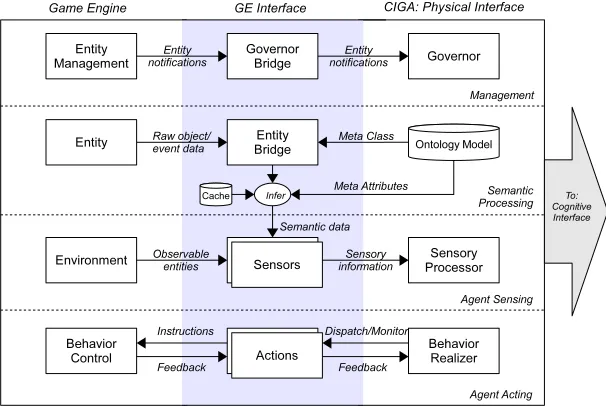
3.2 Connecting the Game Engine
[image:35.595.151.454.309.512.2]As shown in Figure 1, thePhysical Interface layer of CIGA connects to a game engine. Its main task is the administration of agent embodiments participating in the middleware and individually control their sensors and actuators. Abstraction from the game engine is achieved using an intermediate layer, hereafter called the GE Interface layer, connecting a specific game engine. Figure 3 illustrates the design focusing on the functional interfaces and data flows.
Fig. 3.Integration Middleware in Game Engine.
Management The role of theGovernor in thePhysical Interface is to provide a connection mechanism for synchronizing the simulation between the game en-gine and the MAS. It monitors the creation and destruction of entities in the environment that are candidates for agent embodiment and notifies the MAS about their existence. Additionally, simulation time is synchronized by send-ing regular time updates to the MAS, who often don’t have an internal clock explicitly defined.
Semantic Processing The goal of semantic processing is to translate raw object and event data available in the game engine to semantic data. Semantic data is used as sensory information which allows an agent to build a social model of the environment based on meaningful concepts. TheOntology Model can be accessed to retrieve the formal representation of those concepts.
Creating semantic data from raw data at runtime is a process performed in the GE Interface layer. Here, at design time, entity bridges are created asso-ciating object classes from a domain ontology to entities defined in the game engine (E.g. associating thefireconcept to a fire class in the game engine). Dur-ing runtime, the object’s attributes are generated from raw entity data (E.g. an object’ssizeproperty is calculated). This translation process is performed when agents sense environment entities. Furthermore, semantic event classes can be generated based on raw game events or as a result of custom inferences. Inference based on previously sensed information is achieved using a cache belonging to an agent’s sensory processor.
Note that translation and inference rules for generating semantic data are the same for all agents. At this stage, although agents have their individual view of the environment determined by their sensors, their interpretation of it is the same as specified by the domain ontology. This fact must be taken into account when designing the ontology.
Agent Sensing Agent sensing is performed using aSensory Processorprovided for each participating agent within CIGA. Its goal is to collect sensory informa-tion from all sensors assigned to an agent’s embodiment and prepare them as
percepts for the MAS agent to receive.
Since sensors can be dynamically replaced, one can support different level of details (LODs) for sensors.
Based on the list ofobservable entities, sensing in the base class continues by extracting sensory information from these entities using theSemantic Processing
described before. The sensor’s perceptability type is used to filter the object properties and events that can be sensed. E.g., In the example from figure 2, the
heat property of thefire entity can only be sensed by atactile sensor.
After all sensors have been processed, theSensory Processor filters the col-lected data as further described in [20].
Agent Acting Agent behavior is performed using aBehavior Realizerprovided for each agent participating within CIGA. Its goal is to realize semantic actions instructed by a MAS by managing an action’s life cycle and communicating feedback about its state back to the MAS agent. Actions are executed in parallel in an interleaved fashion driven by the game engine loop.
Actions themselves are implemented in the GE Interface layer. They are responsible for realizing the intended action semantics by accessing game engine instructions. The Physical Interface layer provides an abstract base class for actions. Creating specific actions involves implementing the following methods:
• CheckPreconditions(): This method is called before the action is exe-cuted. Here any preconditions can be checked which must pass before the realization of the action can be started. If the preconditions are not met the action will not continue further and the agent is notified.
• Body(): This is the main execution loop. Here game engine functionality can be addressed to realize the intent of the action. This includes controlling the actuators of the agent’s embodiment and monitoring its progress. For virtual characters, this often involves interacting with anAnimation System
in the game engine. The action can end prematurely when problems arise during realization after which the agent is notified about the cause.
• CheckEffects(): This method is called after the action was successfully realized. Here the intended effects of the action on the game state can be validated. If the effects are not met the action will end with a corresponding