study
SHAFIZADEHKENARI, Mohsen <http://orcid.org/0000-0002-7524-1058>,
ABOLFAZLI, Roya and PLATT, Geoffrey K.
Available from Sheffield Hallam University Research Archive (SHURA) at:
http://shura.shu.ac.uk/7124/
This document is the author deposited version. You are advised to consult the
publisher's version if you wish to cite from it.
Published version
SHAFIZADEHKENARI, Mohsen, ABOLFAZLI, Roya and PLATT, Geoffrey K. (2012).
Effect of visual force biofeedback on balance control in people with Multiple
Sclerosis- a Pilot Quasi-experimental study. Journal of Physical Therapy, 6 (1),
21-27.
Copyright and re-use policy
Effect of visual force biofeedback on
balance control in people with Multiple
Sclerosis- a Pilot Quasi-experimental study
Mohsen Shafizadeh
a*, Roya Abolfazli
b, Geoffrey K Platt
a.
Introduction:
Multiple sclerosis (MS) is a neurological problem1 that seems is originated from the structural and functional changes of the body which cause detrimental effects. For example, it is reported that muscular weakness, loss of flexibility and coordination in the limbs, reduced endurance and speed of gait, increased fatigue threshold, and reduced work efficiency occurs in MS patients.2,3,4
Functional movement patterns are one of the important disorders affecting MS patients in the form of posture imbalance and gait disturbance that relate to some mechanisms due to the condition of disease.5,6,7,8,9 For example, one of the consequences of fall in MS patients is poor postural control due to slowed somatosensory conduction and impaired central integration.7 Porosi ska et al6 reported that the increased risk of falling is related to the increased postural sway velocity and length of mean sway in MS patients. Sosnoff et al5 showed that muscle spasticity contributes to postural deficits in MS patients. Tofte et al8 reported
ABSTRACT
Objective: The present study examined the effect of visual force biofeedback (VFB) training on balance control in Multiple Sclerosis (MS) patients.
Design: Within- group subject design.
Subjects: Ten adult volunteers with more than five years relapsing remitting multiple sclerosis and with balance disorder participated and performed six sessions of VFB training.
Methods: All subjects stood on a force plate for 15 minutes totally in each session and the force that they generated was measured to provide a baseline for the research. They then participated in the intervention which consisted of standing upright on the force plate for 30 seconds ten times in each session, whilst receiving visual information about the force generated by each of their feet.
Results: The results of paired-t tests have shown that the VFB condition produced a more stable balance than the baseline condition (p<.001) for reaction force (2.90 vs. 9.10), force symmetry (ML=34, MR=32.7 vs. ML= 38.70, MR= 29.60), and
centre of pressure (7 vs. 23.1).
Conclusion: Perceptual-motor training has an important rehabilitative role for MS patients with sensory-motor dysfunction.
Key words: multiple sclerosis, perceptual-motor, abnormal condition.
Authors’ information:
a- University College London, UK; b- University of Tehran, Iran. *- Corresponding author. Assistant Professor, London, UK UCL Interaction Centre, MPEB 8th floor, University College London, Gower Street, London, WC1E 6BT, UK.
00442076790697.
E-mail for correspondence:
[email protected]
that the reduced or absent
EMG responses to stretch is a problem due to spasticity in MS patients. Similar findings were reported in the Lorentzen et al9 study on stroke, spinal cord injury and multiple
sclerosis patients.
mechanisms will help practitioners to manage rehabilitation programmes according to the needs of the individual. One of the control mechanisms of movement is the degree of freedom problem. This term was introduced by Bernstein10 who recognised that the main role of the motor system is to control the variability in joints in order to achieve the intended outcome. In fact, the important concern of any performer is to change the mechanical degree of freedom (increasing or decreasing) according to the demands of the task.11 On the other hand, restricting some joints’ degrees of freedom (freezing) while leaving other joints unconstrained (freeing) are an appropriate strategy to learn and control a complex skill. Freezing is a control mechanism in some motor disability diseases.12,13,14 Utley et al12 in children with developmental coordination disorder (DCD) showed the smaller ranges of motion and less variable angular excursions of the elbow joints during a catching task. Zyluk et al13 showed that upper limb pain and limited mobility are common complications in cases of stroke. Such motion limitations have also been reported in MS patients.14 One purpose of the present study was to examine to what extent the MS patients have limitation in their limbs during posture control. It is proposed that prolonged asymmetrical force distribution of MS patients during static balance indicates constraining of centre of mass degrees of freedom around the base of support as a compensatory
mechanism to stabilize the posture.
The application of biofeedback in healthy people has been demonstrated in previous studies for different functional abilities such as stability15,16 and locomotors tasks.17,18,19 Davis et al16 revealed that posture sway is diminished in both young and older adults following biofeedback intervention. Similar findings are achieved in the Janssen et al.18 study about reducing body sway in the gait pattern of young
adults. Rougier and
Boudrahem15 through visual force biofeedback (VFB) on a platform studied the healthy subjects’ ability to reduce the difference between their centre of gravity (COG) and their centre of pressure (COP). Their data showed the complementary nature of the VFB conditions to establish the postural control behaviours. Crowel et al17 in the healthy runners indicated that training with real-time visual feedback can reduce the types of lower extremity loading associated with stress fractures.
Previous studies also have shown that biofeedback training had a positive role in the rehabilitation of functional abilities in cases of amputation, brain injury, low back pain and stroke,20,21 and somewhat in MS.22 Srivastava et al21 evaluated the role of balance training on a force platform with visual feedback technique in improving balance and functional outcome in chronic stroke survivors. They showed that balance training employing this technique significantly improved balance and walking abilities. Magnusson20
demonstrated that postural feedback in the form of electromyography (EMG) is a useful method for chronic low back pain participants. Prosperini et al22 in MS patients revealed that training single and double static balance with visual feedback could improve postural control and reduce the risk of falling. Some research findings demonstrate that a long-term lack of awareness of body position and adaptation to poor posture is a likely cause of postural imbalance and deformity23,24. Therefore, it appears likely that any information about correct body position, obtained through different devices (e.g. visual force feedback), would assist in regaining correct body posture and reducing misalignments through changing in different muscular forces.25,26,27
The application of VBF training in improving weight-bearing symmetry of MS patients during static balance was another purpose of the present study that did not evaluate in the previous studies. Alternatively, if it be useful for reducing asymmetry, to what extent it can increase the variability of motion by reducing the centre of mass’s degrees of freedom constraint.
Methods:
Participants:
category, and lack of sever visual problem and routine rehabilitation during the study period. All subjects had disability score between 5-7 (Mean EDSS= 6.5) on the basis of neurological examination by second author and completed the consent form prior to participating in the experiment. The Ethics Committee of the University approved each stage of the experiment and the design of the relevant forms.
Instrument:
The instruments employed in the study consisted of hardware and software. The hardware was a force plate (40 cm× 60cm) equipped with four load cells (China Co) were inserted in the external edge of the front and back , approximately 35 cm apart in each corner, in order to record the reaction force of each foot separately in x-dimension and y-dimension. The maximum measured force was 3500 N with 50Hz data transfer frequency. All load cells were connected to an AC/DC convertor through cables and from it to a personal computer by a 9-Pin RS-232 Serial Com Port. The software in the Delphi programme was able to receive data from sensors and simultaneously analyse the
reaction force. The
programme output included information on the size of the reaction forces of each foot in the form of numerical and graphical feedback. In addition, it measured the COP displacements in medial-lateral and anterior- posterior directions. The software could collect the raw data of two dimensions and by computing
deviation from centre of platform, shows the radial deviation (cm) on both x-axis (medial-lateral) and y-axis (anterior-posterior) separately.
Procedure:
The participants were familiarised with the force plate by standing on it before participating in the main phases of the experiment (see figure 1). They then participated in the experiment programme in six sessions lasting 15 minutes each session, two sessions per week for three weeks. The experiment consisted of two conditions baseline and VFB. The participants performed both conditions in each session, but half of them whom were randomly selected practiced the baseline condition first and the VFB condition second in each session and others practiced them in the reverse order. Each condition was performed ten times with 30 seconds duration and with 30 seconds rest interval between them. In the baseline condition, the subjects did not receive any information and were not able to see the computer screen. The importance of baseline condition in each session was for its control nature. In fact, it used to measure the consistency of protocol in different sessions and equality of VFB trials with No-VFB trials after intervention period. In the VFB condition, they were provided with visual feedback about the reaction force of their two feet in the form of numeric and line graph; for each foot there was a specific coloured line. Y-axis was an indicator of the size of
reaction force and the x-axis was an indicator of time. The subjects were instructed to control the size of the forces by changing their centre of mass through equalizes of two lines that were indicator of force asymmetry in two feet.
Data analysis:
Dependent variables were reaction force (Kg), COP (cm), and force asymmetry (Kg). The reaction force was computed according to absolute force difference between right and left feet. COP was computed as displacement of COP in the medial-lateral direction. Force asymmetry was computed as reaction force of right foot compare with reaction force of left foot.
To examine the effect of VFB training on balance, the paired t tests were used to compare total mean score of baseline and VBF conditions on reaction force, COP, and force asymmetry. Confidence level was determined at two-tailed 95% interval. We used PASW SPSS version 18 software (IBM SPSS. Inc, NY, USA) for data analysis.
Results:
Table 1- Mean and standard deviation of demographic information of participants
Information Mean SD(±)
Age (yrs) 29.8 5.84
EDSS (score) 6.5 1.78
Height (cm) 166 7.84
[image:6.612.86.528.309.406.2]Weight (kg) 58.6 6.7
Table 2. Mean and standard deviation of dependent variables in different conditions
Variable Baseline VFB t p
Right reaction force (Kg) 29.60 (3.09) 32.7 (3.49) -8.12* .001 Left reaction force (Kg) 38.70 (4.44) 34 (1.69)
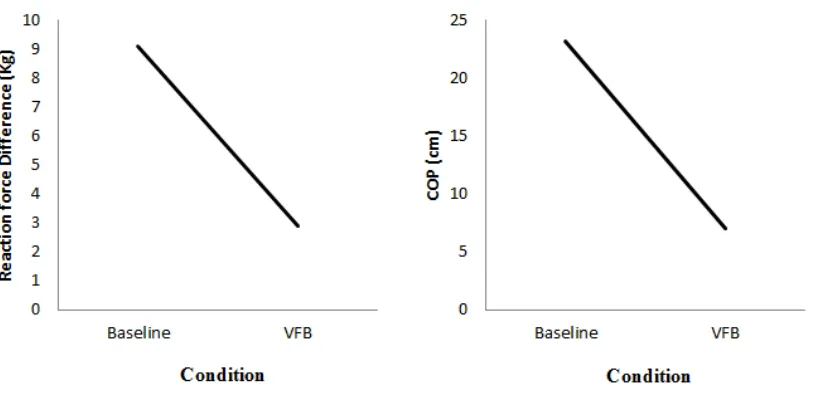
Reaction force difference (Kg) 9.10 (3.54) 2.9 (1.1) 6.01 .001 COP (cm) 23.1 (7.3) 7 (2.5) 6.45 .001
*measure of symmetry between two legs in each condition
[image:6.612.99.507.508.705.2]The mean of the two conditions showed that the VBF condition relative to the baseline condition had a smaller reaction force difference (2.90 vs. 9.10) and COP (7 vs. 23.1).
To examine the force asymmetry between the two feet in both conditions the mean reaction force of each foot was compared. The results of paired t tests demonstrated that there was a significant difference between the two feet in the baseline condition (t= -8.12, p 0.001), but not in the VBF condition (p>0.05). Their mean shows that in the baseline condition the reaction force of the left foot (M= 38.70, SD 4.44) was significantly higher than the right foot (M= 29.60, SD= 3.09), but in the VFB condition the two feet produced nearly equal forces (ML=34, SD=
1.69 vs. MR=32.70, SD= 3.49).
Discussion:
The purposes of the present study were to examine the effects of VFB training on posture control in MS patients and to what extent they use freezing mechanism to control degree of freedom problem in order to avoid losing the balance.
On the regard of first purpose our results showed that MS patients had a significantly smaller amount of two-foot force difference after VFB condition relative to no-VFB condition. In addition, they had significantly lesser COP displacement in the medial-lateral direction with VFB condition.
The results of the current study showed that providing perceptual-motor intervention in the form of visual force biofeedback is an
effective modality for controlling the posture in the patients who have difficulties in balance such as in cases of MS. Our results have revealed that participating in the static balance task with VFB versus no-VFB facilitates the perceptual-motor integration mechanisms by reducing COP displacement in the medial-lateral direction. The current finding is accordance in previous research findings about the effectiveness of
force biofeedback
interventions on balance capability of different disorders such as stroke, MS, and brain injuries.20,21,22 Prosperini et al22 in MS patients revealed that training single and double static balance with visual feedback could improve the posture control and reduce the risk of fall. Srivastava et al21 showed that balance training with force biofeedback significantly improved balance and walking abilities in stroke. Previous studies have showed one of the functional problems of MS patients is imbalance and falling due to a loss of stability due to impaired central integration7, sway length and velocity,6 and spasticity.5,8 On the contrary, freezing or constraining of joint mobility is a control mechanism in some of motor disability diseases.12 Thus, another purpose of this study was to clarify if the freezing or freeing is a control mechanism to avoid losing the balance in people with MS.
Our findings demonstrated that in the baseline condition the reaction force of the left foot was significantly higher than the right foot in all ten patients. Thus they used freezing of variability by limitation of
centre of mass in one side of the body as compensatory mechanism. But after intervention with VFB the reaction force difference between two feet was reduced and there was not significant differences between two feet in VFB condition (34 vs. 32). It showed that VFB facilitated
the centre of mass
displacement from left foot to right foot to better force distribution within the base of support in two out of ten participants. It was valuable finding for rehabilitation through VFB modality because losing of force asymmetry of whole body could reduce the mechanical stress in specific body parts that consequence to reduce the risk of fall due to constraining the degrees of freedom and facilitation of the motor system self-organization via enhanced symmetrical force distribution between two feet and limbs coordination. One of the limitations of this study was the lack of the transfer test in actual situation. Since its design was within-subject AB (baseline-intervention) design, the carryover of such intervention in actual life setting after intervention was not examined. Future studies need to use other research designs such as ABA with a post-test as same as pre-test or use between-subject design with a matched control group.
Clinical messages
• combining perceptual-motor intervention
such as VFB
facilitates the control of posture in MS patients.
the reducing COP displacement in the medial-lateral direction.
• the freeing of centre of mass to move in both sides of the body helps to better balance in MS patients.
Conflicts of interest:
None identified and/or
declared.
References:
1. Hietpas J, Pedretti L, McCormack G. Multiple Sclerosis. In: Pedretti L, eds. Occupational therapy practice skills for physical dysfunction. SL: Mosby; 1996:837-42.
2. Rodgers MM, Mulcare JA, King DL, Mathews T, Gupta SC, Glaser RM. Gait characteristics of individuals with MS before and after a 6- month
aerobic training program. J Rehabil
Res Dev. 1999;36:183-8.
3. Thoumie P. Motor determinants of gait in 100 ambulatory patients with MS. Mult Scler. 2005;11:485-91.
4. Thickbroom GW, Byrnes ML, Archer SA, Kermode AG, Mastaglia FL. Corticomotor organization and
motor function in MS. J Neurol.
2005;252: 765-71.
5. Sosnoff JJ, Shin S, Motl RW. Multiple sclerosis and postural control:
the role of spasticity. Arch Phys Med
Rehabil. 2010;91:93-99.
6. Porosi ska A, Pierzchała K, Mentel M, Karpe J. Evaluation of postural balance control in patients with multiple sclerosis - effect of different sensory conditions and arithmetic task
execution. A pilot study. Neuro
Neurochir Pol. 2010;44:35-42.
7. Cameron MH, Lord S. Postural
control in multiple sclerosis:
implications for fall prevention. Curr
Neurol Neurosci Rep. 2010;10:407-12.
8. Toft E, Sinkjaer T, Andreassen S, Hansen HJ. Stretch responses to ankle rotation in multiple sclerosis
patients with spasticity.
Electroencephalogr Clin Neurophysiol. 1993;89:311-8.
9. Lorentzen J, Grey MJ, Crone C, Mazevet D, Biering-Sørensen F, Nielsen JB. Distinguishing active from passive components of ankle plantar flexor stiffness in stroke, spinal cord
injury and multiple sclerosis. Clin
Neurophysiol. 2010;121:1939-51.
10. Bernstein N. The coordination and
recognition of movements. London: Pergamon Press; 1967.
11. Newell KM, Vaillancourt DE. Dimensional change in motor learning. Hum Mov Sci. 2001; 4-5:695-715.
12. Utley A, Steenbergen B, Astill SL.
Ball catching in children with
developmental coordination disorder:
control of degrees of freedom. Dev
Med Child Neurol. 2007;49:34-8.
13. Zyluk A, Zyluk B. Upper limb pain and limited mobility in the patients
after stroke. Wiad Lek.
2006;59:227-31.
14. Dunn J. Impact of mobility
impairment on the burden of
caregiving in individuals with multiple
sclerosis. Expert Rev Pharmacoecon
Outcomes Res. 2010;10:433-40.
15. Rougier PR, Boudrahem S. Visual
feedback of force platform
displacements for balance control training: what postural ability do healthy subjects have to develop to decrease the difference between center of pressure and center of
gravity movements. Motor Control.
2010;14:277-91.
16. Davis JR, Carpenter MG, Tschanz R, Meyes S, Debrunner D, Burger J, et al. Trunk sway reductions in young and older adults using multi-modal
biofeedback. Gait Posture.
2010;31:465-72.
17. Crowell HP, Milner CE, Hamill J, Davis IS, Reducing impact loading during running with the use of real-time visual feedback. J Orthop Sports Phys Ther. 2010;40:206-13.
18. Janssen LJ, Verhoeff LL, Horlings CG, Allum JH. Directional effects of biofeedback on trunk sway during gait
tasks in healthy young subjects. Gait
Posture. 2009;29:575-581.
19. Widener GL, Allen DD, Gibson-Horn C. Randomized clinical trial of balance-based torso weighting for improving upright mobility in people
with multiple sclerosis. Neurorehabil
Neural Repair. 2009;23:784-91.
20. Magnusson ML, Chow DH, Diamandopoulos Z, Pope MH. Motor control learning in chronic low back
pain. Spine (Phila Pa 1976).
2008;15:532-8.
21. Srivastava A, Taly AB, Gupta A, Kumar S, Murali T. Post-stroke balance training: role of force platform
with visual feedback technique. J.
Neurol. Sci. 2009;15:89-93.
22. Prosperini L, Leonardi L, De Carli P, Mannocchi ML, Pozzilli C. Visuo-proprioceptive training reduces risk of falls in patients with multiple sclerosis. Mult Scler. 2010;16:491-9.
23. Dozza M, Chiari L, Chan B, Rocchi L, Horak FB, Cappello A.
Influence of a portable audio
biofeedback device on structural
properties of postural sway. J
Neuroengineering Rehabil. 2005;31: 13.
24. Cho CY. Survey of faulty postures
and associated factors among
Chinese adolescents. J Manipulative
Physiol Ther. 2008;31:224-9.
25. Bogdanov OV, Nikolaeva NI, Mikhailenok EL. Correction of posture
disorders and scoliosis in
schoolchildren using functional
biofeedback. Zh Nevropatol Psikhiatr
Im S S Korsakova. 1990;90:47-9.
26. Metherall P, Dymond EA, Gravill N. Posture control using electrical stimulation biofeedback: a pilot study. J Med Eng Technol. 1996;20: 53-9.
27. Robbins M, Johnson IP, Cunliffe C. Encouraging good posture in
school children using computers. Clin