Exploring haptic interfacing with a mobile robot without
visual feedback
PENDERS, Jacques <http://orcid.org/0000-0002-6049-508X> and JONES,
Peter <http://orcid.org/0000-0002-1225-0192>
Available from Sheffield Hallam University Research Archive (SHURA) at:
http://shura.shu.ac.uk/4959/
This document is the author deposited version. You are advised to consult the
publisher's version if you wish to cite from it.
Published version
PENDERS, Jacques and JONES, Peter (2012). Exploring haptic interfacing with a
mobile robot without visual feedback. In: HERRMANN, Guido, STUDLEY, Matthew,
PEARSON, Martin, CONN, Andrew, MELHUISH, Chris, WITKOWSKI, Mark,
JONG-HWAN, Kim and VADAKKEPAT, Prahlad, (eds.) Advances in autonomous robotics.
Joint proceedings of the 13th annual TAROS conference and the 15th annual FIRA
Roboworld congress Bristol, UK, August 20-23, 2012. Lecture notes in computer
science (7429). Heidelberg, Springer-Verlag, 432-433.
Copyright and re-use policy
See
http://shura.shu.ac.uk/information.html
Exploring haptic interfacing with a mobile robot without visual feedback
Jacques Penders, Peter Jones, Thrish Nanayakkara
SCentRo, Sheffield Hallam Univeristy; King's College London.
Abstract
Search and Rescue scenarios are often complicated by low or no visibility conditions, because of smoke or dust. The lack of visual feedback causes significant stress for human rescue workers. If a group of robots could overcome the navigation and localisation problems, they would become assistants to a human rescue worker. Trials were held with professional fire fighters; however it became clear that the human subjects by no means were prepared to give up their procedural routine. Following on from these (disappointing) findings we are exploring the context for using a robotic device in no-visibility conditions. In such conditions a haptic interface seems a natural solution and we investigate and experiment with how a human and a semi-autonomous robot can develop cooperation and become a team. The final aim is to design a robotic system and interface that will provide the human with some trust and confidence. In this paper we explore the basic design requirements for haptic human-robot interaction, starting from reviewing the interaction between a blind person and a guide dog.
Introduction
Search and rescue scenarios are often complicated by low or no visibility conditions because of smoke or dust. The lack of visual feedback hampers orientation and navigation and causes significant stress for human rescue workers. Robotic assistants provided with appropriate sensors seem to be an option. The Guardians project [1] pioneered a group of autonomous mobile robots assisting a human rescue worker operating within close range. A basic assumption of the Guardians project was that if the group of robots could overcome the navigation and localisation problems they would be welcome assistants to a human rescue worker. Trials were held with professional fire fighters of South Yorkshire Fire and Rescue. It became clear that the human subjects by no means were prepared to give up their procedural routine and the feel of security provided by these routines: they simply ignored instructions that contradicted their procedural routines.
Based on these (disappointing) findings the Reins project is exploring the context for using a robotic device in no-visibility conditions. Besides the no-visibility, fire scenes are often very noisy thus also limiting the use of audio feedback. In such conditions a haptic (and possibly tactile) interface seems a natural solution. The Reins project is investigating and experimenting with how a human and a semi-autonomous robot can develop cooperation and become a team while using a haptic interface. The final aim is to design a robotic system and interface that will be accepted as a guide and that can enhance human navigation. We are exploring (haptic) human-robot interaction and searching for design cues and clues that may help to provide the human with some trust and confidence while being guided by a machine.
The term 'trust' is not easily defined; without going deep into the issue, the definition of Trusting Intention
As of the start of the project our presumptions on human robot interaction are the following.
1. We view human interaction and cooperation as a flexible, creative and dynamically adaptable process and we perceive human robot interaction as a communicational landscape emerging between the human being and the robot. In this view the interaction not necessarily requires a set of a-priory fixed (command) codes; the interaction becomes more of a cooperation which develops while the team proceeds.
2. Nevertheless, we expect that the human being wants to remain the dominant and initiating partner, at least from his/her perspective.
3. We also expect that the human being, by nature, will try to 'read' the situation [9] and base decision making upon the 'view' obtained.
Presumption (3) is a prerequisite for behaviour confidence, the human being must be able to observe the behaviour of the robot in relation to the environment where it is acting. As the environment does not allow for visual nor audio feedback our primary focus is on creating alternative types of feedback and investigating whether it will be rich enough to aid the human being.The subject of this paper is to define some basic design requirements for the robots and the interface.
Literature on the subject of human-robot interaction in low-visibility is rather sparse. However, a rich domain to learn from is the training and use of guide dogs for the visually impaired, refer to [13]. Moreover, there are several works on robotic assistance for the visual impaired. Allan Melvin et al [5] developed a robot to replace a guide dog; however the paper does not extensively report trials with users. The GuideCane [6] is a cane like device on two unpowered wheels, it uses Ultra Sound to detect obstacles. The user has to push the GuideCane as the wheels are not powered, however it has a steering mechanism that can be operated by the user using a mini joystick. In autonomous mode, when detecting an obstacle the wheels are steering away to avoid the obstacle. The GuideCane has been tested with 10 subjects 3 of whom were blind and cane users, the other 7 were sighted but blindfolded. Basic conclusion 'walking with the GuideCane was very intuitive and required little conscious effort', unfortunately they do not report much on the subjects' experiences. A useful remark nevertheless: the GuideCane does not use acoustic feedback, so that there is no masking of audio cues on which many blind persons rely heavily [6].
The interactive shopping trolley (InBOT) developed in Karlsruhe consists of a haptic handle to steer the shopping trolley [10] and a full navigation system [4]. The shopping trolley is targeted at a 'general' user. The robot autonomously avoids obstacles: 'Even if the user doesn't recognize the obstacle himself InBOT moves around it safely' [10]. Unfortunately the authors have not included comments from users on this behaviour. The robotic shopping trolley developed by Gharpure and Kulyukin [7], is aimed at the visual impaired. This trolley guides the (blind) shopper - who is holding the trolley handle - into the vicinity of the desired product and subsequently instructs the shopper on how to grab the product using voice instructions. The guidance is fully robot driven. Experiments with impaired subjects were performed in a supermarket and observed by the researcher, meaning that there was hardly any stress on the subjects concerning the possibility of getting lost. An interesting comment from the subjects was: 'Instead of just following the robot, doing nothing, I would like to know what products I am passing by'. This seems to underline our presumptions (2) and (3): even non-stressful settings there is reluctance to give up dominance and there is the desire to get to know more about the actual situation. For their application, Ulrich and Borenstein [6] make a distinction between haptic space and locomotor space. The haptic space is the immediate space around the person that can be sensed by touch or limb motion without bodily translation. Exploring locomotor space requires locomotion. Below we will in addition define (safe) locomotion guidance.
Guiding and navigating a fire fighter or a visual impaired person are quite different tasks. Nevertheless we can obviously learn from experiences of the visual impaired with guide dogs. The UK charity 'Guide Dogs for the Blind' kindly introduced us to the subject and also arranged for us a dog to obtain some personal experience. In addition, we held interviews with guide dog users. The result of this is that we were able to identify certain points about using/interacting with a guide dog that are also relevant for applying a robot guide in the fire fighting scenario.
Fire fighting practice under no-visibility
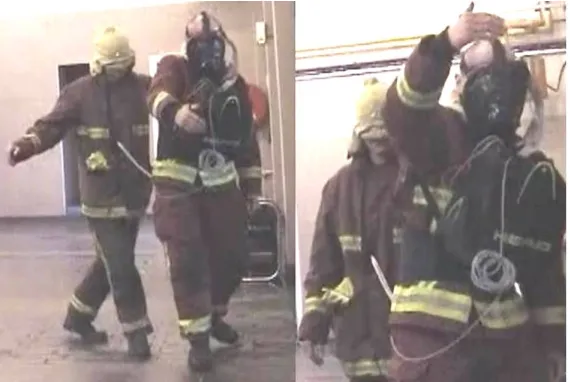
[image:4.595.158.443.202.393.2]In the early stages of a fire incident, the situation is usually far from stable. Risk assessment is therefore of live importance for fire fighting operations1. However to save lives fire fighters have to act swiftly as chances for rescues reduce considerably over time and certainly when the situation deteriorates; this implies considerable time pressure for all the crew and their commanders. When fire fighters have to enter a smoke-filled environment, they are provided with breathing apparatus to provide fresh air. However, smoke or dust reduces visibility dramatically and human beings easily get disoriented and may get lost. Rendered without sight fire fighters can only rely on their touch and hearing senses. However these senses are also restricted. The sense of touch is restricted by clothing gear and hearing is reduced by the noisy breathing apparatus.
Figure 1, Searching fire fighters in a trial with the visor aid, note the arms exploring the Haptic Space.
Haptic Space
When proceeding into an environment with no or limited visibility fire fighters have to rely heavily on their sense of touch. Standing on a rear foot, they use the front foot to stamp ahead in a fan-like pattern in order to feel for obstacles and to test the floor before a real step is made. Meanwhile one hand will be moved up and down in front of the head and upper body to feel for hanging obstructions and in particular loose hanging wires, refer to Figure 1. Exploration of their haptic space is of life importance for a fire fighter and this exploration precedes locomotion.
Navigation
Loosing orientation is one of the biggest dangers for fire fighters and in larger objects it can be deadly. The amount of oxygen contained in the breathing apparatus suffices for about 20 minutes, meaning that they have to be out of the danger zone before running out of oxygen. Obviously, if fire fighters get lost time pressure increases quickly. In a warehouse fire in 1991 in Gillender Street London (UK), two fire fighters died and in the 1999 warehouse fire in Worcester (USA), six fire fighters lost their lives. And recently in November 2007 a tragedy happened in Warwickshire (UK), when four fire fighters were killed in a vegetable warehouse blaze. Search teams usually consist of 2 or 3 members. Because of the danger of loosing bearing, fire fighters precede along the walls of a building and they report recognition points and obstacles and each team member will try to memorize their findings. In the United Kingdom procedures for large buildings are that a first team will lay-out and fix a guideline along a wall, refer to Figure 2. The walls provide position reference but the reference is incomplete: standing at a wall there remains the choice of going in either one of two directions. The guideline has therefore at regular intervals a pair of a long and a short rope knotted onto it. Subsequent teams aiming towards the scene of operations follow the guideline but nevertheless they advance only at a crawling speed. We informally clocked a guideline following exercise by experienced fire fighters: they progressed 12m in about one minute.
1
Figure 2, Basic principle for Guideline layout in a search operation.
Navigation aids
The Guardians project [1] pioneered with a group of autonomous mobile robots to assist fire fighters. The group of robots provided localisation and navigation and could in principle lead the fire fighters. For the interface, the project tried a visual display (a visor mounted in the mask of the fire fighter) that was giving locomotion directions to the fire fighter. In the trials the fire fighter teams were given a set of distracting additional task, while advancing was to be directed by the visor. They performed on the whole quite well with respect to the distracting additional tasks. However, adherence to the direction indicators was poor, on occasions subjects moved ignoring the direction indicated. Afterwards, they pointed out that confidence in position and bearing is extremely important in real fire incidents. In the trial setting attempts were made to disrupt the familiarity of a wall. Consequently the fire fighters suggested there was a lack of realism and that the aid did not provide any indication of bearing that they were confident with. Being away from a wall or a physically stable point of reference is apparently problematic for fire fighters and they suggested that the interface would be more useful if it could provide directions to and from the wall [1]. This experience led us to reconsider the whole concept of interfacing with a fire fighter when providing guidance. They are used to and very strongly rely on haptic and tactile feedback and we decided to explore that area further.
Guide dogs
A domain rich with experience on haptic feedback is the use of guide dogs for the visually impaired. In this section we give a general description of using a guide dog. The information is based on interviews with dog trainers of Guide-Dogs-for-the-Blind but much of it can also be found in [13]. To the general description we add notes from interviews with a visually impaired female adult to whom we will refer as ‘N’. N. currently has a guide dog called Jasper and she has had other guide dogs in the past. She travels to work daily by tram with Jasper's help.
Handling a guide dog
For clarity a few terms: the guiding link between user and dog is called a handle, and the user is usually referred to as the 'handler'. The dog is also on a lead, but this lead does not serve guidance purposes, it is used in the dog's `spare time'.
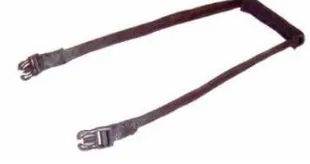
Figure 3, the handle taken apart.
[image:5.595.223.378.612.694.2]is a rigid U shaped instrument (with a square 'bottom' for the actual handle) (see Figure 3). The handle is shaped to hardly require any grip from the handler and is rigid to immediately let the handler know when the dog stops.
The handle is not used to push the dog, nor does the dog drag the handler along with it. The default condition is that dog and handler walk at the same pace: the handler feels the dog's movements and direction while the dog monitors the handler's walking and other aspects of the behaviour as they proceed together. As the dog slows down to stop at or negotiate obstacles the handler feels this through the handle. The handle is also used to communicate particular commands and actions to the dog: it can be used to stop the dog, slow it down, prohibit certain things etc. The dog sees and feels the handler. As a colleague noted: 'I walked blindfolded with the dog along a busy walkway outside. Pretty soon I began to feel even the slight changes of speed and direction. The trainer who walked with me said that it is important to swing your hands so that the dog also gets some feedback on your active participation of walking.'
In addition to the handle, there is a series of verbal and gestural commands that dogs are trained on: directional commands (left, right etc) and control commands (no, leave, steady etc); these can be used in conjunction with commanding through the handle. When stationary, the dog watches the handler`s legs and arms to receive a command, refer to [13]. To start walking, the right leg is taken back and the right arm swigged forward saying “forward” and then the dog starts to walk again.
[N.] N. uses a number of verbal commands and gestural signals with Jasper (as per training) although she finds that the number of gestural signals has dwindled as their relationship has developed; currently she is mainly relying on verbal commands. The handle is used primarily as a simple guidance tool although she will communicate the occasional command through it (she might jiggle it or waggle it in order to emphasise something, or spur Jasper on).
Locomotion Guidance
Dogs are trained to guide according to a strict protocol: they will walk in a straight line, in the middle of the pavement; they will slow down and negotiate minor obstacles on the pavement, refer to Figure . The dog may begin to take evasive action in advance if a slight deviation is required; which means that the handler will have avoided an obstacle without even knowing it. In a supermarket lots of people with trolleys are traversing the aisles. Most people there are concentrating on food shopping and not what is going on behind them. The dogs are trained for this: the dog stops when there is no way through without brushing the handler against the obstacle. On the street people are on the move and more aware of what is coming up ahead and tend to get out of the way. On the street, the dog continues in a straight line until faced with a 'choice' of directions. At that point the handler will have to prime the dog as to the required direction. For instance, the dog will stop at the kerbside when there is a road to cross, refer to Figure 4. It is down to the judgement of the handler to initiate a crossing: the handler will have to command the dog forward. However, the dog will not move forward if it is aware of a hazard, so the handler will have to wait and then issue a further command etc.
[N.] If the pavement is blocked, for example, Jasper will take N. to the kerb, implying the need to cross the road at that point. This deviation from the normal route, will be interpreted by N. as Jasper taking evasive action, although she can check this by telling Jasper to go ahead as normal (in which case he will again refuse). The thing that makes N. most anxious is crossing roads.
Navigation and Exploration
Generally speaking, guide dog and handler only follow fixed routes with which the handler is familiar; indeed prospective handlers are trained on the routes (eg the safest route and way to walk) before they have a dog. [Guide Dogs for the Blind]: Clients would be taught that if they did not know where they were then to stop and ask someone. Most clients have a fixed number of set routes and do not venture off those, some clients work their dogs in lots of environments and they generally tend to have better orientation/spatial awareness and/or residual vision to support their other skills.
is, turn right out of the tram and find the appropriate starting point for the journey to the workplace. On arriving at the specified destination Jasper will find the entrance door or whatever looks
Figure 4, The dog always walk along straight lines at the centre of the walkway(left) and sits down at the curb or crossings (middle) and watches the handler's legs and arms to receive a command (right).
[N.] While being guided, N. knows where she is all the time on the street due to her 'mental map' of the route and her ability to read all kinds of environmental cues about location and direction etc. There are occasional times (e.g. crossing the park) where such cues are s
although - due to the familiarity of the route overall
that people think to help her by giving distance indications but these ar
Conclusions on navigation. Apparently, the guide dog is not taking the handler to a destination
taking the dog to the destination. The team is depending on the handler's spatial awareness and ability to read clues and cues from the environment. The handler (not the dog) has to find the destination; we call this navigation. Navigation concerns making choices, deciding in which direction to go and that requires a (mental) representation of the environment of som
representation, if this link is failing the person is lost. Navigation requires some sort of localisation in the representation of the environment.
The task of the guide dog is, as the a
space as it is called in [6] and we call the task which the dog performs guidance concerns moving from point to point in a nearly straight line witho
avoidance. Locomotion guidance by the dog and navigation decisions taken by the handler are complementary activities each performed by a 'specialised' agent, refer to Figure 5.
Figure 5, Handling a guide dog: task
Other experiences
[N] Dog and handler are aware of each other in various aspects, this awareness influences their relationship and conduct in particular settings. N. senses all Jasper's reactions through the handle; she reads his overall 'body language' - including movements of the head, whether his tail is wagging; she can tell if he has seen another dog and, generally speaking, all kinds of attitudinal states in addition to the navigational functions; she also touches Jasper in a friendly way from time to time, giving encouragement; so the handle allows constant two monitoring of behaviour. What does Jasper get through the handle? He can read N.'s overall state ('he's picking up whether I'm all right'), feeling whether she is nervous, upset
is, turn right out of the tram and find the appropriate starting point for the journey to the workplace. On arriving at the specified destination Jasper will find the entrance door or whatever looks most like an entrance door..
Figure 4, The dog always walk along straight lines at the centre of the walkway(left) and sits down at the curb or crossings (middle) and watches the handler's legs and arms to receive a command (right).
uided, N. knows where she is all the time on the street due to her 'mental map' of the route and her ability to read all kinds of environmental cues about location and direction etc. There are occasional times (e.g. crossing the park) where such cues are sparse or absent for some moments. She has only ever got lost once, due to the familiarity of the route overall - she was quickly able to find her way back again. She notes that people think to help her by giving distance indications but these are of no use to a blind person.
Apparently, the guide dog is not taking the handler to a destination
taking the dog to the destination. The team is depending on the handler's spatial awareness and ability to read clues and cues from the environment. The handler (not the dog) has to find the destination; we call this Navigation concerns making choices, deciding in which direction to go and that requires a (mental) representation of the environment of some sort. It also requires a link between the current position and that representation, if this link is failing the person is lost. Navigation requires some sort of localisation in the
The task of the guide dog is, as the above shows, to negotiate a passage; this activity takes place in locomotor space as it is called in [6] and we call the task which the dog performs locomotion guidance.
guidance concerns moving from point to point in a nearly straight line without collisions and it includes collision avoidance. Locomotion guidance by the dog and navigation decisions taken by the handler are complementary activities each performed by a 'specialised' agent, refer to Figure 5.
Figure 5, Handling a guide dog: task analysis.
Dog and handler are aware of each other in various aspects, this awareness influences their relationship and conduct in particular settings. N. senses all Jasper's reactions through the handle; she reads his overall 'body including movements of the head, whether his tail is wagging; she can tell if he has seen another dog and, generally speaking, all kinds of attitudinal states in addition to the navigational functions; she also touches
from time to time, giving encouragement; so the handle allows constant two monitoring of behaviour. What does Jasper get through the handle? He can read N.'s overall state ('he's picking up whether I'm all right'), feeling whether she is nervous, upset, anxious etc.
is, turn right out of the tram and find the appropriate starting point for the journey to the workplace. On arriving most like an entrance door..
Figure 4, The dog always walk along straight lines at the centre of the walkway(left) and sits down at the curb or crossings (middle) and watches the handler's legs and arms to receive a command (right).
uided, N. knows where she is all the time on the street due to her 'mental map' of the route and her ability to read all kinds of environmental cues about location and direction etc. There are occasional times parse or absent for some moments. She has only ever got lost once, she was quickly able to find her way back again. She notes
e of no use to a blind person.
Apparently, the guide dog is not taking the handler to a destination - the handler is taking the dog to the destination. The team is depending on the handler's spatial awareness and ability to read clues and cues from the environment. The handler (not the dog) has to find the destination; we call this Navigation concerns making choices, deciding in which direction to go and that requires a (mental) e sort. It also requires a link between the current position and that representation, if this link is failing the person is lost. Navigation requires some sort of localisation in the
bove shows, to negotiate a passage; this activity takes place in locomotor locomotion guidance. Locomotion ut collisions and it includes collision avoidance. Locomotion guidance by the dog and navigation decisions taken by the handler are complementary
N. has used a cane in the past. She finds using a dog is infinitely preferable: using a cane means finding a route while the dog can obviously see the route; it's quicker and far less stressful and far more reliable. On the other hand she knows of other people who prefer a cane and can handle it with as much success as she experiences with Jasper.
Requirements for a robot guide
In this section we draw some conclusions from the above in the form of requirements for our robotic guide and the interface.
Haptic space
Exploration of the haptic space is of life importance for a fire fighter. The same is in principle true for a visual impaired person, however this usually remains implicit as the handler and the guide dog pass along trajectories that are supposed to be safe in this respect, other people have passed before. Exploration of the haptic space would require a mobile robot with additional actuators for instance an arm, which is not foreseen in the Reins project. We will have to leave exploration of the haptic space for an additional project.
Mixed initiative
In the introduction we have stated that we presume that the human being wants to remain the dominant and initiating partner, at least from his/her perspective. If not further specified this leads to the question whether the human is leading the robot or whether the robot is leading the human being. However, as the analysis of a guide dog and handler team above shows we can distinguish between locomotion guidance and navigation. The handler does the navigation while the dog provides locomotion guidance and this seems a natural basis for a mixed initiative mode of operation. We carry this on to our experiments in the human-robot scenario and restrict the task of the robot to locomotion guidance. This leaves quite some space for the human to exert initiative and overall dominance. This decision also leaves an important task (which navigation certainly is) with the human. From the overall perspective of aiming to guide a human one might say we are jumping the problem. However, it considerably simplifies our experimentation and we can in this restricted context make a first step towards our basic aim: how a human and a semi-autonomous robot can develop cooperation and become a team; of course without claiming to solve the full problem.
As we have seen above, though the task of the dog is limited to locomotion guidance, the interaction between the handler and the dog is very subtle and the handle is a simple but rich interface. We also have to acknowledge that the dog is a very intelligent source for and processor of 'data'. Present day robots are in this respect no match for a dog and certainly not a guide dog. Given the fact that we are dealing with a robot with restricted capabilities, we feel justified in not trying to solve all problems in one go.
The robot and its potential for feedback
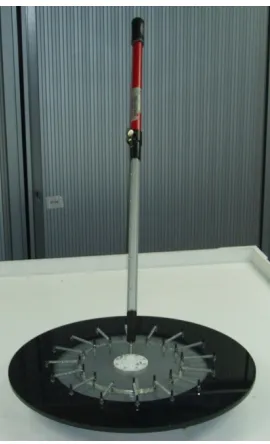
Figure 6, Extended Cane, a flat plate on four omni-directional wheels with a disk on top and a broomstick as handle.
We will adapt a semi-autonomous mobile robot for navigation with a human. Operating as a tactile/haptic sensor the robot will encounter and try obstacles. To enable the human to 'read' the situation the robot must be able to generate rich feedback and we think it is essential that the process of trying obstacles is perceivable for the human. We are designing a 'skirt' or a mechanical impedance filter for exploring the environment and obstacles. In order to trial the usefulness of this type of feedback to a human being, we have built a simple cane like device consisting of a round plate carried by four omni-directional wheels. On top is a flat disk which is held by springs (refer to Figure 6). The extended cane is to be moved by the human being. While being moved, the disk functions as an active tactile sensor with which the handler can try obstacles etc. This sensing is aimed at producing feedback for the human being.
The interface: a Handle or a Rein.
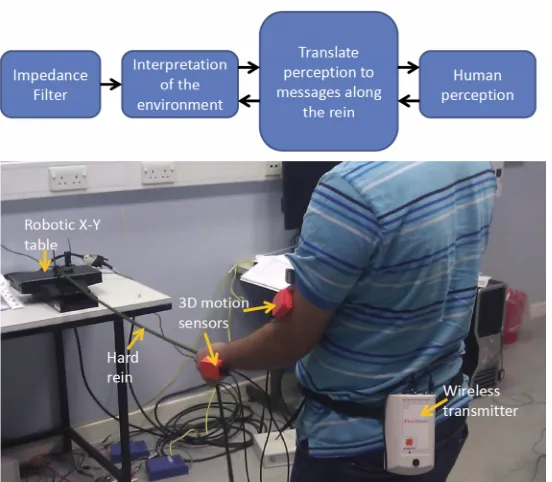
Figure 7: Experimental set up to study human robot interaction through reins.
Figure 7 shows the experimental setup to study the interaction through various types of reins. The X-Y table is used to encode messages from the robot’s end, and to read the messages sent by the human. The 3D wireless motion sensors are used to study the passive perturbation response properties of the human hand for various types of impulsive movements at the robot’s end, and to accurately record the variability of human hand movements during message encoding. We are in the process of conducting three experiments: 1) the robot is fed with a stiffness distribution of the objects around it, which are fit into 3rd order polynomial. The polynomial is then encoded by an X-Y table via a rein connecting the robot and the human partner. 2) We also study the impulse response properties of the freely hanging human hand when the impulsive perturbations are sent through soft and hard reins. The perturbation patterns generated at the robot’s end do not reproduce exactly the same shape of movements in the human hand. Therefore, what the human perceives is a skewed image of what the robot produces at the other end. Mathematical modelling of such impulse response properties will be used in the future to generate mutually orthogonal perturbation primitives to encode messages. 3) We are in the process of testing binary communication through reins. The advantage of binary communication is that it needs only two distinct perturbation primitives. However, the disadvantage is that the limitations in the working memory of human partners especially in stressed situations can cause data losses. We are trying to understand the most reliable ways to encode binary messages and its limitations under various levels of stress and distraction conditions.
References
[1] J. Penders, L. Alboul, U. Witkowski, A. Naghsh, J. Saez-Pons, S. Herrechtsmeier, and M. El- Habbal. A robot swarm assisting a human firefighter. Advanced Robotics, 25:93-117, 2011.
[3] J. Penders (ed.). Guardians final report. Technical report, Sheffield Hallam university, 2010, available from http://shura.shu.ac.uk/2340/.
[4] Göller, Michael; Steinhardt, Florian; Kerscher, Thilo; Zöllner, J. Marius; Dillmann, Rüdiger. Robust navigation system based on RFID transponder barriers for the interactive behavior-operated shopping trolley (InBOT), Industrial Robot: An International Journal, Volume 36, Number 4, 2009 , pp. 377-388(12) Emerald Group Publishing Limited
[6] The GuideCane-applying mobile robot technologies to assist the visually impaired, Ulrich, I.; Borenstein, J.; Systems, Man and Cybernetics, Part A: Systems and Humans, IEEE Transactions, Issue Date: Mar 2001 Volume: 31 Issue:2, page(s): 131 - 136 ISSN: 1083-4427
[7] Chaitanya P. Gharpure and Vladimir A. Kulyukin, Robot-assisted shopping for the blind: issues in spatial cognition and product selection Intelligent Service Robotics 2008) Volume 1, Number 3, 237-251, DOI: 10.1007/s11370-008-0020-9
[8] V. Kulyukin and A. Kutiyanawala. Accessible shopping systems for blind and visually impaired individuals: Design requirements and the state of the art. The Open Rehabilitation Journal, 2010.
[9] Harris, R (1996) Signs, Language and Communication. Routledge
[10] Haptic control for the Interactive Behavior Operated Shopping Trolley InBOT Göller, Michael; Kerscher, Thilo; Ziegenmeyer, Roennau Zöllner, J. Marius; Dillmann, Rüdiger
[11] McKnight, D. H., and Chervany, N. L. (1996). The Meanings of Trust. Scientific report, University of Minnesota<http://www.misrc.umn.edu/wpaper/wp96-04.htm> http://www.misrc.umn.edu/wpaper/wp96-04.htm
[12] D.P. Stormont. Analyzing human trust of autonomous systems in hazardous environments. In Proceedings of the Human Implications of Human-Robot Interaction workshop at AAAI 2008, 2008.