J. CHEM. SOC. FARADAY TRANS., 1995, 91(15), 2331-2338 233 1
Application
of
Density Functional Theory in the Synthesis of
Electroactive Polymers
James R. Smith, Paul A. Cox? and Sheelagh A. Campbell*
School
of
Chemistry, Physics and Radiography, University of Portsmouth, White Swan Road, Portsmouth, UK PO1 2DTNorman
M.
RatcliffeDepartment of Chemical and Physical Sciences, Faculty of Applied Sciences, University of the West of England (Bristol), Coldharbour Lane, Frenchay, Bristol, UK 8S16 IQY
~ ~~ ~~~~
A wide range of conjugated organic compounds undergo anodic electropolymerisation to produce polymers of high conductivity. However, electrooxidation does not always result in t h e formation of electroactive materials, since some reactions produce insulating films or soluble oligomers. Density functional theory (DFT) has been used to predict the outcome of electropolymerisation reactions by calculating t h e unpaired electron x-spin density distribution of monomeric radical cations, in order to determine coupling positions in t h e resultant polymers.
x-Spin densities calculated for pyrrole, thiophene and (€)-stilbene are found to be in good agreement with experimental values. DFT has been used to investigate t h e low conductivity and redox inactivity of poly[(€)-3- styrylthiophenes] and poly[(€)-2-styrylheterocycles]. High positive spin densities at the alkene spacer linkage in t h e corresponding monomeric radical cations were found, suggesting crosslinking of t h e polymers via t h e double bond. In contrast, electroactive polymers of improved conductivity are formed from the electro- polymerisation of some (Z)-2-a,~-diarylacrylonitriles. For these monomers, DFT calculations show the positions of highest spin density to be located at t h e a-positions of t h e heterocyclic rings, suggesting t h e presence of #,a'- linked monomeric couplings necessary for electroactivity.
Intrinsically conducting polymers are an exciting new class of electronic materials which have attracted increasing interest since their discovery in 1979.' These synthetic metals, which have the potential of combining the high conductivities of pure metals with the processibility, corrosion resistance and low density of polymers,2 are beginning to find applications in the fields of battery material^,^ electrochromic displays: electromagnetic hi el ding,^ sensor technology,6 non-linear optics' and molecular
electronic^.^^^
Pyrrole and thiophene heterocycles, and their derivatives, are proving to be the best monomers for the production of desirable conductive polymers in terms of high conductivity, processibility and ease of manufacture. Electroactive films are typically synthesized from the anodic electropolymerisation of the monomer, in an inert organic solvent and in the pres- ence of a supporting electrolyte."
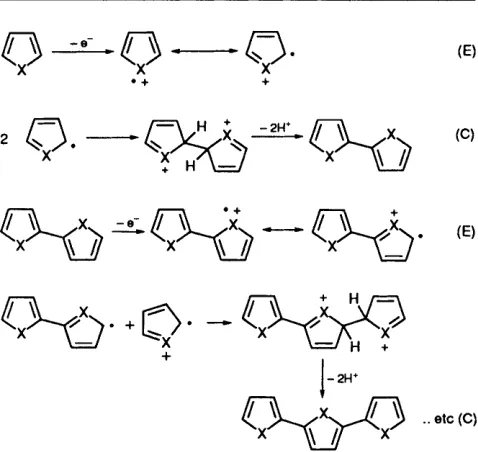
A schematic of the generally accepted mechanism for elec- tropolymerisation of thiophene" is shown in Fig. 1. The initial electrochemical step (E) is a one-electron oxidation of the monomer to form its radical cation. A high concentration of these species is maintained at the anode surface because the rate of electron transfer greatly exceeds the monomer dif- fusion rate to the electrode surface. The second step, a chemi- cal reaction (C), involves the spin-pairing of two radical cations to form a dihydro-dimer dication, which subsequently undergoes the loss of two protons and re-aromatization to form the dimer. Aromatization is the driving force of the chemical step (C). Coupling occurs primarily through the a- carbon atoms of the thiophene ring, since these are the posi- tions of highest unpaired-electron spin density, and hence reactivity. At the applied potential the dimer, which is more easily oxidised than the monomer, exists as a radical cation and undergoes further coupling reactions with other radical cations. This electropolymerisation mechanism, according to
~~~
t
Also at: Centre for Molecular Design, University of Portsmouth,*
Author to whom correspondence should be addressed. Mercantile House, Hampshire Terrace, Portsmouth, UK PO1 2ED..+ +
[image:1.594.306.545.368.594.2]I-2H+
Fig. 1 General schematic of the anodic electropolymerisation of aromatic five-membered heterocycles : E represents an electrochemi- cal step and C represents a chemical step; X = NH, S or 0
the general scheme E(CE),, , continues until the oligomer becomes insoluble in the electrolytic medium and precipitates onto the anode surface.I2
However, it should be noted that this mechanism for elec- tropolymerisation is greatly simplified, with the nature of the rate-limiting step and the exact role of oligomers in the initial deposition step remaining unresolved. Also, the polymers are formed in their oxidised conducting state with dopant anions being incorporated into the film to maintain electroneutrality. Conducting polymers can be cycled between the oxidised conducting state and the neutral insulating state,I3 the oxida- tion and reduction accompanied by diffusion of counterions into and out of the film.14
Downloaded by University of the West of England on 01/05/2013 10:49:48.
2332 J. CHEM. SOC. FARADAY TRANS., 1995, VOL. 91 A wide variety of thiophene derivative^,'^-'^ as well as
thiophene d i m e r ~ ' ~ ~ ' ~ trimers'8*20 and tetramersY2' have been electrochemically polymerised and their conducting properties studied. Electropolymerisation of substituted thiophenes is usually achieved when the substituent is present in the B-position. In this way, the a,a' conjugated backbone is not affected. The oxidation potential of the Q-substituted monomers is dependent on inductive, mesomeric and steric effects of the substituent groups.22
The electrochemical oxidation of B-substituted thiophenes does not always result in the formation of conducting films as, frequently, insulating films or soluble oligomers are pro- d ~ c e d . ~ ~ The stability of the radical cation partly determines the nature of products formed.24 Highly electron-donating species, such as amino groups, stabilise the radical cation to such an extent that it is able to diffuse away from the elec- trode interface into bulk electrolyte before eventually being attacked by the electrolyte or other nucleophilic species in solution. In contrast, if the substituent is electron withdraw- ing, e.g. a nitro group, then the radical cation is rendered highly active and may undergo rapid, less selective couplings to produce films of low cond~ctivity.~' Steric effects do not hinder the formation of the radical cation but appear to become important in the subsequent coupling reaction. With large 8-substituents, the polymerisation reaction is not as efficient and large quantities of short-chain oligomers are formed. l 2
The spin-density distribution of radicals and radical ions is therefore extremely important in the polymerisation reaction. Experimentally, these values can be determined from electron paramagnetic resonance spectroscopy (EPR). The McConnell equation gives the direct proportionality between the iso- tropic component of the H , coupling (a denoting the proton coupled to the carbon atom of interest) and the n-spin density on the a-carbon atom:26
4
= P Z Qwhere a: = isotropic component of the H a coupling, p, = n- spin density on carbon atom and Q = a proportionality con- stant. The value of the proportionality constant, Q, is specific to the radical under s t ~ d y . ~ ' ? ~ ~ For carbon atoms of vinyl radicals, Q = -27 and for carbons of the benzene radical cation, Q = -26.4. Modifications of the McConnell equation by Colpa and B ~ l t o n , ~ ~ and independently by M~Lachlan,~' have been designed to take into account the effect of 'excess charge' at each carbon atom and the polarisation of the spins of the n-electrons by the spin of the unpaired electron, respec- tively. However, not all spin densities can be determined from an EPR spectrum, since very small couplings cannot be mea- sured and the spin densities of carbon atoms which are not bonded to hydrogen cannot be determined in this Therefore, theoretical methods of predicting the nature of products formed from an electropolymerisation reaction, which would be used as a screening technique in the rational design of conducting polymers from novel monomers, would be highly desirable.
The first attempts at predicting the molecular geometry and reactivity for monomer units were carried out using semi-empirical molecular orbital methods, such as INDO, MNDO and CNDO. Spin-density distribution calculations for pyrrole monomeric and oligomeric radical cations3' using INDO have shown a strong correlation between spin-density distribution and sites of electropolymerisation. High spin populations at the a-positions of the heterocyclic radical cations were observed, reflecting a,a'-monomer linkages in the resultant polymer. However, when these calculations were applied to oligomeric pyrrole radical cations, the reactive sites became chemically inequivalent to those of the
monomer, with electron-spin density becoming more delocal- ised from the a-positions to other positions in the hetero- cycle.32 Such linkages were more likely in the later stages of electropolymerisation, where the unpaired-electron-spin density of the B-carbon atom of the oligomer became compa- rable to that of the a-carbon atom.31 Other non-a,cL'-coup- lings have been found experimentally and they are known to cause breaks in the conjugation of the polymer, reducing con- ductivity and electroactivity of the film.32
Advances in both hardware technology and computational methods allow the use of techniques which predict molecular geometry and electronic properties more accurately than the semi-empirical approaches. Ab initio Hartree-Fock molecular orbital (MO) calculations achieve chemical accuracy, but their high computational requirements mean that they cannot be routinely applied to systems containing many atoms. Open-shell calculations using the method of partial retention of diatomic differential overlap (PRDD0)33 within the unrestricted Hartee-Fock approximation have been used to investigate the failure of attempted electropolymerisation of Q-ethylmercapt~thiophenes~~ and fluorophore-containing derivatives of thi~phene.~' Positions of highest unpaired- electron-spin density in the radical cations of these monomers were found to be located away from the a-positions of the thiophene ring, accounting for the failure of electro- polymerisation.
DFT
calculation^^^*^^
are rapidly gaining popularity owing to their comparable accuracy with ab initio MO calcu- lations, with the advantage of requiring significantly less computation time. In essence, the DFT approach determines molecular properties such as spin density from the electron density distribution, as calculated by solving the appropriate Kohn-Sham equations. A detailed discussion of the DFT approach can be found in the book by Parr and Yang.36In the current work, DFT has been used to calculate the spin-density distributions of radical cations of pyrrole, thio- phene and a series of substituted analogues, in an attempt to predict coupling positions in the resultant polymers.
Density Functional Tbeory Calculations
DFT calculations were performed using the program DMol (Version 2.3.5)38 on a Silicon Graphics Indigo I1 workstation. A double numeric basis set with polarisation functions (DNP) was used, incorporating a total of 4282 points in the numerical integration procedure. In order to keep computa- tional time to a minimum, no geometry optimisations were performed in the DFT calculation and the atomic positions were held fixed at positions determined by a molecular mechanics approach using the CVFF forcefield in the program Di~cover.~' AH the molecules investigated adopted planar configurations.
Results and Discussion
In principle, the validity of the DFT approach in determining spin densities can be assessed by direct comparison of the calculated total spin-densities on the atoms for pyrrole (I),
thiophene (11) and (E)-stilbene (111) with the n-spin densities obtained from EPR using the McConnell equation [eqn. (l)].
For all the DFT calculations performed in this study, the total spin density equals the n-spin density because the mol- ecules are held flat during the calculations and the HOMOS were found to be n-orbitals. However, it should be noted that small differences between the calculated and experimental values are anticipated because of the experimental depen- dence of H, on variables such as the nature of the solvent and oxidising agents u ~ e d . ~ ' , ~ ' Compounds I, I1 and I11 were
Downloaded by University of the West of England on 01/05/2013 10:49:48.
J. CHEM. SOC. FARADAY TRANS., 1995, VOL. 91 2333 selected for comparison because their radical cations possess
similar structural features to the compounds of interest, in addition to well documented EPR spectra. Semi-empirical
possesses the highest spin density (0.160) at the 5- and 5”-(a-)
positions. The ratio of spin populations at the 3-(3‘-) and 5-(5’-) positions is further increased to 0.50 in the trimer (V),
(INDO) values for spin densities were also available for pyrrole (I) and (E)-stilbene (111). However, in the original INDO study of Waltman and B a r g ~ n , ~ ~ only the s-orbital component of the total spin density was used to assess reacti- vity for pyrrole. In the present work, the n-component of spin density has been used, since DFT calculations show that the s-orbital component of the spin density is zero, as expected for planar compounds in which the HOMO has n-symmetry.
Table 1 shows the values of the unpaired n-electron spin- density distributions of the respective radical cations, obtained from DFT and INDO calculations, together with the values from EPR spectroscopy. It can be seen that the spin densities calculated are in good agreement with the experimental values for all three compounds. However, spin densities cannot be calculated from INDO methods for all molecules owing to insufficient parametrisation of certain elements, such as sulfur, which are necessary for calculations involving derivatised thiophene compounds. The good agree- ment between the spin densities obtained via DFT and experiment gives us confidence in applying the technique to other systems.
Pyrrole and Thiophene Oligomers
Table 2 shows the calculated unpaired-electron spin-density distributions of the monomeric, dimeric and trimeric radical cations of pyrrole (I, IV and V) and thiophene (11, VI and
VII). In pyrrole (I), the highest spin populations are located at the 2- and 5-(a-) positions, in agreement with INDO calcu- lations, and so spin pairing would be predicted to form 2,2’-
bipyrrole (IV). The highest spin densities in the dimer are again located at the 5- and 5’-(a-) positions, 0.251 each, although the spin magnitude has decreased through conjuga- tion and the ratio of spin populations at the 3-(3’-) and 5-(5’-)
positions is increased to 0.43, compared with 0.20 for the monomer. 2,2‘ : 5’,2”-Terpyrrole (V), produced from spin pairing of the dimer with a monomeric radical cation, also
suggesting the possibility of a greater incidence of non-a,a’- linkages with chain growth.
The DFT calculated unpaired-electron spin-density dis- tributions of the monomeric, dimeric and trimeric radical cations of thiophene (11, VI and VII, respectively, in Table 2), follow a very similar pattern to the corresponding pyrrole oligomers. The highest spin populations are located at the a-positions throughout oligomerisation and in the trimer
(VII), the spin populations at the 3-(3”-) positions (0.075) only reach one half of those at the 5(5”-) positions (0.151). As with pyrrole (I), non-a,a’-linkages become more prevalent as oligo- merisation proceeds.
(@-3-Styrylthiophenes, (E)-2-Styrylheterocycles and
(Z)-ot, ~Diarylacrylonitriles
Spin-density calculations have been performed on a range of (E)-3-~tyrylthiophenes, (E)-2-~tyrylheterocycles and (Z)-a,/3- diarylacrylonitriles, for which conductivity data are available. At present, for these larger systems, calculations have been confined to monomer units only. It is assumed that initial coupling will be through the site of highest spin density for a pair of radical cations, and that subsequent steps may then involve the second highest spin density site or other sites with comparable values. It also seems reasonable to assume for these systems that steric effects will prohibit coupling at sites which already have a substituent present.
(E)-3-Styrylthiophenes
Table 3 shows the spin-density distributions for three mol- ecules based on (E)-3-~tyrylthiophene (VIII, IX and X). In the case of the parent compound, (E)-3-~tyrylthiophene (VIII),
although the highest spin density is located at the 2-(a-) posi- tion of the thiophene ring (0.160), comparably high spins are present at the 4-(para-) position of the phenyl ring (0.145),
and also at both 1”- and 2”-carbon atoms of the alkene
Table 1 Spin-density distributions of pyrrole (I), thiophene (11) and (E)-stilbene (111) radical cations obtained from DFT and INDO calcu- lations, and from EPR
spin densities, p n
radical cation
calculated experimental” calculated
position DFT EPR INDO
H
5 6
4
-”
/
\
1,3 2 Y
I
111
1 2, 5 3, 4
1
2, 5 3, 4 1, 1‘ 2, 2’
3, 3‘ 4, 4‘ 5, 5’
6, 6’ l”, 2“
- 0.042 0.465 0.092
- 0.037 0.456 0.098
0.090 0.069 - 0.003
0.153 0.007
0.055
0.158
b
- 0.606 0.1 14
b
- 0.492
0.095
d
- 0.105
0.165
0.105 0.165
- 0.027 - 0.027
- 0.08 1 ‘ 0.458 0.085
e
-
0.01 3
0.16
0.14 0.18
- 0.072
- 0.076
“ Experimental spin densities were obtained from literature hyperfine coupling constants using the McConnell equation with the proportion- ality constant Q = -26.4. Ref. 40. ‘ INDO reworked calculation from ref. 31 in order to calculate n-spin density for comparison with DFT and EPR data. The original values given in ref. 31 refer to the s-orbital component of spin density. Ref. 48. Ref. 27.
Downloaded by University of the West of England on 01/05/2013 10:49:48.
[image:3.594.53.544.528.747.2]2334 J. CHEM. SOC. FARADAY TRANS., 1995, VOL. 91
Table 2 Spindensity populations of the oligomeric radical cations of pyrrole (I, IV and V) and thiophene (11, VI and VII) obtained from DFT
calculations
radical cation spin densities, p .
54--&5
2'\/ "
"
3 4'4 3
5 Q 2
1
4 3
5%"
3 4 '
3 4
I 1
2, 5 3, 4
IV 1
2
3
4 5
V 1
2 3 4 5
I1 1
2, 5
3, 4
VI 1, 1'
2, 2'
3, 3'
4, 4' 5, 5'
VII 1
2
3
4 5
- 0.042 0.465 0.092
- 0.006
0.132 0.108
0.040
0.251
0 0.06 1 0.080
0.023
0.160
- 0.037
0.456 0.098
0.037 0.168 0.049 0.050 0.216
0.0 12
0.062
0.075 0.024 0.151
1' 2' 3' 4' 5'
1' 2'
3'
4'
5'
1' 2'
3'
4'
5'
-
0.0090.133 0.109
0.040
0.251
-0.018 1 I' 0.001
0.125 2" 0.060
0.078 3" 0.080
0.078 4 0.023
0.025 5" 0.158
-0.019 1" 0.01 1
0.127 2'' 0.062
0.077 3" 0.075 0.077 4" 0.024 0.127 5" 0.151
Table 3 Spin-density populations of (E)-3-styrylthiophene radical cations (VII, IX and X) obtained from DFT calculations
radical cation spin densities, p n
VIII 1 0.08 1 1' 0.083 1" 0.145
2 0.160 2' 0.064 2" 0.149
3 0.098 3' - 0.004
4 -0.012 4' 0.145
5 0.084 5' 0.005
6' 0.053
"\
1"
-
IX 1 0.034 1' 0.085 1" 0.157
2 0.292 2' 0.027 2" 0.06 1
3 0.026 3' 0.035
4 -0.010 4' 0.062
5 0.068 5' 0.048
6' 0.025 3" 0.135
1
X 1 0.069 1' 0.099 1'' 0.104
2 0.157 2' 0.060 2" 0.124
3 0.162 3' -0.001
4
-
0.020 4' 0.1465 0.101 5' 0.01 1 3"
-
0.0056 0.046 4 0.05 1
1
Downloaded by University of the West of England on 01/05/2013 10:49:48.
[image:4.594.52.541.92.446.2] [image:4.594.59.541.465.776.2]CHEM. SOC. FARADAY TRANS., VOL. 91 2335
1
1
Fig. 2 Proposed mechanism for the electropolymerisation of (E)-3- styrylthiophene (IX)
spacer linkage (0.145 and 0.149, respectively). By analogy with the mechanism of pyrrole electropolymerisation, the first chemical step in the electrooxidation of (E)-3-styrylthio- phenes should be the spin-pairing of radical cations, with the concomitant elimination of two protons, to produce a conju- gated dimer. Many dimeric structures are possible (Fig. 2) because of the highly delocalised spin density of the (E)-3- styrylthiophene radical cation (VIII). Further steps in the electropolymerisation reaction would be expected to result in the formation of a dense, highly crosslinked polymeric matrix. This is in agreement with electrochemical studies which show that electrooxidation of the alkene spacer linkage and the thiophene ring occur concurrently to produce a redox inactive polymer of low conductivity (a = S The introduction of an electron-donating amino group at the para-position of the phenyl ring, as in the case of (E)-3-(4‘- aminostyry1)thiophene (IX), significantly alters the spin- density distribution from that of the parent compound VIII.
The highest spin density, 0.292, remains at the 2-position, and the spin population is almost double that of the unsubstituted compound VIII. Thus, the first chemical step in the electropolymerisation of IX will be the spin-pairing of two radicals at the a,a’-positions, with the elimination of two
cm-l 42
1.
protons. However, although the spin density at one of the carbon atoms (2”) in the alkene spacer linkage is significantly reduced (0.061 compared with 0.149), the spin density at the 1”-carbon atom is slightly increased (0.157 compared with
0.145). Thus, monomer coupling uia the alkene spacer would still be expected, in agreement with electrochemical studies.42 It is also probable that couplings via the amino group will occur, since the spin density at the amino-nitrogen atom (3”) is very high. This is not surprising, since the highest spin den- sities in aniline are found at the nitrogen atom and the para-
position of the phenyl ring.
The presence of a strong electron-withdrawing nitrile group at the alkene spacer linkage (27, as in (2)-a-(pheny1)-B-
(3-thieny1)acrylonitrile (X), might be expected to reduce the overall reactivity of the double bond significantly, as well as preventing coupling reactions via this site. However, DFT calculations show that the spin density at the 2-position of the thiophene ring, 0.157, is scarcely reduced compared with that of (E)-3-~tyrylthiophene (VIII), 0.160, and the spin density at the remaining 1”-carbon atom of the double bond remains relatively high (0.104). The 4-(para-) position of the phenyl ring also remains a reactive position (0.146). In agree- ment with these results, electropolymerisation also show oxidation of the double bond and the thiophene ring, with the formation of a dense crosslinked polymer of low conductivity (c = S cm- ’).
(E)-2-StyryZheterocycles
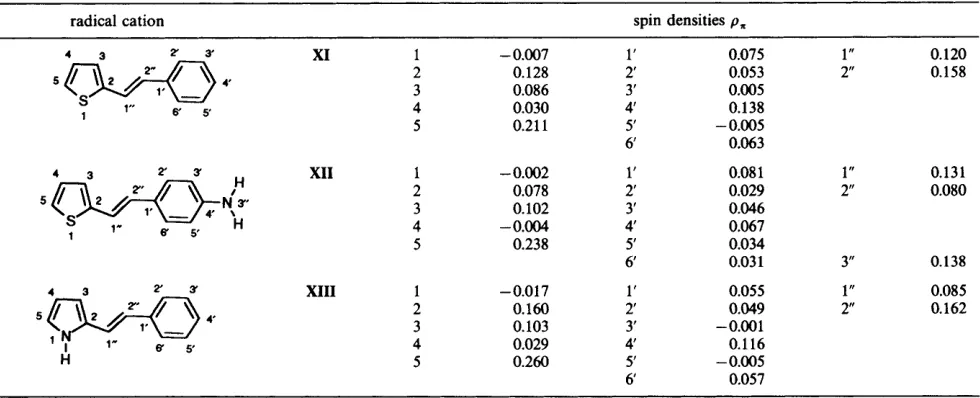
The spin-density distributions of the (E)-Zstyrylheterocyclic radical cations (XI, XI1 and XIII) are shown in Table 4. In the case of (E)-2-styrylthiophene (XI), the highest spin popu- lation is located at the 5-position of the thiophene ring (0.211), although both 1”- and 2”-carbon atoms of the alkene spacer linkage and the 4’-(para-) position of the phenyl ring possess almost comparably high spin (0.120, 0.158 and 0.138, respectively). As with the (E)-3-styrylthiophenes, such a delo- calisation of spin-density distribution would be expected to result in a polymer of low conductivity, containing many random crosslinked couplings, as is observed in electrochemi- cal experiment^.^^
As
with the amino derivative of (E)-3-~tyrylthiophene (IX),the introduction of an amino group at the 4’-(para-) position of the phenyl ring, to give (E)-2-(4‘-aminostyryl)thiophene
(XII), leads to a redistribution of spin density relative to the parent heterocycle XI. However, the effect is less dramatic
Table 4 Spin-density populations of (E)-2-~tyrylheterocyclic radical cations (XI, XI1 and XIII) obtained from DFT calculations
~~~ ~~
radical cation spin densities p,
5
-1”
5 0.21 1 5’
6‘
5 1
w 4
\ 2 /1 5‘ H
XI1
XI11
1
-
0.002 1’2 0.078 2’
3 0.102 3‘
4 - 0.004 4‘
5 0.238 5‘
6‘
1 -0.017 1‘
2 0.160 2’
3 0.103 3’
4 0.029 4‘
5 0.260 5’
6
0.075 1“ 0.120
0.053 2“ 0.158
0.005 0.138
0.063
0.08 1 1”
0.029 2
0.046 0.067 0.034
0.03 1 3“
0.055 1”
0.049 2
-0.001 0.1 16
- 0.005
0.057
- 0.005
0.131 0.080
0.138
0.085 0.162
Downloaded by University of the West of England on 01/05/2013 10:49:48.
[image:5.594.65.268.73.257.2] [image:5.594.56.546.577.776.2]2336 SOC. VOL.
Table 5 Spin-density populations of the radical cations of (E)-1,2-di-(2-thienyl)ethene (XIV) and three (Z)-2-a,B-diarylacrylonitriles (XV-XVII)
obtained from DFT calculations
radical cation spin densities p,
4 3
5w
2'\I S
1"
3' 4'
&
s,"
2 ' \ I S
3' 4'
N 4 "
H 3' 4'
N 4 "
I
3' 4'
XIV 1
2 3 4 5
xv
XVI
XVII
0.024 0.118 0.043 0.026 0.161 0.027 0.133 0.029 0.039 0.171 -0.016 0.149 0.082 0.028 0.222 -0.012 0.118 0.089 0.014 0.2 18
1'
2' 3'
4
5' 1' 2' 3'
4
5'
1'
2' 3'
4
5' 1' 2 3'
4
5'
0.024 1 '' 0.154 0.118 2'' 0.153 0.043
0.026 0.161 0.024 0.123 0.039 0.029 0.162
1" 0.106 2" 0.133 3" - 0.008
4" 0.03 1
- 0.005 1" 0.055
0.105 2 0.1 14 0.072
0.026 3" - 0.008
0.175 4" 0.040
- 0.008 1" 0.074
0.124 2 0.102 0.075
0.029 3"
-
0.W8 0.192 4 0.038with little additional spin being localised on the 5-position of the thiophene ring (0.238 compared with 0.211). The spin density at the 2"-carbon atom in the alkene spacer linkage is significantly reduced, from 0.158 to 0.080, although the spin population at the 1"-carbon atom is slightly increased, from 0.120 to 0.131. Thus, as with the (E)-3-~tyrylthiophene amino derivative (IX), coupling via the alkene spacer linkage would also be predicted, as was indeed observed in electrochemical
Monomer couplings via the amino group would also be expected, owing to the high spin population at the amino-nitrogen atom (3").
(E)-2-Styrylpyrrole (XIII) has its highest spin density located at the 5-position of the pyrrole ring (0.260). High spin density is observed on the alkene spacer linkage at the 2" position (0.162) and on this basis we would expect cross- linking, a conclusion which is again in agreement with the experimentally observed
(Z)-a,/?-Diarylacrylonitriles containing Two Heterocycles
In contrast to the styrylheterocycles, some (Z)-a,#I-diaryl- acrylonitriles undergo electropolymerisation to produce elec- troactive polymers with enhanced c o n d ~ c t i v i t y , ~ ~ of the order of S cm-'.
Spin-densi t y distributions of (E)- 1,2-di-2- t hienylen t hene (XIV) and three (9-a,/?-diarylacrylonitrile radical cations (XV-XVII) are shown in Table 5. As expected, the nitrile groups possess very low spin populations, as reflected by their known electr~inactivity.~' The highest spin density of XIV is located at the (5- and 5'-)a-positions of the thiophene rings (0.161), although comparably high spin populations were observed at the 1"- and 2"-carbon atoms of the alkene linkage (0.1 54 and 0.153, respectively). Therefore, polymeric coupling may occur uia the a-positions to produce an electro- active polymer, or via the alkene linkages to result in a cross- linked polymer, with the exact balance depending on electrosynthetic conditions. This dichotomy is reflected in the
range of conductivities reported for the polymerisation of this species (102-10- l o S cm- 1).46*47
Introduction of a nitrile group at the alkene spacer linkage,43 as in the case of (Z)-a,/?-(2-thienyl)acrylonitrile
(XV),
produces a desirable redistribution of spin density com-pared to the parent compound XIV. The spin density at the 1"-carbon atom of the alkene spacer linkage is decreased by about one third (to 0.106), whereas the spin populations at the 5- and 5'-(a-)-positions of both thiophene rings remain high (0.17 1 and 0.162, respectively). Therefore, couplings via the alkene spacer linkage in XV would be expected to occur much less frequently, producing a polymer with improved electroactivity. This was indeed the case, as a redox active polymer was produced with a conductivity of S cm-1,43 a significant improvement on the poly[(E)-3-~tyrylthio- phenes] and poly[(E)-2-styrylheterocycles] discussed earlier.
Replacement of one of the thiophene rings by a pyrrole or furan ring, as in (Z)-a-(2-thienyl)-/3-(2'-pyrryl)acrylonitrile (XVI) and (Z)-a-(2-thienyl)-/3-(2'-furyl)acrylonitrile (XVII), respectively, results in an even greater shift in the spin-density distribution from the alkene spacer linkage to the a-positions of both heterocyclic rings. In addition, the unpaired-electron spin densities at the 4-positions of the heterocyclic rings are less than those in (Z)-a,/3-(2-thienyl)acrylonitrile (XV) (e.g. a reduction from 0.039 to 0.014, in the case of XVII), further maximising the extent of a,a'-monomer couplings and reducing a,/?'- and /?,/?'-linkages which are known to cause breaks in conjugation length and hence a reduction in con- ductivity.12 For the pyrrole and furan derivatives, XVI and XVII, respectively, polymer growth should be less hindered by couplings via the alkene spacer linkage, as was indeed observed from electrochemical where very thick homogeneous redox active polymers were produced with measured conductivities of the order of l o p 4 S cm-'.
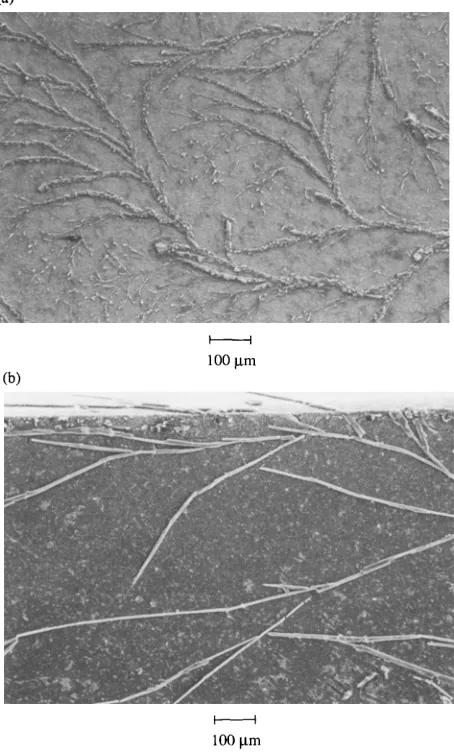
In poly(XV1) and poly(XVII), extensive raised dendritic structures, branching across the entire surface, were observed [Fig. 3(a) and (b)], probably formed as a result of unidirec-
Downloaded by University of the West of England on 01/05/2013 10:49:48.
[image:6.594.58.543.92.381.2]J. CHEM. SOC. FARADAY TRANS., 1995, VOL. 91
(4
H 100 pm
[image:7.594.50.277.83.459.2]H 100 pm
Fig. 3 SEM of poly(XV1) ( a ) and poly(XVI1) (b) on I T 0 glass, showing extensive raised dendritic structures
tional growth of the polymer via the ~, a’ -l ink a g es . ~ ~ The absence of these features from poly[(Z)-a,fi-di-(2-thienyl)
acrylonitrile] (XV) may be due to the high spin densities at the alkene spacer linkage, resulting in some crosslinking rather than fully unidirectional polymer growth.
Conclusion
The calculations on model systems show DFT to yield n-spin density values in good agreement with experimental results. It has been shown that spin-density calculations can be suc- cessfully employed to interpret the coupling steps in the anodic electropolymerisations of a range of monomers. For the majority of the systems studied, calculations have only been undertaken on monomer units. This enables potential initial coupling sites to be identified, but it is now important to extend these calculations to dimers, trimers and higher oli- gomers in order to examine changes in the spin densities during polymer chain growth.
Although spin-density distribution plays a major role in determining the location of coupling sites, it is clear that steric influences will be an important factor for many systems. However, DFT calculations may not be the most productive means of obtaining this information and further modelling studies on suitable model systems should be undertaken in order to investigate the relative effects of these factors in coupling steps.
2337
We believe that this type of calculation represents a useful predictive tool to screen novel monomers prior to experimen- tal investigation and the approach may form a key step in the rational design of novel conducting polymers uia computa- tional methods.
J.R.S., N.M.R. and S.A.C. would like to thank the EPSRC for financial support.
References 1
2 3 4
5 6
7
8 9 10
11
12 13
14 15
16
17
18
19
20
21
22 23
24
25
26
27
28
29 30 31 32
33
34
35
36
37
38
A. F. Diaz, K. K. Kanazawa and G. P. Gardini, J . Chem. SOC., Chem. Commun., 1979,635.
A. R. Hepburn, M e t . Muter. (Znst. Muter.), 1991,7, 747. T. J. Yamamoto, J . Chem. SOC., Chem. Commun., 1981,187. M. Mastragostino, A. M. Marinangeli, A. Corradini and S. Gia- cobbe, Synth. Met., 1989,28, C501.
J. C. Dubois, Synth. Met., 1989,28, C871.
J. Roncali, R. Garreau, D. Delabouglise, F. Garnier and M. Lemaire, J . Chem. SOC., Chem. Commun., 1989,679.
W. R. Salaneck, Science and Applications of Conducting Poly- mers, Proc. of the 6th Europhysics Industrial Workshop, Adam Hilger, Bristol, 1991.
D. D. C. Bradley, Chem. Br., 1991,8,719. K. Davidson, Educ. Chem., 1991,28, 155.
R. B. Kaner, Electrochemical Science and Technology of Poly- mers, ed. R. G. Linford, Elsevier Applied Science, Essex, 1990, p. 97.
E. M. Genies, G. Bidan and A. F. Diaz, J . Electroanal. Chem., 1983,149, 101.
J. Roncali, Chem. Rev., 1992,92,711.
R. J. Waltman, J. Bargon and A. F. Diaz, J . Phys. Chem., 1983, 87, 1459.
G. Dian, G. Barbey and B. Decroix, Synth. Met., 1986,13,281. D. T. Glazhofer, J. Ulanski and G. Wegner, Polymer, 1987, 28, 449.
M-A. Sato, S. Tanaka and K. Kaeriyama, J. Chem. SOC., Chem. Commun., 1985,713.
A. Czerwinski, H. Zimmer, C. V. Pham and H. B. Mark Jr., J . Electrochem. SOC., 1985, 132, 2669.
J. Roncali, F. Garnier, M. Lemaire and R. Garreau, Synth. Met., 1986, 15, 323.
T. C. Chung, J. H. Kaufman, A. J. Heeger and F. Wudl, Phys. Rev. B, 1984,33,702.
0. Inganas, B. Liedberg, W. Chang-Ru and H. Wynberg, Synth. Met., 1985, 11, 239.
A. F. Diaz, J. Crowley, J. Bargon, G. P. Gardini and J. B. Tor- rance, J . Electroanal. Chem., 1981, 121, 355.
A. F. Diaz, Chem. Scr., 1981, 17, 145.
J. Bargon, S. Mohamand and R. J. Waltman, ZBM J . Res. Deo., 1983,27, 330.
R. J. Waltman, A. F. Diaz and J. Bargon, J. Electrochem. SOC., 1984,131,1452.
A. F. Diaz, Handbook of Conducting Polymers, ed. T. J. Sko- theim, Marcel Dekker, New York, 1986, ch. 3.
J. R. Bolton, Electron Spin Resonance, Elemental Theory and Practical Applications, McGraw-Hill, New York, 1972, p. 96. L. Bonazzola, J-P. Michaut, J. Roncin, H. Misawa, H. Sakuragi and K. Tokumaru, Bull. Chem. Soc. Jpn., 1990,63,347.
S . Nagai, S. Ohnishi and I. Nitta, Bull. Chem. SOC. Jpn., 1971, 44,
1230.
J. P. Colpa and J. R. Bolton, Mol. Phys., 1963,6, 273. A. D. McLachlan, Mol. Phys., 1960,3,233.
R. J. Waltman and J. Bargon, Tetrahedron, 1984,40, 3963. K. Sanechika, T. Yamamoto and A. Yamamoto, J . Polym. Sci. Polym. Lett. Ed., 1982, 20, 365.
D. S. Marynick and W. N. Lipscomb, Proc. Nut. Acad. Sci. U S A , 1982,79,1341.
J. P. Ruiz, M. B. Gieselman, K. Nayak, D. S. Marynick and J. R. Reynolds, Synth. Met., 1989,28, C341.
S . Basak, K. Nayak, D. S. Marynick and K. Rajeshwar, Chem. Muter., 1989, 1,611.
R. G. Parr and W. Yang, Density Functional Theory of Atoms and Molecules, Oxford University Press, New York, 1989. A. J. Freeman, Density Funct. Methods Chem., ed. J. K. Laba- nowski, Springer, New York, 1991, p. 61.
DMol ; A Density Functional Theory Program within the Insight I1 Molecular Modelling Package, Biosym. Technologies Inc., San Diego, 1993.
Downloaded by University of the West of England on 01/05/2013 10:49:48.
39 Discover; A Molecular Mechanics Program within the Insight
I1 Molecular Modelling Package, Biosym. Technologies Inc., San Diego, 1993.
40 D. N. Ramakrishna Rao and M. C. R. Symons, J . Chem. Soc., Perkin Trans. 2, 1983, 135.
41 F. Gerson, H. Ohya Nishiguchi, M. Szarc and G. Levin, Chem. Phys. LRtt., 1977, 52, 587.
42 J. R. Smith, S. A. Campbell, N. M. Ratcliffe and M. Dunleavy, Synth. Met., 1994, 63, 233.
43 J. R. Smith, S. A. Campbell, P. A. Cox and N. M. Ratcliffe, Synth. Met., 1995, to be submitted.
44 J. R. Smith, S. A. Campbell and N. M. Ratcliffe, Synth. Met.,
1995,73, 171.
45 T. Shono, Electroorganic Synthesis, Academic Press, London,
1991.
46 S. Tanaka, M-A. Sat0 and K. Kaeriyama, Makromol. Chem.,
1985,186,1685.
47 M. Bragadin, P. Cescon, A. Berlin and F. Sannicolo, Makromol. Chem., 1987,188,1425.
48 J. L. Courtneidge and A. G. Davis, Acc. Chem. Res., 1987,20,90.
Paper 5/00325C; Received 18th January, 1995
Downloaded by University of the West of England on 01/05/2013 10:49:48.