THERMAL STABILITY OF SOME BIOLOGICALLY ACTIVE
FUNCTIONALLY MODIFIED POLY (VINYL ALCOHOL)
P. Narendiran and S. Guhanathan*
P.G. and Research Department of Chemistry, Muthurangam Government Arts College
(Autonomous), Vellore-632 002, Tamil Nadu.
ABSTRACT
Polymers form a very important class of materials without which the
life seems very difficult. It has been believed that the antimicrobial
activity of the compound mainly due to the presence of heteroatoms
like nitrogen and phosphorous as similar to the naturally occurring
polymers viz., DNA, proteins etc., incorporation of heterocyclic
functionality to the synthetic polymers found to exhibit the biological
activity to the existing polymers than their unmodified polymers.
Based on the literature, the present work have been designed to have
benzodiazepine functionalized vinyl polymers like Poly (vinylalcohol).
Functionally modified PVA have been characterized by spectral
(FTIR, 1H-NMR and 13C-NMR), thermal (TGA) analysis. Functionally modified PVA have also been subjected into antimicrobial studies.
Results of the investigation reveals that the functionally modified PVA exhibited good
thermal stability and moderate antimicrobial action against unmodified PVA.
KEYWORDS: Chalcones; benzodiazepines; functional modification; thermal stability;
antimicrobial activity.
1. INTRODUCTION
Polymeric flame retardants (FRs) have been very much attractive field due to the large
applications towards the fire retardant activity. Incorporation of a polymeric flame retardants,
the physical and mechanical properties of the polymer are considerably changed. It can helps
to decrease the diffusion in the polymeric systems and consequent risk of environmental
contamination. Polydibromostyrene and polyphosphazenes are popular FRs among the all
flame retardants.[1,2] In a broad sense, all the fire-resistant polymers can be used as polymeric
Volume 7, Issue 8, 490-498. Conference Article ISSN 2277– 7105
*Corresponding Author
S. Guhanathan
P.G. and Research
Department of Chemistry,
Muthurangam Government Arts College
(Autonomous), Vellore-632 002, Tamil Nadu. Article Received on 05 March 2018,
Revised on 25 March 2018, Accepted on 15 April 2018
flame retardants must be blended with some other organic flame retardant compounds to
enhance their fire retardancy. Finally, the ultimate and convenient way to reduce the polymer
flammability is to incorporate the phosphorus and nitrogen containing heterocycles with
polymeric backbone by chemical methods. Incorporation of P=O unit into PVA showed
improved flame retardancy, thermal oxidative stability and good adhesion.[3]
Phosphorus containing organophosphorus compounds, in general used in combination with
nitrogen to exhibit flame retardant applications. These FRs are commonly known as char
formers due to thermal decomposing process to produce phosphoric acids. These acids react
with components in the substrate to eventually form a char which protects the substrate from
further pyrolysis. The presence of nitrogen in natural polymers appears to exert some degree
of flame retardance, as shown by the relatively low flammability of wool, silk and leather.[4] A number of nitrogen-containing organic compounds are used as reactive flame retardants for
certain polymers. These include triazines, isocyanates, urea, guanidine, and cyanuric acid
derivatives.[5]
Polymeric materials have widely been used for many applications. Vinyl polymer is one
among the polymers usually encountered in day to day life. It has been well-known in
numerous applications viz., computer applications, automobiles, biomedical applications,[6] aero components, toys and other numerous household appliances. Although vinyl polymers
has huge applications, it suffers from high flammability which limits its use for many
desirable applications. The most common method to impart fire retardance vinyl polymers is
the use of flame retardant additives such as halogenated aromatics or organic and inorganic
phosphorus compounds. Additive systems have the disadvantages of promoting undesirable
changes in physical and mechanical properties of the polymer and found to have poor
durability in long term use.[7] PVA fibers, gels, and films are potentially high performance materials because they have high tensile strength and modulus, excellent impact strength,
high abrasion resistance, excellent alkali resistance, and oxygen barrier property are superior
to those of any known polymer.[8-10]
In recent years, Phosphorus-based polymers have widely been studied as they exhibit very
constructive and motivating properties. Phosphorus-containing organic polymers can be
employed for a wide range of technological applications. For instance, they are extensively
used in industry as binding metals, dispersants, corrosion inhibiting as well as to prevent
biodegradable, blood compatible, show reduced protein adsorption and lead to strong
interactions with dentin, enamel or bones. Phosphorus-containing polymers are able to
increase the char while burning, which decreases the amount of flammable zone and reduce
the heat transfer from the flame to the material.[11-13]
Hence, the work has been designed to increase the thermal stability and flame retardant
activity of PVA by incorporating phosphorus and nitrogen containing organic groups through
N-P linkage. The N-P linkages, in general, believe to have most stable as they were found in
natural polymers like DNA and RNA.
2. MATERIALS AND METHODS
Commercially available AR grade chemicals with high purity were used. PVA, silica gel and
POCl3 were purchased Merck and used for the synthesis of functionally modified PVA. The
solvents like THF, DMSO and ethanol were purified by according to standard procedure.
Fourier-transform infrared spectra were obtained as KBr disks on Shimadzu spectrometer.1 H-NMR (400 MHz) and 13C-NMR (100 MHz) spectra were obtained using Bruker Advanced 300MHz NMR spectrometer, using TMS as internal standard and CDCl3 used as a solvent.
Thermogravimeric analysis (TGA) of the samples was carried out using SEIKO SII, Model
6200 TGA/DTG, USA, with heating rate for 20°C per minute in nitrogen atmosphere. The
weight losses at different stages were analysed. 1-6 mg of the sample was taken for analysis
and TGA scan was run upto 720°C. Anti-bacterial activity have been studied using disc
diffusion method for a series of selected number of pathogens viz., Staphylococcus aureus,
Streptococcus fecalis, Pseudomonas aeruginosa and Escherichia coli. Similarly, the disc
diffusion method has also been used for antifungal activity, against the selected fungi namely,
Aspergillus niger, Aspergillus flavus, Penicillium sps,Fusarium sps.
2.1. Procedure for the Synthesis of Poly
(tetravinyl-4-(4-chlorophenyl)-2-phenyl-2H-benzo[b][1,4] diazepin -1,5-diyl-1,5-bis(phosphonate)) (A4)
4-(4-chlorophenyl)-2-phenyl-2H-benzo[b][1,4]diazepine-1,5-diphosphonyl tetrachloride (A3)
(0.494 g, 1 mmol) and Poly (vinyl alcohol) (PVA) (20.4 g, 12 mmol) were dissolved in 50 ml
of dry dimethylformamide (DMF) at 90°C for 12 hours with constant stirring. Then, the
solvent was removed under reduced pressure the resulting in pale yellow crystalline polymer
was dried at 50°C using vacuum oven (scheme 2.1) and the pure product has been
Scheme 2.1. Synthetic route for the formation of functionally modified PVA derivative
3. RESULTS AND DISCUSSION
3.1. Spectral data for the compound A4
Poly (tetravinyl-4-(4-chlorophenyl)-2-phenyl-2H-benzo[b][1,4] diazepin
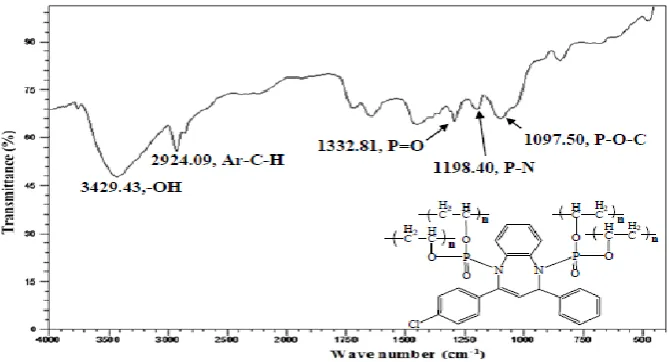
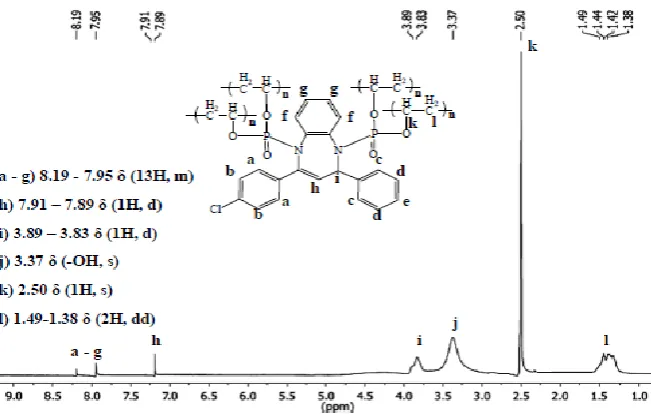
-1,5-diyl-1,5-bis(phosphonate)): Dark brown granulars; FTIR(KBr,cm-1): 3429 (O-H), 2924 (Ar-C-H), 1332 (P=O), 1198 (P-N), 1097 (P-O-C);1H NMR (CDCl3, 400MHz) δ ppm: 8.19-7.95
(13H,m,Ar-H), 7.91-7.89 (1H,d), 3.89-3.83 (1H,d), 3.37(-OH,s),2.50 (1H,s), 1.49-1.38
(2H,dd); 13C NMR (CDCl3, 100MHz) δ ppm: 36.6, 45.8, 68.2, 111.4,125-128, 151.8. 31P
NMR δ ppm: 2.60, 2.97.
In FTIR spectra of A4 (Fig-3.1), considerable decrease in the area of the –OH peak reveals
that the hydroxyl groups of the polymer which decreases after modification. The
disappearance of P-Cl stretching at 565 cm-1 and formation of P-O-C stretching at 1097.50 cm-1 have confirmed the formation of the A4. The existence of P-N and P=O stretching at 1198.40 and 1332.81 cm-1 has also been supported the structure of A4. Somasundaran, et.al.,
[image:4.595.127.462.564.745.2](2014) have also noticed the similar stretching frequencies for their modified PVA.[14]
The 1H NMR spectra of compound A4 have shown in Fig-3.2, The peaks at δ ppm 7.91-7.89 and 3.89-3.83 values for Benzodiazepine protons and peaks at 7.95-8.19 δ ppm for aromatic
ring protons. A doublet of doublet peak at 1.49-1.38 δ ppm, the singlet peak at 2.50 δ ppm
associated with CH2 and CH protons of PVA respectively.
Figure 3.2. 1H NMR spectrum of compound A4.
Fig-3.3 showed the 13C NMR spectrum of compound A4. The peaks appeared at 36.6, 68.2 δ ppm related to CH2 and CH carbons of the PVA respectively. Further, the peaks at 45.8, 111.
4,151.8 δ ppm due to –CH carbon and ethylenic carbons labelled as ‘b,d,e’ respectively.
Figure 3.3. 13C NMR spectrum of compound A4.
Fig-3.4 represents the 31P NMR spectrum of compound A4. The two peaks at 2.60, 2.97 δ ppm confirmed the presence of two different environmental phosphorus in target compound
[image:5.595.133.459.167.374.2] [image:5.595.128.469.495.656.2]Figure 3.4. 31P NMR spectrum of compound A4.
3.2. Thermo gravimetric analysis of compound A4
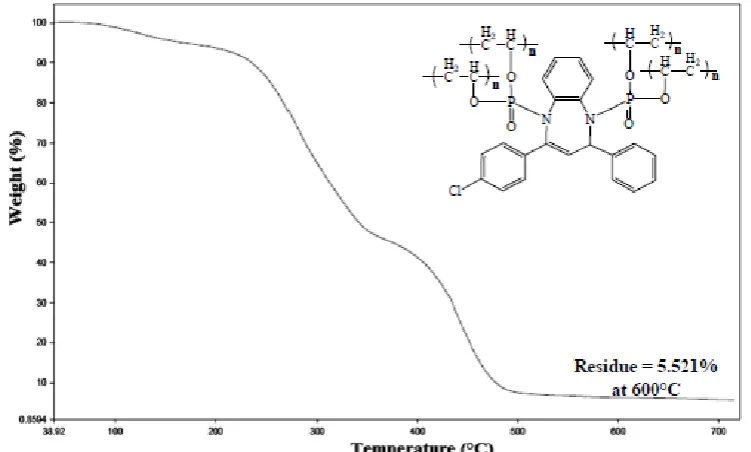
Thermal Gravimetric Analyser measures the change in the mass of a sample as on when a
sample is heated, cooled or held at a constant (isothermal) temperature. Functionally
modified PVA A4 has three stage of disintegration (Fig-3.5). At 10-15% initial weight loss
might be due to loss of phenyl groups were identified at 280ºC in benzodiazepine moiety.
45-60% weight loss was noticed at 340ºC. This can be related to the cleavage of four modified
vinyl linkages attached to two nitrogen of organophosphorus benzodiazepine. 61-90% weight
[image:6.595.126.463.72.290.2]loss was observed at 490ºC due to deformation of organophosphorus moiety.[15] (Tagawa, (1984)).
[image:6.595.108.484.514.740.2]This implies that heterocyclic modified PVA has good flame retardant compound. This
behaviour was mainly due to the presence of P-N, P-O-C bonds, and heterocyclic compounds
in the modified polymers. These structures act as weak links and they were highly susceptible
to chain scission during thermal degradation. A similar fashion was sensed by Chiang,
et.al.,(2002).[16] According to their report the excellent thermal stability and flame retardancy
was due to the presence of N-P bond formation.
3.3. Biological activity
3.3.1. Antibacterial activity of functionally modified PVA (A4) and pure PVA
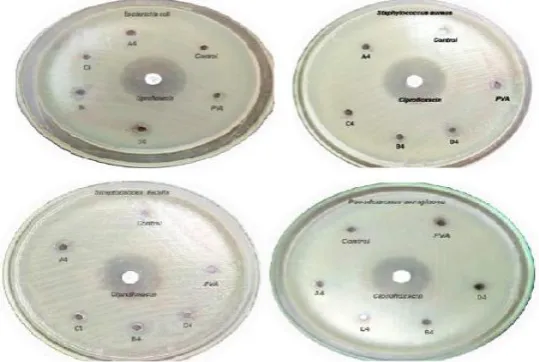
As per the study on ZOI for the synthesized compound (A4) found to have certain activity
against the pathogenic organisms. Table 3.1 summarised the consolidated ZOI values of
organophosphorus benzodiazepine containing modified PVA with pure PVA. According to
this table, target compound found to have excellent activity towards Staphylococcus aureus.
and Escherichia coli than pure PVA (Fig-3.6).
Table 3.1. Anti-bacterial activity values of modified PVA (A4) with pure PVA.
[image:7.595.161.431.557.738.2](*Activity of Ciprofloxacin considered as 100% inhibition against selected pathogens).
Figure-3.6. Antibacterial activity of compound A4 and PVA. Compound
Code
Gram-positive Gram-negative
Staphylococcus aureus
Streptococcus faecalis
Pseudomonas aeruginosa
Escherichia coli Zone Of Inhibition (ZOI)
mm % mm % mm % mm %
PVA 7 26.9 6 25.0 6 24.0 7 25.9
A4 8 30.8 6 25.0 4 16.0 9 33.3
Control - - - - - - - -
*
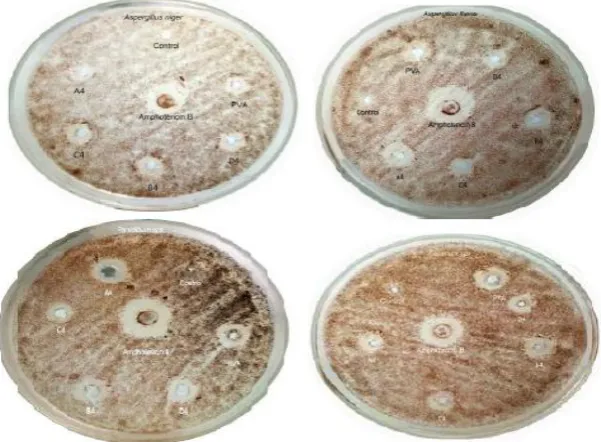
3.3.2. Antifungal activity of functionally modified PVA (A4) and pure PVA
From the careful observation of Zone of inhibition values of compound A4 and PVA
(Table-3.2), compound A4 found to have nice anti-fungal activity against selected species namely,
Aspergillus niger, Aspergillus flavus, Penicillium ps, Fusarium sps through Zone Of
[image:8.595.148.449.393.614.2]Inhibition method as shown in the Fig-3.7.
Table 3.2. Anti-fungal activity values of modified PVA (A4) with unmodified PVA.
(*Activity of Amphotericin B considered as 100% inhibition against selected
pathogens).
Figure-3.7 Antifungal activity of compound A4 and PVA.
4. CONCLUSION
Finally, the functionally modified PVA derivative was achieved through the creation of N-P
bond and it was confirmed by various spectral techniques namely, FTIR, 1H NMR, 13C NMR and 31P NMR. The enhanced thermal stability was also observed from TGA analysis for the compound A4 than PVA. The antibacterial and antifungal activities were also found for the
Compound Code
Aspergillus niger
Aspergillus
flavus Penicillium sps Fusarium sps Zone Of Inhibition (ZOI)
mm % mm % mm % Mm %
PVA 8 61.5 8 57.1 10 66.7 10 62.5
A4 7 53.8 11 78.6 11 73.3 9 56.3
Control - - - -
*
compound A4 was excellent against the selected pathogens. Moreover, the expected
modification to PVA were successfully observed and found the increased thermal and
biological activities due to the incorporation of biologically active organophosphorus
benzodiazepine compound.
5. ACKNOWLEDGEMENT
Author very much thankful to Muthurangam Govt. Arts College (Autonomous) affiliated by
Thiruvalluvar University for providing laboratory facilities and IIT Madras and SAIF-VIT for
recording spectral data.
REFERENCES
1. Mark, J.E., Allcock, H.R., and West, R., Inorganic Polymers, Prentice Hall, New Jersey,
1992.
2. Zingde, G., In ANTEC Technical Conference Proceedings, 1996; 54(3): 3004.
3. Vld-Bubulac, T.; Hamciuc, C.; Petreus1, O.; Bruma, M. Proceeding of the 8th Polymers for Advanced Technologies International Symposium, Budapest, Hungary, September,
2005; 13–16.
4. Horacek, H., and Grabner, R., Polym. Degrad. and Stability, 1996; 54: 205.
5. Horacek, H., and Grabner, W., Makromol. Chem., Macromol. Symp., 1993; 74: 271.
6. Christie M. Hassan.,Nikolaos A. Peppas., Advances in Polymer Science, 2000; 154.
7. Somasundaran, D., and Guhanathan, S., Der Chemica Sinica, 2014; 5(6): 90.
8. Sakurada, I. In Polyvinyl Alcohol Fibers; Lewin, M., Ed.; Marcel Dekker: New York,
1985.
9. Martin, F. L. In Encyclopedia of Polymer Science and Technology; Mark, H. F., Bikales,
N. M., Menges C. G., Kroschwitz, J.I., Eds.; Wiley: New York., 1985.
10.Masuda, M. In Polyvinyl Alcohol-Development; Finch, C. A., Ed.; Wiley: New York,
1991.
11.Hamciuc, C.; Bubulac, T. V.; Petreus, O.; Lisa, G. Eur. Polym. J., 2007; 43: 980.
12.Wang, Y.-Z.; Chen, X.-T.; Tang, X.-D. J. Appl. Polym. Sci., 2002; 86: 1278.
13.Liu, Y. L.; Tsai, S. H. Polymer, 2002; 43: 5757.
14.Somasundaran, D., Elumalai, S., and Guhanathan, S., IJACSA, 2(4): 2014.
15.Tagawa, H., Thermochimica Acta, 1984; 80: 23.